
Life, 1918-02-14 · page 15 of 40
Life — February 14, 1918 — page 15: what you’re looking at
What you’re looking at
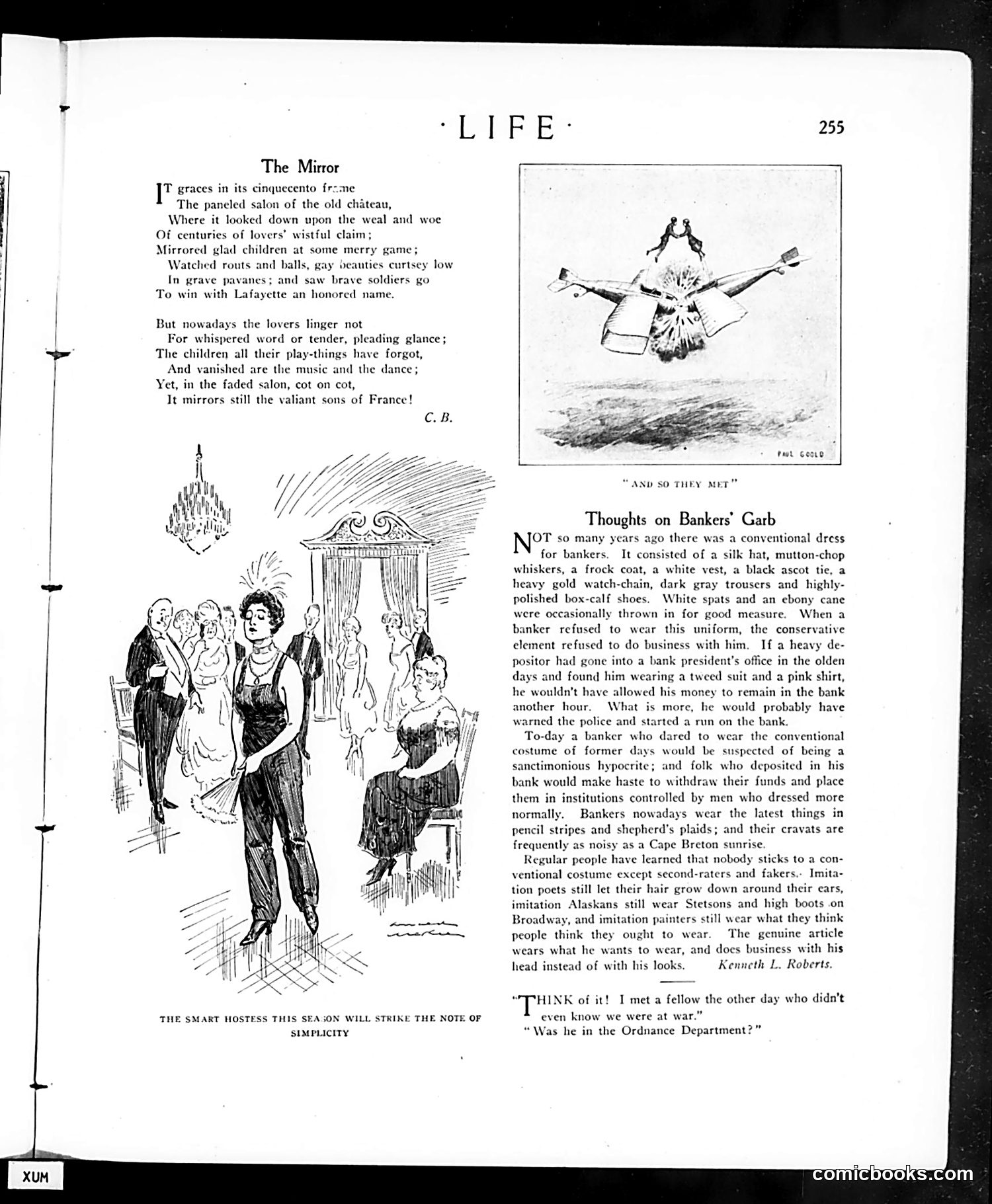
**"The Mirror" Poem** (top left): A nostalgic verse by C.B. mourning how an old French château's mirror once reflected aristocratic romance and military glory, but now reflects nothing—suggesting cultural decay or loss after WWI. **Left Cartoon**: Shows a formal gathering in what appears to be a grand salon. The caption reads "THE SMART HOSTESS THIS SEA SON WILL STRIKE THE NOTE OF SIMPLICITY"—satirizing wealthy society hostesses who claim to embrace wartime austerity while maintaining elaborate, expensive social events. The irony is visual: they're dressed formally in an ornate setting. **Right Section**: "Thoughts on Bankers' Garb" critiques how bankers abandoned formal dress codes, suggesting this represents broader social loosening of conventions and class distinctions.
📄 Transcribed text from this page (OCR, searchable)
Machine-transcribed from the original scan — historical spelling and the odd misread are preserved.
“LIFE: 255 The Mirror T graces in its cinquecento fr-me The pancled salon of the old chateau, Where it looked down upon the weal and woe Of centuries of lovers’ wistful claim; Mirrored glad children at some merry game; Watched routs and balls, gay beauties curtsey low In grave pavanes; and saw brave soldiers go To win with Lafayette an honored name. But nowadays the lovers linger not For whispered word or tender, pleading glance; The children all their play-things have forgot, And vanished are the music and the dance ; Yet, in the faded salon, cot on cot, It mirrors still the valiant sons of France! THE SMART HOSTESS THIS SEASON WILL STRIKE THE NOTE OF SIMPLICITY AND SO THEY MET” Thoughts on Bankers’ Garb OT so many years ago there was a conventional dress for bankers. It consisted of a silk hat, mutton-chop whiskers, a frock coat, a white vest, a black ascot tie, a heavy gold watch-chain, dark gray trousers and highly- polished box-calf shoes. White spats and an ebony cane were occasionally thrown in for good measure. When a banker refused to wear this uniform, the conservative element refused to do business with him. If a heavy de- positor had gone into a bank president's office in the olden days and found him wearing a tweed suit and a pink shirt, he wouldn't have allowed his money to remain in the bank another hour. What is more, he would probably have warned the police and started a run on the bank. To-day a banker who dared to wear the conventional costume of former days would be suspected of being a sanctimonious hypocrite; and folk who deposited in his bank would make haste to withdraw their funds and place them in institutions controlled by men who dressed more normally, Bankers nowadays wear the latest things in pencil stripes and shepherd's plaids; and their cravats are frequently as noisy as a Cape Breton sunrise. Regular people have learned that nobody sticks to a con- ventional costume except second-raters and fakers.. Imita- tion poets still let their hair grow down around their ears, imitation Alaskans still wear Stetsons and high boots .on Broadway, and imitation painters still wear what they think The genuine article people think they ought to wear. wears what he wants to wear, and does business with his head instead of with his looks. Kenneth L. Roberts. “THINK of it! I met a fellow the other day who didn’t even know we were at war.” “Was he in the Ordnance Department?”