
Life, 1918-02-14 · page 18 of 40
Life — February 14, 1918 — page 18: what you’re looking at
What you’re looking at
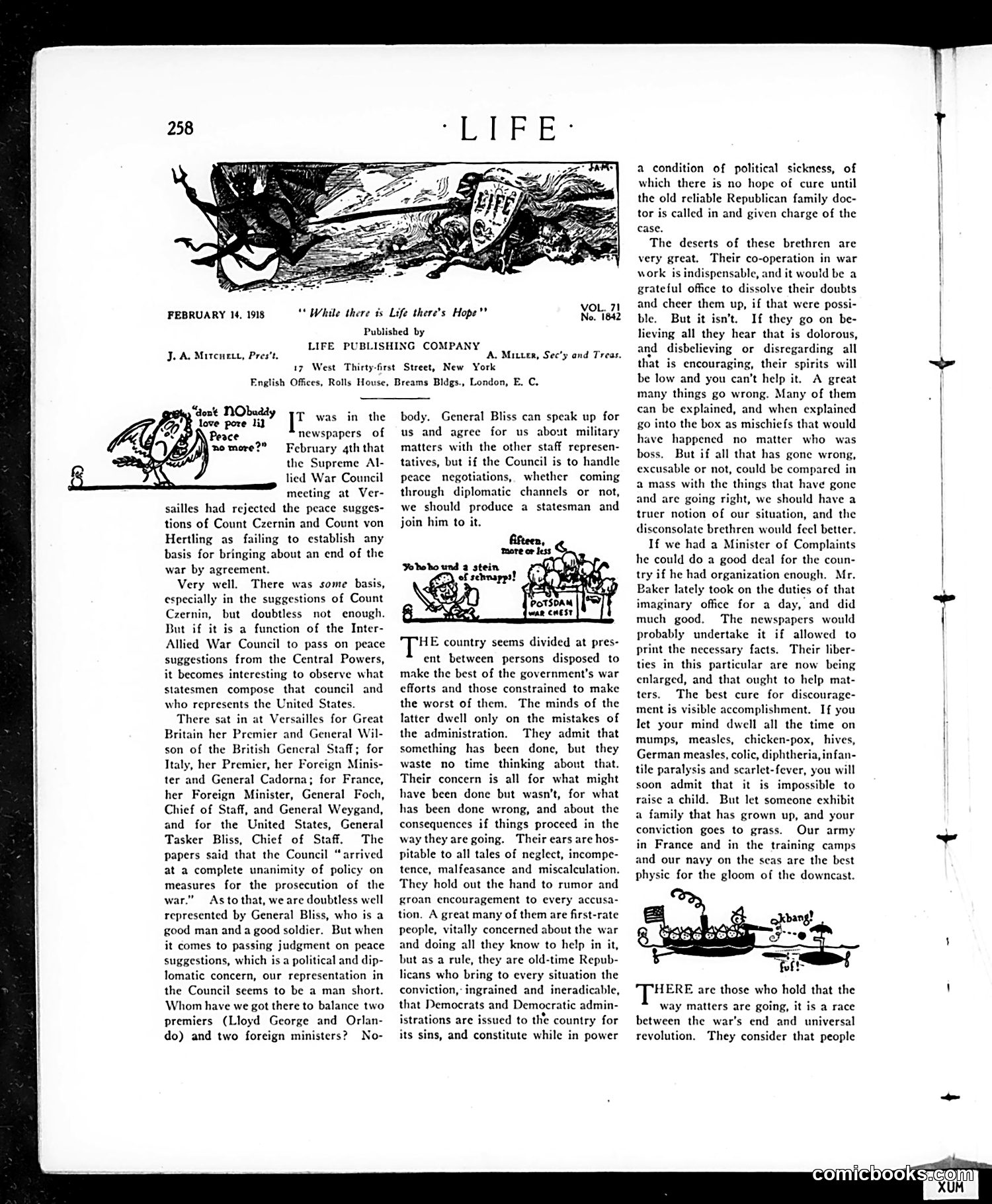
This page contains political commentary on World War I–era governance, not primarily cartoons. The main content criticizes two issues: **First issue:** The Inter-Allied War Council at Versailles rejected peace overtures from Austria-Hungary. The writer argues America's representation—General Tasker Bliss (Chief of Staff)—is inadequate. A military officer cannot properly handle diplomatic peace negotiations; the U.S. needs a statesman at the table alongside British Premier Lloyd George, Italian Premier Orlando, and their foreign ministers. **Second issue:** The writer addresses Republican critics of the Democratic Wilson administration. Though many are patriotic and helpful in war efforts, they're predisposed to assume Democrats are inherently incompetent and await "the old reliable Republican family doctor" to fix things. The author suggests this partisan skepticism undermines morale, regardless of actual accomplishments. The small cartoons appear to illustrate these complaints humorously but aren't central to the argument.
📄 Transcribed text from this page (OCR, searchable)
Machine-transcribed from the original scan — historical spelling and the odd misread are preserved.
FEBRUARY I, 1918 “While there is Life there’s Hope" VOL. 71 No. 1842 Published by LIFE PUBLISHING COMPANY J. A. Mirenett, Pres‘t. A. Minter, Sec’y and Treas. 17 West Thirty-first Street, New York English Offices, Rolls House, Breams Bldgs., London, E. C. aoe DONT inthe newspapers of February 4th that the Supreme Al- lied War Council meeting at Ver- sailles had rejected the peace sugges- tions of Count Czernin and Count von Hertling as failing to establish any basis for bringing about an end of the war by agreement. Very well. There was some basis, especially in the suggestions of Count Czernin, but doubtless not enough. But if it is a function of the Inter- Allied War Council to pass on peace suggestions from the Central Powers, it becomes interesting to observe what statesmen compose that council and who represents the United States. There sat in at Versailles for Great Britain her Premier and General Wil- son of the British General Staff; for Italy, her Premier, her Foreign Minis- ter and General Cadorna; for France, her Foreign Minister, General Foch, Chief of Staff, and General Weygand, and for the United States, General Tasker Bliss, Chief of Staff. The papers said that the Council “arrived at a complete unanimity of policy on measures for the prosecution of the war.” As to that, we are doubtless well represented by General Bliss, who is a good man and a good soldier. But when it comes to passing judgment on peace suggestions, which is a political and dip- lomatic concern, our representation in the Council seems to be a man short. Whom have we got there to balance two premiers (Lloyd George and Orlan- do) and two foreign ministers? No- body. General Bliss can speak up for us and agree for us about military matters with the other staff represen- tatives, but if the Council is to handle peace negotiations, whether coming through diplomatic channels or not, we should produce a statesman and join him to it. THe country seems divided at pres- ent between persons disposed to make the best of the government's war efforts and those constrained to make the worst of them. The minds of the latter dwell only on the mistakes of the administration. They admit that something has been done, but they waste no time thinking about. that. Their concern is all for what might have been done but wasn’t, for what has been done wrong, and about the consequences if things proceed in the way they are going. Their ears are hos- pitable to all tales of neglect, incompe- tence, malfeasance and miscalculation. They hold out the hand to rumor and groan encouragement to every accusa- tion. A great many of them are first-rate people, vitally concerned about the war and doing all they know to help in it, but as a rule, they are old-time Repub- licans who bring to every situation the conviction, ingrained and ineradicable, that Democrats and Democratic admin- istrations are issued to the country for its sins, and constitute while in power a condition of political sickness, of which there is no hope of cure until the old reliable Republican family doc- tor is called in and given charge of the case. The deserts of these brethren are very great. Their co-operation in war work is indispensable, and it would be a grateful office to dissolve their doubts and cheer them up, if that were possi- ble. But it isn’t. If they go on be- lieving all they hear that is dolorous, and disbelieving or disregarding all that is encouraging, their spirits will be low and you can’t help it. A great many things go wrong. Many of them can be explained, and when explained go into the box as mischiefs that would have happened no matter who was boss. But if all that has gone wrong, excusable or not, could be compared in a mass with the things that have gone and are going right, we should have a truer notion of our situation, and the disconsolate brethren would feel better. If we had a Minister of Complaints he could do a good deal for the coun- try if he had organization enough. Mr. Baker lately took on the duties of that imaginary office for a day, and did much good, The newspapers would probably undertake it if allowed to print the necessary facts. Their liber- ties in this particular are now being enlarged, and that ought to help mat- ters. The best cure for discourage- ment is visible accomplishment. If you let your mind dwell all the time on mumps, measles, chicken-pox, hives, German measles, colic, diphtheria, infan- tile paralysis and scarlet-fever, you will soon admit that it is impossible to raise a child. But let someone exhibit a family that has grown up, and your conviction goes to grass. Our army in France and in the training camps and our navy on the scas are the best physic for the gloom of the downcast. HERE are those who hold that the way matters are going, it is a race between the war's end and universal revolution. They consider that people