
A complete issue · 44 pages · 1917
Life — November 22, 1917
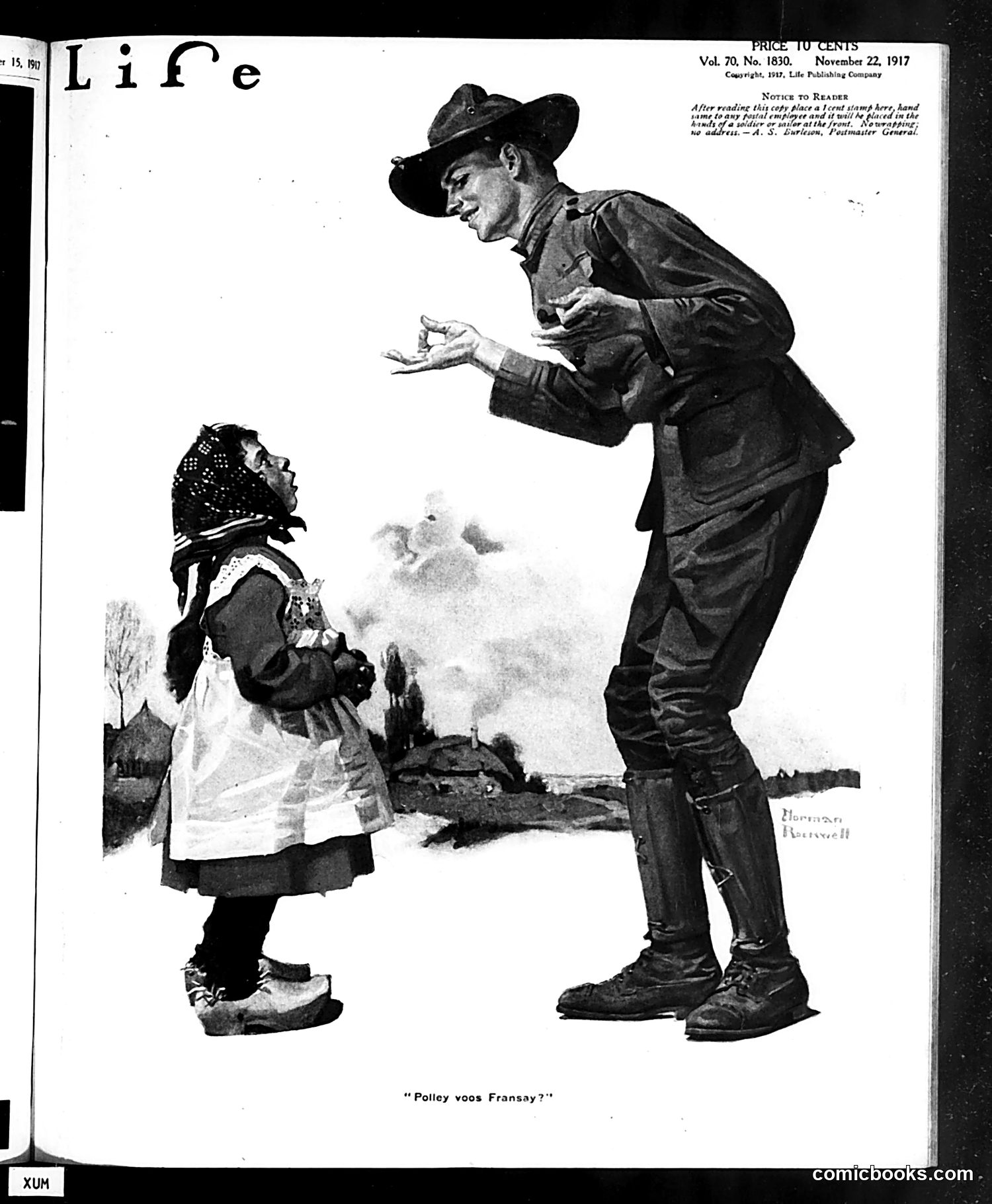
This cover cartoon titled "Polley vos Fransay?" depicts a tall American soldier in WWI uniform bending down to communicate with a small French child. The soldier appears to be asking the child a question in broken French ("Do you speak French?"). The humor relies on the language barrier between American troops and French civilians during World War I. American soldiers, newly deployed to France, often struggled with the French language. The exaggerated height difference and the soldier's earnest attempt at communication satirize the cultural and linguistic challenges American soldiers faced while fighting alongside their French allies. The background shows a rural French landscape, emphasizing the foreign setting.
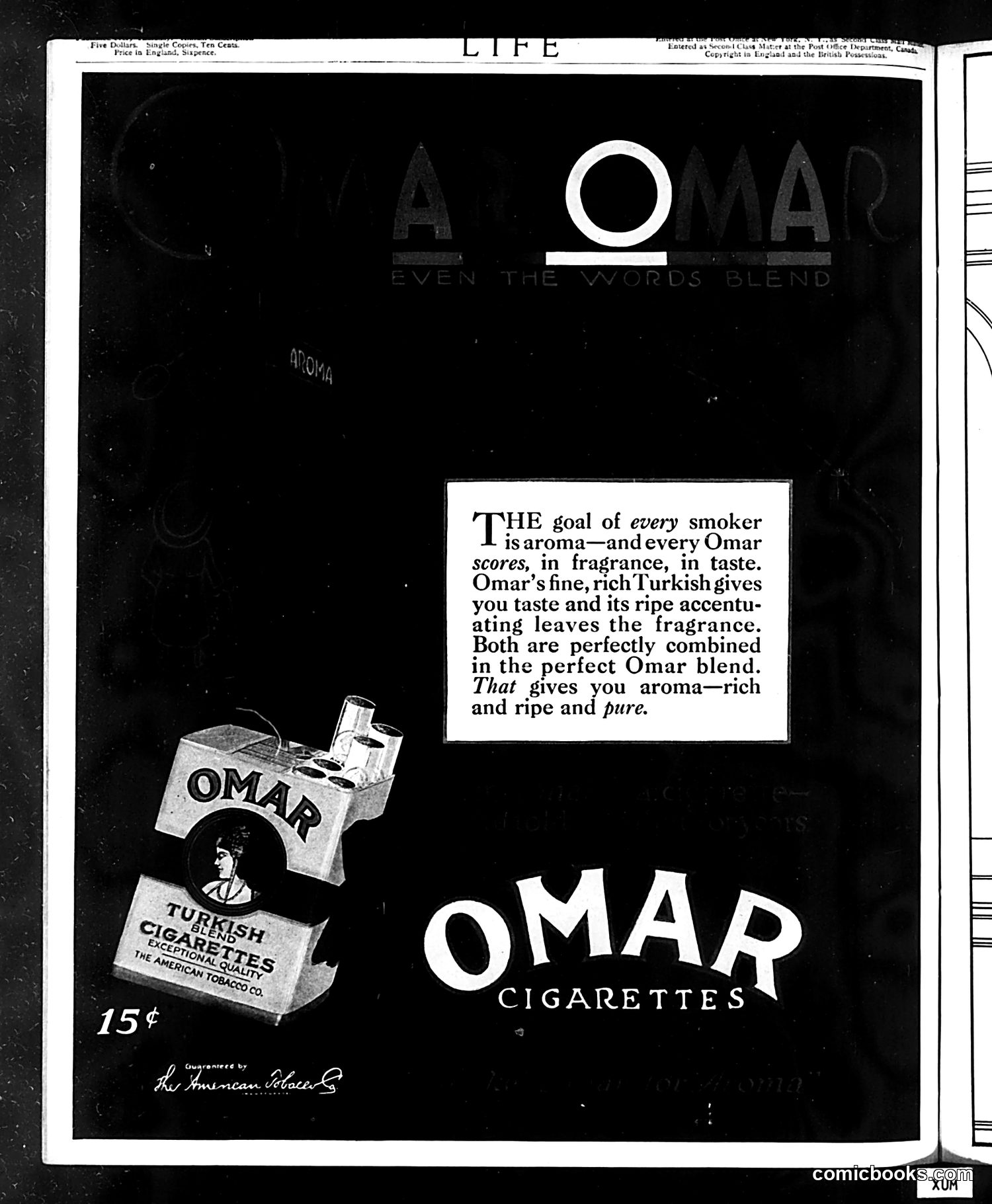
This is an **advertisement**, not satire or political commentary. It promotes Omar Turkish cigarettes, priced at 15 cents, manufactured by The American Tobacco Co. The ad emphasizes the product's blend of Turkish tobacco and accentuating leaves, claiming to deliver both "aroma" and "ripe and pure" taste. The visual shows a cigarette package and an ornate holder featuring what appears to be a **Turkish figure**—likely referencing the exotic "Omar" brand name to suggest authenticity and premium quality. The headline "Even the words blend" is a play on the product's blended tobacco composition. This represents early-20th-century marketing that used orientalist imagery and naming to position cigarettes as sophisticated and desirable to American consumers.
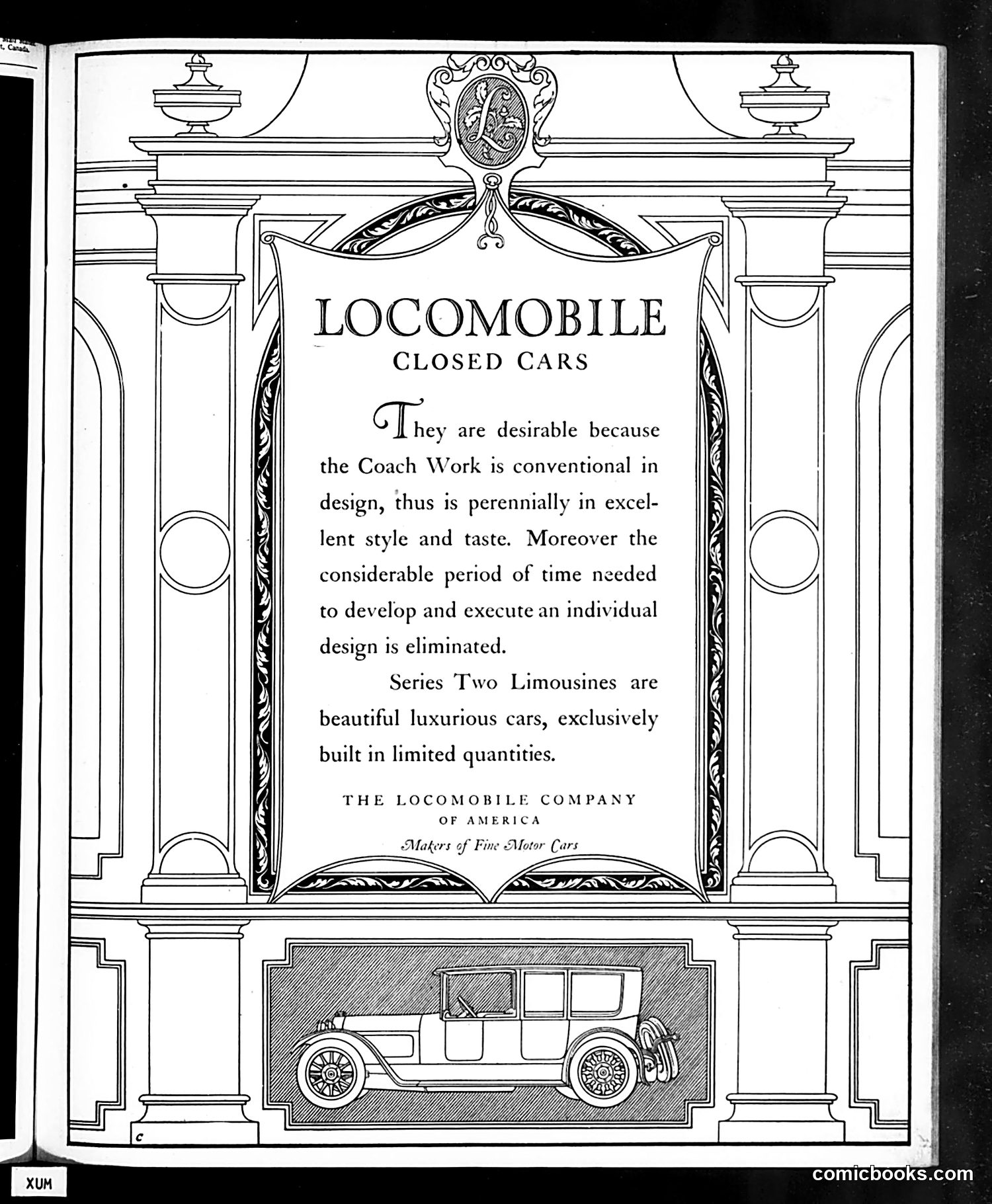
This is a **luxury automobile advertisement**, not a political cartoon. The Locomobile Company of America is marketing their Series Two Limousines as high-end vehicles with traditionally designed coach work. The ad's appeal emphasizes that closed cars are "desirable because the Coach Work is conventional in design, thus is perennially in excellent style and taste." This suggests closed automobiles were becoming fashionable among wealthy buyers—a shift from open-air vehicles. The ornate classical architectural framing (columns, urns, decorative elements) reinforces the product's luxury and timeless elegance. The illustration shows a formal limousine with multiple passenger compartments, targeting affluent clientele who valued both comfort and refined aesthetics in early 20th-century motorcar design.
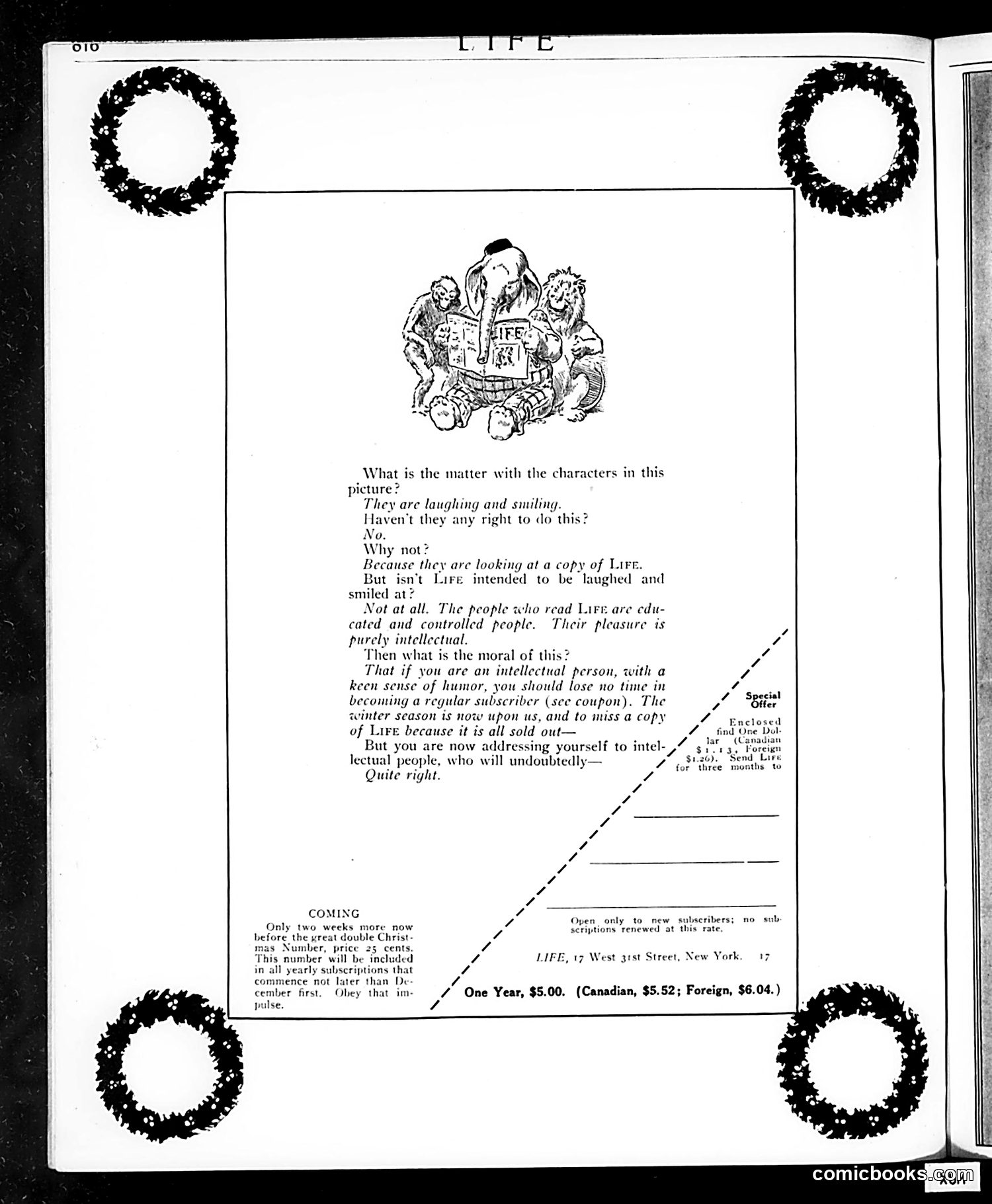
This page combines an advertisement and social commentary. The cartoon depicts figures reading a copy of *Life* magazine, with a dialogue questioning whether intellectual people should find humor in the publication. The satirical argument claims that *Life* targets "educated and controlled people" whose pleasure is "purely intellectual," not laugh-based. The moral conclusion suggests that intellectuals shouldn't waste time subscribing when they could be doing more worthwhile pursuits. The wreath decorations indicate this is a holiday/Christmas season issue. The "Coming" section notes this will be the final double-Christmas issue, requiring subscriptions by December first. This appears to be self-aware satire—*Life* magazine ironically arguing against its own readership while promoting subscriptions.
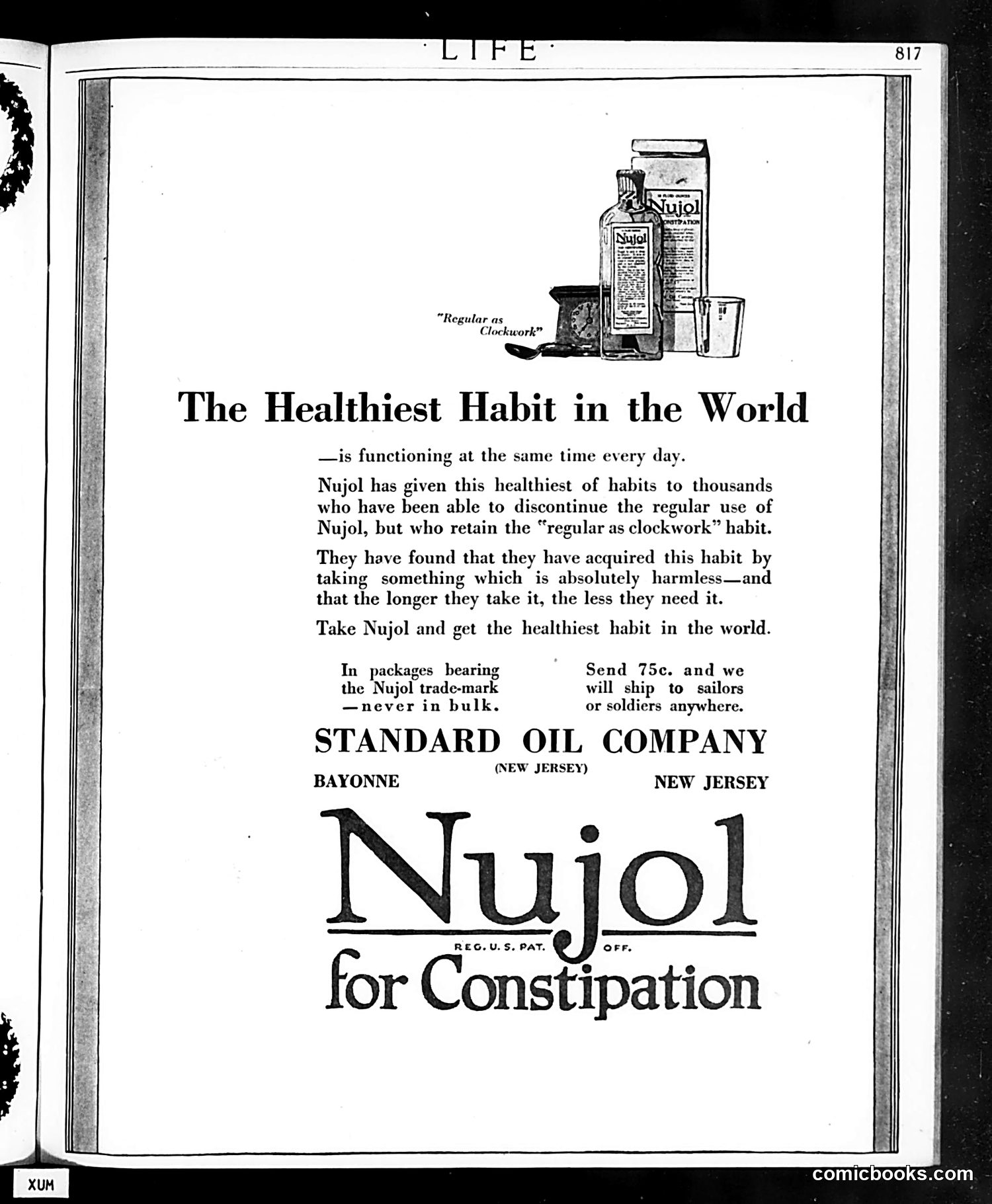
This is **not a political cartoon or satire**—it's a straightforward advertisement for Nujol, a laxative product made by Standard Oil Company. The ad promotes Nujol as "the healthiest habit in the world," claiming it helps users maintain regular bowel function "as clockwork." The pitch emphasizes that people can discontinue regular Nujol use while maintaining the habit itself, and that prolonged use requires smaller doses. The ad also includes a wartime appeal, offering to ship 75-cent packages to sailors and soldiers. By modern standards, this represents outdated medical marketing: promoting a laxative as a health-building habit would face significant regulatory scrutiny today. The casual normalization of daily laxative use reflects early-20th-century attitudes toward digestive health that have since been medically reconsidered.
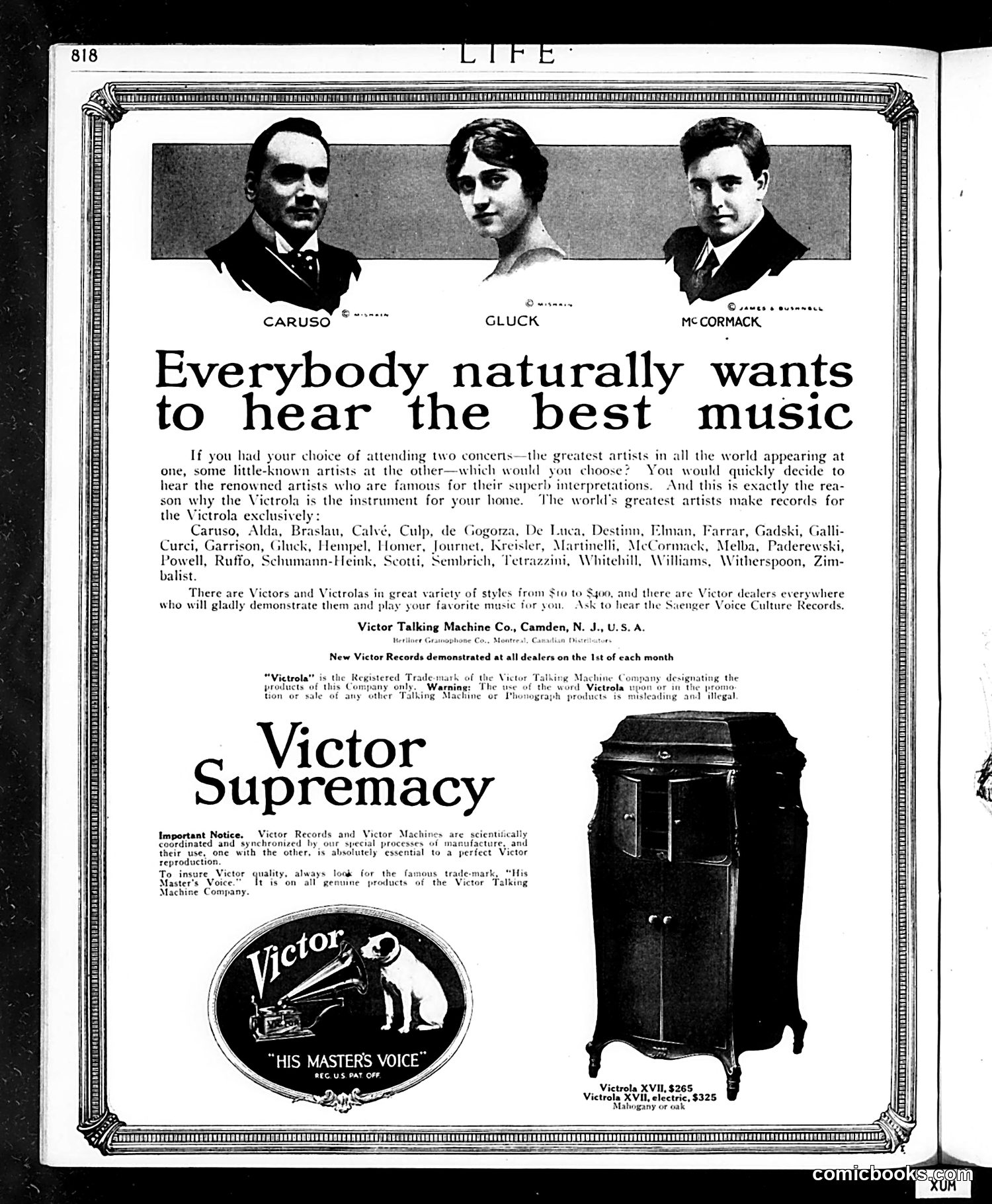
This is primarily **advertising, not satire or political content**. The page promotes Victor Talking Machines (phonographs) and Victor Records. The three portraits at top are famous opera singers—Caruso, Gluck, and McCormack—who recorded for Victor, lending prestige to the brand. The ad's argument is straightforward: just as people desire attending concerts by the world's greatest artists, they should want Victor phonographs to hear those same artists at home. The "Supremacy" section emphasizes Victor's technical superiority and warns consumers to look for the "His Master's Voice" trademark on genuine products. The lower half shows a Victrola XVII model with pricing ($265 acoustic; $325 electric). This represents early 20th-century marketing using celebrity endorsement and product differentiation.
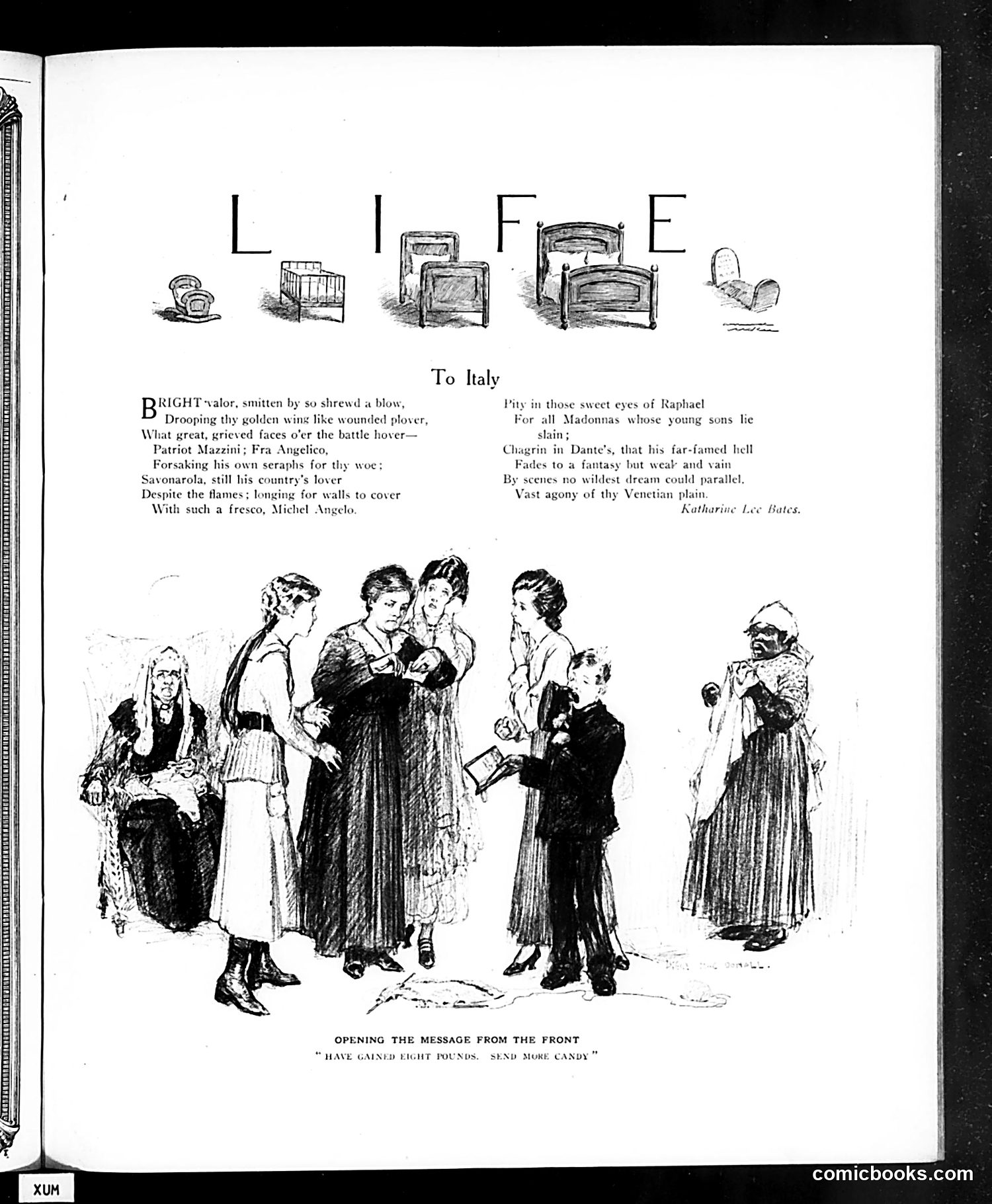
This page presents a satirical poem "To Italy" by Katharine Lee Bates, accompanied by an illustration titled "Opening the Message from the Front: 'Have Gained Eight Pounds. Send More Candy.'" The cartoon depicts women and children receiving wartime correspondence, likely from soldiers abroad during World War I (based on the "front" reference). The joke satirizes domestic morale-boosting efforts: while soldiers supposedly fight at war, the comical message about gaining weight from candy reveals the disconnect between romantic notions of warfare and soldiers' actual preoccupations with comfort items like sweets. The bedroom sketches at top spell "LIFE," the magazine's title. The accompanying poem invokes Italian Renaissance art and suffering to contrast with the frivolous candy concern, deepening the satire about wartime sentimentality versus reality.
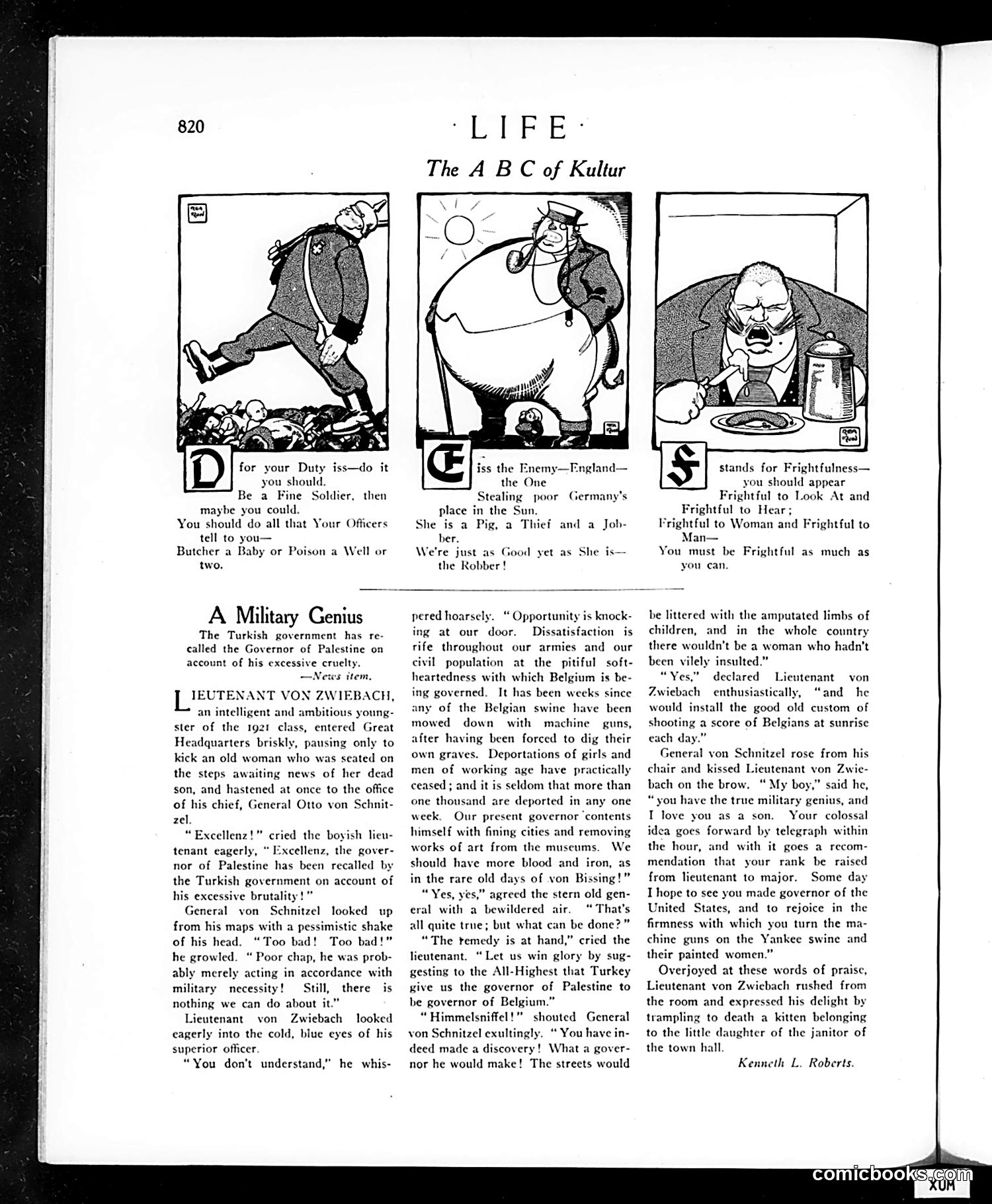
This page contains three panels satirizing German militarism and the wartime Governor of Palestine during WWI. The cartoons use caricature to mock German "kultur" (culture): - **"D" panel**: Depicts a soldier kicking civilians, mocking German military brutality - **"E" panel**: Shows Germany as a bloated thief stealing from England, with the caption comparing it unfavorably to a pig and robber - **"S" panel**: Illustrates a frightful-looking military figure, emphasizing the need to "appear Frightful" Below, "A Military Genius" satirizes **Lieutenant von Zwiebach**, apparently a real Ottoman official responsible for Palestinian governance. The text mocks his excessive cruelty and incompetence, suggesting he's merely playing at military authority while causing suffering. The satire suggests his brutality reflects poorly on German military values rather than demonstrating genius.
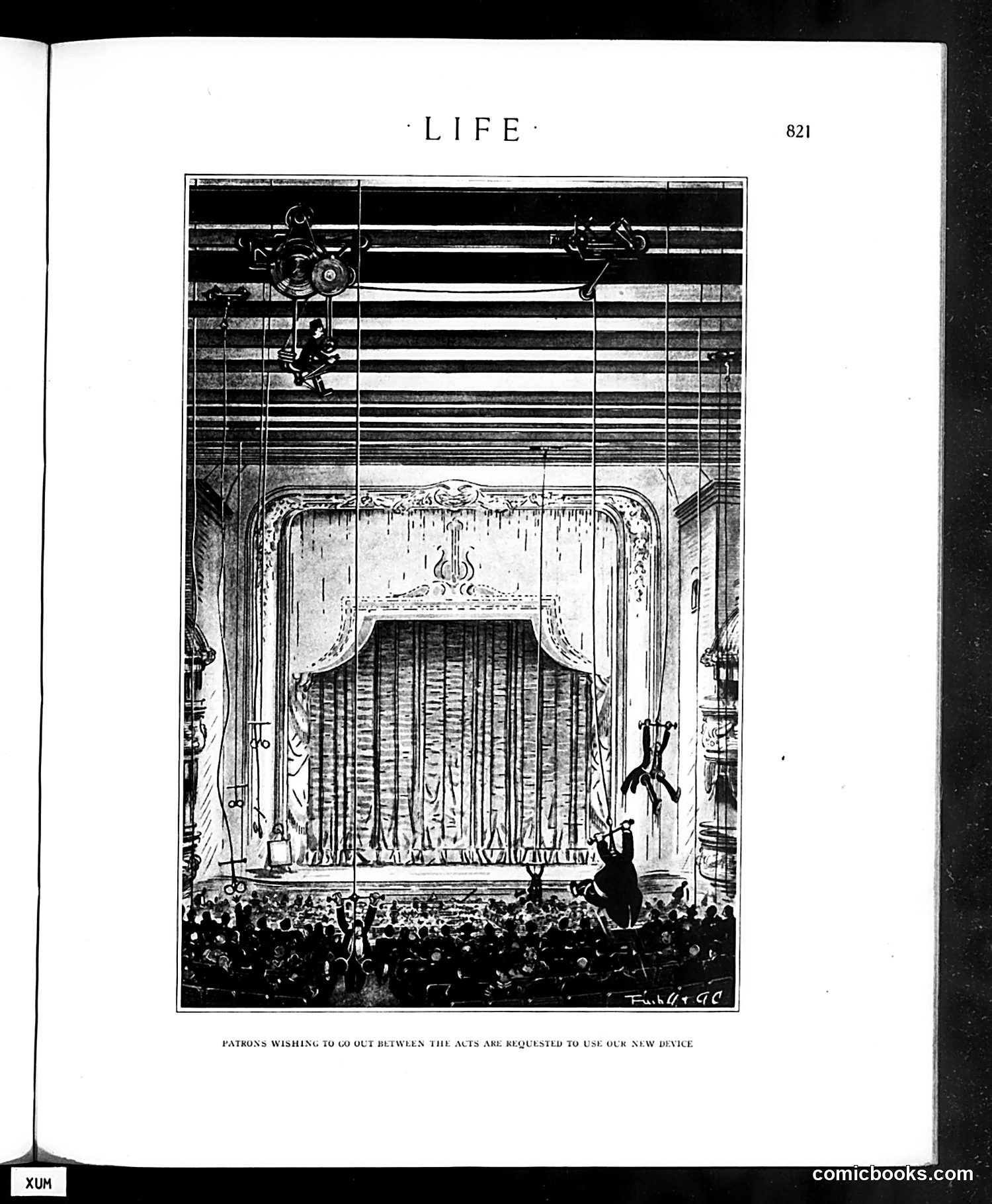
This is a single-panel cartoon from *Life* magazine (page 821) depicting a theater scene. The image shows an orchestra pit with mechanical equipment visible above the stage, a grand curtain, and a packed audience below. A conductor stands ready before the crowd. The caption reads: "PATRONS WISHING TO GO OUT BETWEEN THE ACTS ARE REQUESTED TO USE OUR NEW DEVICE" The satire targets theatrical inconvenience—specifically the difficulty theater-goers face leaving during intermissions in crowded venues. The "new device" appears to be the mechanical apparatus visible above, suggesting an absurdly complex or impractical contraption meant humorously to solve a mundane problem. The joke mocks both theater management's over-engineering of minor issues and the frustration of audience members trapped in their seats.
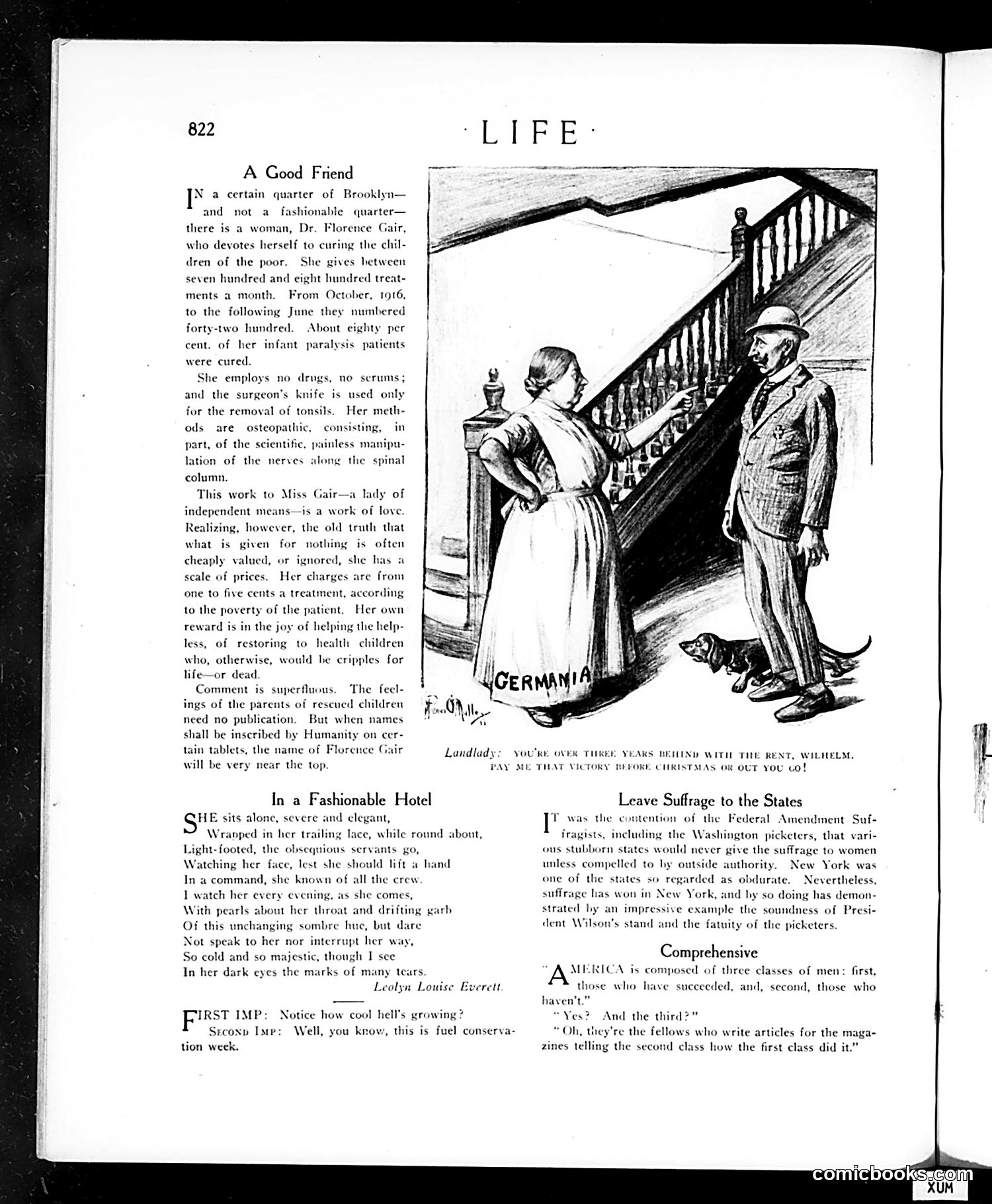
The main cartoon depicts a woman labeled "Germania" (representing Germany) speaking with two men on a staircase. The caption references "three months behind with the rent" and paying "that victory before Christmas of 1917." This is WWI-era political satire. "Germania" personifies Germany as a struggling tenant unable to pay rent—a metaphor for Germany's failing war effort and economic collapse. The cartoon mocks German confidence in achieving victory by Christmas 1917, suggesting instead that Germany faces financial ruin. The page also contains unrelated content: a biographical piece about Dr. Florence Gair, who treats poor children; a poem "In a Fashionable Hotel"; and brief commentary on women's suffrage and American social classes. These pieces share the page but are separate from the political cartoon's message.
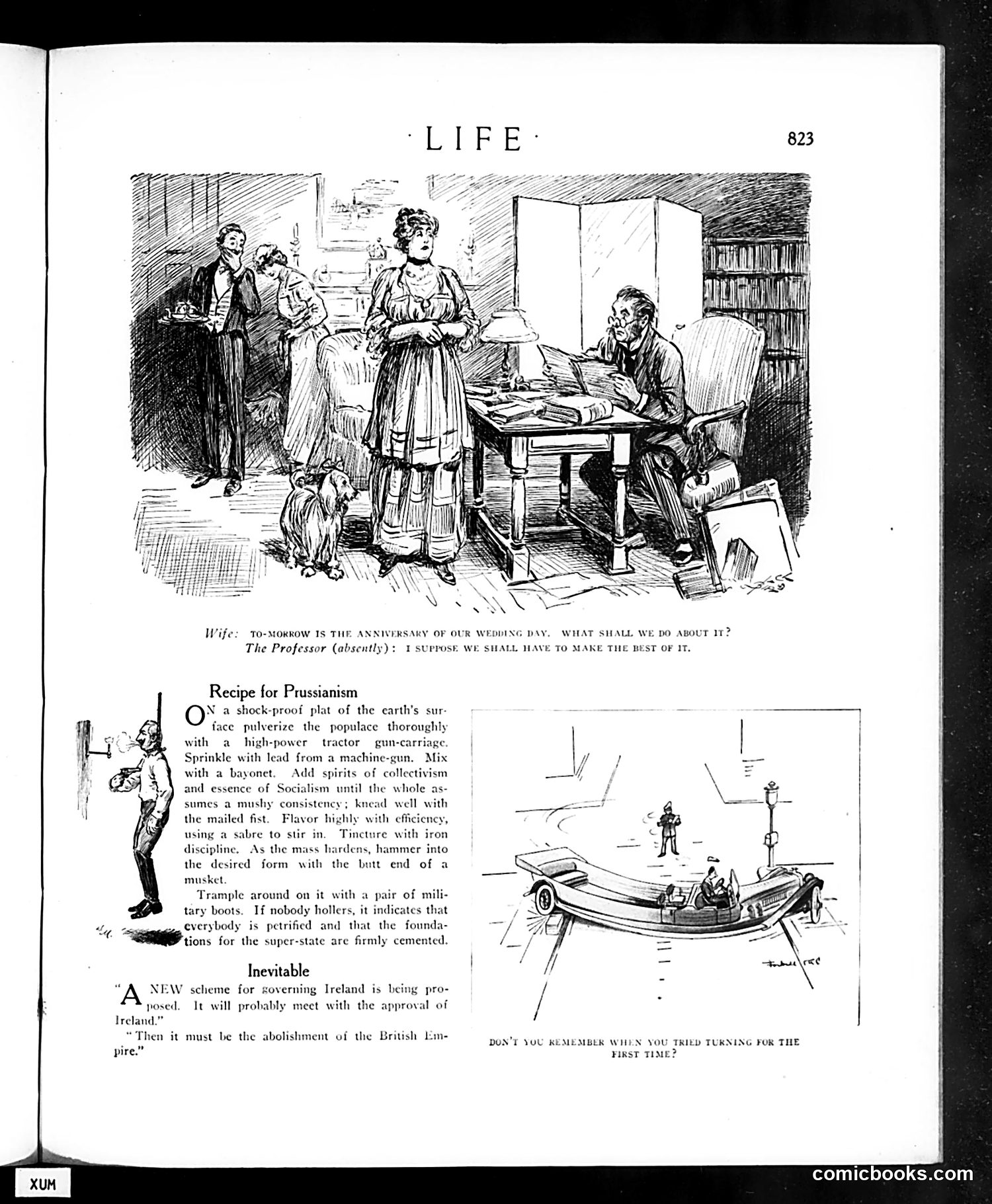
**Top Cartoon:** A domestic scene showing a wife asking her husband about their upcoming wedding anniversary. The Professor responds absently that they'll "have to make the best of it"—a joke about marital indifference and the mundane reality of long marriages contrasting with romantic ideals. **"Recipe for Prussianism":** A satirical mock-recipe mocking German militarism and authoritarianism. It humorously "instructs" readers to combine military conquest, collectivism, and socialism into an oppressive state, finishing with "iron discipline." This reflects anti-German sentiment, likely from the World War I era. **"Inevitable":** A brief political exchange about Irish governance, suggesting Irish independence would inevitably lead to abolishing British rule—a commentary on Irish-British relations during a period of independence agitation. **Bottom Cartoon:** Appears to mock inexperienced drivers learning to turn a vehicle.
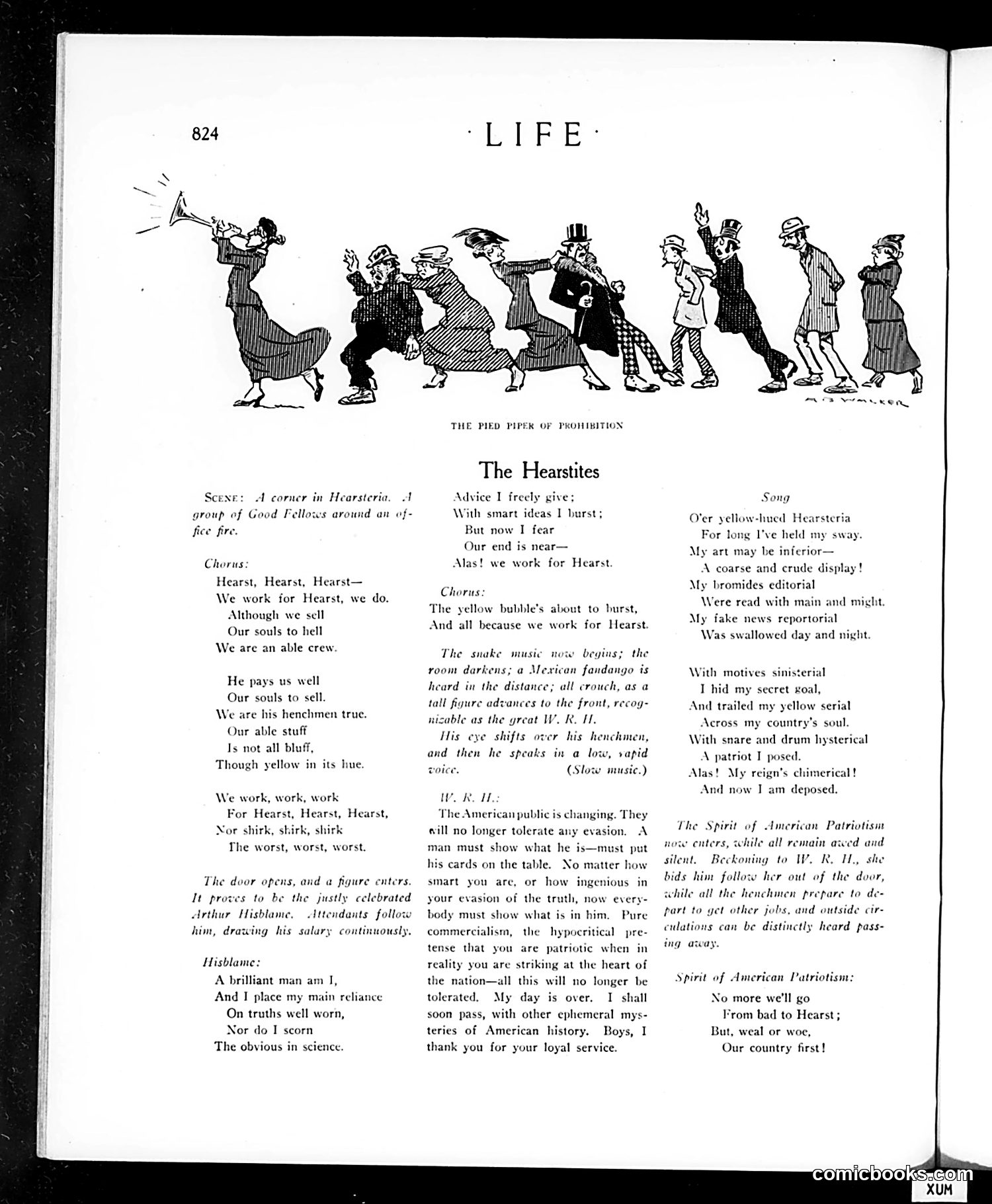
This satirical piece critiques **Hearst** (likely William Randolph Hearst, the powerful newspaper magnate), depicted as a pied piper leading a group of men away—presumably his editorial staff or journalists. The caption indicates these are "Good Fellowes" corrupted by his influence. The accompanying play script mocks Hearst's control over his employees and sensationalist journalism. References to "yellow-hued Hearsteria," "fake news reportorial," and his staff's blind loyalty suggest the satirist viewed Hearst's media empire as manipulative and corrosive to truth. The final section shifts to attacking American patriotism as commercialized hypocrisy—suggesting Hearst weaponized patriotic rhetoric while actually serving commercial interests rather than the nation's welfare.
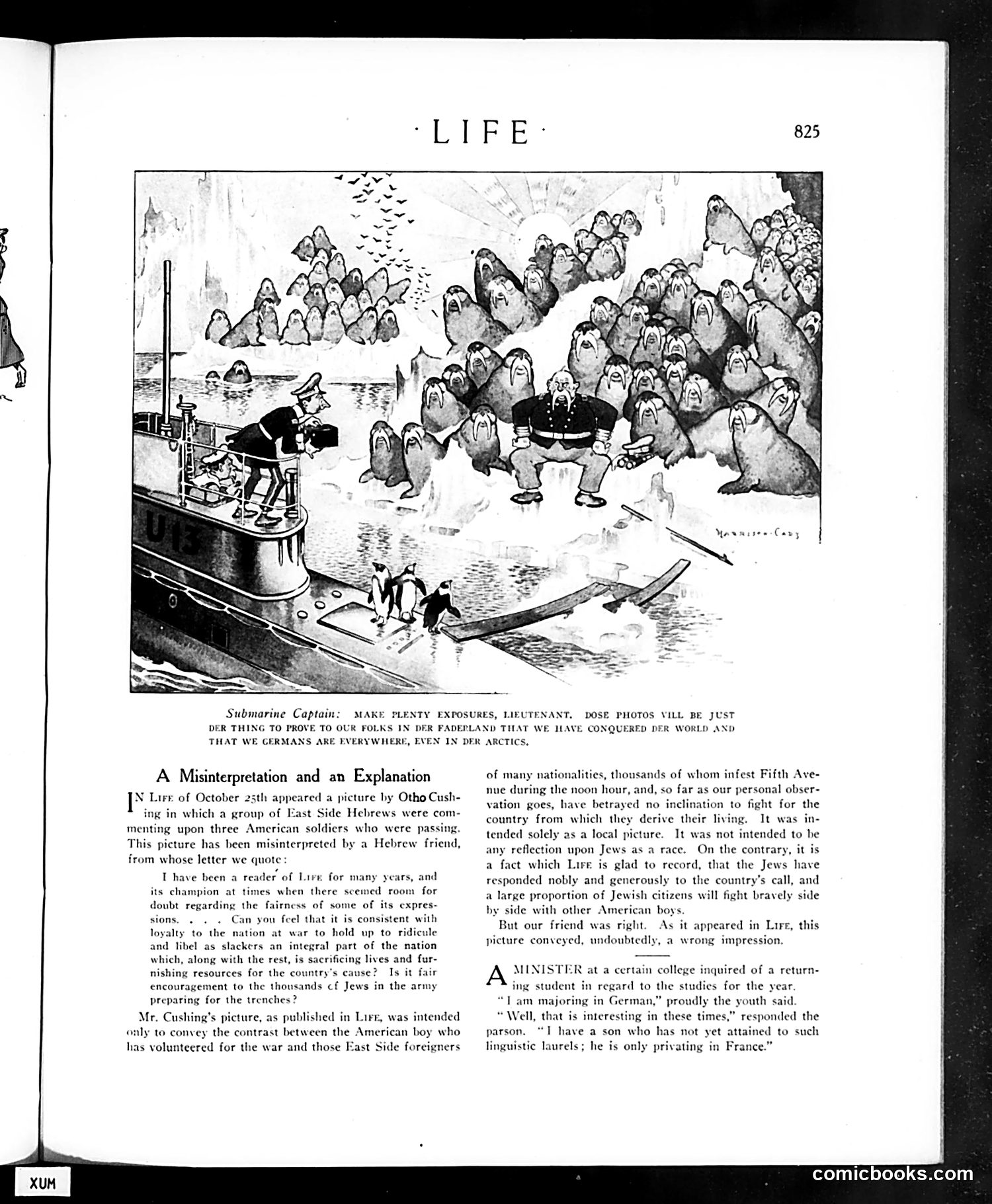
The cartoon depicts a submarine captain addressing a large group of walruses or seals on an Arctic ice floe. The captain declares he will "make plenty exposures" and take photos to "prove to our folks in der Faderland that we have conquered der world and that we Germans are everywhere, even in der Arctics." This is **WWI-era German satire**. The exaggerated German accent and boastful militarism mock German imperial ambitions and propaganda efforts. The absurdity of a German submarine commander photographing Arctic animals as "proof" of conquest ridicules German claims of worldwide dominance. The accompanying text discusses a previous Life cartoon by Otho Cushing showing East Side Hebrews, clarifying that Life intended no anti-Semitic message—merely contrasting American soldiers' sacrifice with foreign volunteers' participation.
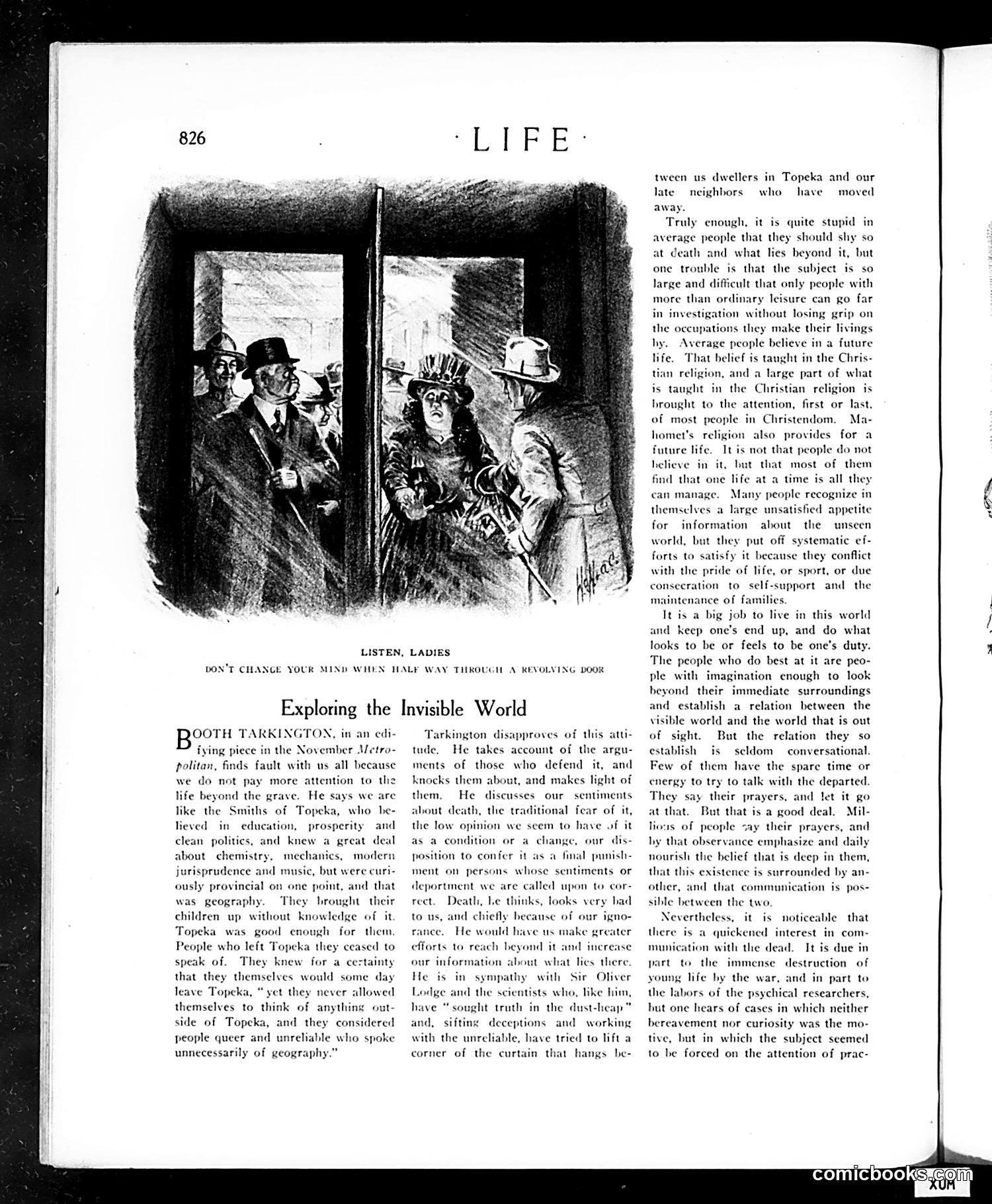
This satirical cartoon depicts well-dressed men in top hats emerging from what appears to be a revolving door, with the caption "Don't change your mind when half way through a revolving door." The accompanying article is titled "Exploring the Invisible World" and discusses Booth Tarkington's November *Metropolitan* magazine piece about communicating with the afterlife and spiritualism. The cartoon mocks women's perceived indecisiveness, a common satirical trope of the era. The revolving door serves as a visual metaphor for commitment—the joke being that women characteristically vacillate in their choices. This reflects period attitudes portraying women as fickle, particularly regarding serious matters like spiritualism and the supernatural topics Tarkington addresses.
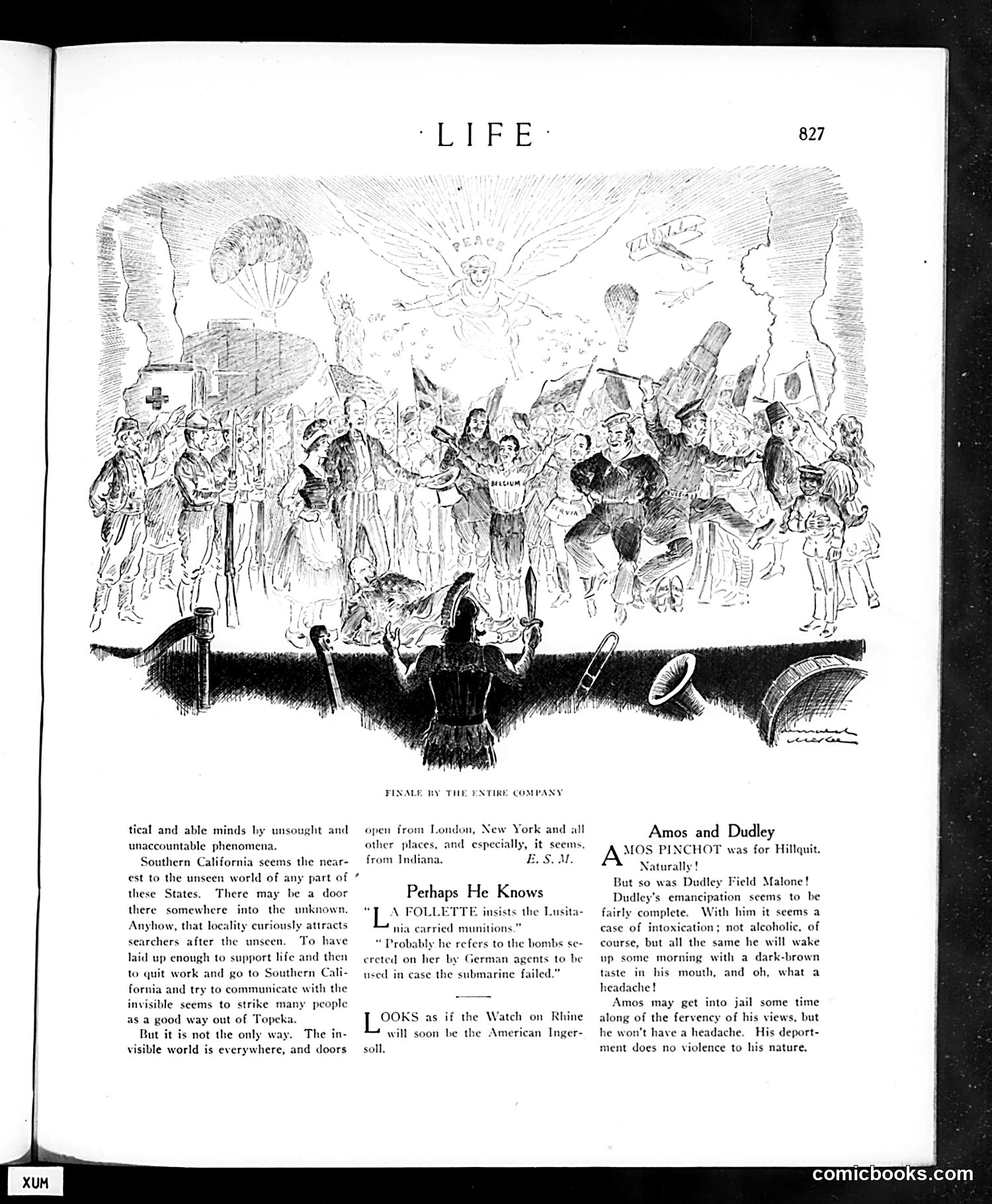
The main illustration is titled "FINALE BY THE ENTIRE COMPANY" and depicts a theatrical scene—likely a stage performance's grand finale with an angelic figure descending from above amid orchestral musicians and costumed performers below. The satire appears to be mocking elaborate theatrical productions or operatic spectacles popular at the time. Below are two brief text pieces: "Perhaps He Knows" (about the Lusitania carrying munitions) and "Amos and Dudley" (discussing characters named Amos Pinchot and Dudley Field Malone). These reference actual contemporary political figures, likely concerning WWI-era debates about American neutrality and military involvement. The Lusitania reference suggests this page dates to around 1915.
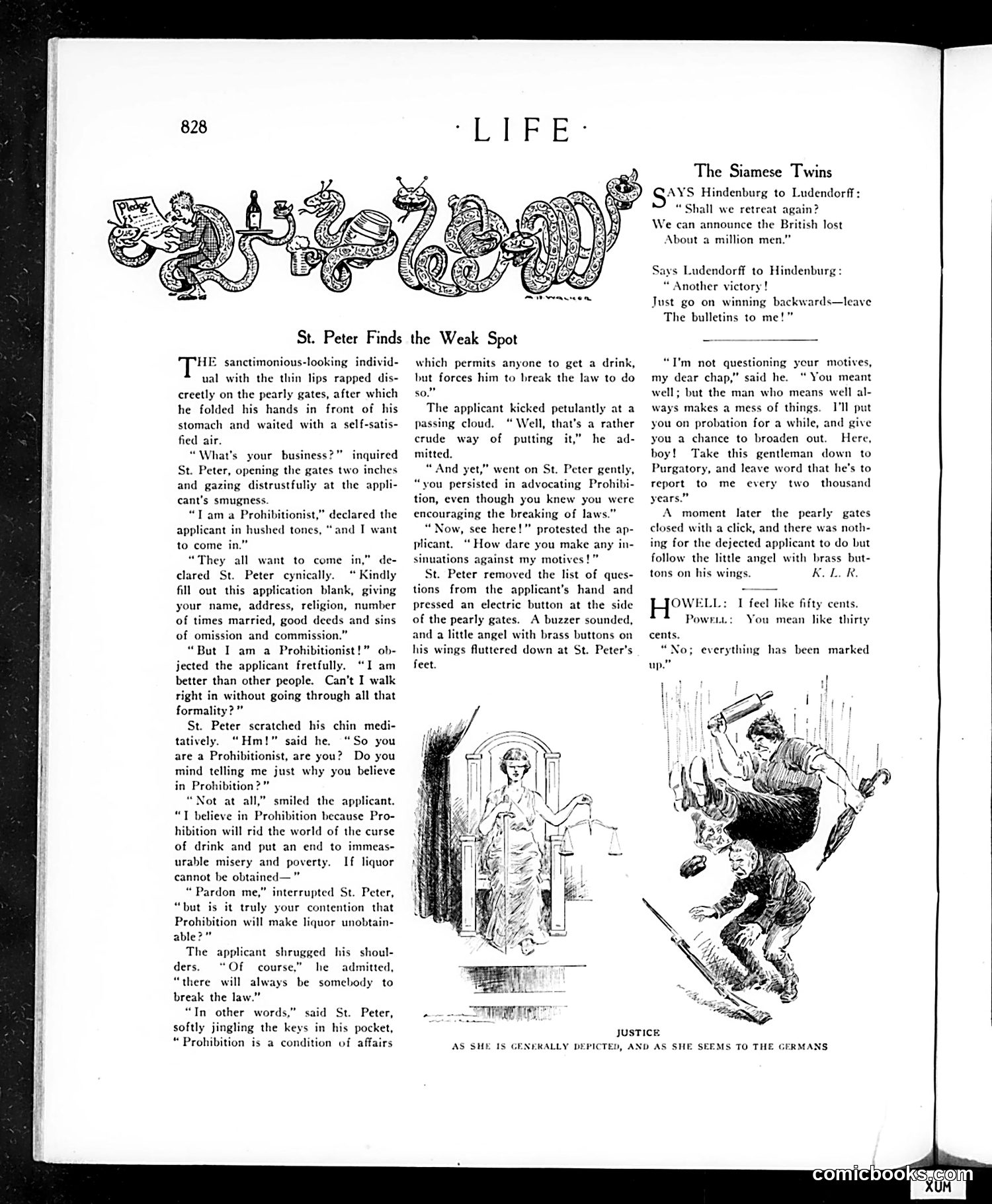
This 1918 *Life* magazine page satirizes Prohibition advocates through a theological dialogue. St. Peter interrogates a self-righteous Prohibitionist applicant, exposing the logical flaw in his position: Prohibition cannot actually prevent drinking—it only makes it illegal. When the applicant admits someone will always break the law to obtain alcohol, St. Peter points out the hypocrisy: the Prohibitionist knowingly advocated a policy he understood would encourage lawbreaking. St. Peter banishes him to Purgatory for 2,000 years. The satire targets moral smugness and the naive idealism of Prohibition supporters, suggesting they caused more harm than good by criminalizing behavior they couldn't actually prevent. The page's second cartoon mocks German military leadership (Hindenburg and Ludendorff), portraying their retreat as a "victory" won through creative propaganda—a jab at wartime spin-doctoring during WWI's final year.
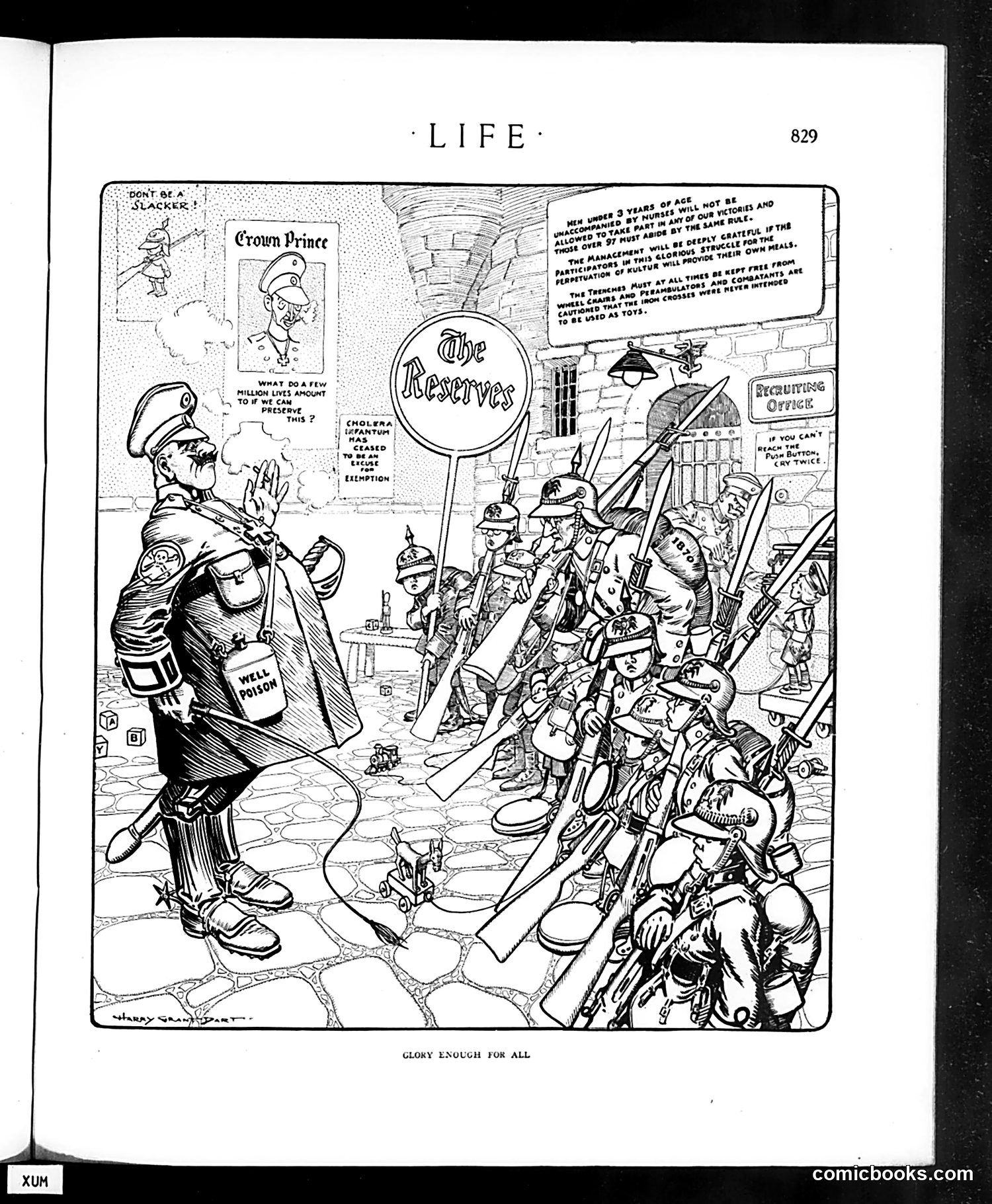
This WWI-era satirical cartoon depicts a large German military officer (identifiable by the spiked Prussian helmet) towering over a group of smaller soldiers carrying rifles with bayonets. The officer appears menacing and dominant. Inset panels mock German military culture with references to "Crown Prince," cholera, and other diseases, suggesting criticism of German practices or leadership. A banner labeled "The Reserves" is central to the composition. The caption "Glory Enough for All" appears ironic—contrasting the grandiose officer's apparent confidence with the disposable masses of ordinary soldiers beneath him, likely satirizing German militarism and the human cost of war. The cartoon critiques both German imperial ambitions and the expendability of common soldiers in pursuit of military glory.
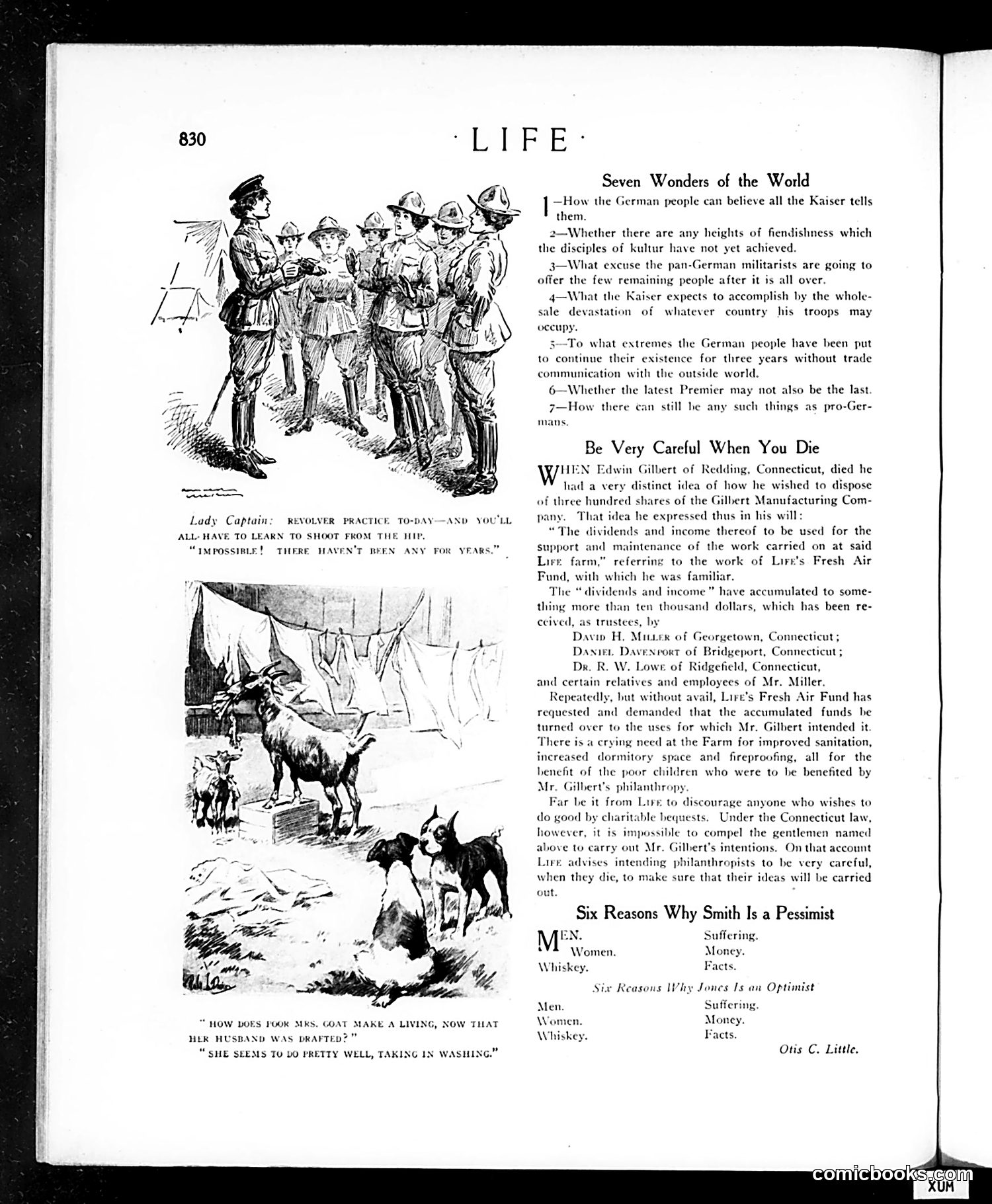
This WWI-era satirical page contains three distinct pieces: ## Top Cartoon A female officer conducting "revolver practice" is told her volunteers "haven't been any for years"—satirizing women's newly active military roles during the war. The bottom cartoon shows a widow supporting herself through laundry work after her husband was drafted, highlighting the economic hardship war imposed on civilian families. ## "Seven Wonders of the World" A list mocking German leadership and culture during WWI: the Kaiser's propaganda power, German militarism's cruelty, and the population's tolerance of wartime suffering. This reflects American wartime hostility toward Germany. ## "Be Very Careful When You Die" A cautionary tale about Edwin Gilbert's will: he left Manufacturing Company dividends to Life's Fresh Air Fund (a charitable organization), but trustees withheld the accumulated ten thousand dollars. The article warns philanthropists to ensure their charitable intentions are legally enforceable—a dig at Connecticut law and the trustees' apparent obstruction. The humor pieces at bottom contrast Smith (pessimist) and Jones (optimist) through identical lists: both cite suffering, women, money, and whiskey—suggesting pessimism and optimism are arbitrary distinctions.
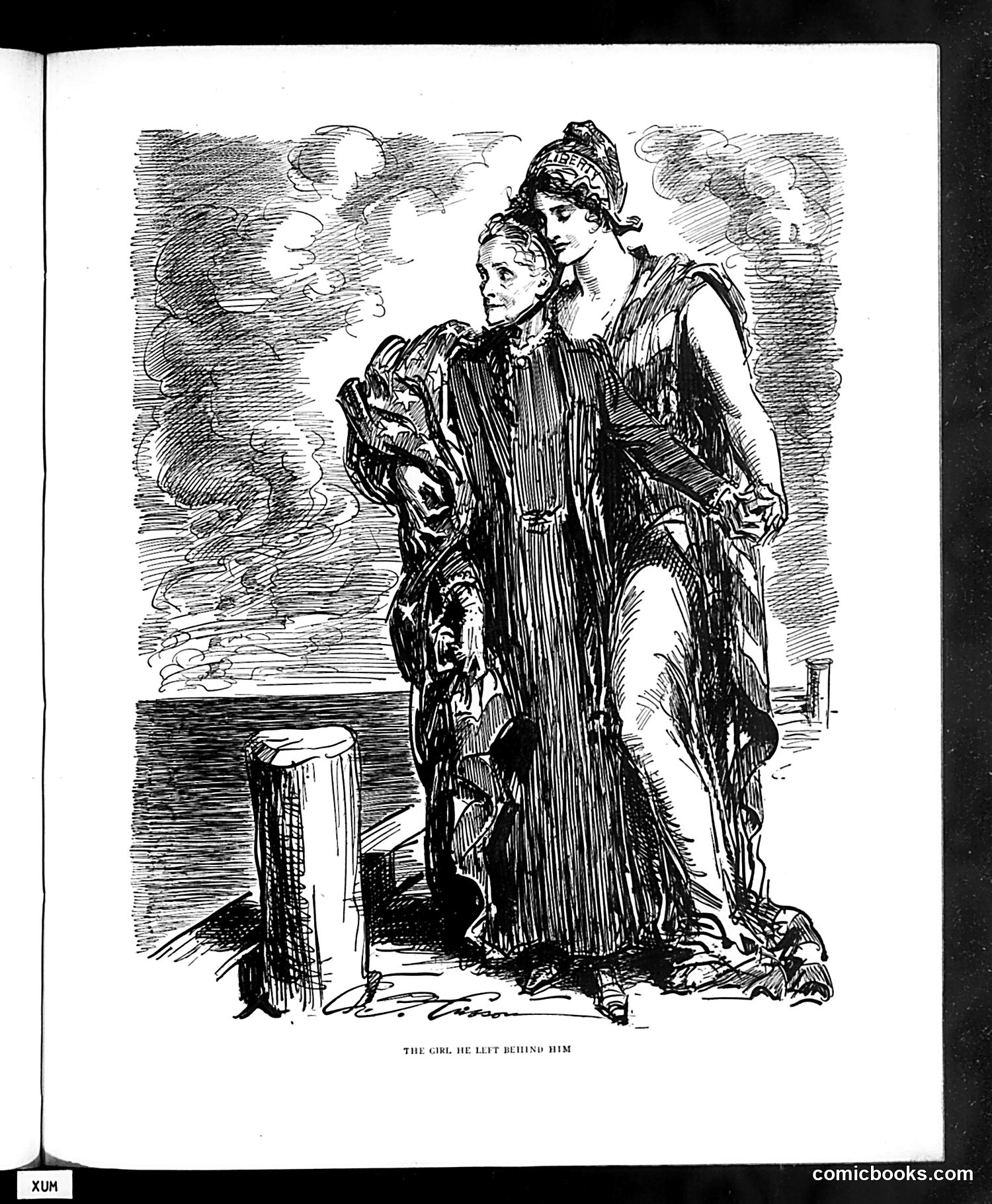
This Victorian-era engraving depicts a domestic scene with romantic/melodramatic overtones. An older man in formal robes stands with a young woman in classical dress and ornate headpiece. The caption "The Girl He Left Behind Him" suggests a narrative of separation or departure—likely playing on the popular 19th-century song of the same name about soldiers leaving sweethearts. The satire appears to mock sentimental romanticism or, possibly, social hypocrisy regarding relationships and class differences. The woman's classical styling and the man's formal attire suggest this may reference theatrical or literary traditions. Without additional context about Life magazine's specific issue, the exact political or social target remains unclear, though the tone suggests irony toward conventional romantic sentiment.
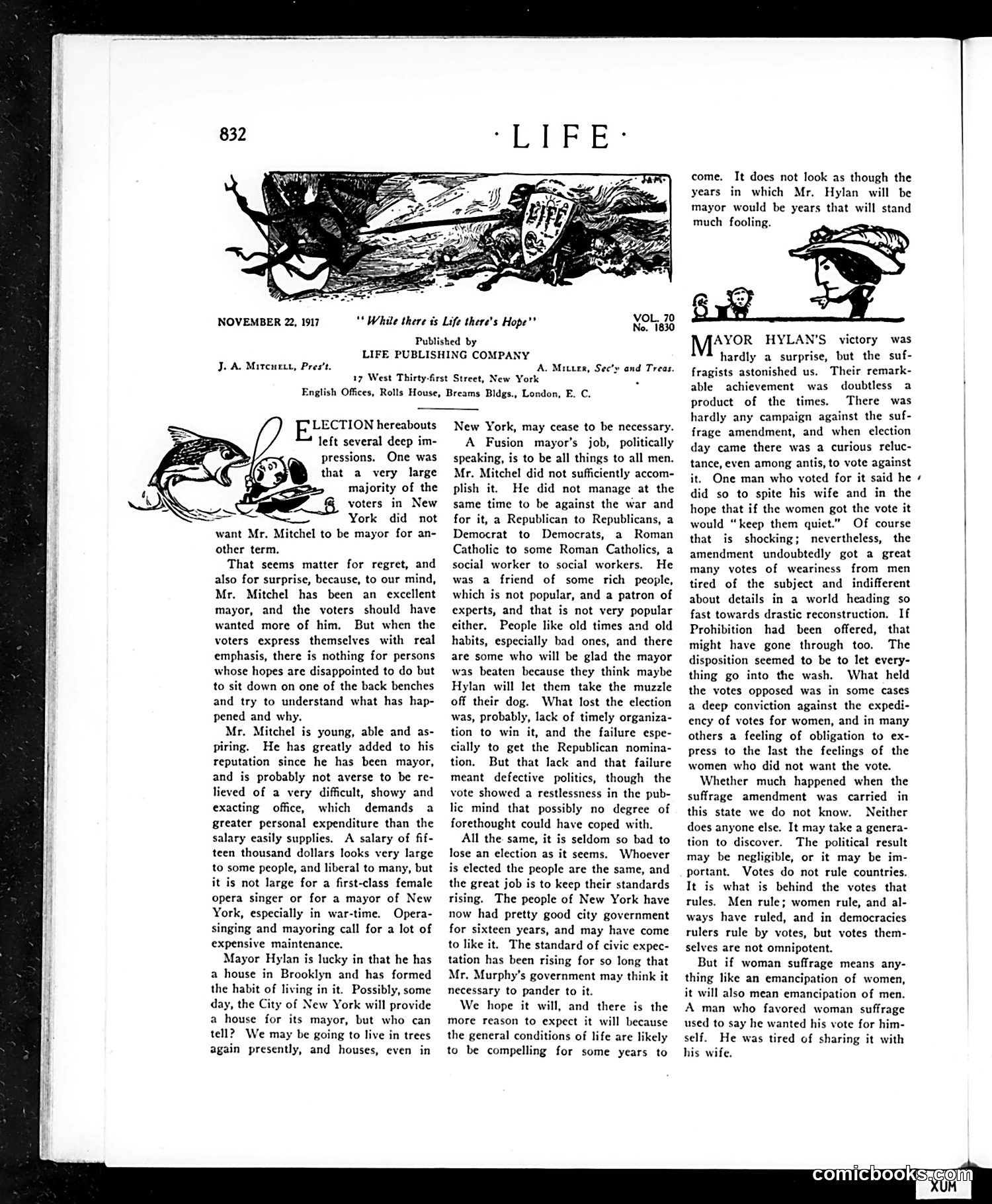
This page discusses New York City's mayoral election, in which incumbent **John Purroy Mitchel** (a Fusion candidate) lost his reelection bid to **John F. Hylan**. The article expresses regret at Mitchel's defeat, arguing he was an excellent, reform-minded mayor hampered by the impossible task of pleasing all factions—Republicans, Democrats, Catholics, social workers, and the wealthy simultaneously. The piece suggests his loss resulted from poor political organization and failure to secure Republican nomination, not policy failures. The text notes that Hylan, the victor, owned a Brooklyn house and could live there affordably—a pointed contrast to Mitchel's expensive mayoral lifestyle. Notably, the article also **praises female suffragists** whose recent voting achievements "astonished" the magazine, calling their accomplishment "remarkable" and "a product of the times." This reflects the 1917 context: New York women had just gained voting rights that year (preceding the 1920 national amendment).
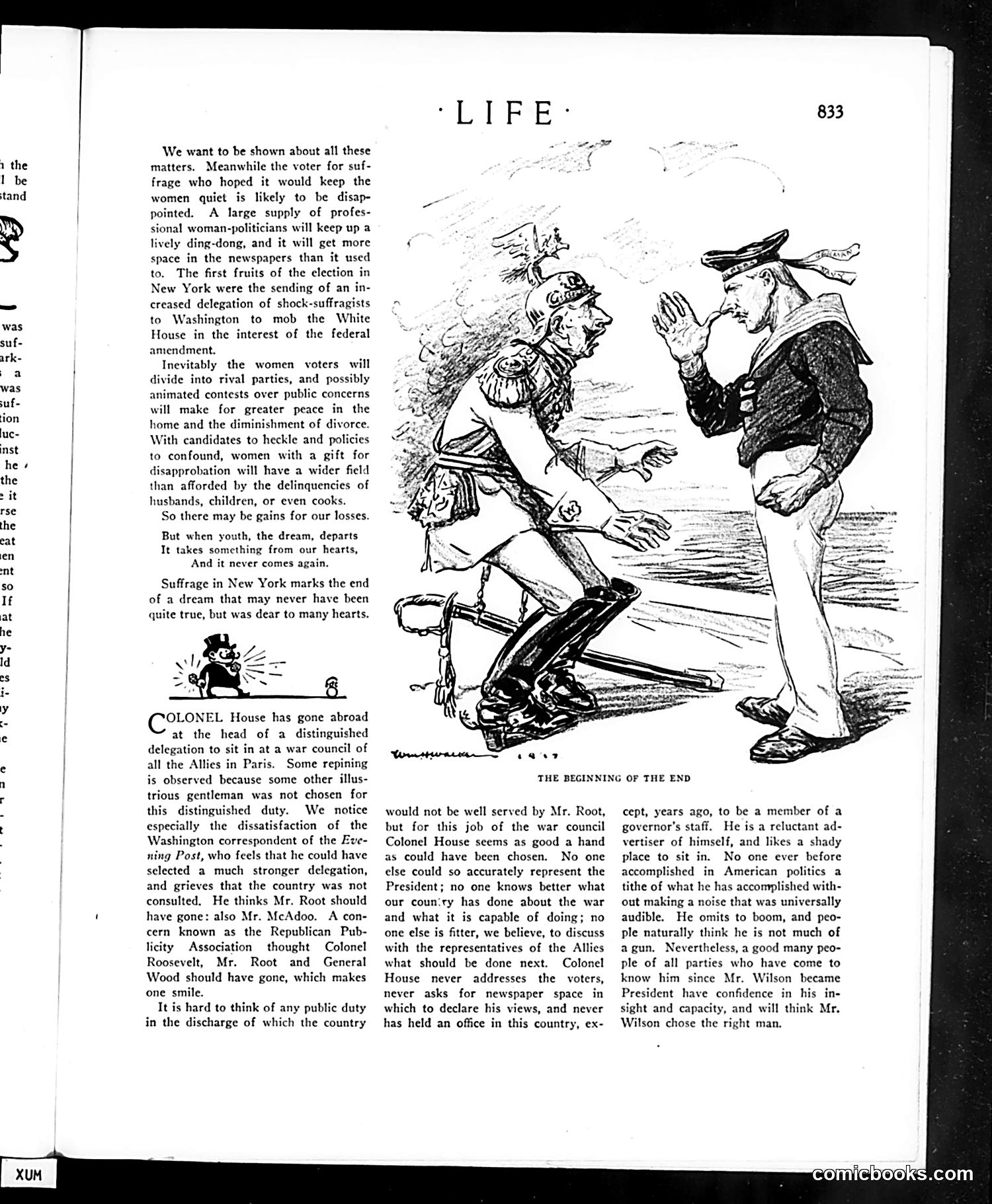
**Main Cartoon ("The Beginning of the End"):** The illustration depicts a military or political figure (left, in ornate uniform) appearing to pedal away on a bicycle-like contraption, while another figure (right, in civilian dress) waves goodbye. The caption suggests this represents the end of women's suffrage activism as a romantic ideal. **Context:** The surrounding text discusses New York's recent adoption of women's suffrage, mourning the loss of the suffragists' "dream" while acknowledging women will now enter practical politics. The tone is ambivalent—predicting women voters will form rival parties and engage in contentious debates, potentially creating household discord but also channeling their energies into public policy rather than domestic grievance. **Secondary Section:** The text praises Colonel House's appointment to the Allied war council in Paris, defending him against Republican critics (including Theodore Roosevelt and General Wood) who believe Root or other figures should have been chosen. The piece argues House's quiet competence and proximity to President Wilson make him ideal.
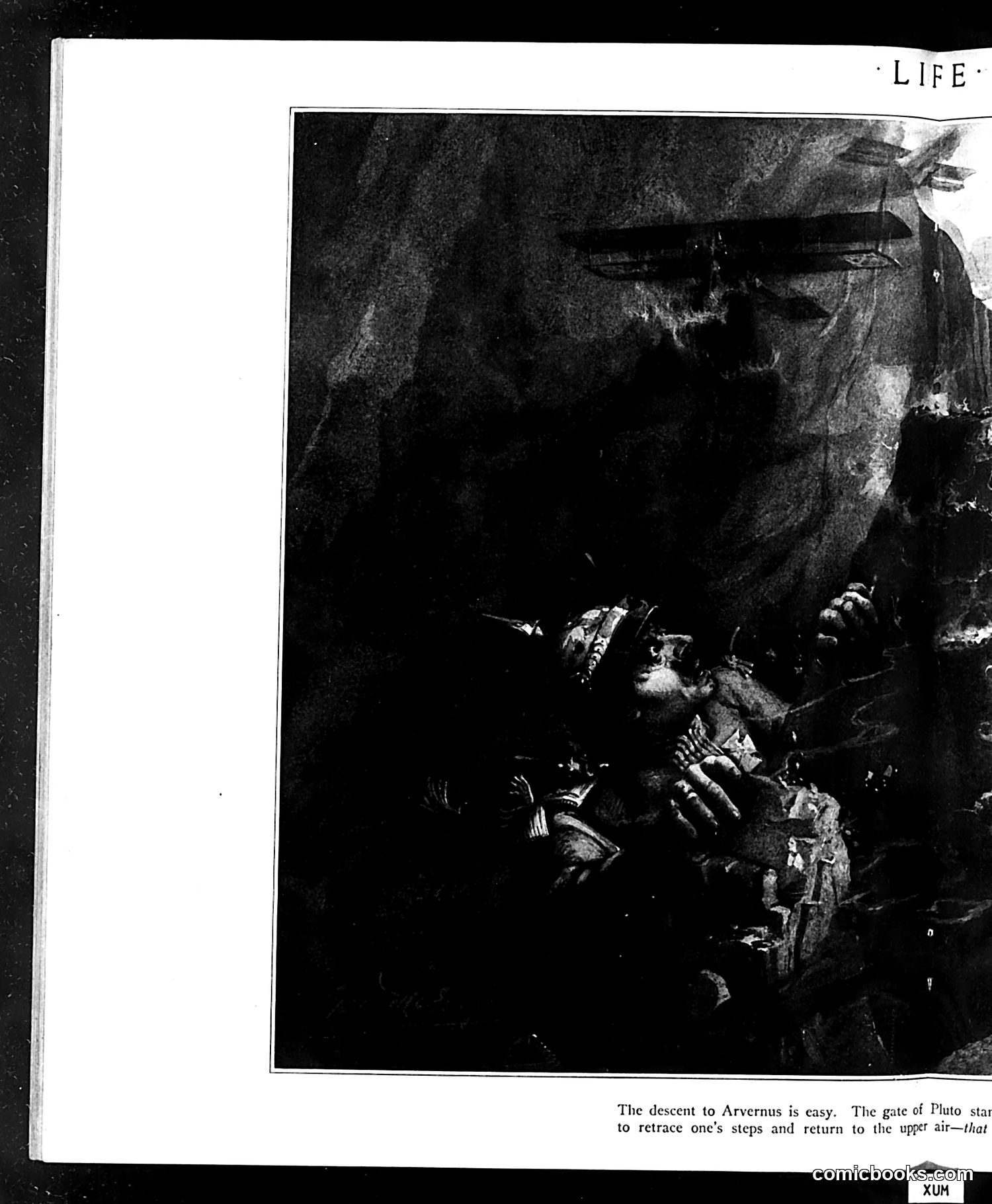
This page references Virgil's *Aeneid*, specifically the descent to the Underworld (Avernus). The text quotes the classical principle that "it is easy to descend to Avernus" but difficult to return—a metaphor for how easy it is to fall into vice or corruption, but hard to escape it. The dramatic black-and-white illustration shows figures in what appears to be a dark, cavernous underworld setting, likely depicting souls or characters in a hellish realm. Without seeing the full caption or context, the specific satirical target is unclear, but Life magazine typically used classical allusions to critique contemporary political figures or social vices. The imagery suggests a moral or political commentary about descent into corruption or moral failure.
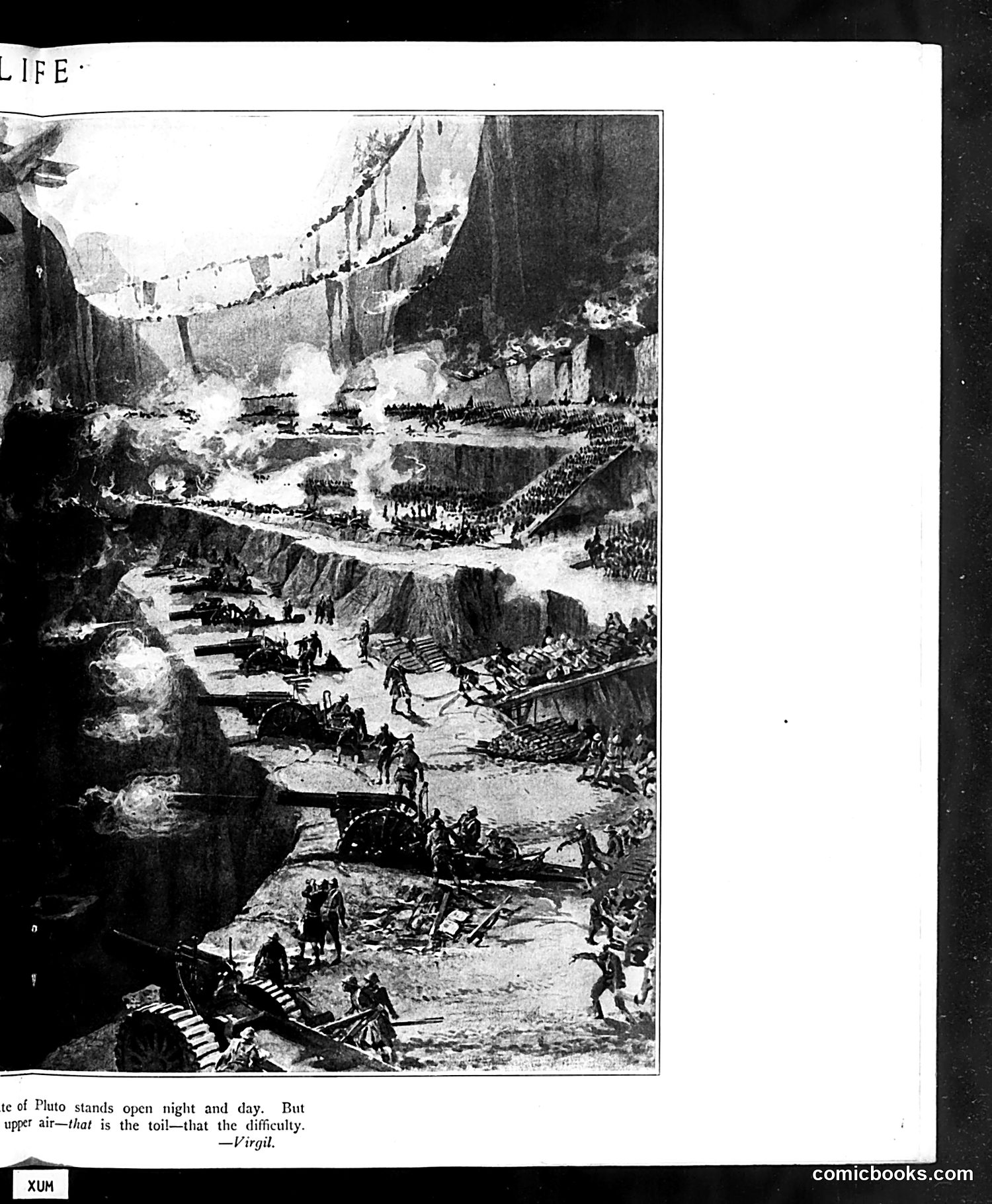
This appears to be a classical allegorical illustration rather than political satire. The image depicts an underground scene with numerous figures, fortifications, and activity—consistent with the quoted excerpt from Virgil about Pluto (the Roman god of the underworld) and the difficulty of the "upper air." The illustration likely represents the underworld or Hell, a common subject in classical literature and artistic tradition. The quote attributes the text to Virgil, the Roman poet, suggesting this relates to classical mythology rather than contemporary political commentary. Without additional context or captions identifying specific figures or events, the page appears to be educational or literary in nature, illustrating classical concepts rather than delivering modern satirical commentary. The "Life" magazine attribution and "comicbooks.com" reference indicate this is an archived historical document.
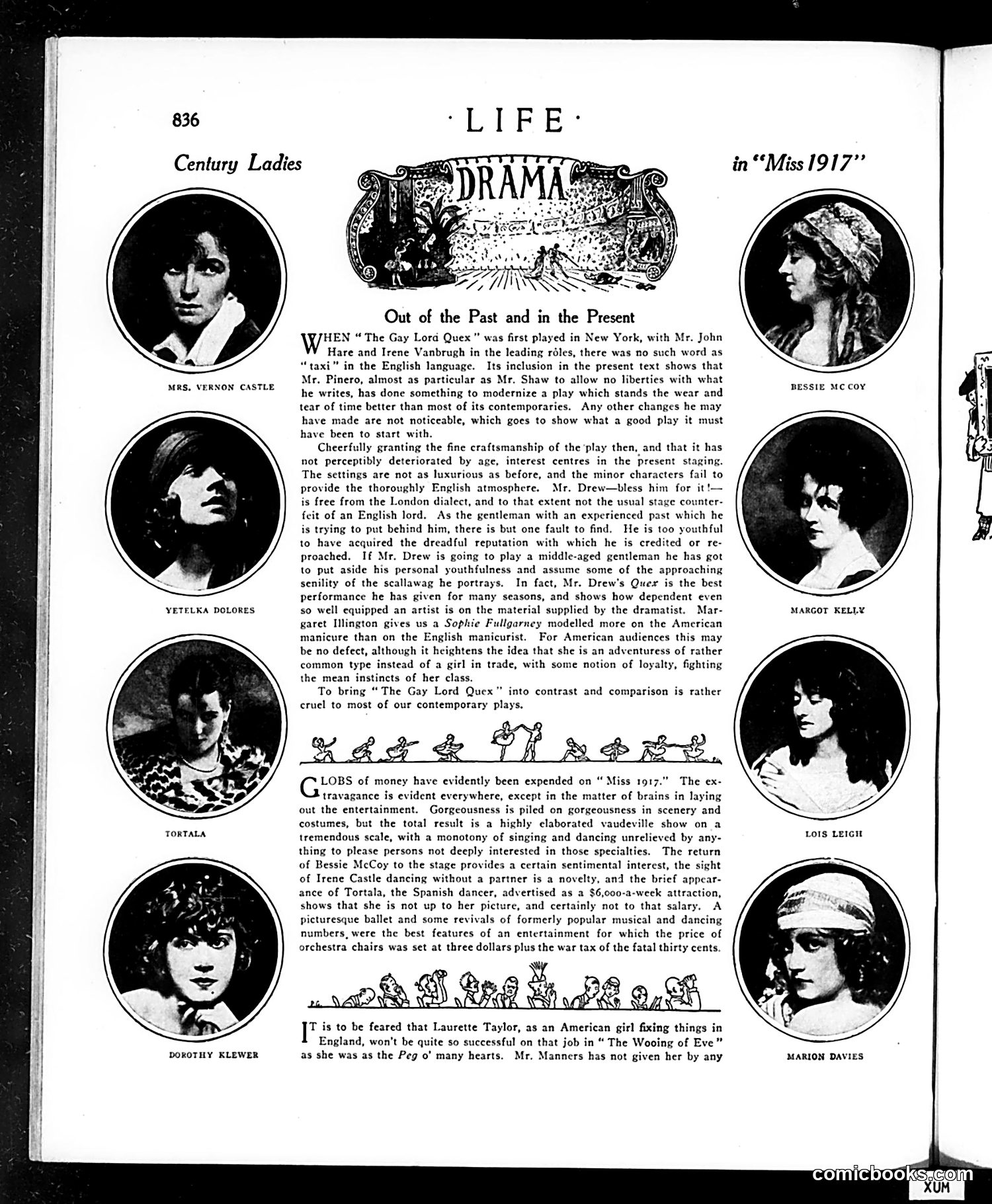
This page reviews three Broadway productions from 1917, featuring photographs of actresses who appeared in them. **"The Gay Lord Quex"**: A revival of an older play (originally featuring John Hare and Irene Vanbrugh). The reviewer praises its craftsmanship and notes Pinero updated it slightly—adding the word "taxi," which didn't exist in the original English language version. The review critiques actor Mr. Drew for appearing too youthful to convincingly play a middle-aged man with a disreputable past, and notes Margaret Illington's performance emphasizes American rather than English character traits. **"Miss 1917"**: A lavish musical revue featuring expensive scenery and costumes but criticized as an overly elaborate vaudeville show lacking intellectual substance. The review highlights Bessie McCoy's return to stage and Irene Castle's novelty of dancing solo, though Spanish dancer Tortala disappoints despite her high salary. **"The Wooing of Eve"**: Brief mention expressing doubt that Laurette Taylor will succeed in this role. The page represents typical theater criticism from the era.
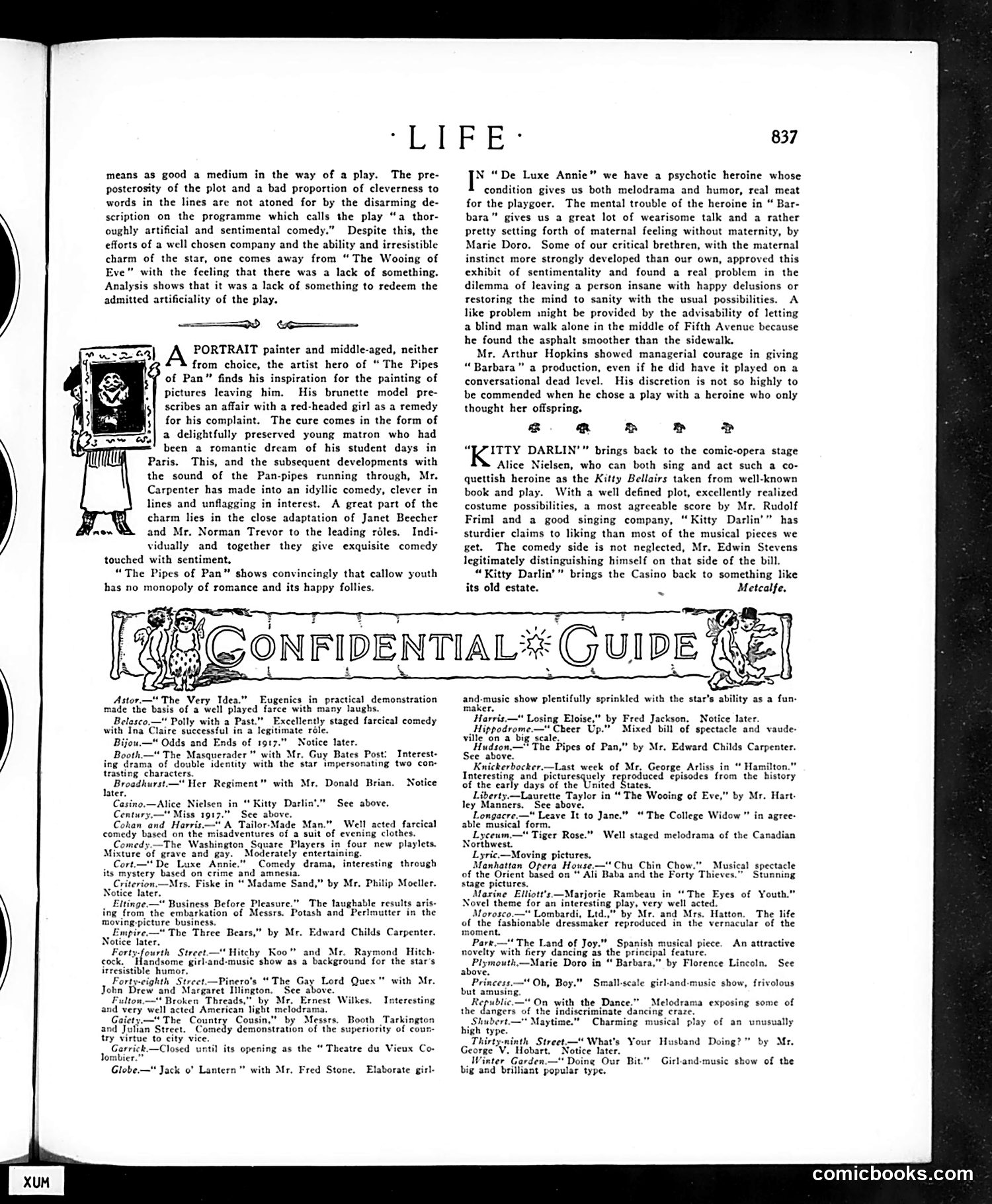
This page contains theater reviews from Life magazine's "Confidential Guide" section—a regular feature critiquing Broadway productions. The left column discusses several plays ("The Wooing of Eve," "The Pipes of Pan") with detailed critical commentary. The right column reviews "De Luxe Annie" and "Kitty Darlin'," praising the latter as a successful comic-opera revival featuring Alice Nielsen. The bulk of the page is the "Confidential Guide"—a comprehensive listing of current New York theater productions with brief, witty evaluations of each show's merits, cast, and plot. These are consumer-oriented theater recommendations, not satire or political commentary. Life magazine used this format to guide readers toward worthwhile entertainment while occasionally mocking poor productions through sarcastic descriptions of their plots or performances.
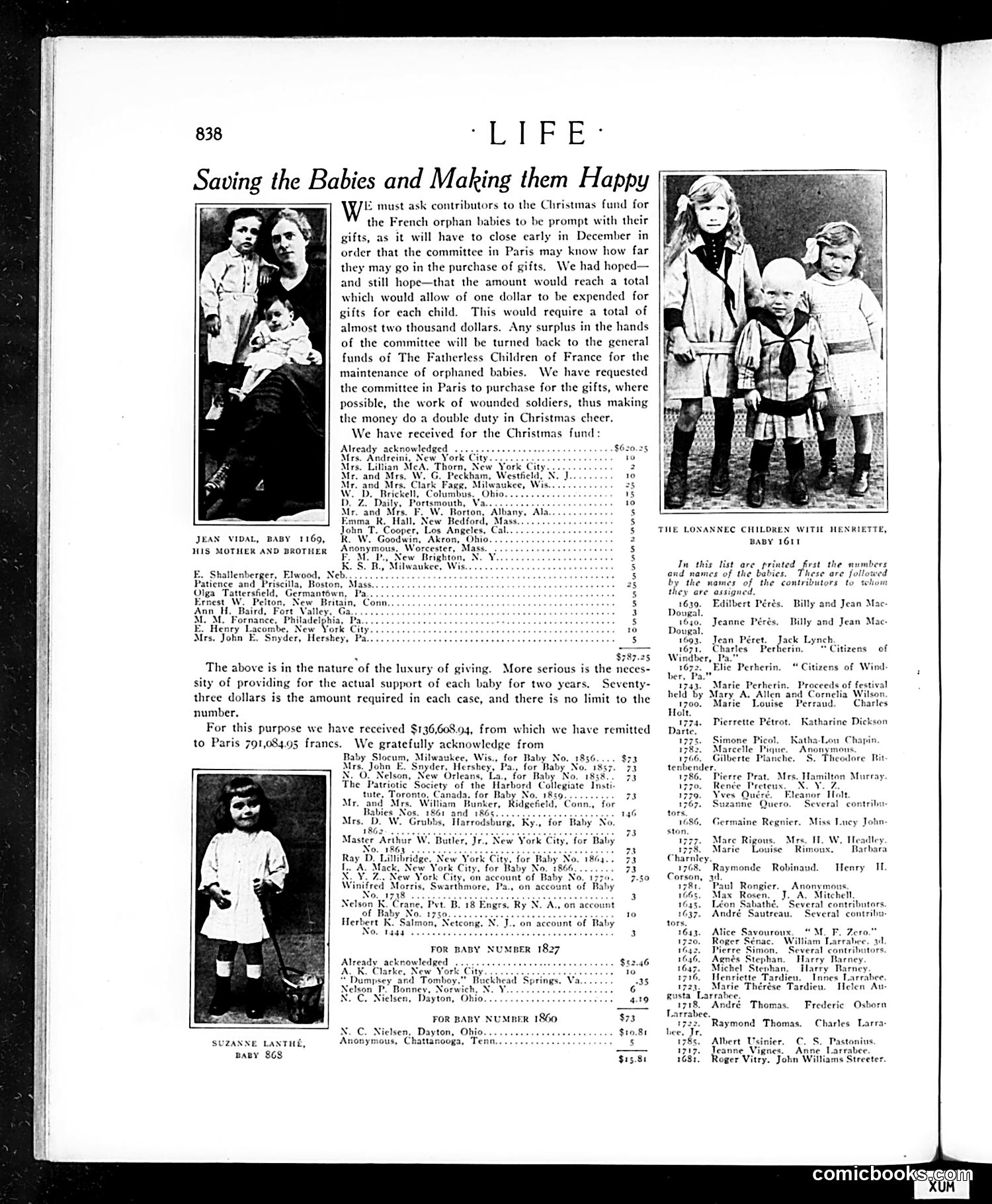
This is **not a political cartoon** but rather a charitable fundraising article from *Life* magazine documenting American donations to support French orphans after World War I. The page features three photographs of orphaned French children (Jean Vidal with his mother and brother; Suzanne Lanthé; and the Lonannec children with baby Henriette) alongside detailed lists of donors and the amounts contributed. The article explains that *Life* is collecting funds to provide Christmas gifts and two-year support ($73 per child) for French orphan babies through "The Fatherless Children of France" organization. It notes that purchases will prioritize goods made by wounded soldiers when possible—making donations serve double duty for wartime relief. The content reflects American charitable efforts toward war-displaced European children in the WWI era, presenting both the human faces of the beneficiaries and the communal donor participation as evidence of American generosity and commitment to postwar humanitarian aid.
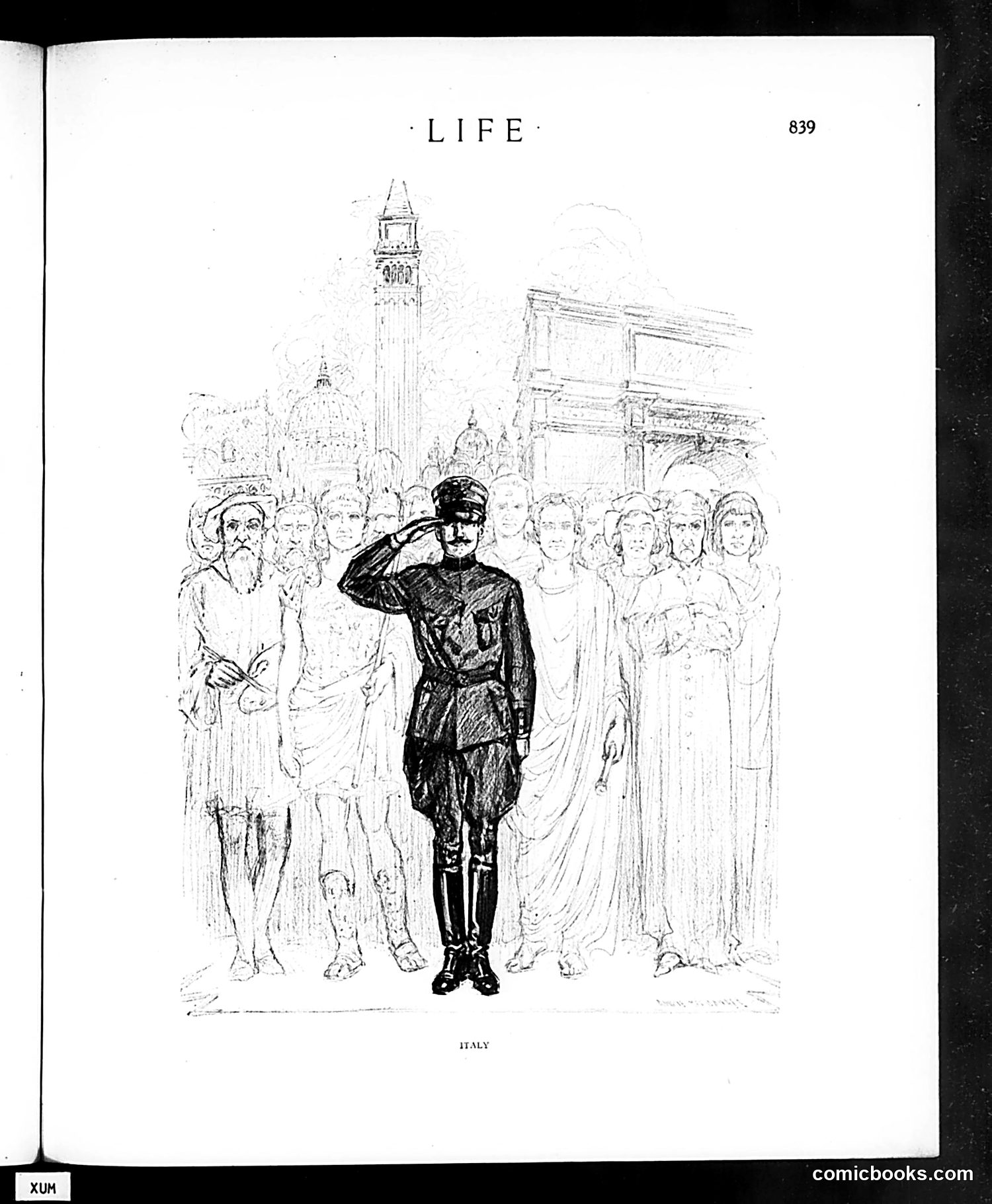
This page from *Life* magazine (page 839) features a political cartoon titled "ITALY." The illustration depicts a military officer in dark uniform and cap, saluting prominently in the center. He is surrounded by a crowd of civilians and religious figures (identifiable by robes and head coverings) set against Italian architectural landmarks, including what appears to be a tall tower and classical buildings in the background. The cartoon likely satirizes Italian military or political authority during a specific historical moment—possibly commenting on militarism, authoritarianism, or the relationship between the military and civilian/religious institutions in Italy. The officer's formal salute and central positioning suggest commentary on power dynamics or political control. Without a caption or date visible, the specific historical context remains unclear.
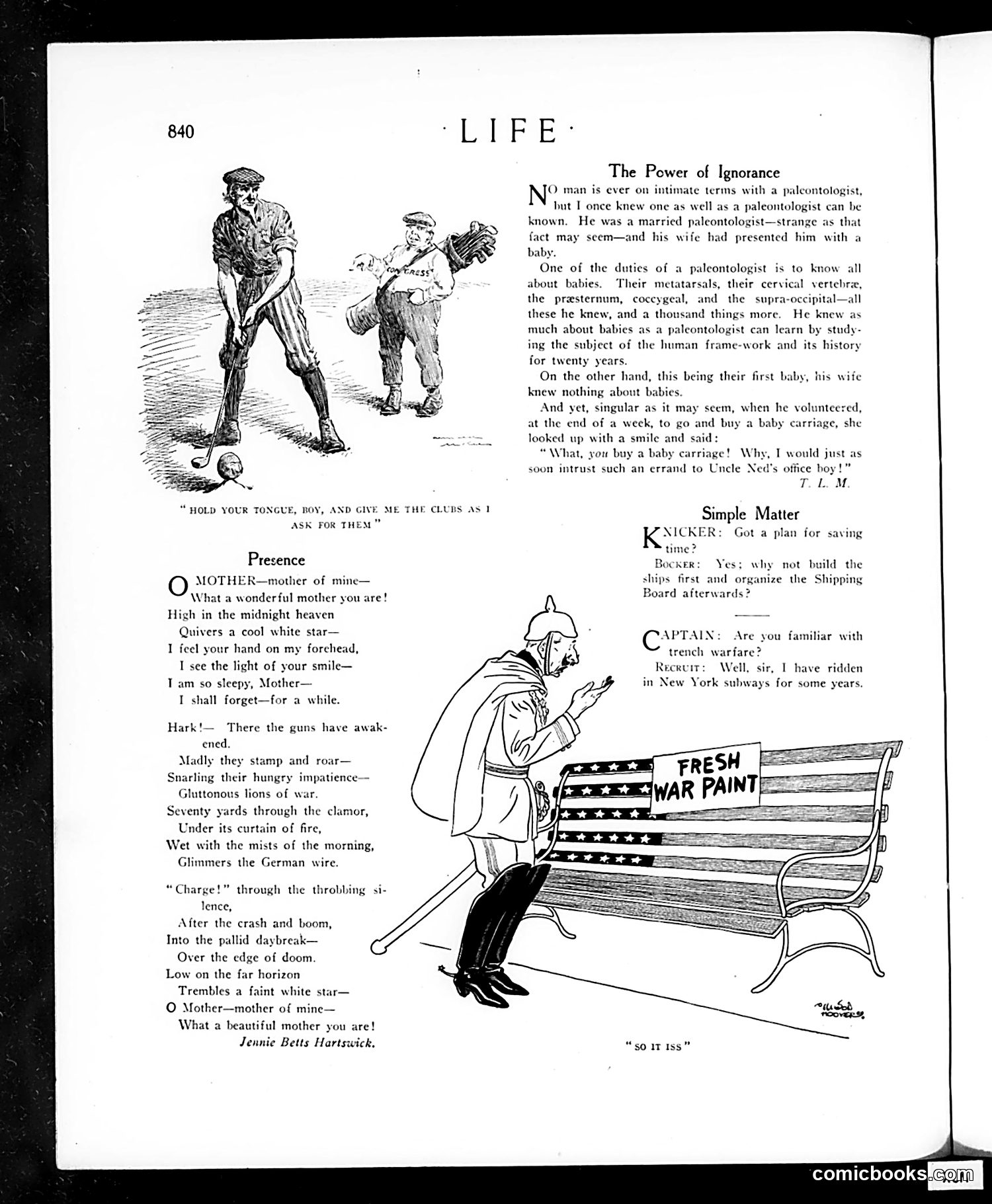
This page contains three satirical pieces reflecting World War I-era American anxieties: **"The Power of Ignorance"** mocks the gap between theoretical and practical knowledge. A paleontologist who can recite anatomical details about babies proves useless when buying a baby carriage—his wife, despite knowing nothing scientifically, trusts her instincts over his expertise. The satire suggests that specialized education doesn't guarantee common sense. **"Simple Matter"** is a quick joke about wartime inefficiency: a character suggests building ships before organizing the Shipping Board—obvious logic satirizing bureaucratic backwards priorities during WWI mobilization. **"Presence"** is a patriotic war poem by Jennie Betts Hartswick describing a soldier's experience in trench warfare, invoking his mother as an emotional anchor. The right cartoon shows a German soldier sitting on a bench labeled "Fresh War Paint," captioned "So It Is"—likely commenting on Germany's militarism or recycled warfare tactics. These pieces reflect American WWI-era concerns about competence, military organization, and the soldier's experience.
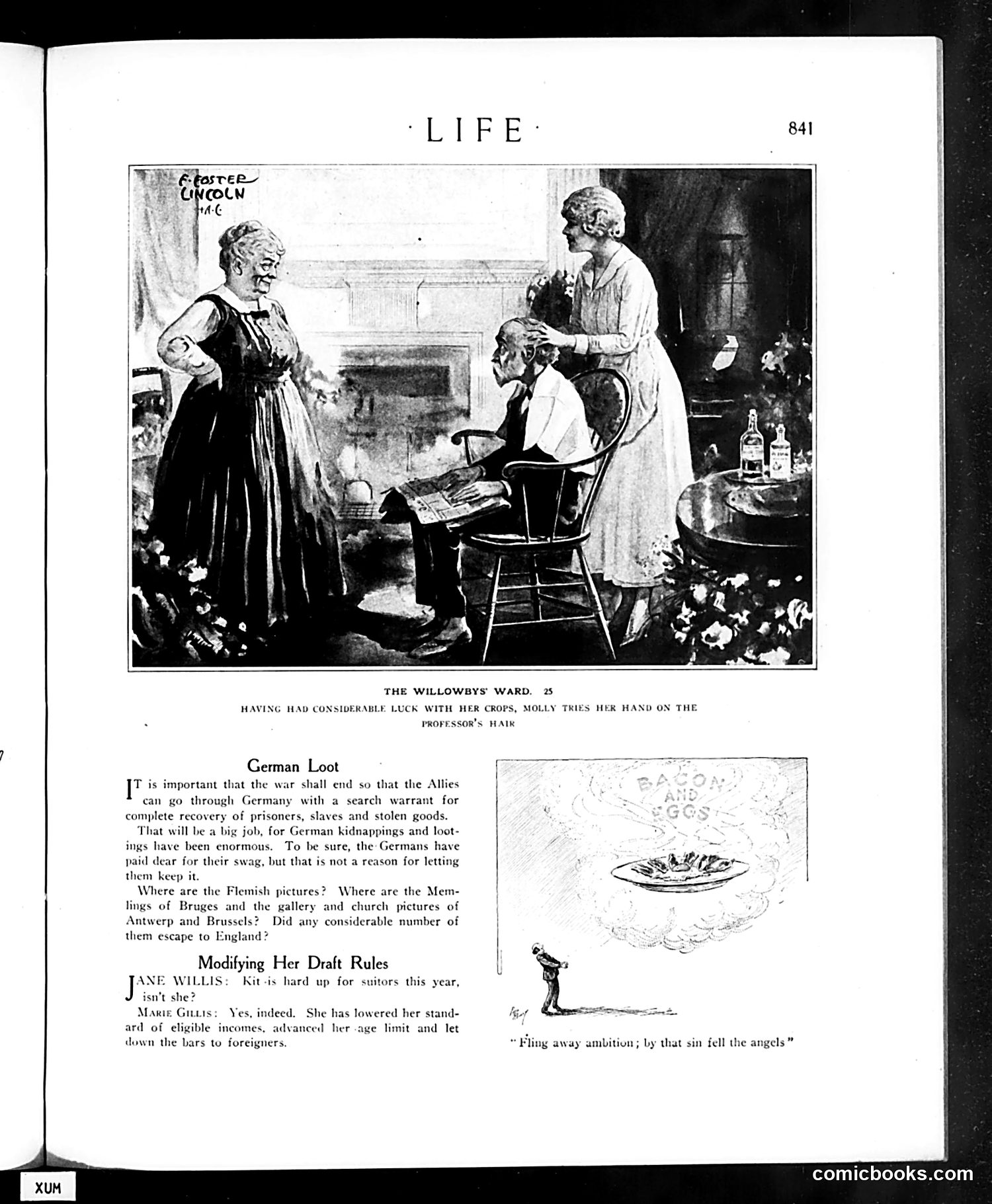
**"The Willowbys' Ward"** (top illustration): A domestic comedy strip showing a character named Molly attempting to influence a professor's luck with crops by touching his hair, playing on superstition and romantic subplot conventions of the era. **"German Loot"** (main article): A WWI-era piece arguing that Allied victory must include systematic recovery of stolen cultural treasures from Germany—specifically Flemish paintings from Bruges, Antwerp, and Brussels. The author expresses concern these masterpieces may have been lost or taken to England, treating German wartime looting as a serious crime requiring legal restitution. **"Modifying Her Draft Rules"** (dialogue joke): A social commentary on how Kit, a single woman, has adjusted her marriage prospects downward—accepting lower incomes, older men, and foreign suitors—presumably due to male shortage caused by WWI military service. All three items reflect wartime American concerns: romantic morale, German war crimes accountability, and home-front social disruption.
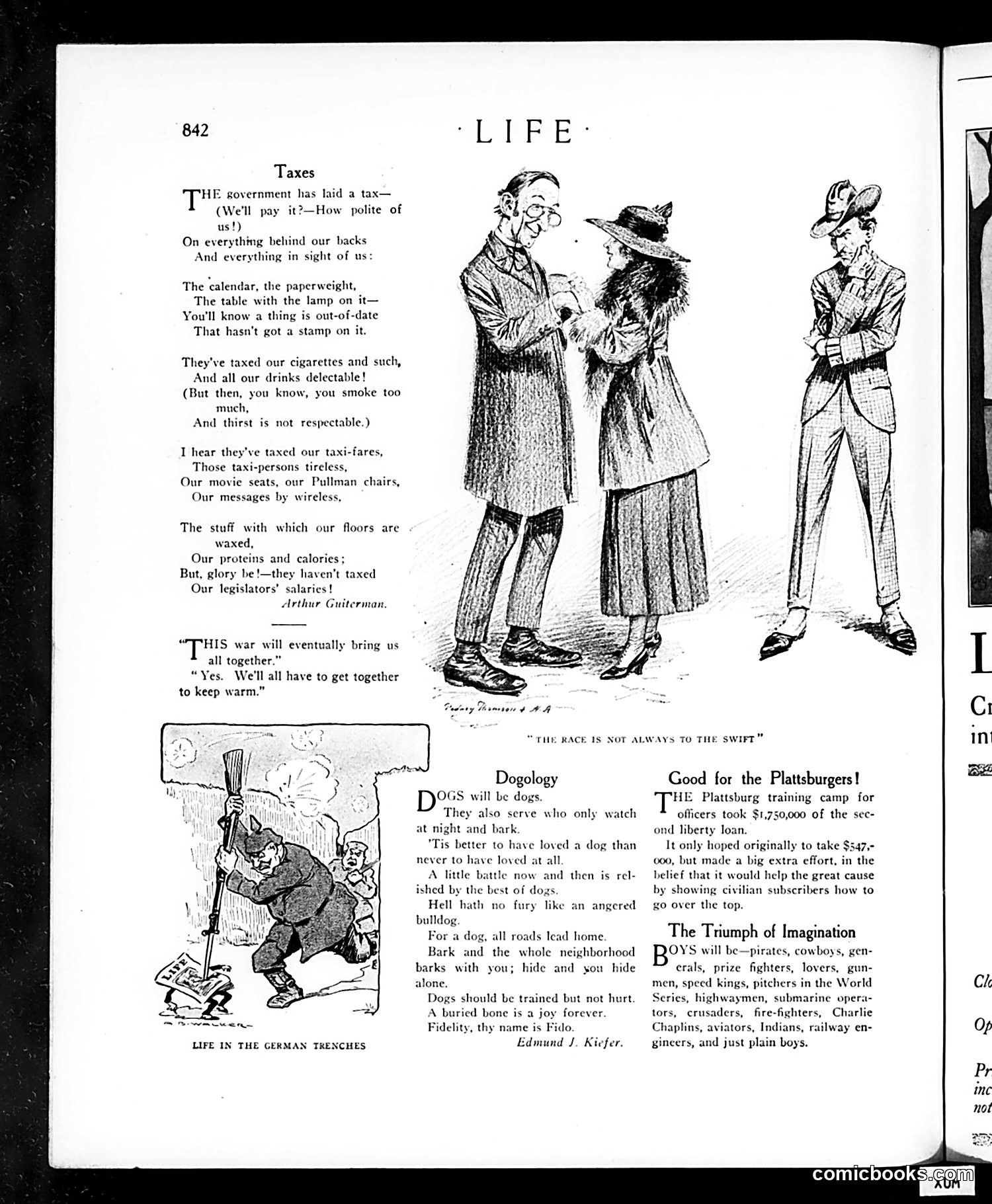
This *Life* magazine page satirizes American life during World War I (evidenced by references to "liberty loan" and German trenches). The main poem "Taxes" mocks government taxation of everyday items—calendars, cigarettes, taxi fares, movie seats, wireless messages—while pointedly noting that **legislators exempt their own salaries** from taxation. The satire's target: hypocrisy of those in power. The cartoon "Life in the German Trenches" offers dark humor about wartime hardship, showing soldiers saying they'll "get together to keep warm"—gallows humor about shared misery. "Dogloology" presents dog sayings as philosophical wisdom, likely offering gentle comic relief amid war news. "Good for the Plattsburgers!" praises a military officers' training camp for exceeding fundraising goals for the Liberty Loan (war bonds). Overall, the page balances satirical criticism of government taxation policy with patriotic support for the war effort—a typical *Life* magazine blend of irreverent social commentary and wartime solidarity.
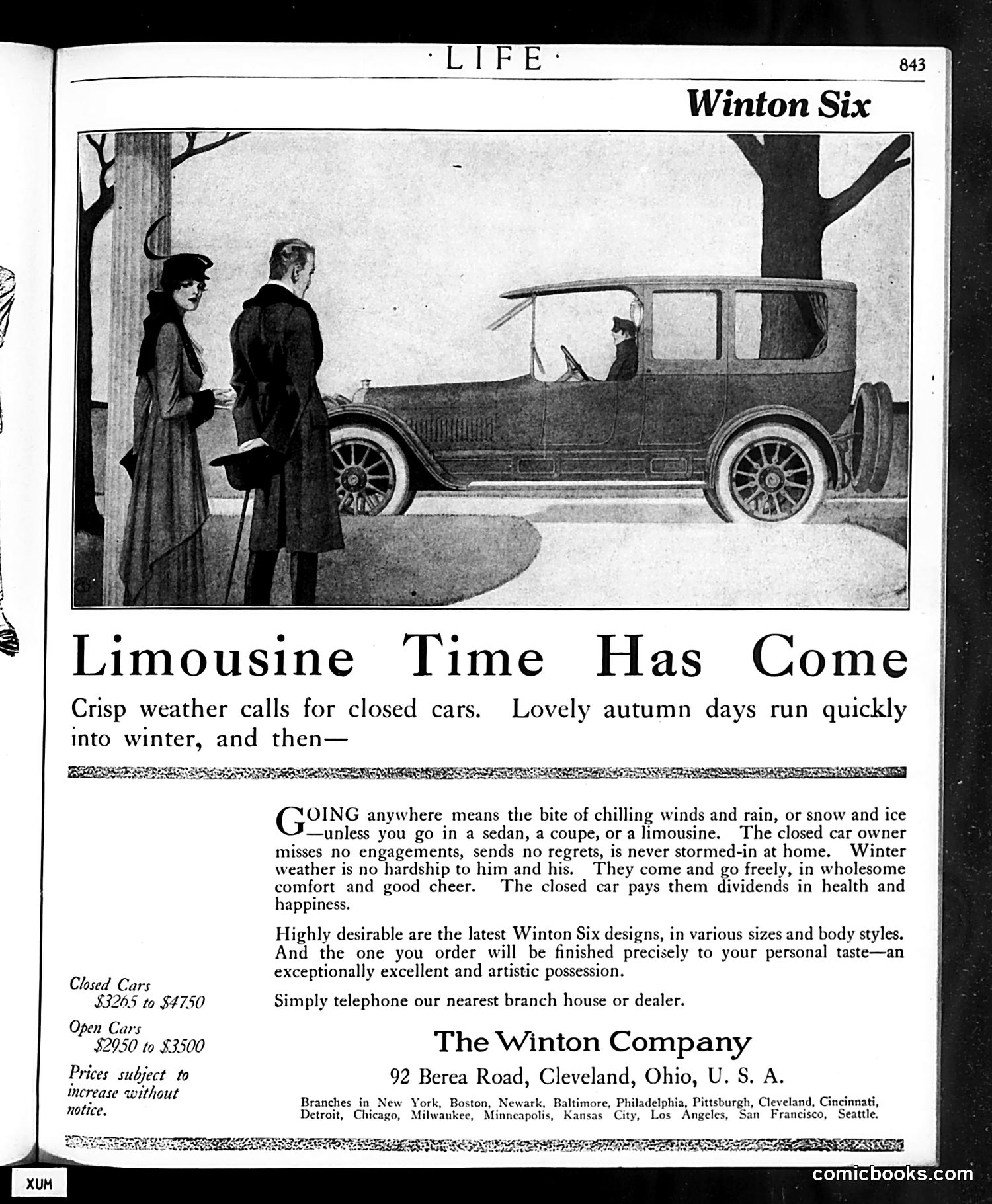
This is a **car advertisement, not satire or political content**. It appears in Life magazine (page 843) promoting the Winton Six automobile, a closed-car limousine. The illustration shows two well-dressed figures observing a Winton Six sedan with a driver, emphasizing the vehicle's enclosed design—a selling point for autumn and winter travel. The advertisement's appeal is social and comfort-focused: closed cars protect owners from harsh weather while allowing them to maintain their social obligations ("misses no engagements, sends no regrets"). The pitch targets affluent buyers, positioning car ownership as a marker of status and health ("dividends in health and happiness"). Pricing ranges from $2,950 to $4,750, substantial sums in the early 20th century. There is no cartoon joke or political satire here—it's straightforward commercial messaging typical of Life's advertising content during this era.
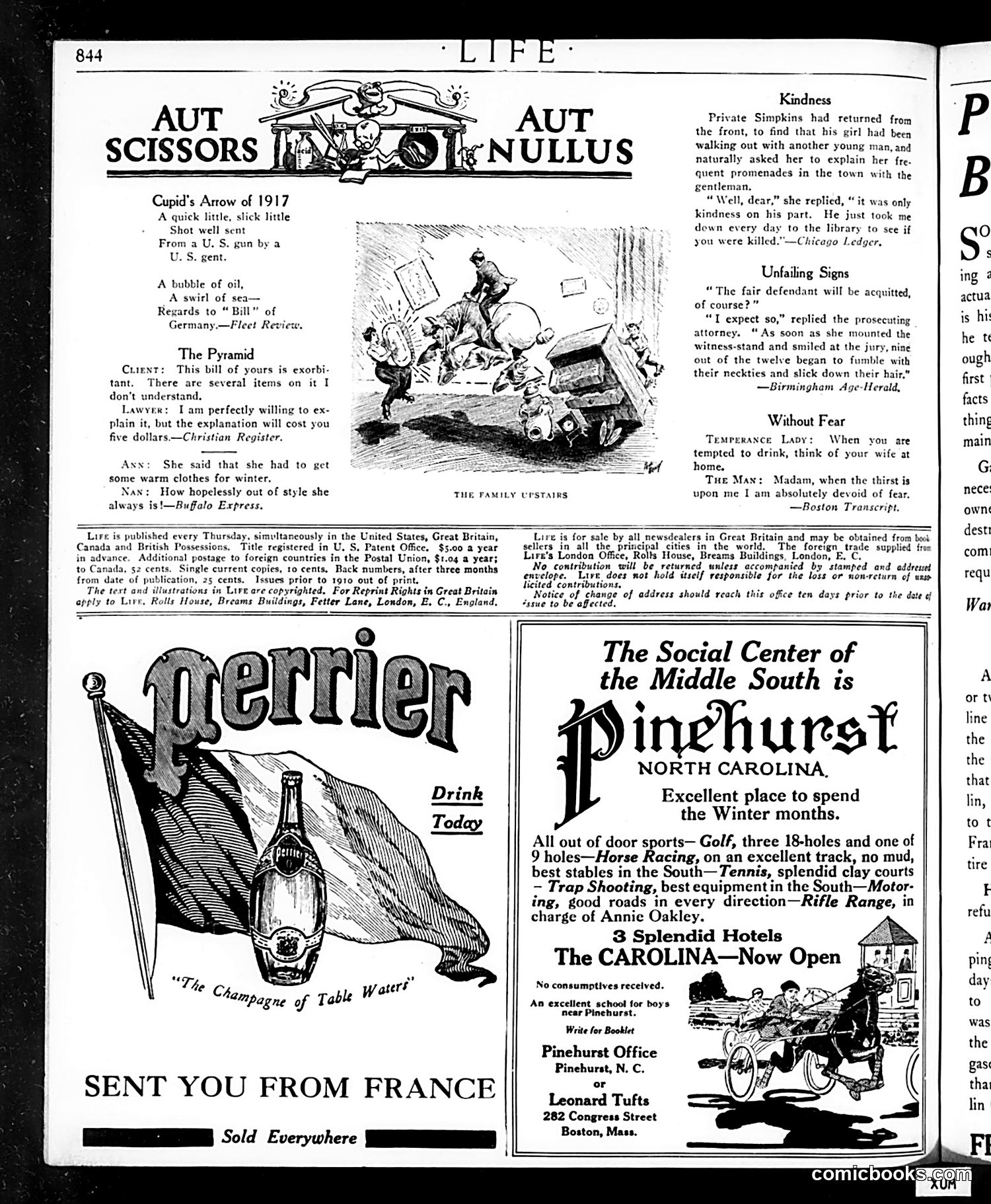
This page contains several brief satirical jokes typical of *Life* magazine's style, plus advertisements. The main cartoon, "Aut Scissors/Aut Nullus" ("Either Scissors or Nothing"), depicts a chaotic domestic scene labeled "The Family Upstairs," referencing noisy upstairs neighbors—a common urban complaint. The numbered jokes mock contemporary social situations: a lawyer's inflated bills, outdated fashion advice, and courtroom dynamics where a woman's charm influences jurors. One joke references WWI ("Cupid's Arrow of 1917"), showing a U.S. soldier's romantic competition with German rivals. The "Temperance" joke plays on a husband's fearlessness when drunk—implying he drinks despite his wife's warnings. These are light, domestic humor pieces common to the era. The page also includes period advertisements for Perrier water and Pinehurst, North Carolina resort facilities (notably mentioning Annie Oakley as rifle range director), reflecting 1917 leisure culture and consumer advertising.
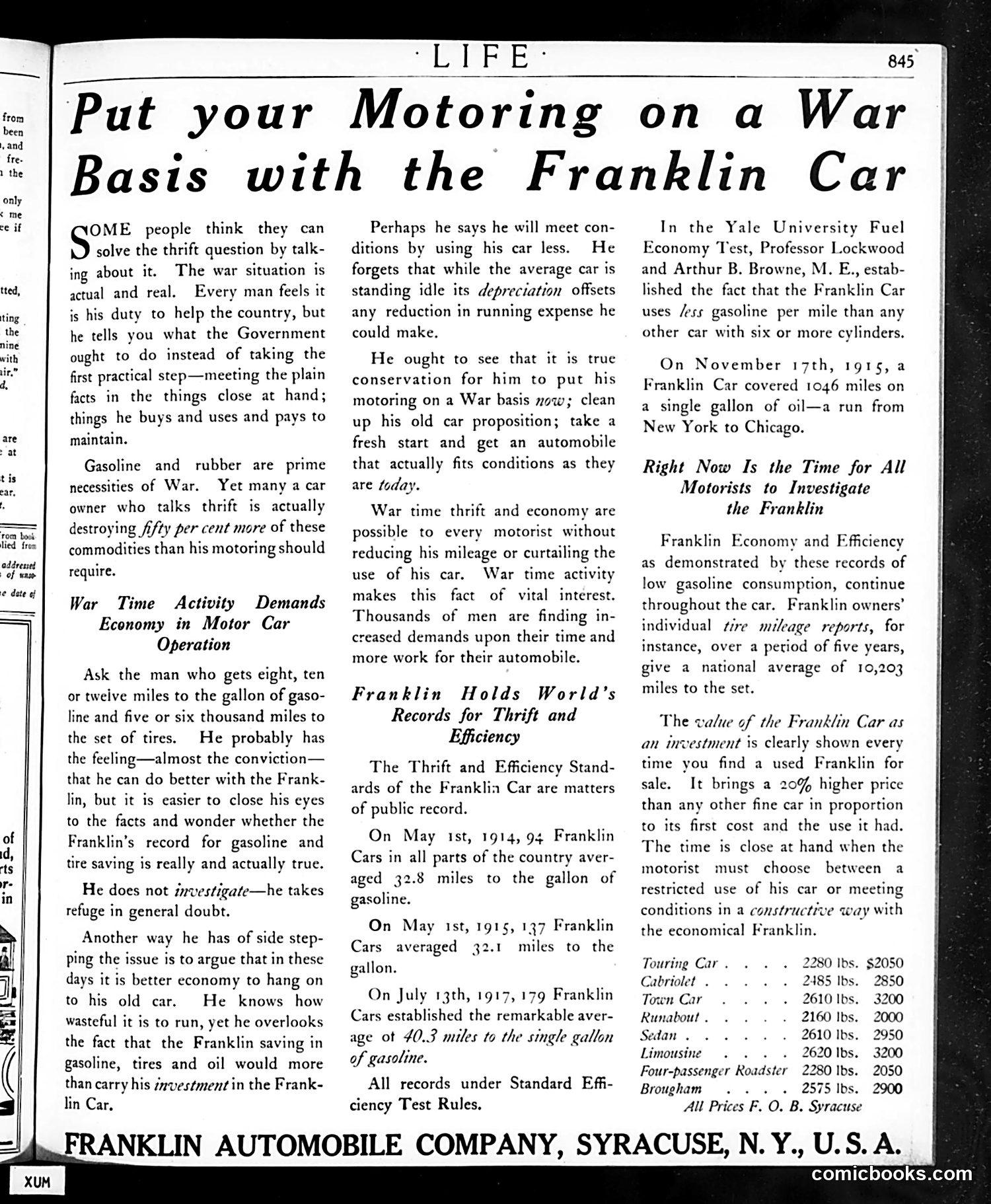
This is primarily a **full-page advertisement**, not satire. It appears in *Life* magazine during World War I (references to 1914-1917 tests and "War basis" motoring suggest circa 1918). The ad argues that patriotic car owners should buy Franklin automobiles as an act of wartime conservation. It addresses common objections—people say they'll drive less, keep old cars, or doubt the Franklin's efficiency claims—then counters each with data. The pitch: Franklin cars use significantly less gasoline and tire rubber than competitors (40.3 miles per gallon in 1917 tests), so buying one is actually *patriotic economy* during wartime fuel/rubber shortages. The car also holds its resale value well (20% premium). This reflects WWI-era marketing strategy: framing consumer purchases as dutiful sacrifice rather than indulgence, appealing to Americans' sense of contributing to the war effort through smart purchasing decisions.
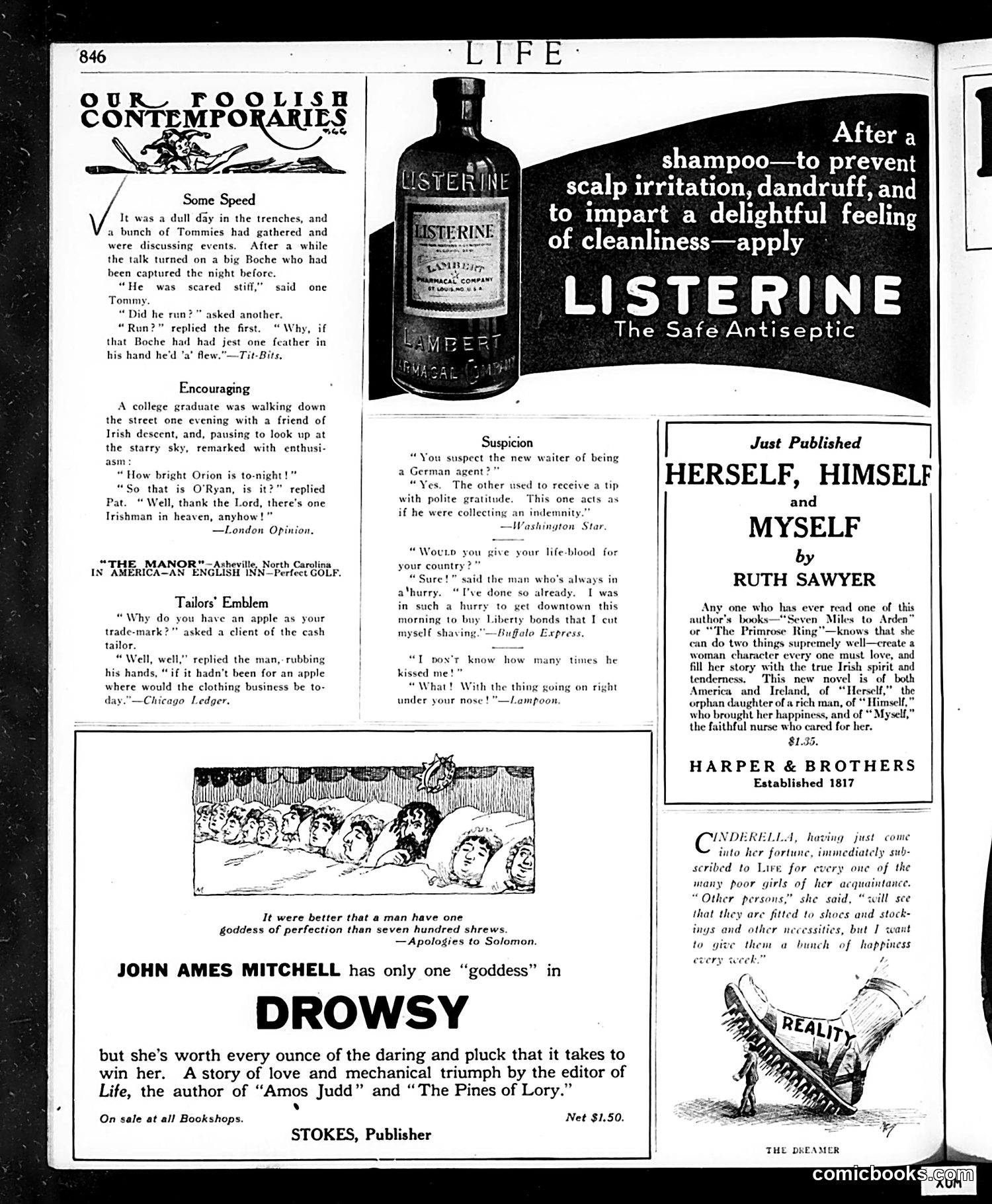
This page from *Life* magazine contains several brief satirical anecdotes and period advertisements. The humor relies on wordplay and gentle social observation rather than political commentary. The cartoons mock everyday situations: British soldiers ("Tommies") during wartime discussing a captured German ("Boche") soldier who fled so fast he'd lose feathers; an Irish immigrant ("Pat O'Ryan") mishearing the constellation Orion; and a tailor's apple trademark deriving from the Biblical apple that ruined Eden's clothing industry. Other jokes target wartime attitudes—a man so eager to buy Liberty bonds he cut himself shaving—and social pretense, including skepticism toward suspicious new waiters. The page is primarily **advertising and book promotion** (Listerine antiseptic, novels by Ruth Sawyer and John Ames Mitchell), with the ads occupying more space than the actual satirical content. The overall tone is lighthearted rather than pointed criticism.
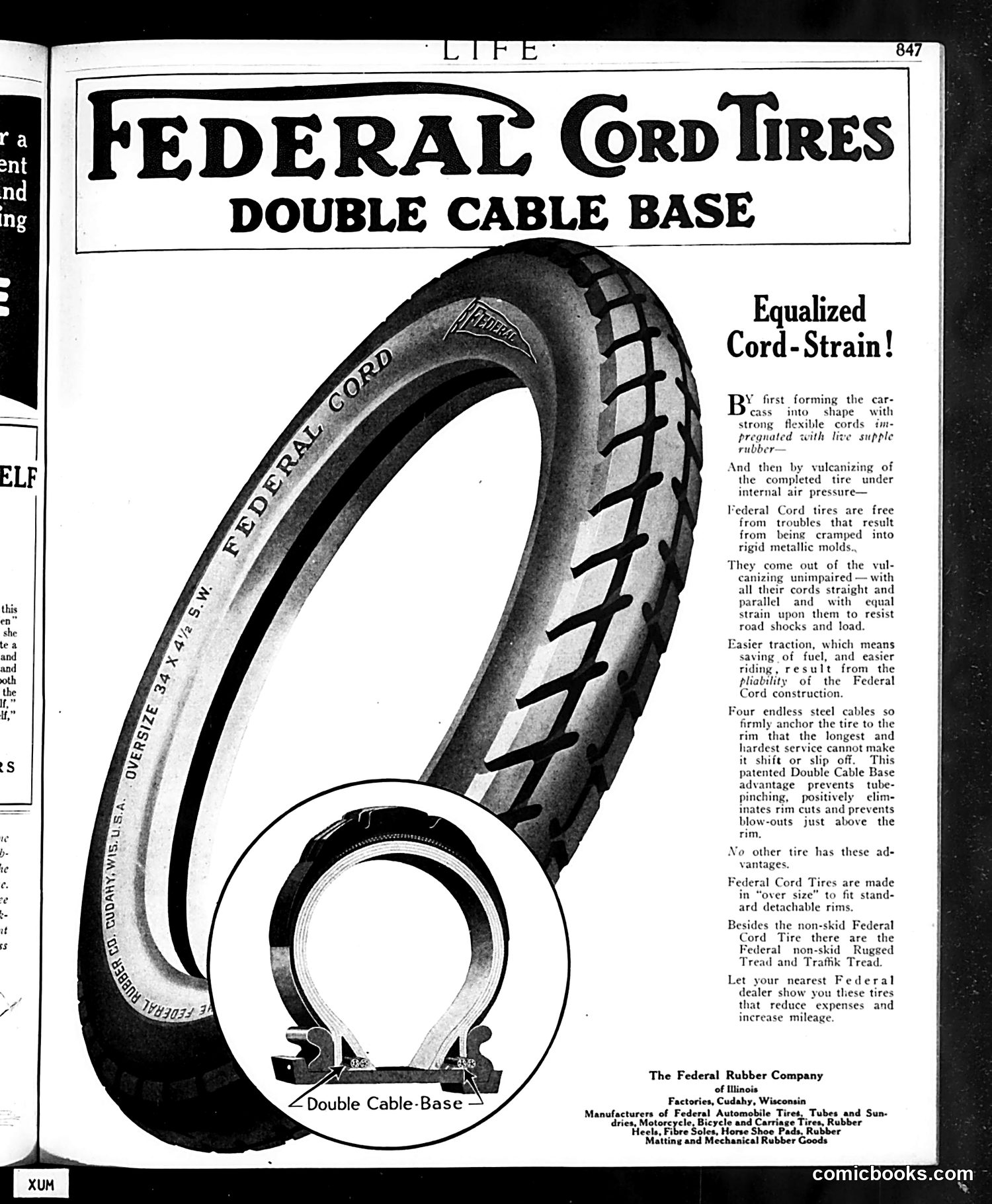
This is **not a cartoon or satire**—it's a straightforward product advertisement for Federal Cord Tires, a manufacturer based in Cudahy, Wisconsin. The page features a large photograph of a tire cross-section displaying the "Double Cable Base" construction. The accompanying text describes technical features: the tire uses flexible cords impregnated with rubber, is vulcanized under air pressure, and features four steel cables anchoring it to the rim to prevent slipping and blowouts. The marketing emphasizes practical benefits for early 20th-century motorists: improved traction, fuel savings, easier riding, and durability. The ad notes Federal made various tire types (non-skid, rugged tread, traffic tread) and other rubber products. This represents typical automobile industry advertising from Life magazine's early period, when tire technology was actively marketed as a competitive advantage.
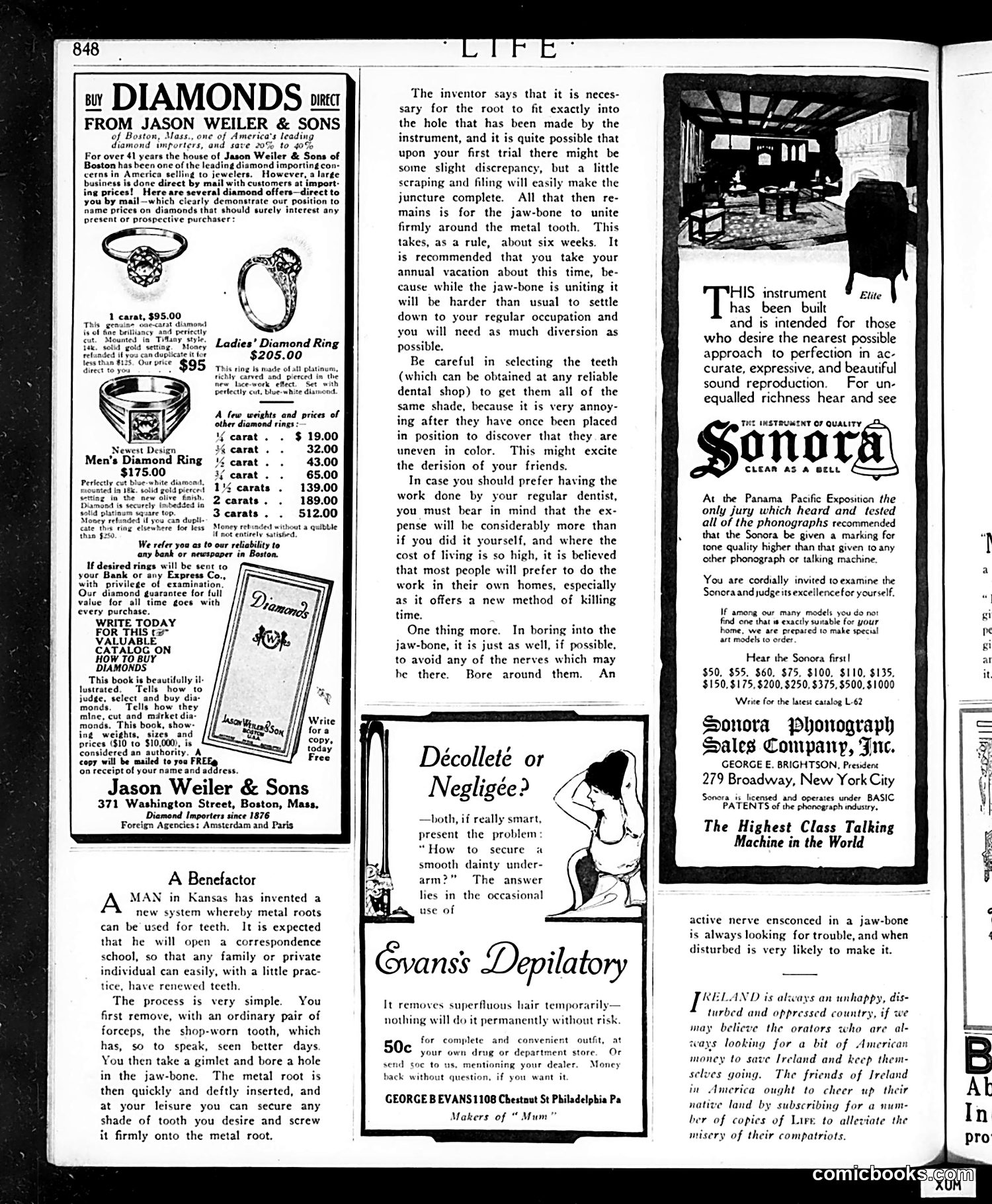
This page is primarily **advertisements** for diamonds and dental products, with satirical commentary embedded in the text. The main satire appears in "A Benefactor" section: it mockingly describes a Kansas inventor's system for DIY metal tooth implants. The humor is **deadpan absurdist satire**—Life presents this dangerous procedure as practical advice, complete with instructions to "bore a hole in the jaw-bone" using a gimlet, avoid hitting nerves, and take a six-week vacation for healing. The satire targets **early-1900s American entrepreneurialism and mail-order instruction schemes**—the idea that any complex procedure could be learned at home through correspondence courses. It's mocking both the inventor's dubious claims and public gullibility toward such schemes. The final aside about "Decolleté or Negligée" appears unrelated, likely transitioning to another article. The diamond ads represent standard period advertising; the satire lies in juxtaposition with the obviously dangerous tooth-implant scheme.
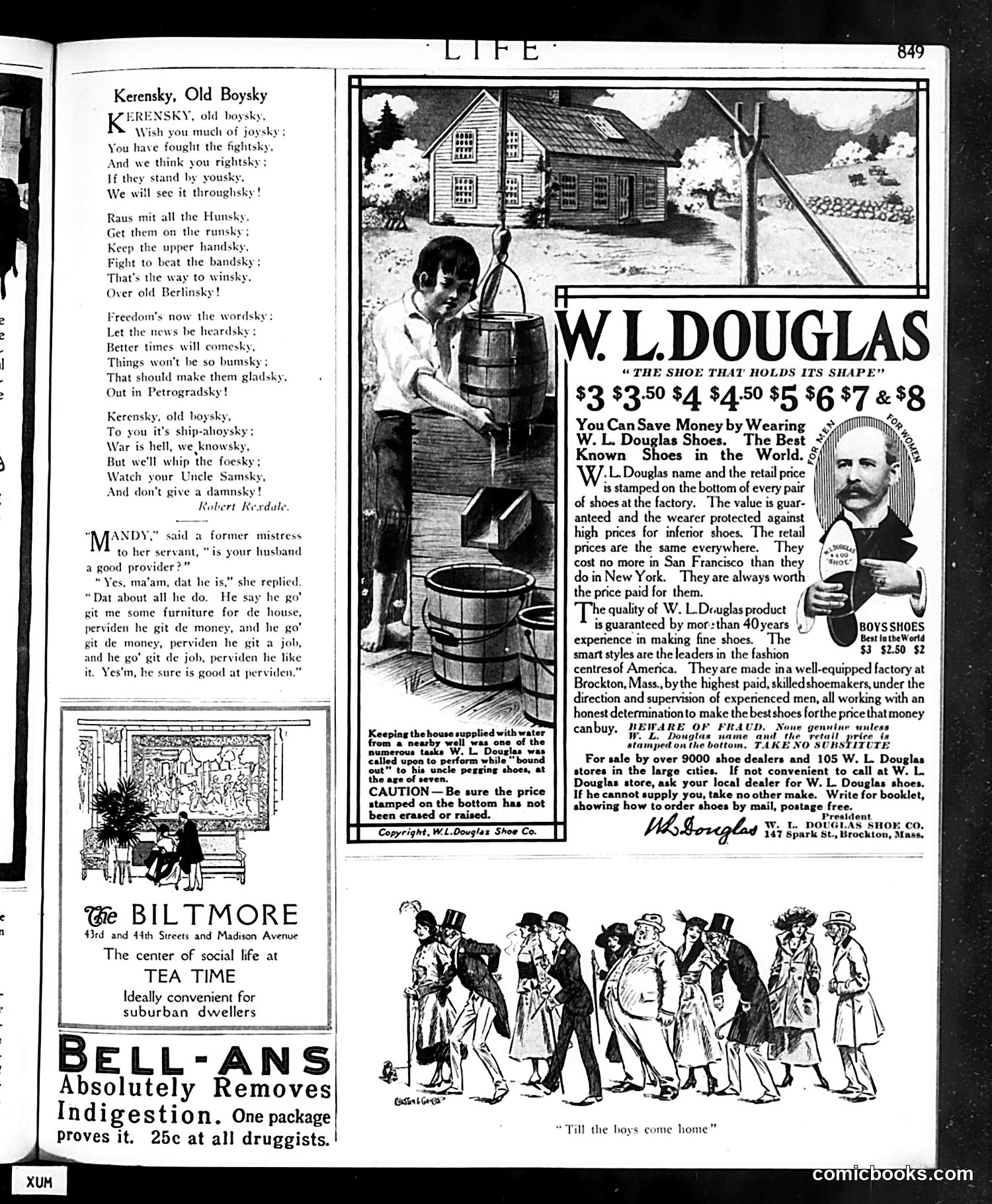
This page contains **political commentary on World War I** through a poem titled "Kerensky, Old Boysky," written by Robert Rexdale. The poem addresses **Alexander Kerensky**, the Russian Prime Minister (1917), encouraging him to maintain Russia's commitment to fighting Germany in WWI. The satirical language—adding "-sky" suffixes to English words—mocks Russian speech patterns while earnestly rallying support for the war effort. The poem's tone is urgent and patriotic, urging Kerensky to "get them on the run" against "the Hunsky" (Germans) and assuring him of American support ("Watch your Uncle Sams"). Below this is a brief humorous anecdote about a domestic servant whose husband is perpetually promising future provisions—a lighthearted social commentary unrelated to the war. The remainder is **advertising**: W.L. Douglas shoes, the Biltmore hotel, and Bell-Ans indigestion remedy. The illustration at bottom shows civilians, captioned "Till the boys come home"—referencing soldiers overseas during WWI.
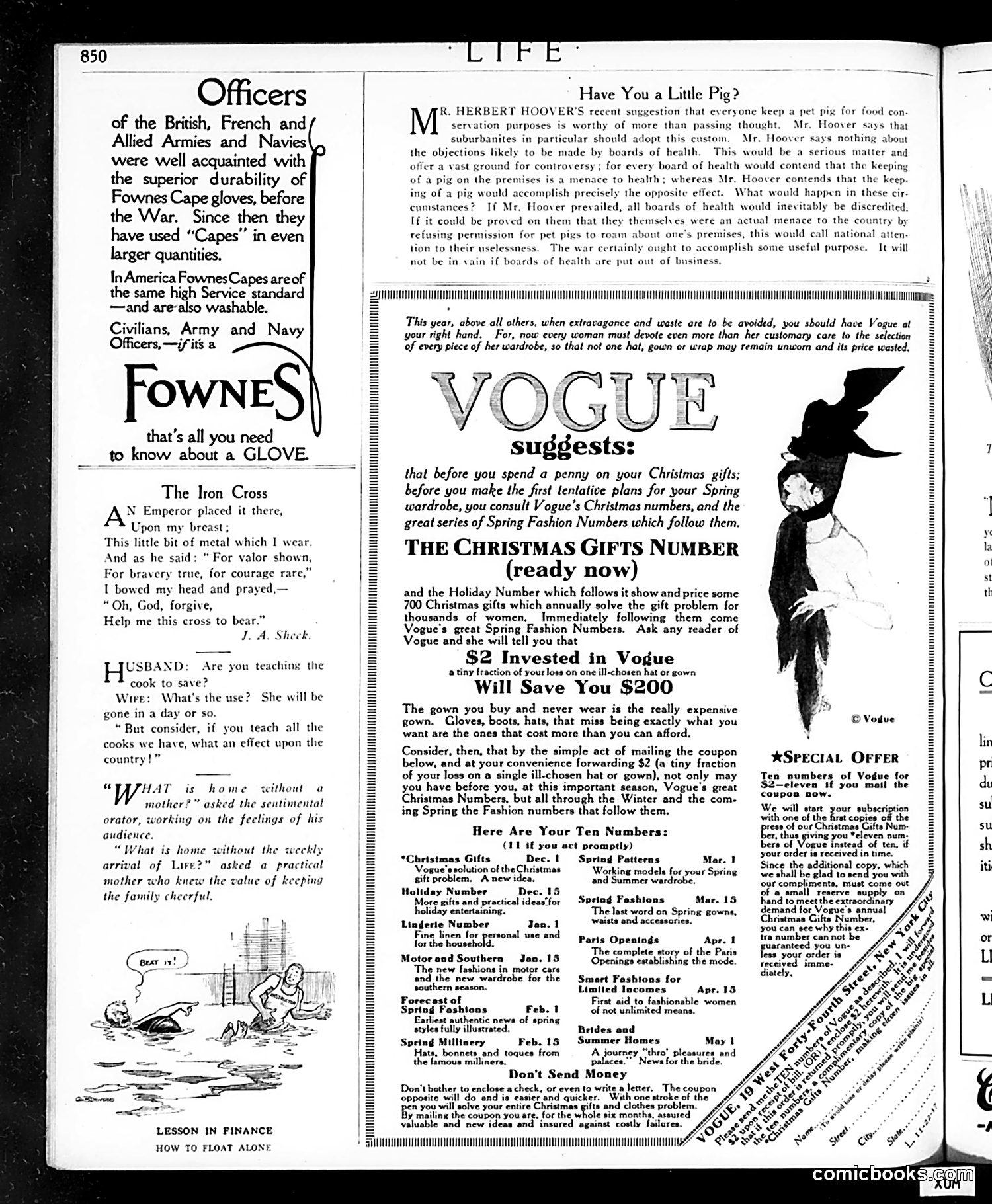
This page primarily contains **advertisements and fashion/lifestyle advice** rather than political satire. The main elements are: **"Have You a Little Pig?" article**: A satirical commentary on Herbert Hoover's WWI-era food conservation suggestion that civilians keep pet pigs. The piece mocks the tension between Hoover's proposal and public health boards' opposition—arguing that if Hoover were right, health boards would be discredited, and "it will not be in vain if boards of health are put out of business." This is **satirical critique** of government contradiction and waste during wartime. **Other content**: - Fownes glove advertisement - Poem about "The Iron Cross" - A domestic humor exchange about teaching cooks to economize - Vogue magazine advertisement promoting Christmas gift guides The page reflects **WWI-era concerns** (conservation, food rationing) and period assumptions about women's domestic roles. The Hoover reference anchors this to early 1900s wartime America.
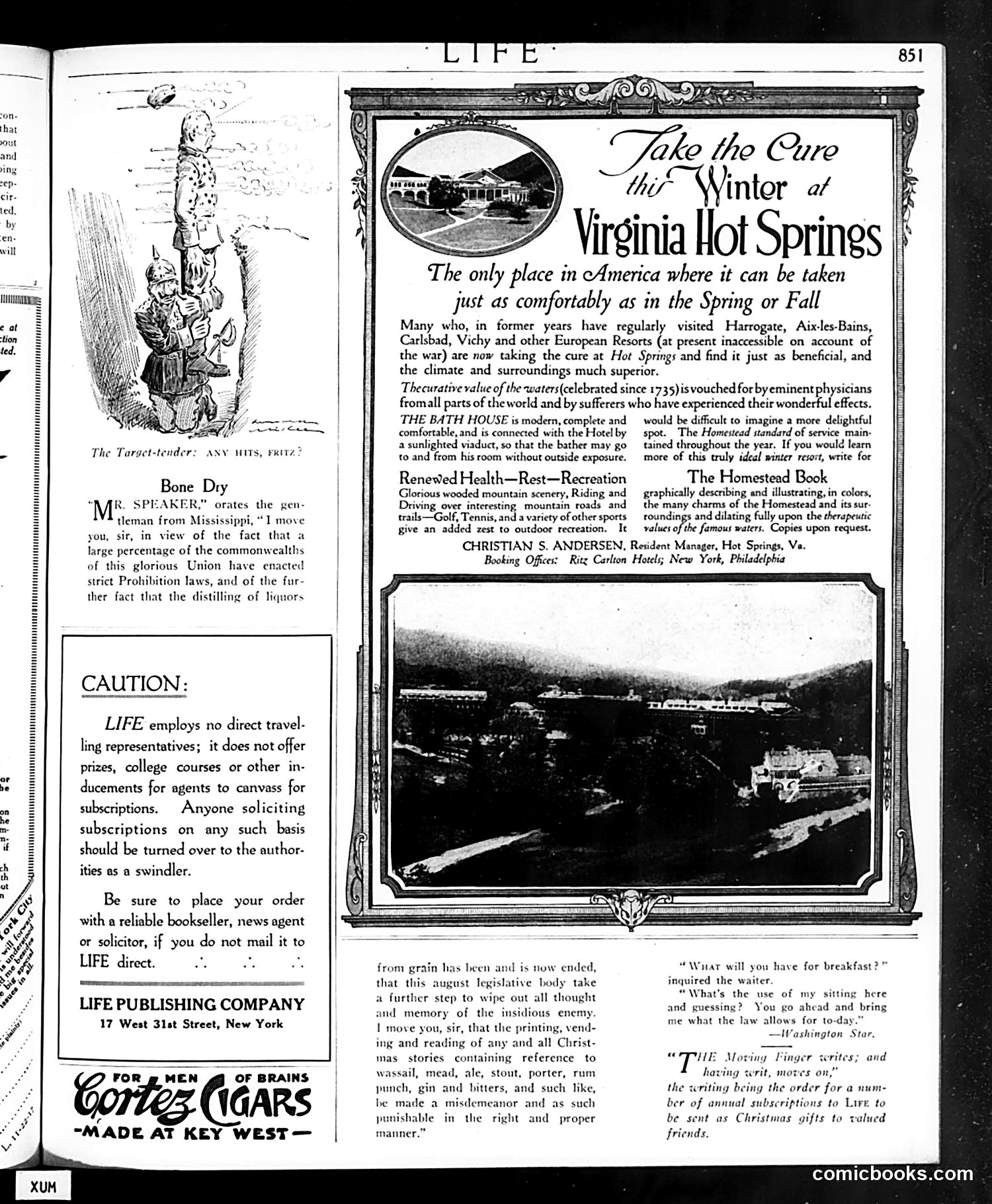
This cartoon satirizes Prohibition-era excess. A congressman proposes banning not just alcohol production, but the *reading* of Christmas stories mentioning alcoholic beverages—treating references to "wassail, mead, ale, stout, porter, rum punch" as criminal offenses. The joke's target is the absurdity of Prohibition zealotry taken to its logical extreme. By suggesting legislators criminalize even *literary mentions* of drinks, Life mocks how Prohibitionists sought to erase alcohol from American culture entirely, not merely regulate its sale. The cartoon's title, "Bone Dry," uses period slang for strict Prohibition. The final exchange—a waiter asking what breakfast the man wants, the man responding "bring me what the law allows"—emphasizes how Prohibition restricted daily life to near-nothing, leaving citizens with no actual choices under such extreme legislation. This reflects genuine 1920s debate: Prohibition was enacted in 1920, and critics argued its supporters wanted sweeping cultural censorship.
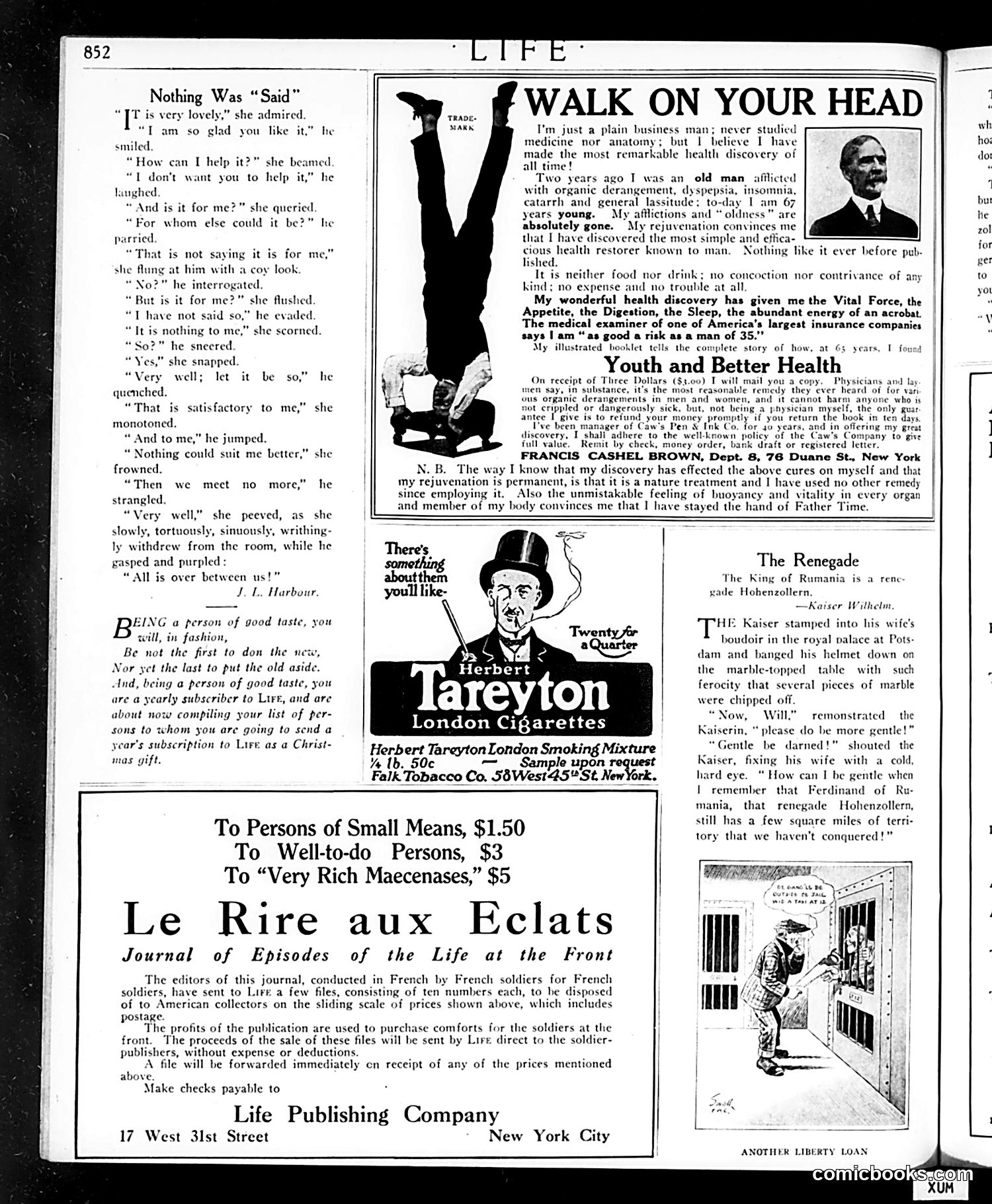
This Life magazine page contains several satirical pieces: **"Nothing Was Said"** (top left): A humorous poem by J.L. Harbour depicting a couple's conversation where neither directly states their feelings, instead using evasive language and contradictions. The satire mocks indirect communication and emotional avoidance in relationships. **"Walk on Your Head"** (center): A patent medicine advertisement featuring Francis Cashel Brown claiming his discovery rejuvenated him from age 67 to appearing 35. This satirizes the era's widespread quack health remedies and fraudulent medical claims that promised miraculous cures without explanation. **"The Renegade"** (right): A brief satirical piece about the German Kaiser (Wilhelm II) losing his temper at his wife in their palace, sardonically attributed to "Kaiser Wilhelm" as the source. It mocks the Kaiser's volatile temperament and authoritarian behavior. The page exemplifies Life's satirical approach to contemporary social absurdities, relationship dynamics, medical fraud, and political figures of the period.
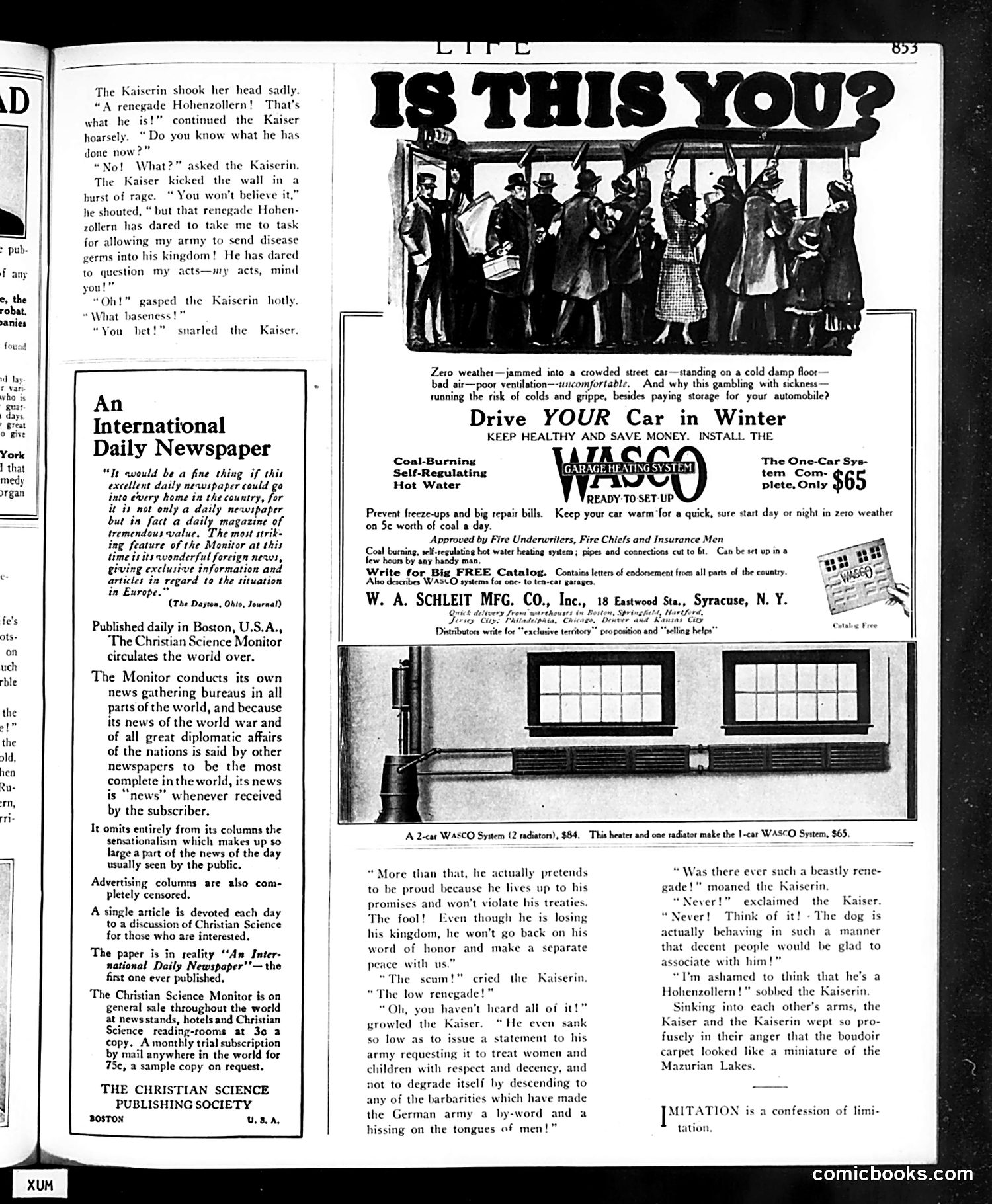
This page contains **satirical dialogue mocking German leadership during World War I**. The cartoon depicts the Kaiser (German Emperor Wilhelm II) angrily confronting the Kaiserin (his wife) about a "renegade Hohenzollern"—likely referring to a German official or relative who has criticized the Kaiser's conduct of war, specifically for allowing his army to spread disease into enemy territory. The satire's point: The Kaiser is outraged not that spreading disease is immoral, but that someone dares *question his authority* or suggest he violates treaties and his word. The Kaiserin's shocked responses ("What baseness!") mock how the German court prioritizes obedience and honor-of-authority over ethical conduct. This reflects American WWI-era propaganda portraying German leadership as hypocritical, militaristic, and indifferent to civilian suffering—justifying U.S. opposition to Germany. The page also contains advertisements and a Christian Science Monitor promotion, typical of Life's mixed content.
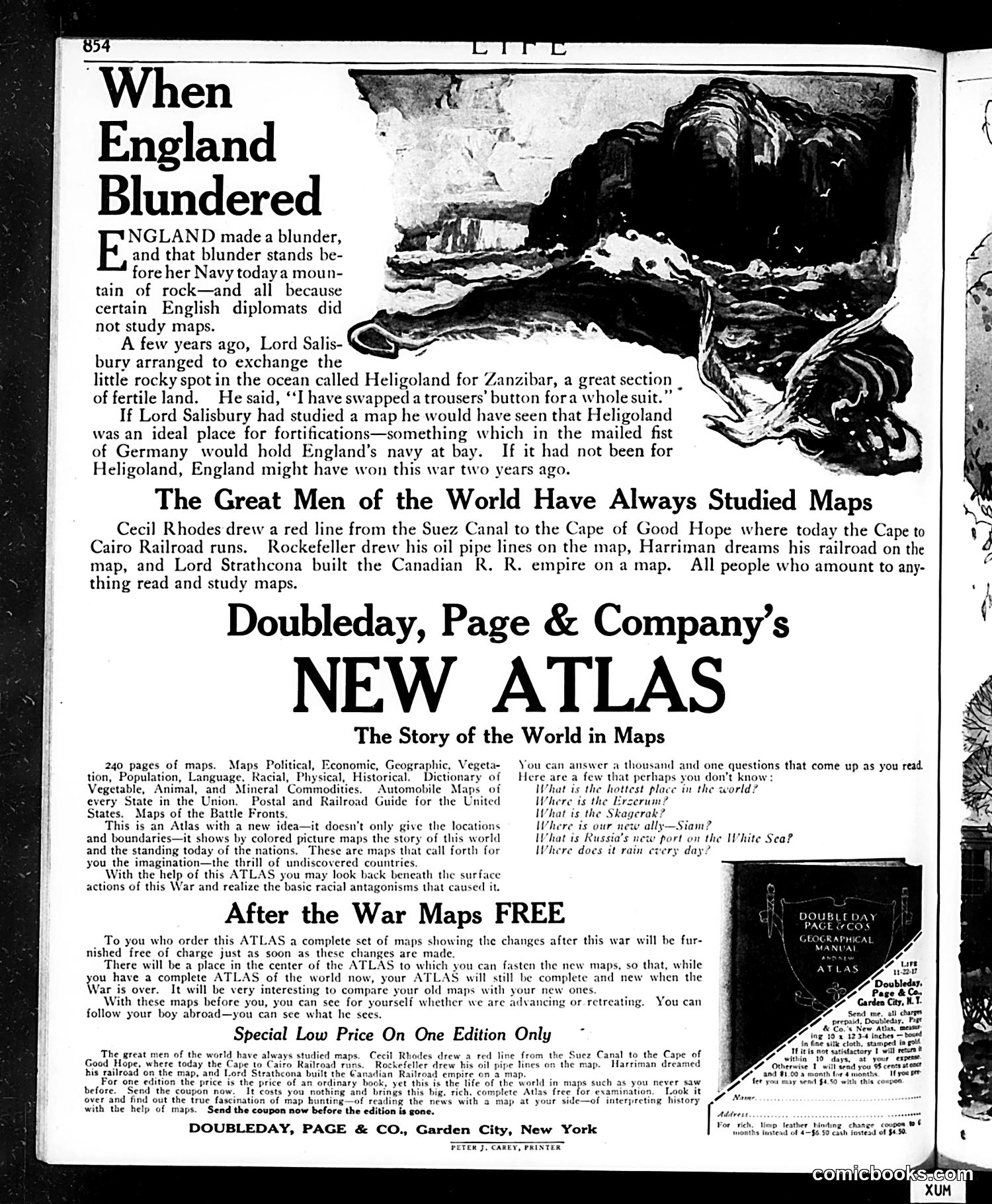
This page is primarily **advertising for Doubleday, Page & Company's New Atlas**, framed as editorial commentary. The satire targets British diplomatic incompetence during World War I. ## The Argument: The opening section criticizes Lord Salisbury's 1890 decision to trade Heligoland (a rocky German island) for Zanzibar (fertile African land). The advertisement claims Salisbury dismissed Heligoland as worthless—"a trousers' button for a whole suit"—because he hadn't studied maps. The piece argues that had he consulted cartography, he would have recognized Heligoland's strategic naval value. The implied claim: Germany later used it to threaten British naval dominance, affecting WWI's outcome. ## The Point: Maps equal power and foresight. Great leaders (Cecil Rhodes, Rockefeller, Harriman, Lord Strathcona) succeed through map study. England's failure demonstrates the consequences of geographical ignorance. ## Context: This reflects genuine WWI-era debate about prewar diplomatic decisions. The piece uses historical criticism to sell atlases by positioning map literacy as essential to national competence and individual success.
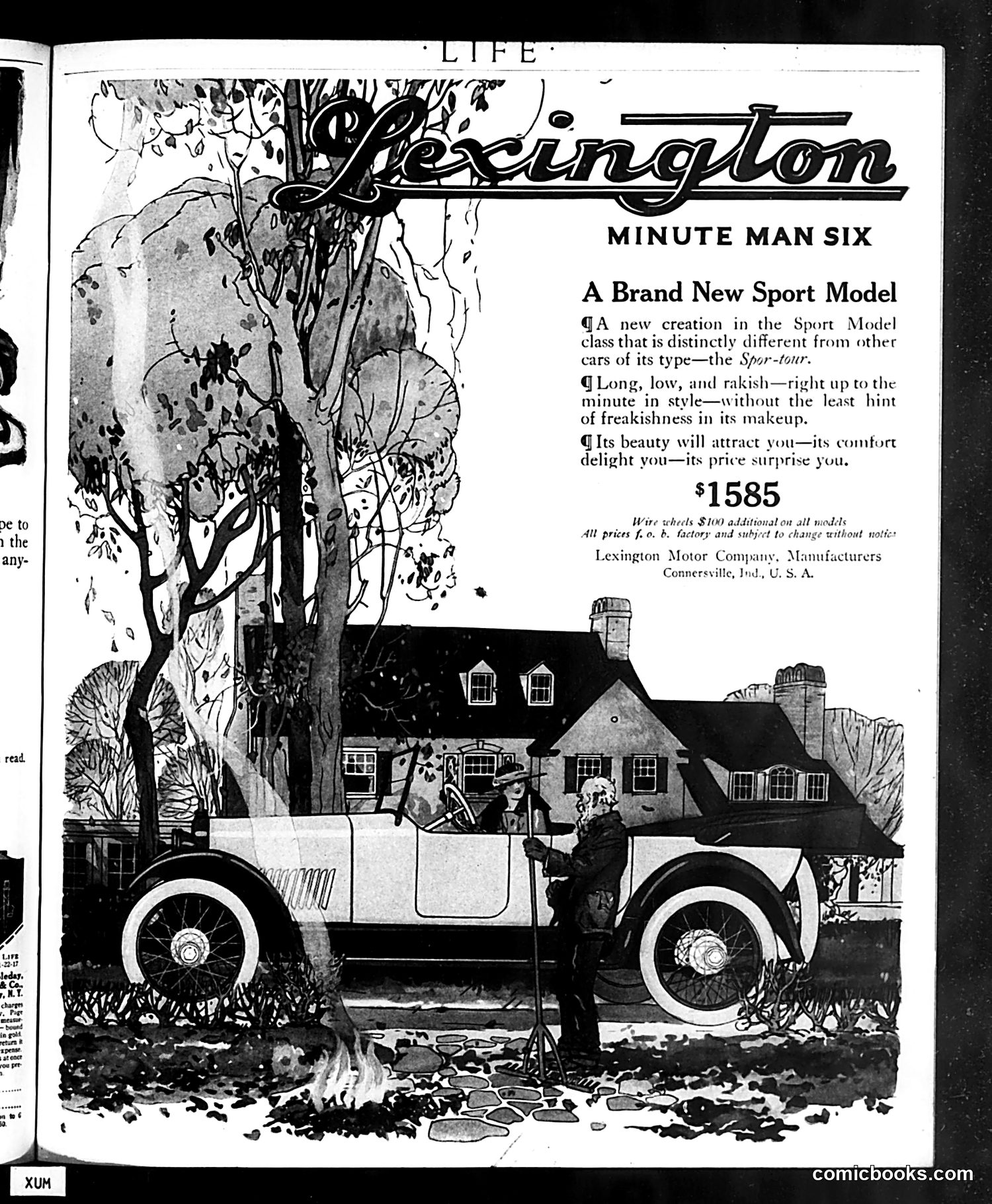
This is a straightforward automobile advertisement, not satire or political commentary. It promotes the Lexington Motor Company's new "Minute Man Six" sport model automobile, priced at $1,585 (plus $100 additional on all models). The ad emphasizes the car's stylish, compact design—described as "long, low, and rakish" while maintaining comfort and practicality. The illustration depicts a well-dressed couple posed with the vehicle in front of a colonial-style house, evoking genteel leisure and domestic comfort. The "Minute Man" branding appears to reference American colonial militia readiness, suggesting the car's reliability and promptness. The manufacturer was based in Connersville, Indiana. This represents typical early-20th-century automobile marketing targeting middle-to-upper-class consumers.
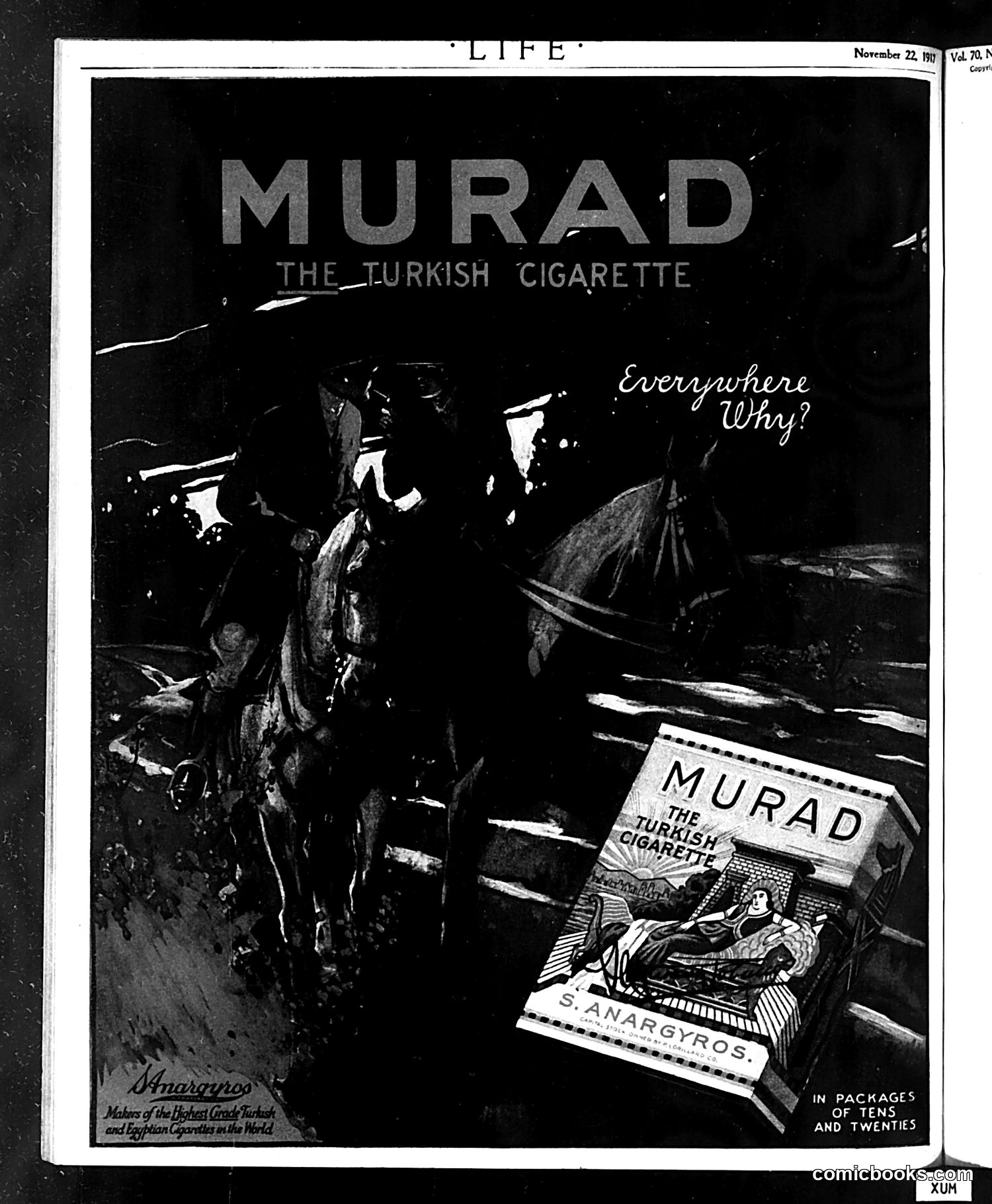
This is a **Murad cigarette advertisement** from Life magazine (November 22, 1917). The ad features a dramatic, orientalist scene with silhouetted figures on horseback against a dark background, evoking exotic Turkish imagery. The tagline "Everywhere Why?" suggests the product's widespread popularity and availability. The small package shown displays "Anagyros," likely the manufacturer. The advertisement emphasizes Murad as "The Turkish Cigarette," capitalizing on early 20th-century fascination with Near Eastern exoticism. The dramatic artwork and romantic imagery of horsemen were typical marketing strategies for premium cigarette brands of the era, appealing to consumers' desires for sophistication and adventure through a product marketed as having Turkish origins or quality.