
Life, 1917-11-22 · page 21 of 44
Life — November 22, 1917 — page 21: what you’re looking at
What you’re looking at
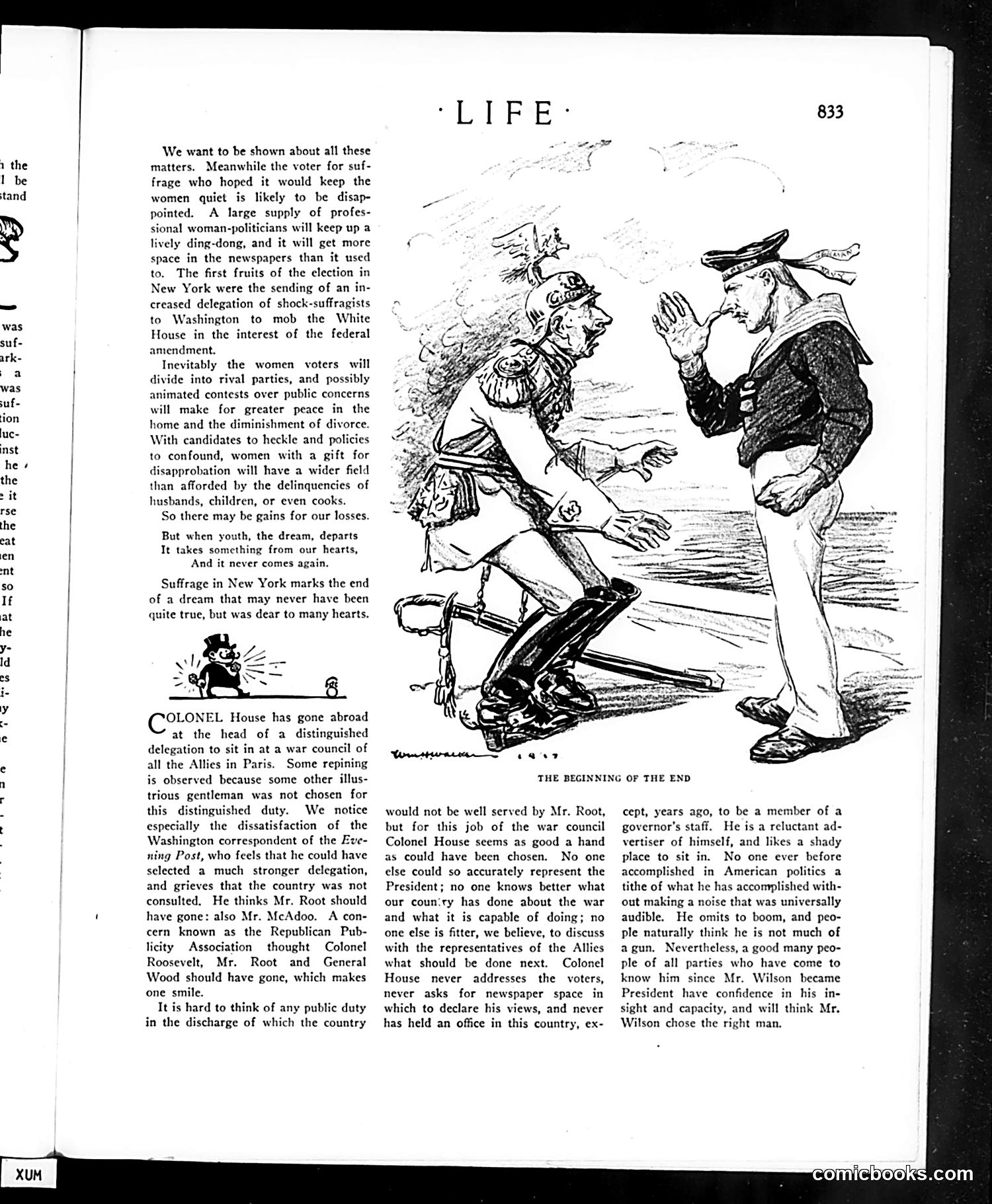
**Main Cartoon ("The Beginning of the End"):** The illustration depicts a military or political figure (left, in ornate uniform) appearing to pedal away on a bicycle-like contraption, while another figure (right, in civilian dress) waves goodbye. The caption suggests this represents the end of women's suffrage activism as a romantic ideal. **Context:** The surrounding text discusses New York's recent adoption of women's suffrage, mourning the loss of the suffragists' "dream" while acknowledging women will now enter practical politics. The tone is ambivalent—predicting women voters will form rival parties and engage in contentious debates, potentially creating household discord but also channeling their energies into public policy rather than domestic grievance. **Secondary Section:** The text praises Colonel House's appointment to the Allied war council in Paris, defending him against Republican critics (including Theodore Roosevelt and General Wood) who believe Root or other figures should have been chosen. The piece argues House's quiet competence and proximity to President Wilson make him ideal.
📄 Transcribed text from this page (OCR, searchable)
Machine-transcribed from the original scan — historical spelling and the odd misread are preserved.
was suf- ark was suf- ion juc- inst the > it rse the en nt so If at We want to be shown about all these matters. Meanwhile the voter for suf- frage who hoped it would keep the women quiet is likely to be disap- pointed. A large supply of profes- onal woman-politicians will keep up a y ding-dong, and it will get more space in the newspapers than it used to. The first fruits of the election in New York were the sending of an in- creased delegation of shock-suffragists to Washington to mob the White House in the interest of the federal amendment. Inevitably the women voters will divide into rival parties, and possibly animated contests over public concerns will make for greater peace in the home and the diminishment of divorce. With candidates to heckle and policies to confound, women with a gift for disapprobation will have a wider field than afforded by the delinquencies of husbands, children, or even cooks. So there may be gains for our losses. But when youth, the dream, departs It takes something from our hearts, ‘And it never comes again. Suffrage in New York marks the end of a dream that may never have been quite true, but was dear to many hearts. OLONEL House has gone abroad at the head of a distinguished delegation to sit in at a war council of all the Allies in Paris. Some repining is observed because some other illus- trious gentleman was not chosen for this distinguished duty. We notice especially the dissatisfaction of the Washington correspondent of the Eve- ning Post, who feels that he could have selected a much stronger delegation, and grieves that the country was not consulted. He thinks Mr. Root should have gone: also Mr. McAdoo. A con- cern known as the Republican Pub- licity Association thought Colonel Roosevelt, Mr. Root and General Wood should have gone, which makes one smile. It is hard to think of any public duty in the discharge of which the country THE BEGINNING OF THE END would not be well served by Mr. Root, but for this job of the war council Colonel House seems as good a hand as could have been chosen. No one else could so accurately represent the President; no one knows better what our county has done about the war and what it is capable of doing; no one else is fitter, we believe, to discuss with the representatives of the Allies what should be done next. Colonel House never addresses the voters, never asks for newspaper space in which to declare his views, and never has held an office in this country, ex- ad cept, years ago, to be a member of a governor's staff. He is a reluctant ad- vertiser of himself, and likes a shady place to sit in. No one ever before accomplished in American politics a tithe of what he has accomplished with- out making a noise that was universally audible. He omits to boom, and peo- ple naturally think he is not much of agun. Nevertheless, a good many peo- ple of all parties who have come to know him since Mr. Wilson became President have confidence in his in- sight and capacity, and will think Mr. Wilson chose the right man.