
Life, 1917-11-22 · page 42 of 44
Life — November 22, 1917 — page 42: what you’re looking at
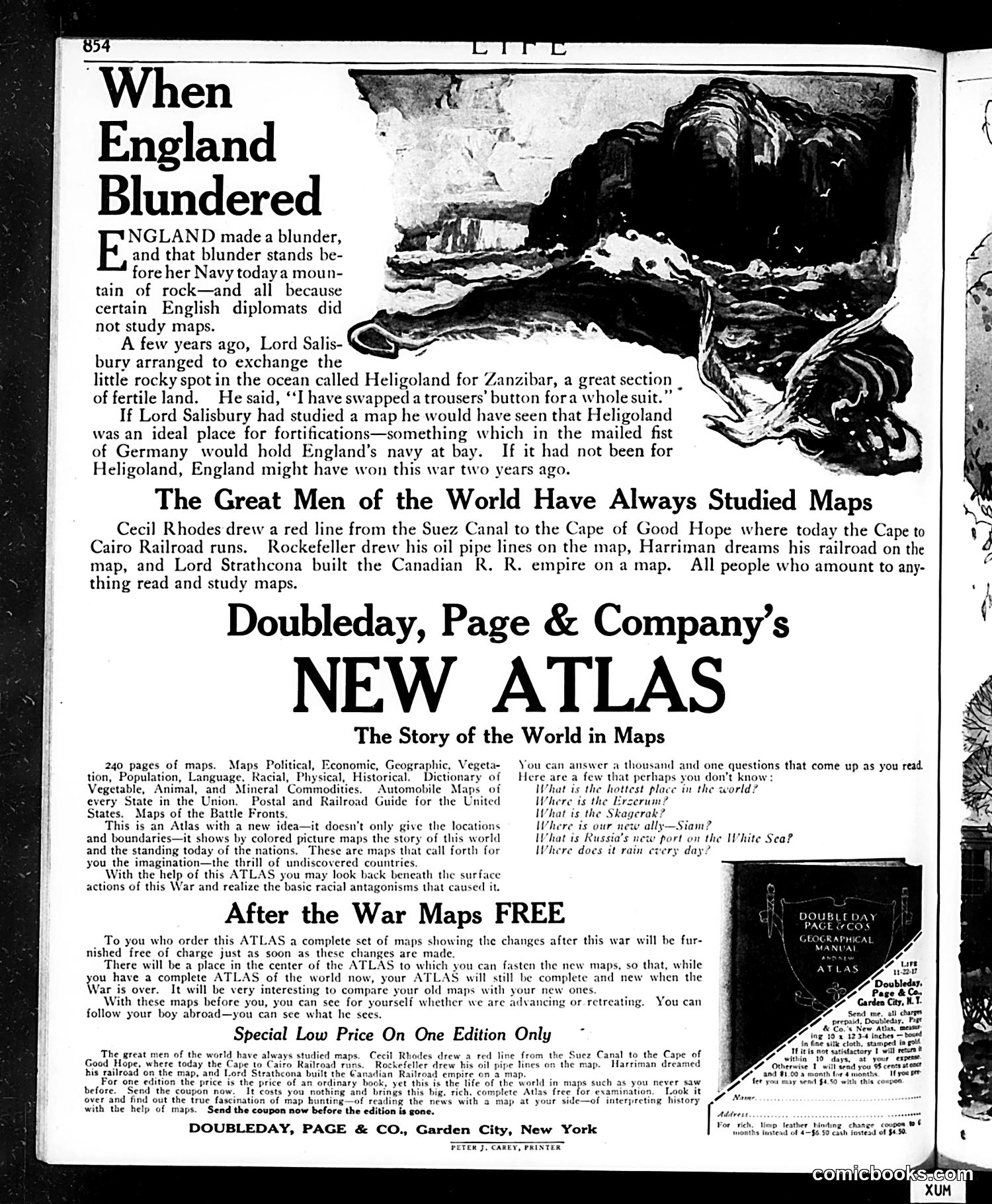
What you’re looking at
This page is primarily **advertising for Doubleday, Page & Company's New Atlas**, framed as editorial commentary. The satire targets British diplomatic incompetence during World War I. ## The Argument: The opening section criticizes Lord Salisbury's 1890 decision to trade Heligoland (a rocky German island) for Zanzibar (fertile African land). The advertisement claims Salisbury dismissed Heligoland as worthless—"a trousers' button for a whole suit"—because he hadn't studied maps. The piece argues that had he consulted cartography, he would have recognized Heligoland's strategic naval value. The implied claim: Germany later used it to threaten British naval dominance, affecting WWI's outcome. ## The Point: Maps equal power and foresight. Great leaders (Cecil Rhodes, Rockefeller, Harriman, Lord Strathcona) succeed through map study. England's failure demonstrates the consequences of geographical ignorance. ## Context: This reflects genuine WWI-era debate about prewar diplomatic decisions. The piece uses historical criticism to sell atlases by positioning map literacy as essential to national competence and individual success.
📄 Transcribed text from this page (OCR, searchable)
Machine-transcribed from the original scan — historical spelling and the odd misread are preserved.
England Blundered NGLAND made a blunder, E and that blunder stands be- fore her Navy todaya moun- tain of rock—and all because certain English diplomats did not study maps. A few years ago, Lord Salis- bury arranged to exchange the little rocky spot in the ocean called Heligoland for Zanzibar, a great section | of fertile land. He said, “I have swapped a trousers’ button fora whole suit.’ If Lord Salisbury had studied a map he would have seen that Heligoland was an ideal place for fortifications—something which in the mailed fist of Germany would hold England’s navy at bay. If it had not been for Heligoland, England might have won this war two years ago. The Great Men of the World Have Always Studied Maps Cecil Rhodes drew a red line from the Suez Canal to the Cape of Good Hope where today the Cape to Cairo Railroad runs. Rockefeller drew his oil pipe lines on the map, Harriman dreams his railroad on the map, and Lord Strathcona built the Canadian R. R. empire ona map. All people who amount to any- thing read and study maps. Doubleday, Page & Company’s NEW ATLAS The Story of the World in Maps answer a thousand and one questions that come up as you read. tion, Population, Language, Racial, Physical, Historical. Dictionary of | Here are a few that perhaps you don’t know: Vegetable, Animal, and Mineral Commodities. Automobile Maps. of What is the hottest place in the world? every State in the Union. Postal and Railroad Guide for the United Where is the rum? 240 pages of maps. Maps Political, Economic, Geographic, Vegeta- You c: What is the Skagerak? Where is our ne: Siam? What is Russia's ni ort on the White Sea? Where does it rain every day? States. Maps of the Battle Fronts. This is an Atlas with a new idea—it doesn’t only give the locations and boundaries—it shows by colored picture maps the story of this world and the standing today of the nations. These are maps that call forth for you the imagination—the thrill of undiscovered countries. With the help of this ATLAS you may look back beneath the surface actions of this War and realize the basic racial antagonisms that caused it, After the War Maps FREE To you who order this ATLAS a complete set of maps showing the changes after this war will be fur- nished free of charge just as soon as these changes are made, There will be a place in the center of the / S to which you can fasten the new maps, so that, while you have a complete ATLAS of the world now, “your ATLAS will still be complete and new when the War is over. It will be very interesting to compare your old maps with your new ones. With these maps before you, you can see for yourself whether we are advancing or retreating. You can follow your boy abroad—you can sce what he sees. Special Low Price On One Edition Only Suez Canal to the Cape of The great men of the world have always studied maps. Cecil Rhodes drew a red line from t Good Hope, where today the ¢ Railroad runs. Rockefeller drew his oil pipe lines map. Harriman dreamed his railroad on the map, and Strathcona built the Canadian Railroad emp P S ff For one edition the price is the price of an + ye is the life of the world in maps s you never saw 0% tery before. Send the coupon now. It costs you nothin i I free for ex Look it 97) over and find out the true fascination of map bu side—of ng history [: vee nay send $4.50 with this compen Aditvest For rich, timp leather Nnding chaser cov instenid of $6 $9 cash lostead of 54.50 with the help of maps. DOUBLEDAY, PAGE & CO., Garden City, New York ‘PETER J, CAREY, PRINTER