
Life, 1917-11-22 · page 20 of 44
Life — November 22, 1917 — page 20: what you’re looking at
What you’re looking at
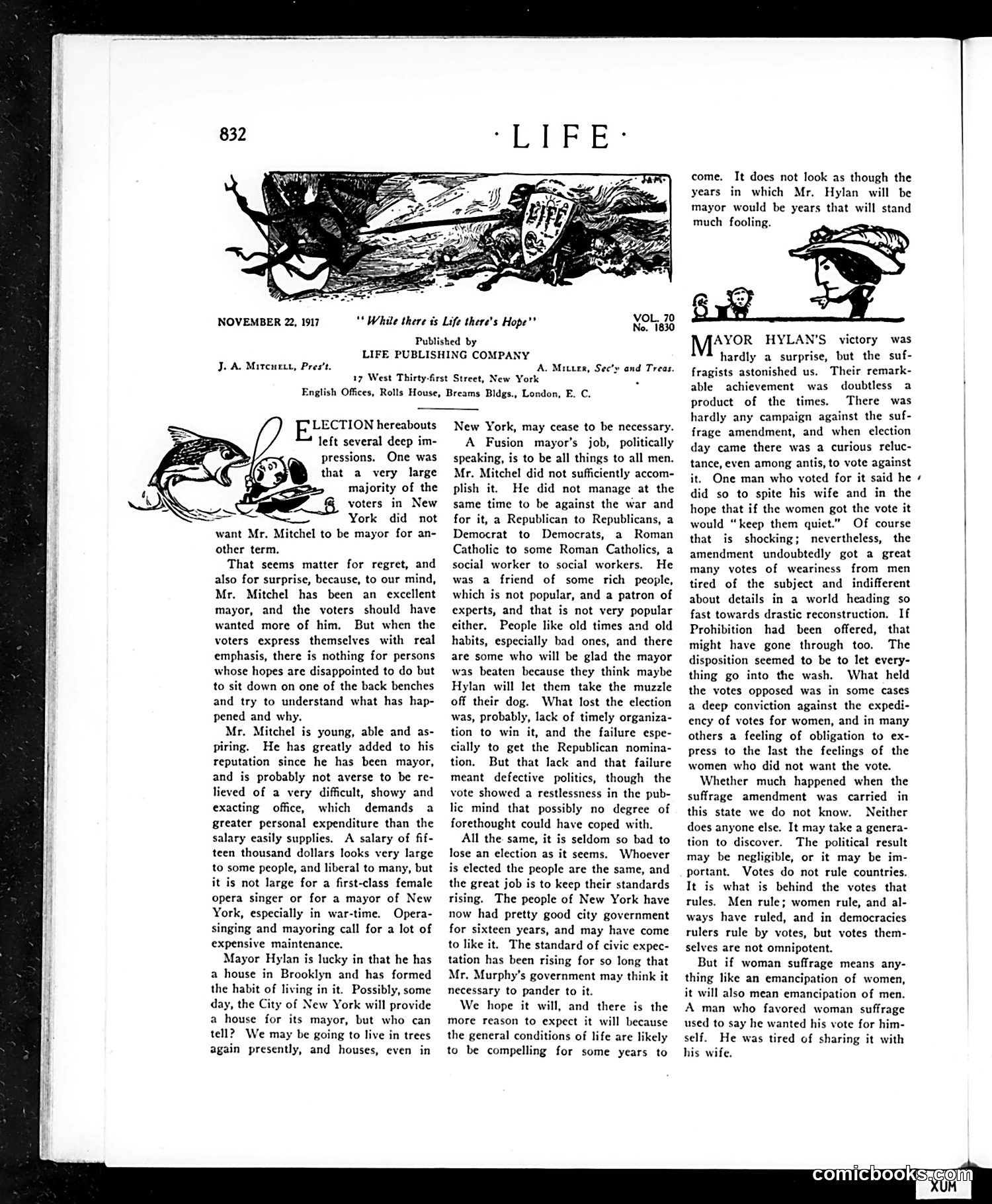
This page discusses New York City's mayoral election, in which incumbent **John Purroy Mitchel** (a Fusion candidate) lost his reelection bid to **John F. Hylan**. The article expresses regret at Mitchel's defeat, arguing he was an excellent, reform-minded mayor hampered by the impossible task of pleasing all factions—Republicans, Democrats, Catholics, social workers, and the wealthy simultaneously. The piece suggests his loss resulted from poor political organization and failure to secure Republican nomination, not policy failures. The text notes that Hylan, the victor, owned a Brooklyn house and could live there affordably—a pointed contrast to Mitchel's expensive mayoral lifestyle. Notably, the article also **praises female suffragists** whose recent voting achievements "astonished" the magazine, calling their accomplishment "remarkable" and "a product of the times." This reflects the 1917 context: New York women had just gained voting rights that year (preceding the 1920 national amendment).
📄 Transcribed text from this page (OCR, searchable)
Machine-transcribed from the original scan — historical spelling and the odd misread are preserved.
NOVEMBER 22, 1917 ‘* While there ts Life there's Hope’’ VOL. 70 No. 1830 Published by LIFE PUBLISHING COMPANY J. A. Mircurit, Pres't. A. Miture, Sec’y and Treas. 17 West Thirty-first Street, New York . English Offices, Rolls House, Breams Bldgs., London, E. C. LECTION hereabouts left several deep im- pressions. One was that a very large = majority of the & voters in New = York did not want Mr. Mitchel to be mayor for an- other term. That seems matter for regret, and also for surprise, because, to our mind, Mr. Mitchel has been an excellent mayor, and the voters should have wanted more of him, But when the voters express themselves with real emphasis, there is nothing for persons whose hopes are disappointed to do but to sit down on one of the back benches and try to understand what has hap- pened and why. Mr. Mitchel is young, able and as- piring. He has greatly added to his reputation since he has been mayor, and is probably not averse to be re- lieved of a very difficult, showy and exacting office, which demands a greater personal expenditure than the salary easily supplies. A salary of fif- teen thousand dollars looks very large to some people, and liberal to many, but it is not large for a first-class female opera singer or for a mayor of New York, especially in war-time. Opera- singing and mayoring call for a lot of expensive maintenance. Mayor Hylan is lucky in that he has a house in Brooklyn and has formed the habit of living in it. Possibly, some day, the City of New York will provide a house for its mayor, but who can tell? We may be going to live in trees again presently, and houses, even in New York, may cease to be necessary. A Fusion mayor's job, politically speaking, is to be all things to all men. Mr. Mitchel did not sufficiently accom- plish it. He did not manage at the same time to be against the war and for it, a Republican to Republicans, a Democrat to Democrats, a Roman Catholic to some Roman Catholics, a social worker to social workers. He was a friend of some rich people, which is not popular, and a patron of experts, and that is not very popular either. People like old times and old habits, especially bad ones, and there are some who will be glad the mayor was beaten because they think maybe Hylan will let them take the muzzle off their dog. What lost the election was, probably, lack of timely organiza- tion to win it, and the failure espe- cially to get the Republican nomina- tion. But that lack and that failure meant defective politics, though the vote showed a restlessness in the pub- lic mind that possibly no degree of forethought could have coped with. All the same, it is seldom so bad to lose an election as it seems. Whoever is elected the people are the same, and the great job is to keep their standards rising. The people of New York have now had pretty good city government for sixteen years, and may have come to like it. The standard of civic expec- tation has been rising for so long that Mr. Murphy’s government may think it necessary to pander to it. We hope it will, and there is the more reason to expect it will because the general conditions of life are likely to be compelling for some years to come. It does not look as though the years in which Mr. Hylan will be mayor would be years that will stand much fooling. AYOR HYLAN’S was victory hardly a surprise, but the suf- fragists astonished us. Their remark- able achievement was doubtless a product of the times. There was hardly any campaign against the suf- frage amendment, and when election day came there was a curious reluc- tance, even among antis, to vote against it. One man who voted for it said he « did so to spite his wife and in the hope that if the women got the vote it would “keep them quiet.” Of course that is shocking; nevertheless, the amendment undoubtedly got a great many votes of weariness from men tired of the subject and indifferent about details in a world heading so fast towards drastic reconstruction. If Prohibition had been offered, that might have gone through too. The disposition seemed to be to let every- thing go into the wash. What held the votes opposed was in some cases a deep conviction against the expedi- ency of votes for women, and in many others a feeling of obligation to ex- press to the last the feelings of the women who did not want the vote. Whether much happened when the suffrage amendment was carried in this state we do not know. Neither does anyone else. It may take a genera- tion to discover. The political result may be negligible, or it may be im- portant, Votes do not rule countries. It is what is behind the votes that rules. Men rule; women rule, and al- ways have ruled, and in democracies rulers rule by votes, but votes them- selves are not omnipotent. But if woman suffrage means any- thing like an emancipation of women, it will also mean emancipation of men. A man who favored woman suffrage used to say he wanted his vote for him- self. He was tired of sharing it with his wife.