
Life, 1917-11-22 · page 24 of 44
Life — November 22, 1917 — page 24: what you’re looking at
What you’re looking at
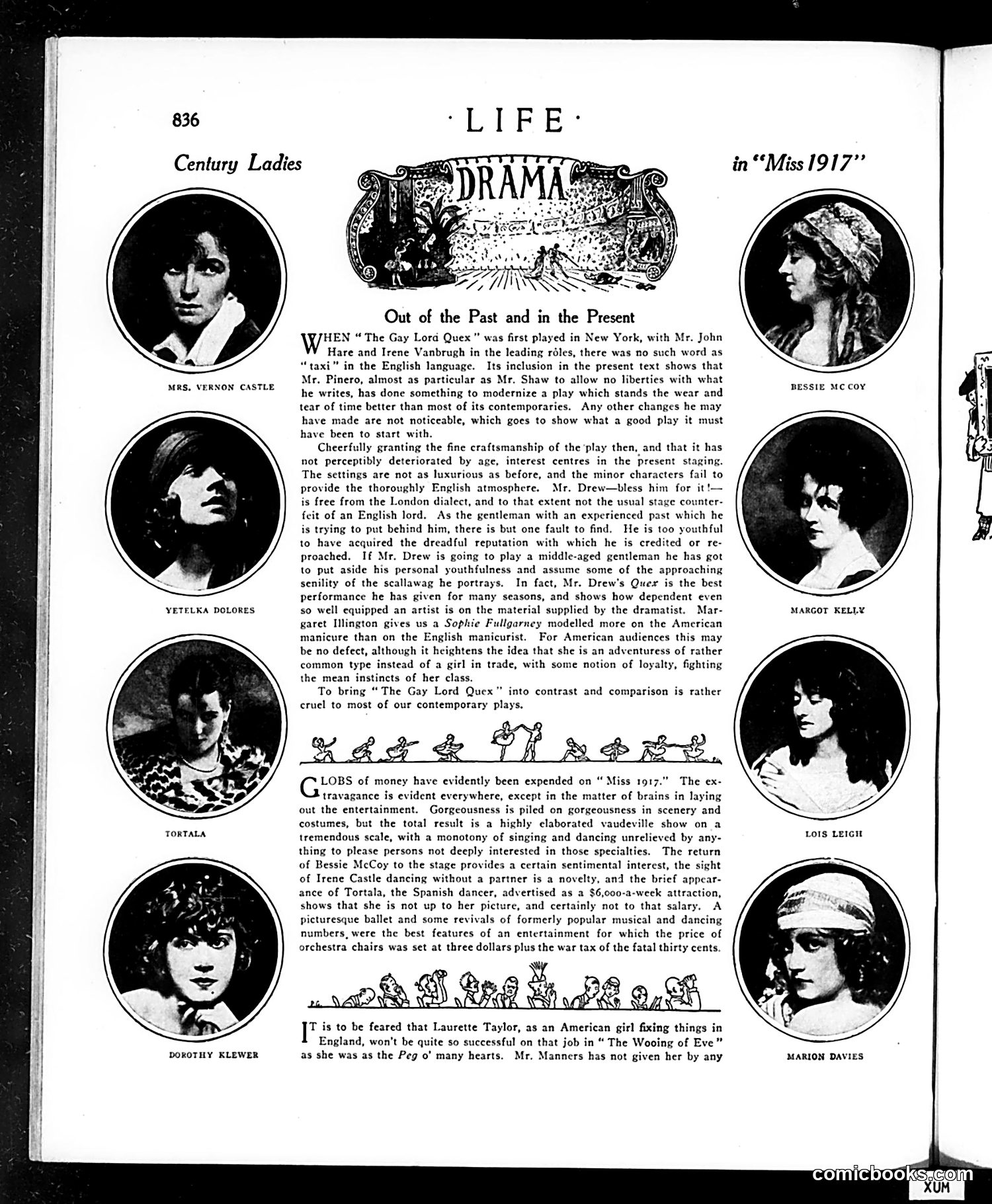
This page reviews three Broadway productions from 1917, featuring photographs of actresses who appeared in them. **"The Gay Lord Quex"**: A revival of an older play (originally featuring John Hare and Irene Vanbrugh). The reviewer praises its craftsmanship and notes Pinero updated it slightly—adding the word "taxi," which didn't exist in the original English language version. The review critiques actor Mr. Drew for appearing too youthful to convincingly play a middle-aged man with a disreputable past, and notes Margaret Illington's performance emphasizes American rather than English character traits. **"Miss 1917"**: A lavish musical revue featuring expensive scenery and costumes but criticized as an overly elaborate vaudeville show lacking intellectual substance. The review highlights Bessie McCoy's return to stage and Irene Castle's novelty of dancing solo, though Spanish dancer Tortala disappoints despite her high salary. **"The Wooing of Eve"**: Brief mention expressing doubt that Laurette Taylor will succeed in this role. The page represents typical theater criticism from the era.
📄 Transcribed text from this page (OCR, searchable)
Machine-transcribed from the original scan — historical spelling and the odd misread are preserved.
836 Century Ladies MRS, VERNON CASTLE YETELKA DOLORES: DOROTHY KLEWER Out of the Past and in the Present HEN “ The Gay Lord Quex " was first played in New York, with Mr. John Hare and Irene Vanbrugh in the leading réles, there was no such word as “taxi” in the English language. Its inclusion in the present text shows that Mr. Pinero, almost as particular as Mr. Shaw to allow no liberties with what he writes, has done something to modernize a play which stands the wear and tear of time better than most of its contemporaries. Any other changes he may have made are not noticeable, which goes to show what a good play it must have been to start with. Cheerfully granting the fine craftsmanship of the ‘play then, and that it has not perceptibly deteriorated by age, interest centres in the present staging. The settings are not as luxurious as before, and the minor characters fail to provide the thoroughly English atmosphere. Mr. Drew—bless him for it!— is free from the London dialect, and to that extent not the usual stage counter- feit of an English lord. As the gentleman with an experienced past which he is trying to put behind him, there is but one fault to find. He is too youthful to have acquired the dreadful reputation with which he is credited or re- proached. If Mr. Drew is going to play a middle-aged gentleman he has got to put aside his personal youthfulness and assume some of the approaching senility of the scallawag he portrays. In fact, Mr. Drew's Quex is the best performance he has given for many seasons, and shows how dependent even so well equipped an artist is on the material supplied by the dramatist. Mar- garet Illington gives us a Sophie Fullgarney modelled more on the American manicure than on the English manicurist. For American audiences this may be no defect, although it heightens the idea that she is an adventuress of rather common type instead of a girl in trade, with some notion of loyalty, fighting the mean instincts of her class. To bring “The Gay Lord Quex” into contrast and comparison is rather cruel to most of our contemporary plays. LOBS of money have evidently been expended on “ Miss 1917." The ex- travagance is evident everywhere, except in the matter of brains in laying out the entertainment. Gorgeousness is piled on gorgeousness in scenery and costumes, but the total result is a highly elaborated vaudeville show on a tremendous scale, with a monotony of singing and dancing unrelieved by any- thing to please persons not deeply interested in those specialties. The return of Bessie McCoy to the stage provides a certain sentimental interest, the sight of Irene Castle dancing without a partner is a novelty, and the brief appear- ance of Tortala, the Spanish dancer, advertised as a $6,co0-a-week attraction, shows that she is not up to her picture, and certainly not to that salary. A picturesque ballet and some revivals of formerly popular musical and dancing numbers, were the best features of an entertainment for which the price of orchestra chairs was set at three dollars plus the war tax of the fatal thirty cents. T is to be feared that Laurette Taylor, as an American girl fixing things in England, won't be quite so successful on that job in “ The Wooing of Eve” as she was as the Peg o' many hearts. Mr. Manners has not given her by any BESSIE MCCOY MARGOT KELLY Lols LEIGH MARION DAVIES