
Life, 1917-11-22 · page 25 of 44
Life — November 22, 1917 — page 25: what you’re looking at
What you’re looking at
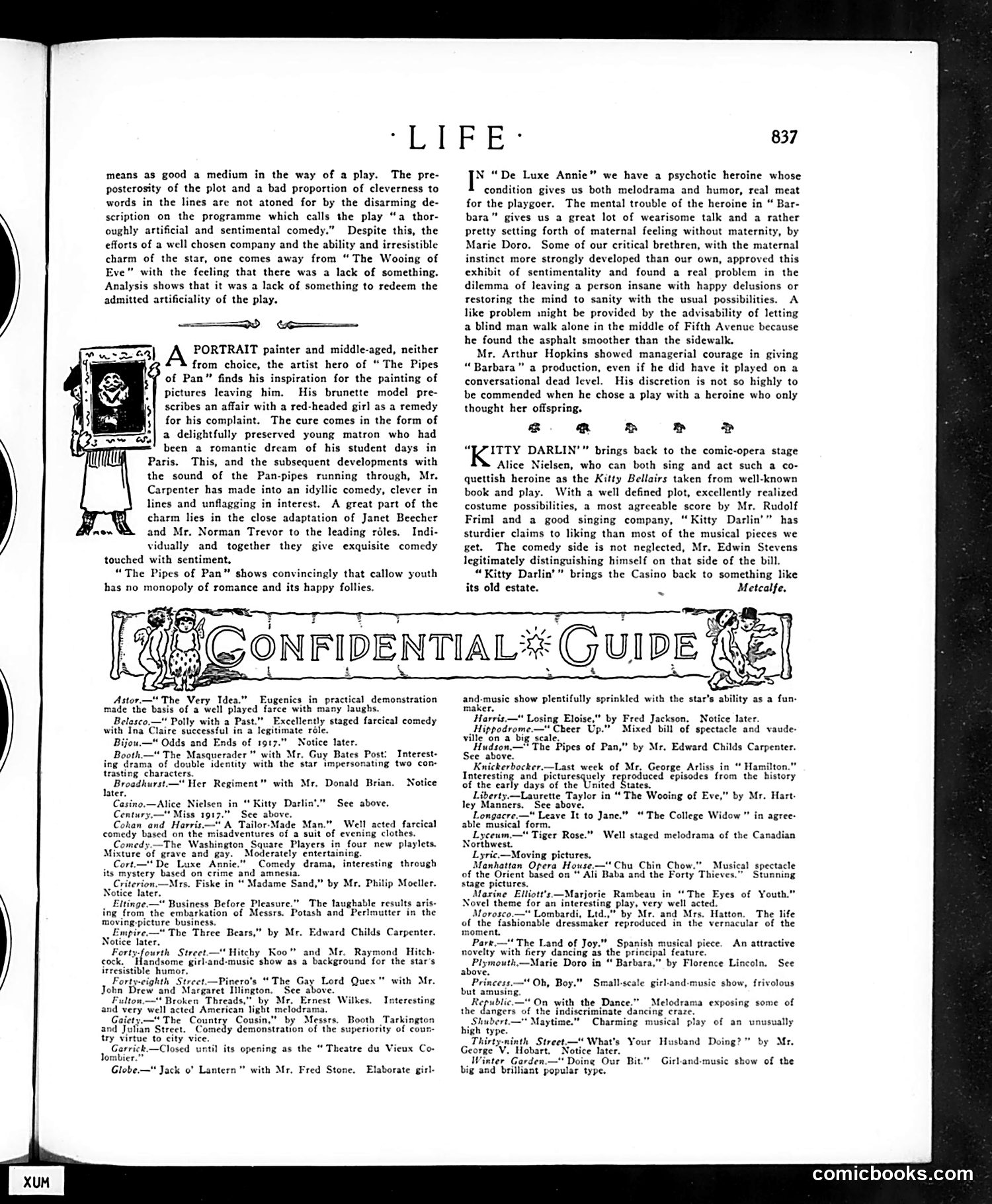
This page contains theater reviews from Life magazine's "Confidential Guide" section—a regular feature critiquing Broadway productions. The left column discusses several plays ("The Wooing of Eve," "The Pipes of Pan") with detailed critical commentary. The right column reviews "De Luxe Annie" and "Kitty Darlin'," praising the latter as a successful comic-opera revival featuring Alice Nielsen. The bulk of the page is the "Confidential Guide"—a comprehensive listing of current New York theater productions with brief, witty evaluations of each show's merits, cast, and plot. These are consumer-oriented theater recommendations, not satire or political commentary. Life magazine used this format to guide readers toward worthwhile entertainment while occasionally mocking poor productions through sarcastic descriptions of their plots or performances.
📄 Transcribed text from this page (OCR, searchable)
Machine-transcribed from the original scan — historical spelling and the odd misread are preserved.
LIFE means as good a medium in the way of a play. The pre- posterosity of the plot and a bad proportion of cleverness to words in the lines are not atoned for by the disarming de- scription on the programme which calls the play “a thor- oughly artificial and sentimental comedy.” Despite this, the efforts of a well chosen company and the ability and irresistible charm of the star, one comes away from “The Wooing of Eve” with the feeling that there was a lack of something. Analysis shows that it was a lack of something to redeem the admitted artificiality of the play. — = + PORTRAIT painter and middle-aged, neither from choice, the artist hero of “ The Pipes of Pan” finds his inspiration for the painting of pictures leaving him. His brunette model pre- scribes an affair with a red-headed girl as a remedy for his complaint. The cure comes in the form of a delightfully preserved young matron who had been a romantic dream of his student days in Paris. This, and the subsequent developments with the sound of the Pan-pipes running through, Mr. Carpenter has made into an idyllic comedy, clever in lines and unflagging in interest. A great part of the charm lies in the close adaptation of Janet Beecher and Mr. Norman Trevor to the leading réles. Indi- vidually and together they give exquisite comedy touched with sentiment, “The Pipes of Pan” shows convincingly that callow youth has no monopoly of romance and its happy follies. Astor.—“ The Very Idea.” Eugenics in practical demonstration made the basis of a well played farce with many laughs. Belasco.—" Polly with a Past." Excellently staged farcical comedy with Ina Claire successful in a legitimate réle. Bijou. Odds and Ends of 1917.” nae later. Booth.—" The Masquerader ” with Mr. Guy Bates Post: Interest- ing drama of double identity with the sige ‘Impersonating two con- trasting characters. | Broadhurst.— Her Regiment” with Mr, Donald Brian. .”" See above. Notice Isen_in "Kitty Darl ."" See above. ‘A Tailor-Made Man.” Well acted farcical comedy based on the misadventures of a suit of evening clothes. Iy.—The Washington Square Players in four new playlets, Mixture of grave and gay. Moderately entertain: Cort.—"De Luxe Annie.” Comedy drama, interesting through its mystery based on crime and amnesia. Criterion, —Mrs. Fiske in “ Madame Sand," by Mr. Philip Moeller. Notice later. Eltinge —" Business Before Pleasure.” The laughable results aris- ing from the embarkation of Messrs, Potash and Perlmutter in the moving-picture business. ‘mpire—" The Three Bears,” by Mr. Edward Childs Carpenter. Notice later. fourth Strect—*" Hitchy Koo” and Mr landsome girland-music show as a background irresistible humor. Forty-cighth Strect-—Pinero’s “ The Gay Lord Quex” John Drew and Margaret Illington. See above. Fulton. Broken Threads,” by Mr. Ernest Wilkes. and very well acted American light melodrama. Gaiety.—" The Country Cousin,” by Messrs, Booth Tarkingtc and Julian Street. Comedy demonstration of the superiority of coun- try virtue to city vice. piGgrrick—Closed until its opening as the “ Theatre du Views Co- lombier.”” Globe. Raymond Hitch: yr the star's with Mr. Interesting “Jack of Lantern” with Mr. Fred Stone, Elaborate girl- 837 I “De Luxe Annie” we have a psychotic heroine whose condition gives us both melodrama and humor, real meat for the playgoer. The mental trouble of the heroine in “ Bar- bara” gives us a great lot of wearisome talk and a rather pretty setting forth of maternal feeling without maternity, by Marie Doro. Some of our critical brethren, with the maternal instinct more strongly developed than our own, approved this exhibit of sentimentality and found a real problem in the dilemma of leaving a person insane with happy delusions or restoring the mind to sanity with the usual possibilities. A like problem inight be provided by the advisability of letting a blind man walk alone in the middle of Fifth Avenue because he found the asphalt smoother than the sidewalk. Mr. Arthur Hopkins showed managerial courage in giving “Barbara” a production, even if he did have it played on a conversational dead level. His discretion is not so highly to be commended when he chose a play with a heroine who only thought her offspring. cs Rm & = > ITTY DARLIN’” brings back to the comic-opera stage Alice Nielsen, who can both sing and act such a co- quettish heroine as the Kitty Bellairs taken from well-known book and play. With a well defined plot, excellently realized costume possibilities, a most agreeable score by Mr. Rudolf Friml and a good singing company, “Kitty Darlin’” has sturdier claims to liking than most of the musical pieces we The comedy side is not neglected, Mr. Edwin Stevens legitimately distinguishing himself on that side of the bill. “Kitty Darlin’” brings the Casino back to something like its old estate. Metcalfe, | and-musie show plentifully sprinkled with the star’s ability as a fun- maker, Harris —" Losing Eloise," by Fred Jackson. Notice later. Hippodrome." Cheer Up.” Mixed bill of spectacle and vaude- ville'on a big scale. Hudson.—" The Pipes of Pan,” by Mr, Edward Childs Carpenter. See above. Knickerbocker.—Last week of Mr, George Arliss in “ Hamilton.” Interesting and ‘picturesquely reproduced episodes from the history of the early days of the United States. Liberty.—Laurette Taylor in “ The Wooing of Eve,” by Mr. Hart- ley Manners, See above. Longacre.—" Leave It to Jane.” able musical form. _Lyceum.—" Tiger Rose.” Northwest. Lyric.—Moving pictures. Manhattan Opera House.—" Chu Chin Chow.” Musical spectacle of the Orient based on" Ali Baba and the Forty Thieves.” Stunning stage pictures. Marine Elliott's—Marjorie Rambeau in “The Eyes of Youth.” Novel theme for an interesting play, very well acted. Morosco.—" Lombardi, Ltd." by Mr. and Mrs, Hatton, The life of the fasbionable dressmaker reproduced in the vernacular of the moment. Park.— The Land of Joy." Spanish musical piece, novelty with fiery dancing as the principal feature. Plymouth —Marie Doro in “Barbara,” by Florence Lincoln. See above. Princess.—"" Oh, Boy.” but amusing. Republic. the dangers Shubert: high type. Thirty-ninth Street-—" What's Your Husband Doing? by Mr. George V. Hobart. Notice later. Winter Garden.—" Doing Our Bit.” big and brilliant popular type. “The College Widow ” in agree: Well staged melodrama of the Canadian An attractive Small-scale girland-music show, frivolous “On with the Dance.” Melodrama exposing some of f the indiscriminate dancing craze. Maytime.” Charming musical play of an unusually Girl-and-music show of the comicbooks.com