
Life, 1917-11-22 · page 33 of 44
Life — November 22, 1917 — page 33: what you’re looking at
What you’re looking at
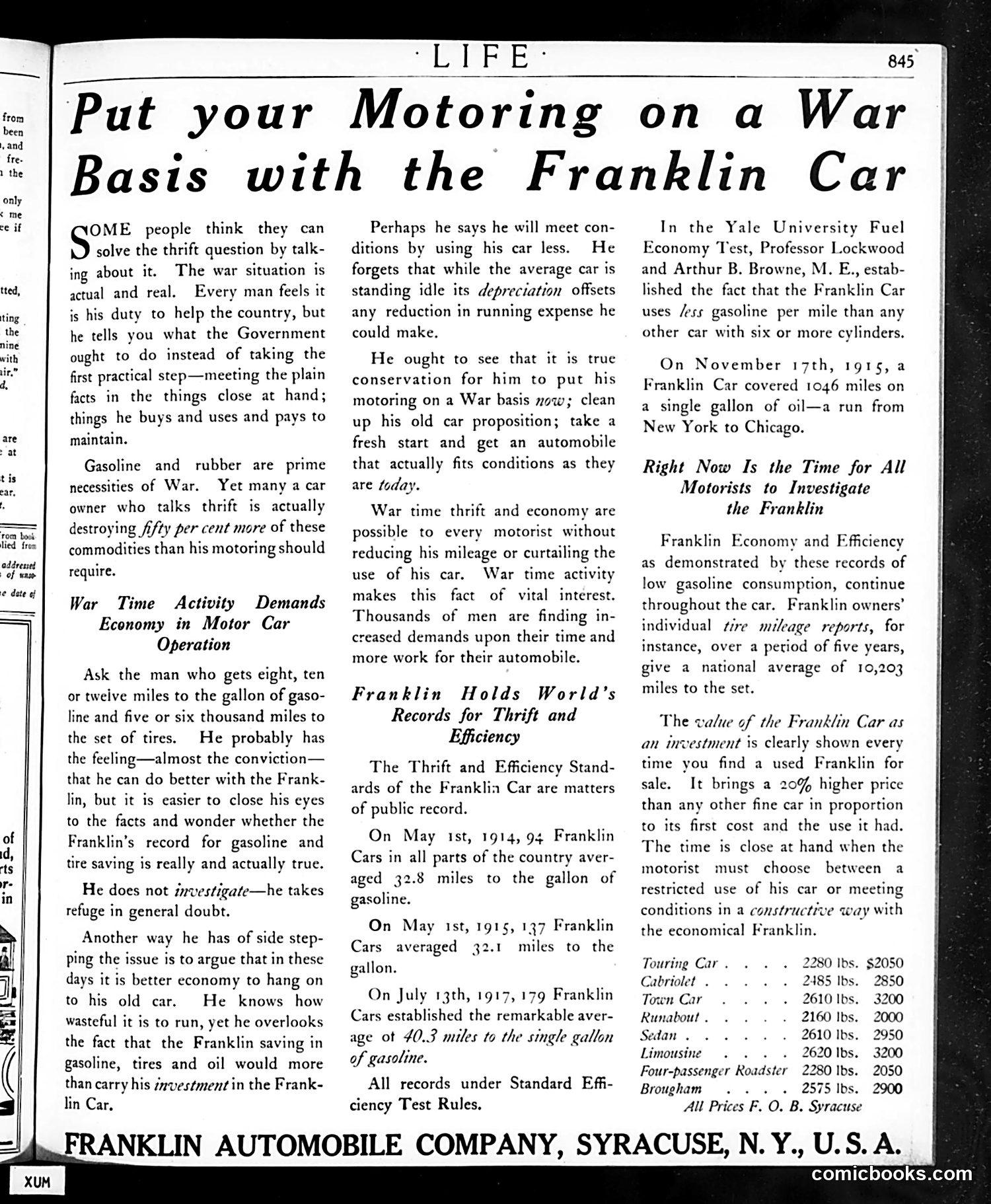
This is primarily a **full-page advertisement**, not satire. It appears in *Life* magazine during World War I (references to 1914-1917 tests and "War basis" motoring suggest circa 1918). The ad argues that patriotic car owners should buy Franklin automobiles as an act of wartime conservation. It addresses common objections—people say they'll drive less, keep old cars, or doubt the Franklin's efficiency claims—then counters each with data. The pitch: Franklin cars use significantly less gasoline and tire rubber than competitors (40.3 miles per gallon in 1917 tests), so buying one is actually *patriotic economy* during wartime fuel/rubber shortages. The car also holds its resale value well (20% premium). This reflects WWI-era marketing strategy: framing consumer purchases as dutiful sacrifice rather than indulgence, appealing to Americans' sense of contributing to the war effort through smart purchasing decisions.
📄 Transcribed text from this page (OCR, searchable)
Machine-transcribed from the original scan — historical spelling and the odd misread are preserved.
from been and fre. 1 the only me ce if rom book lied. frex addressed of wae e date a EEAEe 845 Put your Motoring on a War Basis with the Franklin Car OME people think they can S solve the thrift question by talk- ing about it. The war situation is actual and real. Every man feels it is his duty to help the country, but he tells you what the Government ought to do instead of taking the first practical step—meeting the plain facts in the things close at hand; things he buys and uses and pays to maintain. Gasoline and rubber are prime necessities of War. Yet many a car owner who talks thrift is actually destroying fifty per cent more of these commodities than his motoring should require. War Time Activity Demands Economy in Motor Car Operation Ask the man who gets eight, ten or tweive miles to the gallon of gaso- line and five or six thousand miles to the set of tires. He probably has the feeling—almost the conviction— that he can do better with the Frank- lin, but it is easier to close his eyes to the facts and wonder whether the Franklin’s record for gasoline and tire saving is really and actually true. He does not investigate—he takes refuge in general doubt. Another way he has of side step- ping the issue is to argue that in these days it is better economy to hang on to his old car. He knows how wasteful it is to run, yet he overlooks the fact that the Franklin saving in gasoline, tires and oil would more than carry his ¢vestment in the Frank- lin Car. Perhaps he says he will meet con- ditions by using his car less. He forgets that while the average car is standing idle its depreciation offsets any reduction in running expense he could make. He ought to see that it is true conservation for him to put his motoring on a War basis now; clean up his old car proposition; take a fresh start and get an automobile that actually fits conditions as they are today. War time thrift and economy are possible to every motorist without reducing his mileage or curtailing the use of his car. War time activity makes this fact of vital interest. Thousands of men are finding in- creased demands upon their time and more work for their automobile. Franklin Holds World’s Records for Thrift and Efficiency The Thrift and Efficiency Stand- ards of the Franklia Car are matters of public record. On May ist, 1914, 94 Franklin Cars in all parts of the country aver- aged 32.8 miles to the gallon of gasoline. On May 1st, 1915, 137 Franklin Cars averaged 32.1 miles to the gallon. On July 13th, 1917, 179 Franklin Cars established the remarkable aver- age ot 40.3 miles to the single gallon of gasoline. All records under Standard Effi- ciency Test Rules, In the Yale University Fuel Economy Test, Professor Lockwood and Arthur B. Browne, M. E., estab- lished the fact that the Franklin Car uses /ess gasoline per mile than any other car with six or more cylinders. On November 17th, 1915, a Franklin Car covered 1046 miles on a single gallon of oil—a run from New York to Chicago. Right Now Is the Time for All Motorists to Investigate the Franklin Franklin Economy and Efficiency as demonstrated by these records of low gasoline consumption, continue throughout the car. Franklin owners’ individual “re mileage reports, for instance, over a petiod of five years, give a national average of 10,203 miles to the set. The value of the Franklin Car as an investment is clearly shown every time you find a used Franklin for sale. It brings a 20% higher price than any other fine car in proportion to its first cost and the use it had. The time is close at hand when the motorist choose restricted use of his car or meeting conditions in a constructive way with the economical Franklin. must between a Touring Car . 2280 Ibs. $2050 Cabriolet. 2485 Ibs. 2850 Town Car 2610 Ibs. 3200 Runabout . 2160 Ibs. 2000 Sedan . 2610 Ibs. 2950 Limousine - + 2620 Ibs. 3200 Four-passenger Roadster 2280 Ibs. 2050 Brougham 2575 Ibs. 2900 All Prices F. O. B. Syracuse FRANKLIN AUTOMOBILE COMPANY, SYRACUSE, N. Y., U.S. A. comicbooks.com