
Life, 1917-11-22 · page 14 of 44
Life — November 22, 1917 — page 14: what you’re looking at
What you’re looking at
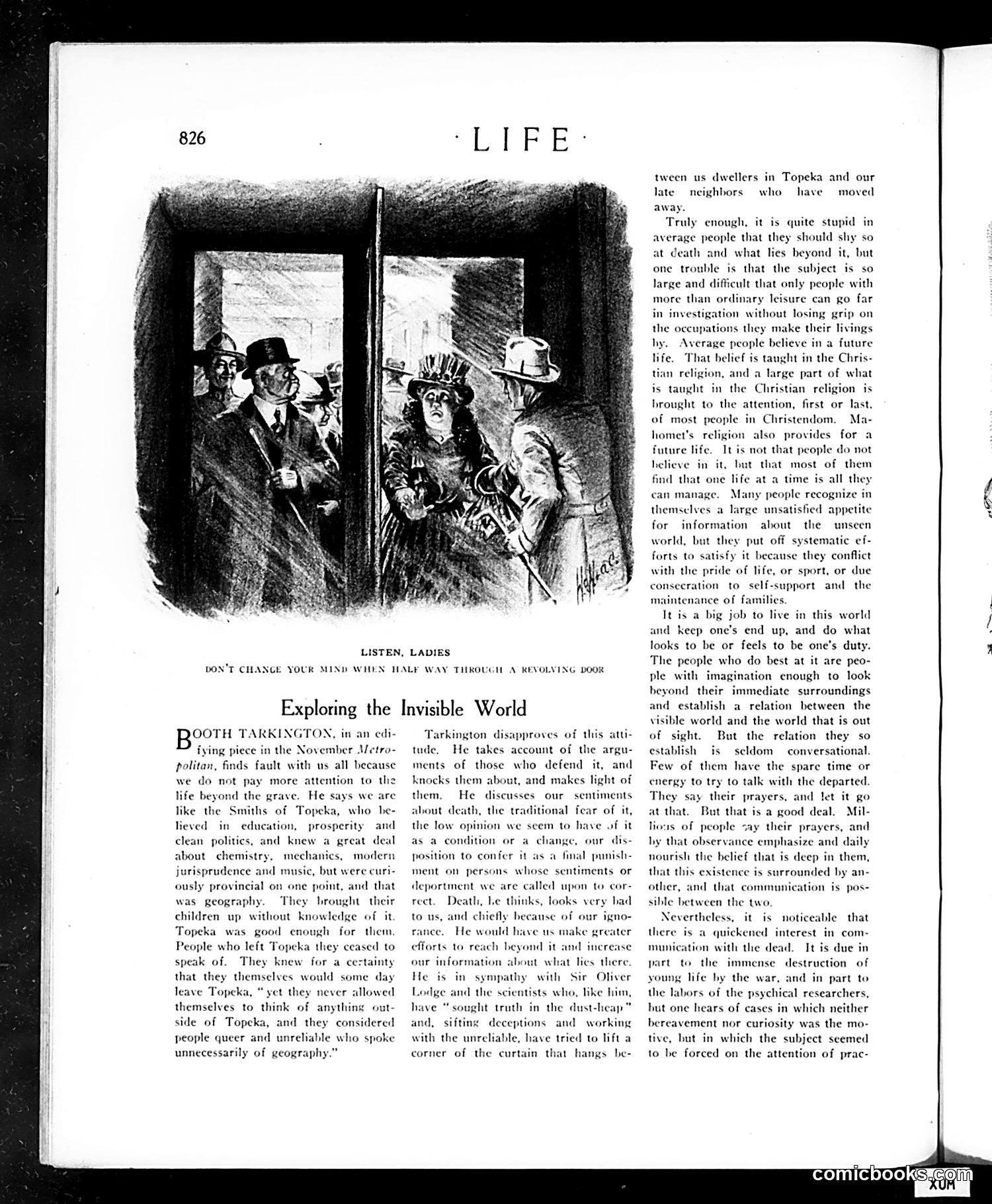
This satirical cartoon depicts well-dressed men in top hats emerging from what appears to be a revolving door, with the caption "Don't change your mind when half way through a revolving door." The accompanying article is titled "Exploring the Invisible World" and discusses Booth Tarkington's November *Metropolitan* magazine piece about communicating with the afterlife and spiritualism. The cartoon mocks women's perceived indecisiveness, a common satirical trope of the era. The revolving door serves as a visual metaphor for commitment—the joke being that women characteristically vacillate in their choices. This reflects period attitudes portraying women as fickle, particularly regarding serious matters like spiritualism and the supernatural topics Tarkington addresses.
📄 Transcribed text from this page (OCR, searchable)
Machine-transcribed from the original scan — historical spelling and the odd misread are preserved.
LISTEN, LADIES DON'T CHANGE YOUR MIND WHEN HALF WAY THROUGH A REVOLVING DOOR Exploring the Invisible World OOTH TARKINGTON, in an edi- fying piece in the November Metro- politan, finds fault with us all because we do not pay more attention to the ife beyond the grave. He says we are like the Smiths of Topeka, who he- lieved in. education, prosperity and clean politics, and knew a great deal about jurisprudence and music, but were curi- ously provincial on one point, and that was geography. They brought. their children up without knowledge of it Topeka was good enough for them People who left Topeka they ceased to speak of. They knew for a certainty that they themselves would some day leave Topeka, “ yet they never allowed themselves to think of anything out- side of Topeka, and they considered people queer and unreliable who spoke chemistry, mechanics, modern unnecessarily of geography.” Tarkington disapproves of this atti- tude. He takes account of the argu- ments of those who defend it, and knocks them about, and makes light of them. He discusses our sentiments ahout death, the traditional fear of it, the low opinion we seem to have of it as a condition or a change, our dis- position to confer it as a final punish- ment on persons whose sentiments or deportment we are called upon to cor- rect. Death, he thinks, looks very bad to us, and chiefly because of our igno- rance. He would have us make greater efforts to reach beyond it and increase our information about what lies there. He is in sympathy with Sir Oliver Lodge and the scientists who, like him, have “sought truth in the dust-heap” and, sifting deceptions and working with the unreliable, have tried to lift a corner of the curtain that hangs be- tween us dwellers in Topeka and our late neighbors who have moved away. Truly enough, it is quite stupid in average people that they should shy so at death and what lies beyond it, but one trouble is that the subject is so large and difficult that only people with more than ore y leisure can go far in investigation without losing grip on the occupations they make their livings hy. Average people believe in a future life. That belief is taught in the Chris- tian religion, and a large part of what is taught in the Christian religion is brought to the attention, first or last. of most people in Christendom. Ma- homet’s religion also provides for a future life. It is not that people do not ieve in it, but that most of them find that one life at a time is all they can manage. Many people recognize in themselves a large unsatished appetite for information about the world, but they put off systematic ef- unseen. forts to satisfy it because they conflict pride of life, or sport, or due with tl consecration to self-support and. the maintenance of families. It is a big job to live in this world and keep one’s end up, and do what looks to be or feels to be one’s duty. The people who do best at it are peo- ple with imagination enough to look beyond their immediate surroundings and establish a relation between the visible world and the world that is out of sight. But the relation they so establish is seldom — conversational. Few of them have the spare time or energy to try to talk with the departed. They say their prayers, and let it go at that. But that is a good deal. Mil- lious of people say their prayers, and hy that observance emphasize and daily nourish the belief that is deep in them, that this existence is surrounded by an- other, and that communication is pos- sible between the two, Nevertheless, it is noticeable that there is a quickened interest in com- It is due in part to the immense destruction of young life by the war, and in part to the labors of the psychical researchers, but one hears of cases in which neither bereavement nor curiosity was the mo- tive, but in which the subject seemed to be forced on the attention of prac- munication with the dead. Ccomicboo BS aR mM