
A complete issue · 40 pages · 1917
Life — November 8, 1917
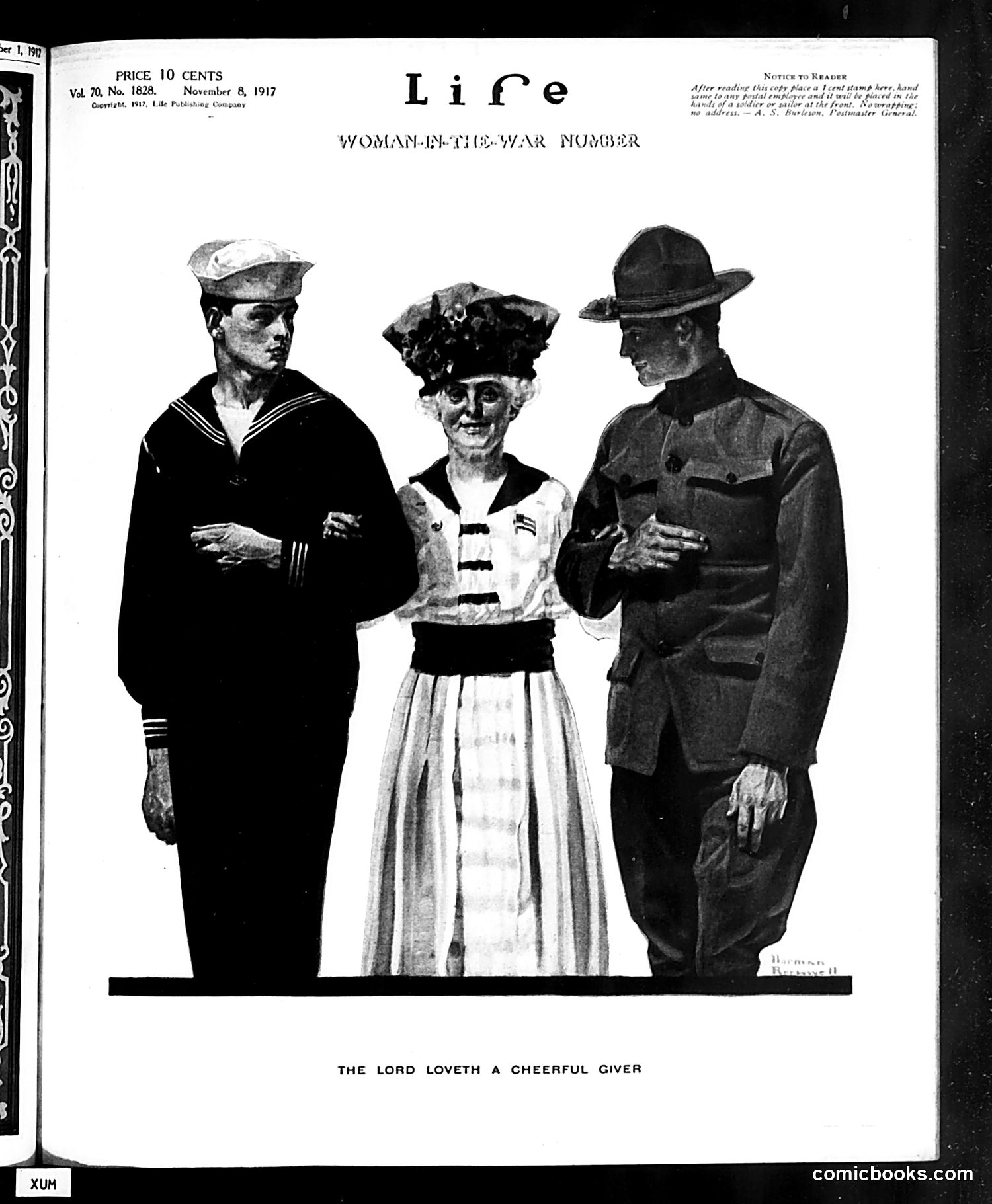
This is the cover of Life magazine's "Woman-in-the-War Number" from November 8, 1917—during America's active involvement in World War I. The image shows three figures representing different roles in the war effort: a sailor (left), a woman in the center wearing a patriotic outfit with what appears to be Red Cross or nursing insignia, and a soldier (right). The caption reads "THE LORD LOVETH A CHEERFUL GIVER." This is likely promoting women's contributions to WWI through charitable giving, nursing, and support roles. The biblical reference suggests wartime sacrifice is morally virtuous. The composition emphasizes women as active participants in the national war effort—whether through direct service (nursing) or financial support—rather than passive observers.

This page is primarily a **commercial advertisement**, not political satire. It promotes Fisk Non-Skid tires for winter driving safety, emphasizing their button-tread design that provides "direct planes of resistance against slipping—in all directions." The small illustration at bottom left shows the Fisk company mascot—a cherubic sleeping child—with the caption "Time to Retire?" (a pun on the Fisk brand). This mascot was the company's standard trademark from the early 1900s onward. The advertisement targets drivers concerned about winter road hazards, claiming Fisk tires offer superior safety and value compared to competitors. The page reflects early-20th-century automotive culture when tire quality significantly affected vehicle performance in harsh weather.
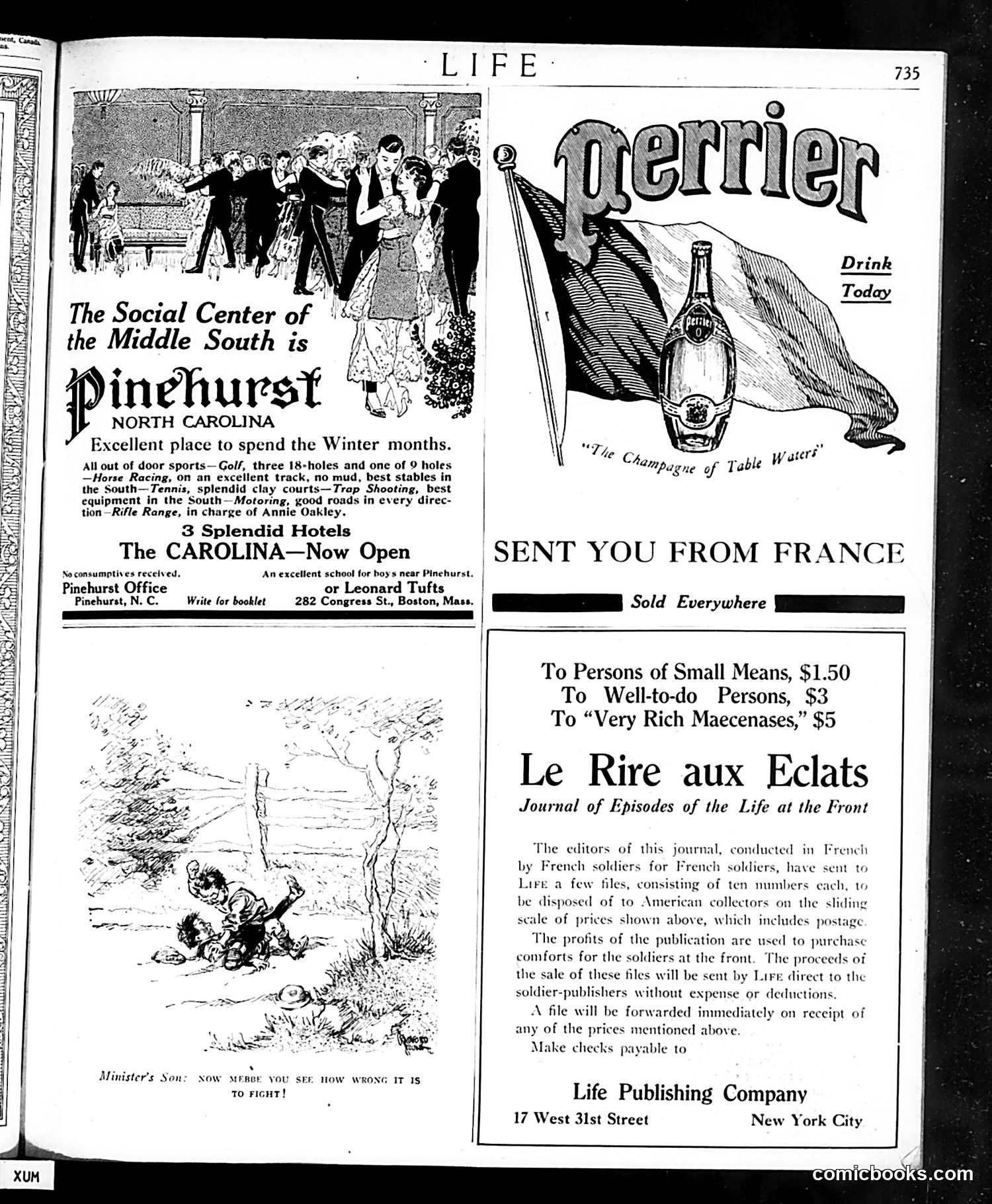
This page is primarily **advertising and editorial content** rather than political satire. The left side advertises **Pinehurst, North Carolina** as a winter resort destination, highlighting its golf course, horse racing, and shooting facilities—leisure activities for wealthy Americans. The right side contains two advertisements: one for **Perrier sparkling water** ("sent you from France"), and another for **"Le Rire aux Eclats,"** a French soldier-published journal documenting WWI front-line life. Life Publishing Company is collecting funds by selling this French publication to American donors, with proceeds going directly to soldiers without overhead costs. The cartoon below shows a dead soldier, captioned "Minister's Son: Now WHERE YOU SEE HOW WRONG IT IS TO FIGHT!"—a darkly satirical commentary on the human cost of war versus civilians' abstract patriotic rhetoric.
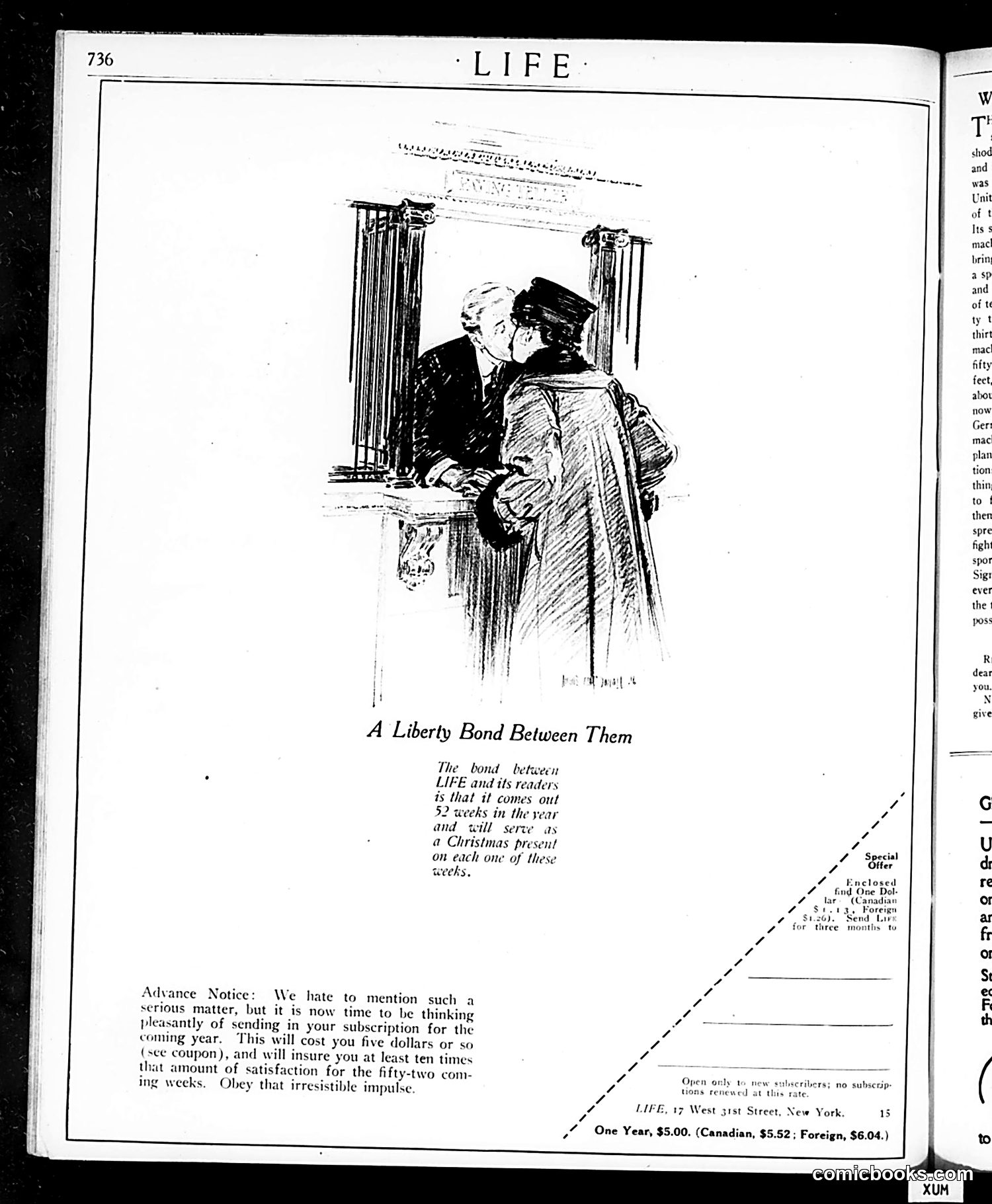
This is primarily a **subscription advertisement** for LIFE magazine itself, not political satire. The illustration depicts two figures at what appears to be a business transaction—likely representing LIFE and its readers conducting a financial exchange. The title "A Liberty Bond Between Them" references **Liberty Bonds**, U.S. government bonds sold to finance World War I, making this a patriotic appeal tying magazine subscription to national duty. The ad promises subscribers will receive LIFE "52 weeks in the year" as "a Christmas present," and urges people to renew subscriptions for the coming year at five dollars. The text below frames subscription as an "irresistible impulse"—framing reading as both patriotic and pleasurable consumption.
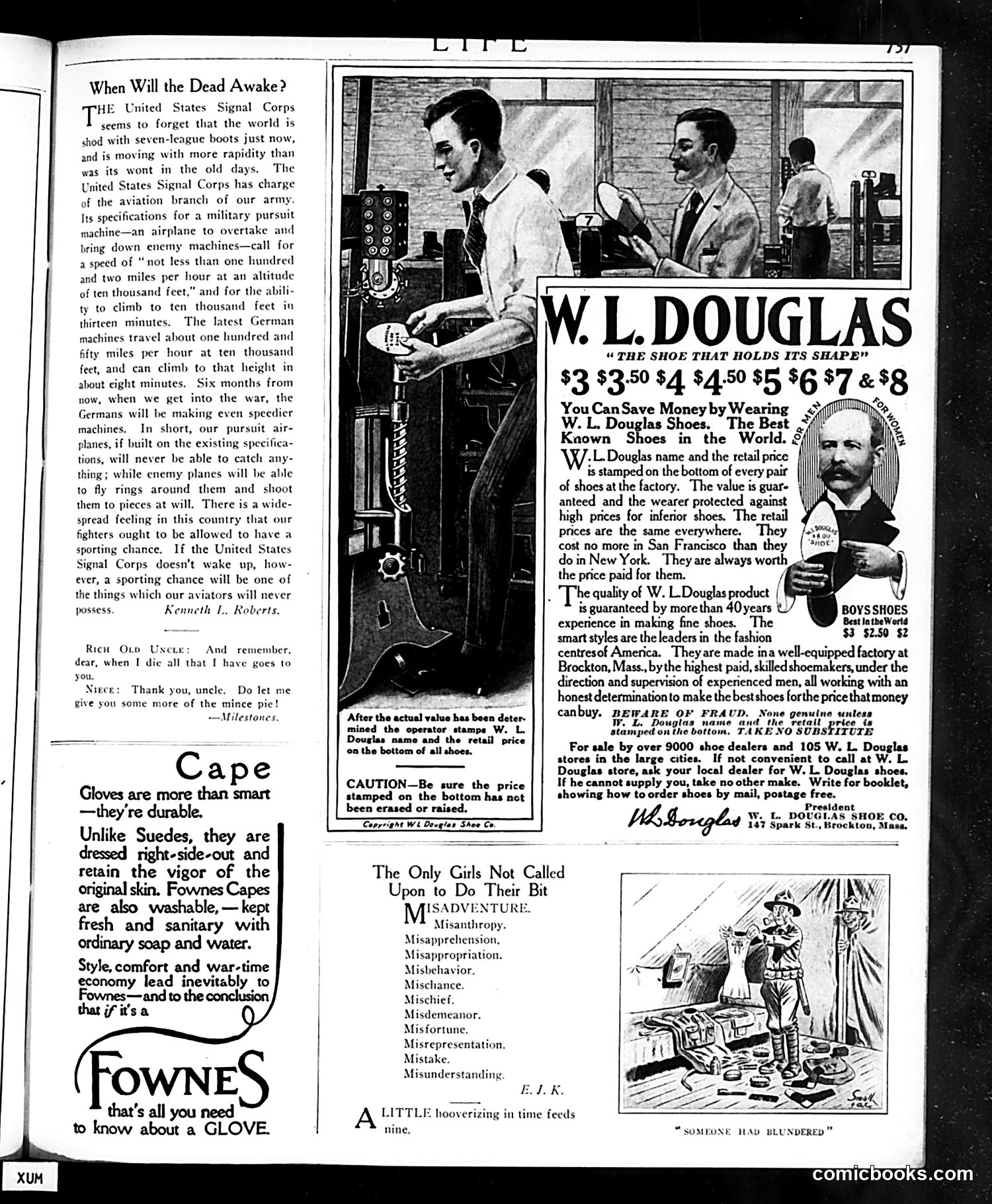
This page is primarily **advertising and humor content** rather than political commentary. The main feature is a **W.L. Douglas Shoes advertisement** showing factory workers and emphasizing the brand's quality and value across multiple price points ($3-$8). The ad includes a portrait of what appears to be the company founder/owner and notes the shoes are made at a factory in Brockton, Massachusetts. Below is a **Fownes Gloves advertisement** promoting durable, washable gloves suitable for wartime use. At the bottom is a **small humor cartoon** titled "The Only Girls Not Called Upon to Do Their Bit," listing various "mis-" words (misadventure, misappropriation, etc.)—a lighthearted pun about girls avoiding trouble. The page reflects **early WWI-era commercial messaging**, emphasizing patriotic consumption and practical, durable goods.
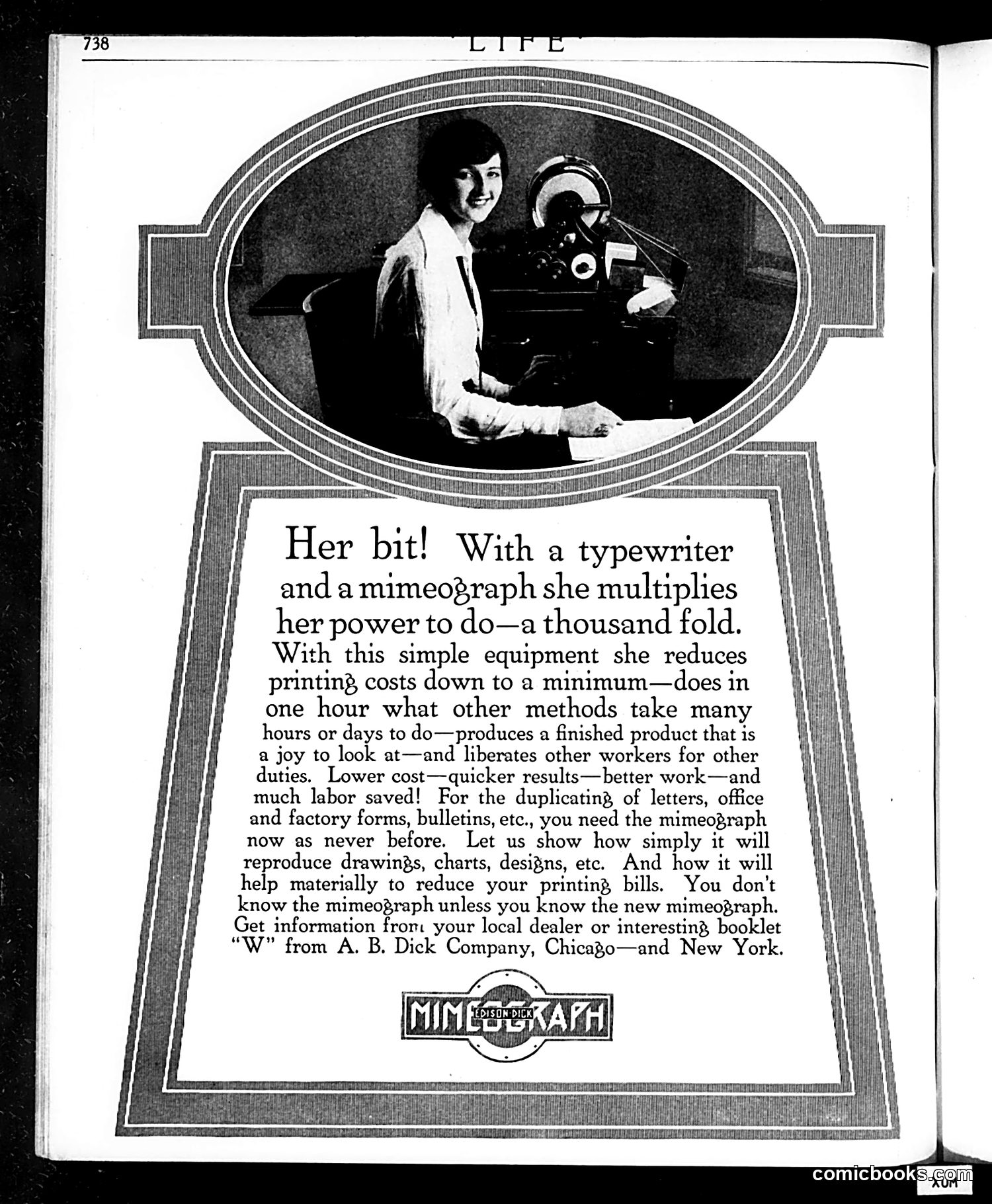
This is a **Mimeograph Company Advertisement**, not satire or political commentary. The ad promotes the mimeograph machine—an early duplicating technology—to businesspeople. The woman pictured operates a typewriter connected to a mimeograph, which reproduces typed documents mechanically. The headline "Her bit!" uses patriotic World War I-era language, framing office efficiency as a contribution to the war effort. The ad emphasizes how this equipment multiplies productivity "a thousand fold," reduces printing costs, and frees workers for other duties. The text appeals directly to businesses needing to duplicate forms, letters, and bulletins—practical office needs of the 1910s-1920s. A.B. Dick Company manufactured these machines and placed this ad in *Life* magazine to reach potential commercial customers. There is no political cartoon here—this is purely commercial advertising.
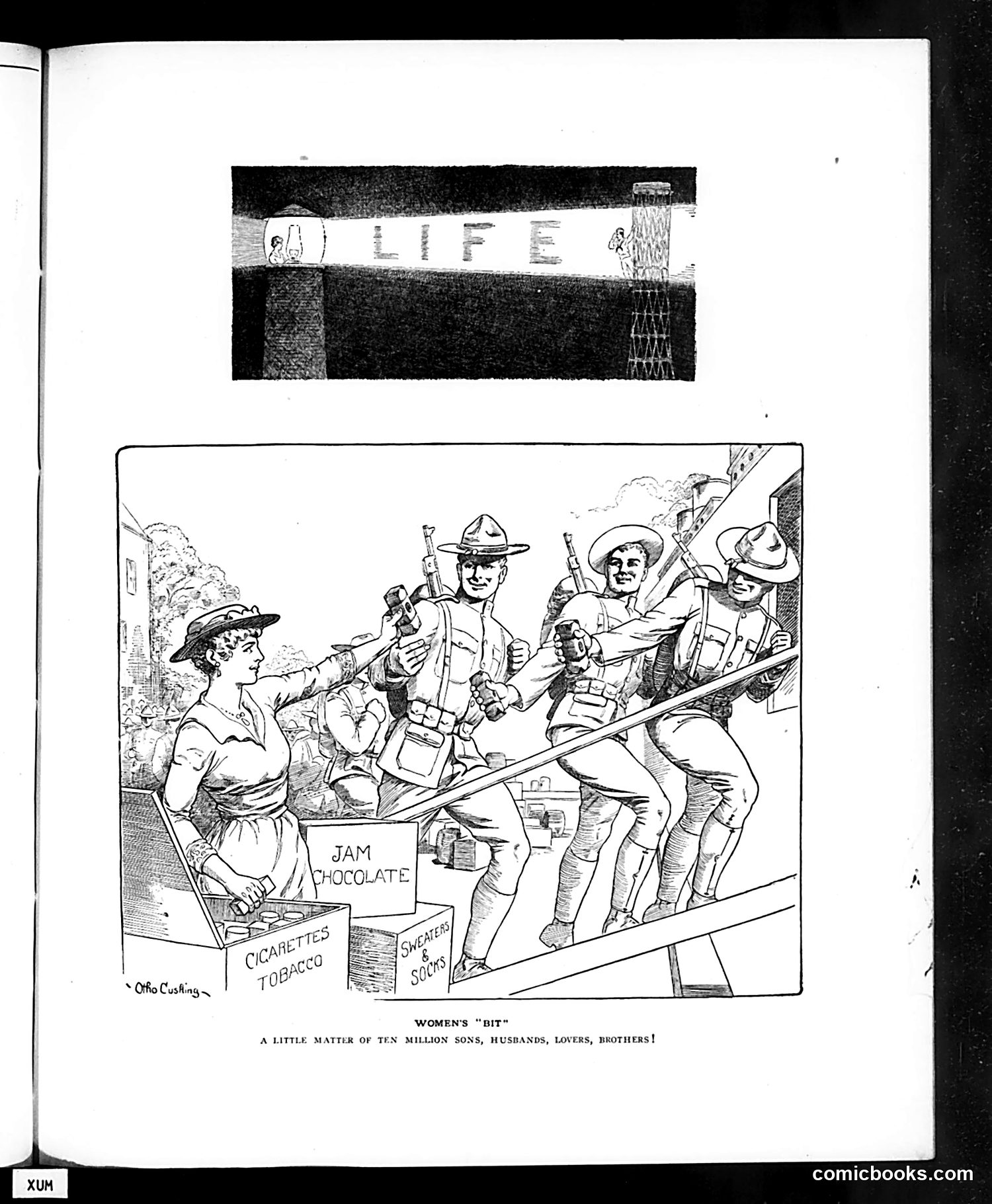
This satirical cartoon depicts a woman providing supplies—jam, chocolate, cigarettes, tobacco, and sweaters/socks—to armed soldiers. The caption reads: "A Little Matter of Ten Million Sons, Husbands, Lovers, Brothers!" The satire critiques how women's wartime contributions were trivialized. While men fought and died in large numbers ("ten million sons"), women's essential support work (providing comfort items and supplies to troops) was dismissed as merely their "bit"—a minor, almost quaint contribution. The cartoon highlights the gender disparity in how wartime sacrifice was valued and discussed. Women's labor kept soldiers sustained, yet their contributions were linguistically minimized compared to male combat roles, reflecting early-20th-century attitudes about gendered wartime responsibility.
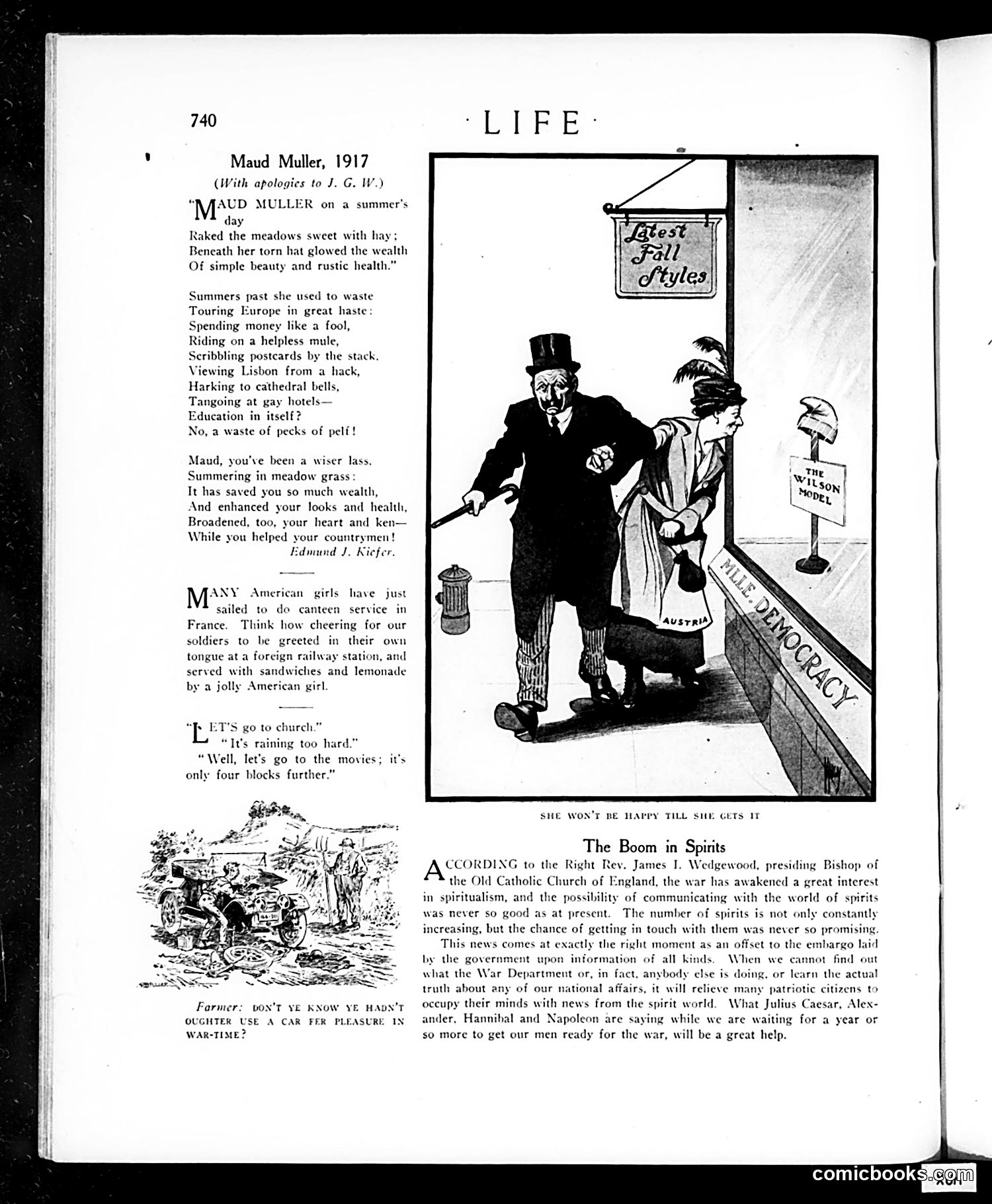
This 1917 cartoon satirizes American women's fashion consumption during wartime. A fashionably dressed woman enters a shop advertising "Latest Fall Styles" while a stern-looking man (likely representing either a husband or wartime authority figure) pulls her back. The shop window displays the "Wilson Model"—a reference to President Wilson's wartime policies. The satire criticizes women for prioritizing frivolous shopping for expensive fall fashions during World War I, when resources and materials were needed for the war effort. The caption "She Won't Be Happy Till She Gets It" suggests women's supposed insatiable consumerism conflicts with patriotic wartime sacrifice. The cartoon reflects contemporary anxiety about civilian consumption during the 1917-1918 war period.
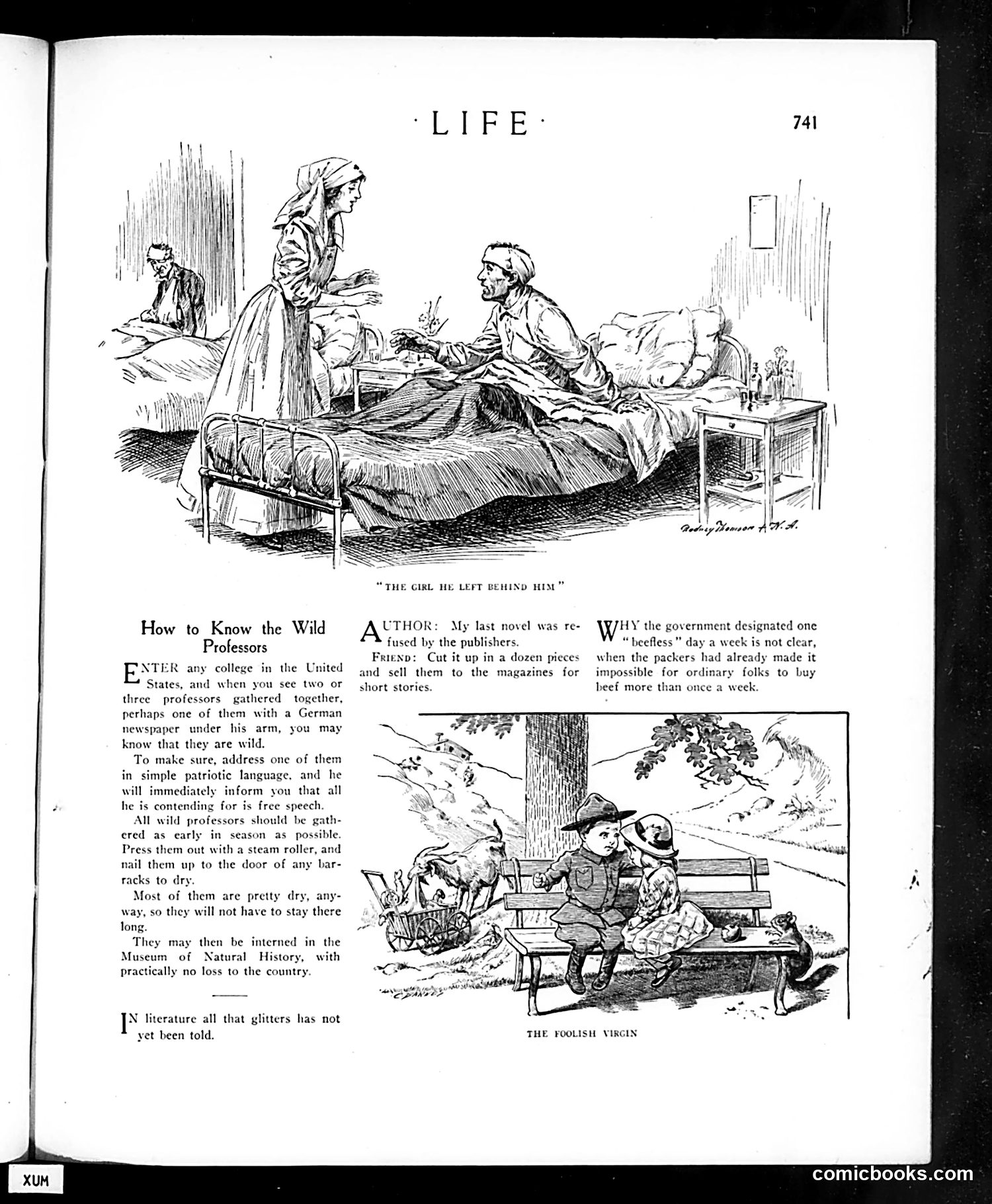
This page contains two satirical pieces: **"The Girl He Left Behind Him"** (top illustration) depicts a hospital or sickbed scene, likely commenting on romantic relationships during wartime or separation. **"How to Know the Wild Professors"** (left column) is a humorous essay mocking absent-minded academics. It suggests addressing professors in "simple patriotic language" will reveal their eccentricity, recommends gathering them "en masse," pressing them with a steam roller, and nailing them to museum doors. The satire ridicules professors as impractical, detached from reality—"pretty dry" specimens unsuitable for society. **"The Foolish Virgin"** (bottom illustration) shows children on a park bench, likely satirizing naive or overly trusting behavior, though the specific social commentary isn't entirely clear from the visible context. The page reflects early 20th-century American attitudes toward intellectuals and social behavior.
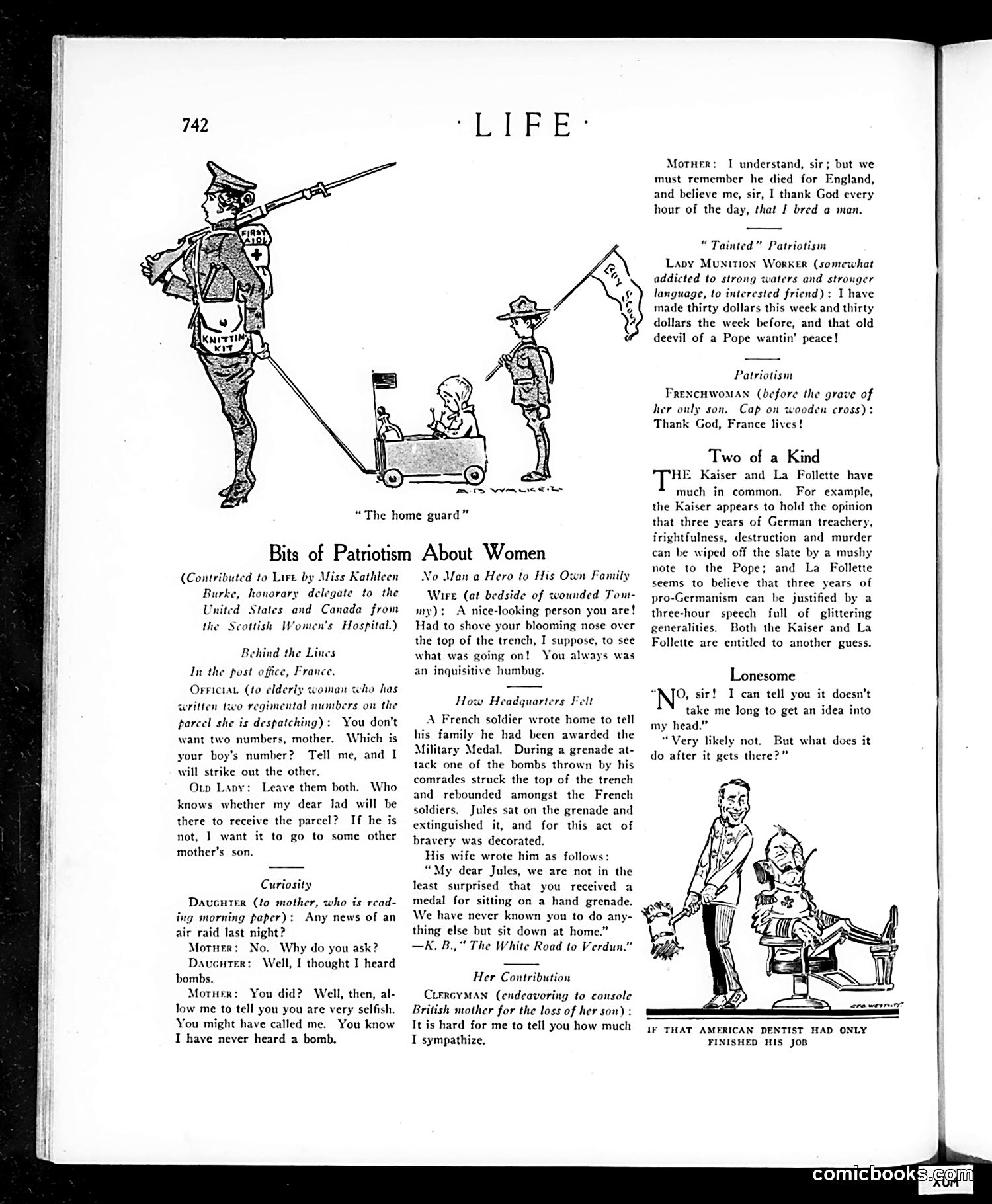
This page satirizes patriotism during World War I, particularly among women. The central cartoon "The home guard" depicts a soldier and civilian man flanking a woman with a baby carriage, mocking domestic "patriotism." The text sections mock exaggerated patriotic claims: - **"Tainted" Patriotism**: A munitions worker brags about earnings while calling for the Pope's death—questioning if profit-seeking equals true patriotism. - **Patriotism**: A Frenchwoman's simple statement ("France lives!") contrasts with the worker's verbose self-interest. - **Two of a Kind**: Compares the Kaiser and "La Follette" (likely Senator Robert La Follette, a prominent war critic), suggesting anti-war voices use similar rhetoric to German leaders. The overall message: American wartime "patriotism" often masks selfishness, hypocrisy, or disloyalty.
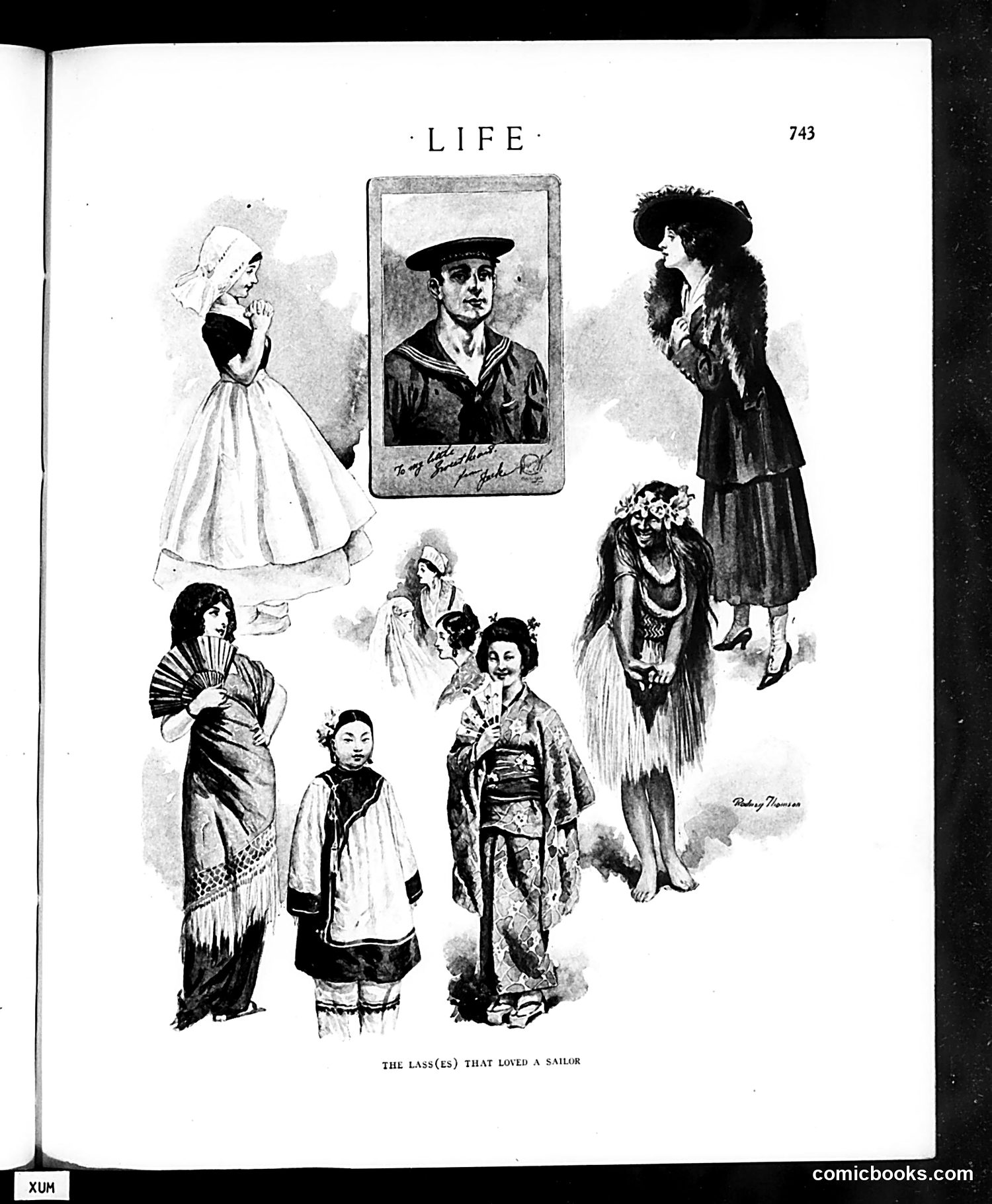
This satirical illustration depicts various women from different cultures and nationalities, all apparently attracted to a sailor (shown in the central portrait). The composition mocks the sailor stereotype of having romantic conquests across the globe. The figures include women in diverse traditional dress—appearing to represent Asian, European, and other international origins—suggesting the sailor's claimed romantic escapades worldwide. The title's plural "lass(es)" emphasizes this multiplicity of relationships. The satire likely targets both sailor mythology and period attitudes about international romance and cultural exoticism. It plays on the common trope of sailors having paramours in "every port," presented here as humorous evidence of the sailor's appeal across racial and cultural boundaries—reflecting early 20th-century attitudes toward both sailors and international relations.
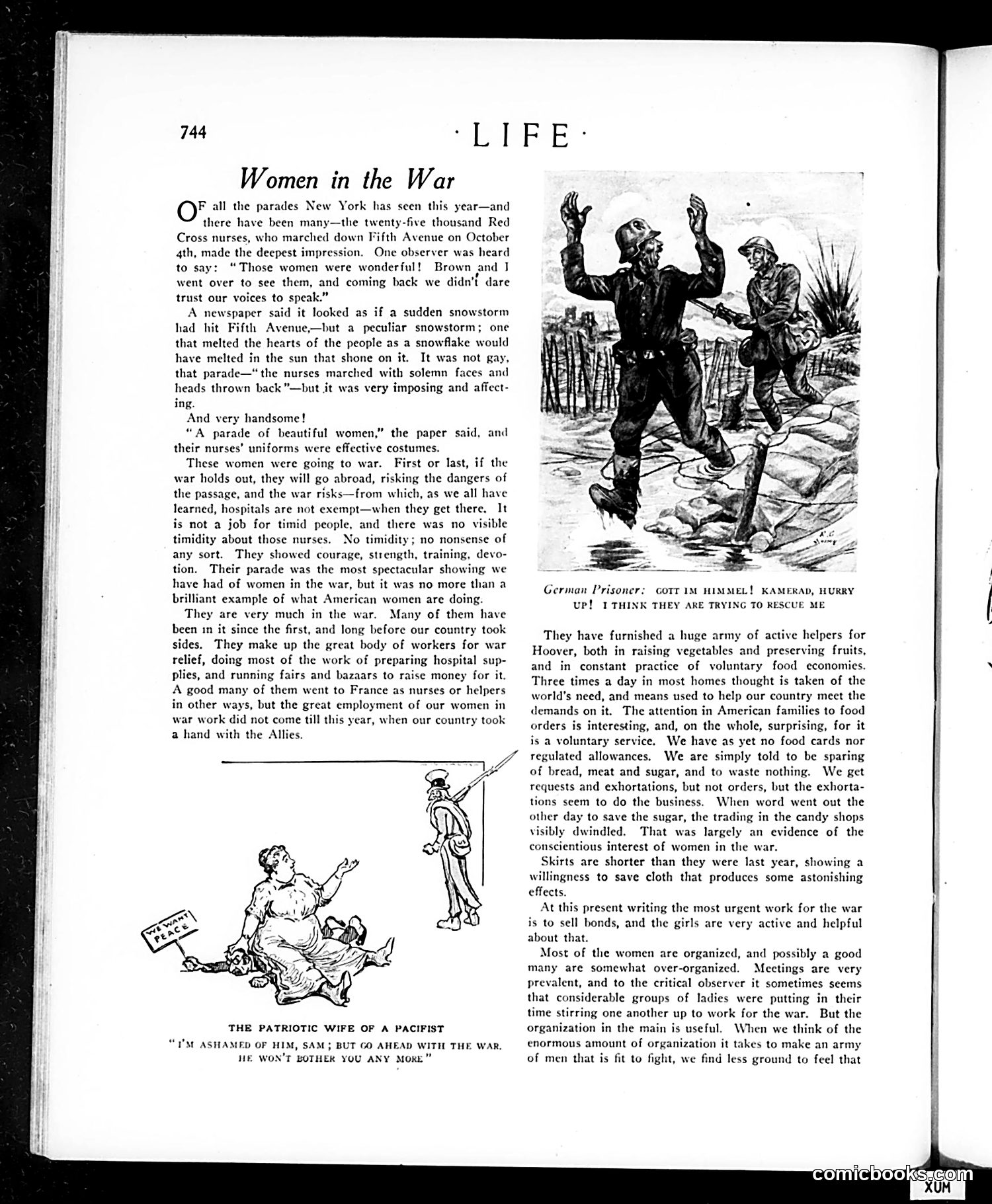
This page celebrates American women's contributions to World War I efforts. The top cartoon shows German prisoners encountering Red Cross nurses marching down Fifth Avenue—the prisoners' shocked reaction ("Gott im Himmel! Kamerad, hurry up!") mocks enemy surprise at American women's military involvement. The lower cartoon, "The Patriotic Wife of a Pacifist," depicts a woman confronting a man opposing the war, shaming him into support ("I'm ashamed of him, Sam; but go ahead with the war. He won't bother you any more"). The accompanying article praises nurses, volunteers, and women's organizational work for war relief, food conservation, and bond sales. The satire targets both pacifist resistance and enemy underestimation of American female mobilization as sources of national strength.
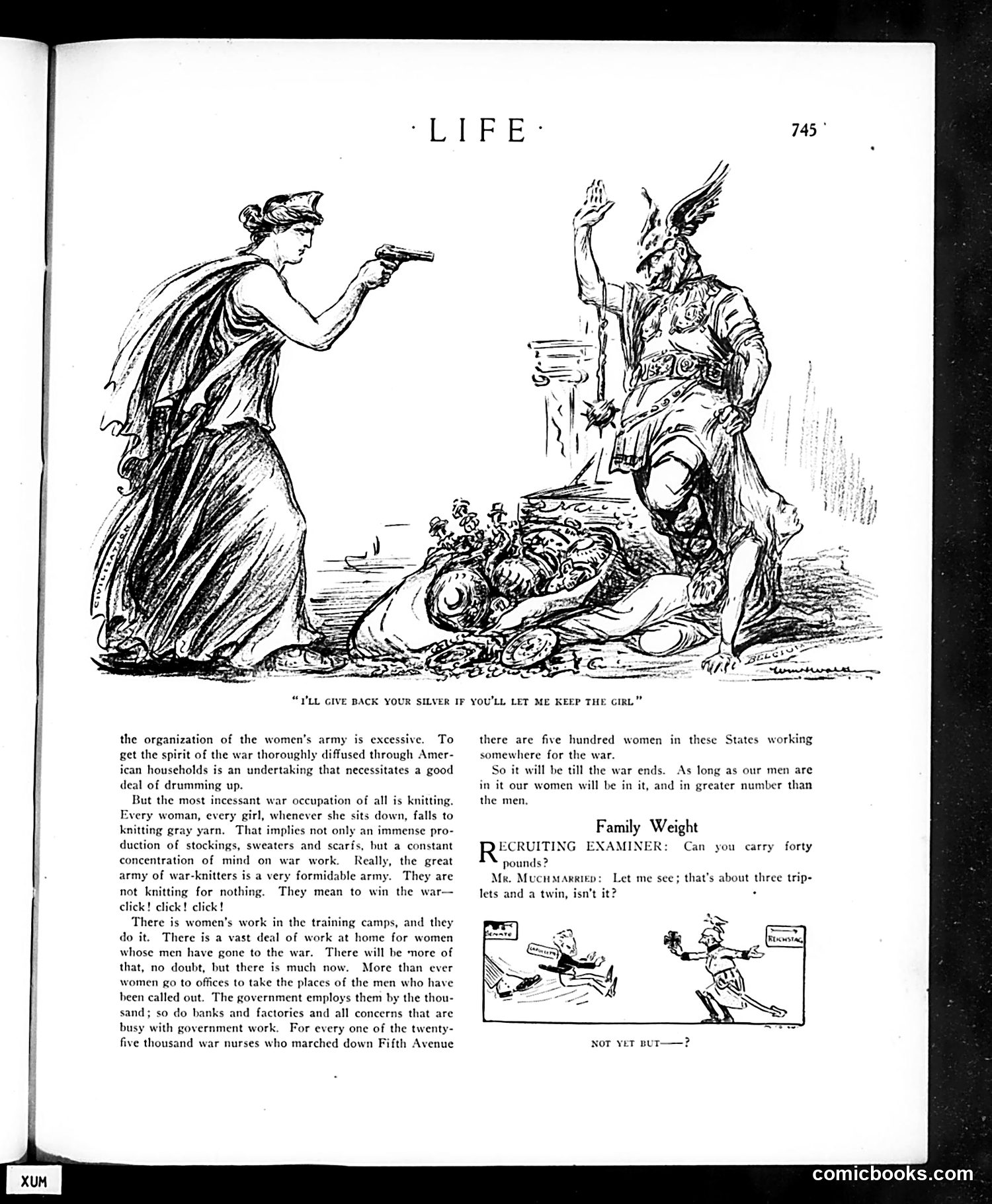
**Main Cartoon:** A winged female figure (Liberty or Victory) aims a pistol at a bearded man in ornate military dress with feathered headgear, who holds a torch and staff. A prone figure lies at their feet. The caption reads: "I'LL GIVE BACK YOUR SILVER IF YOU'LL LET ME KEEP THE GIRL." This appears to reference **World War I-era negotiations**, satirizing military leadership's willingness to trade resources (silver/wealth) for control over women or civilian populations. The caricatured military figure likely represents an enemy power or corrupt authority. **Secondary Content:** "Family Weight" is a humorous recruiting examiner dialogue about carrying forty pounds, featuring cartoon illustrations of physical exertion. The page overall satirizes **wartime priorities and gender dynamics** during WWI mobilization, mocking militarism and highlighting women's expanded wartime roles.
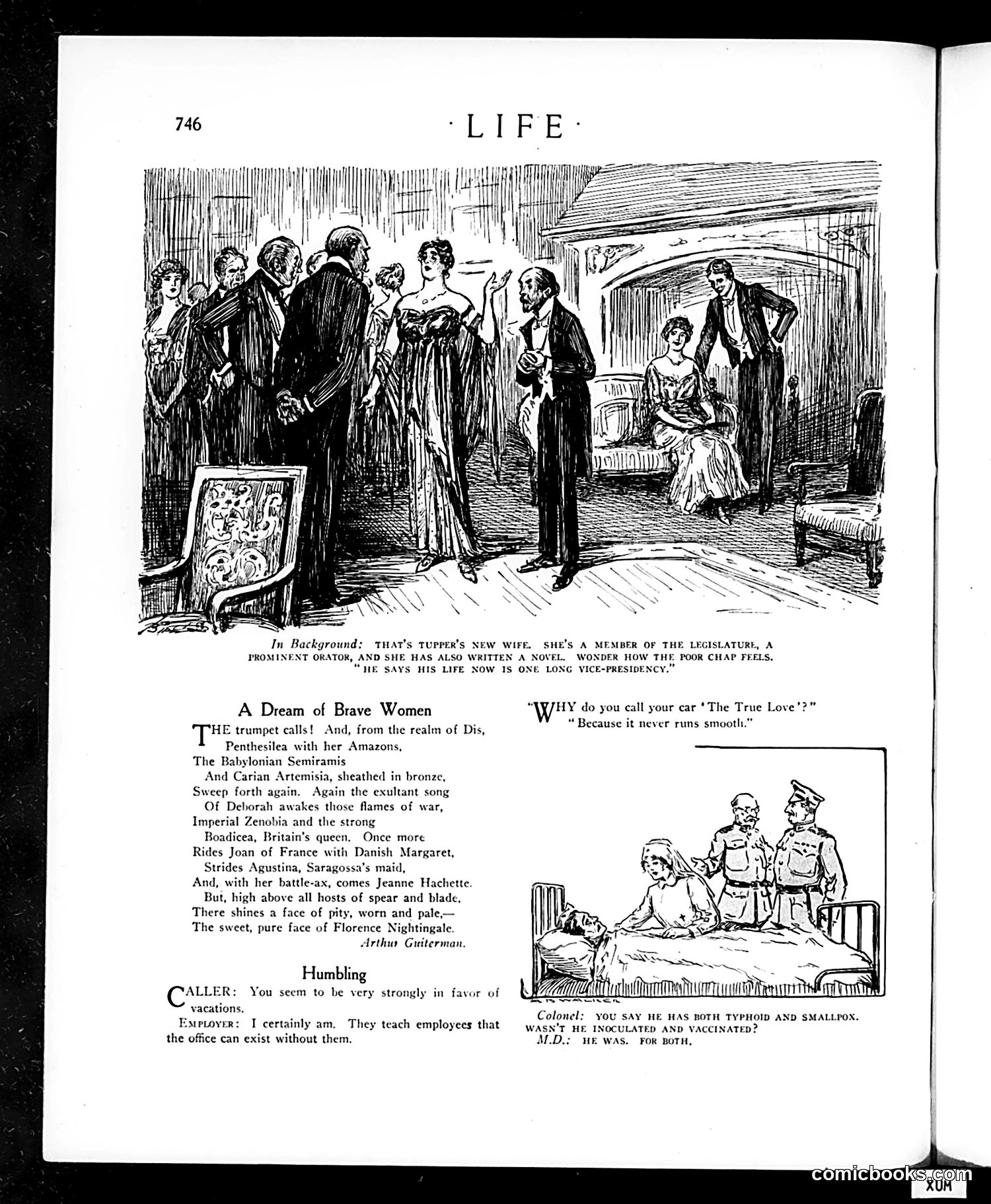
This page contains three distinct pieces of satire: 1. **Top illustration**: A social scene captioned to mock a politician's wife who is a legislator, orator, and novelist. The joke critiques her multiple roles, suggesting her husband's life is "one long vice-presidency"—implying he's merely a supporting figure to her ambitions. 2. **"A Dream of Brave Women"**: A poem celebrating historical female warriors and leaders (Artemisia, Joan of Arc, Florence Nightingale), satirizing contemporary debates about women's expanded public roles. 3. **Bottom dialogues**: Two brief exchanges—one about employee vacations, another about medical inoculations—using workplace and domestic settings to comment on social attitudes, likely reflecting early 20th-century concerns about labor rights and public health. The page collectively satirizes evolving gender roles and social modernization.
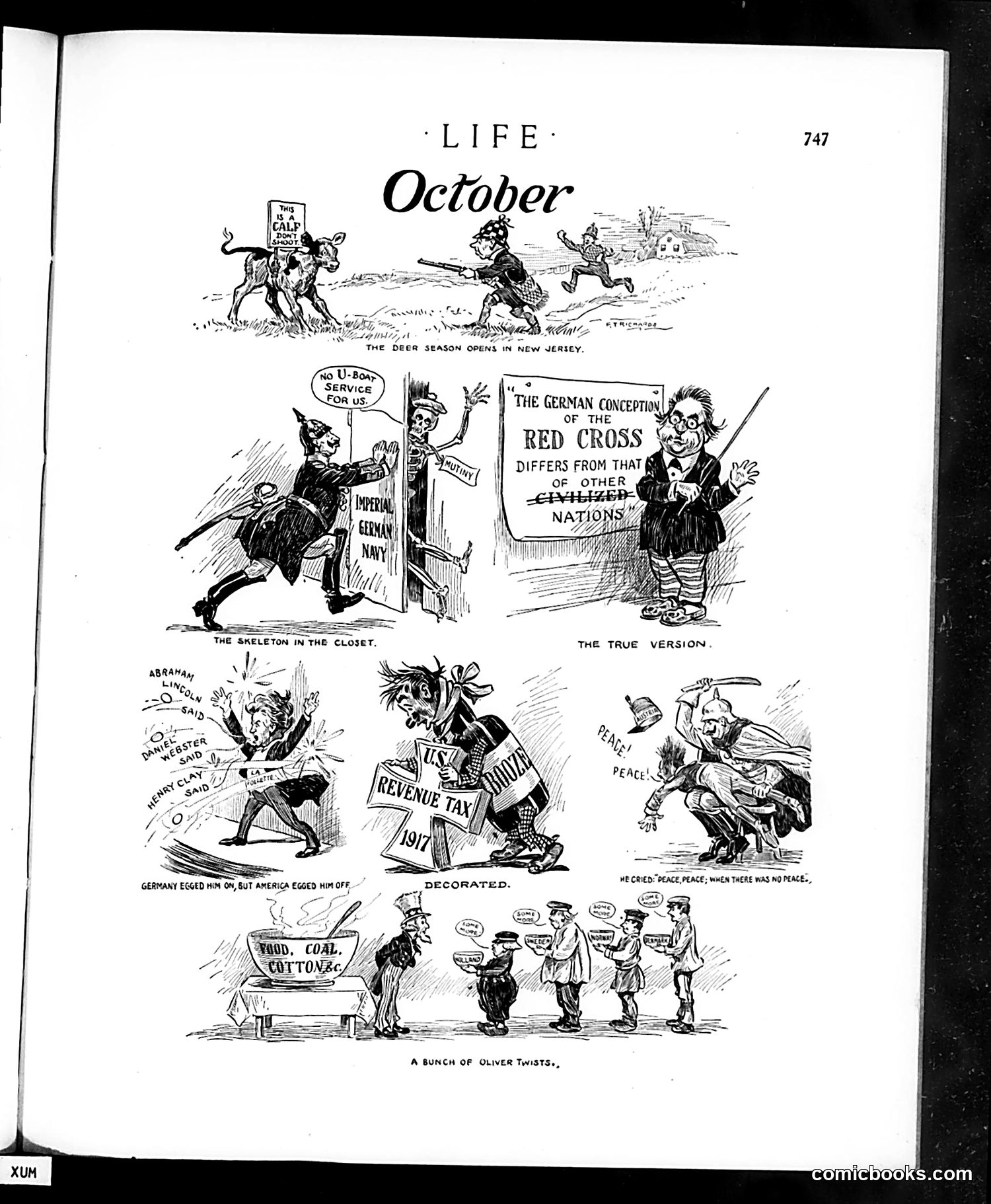
This page contains WWI-era American political cartoons mocking Germany and satirizing domestic issues: **Top cartoon**: "The Skeleton in the Closet" shows Germany's navy attempting to hide from U-boat service, contrasted with "The True Version" depicting Germany's Red Cross conception as different from other nations'. **Middle cartoons**: One depicts Germany "egging" America on while America "eggs him off"; another shows revenue tax decorating a figure labeled "1917"; a third references peace negotiations. **Bottom cartoon**: "A Bunch of Oliver Twists" shows civilians requesting basic necessities (food, coal, cotton) from an authority figure—likely satirizing wartime rationing or economic hardship on the American home front. The overall theme critiques both German conduct and American domestic wartime pressures, using exaggerated caricature and visual metaphor typical of WWI-era American editorial cartooning.
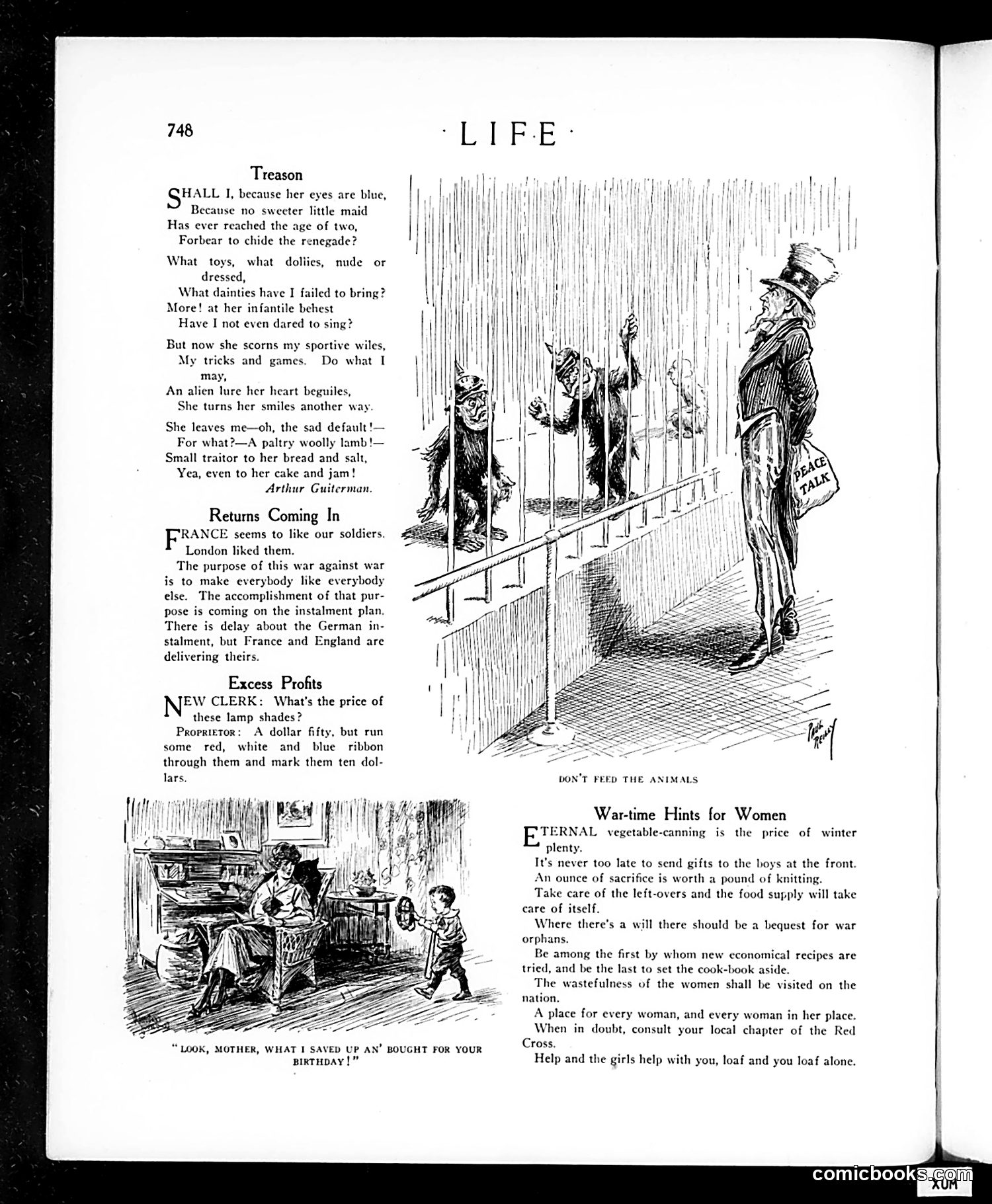
This WWI-era satirical page contains multiple pieces targeting wartime attitudes and profiteering: **"Treason" poem**: A father humorously laments his toddler preferring a toy lamb to his attention—gentle domestic satire about parental neglect dressed up as mock-serious patriotic language. **"Returns Coming In"**: Brief commentary on Allied soldiers being welcomed in France and England, sardonically suggesting the war's stated purpose is promoting international goodwill, though Germany's slow "installment" on peace suggests cynicism about actual progress. **"Excess Profits"**: Mocks wartime price-gouging—a shopkeeper marks up cheap lamp shades 667% by adding patriotic ribbon and relabeling them as "war goods." **Bottom cartoon**: Shows a child presenting savings to his mother, titled "Don't Feed the Animals"—appears to criticize wasteful consumer spending during wartime. **"War-time Hints for Women"**: Prescriptive wartime messaging directing women toward food conservation, knitting, and sacrifice, reflecting government mobilization efforts. The page collectively critiques profiteering, consumerism, and propaganda while supporting the war effort itself.
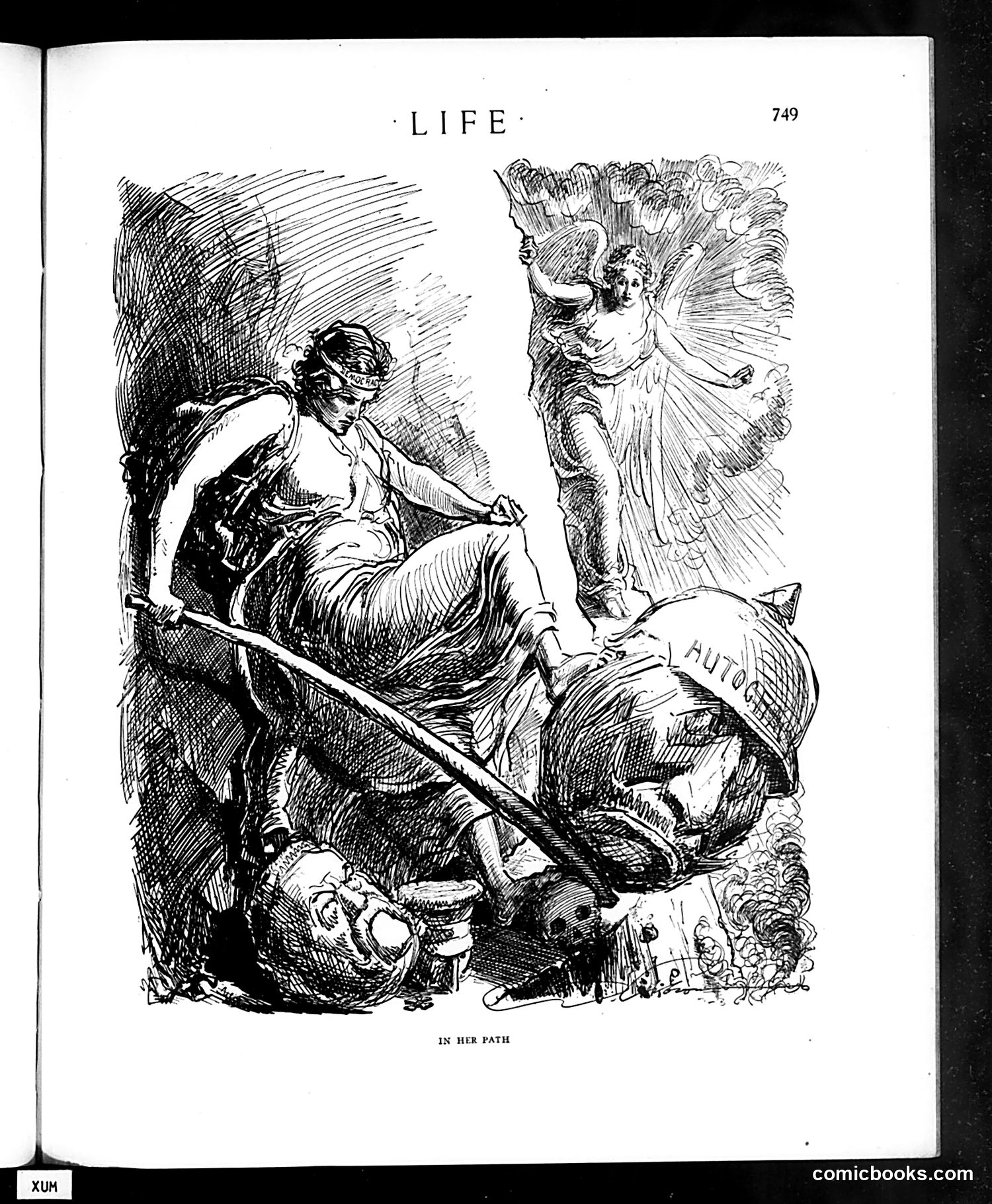
This is a satirical illustration from *Life* magazine (page 749) depicting allegorical figures. A seated woman representing **Liberty or Justice** (crowned, classical dress) sits elevated, while below her a figure labeled "**AUTOCRACY**" (wearing a military helmet) lies crushed or defeated in her path. An angelic female figure hovers above, appearing to celebrate or witness this triumph. The cartoon appears to celebrate **democracy's victory over authoritarian rule**, likely referencing early 20th-century political conflicts. The classical allegorical style—common in American political satire of the era—contrasts enlightened governance with militaristic despotism. Without the specific issue date visible, the exact historical context remains unclear, though it likely references conflicts between democratic and autocratic systems prominent during or after World War I.
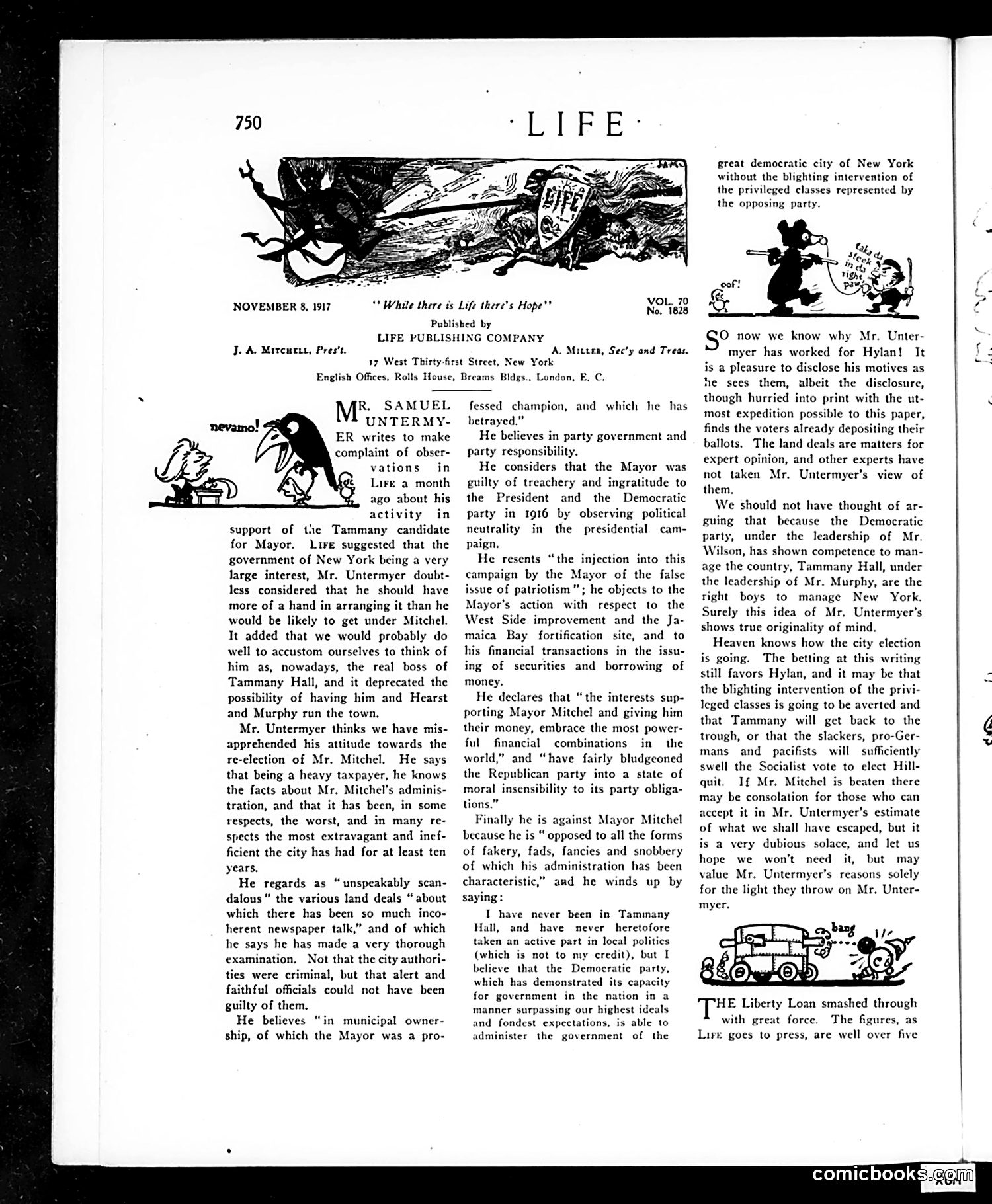
This Life magazine page satirizes wealthy lawyer Samuel Untermyer's complaints about New York Mayor John Mitchel's re-election campaign. Untermyer, a major Democratic supporter, had backed Tammany Hall's mayoral candidate (likely John Hylan) instead of the incumbent Mitchel. Life's satire centers on Untermyer's self-righteous objections to Mitchel's administration—criticizing land deals, municipal ownership betrayals, and financial impropriety—while conveniently omitting his own interest in political power. The magazine's subtitle, "While there is Life there's Hope," ironically undercuts Untermyer's moral posturing. The cartoons (appearing top-left and bottom-right) use exaggerated caricature typical of the era to ridicule the political machinations. Life suggests Untermyer's real motivation isn't civic virtue but personal influence—he preferred Tammany Hall (traditionally corrupt but accommodating to wealthy interests) over Mitchel's reformist approach. The piece exposes how ostensibly principled political arguments often mask self-interest.
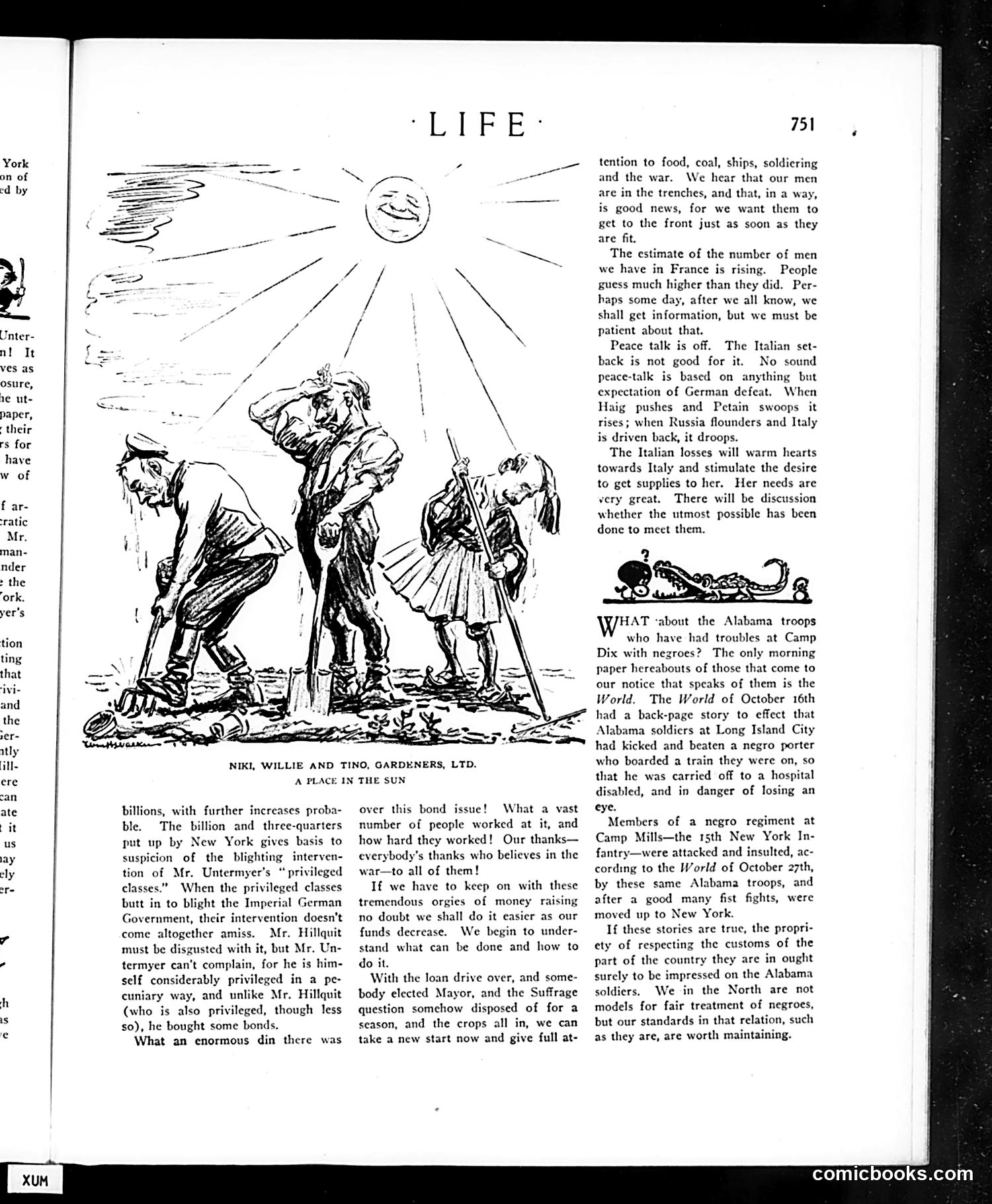
This cartoon satirizes European imperial powers during World War I. The three figures—likely representing Germany (Wilhelm II), Italy (likely "Tino"), and Austria-Hungary ("Niki")—are depicted as gardeners tending the sun, suggesting they're competing to control global resources and influence. The accompanying editorial discusses American war financing, food/coal/ship logistics, and troop deployment to France. A secondary item addresses racial violence: Alabama soldiers allegedly attacked Black soldiers and porters at Camp Dix and Camp Mills. The author criticizes this conduct, arguing Northern racial standards—while imperfect—should be respected and impressed upon Southern troops. The overall page reflects 1918 concerns: mobilizing for war, managing resources, and exposing domestic racial tensions even as America fought abroad.
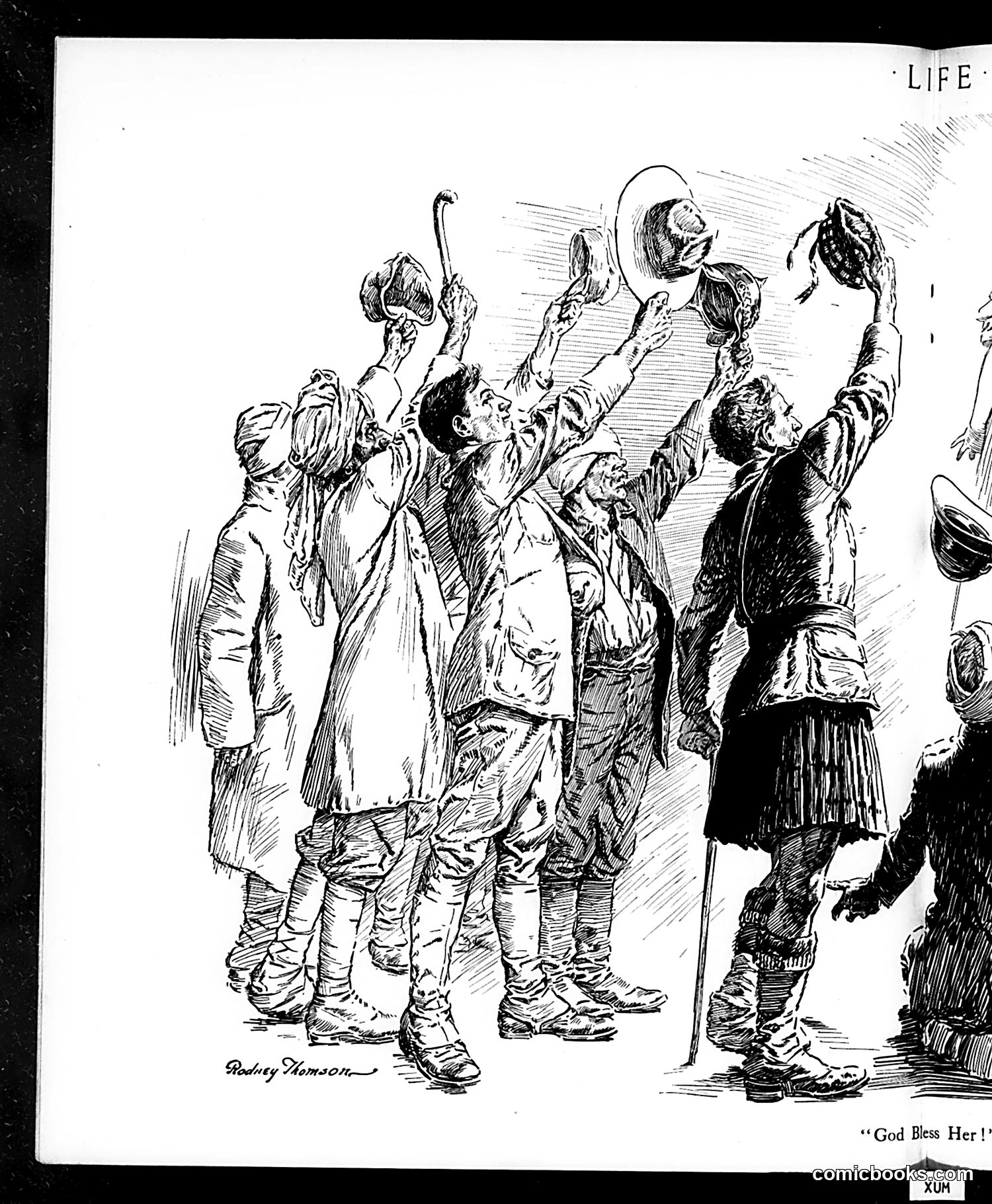
This is a political cartoon by Rodney Thomson showing several men in military/formal dress raising their arms in celebration, holding what appear to be wreaths or laurel branches. The caption reads "God Bless Her!" The cartoon likely commemorates a military or patriotic victory, with the figures celebrating some achievement. However, **without knowing the specific date of this Life magazine issue, I cannot identify which historical event or female figure ("Her") is being referenced.** The style and uniforms suggest this is from the late 19th or early 20th century. The celebratory pose and formal dress indicate this marks a significant national moment, possibly related to a military success or the actions of a notable woman of the era. To accurately identify the specific historical context and the woman being honored, the publication date would be essential.
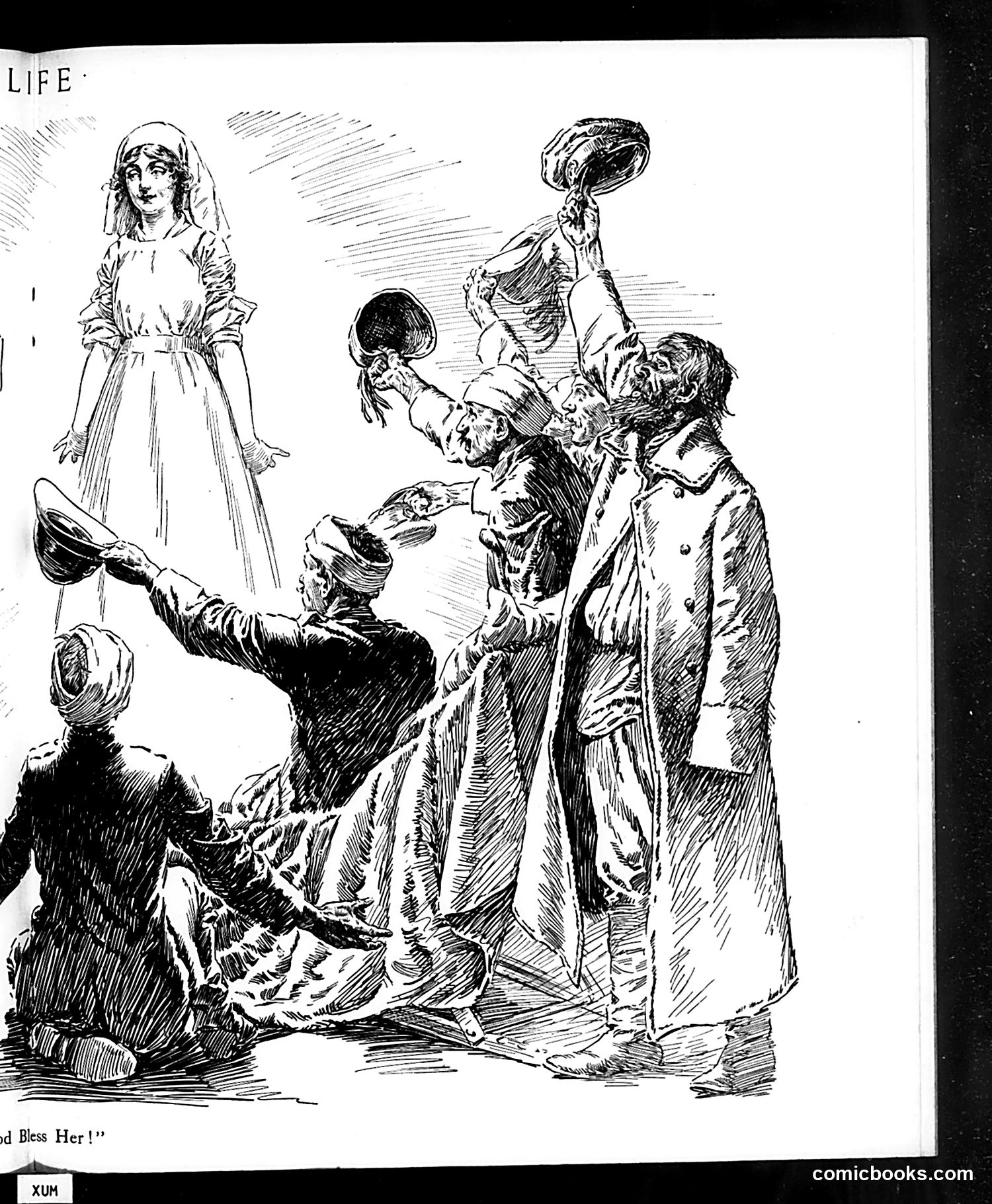
This page from *Life* magazine shows a satirical scene of social charity or welfare. On the left stands a well-dressed young woman in fine clothes and a bonnet, observing from a distance. On the right, several working-class or poor figures (men in worn coats and hats, a woman) gesture toward her with apparent gratitude or supplication. The visible caption fragment "d Bless Her!" suggests the cartoon satirizes *performative charity*—wealthy individuals receiving praise and blessing for charitable acts, likely with minimal personal sacrifice or effort. The composition emphasizes the distance between the benefactor and beneficiaries, satirizing the self-congratulatory nature of upper-class philanthropy in the period. The exact historical context remains unclear without the full caption.
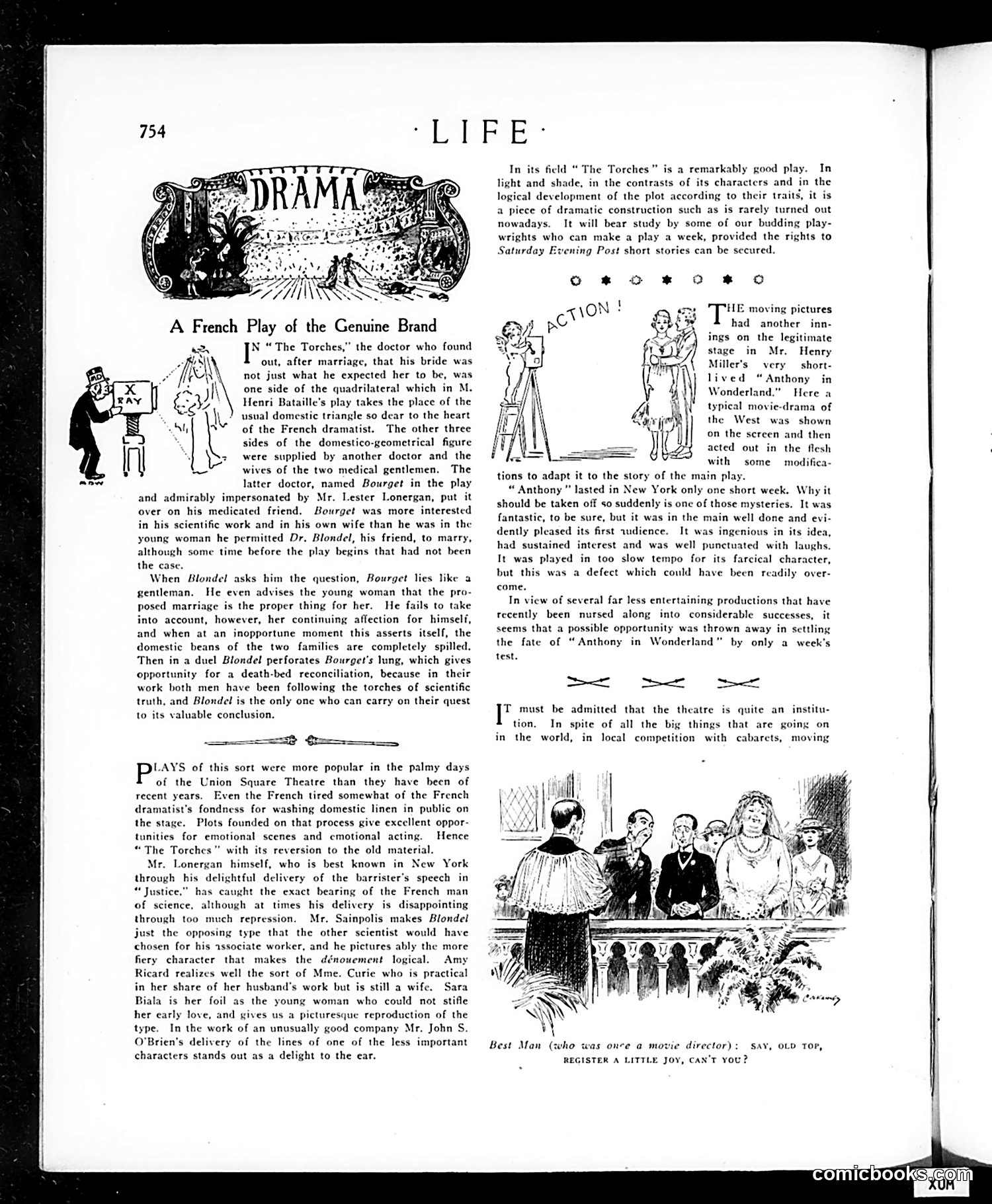
This page reviews two theatrical productions from the early 20th century. **"The Torches"** is a French play by Henri Bataille featuring a quadrilateral romantic entanglement between two doctors and their wives—a departure from the traditional "domestic triangle" common in French drama. The plot involves deception, infidelity, and culminates in a duel. The review praises the play's construction and the performances, particularly Lester Lonergan's portrayal of the scientist Bourget and the company's overall quality. **"Anthony in Wonderland"** was Henry Miller's short-lived theatrical experiment combining film and live performance—showing a Western movie on screen, then recreating scenes onstage with modifications. The production lasted only one week in New York. The review contextualizes both as examples of theatrical trends: French domestic dramas with emotional complexity, and early experiments blending new cinema technology with traditional theater. The cartoons (visible but not detailed in text) appear to illustrate theatrical scenes, including what's captioned as "Best Man (who was once a movie director)."
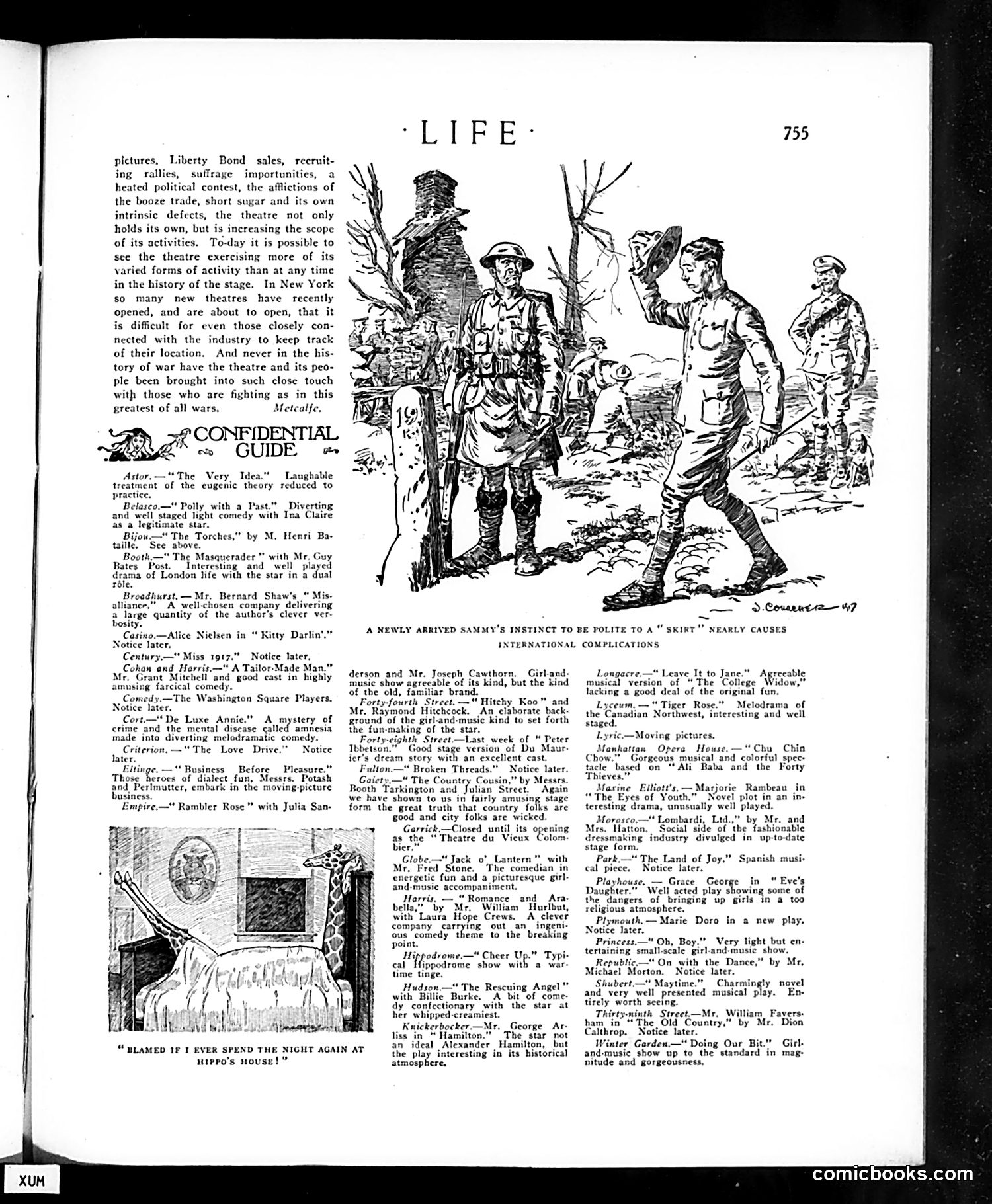
This page from *Life* magazine consists primarily of theatre reviews rather than political cartoons. The main illustration—a sketch by D. Cesare showing American soldiers (identified as "Sammy") encountering a woman—satirizes the social friction arising from American military presence during World War I. The caption jokes that a soldier's attempt at politeness toward a "skirt" (period slang for woman) nearly causes "international complications," suggesting cultural misunderstandings or romantic entanglements between American troops and foreign civilians. The bulk of the page contains condensed Broadway theatre reviews discussing contemporary plays. The introductory text notes how wartime has paradoxically *increased* theatrical activity in New York, as entertainment provides escape during conflict. References to "Liberty Bond sales" and "recruiting rallies" confirm the WWI context and theatre's role in supporting the war effort. The reviews themselves offer no obvious political satire—they're straightforward theatrical criticism of shows ranging from farces to historical dramas.
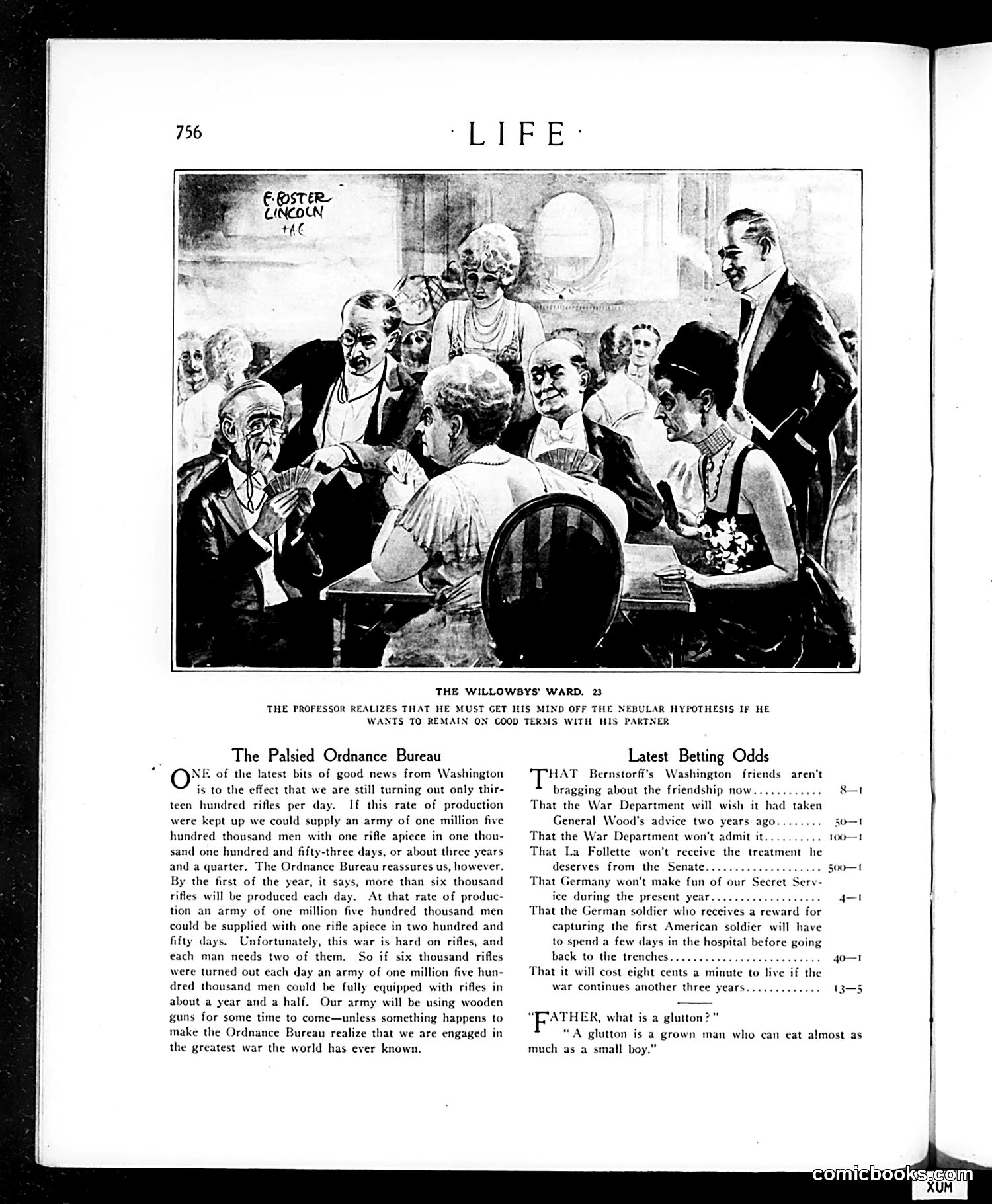
This *Life* magazine page satirizes American military readiness during World War I. The main article, "The Palsied Ordnance Bureau," mocks the slow rifle production rate—only 1,300 rifles daily when the military needs thousands. The satire's bitter point: at current rates, the army would need over three years to equip one million men, yet the Ordnance Bureau claims it will triple production by year's end. The author doubts this, suggesting the bureau doesn't grasp the war's scale and urgency. The cartoon depicts a social gathering where a professor realizes he must abandon his "nebular hypothesis" (scientific work) to maintain his partnership—likely satirizing how civilians must set aside normal life for wartime obligations. "Latest Betting Odds" offers sardonic predictions about the war and politics, including references to Bernstorff (German ambassador) and La Follette (anti-war senator), using impossible odds to mock various wartime absurdities. The final joke about gluttons is unrelated filler humor.
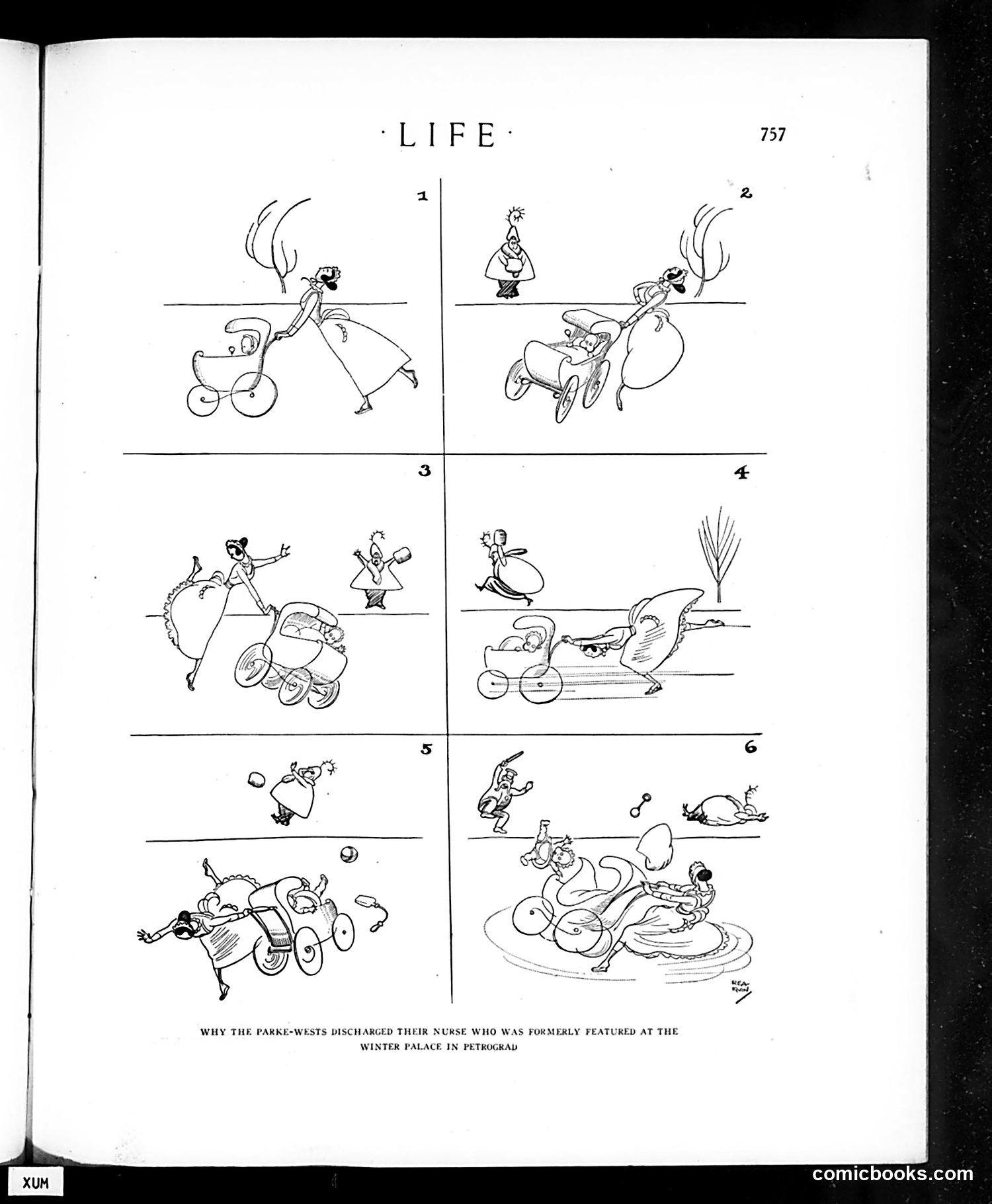
This is a six-panel satirical comic strip depicting why the fictional Parke-West family fired their nurse who "was formerly featured at the Winter Palace in Petrograd" (Russia). The narrative appears to show a caregiver whose chaotic, destructive behavior—depicted across panels 1-6 with increasingly wild scenes of mayhem involving a baby carriage, collisions, and general disorder—makes her unsuitable for childcare, despite her prestigious Russian credentials. The satire targets post-Russian Revolution émigré workers, likely implying that prestigious Russian aristocratic or palace credentials mean nothing when the person is actually incompetent or unstable. This reflects 1920s American attitudes toward Russian émigrés, playing on class anxieties and the idea that foreign credentials shouldn't override obvious unsuitability for employment.
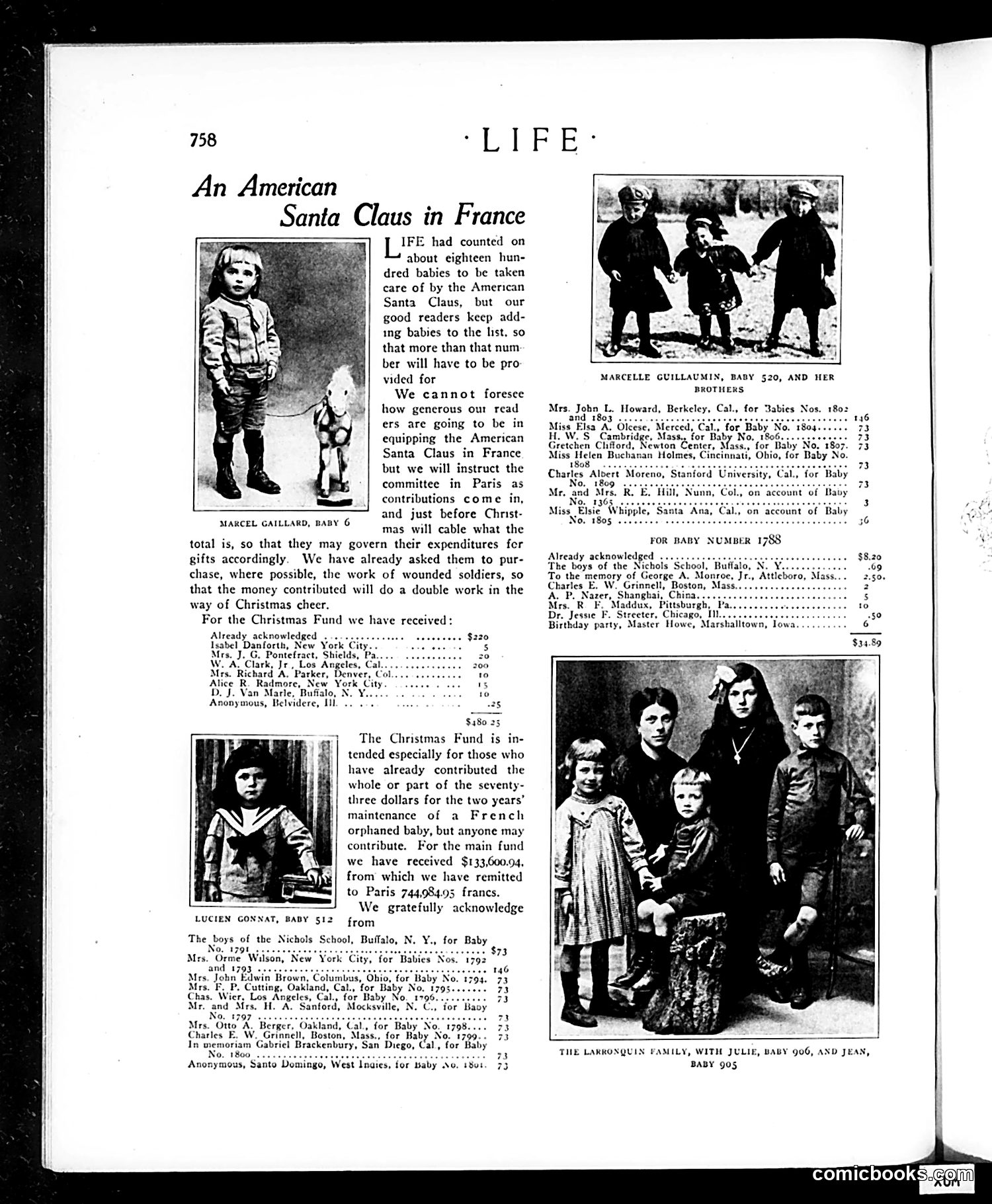
This Life magazine page documents a charitable fundraising campaign—not a cartoon or satire, but rather a social-welfare initiative. Life magazine was organizing donations from American readers to support French orphaned babies following World War I (the text references "wounded soldiers" and maintaining orphans for "two years," suggesting post-WWI reconstruction efforts). The page features photographs of specific French children being sponsored by American donors, with detailed lists of contributors and donation amounts. It explains that Life will compile contributions to instruct a Paris committee on gift purchases, requesting they buy from wounded soldiers' workshops to support disabled veterans. The "American Santa Claus" metaphor frames American charitable generosity as gift-giving. This reflects early 20th-century American philanthropic efforts toward European relief, particularly France as a war-affected ally.
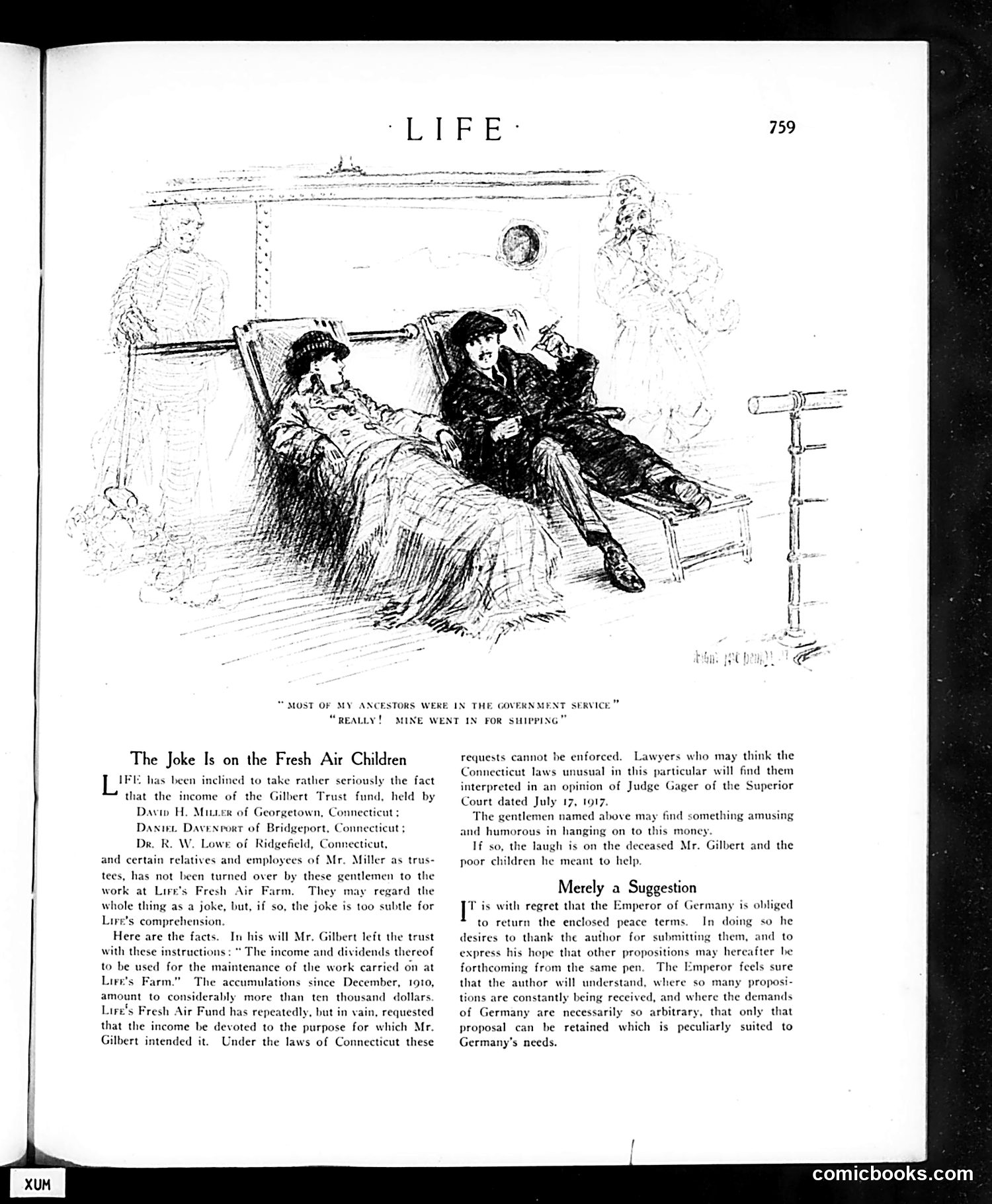
**Main Cartoon:** A sketch shows two figures on a ship's deck discussing ancestry. The caption reads: "Most of my ancestors were in the government service" / "Really! One went in for shipping." This appears to be a gentle social satire about class pretension—suggesting someone boasting of respectable government lineage while their relative was actually engaged in less prestigious commercial work. **Primary Article:** Life criticizes trustees of the Gilbert Trust Fund (held by named Connecticut gentlemen) for withholding income intended for Life's Fresh Air Farm—a children's charitable organization. Since December 1910, over $10,000 has accumulated but not been distributed as the donor specified. Life's tone is scathing: the trustees may find this "amusing," but the joke harms poor children the deceased Mr. Gilbert meant to help. **Secondary Section:** A satirical open letter to Germany's Emperor regarding peace proposals, treating his rejection of terms with mock-formal courtesy. The page reflects Life's role as both satirical entertainer and social watchdog, exposing trustee malfeasance affecting vulnerable children.
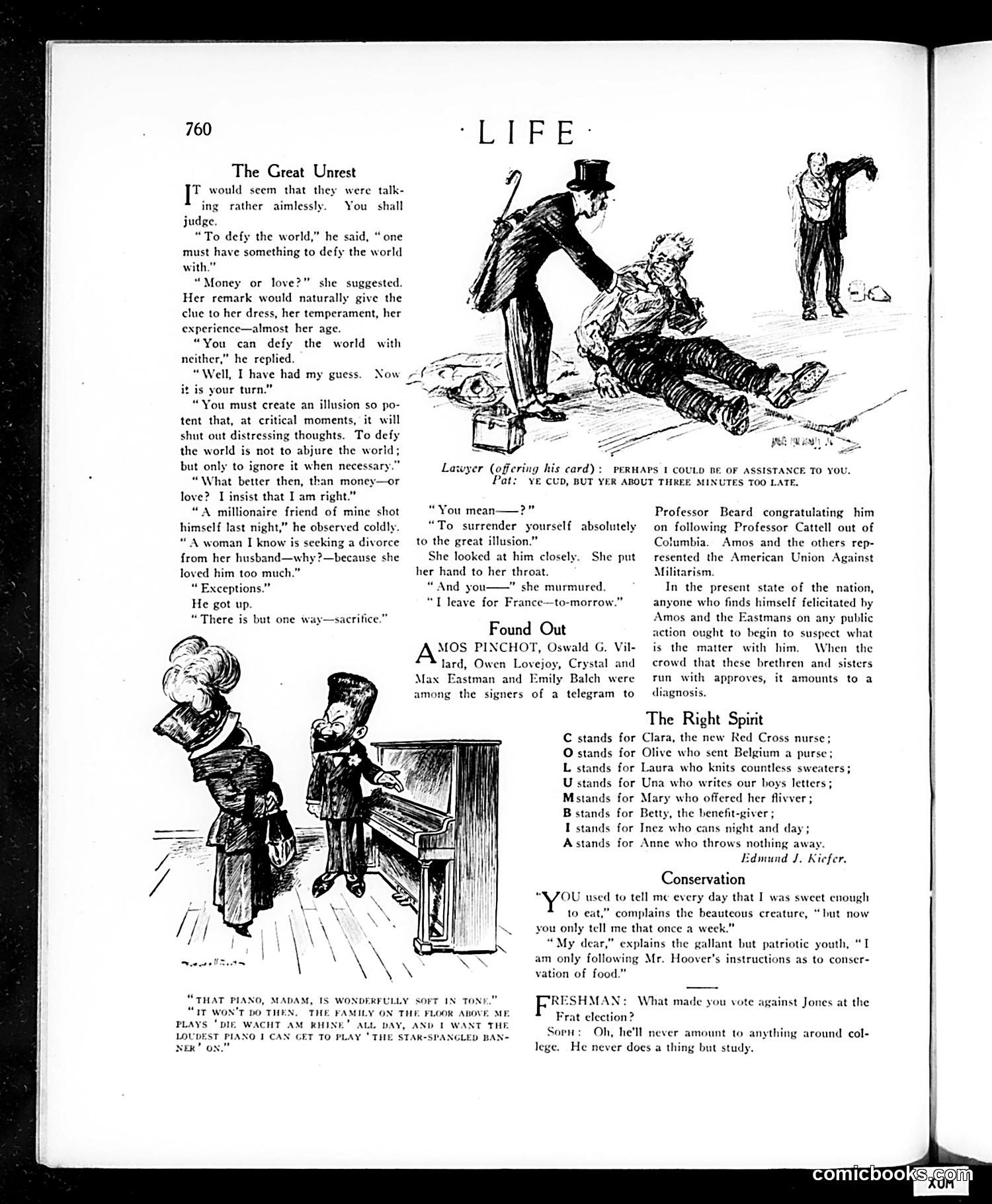
This page from *Life* magazine contains several satirical sketches reflecting early 20th-century American concerns: **"The Great Unrest"** (top): A philosophical dialogue between a man and woman debating how to "defy the world"—through money, love, or illusion. The accompanying cartoon shows a lawyer offering his services to an injured man, who replies he's "three minutes too late," satirizing lawyers' opportunism. **"Found Out"**: References real public figures (Amos Pinchot, Oswald Villard, Owen Lovejoy, and others) who signed a telegram. The text suggests these progressives face suspicion—if establishment figures approve of them, they must be compromised. This reflects wartime divisions over pacifism and radicalism. **"The Right Spirit"**: An acrostic celebrating women's wartime contributions (Red Cross nursing, knitting, canning)—patriotic home-front activities. **"Conservation"**: A joke about food rationing (likely WWI-era), where a young man uses government conservation rhetoric to reduce compliments to his girlfriend, mimicking official appeals. All sketches mock contemporary social anxieties and pretensions.
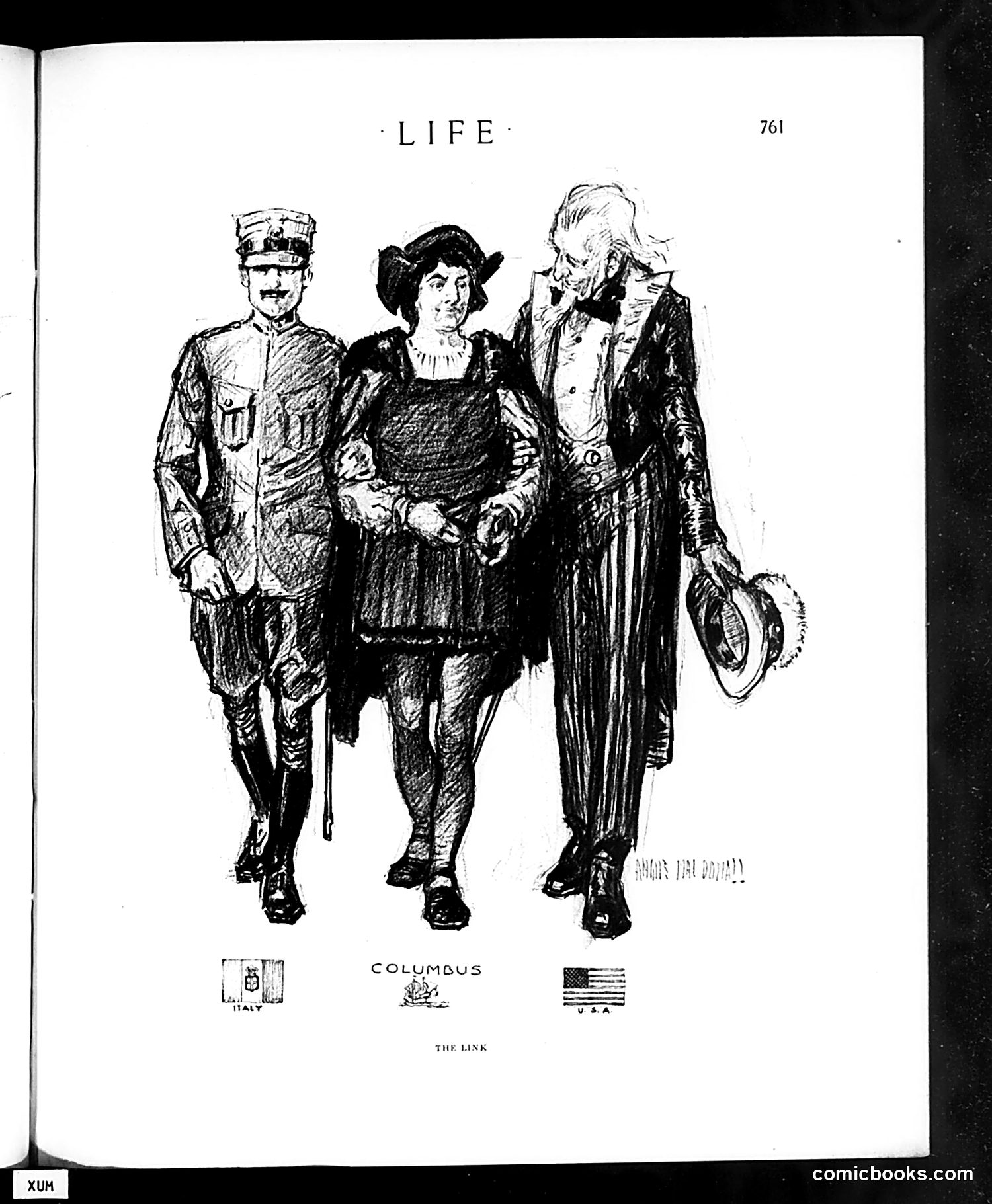
This political cartoon depicts three figures walking together under the title "Columbus" and "The Link," with flags identifying them as Italy, Columbus, and the USA. The satire appears to reference early 20th-century immigration and international relations. Columbus—the historical explorer credited with "discovering" America—serves as a symbolic "link" connecting Italy and the United States. The cartoon likely comments on Italian-American identity and the role of Italian immigrants in American society, using Columbus (himself of Italian origin, claimed by both nations) as a bridge between the two countries. The caricatured military and aristocratic figures suggest commentary on national power dynamics or diplomatic relationships during this period.
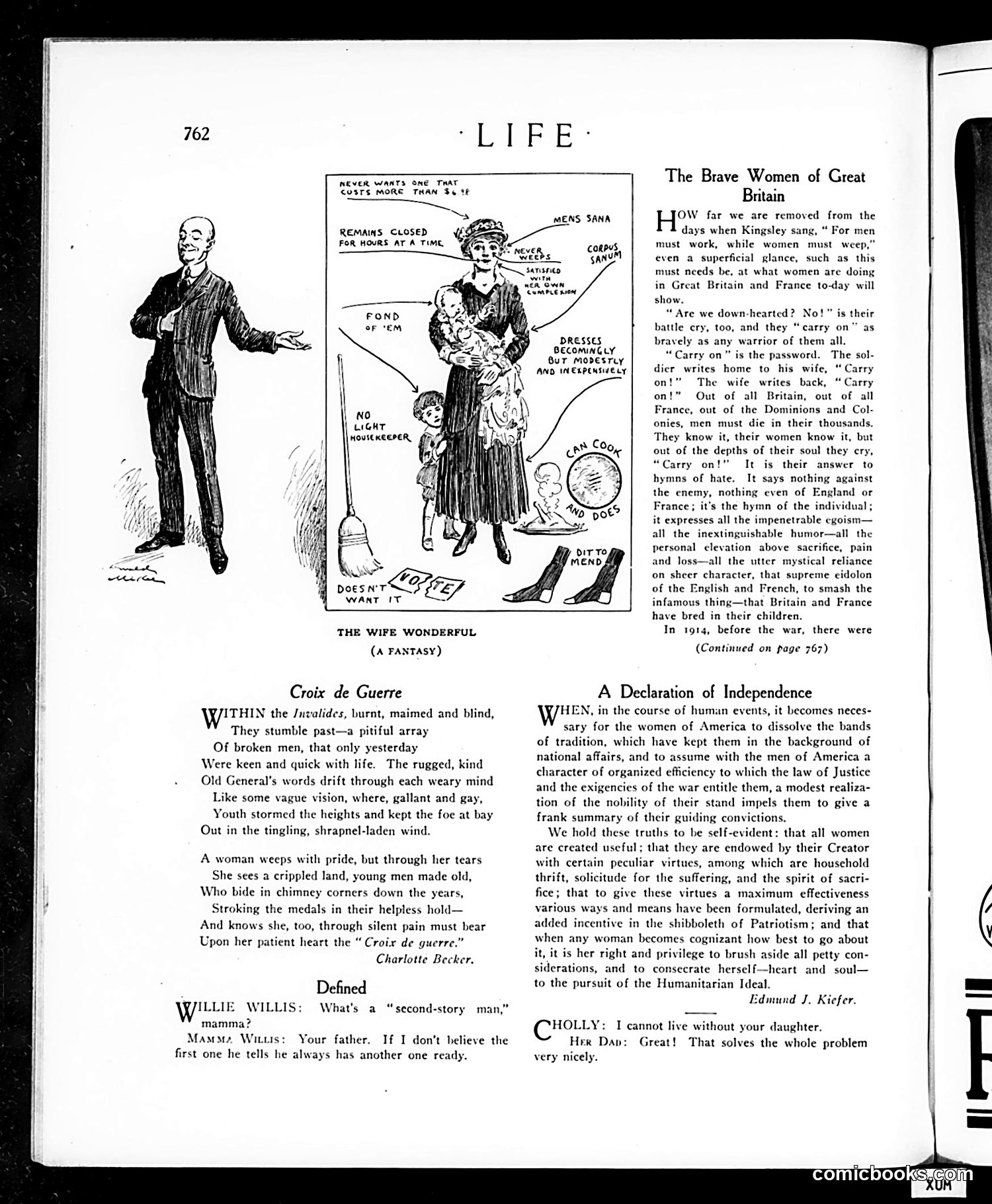
**"The Wife Wonderful (A Fantasy)"** is a satirical cartoon mocking domestic life during WWI. The illustration shows a wife surrounded by household management annotations—her dress costs under $4, she keeps closets closed, avoids expensive items, uses no electric lights, and patches clothes. The fantasy premise satirizes the gap between wartime sacrifice rhetoric and actual women's economic constraints. The husband figure on the left appears unconcerned. The surrounding text celebrates British and French women's patriotic endurance during the war, celebrating their "Carry on!" motto while men die "in their thousands." This creates ironic contrast: while propaganda glorifies women's wartime contributions, the cartoon reveals their actual lives involve strict penny-pinching and household deprivation. The humor relies on the disconnect between heroic patriotic narratives and unglamorous domestic reality—women are praised for courage while simultaneously expected to manage impossible household budgets.
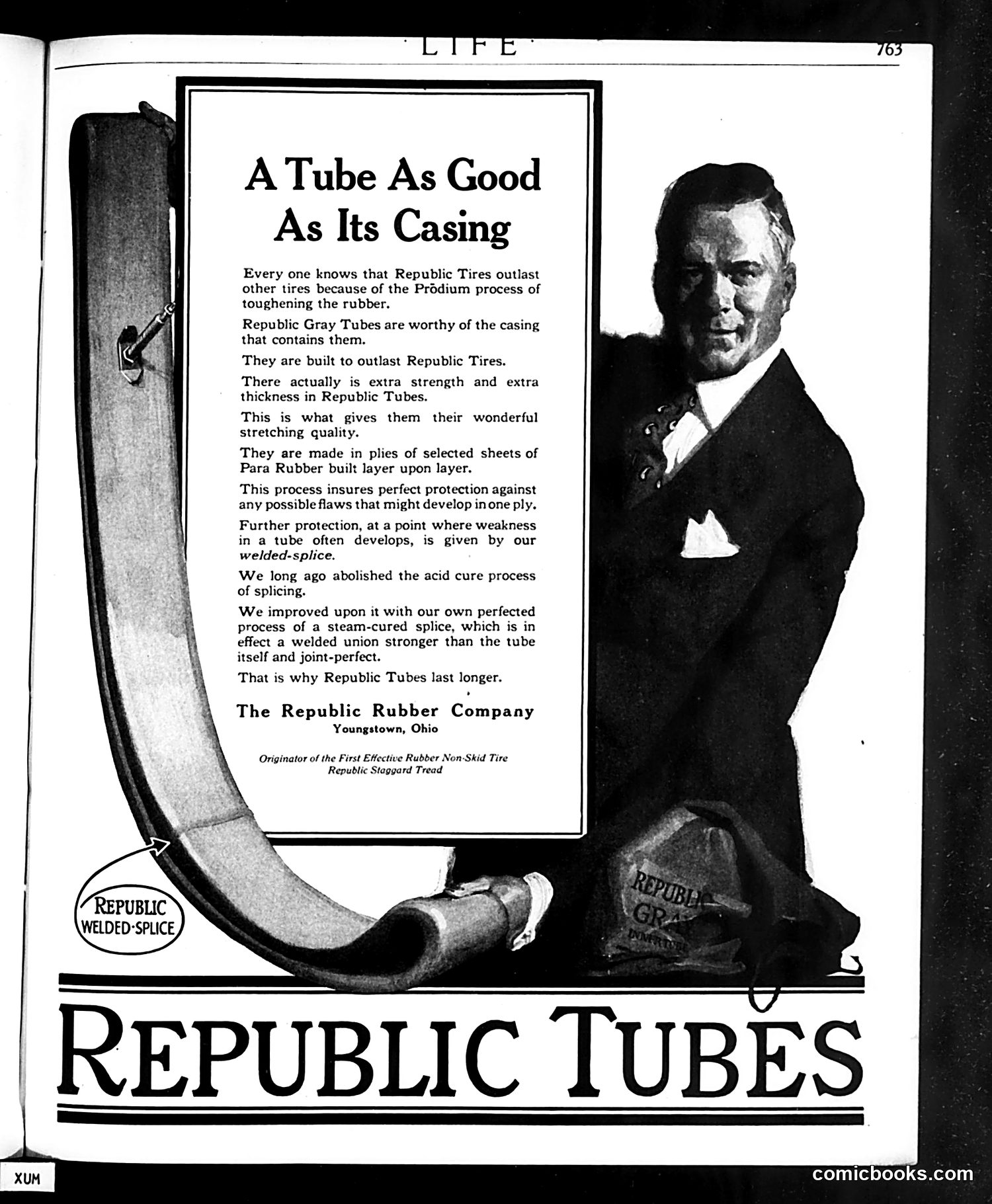
This is a **straightforward advertisement**, not satire or political commentary. It's a full-page ad for Republic Rubber Company (Youngstown, Ohio) promoting their tire tubes, published in *Life* magazine. The page features a well-dressed businessman posing with an oversized tire tube to demonstrate the product's quality and durability. The ad emphasizes technical superiority: Republic tubes are built with multiple rubber plies, use a proprietary "steam-cured splice" (marketed as "welded-splice") rather than acid-curing, and supposedly outlast competitors' products. The headline "A Tube As Good As Its Casing" is a sales pitch claiming the tube quality matches the tire quality—an important selling point when tubes were separate, replaceable components of tire systems. There are no caricatures, political references, or satirical elements. This represents early 20th-century automotive advertising emphasizing manufacturing innovation as a competitive advantage. The "Republic" branding appears on the man's visible pocket area, reinforcing brand presence.
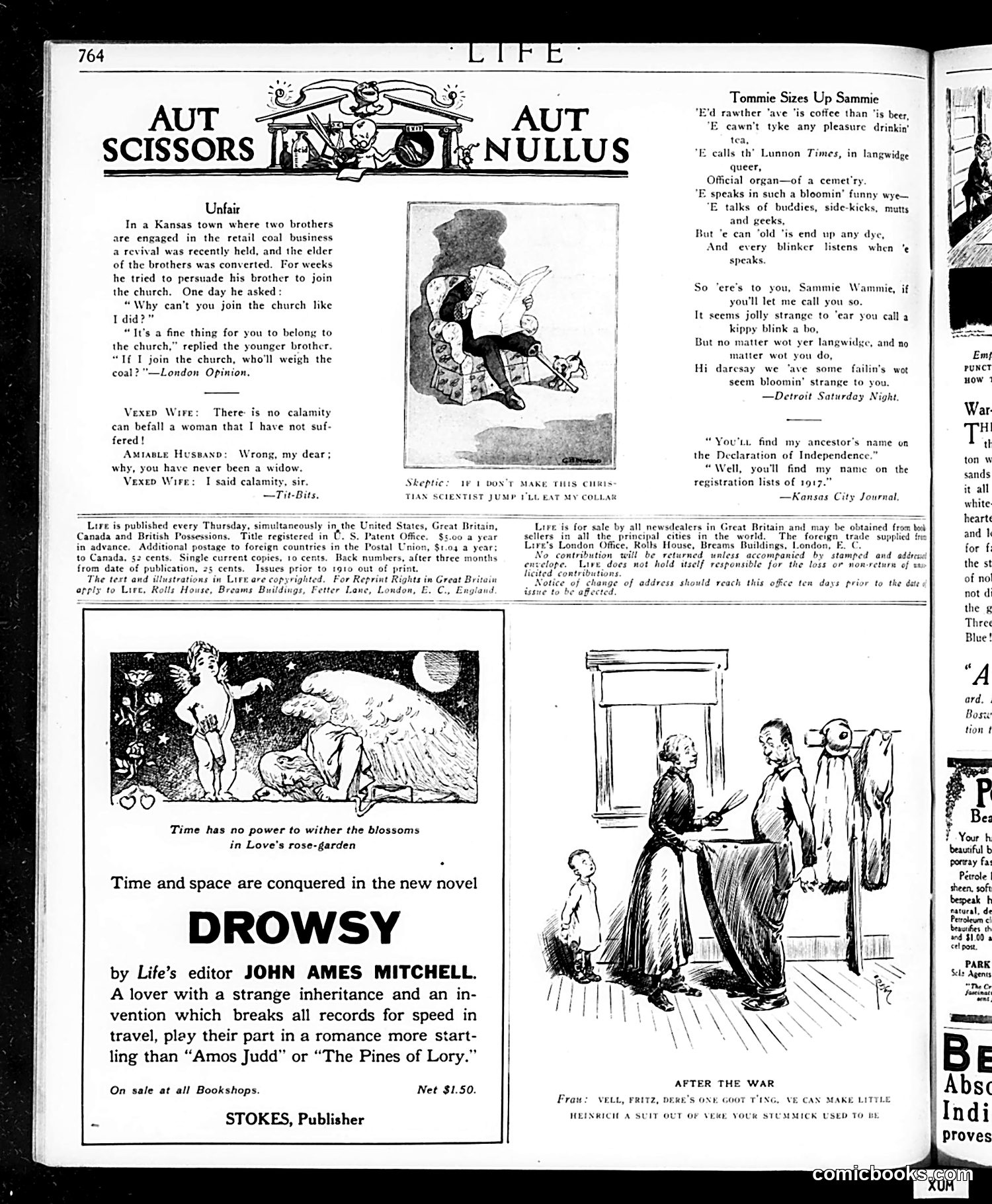
This page contains several satirical pieces typical of Life's humor: **"Unfair"** mocks religious hypocrisy: a coal merchant converts to church but his brother refuses to join, joking that someone must remain to weigh the coal—implying the converted brother can no longer be trusted in business. **"Tommie Sizes Up Sammie"** appears to be post-WWI commentary on American-British cultural differences, written in exaggerated cockney dialect. A British speaker observes that Americans ("Sammie") use strange slang ("kippy blink," "bo") and have odd customs, but acknowledges both nations have peculiarities the other finds strange. **"After the War"** shows Germans (indicated by accents "Vell, Fritz") joking grimly about repurposing fabric from a dead soldier's stomach for a child's suit—dark humor about war's aftermath and material scarcity. The page also advertises a novel called *Drowsy* by Life's editor John Ames Mitchell, emphasizing romantic adventure and technological innovation.
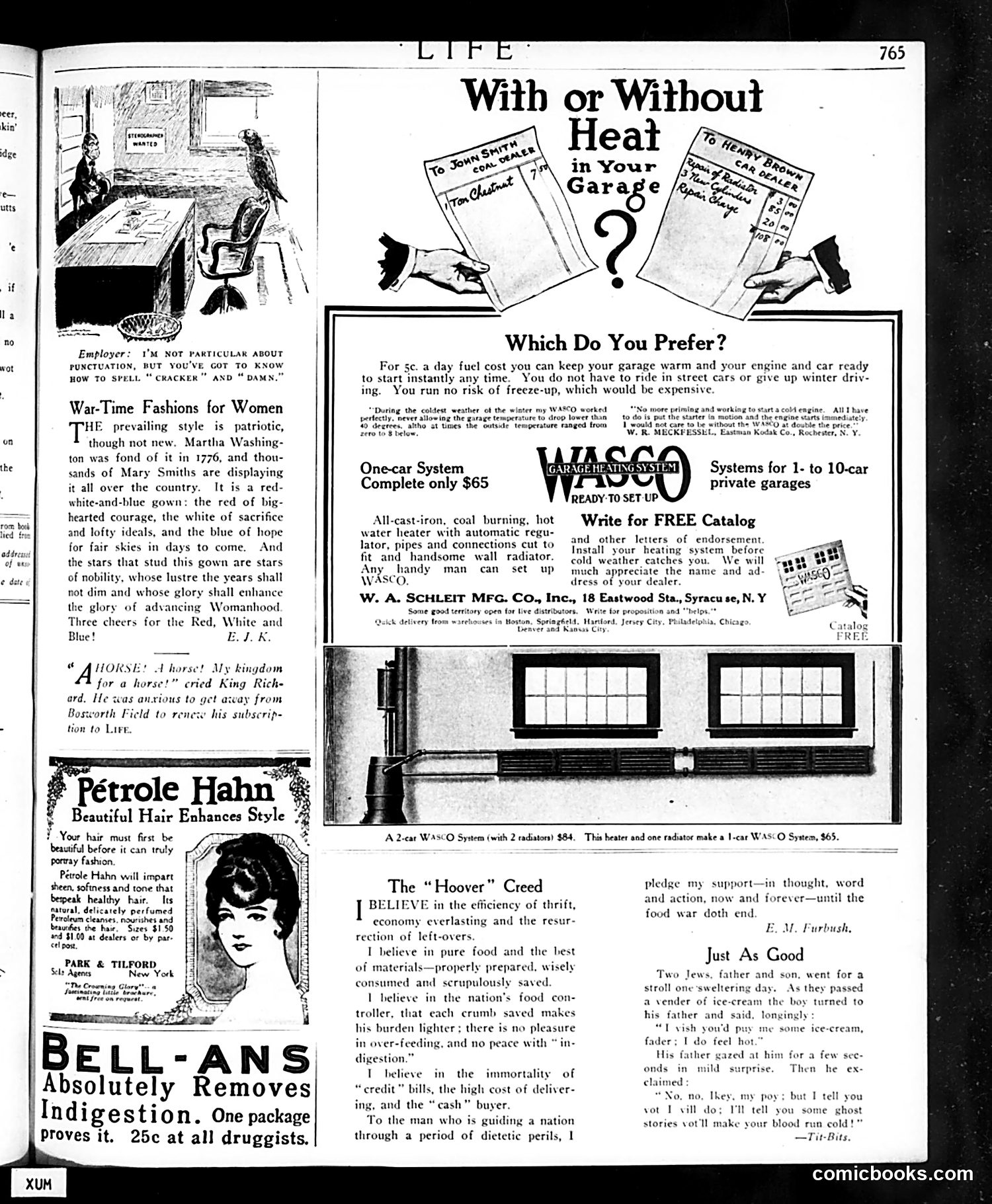
This page is primarily **advertising and filler content** from WWI-era Life magazine, with limited satirical cartooning. The main cartoon (top left) shows an employer correcting an employee's spelling, making a crude joke about the phrase "cracker and dam" — likely a bawdy pun that would have amused contemporary readers. The substantial content includes: - **"War-Time Fashions for Women"**: Patriotic commentary celebrating red-white-blue dresses as representing American values (courage, sacrifice, hope) - **"The Hoover Creed"**: A satirical piece mocking Food Administrator Herbert Hoover's wartime rationing/conservation messaging through mock-religious language about thrift and food control - Multiple product advertisements (hair products, indigestion remedies, garage heating systems) The "Hoover Creed" is the sharpest satirical content, using religious rhetoric to lampoon government food restrictions during WWI—suggesting Americans viewed rationing policies as preachy or excessive.
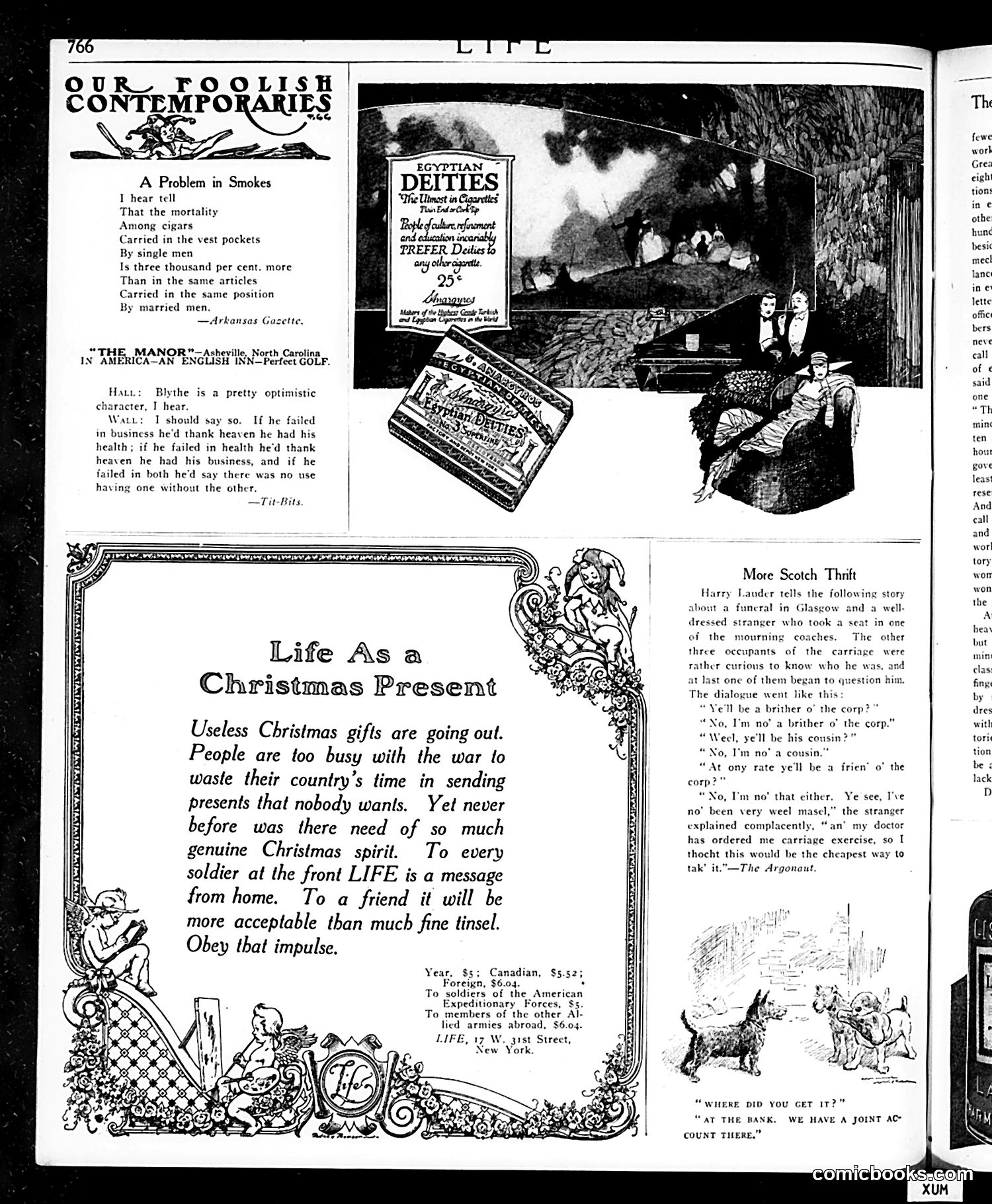
This page contains several satirical pieces typical of WWI-era *Life* magazine: **"A Problem in Smokes"** jokes that cigars in single men's vest pockets have vastly higher "mortality" (are smoked/consumed) than those carried by married men—implying married men are more restrained or their wives control their habits. **"The Manor" snippet** quotes an optimistic character named Blythe who finds silver linings in any misfortune (failed business? grateful for health; failed health? grateful for business), satirizing blind optimism. **"Life As a Christmas Present"** is an advertisement encouraging readers to send *Life* magazine subscriptions to soldiers at the front during WWI, framing it as meaningful wartime communication rather than frivolous tinsel. **"More Scotch Thrift"** attributes a humorous anecdote to Harry Lauder (famous Scottish entertainer) about a well-dressed stranger attending a funeral solely for free carriage exercise prescribed by his doctor—poking fun at Scottish frugality. All pieces employ gentle, era-appropriate humor about social habits and character types.
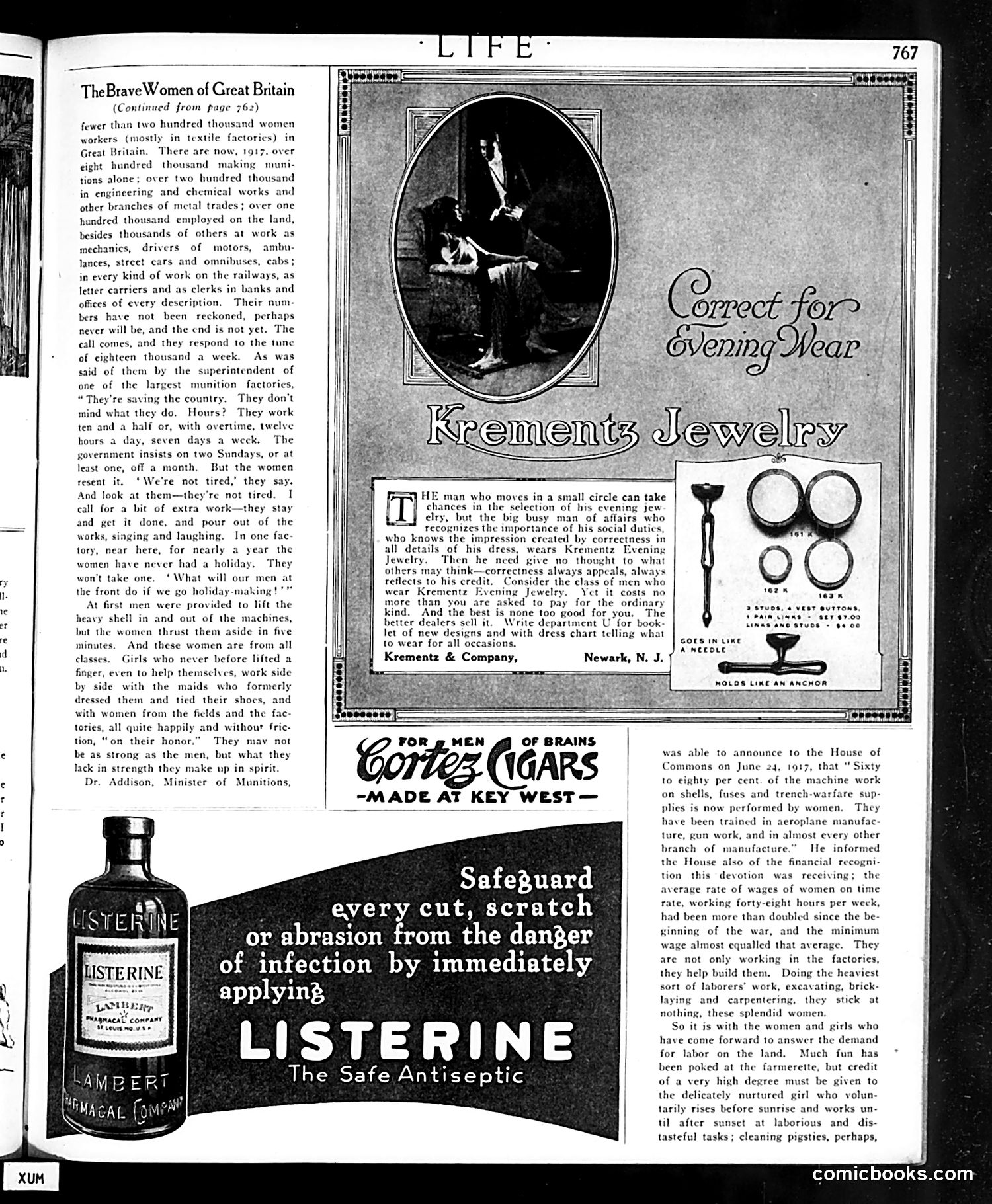
This 1917 *Life* magazine page celebrates British women's contributions to World War I manufacturing. The article (left column) describes how over 800,000 women had entered munitions factories, engineering works, and transportation roles—unprecedented labor mobilization. The text quotes a munitions superintendent praising their work ethic: they labor 10-12 hours daily, seven days weekly, resist taking holidays, and cross class boundaries working "quite happily and without friction." The satire is subtle: while ostensibly praising women's patriotic sacrifice, the piece emphasizes their cheerful exploitation—grueling hours, doubled wages still meager by male standards, and moral pressure ("What will our men at the front do?") replacing fair compensation. The page also contains period advertisements (Krementz jewelry, Listerine antiseptic, Cortes cigars) unrelated to the article's content, typical of magazine layout of that era.
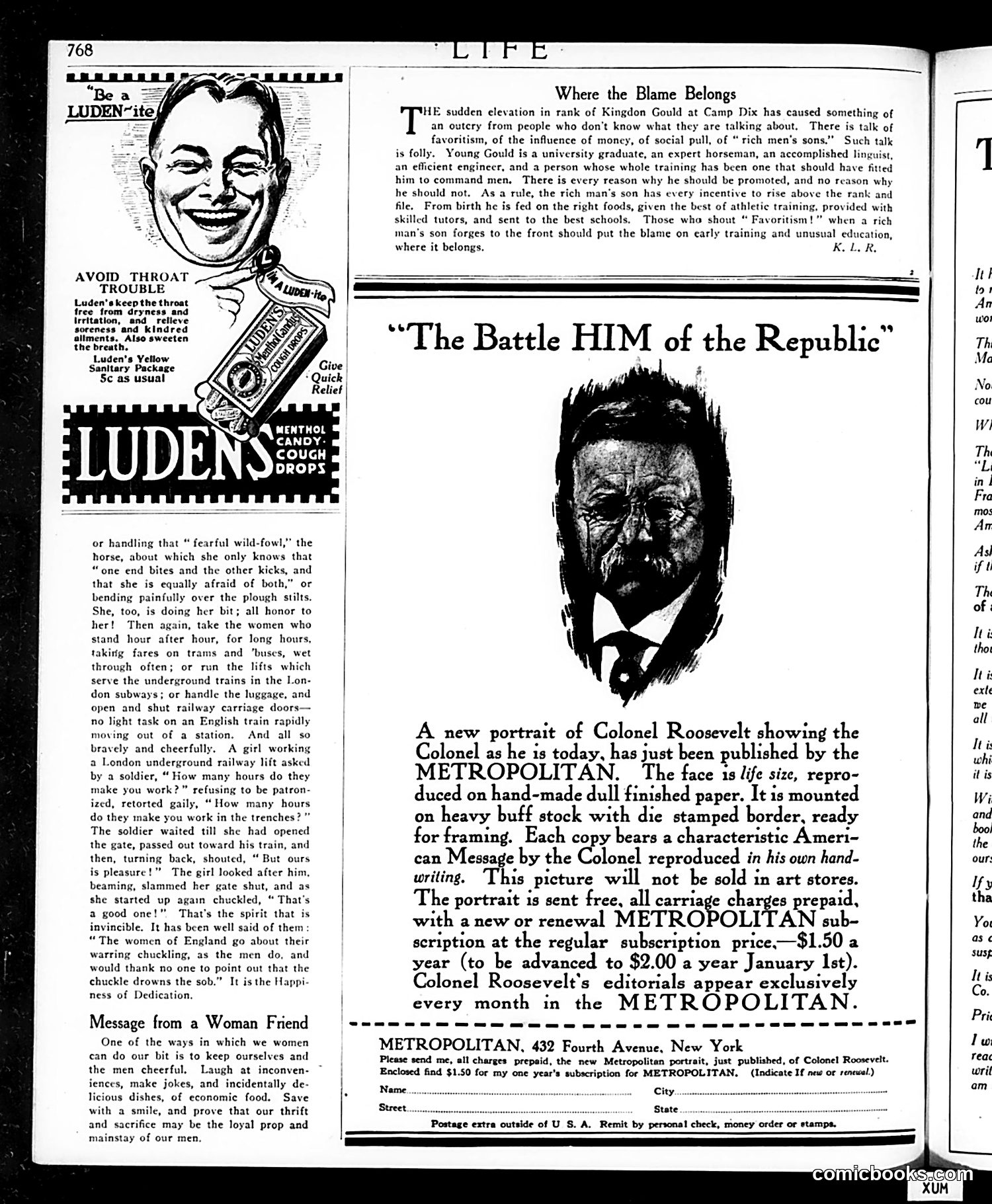
This page contains multiple elements typical of WWI-era Life magazine: **Main Content:** An essay titled "Where the Blame Belongs" defends Kingdon Gould's rapid military promotion at Camp Dix against accusations of favoritism. The author argues Gould's elevation is merit-based, citing his education, linguistic skills, horsemanship, and engineering expertise. The piece suggests critics unfairly blame "rich men's sons" when early advantages (superior training, tutors, schools) naturally produce capable officers. This reflects period attitudes justifying class-based advancement through inherited advantage. **Supporting Material:** An adjacent section celebrates women's wartime contributions—tram conductors, lift operators, railway workers—in patronizing but admiring tone. A "Message from a Woman Friend" urges women to maintain cheerfulness and thrift as patriotic duty. **Advertisement:** A Ludens cough drops ad occupies the left margin. **Promotion:** The page advertises a Colonel Roosevelt portrait offer tied to Metropolitan magazine subscriptions, appealing to patriotic sentiment. The page overall reflects American WWI-period values: class deference, gendered patriotism, and hero-worship of Roosevelt.
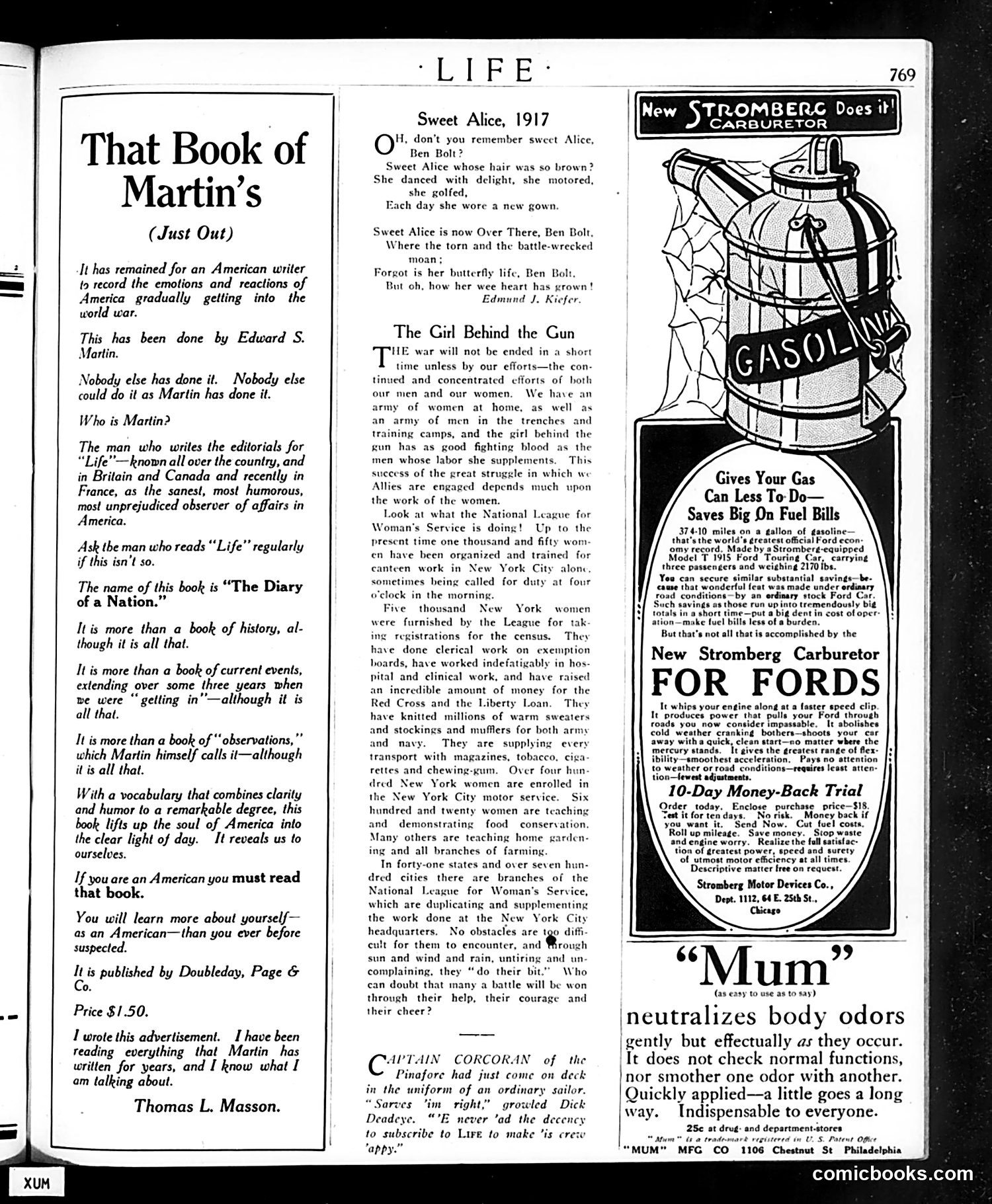
This page contains **advertisements and WWI-era content**, not political cartoons. The main left advertisement promotes Edward S. Martin's book *"The Diary of a Nation,"* about America's emotional experience entering World War I. The endorsement emphasizes Martin as Life magazine's editor—a trusted, "sanest" observer of American affairs. The center contains two pieces celebrating women's war contributions: 1. **"Sweet Alice, 1917"** — a poem reworking the Civil War-era song "Sweet Alice, Ben Bolt," contrasting her pre-war frivolity (dancing, motoring, new gowns) with her current sacrifice "Over There" (in WWI combat zones). 2. **"The Girl Behind the Gun"** — an article praising women's wartime work: organizing canteens, census work, knitting supplies, teaching food conservation, and motor service across 41 states. The right side shows advertisements for a Stromberg carburetor (fuel efficiency) and "Mum" deodorant—typical period products. The page reflects **1917 American patriotic sentiment**, celebrating women's mobilization for war efforts while maintaining gendered roles (support work rather than combat).
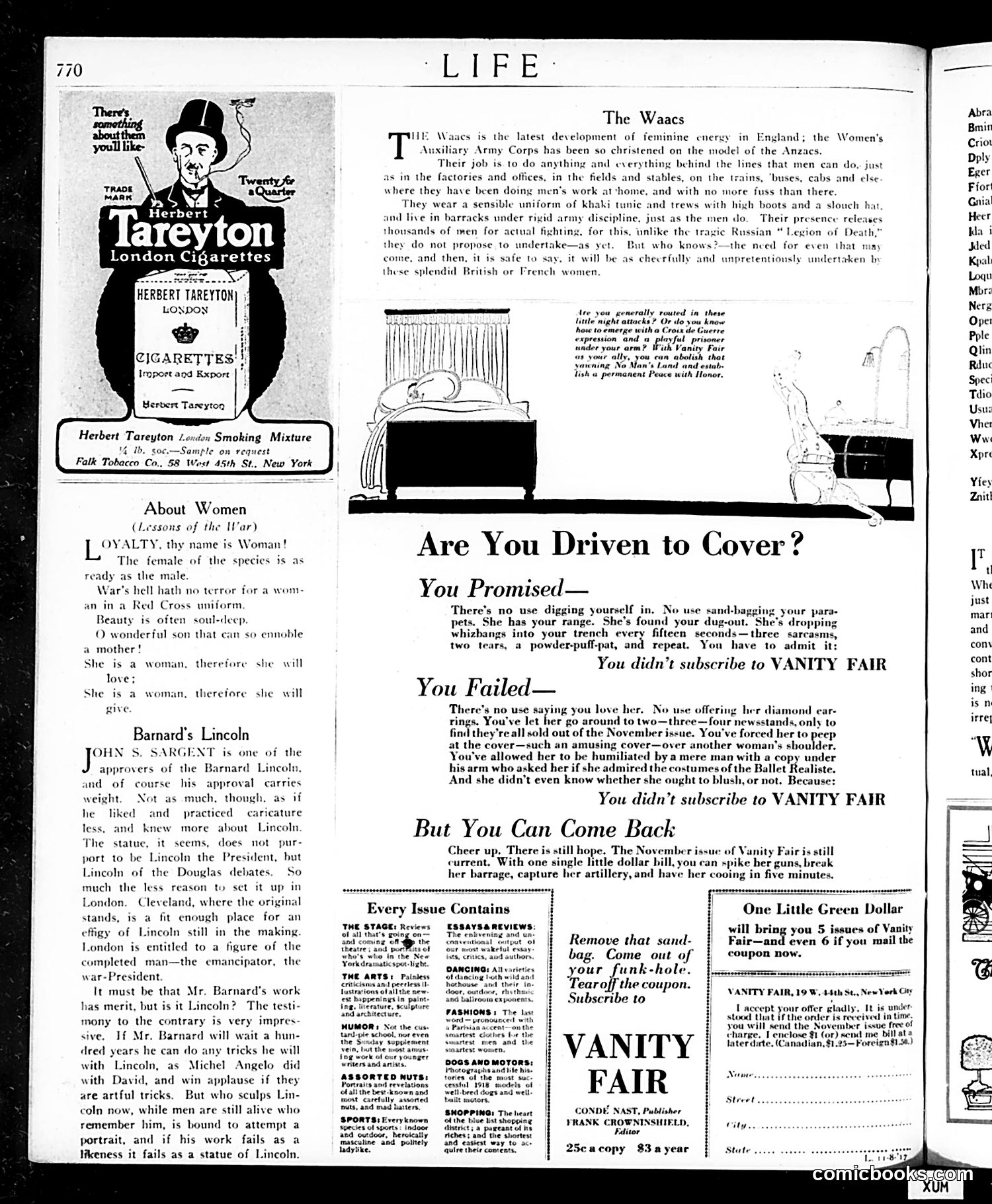
This page contains **wartime propaganda and advertising** from WWI-era England. **"The Waacs" article**: Celebrates the Women's Auxiliary Army Corps, newly established to free men for combat by performing support work (clerical, agricultural, transportation). The text emphasizes their patriotic "sensible" uniforms and discipline, positioning female military service as a patriotic duty. The underlying message suggests women are naturally suited to this subordinate role while praising their sacrifice. **"About Women" section**: Contains patriotic poetry celebrating female loyalty and self-sacrifice during wartime, presented as inherent female virtues. **"Are You Driven to Cover?" advertisement**: A humorous rebuke to male readers who failed to subscribe to *Vanity Fair*, using their girlfriends' embarrassment as motivational guilt. It jokingly positions the magazine as essential to romantic success—a clever guilt-based marketing pitch targeting soldiers. The **cigarette advertisement** (Tareyton) is standard period marketing. Overall, the page blends wartime morale-boosting with commercial messaging typical of American magazines addressing WWI audiences.
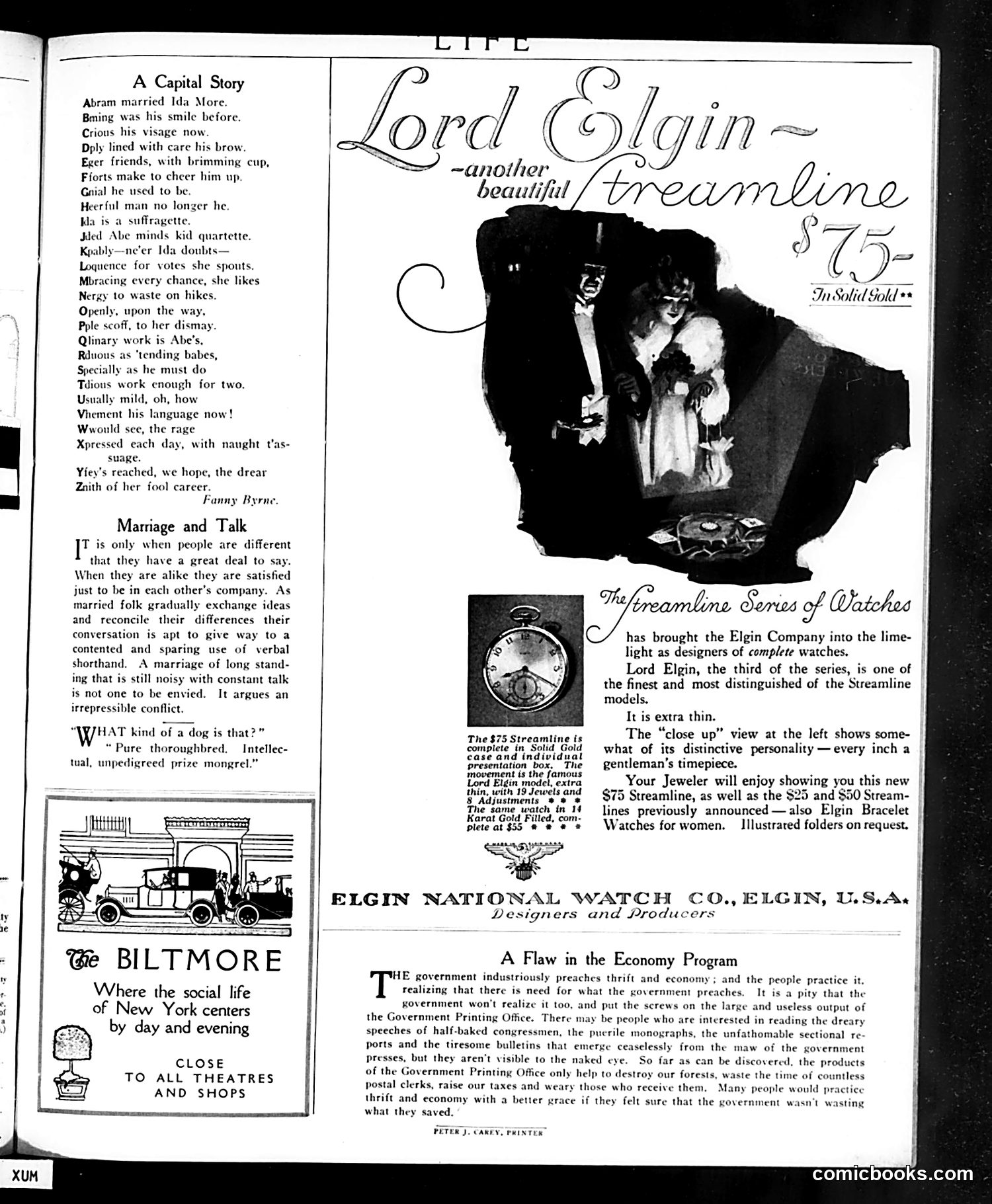
This page combines satirical commentary on gender roles with period advertising. **"A Capital Story" (alphabetical poem):** This satirizes the women's suffrage movement through the story of Ida, a woman activist whose husband Abram has become miserable. The poem, arranged alphabetically from A-Z, depicts Ida as neglecting domestic duties (cooking, housework) to campaign for voting rights, leaving Abram to handle childcare and household tasks. He's portrayed as increasingly angry and resentful. The concluding lines hope her "fool career" has ended. This reflects anti-suffrage sentiment common in the 1920s, mocking women's political engagement as destructive to traditional marriage and family. **"Marriage and Talk":** A brief essay arguing that long marriages naturally become quieter as couples achieve understanding—framing constant conversation as a sign of marital discord. **Lower section:** Contains ads for the Biltmore hotel/theaters and Elgin watches, plus "A Flaw in the Economy Program"—satire criticizing government waste (excessive printing) while citizens practice thrift. The page reflects 1920s social tensions over women's roles and government efficiency concerns.
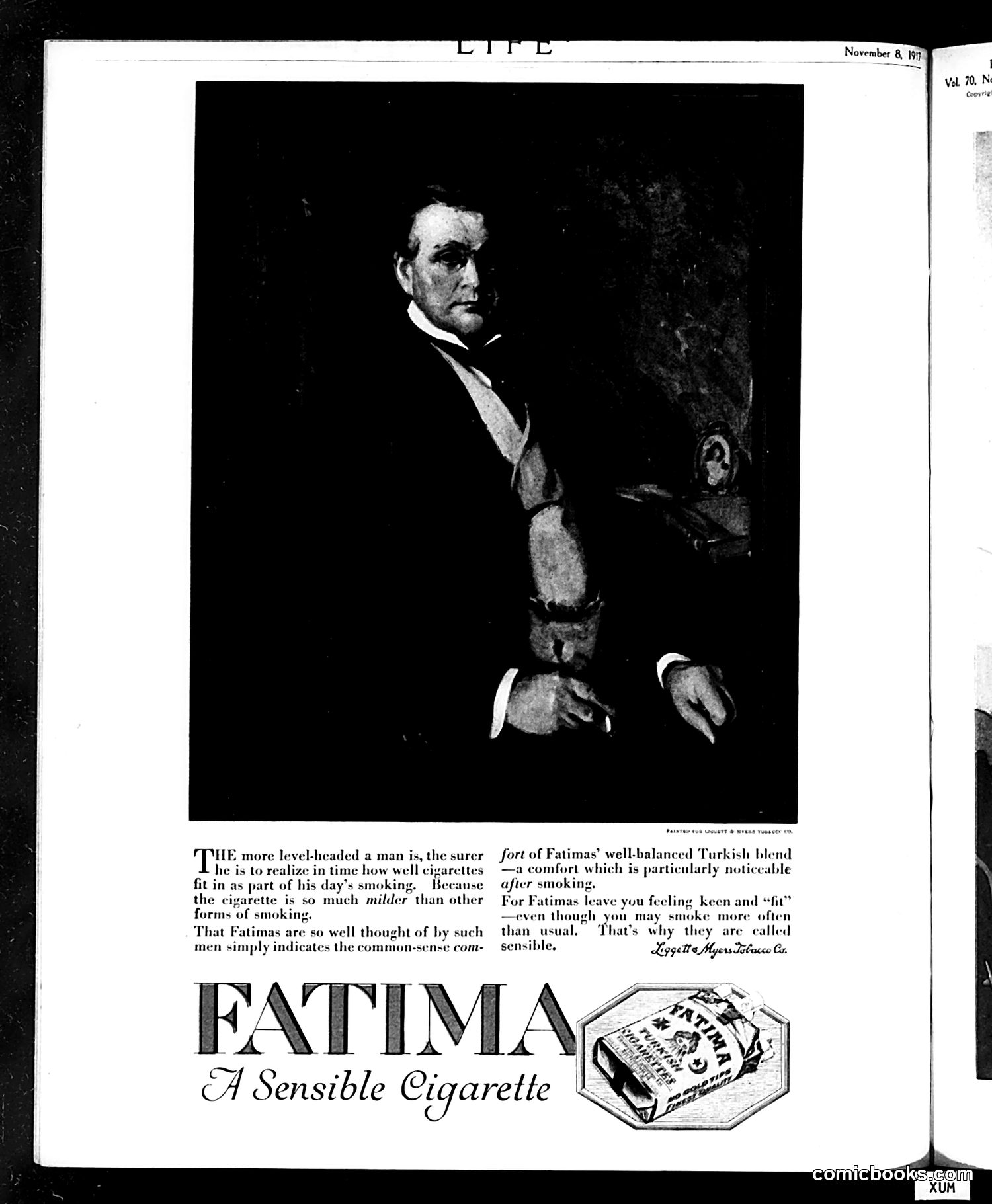
This is primarily a **cigarette advertisement**, not political satire. It features a formal portrait of a distinguished-looking older gentleman in formal attire, presented as an endorsement figure for Fatima cigarettes. The ad's pitch appeals to "level-headed" men—positioning cigarette smoking as a rational, sensible choice. The marketing copy emphasizes the "well-balanced Turkish blend" and claims Fatimas are notably mild compared to other brands, promoting a feeling of comfort "after smoking." The term "sensible cigarette" and the appeal to common-sense reasoning reflect early 20th-century cigarette marketing strategies that attempted to normalize and legitimize smoking by associating it with rationality and good judgment. The identity of the portrait subject is unclear from visible text. This represents the era when Life magazine carried substantial advertising alongside satirical content, and when tobacco companies freely advertised in mainstream publications without health warnings.