
Life, 1917-11-08 · page 35 of 40
Life — November 8, 1917 — page 35: what you’re looking at
What you’re looking at
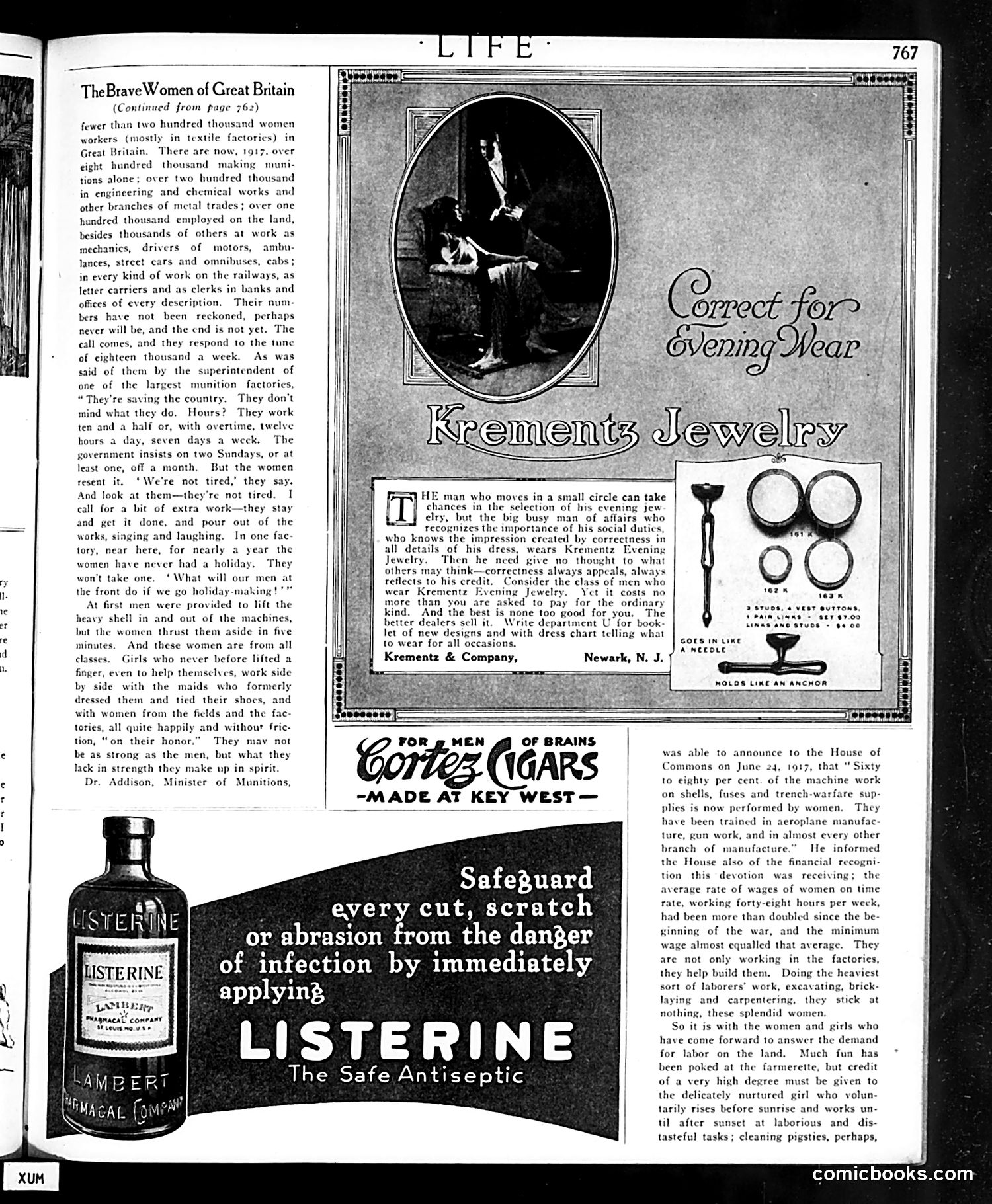
This 1917 *Life* magazine page celebrates British women's contributions to World War I manufacturing. The article (left column) describes how over 800,000 women had entered munitions factories, engineering works, and transportation roles—unprecedented labor mobilization. The text quotes a munitions superintendent praising their work ethic: they labor 10-12 hours daily, seven days weekly, resist taking holidays, and cross class boundaries working "quite happily and without friction." The satire is subtle: while ostensibly praising women's patriotic sacrifice, the piece emphasizes their cheerful exploitation—grueling hours, doubled wages still meager by male standards, and moral pressure ("What will our men at the front do?") replacing fair compensation. The page also contains period advertisements (Krementz jewelry, Listerine antiseptic, Cortes cigars) unrelated to the article's content, typical of magazine layout of that era.
📄 Transcribed text from this page (OCR, searchable)
Machine-transcribed from the original scan — historical spelling and the odd misread are preserved.
¢ r TheBrave Women of Great Britain (Continued from page 762) fewer than two hundred thousand women workers (mostly in textile factories) in Great Britain, ‘There are now, 1917, over eight hundred thousand making muni- tions alone; over two hundred thousand in engineering and chemical works and other branches of metal trades; over one hundred thousand employed on the land, besides thousands of others at work as mechanics, drivers of motors, ambu- lances, street cars and omnibuses, cabs; in every kind of work on the railways, as letter carriers and as clerks in banks and offices of every description. Their num- bers have not been reckoned, perhaps never will be, and the end is not yet. The call comes, and they respond to the tune of eighteen thousand a week. As was said of them by the superintendent of one of the largest munition factories, “They're saving the country. They don’t mind what they do. Hours? They work ten and a half or, with overtime, twelve hours a day, seven days a week, The government insists on two Sundays, or at least one, off a month, But the women resent it. ‘We're not tired,’ they say. And look at them—they’re not tired. I call for a bit of extra work—they stay and get it done, and pour out of the works, singing and laughing, In one fac tory, near here, for nearly a year the women have never had a holiday. They won't take one. ‘What will our men at the front do if we go holiday-making! At first men were provided to lift the shell in and out of the machines, but the women thrust them aside in five minutes, And these women are from all classes. Girls who never before lifted a finger, even to help themselves, work side by side with the maids who formerly dressed them and tied their shoes, and with women from the fields and the fac tories, all quite happily and without fric- tion, They mav not be as strong as the men, but what they lack in strength they make up in spirit. Dr. Addison, Minister of Munitions, on their honor.” Cree for? vening cap is all details of his dress, wears Krementz Even Jewelry. Then he need give no thought to w others may think—correctness always appeals, alw wear Krementz Evening Jewelry. Yet it costs more than you are asked to pay fort let of new designs and with dress chart telling w to wear for all occasions, Krementz & Company, [FRR] HE man who moves ina small circle can take i chances in the selection of his evening jew- | Tj elry, but the big busy man of affairs who recognizes the importance of his social duties, who knows the impression created by correctness. in reflects to his credit. Consider the class of men who he ordinary kind. And the best is none too good for you. The Veninatanentacsiencs better dealers sell it. Write department U for book- linegansertes see ee Newark, N. J. ins hat ays > 162 « ne 169% hat GOS IN Like A NECOLE novo CAN ANCHOR, -MADE AT KEY WEST— Safeguard every cut, scratch or abrasion from the danger of infection by immediately applying, LISTERINE The Safe Antiseptic was able to announce to the H Commons on June 24, 1917, that “S to eighty per cent. of the machine work on shells, fuses and trench-warfare sup plies is now performed by women. They have been trained in aeroplane manufac ture, gun work, and in almost every other branch of many the House also of the financial recogni tion this devotion was receiving; the facture.” He informed average rate of wages of women on time te, working forty-eight hours per week, had been more than doubled since the be- ginning of the war, and the minimum wage almost equalled that average. They are not only working in the factories, they help build them. Doing the heaviest sort of laborers’ work, excavating, br laying and carpentering, they stick at nothing, these splendid women. So it is with the women and girls who have come forward to answer the demand for labor on the land, Much fun has been poked at the farmerette, but credit of a very high degree must be given to the delicately nurtured girl who volun- tarily rises before sunrise and works un- til after sunset at laborious and dis- tasteful tasks ; cleaning pigsties, perhaps, comicbooks.com