
Life, 1917-11-08 · page 19 of 40
Life — November 8, 1917 — page 19: what you’re looking at
What you’re looking at
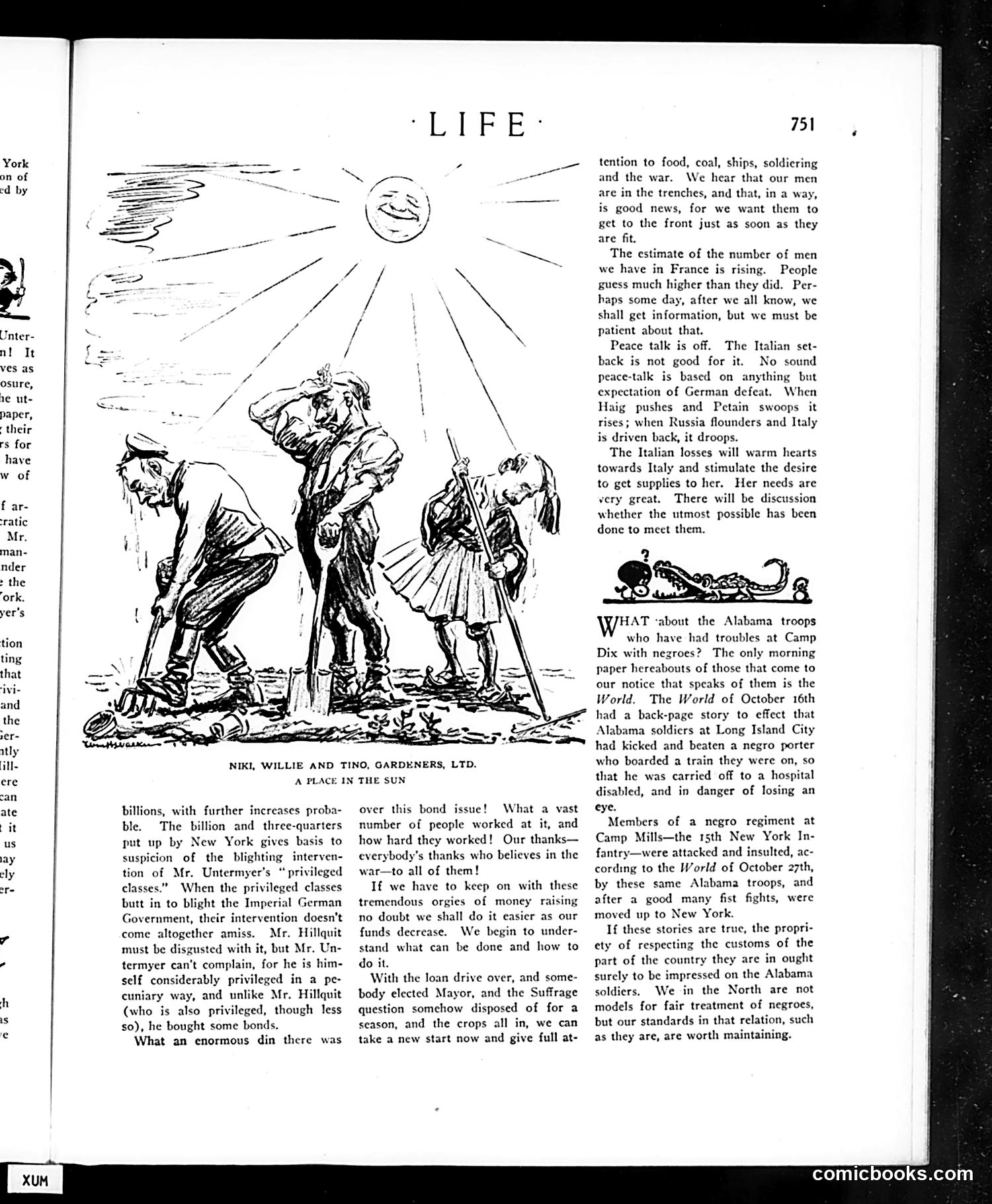
This cartoon satirizes European imperial powers during World War I. The three figures—likely representing Germany (Wilhelm II), Italy (likely "Tino"), and Austria-Hungary ("Niki")—are depicted as gardeners tending the sun, suggesting they're competing to control global resources and influence. The accompanying editorial discusses American war financing, food/coal/ship logistics, and troop deployment to France. A secondary item addresses racial violence: Alabama soldiers allegedly attacked Black soldiers and porters at Camp Dix and Camp Mills. The author criticizes this conduct, arguing Northern racial standards—while imperfect—should be respected and impressed upon Southern troops. The overall page reflects 1918 concerns: mobilizing for war, managing resources, and exposing domestic racial tensions even as America fought abroad.
📄 Transcribed text from this page (OCR, searchable)
Machine-transcribed from the original scan — historical spelling and the odd misread are preserved.
York on of ed by > Unter- nt It ves as osure, 1 ut- paper, their rs for have w of ate it ay ely re NIKI, WILLIE AND TINO, GARDENERS, LTD. A PLACE IN THE SUN billions, with further increases proba- ble. The billion and three-quarters put up by New York gives basis to suspicion of the blighting interven- tion of Mr. Untermyer’s “ privileged classes.” When the privileged classes butt in to blight the Imperial German Government, their intervention doesn’t come altogether amiss. Mr. Hillquit must be disgusted with it, but Mr. Un- termyer can’t complain, for he is him- self considerably privileged in a pe- cuniary way, and unlike Mr. Hillquit (who is also privileged, though less so), he bought some bonds. What an enormous din there was over this bond issue! What a vast number of people worked at it, and how hard they worked! Our thanks— everybody's thanks who believes in the war—to all of them! If we have to keep on with these tremendous orgies of money raising no doubt we shall do it easier as our funds decrease. We begin to under- stand what can be done and how to do it. With the loan drive over, and some- body elected Mayor, and the Suffrage question somchow disposed of for a season, and the crops all in, we can take a new start now and give full at- 751 tention to food, coal, ships, soldicring and the war. We hear that our men are in the trenches, and that, in a wa is good news, for we want them to get to the front just as soon as they are fit. The estimate of the number of men we have in France is rising. People guess much higher than they did. Per- haps some day, after we all know, we shall get information, but we must be patient about that. Peace talk is off. The Italian set- back is not good for it. No sound peace-talk is based on anything but expectation of German defeat. When Haig pushes and Petain swoops it rises; when Russia flounders and Italy is driven back, it droops. The Italian losses will warm hearts towards Italy and stimulate the desire to get supplies to her. Her needs are very great. There will be discussion whether the utmost possible has been done to meet them. HAT ‘about the Alabama troops who have had troubles at Camp Dix with negroes? The only morning paper hereabouts of those that come to our notice that speaks of them is the World. The World of October 16th had a back-page story to effect that Alabama soldiers at Long Island City had kicked and beaten a negro porter who boarded a train they were on, so that he was carried off to a hospital disabled, and in danger of losing an eye. Members of a negro regiment at Camp Mills—the 15th New York In- fantry—were attacked and insulted, ac- cording to the World of October 27th, by these same Alabama troops, and after a good many fist fights, were moved up to New York. If these stories are true, the propri- ety of respecting the customs of the part of the country they are in ought surely to be impressed on the Alabama soldiers, We in the North are not models for fair treatment of negroes, but our standards in that relation, such as they are, are worth maintaining. comicbooks.co