
Life, 1917-11-08 · page 10 of 40
Life — November 8, 1917 — page 10: what you’re looking at
What you’re looking at
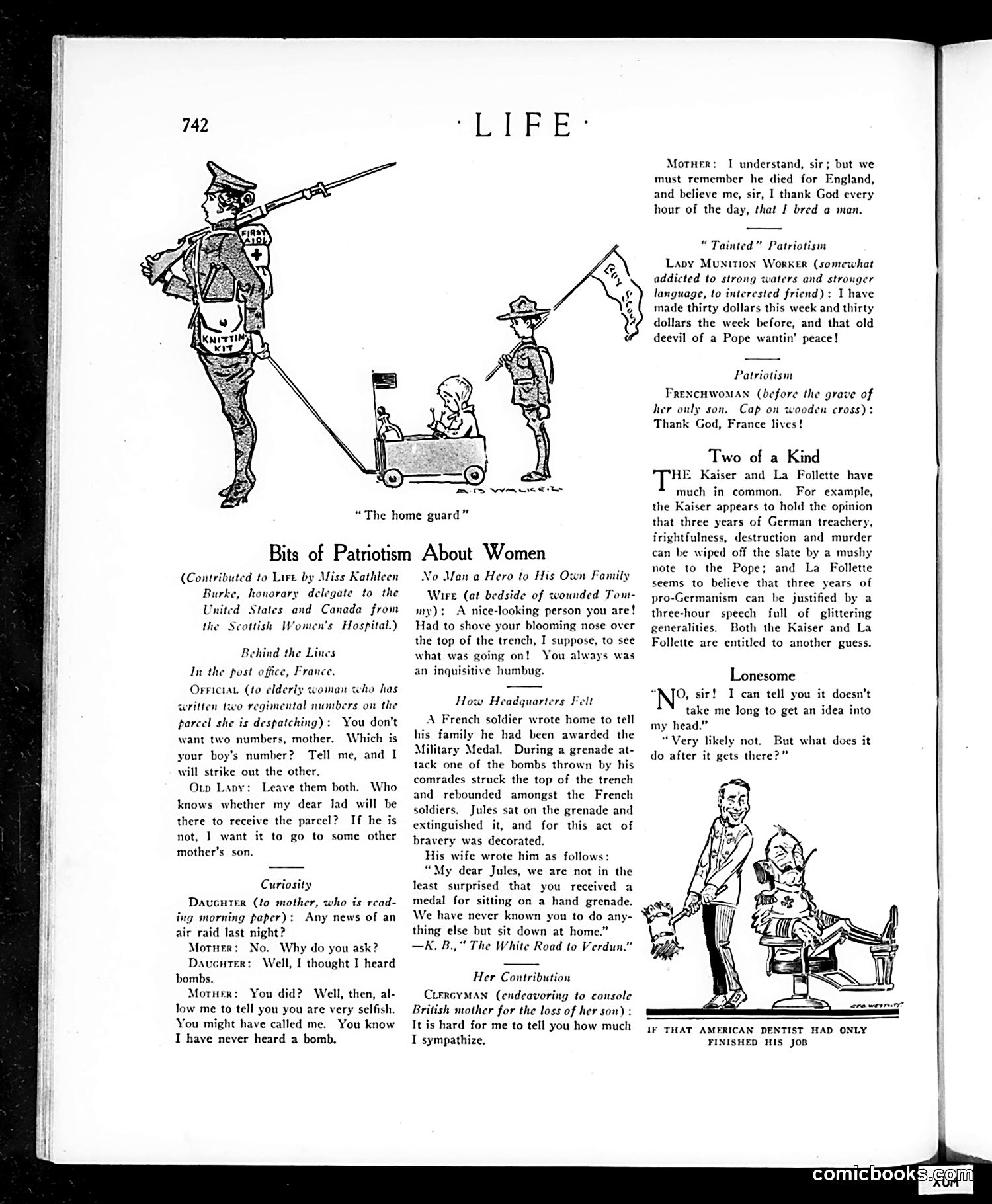
This page satirizes patriotism during World War I, particularly among women. The central cartoon "The home guard" depicts a soldier and civilian man flanking a woman with a baby carriage, mocking domestic "patriotism." The text sections mock exaggerated patriotic claims: - **"Tainted" Patriotism**: A munitions worker brags about earnings while calling for the Pope's death—questioning if profit-seeking equals true patriotism. - **Patriotism**: A Frenchwoman's simple statement ("France lives!") contrasts with the worker's verbose self-interest. - **Two of a Kind**: Compares the Kaiser and "La Follette" (likely Senator Robert La Follette, a prominent war critic), suggesting anti-war voices use similar rhetoric to German leaders. The overall message: American wartime "patriotism" often masks selfishness, hypocrisy, or disloyalty.
📄 Transcribed text from this page (OCR, searchable)
Machine-transcribed from the original scan — historical spelling and the odd misread are preserved.
BR Vie ete “The home guard” Bits of Patriotism About Women (Contributed to Lire by Miss Kathleen Burke, honorary delegate to the United States and Canada from the Scottish Women's Hospital.) Behind the Lines In the post office, France. Orrictat (to elderly woman who has written two regimental numbers on the parcel she is despatching) : You don't want two numbers, mother. Which is your boy’s number? Tell me, and I will strike out the other. Oto Lapy: Leave them both. Who knows whether my dear lad will be there to receive the parcel? If he is not, I want it to go to some other mother’s son. Curiosity Davcuter (to mother, who is read- ing morning paper): Any news of an air raid last night? Motuer: No. Why do you ask? Daucuter: Well, I thought I heard bombs. Morner: You did? Well, then, al- low me to tell you you are very selfish. You might have called me. You know I have never heard a bomb, No Man a Hero to His Own Fam Wire (at bedside of wounded my): A nice-looking person you are! Had to shove your blooming nose over the top of the trench, I suppose, to see what was going on! You always an inquisitive humbug. How Headquarters Feit A French soldier wrote home to tell his family he had been awarded the Military Medal. During a grenade at- tack one of the bombs thrown by his. comrades struck the top of the trench and rebounded amongst the French soldiers. Jules sat on the grenade and extinguished it, and for this act of bravery was decorated. His wife wrote him as follows: “My dear Jules, we are not in the least surprised that you received a medal for sitting on a hand grenade. We have never known you to do any- thing else but sit down at home.” —K. B.,““ The White Road to Verdun.” Her Contribution CLERGYMAN (endeavoring to console British mother for the loss of her son) : It is hard for me to tell you how much I sympathize. Morner: I understand, sir; but we must remember he died for England, and believe me, sir, I thank God every hour of the day, that J bred a man. inted” Patriotism Lapy Munition Worker (somewhat addicted to strong waters and stronger language, to interested friend): I have made thirty dollars this week and thirty dollars the week before, and that old deevil of a Pope wantin’ peace! Patriotism FRENCHWOMAN (before the grave of her only son. Cap on wooden cross): Thank God, France lives! Two of a Kind HE Kaiser and La Follette have much in common. For example, the Kaiser appears to hold the opinion that three years of German treachery, irightfulness, destruction and murder can be wiped off the slate by a mushy note to the Pope; and La Follette seems to believe that three years of pro-Germanism can he justified by a three-hour speech full of glittering generalities. Both the Kaiser and La Follette are entitled to another guess. Lonesome N°: ! I can tell you it doesn’t take me long to get an idea into my head.” “Very likely not. But what does it do after it gets there?” IF THAT AMERICAN DENTIST HAD ONLY FINISHED HIS JOB comicbookseag