
Life, 1917-11-08 · page 18 of 40
Life — November 8, 1917 — page 18: what you’re looking at
What you’re looking at
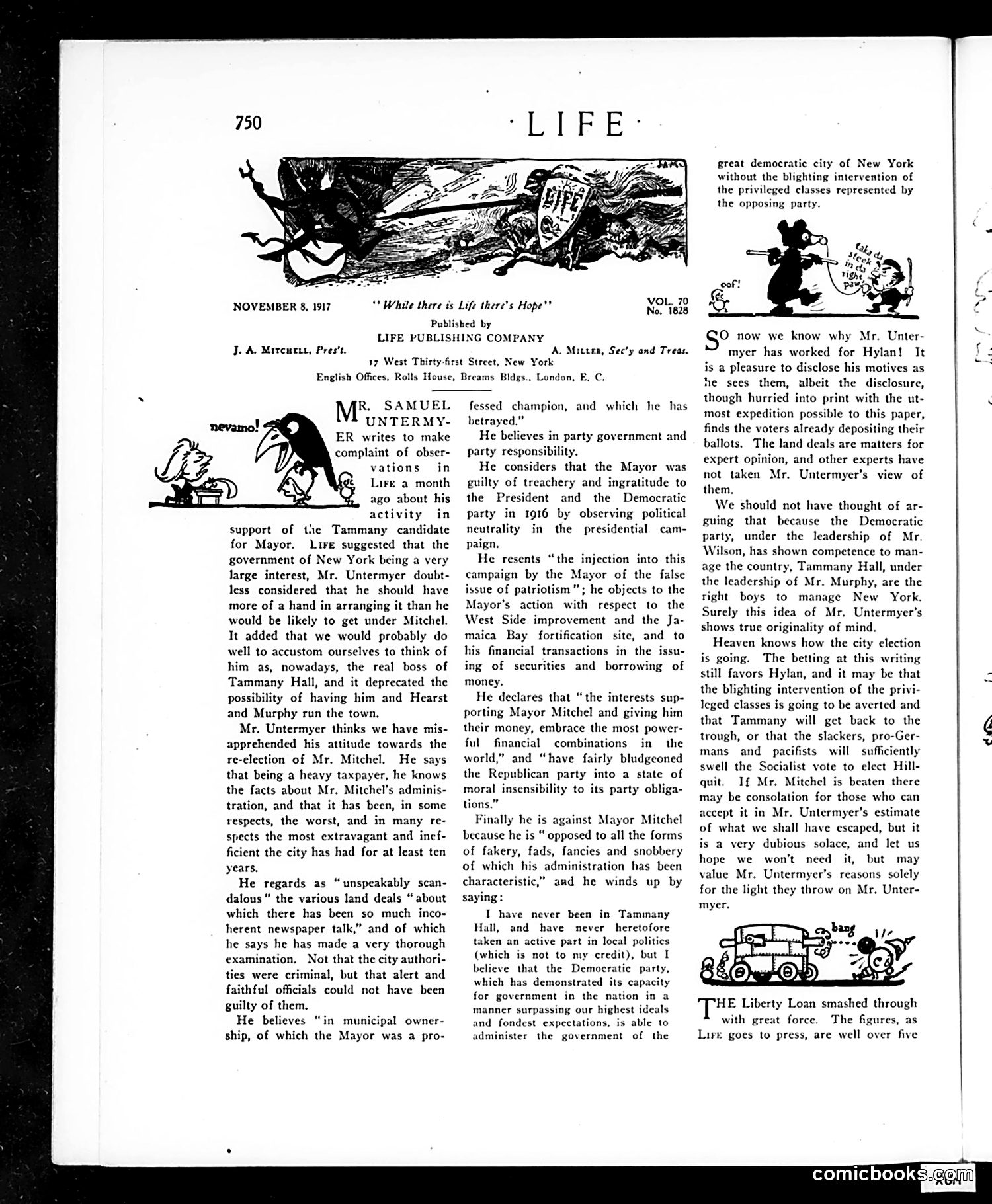
This Life magazine page satirizes wealthy lawyer Samuel Untermyer's complaints about New York Mayor John Mitchel's re-election campaign. Untermyer, a major Democratic supporter, had backed Tammany Hall's mayoral candidate (likely John Hylan) instead of the incumbent Mitchel. Life's satire centers on Untermyer's self-righteous objections to Mitchel's administration—criticizing land deals, municipal ownership betrayals, and financial impropriety—while conveniently omitting his own interest in political power. The magazine's subtitle, "While there is Life there's Hope," ironically undercuts Untermyer's moral posturing. The cartoons (appearing top-left and bottom-right) use exaggerated caricature typical of the era to ridicule the political machinations. Life suggests Untermyer's real motivation isn't civic virtue but personal influence—he preferred Tammany Hall (traditionally corrupt but accommodating to wealthy interests) over Mitchel's reformist approach. The piece exposes how ostensibly principled political arguments often mask self-interest.
📄 Transcribed text from this page (OCR, searchable)
Machine-transcribed from the original scan — historical spelling and the odd misread are preserved.
NOVEMBER 8, 1917 “While there ts Life there's Hope"* VOL. 70 No, 1828 Published by LIFE PUBLISHING COMPANY J. A. Mitcuent, Pres’t. A. Minter, Sec’y and Treas. 17 West Thirty-first Street, New York English Offices, Rolls House, Breams Bldgs., London, E, C. R, SAMUEL UNTERMY- ER writes to make complaint of obser- vations in Lire a month ago about his activity in support of the Tammany candidate for Mayor. Lire suggested that the government of New York being a very large interest, Mr. Untermyer doubt- less considered that he should have more of a hand in arranging it than he would be likely to get under Mitchel. It added that we would probably do well to accustom ourselves to think of him as, nowadays, the real boss of Tammany Hall, and it deprecated the possibility of having him and Hearst and Murphy run the town. Mr. Untermyer thinks we have mis- apprehended his attitude towards the re-election of Mr. Mitchel, He says that being a heavy taxpayer, he knows the facts about Mr. Mitchel’s adminis- tration, and that it has been, in some respects, the worst, and in many re- spects the most extravagant and inef- ficient the city has had for at least ten years. He regards as “unspeakably scan- dalous” the various land deals “about which there has been so much inco- herent newspaper talk,” and of which he says he has made a very thorough examination. Not that the city authori- ties were criminal, but that alert and faithful officials could not have been guilty of them. He believes “in municipal owner- ship, of which the Mayor was a pro- fessed champion, and which he has betrayed.” He believes in party government and party responsibility, He considers that the Mayor was guilty of treachery and ingratitude to the President and the Democratic party in 1916 by observing political neutrality in the presidential cam- paign. He resents “the injection into this campaign by the Mayor of the false issue of patriotism”; he objects to the Mayor’s action with respect to the West Side improvement and the Ja- maica Bay fortification site, and to his financial transactions in the issu- ing of securities and borrowing of money. He declares that “the interests sup- porting Mayor Mitchel and giving him their money, embrace the most power- ful financial combinations in the world,” and “have fairly bludgconed the Republican party into a state of moral insensibility to its party obliga- tions.” Finally he is against Mayor Mitchel because he is “ opposed to all the forms of fakery, fads, fancies and snobbery of which his administration has been characteri: and he winds up by saying: I have never been in Tammany Hall, and have never heretofore taken an active part in local politics (which is not to my credit), but I believe that the Democratic party, which has demonstrated its capacity for government in the nation in a manner surpassing our highest ideals and fondest expectations, is able to administer the government of the great democratic city of New York without the blighting intervention of the privileged classes represented by the opposing party. se now we know why Mr. Unter- myer has worked for Hylan! It is a pleasure to disclose his motives as he sees them, albeit the disclosure, though hurried into print with the ut- most expedition possible to this paper, finds the voters already depositing their ballots. The land deals are matters for expert opinion, and other experts have not taken Mr. Untermyer’s view of them. We should not have thought of ar- guing that because the Democratic party, under the leadership of Mr. Wilson, has shown competence to man- age the country, Tammany Hall, under the leadership of Mr. Murphy, are the right boys to manage New York. Surely this idea of Mr. Untermyer's shows true originality of mind. Heaven knows how the city election is going. The betting at this writing still favors Hylan, and it may be that the blighting intervention of the privi- leged classes is going to be averted and that Tammany will get back to the trough, or that the slackers, pro-Ger- mans and pacifists will sufficiently swell the Socialist vote to elect Hill- quit. If Mr. Mitchel is beaten there may be consolation for those who can accept it in Mr. Untermyer’s estimate of what we shall have escaped, but it is a very dubious solace, and let us hope we won't need it, but may value Mr. Untermyer’s reasons solely for the light they throw on Mr. Unter- myer. HE Liberty Loan smashed through with great force. The figures, as Lire goes to press, are well over five comicbookSfeem) rl