
Life, 1917-11-08 · page 12 of 40
Life — November 8, 1917 — page 12: what you’re looking at
What you’re looking at
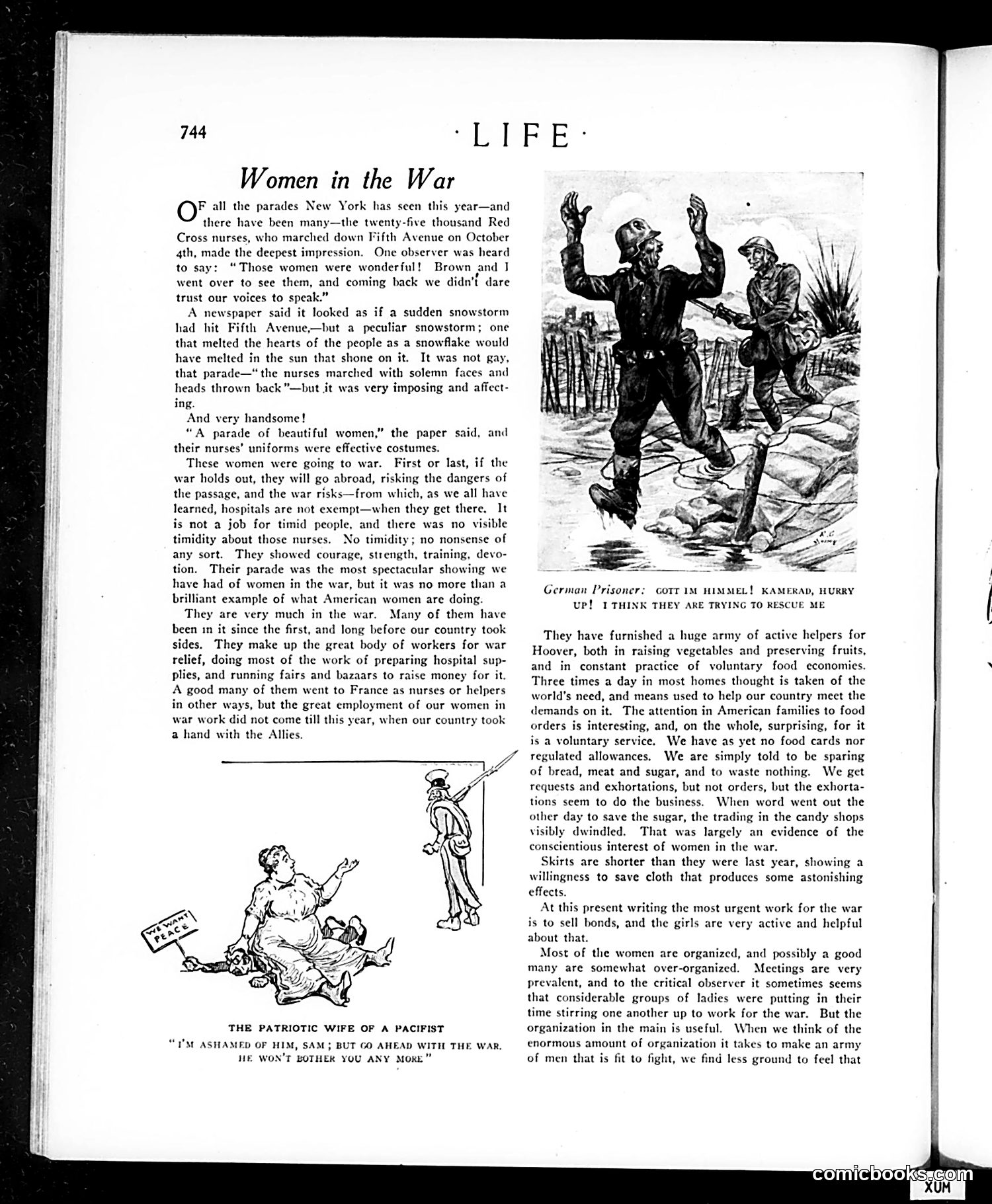
This page celebrates American women's contributions to World War I efforts. The top cartoon shows German prisoners encountering Red Cross nurses marching down Fifth Avenue—the prisoners' shocked reaction ("Gott im Himmel! Kamerad, hurry up!") mocks enemy surprise at American women's military involvement. The lower cartoon, "The Patriotic Wife of a Pacifist," depicts a woman confronting a man opposing the war, shaming him into support ("I'm ashamed of him, Sam; but go ahead with the war. He won't bother you any more"). The accompanying article praises nurses, volunteers, and women's organizational work for war relief, food conservation, and bond sales. The satire targets both pacifist resistance and enemy underestimation of American female mobilization as sources of national strength.
📄 Transcribed text from this page (OCR, searchable)
Machine-transcribed from the original scan — historical spelling and the odd misread are preserved.
Women in the War F all the parades New York has seen this year—and there have been many—the twenty-five thousand Red Cross nurses, who marched down Fifth Avenue on October 4th, made the deepest impression. One observer was heard to say: “Those women were wonderful! Brown and J went over to see them, and coming back we didn’t dare trust our voices to speak.” A newspaper said it looked as if a sudden snowstorm had hit Fifth Avenue—but a peculiar snowstorm; one that melted the hearts of the people as a snowflake would have melted in the sun that shone on Tt was not gay, that parade—“ the nurses marched with solemn faces and heads thrown back "—but it was very imposing and affect- ing. And very handsome! “A parade of beautiful women,” the paper said, and their nurses’ uniforms were effective costumes. These women were going to war. First or last, if the war holds out, they will go abroad, risking the dangers of the passage, and the war risks—from which, as we all have learned, hospitals are not exempt—when they get there. It is not a job for timid people, and there was no ble timidity about those nurses. No timidity; no nonsense of any sort. They showed courage, strength, training, devo- tion. Their parade was the most spectacular showing we have had of women in the war, but it was no more than a brilliant example of what American women are doing. They are very much in the war. Many of them have been in it since the first, and long before our country took sides. They make up the great body of workers for war relief, doing most of the work of preparing hospital sup- plies, and running fairs and bazaars to raise money for it. A good many of them went to France as nurses or helpers in other ways, but the great employment of our women in war work did not come till this year, when our country took a hand with the Allies. THE PATRIOTIC WIFE OF A PACIFIST “I'M ASHAMED OF HIM, SAM; BUT GO AHEAD WITH THE WAR. NE WON'T BOTHER YOU AN German Prisoner; GoTT 1M HIMMEL! KAMERAD, HURRY up! I THINK THEY ARE TRYING TO RESCUE ME They have furnished a huge army of active helpers for Hoover, both in raising vegetables and preserving fruits, and in constant practice of voluntary food economies. Three times a day in most homes thought is taken of the world’s need, and means used to help our country meet the demands on it. The attention in American families to food orders is interesting, and, on the whole, surprising, for it is a voluntary service. We have as yet no food cards nor regulated allowances, We are simply told to be sparing of bread, meat and sugar, and to waste nothing. We get requests and exhortations, but not orders, but the exhorta- tions seem to do the business. When word went out the other day to save the sugar, the trading in the candy shops visibly dwindled. That was largely an evidence of the conscientious interest of women in the war. Skirts are shorter than they were last year, showing a villingness to save cloth that produces some astonishing effects. At this present writing the most urgent work for the war is to sell bonds, and the girls are very active and helpful about that. Most of the women are organized, and possibly a good many are somewhat over-organized. Mectings are very prevalent, and to the critical observer it sometimes seems that considerable groups of ladies were putting in their time stirring one another up to work for the war. But the organization in the main is useful. When we think of the enormous amount of organization it takes to make an army of men that is fit to fight, we find less ground to feel that