
Life, 1917-11-08 · page 22 of 40
Life — November 8, 1917 — page 22: what you’re looking at
What you’re looking at
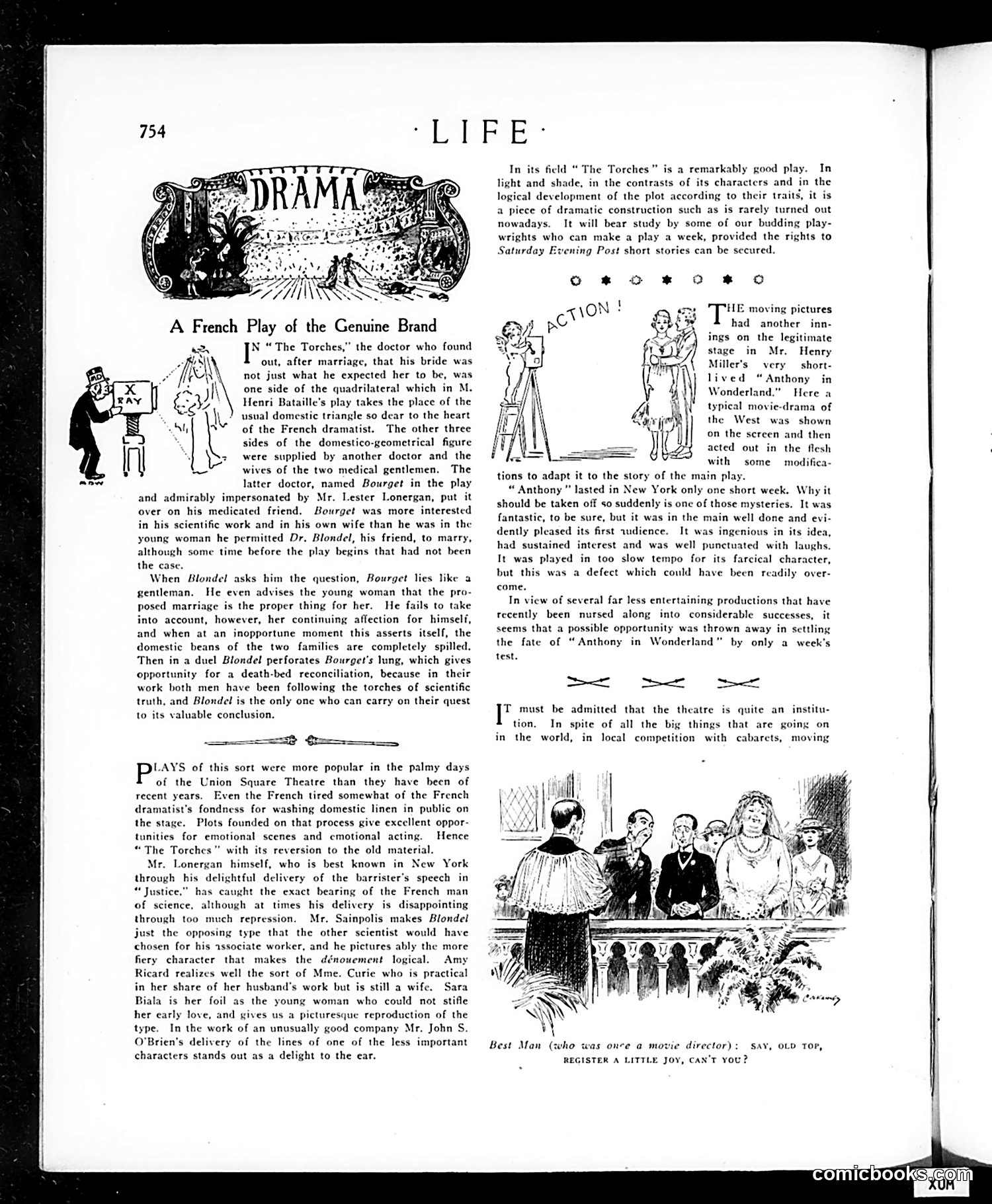
This page reviews two theatrical productions from the early 20th century. **"The Torches"** is a French play by Henri Bataille featuring a quadrilateral romantic entanglement between two doctors and their wives—a departure from the traditional "domestic triangle" common in French drama. The plot involves deception, infidelity, and culminates in a duel. The review praises the play's construction and the performances, particularly Lester Lonergan's portrayal of the scientist Bourget and the company's overall quality. **"Anthony in Wonderland"** was Henry Miller's short-lived theatrical experiment combining film and live performance—showing a Western movie on screen, then recreating scenes onstage with modifications. The production lasted only one week in New York. The review contextualizes both as examples of theatrical trends: French domestic dramas with emotional complexity, and early experiments blending new cinema technology with traditional theater. The cartoons (visible but not detailed in text) appear to illustrate theatrical scenes, including what's captioned as "Best Man (who was once a movie director)."
📄 Transcribed text from this page (OCR, searchable)
Machine-transcribed from the original scan — historical spelling and the odd misread are preserved.
“LEE A French Play of the Genuine Brand Ik “The Torch the doctor who found out, after marriage, that his bride was not just what he expected her to be, was one side of the quadrilateral which in M. Henri Bataille’s play takes the place of the usual domestic triangle so dear to the heart of the French dramatist. The other three sides of the domestico-geometrical figure were supplied by another doctor and the wives of the two medical gentlemen. The latter doctor, named Bourget in the play and admirably impersonated by Mr. Lester Lonergan, put it over on his medicated friend. Bourget was more interested in his scientific work and in his own wife than he was in the young woman he permitted Dr, Blondel, his friend, to marry, although some time before the play begins that had not been the case. When Blondel asks him the question, Bourget lies like a gentleman. He even advises the young woman that the pro- posed marriage is the proper thing for her. He fails to take into account, however, her continuing affection for himseli, and when at an inopportune moment this asserts itself, the domestic beans of the two families are completely spilled. Then in a duel Blondel perforates Bourget’s lung, which gives opportunity for a death-bed reconciliation, because in their work both men have been following the torches of scientific truth, and Blondel is the only one who can carry on their quest to its valuable conclusion. == ¢=—-—.__, LAYS of this sort were more popular in the palmy days of the Union Square Theatre than they have been of recent years. Even the French tired somewhat of the French dramatist’s fondness for washing domestic linen in public on the stage. Plots founded on that process give excellent oppor- tunities for emotional scenes and emotional acting. Hence “The Torches" with its reversion to the old material. Mr. Lonergan himself, who is best known in New York through his delightful delivery of the barrister’s speech in “ Justice.” has caught the exact bearing of the French man of science, although at times his delivery is disappointing through too much repression. Mr. Sainpolis makes Blondel just the opposing type that the other scientist would have chosen for his associate worker, and he pictures ably the more fiery character that makes the dénouement logical. Amy Ricard realizes well the sort of Mme. Curie who is practical in her share of her husband's work but is still a wife. Sara Biala is her foil as the young woman who could not stifle her early love, and gives us a picturesque reproduction of the type, In the work of an unusually good company Mr. John S. O'Brien's delivery of the lines of one of the less important characters stands out as a delight to the ear. In its field “The Torches” is a remarkably good play. In ht and shade, in the contrasts of its characters and in the logical development of the plot according to their traits, it is a piece of dramatic construction such as is rarely turned out nowadays. It will bear study by some of our budding play- wrights who can make a play a week, provided the rights to Saturday Evening Post short stories can be secured. oO *£ Oo * O * 0 HIE moving pictures had another inn- ings on the legitimate stage in Mr. Henry Miller's very — short- lived “Anthony in Wonderland.” Here a typical movie-drama of the West was shown on the screen and then acted out in the flesh with modifica- tions to adapt it to the story of the main play. “ Anthony” lasted in New York only one short week. Why it should be taken off so suddenly is one of those mysteries. It was fantastic, to be sure, but it was in the main well done and evi dently pleased its first wdience. had sustained interest and was well punctuated with laughs. It was played in too slow tempo for its farcical character, but this was a defect which could have been readily over- some It was ingenious in its idea, come. In view of several far less entertaining productions that have recently been nursed along into considerable successes, it seems that a possible opportunity was thrown away in settling the fate of “Anthony in Wonderland” by only a week's test. =— CU OT i T must be admitted that the theatre is quite an institu- tion, In spite of all the big things that are going on in the world, in local competition with cabarets, moving Best Man (who was once a movie director): say, REGISTER A LITTLE JOY, CAN'T You? OLD Tor, comichookgscam