
A complete issue · 42 pages · 1917
Life — March 1, 1917
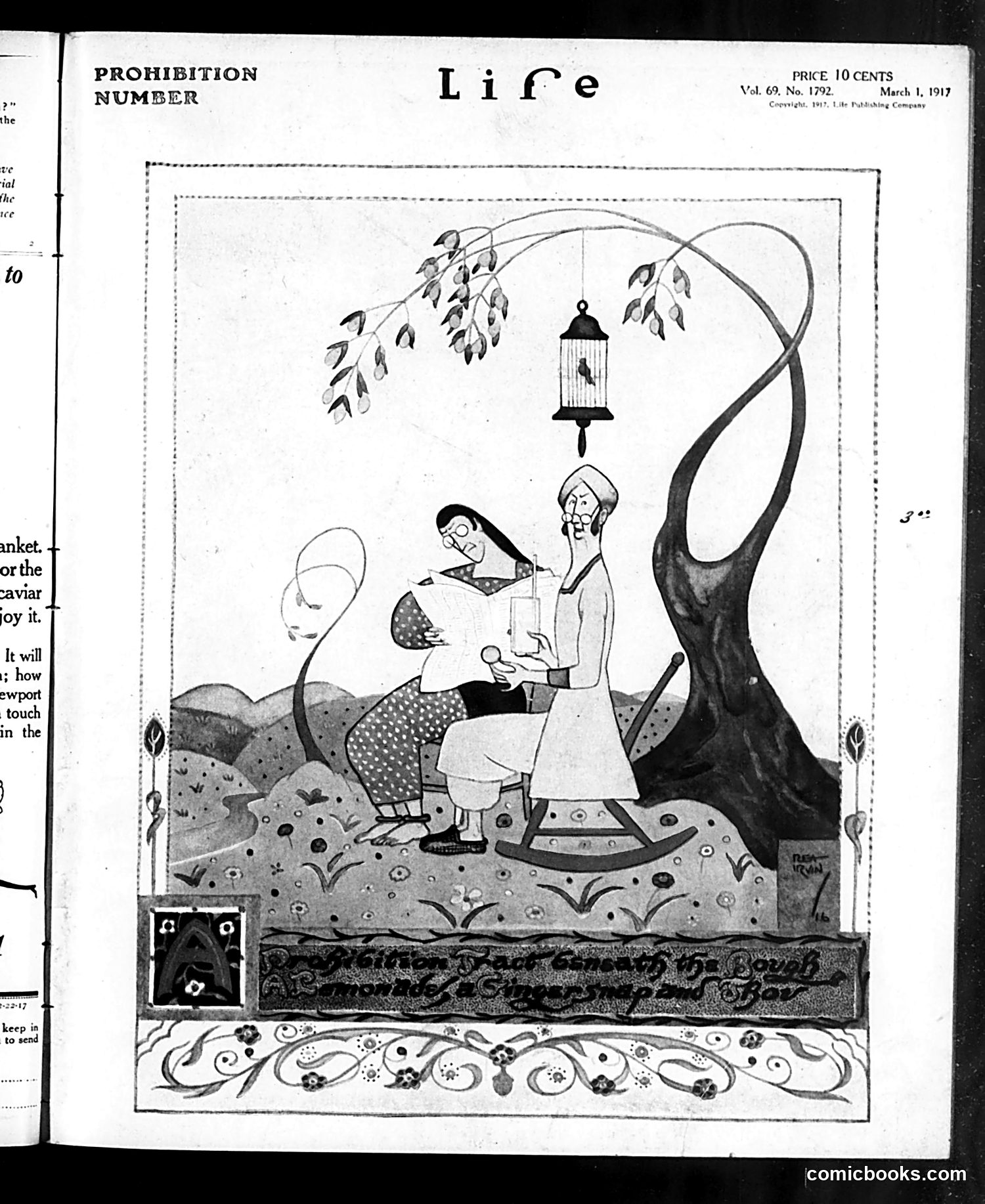
This is the cover of Life's "Prohibition Number" issue, published just before the U.S. entered World War I. The illustration satirizes the prohibition movement through surreal imagery: two figures tend a birdcage in an otherworldly landscape dominated by a massive dark tree or hand-like form. The satire likely depicts prohibition advocates as naive or delusional—the dreamlike setting with floating leaves and distorted scale suggests the unreality of their goals. The caged bird may represent trapped freedom or restricted liberty. The overall tone is mocking, suggesting Life's editorial stance opposed prohibition's impending passage (which occurred in December 1917). The artistic style is typical of early-20th-century American political cartooning—expressionistic and symbolically dense.
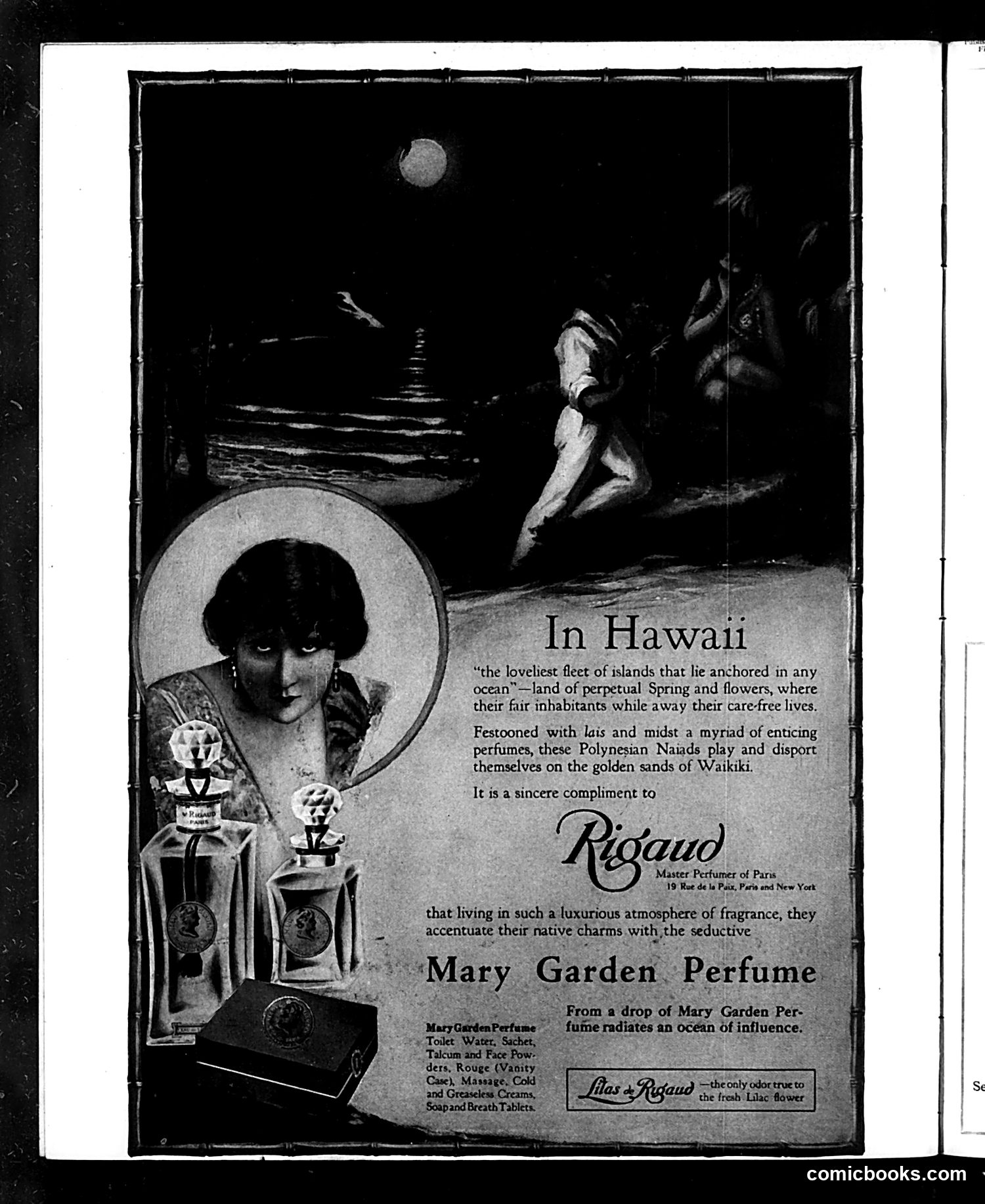
This is primarily a **perfume advertisement**, not satire or political commentary. It's a Rigaud "Mary Garden Perfume" ad from an early 20th-century Life magazine. The advertisement uses exoticized imagery of Hawaii to market luxury fragrance. It features a woman in a decorative circular frame (resembling a halo or portrait medallion) alongside perfume bottles, positioned against a romanticized scene of Hawaiian figures in the background. The text employs orientalist marketing language—describing Hawaii as a paradise of "perpetual Spring and flowers" where inhabitants live "care-free lives." The perfume is positioned as a luxury product that would enhance the wearer's "native charms." This reflects period advertising conventions that capitalized on Western fascination with non-Western cultures to sell high-end goods to affluent consumers.
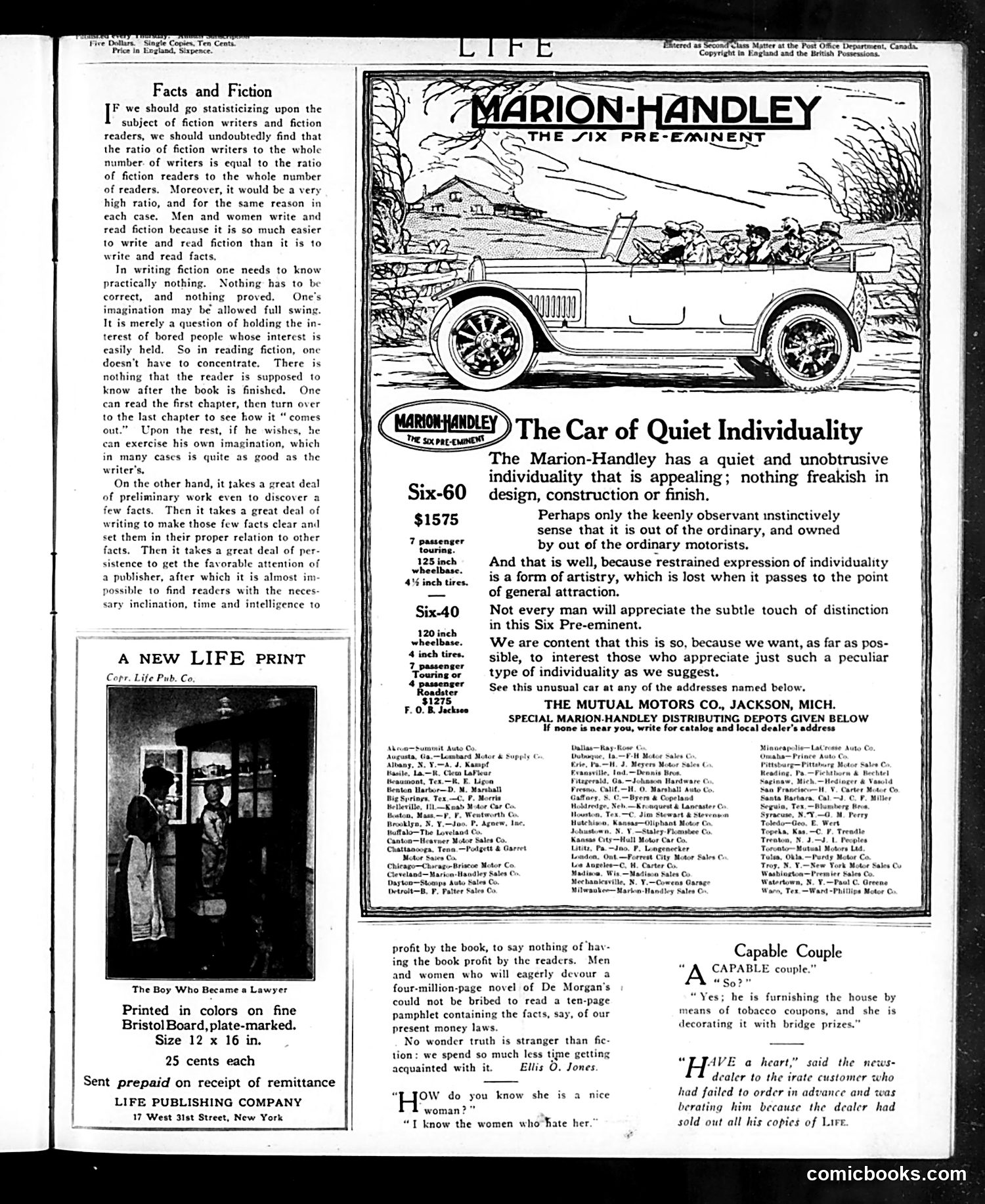
This page contains two distinct elements: **Left side**: An essay titled "Facts and Fiction" discussing the relationship between fiction writers and readers—arguing that fiction requires less preparation than nonfiction since imagination can run freely, while nonfiction demands accuracy and proper contextualization of facts. **Right side**: A Marion-Handley automobile advertisement featuring a detailed sketch of the Six-60 model priced at $1575. The ad emphasizes "quiet individuality" and "restraint" in design, positioning the car as appealing to discerning motorists who prefer subtle distinction over flashiness. Lists numerous regional distributors nationwide. **Bottom left**: A separate advertisement for "A New Life Print" showing a photograph titled "The Boy Who Became a Lawyer," available printed in colors on Bristol board for 25 cents. **Bottom right**: A brief anecdote titled "Capable Couple" about a woman using tobacco coupons for household decoration. This is primarily advertising content with editorial material.
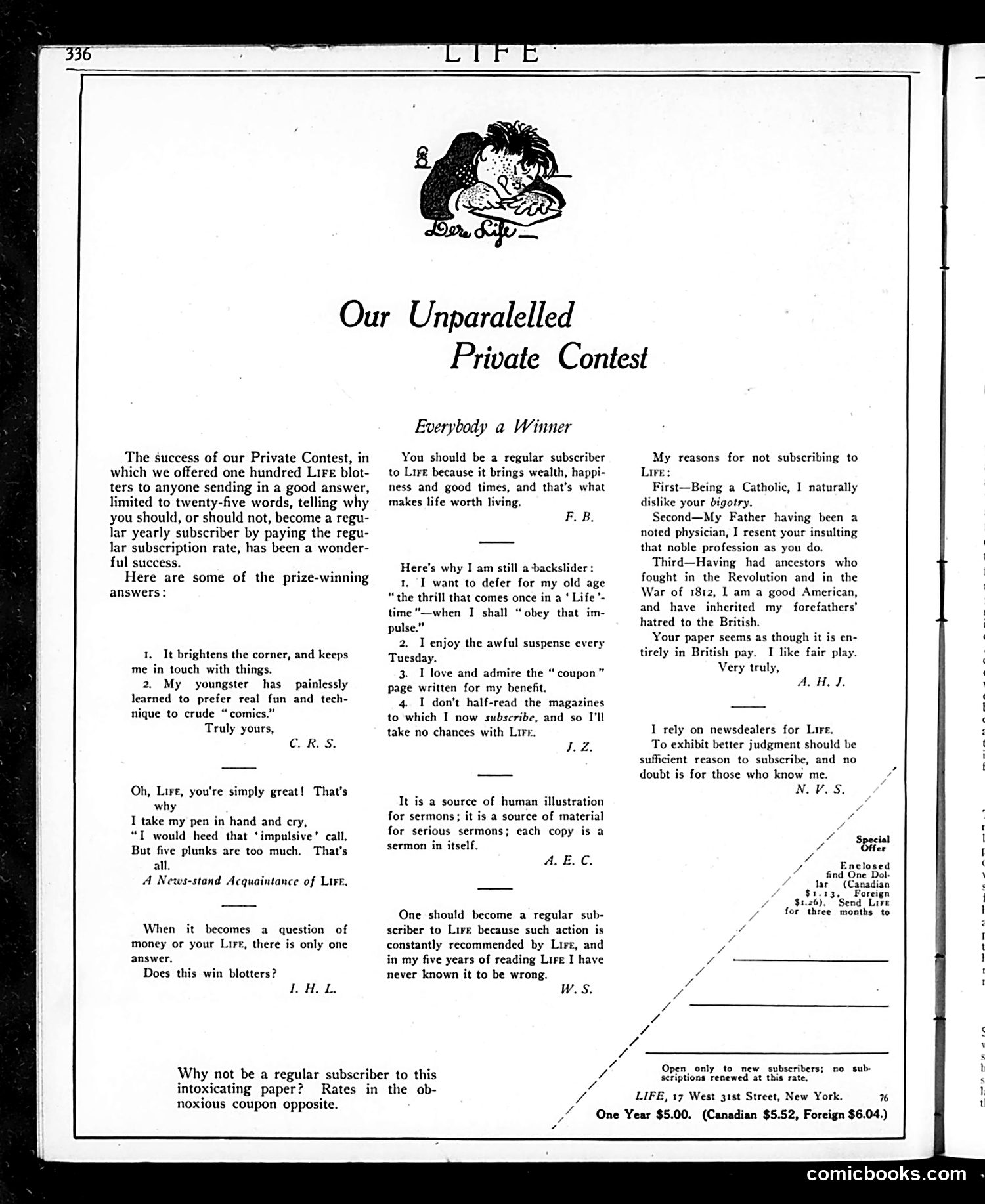
This page features Life magazine's "Private Contest," inviting readers to submit 25-word answers explaining why they should subscribe. The small illustration at the top appears to be Life's logo or mascot. The contest celebrates subscription benefits through humorous reader responses. Respondents cite reasons ranging from practical ("brightens the corner") to satirical critiques of competitors ("I don't half-read the magazines to which I now subscribe"). Notable is one reader's (A.H.J.) pointed rejection: claiming religious objections to Life's "bigotry," resentment of professional criticism, and anti-British sentiment inherited from Revolutionary War ancestors. The page primarily functions as **subscription advertising** disguised as reader engagement, promoting Life as an essential periodical while showcasing witty subscriber testimonials. The contest mechanism encourages participation while promoting the magazine's satirical reputation.
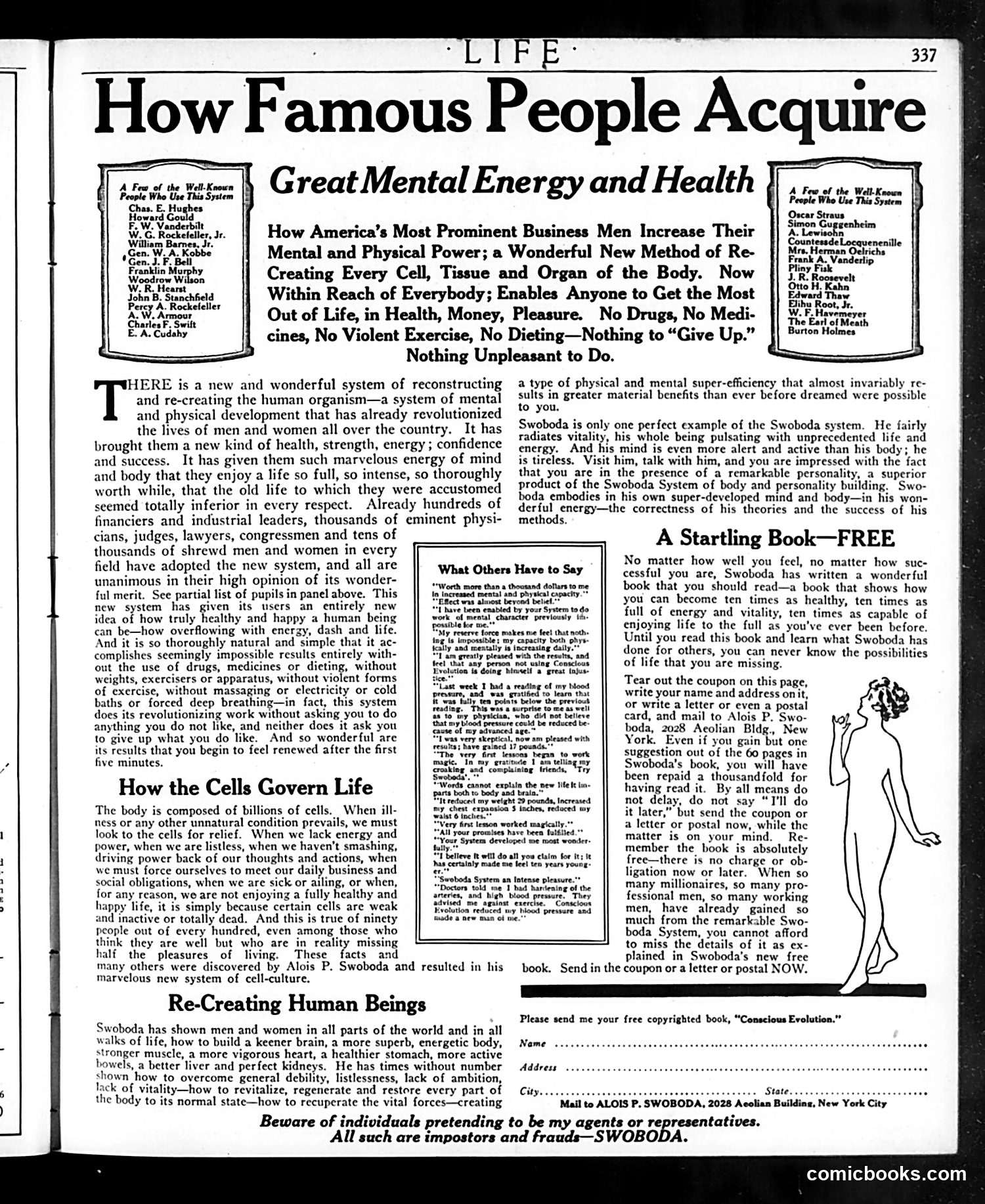
This page is primarily **advertising disguised as editorial content** for the "Swoboda System"—a dubious health regimen marketed as a revolutionary method for achieving mental and physical vitality without drugs, exercise, or dietary restriction. The satirical element lies in the *format itself*: Life magazine presents this pseudoscientific scheme alongside testimonials from purported prominent businessmen and public figures (listed in boxes), lending false credibility. The accompanying nude figure diagram reinforces the health-product marketing style of the era. The page mocks early 20th-century **health-fraud culture**—a period when unproven systems promised effortless wellness to wealthy, gullible audiences. The promise of results "without violent exercise" or sacrifice epitomizes the unrealistic marketing Life's readers would recognize as absurd, making the advertisement itself the joke.
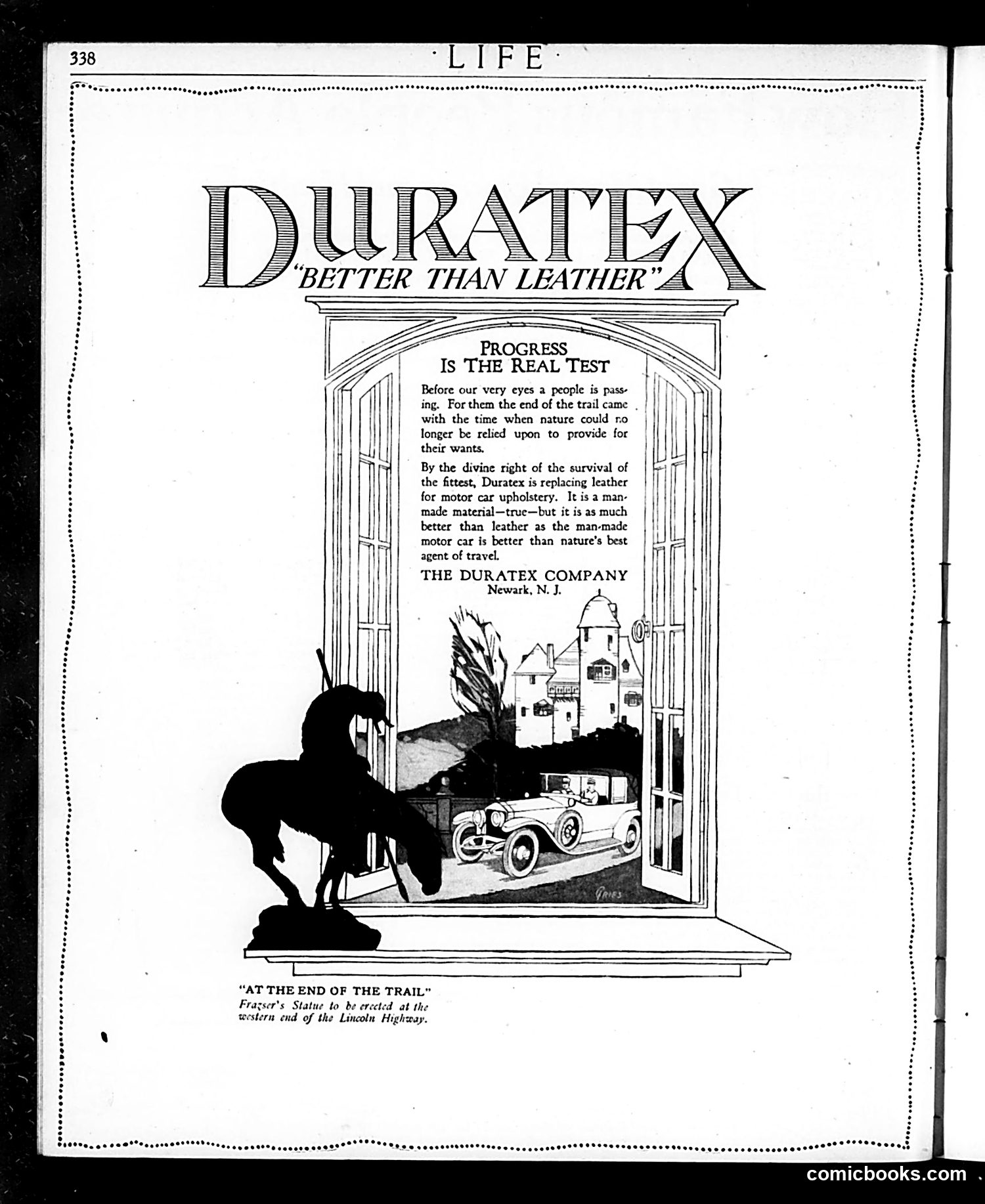
This is a **product advertisement**, not a political cartoon. The Duratex Company (Newark, N.J.) markets an artificial leather substitute for automobile upholstery. The ad's central conceit contrasts **nature versus progress**: a silhouetted Native American figure (representing "the end of the trail"—a reference to westward expansion's displacement of Indigenous peoples) gazes through a window at modern civilization—a house, roads, and a motor car. The copywriting argues that man-made materials surpass natural ones, claiming Duratex is "as much better than leather as the man-made motor car is better than nature's best agent of travel." The satire appears **unintentional**—juxtaposing Indigenous displacement with celebratory modernization suggests an uncomfortable historical irony the advertisers likely didn't recognize.
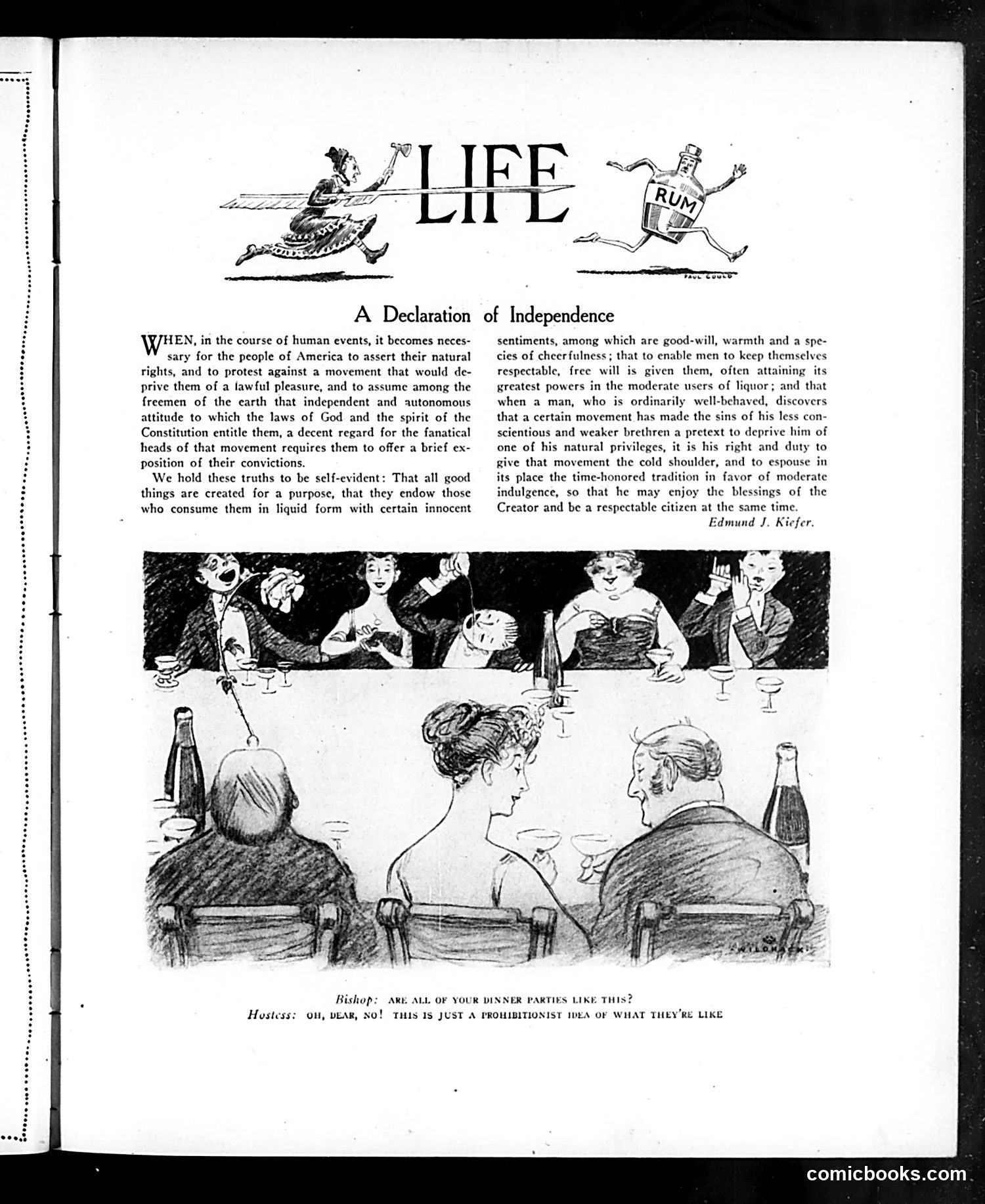
This page satirizes Prohibition-era attitudes toward alcohol. The header, "A Declaration of Independence," mockingly mimics the U.S. Declaration of Independence to argue for the "right" to drink alcohol. It's attributed to Edmund J. Kiefer. The cartoon below depicts a dinner party scene. A bishop expresses shock at the lavish drinking depicted, and the hostess responds that this represents what prohibitionists *imagine* happens at modern parties—implying the reality is less scandalous. The satire cuts both ways: it ridicules both prohibitionists (for exaggerating dangers of drinking) and drinkers (for claiming moral justification for defying Prohibition laws). The "rum bottle" in the header reinforces the alcohol theme. This reflects 1920s-1930s American debates over Prohibition enforcement and cultural attitudes toward drinking.
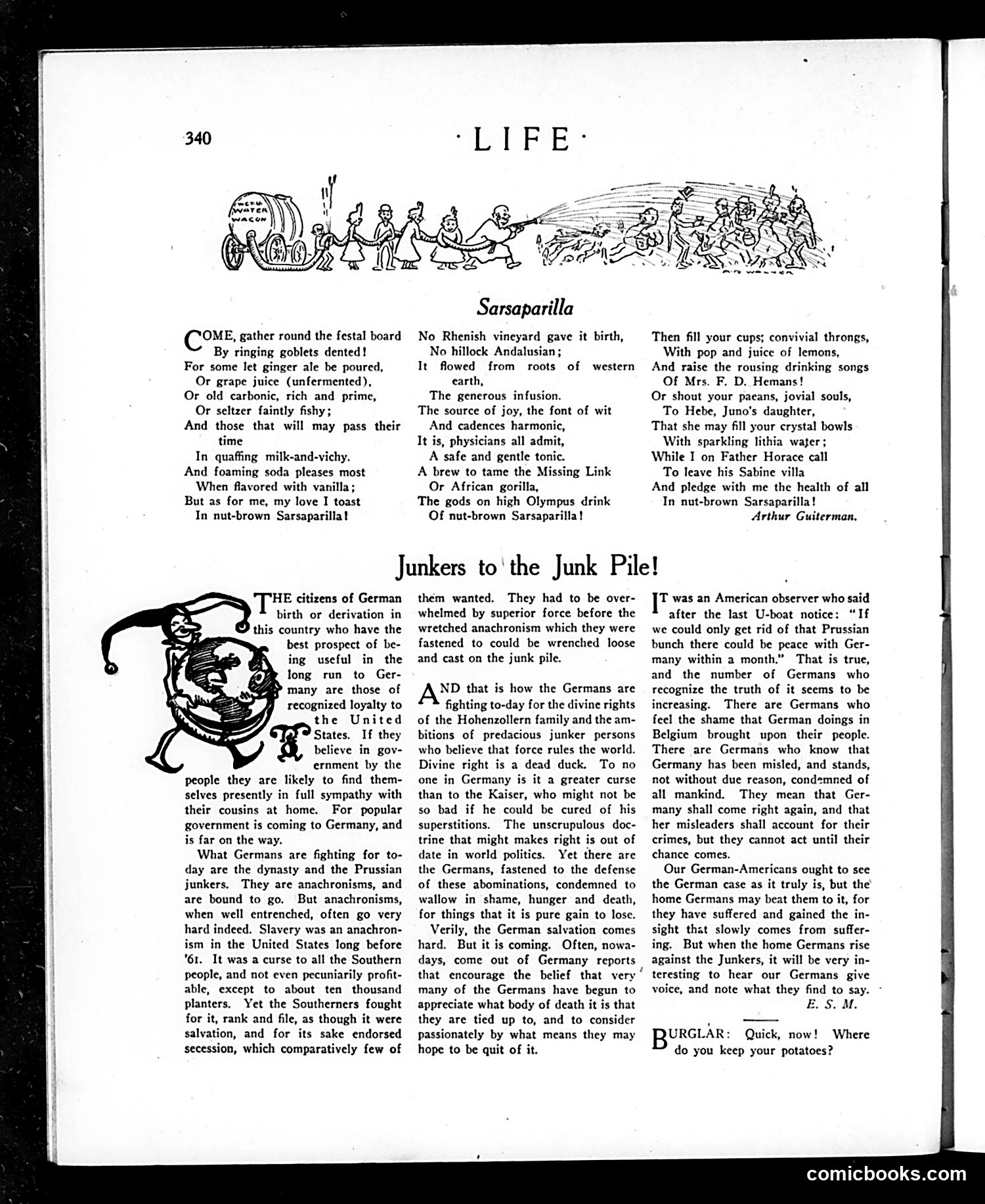
This page contains two distinct pieces: **"Sarsaparilla"** (top): A humorous poem by Arthur Guiterman celebrating sarsaparilla as a drink, mocking its supposed medicinal properties while encouraging convivial drinking. **"Junkers to the Junk Pile!"** (main article): Political commentary on German junkers (Prussian aristocratic military class). The text argues that Germany's defeats in WWI resulted from junker militarism and "divine right" ideology. It calls for their removal from power as necessary for German redemption and peace. The piece addresses German-Americans, urging them to recognize that junker ideology caused German suffering and should be abandoned. A small decorative illustration shows a caricatured junker figure. The article reflects post-WWI American sentiment that Prussian militarism caused the war.
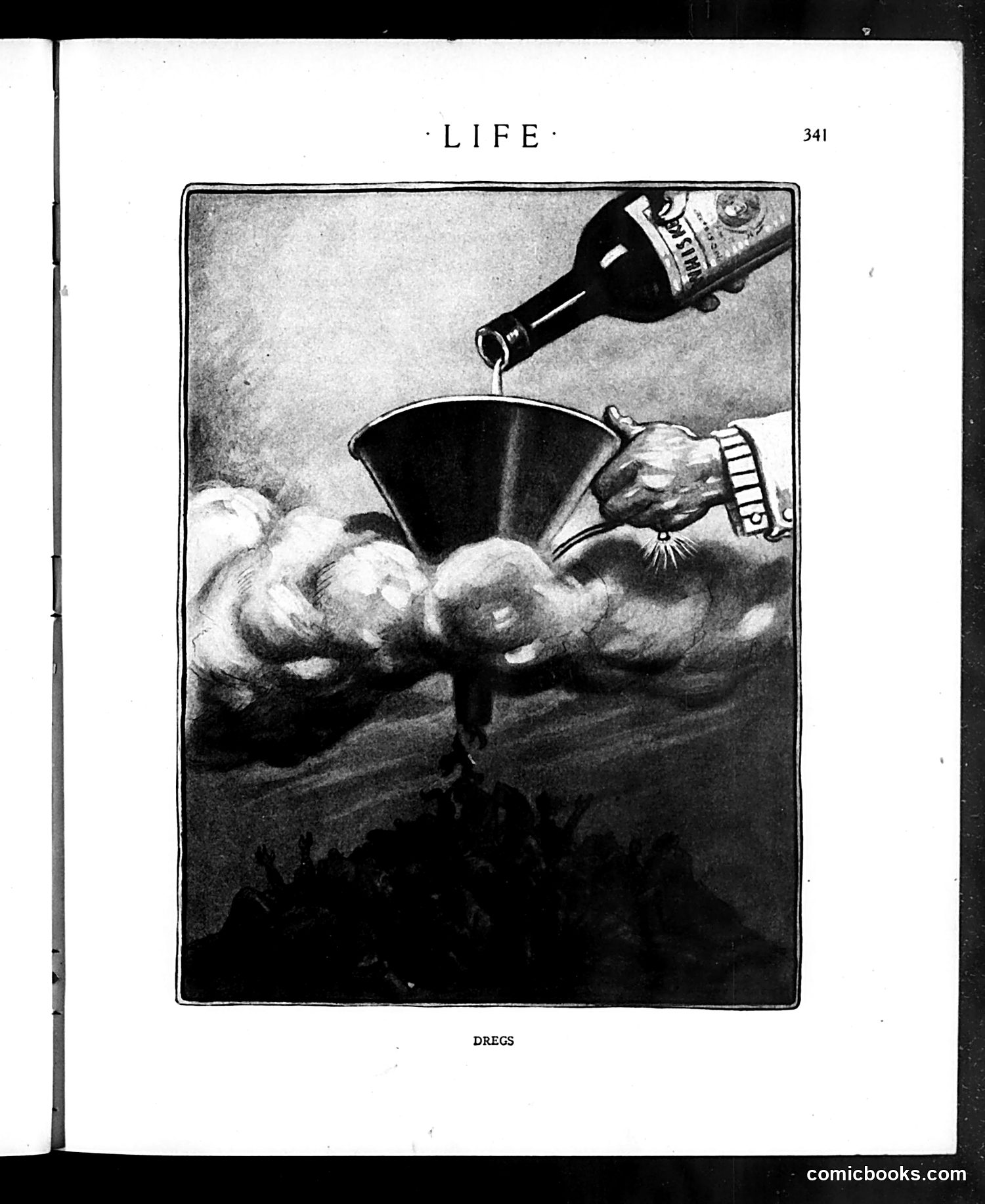
This cartoon depicts a hand pouring liquid from a bottle into a funnel held above a pile of potatoes. The title "Dregs" suggests the satirical message: the worst or most worthless contents (the liquid being poured) are being added to basic food supplies. This appears to be social or political commentary about adulteration of food or contamination of the food supply—a common concern in early 20th-century America. The image critiques either unscrupulous food producers adding inferior or harmful substances to staple foods, or perhaps governmental/institutional mismanagement of food quality. The "dregs" metaphor suggests something discarded or worthless is being introduced into the public's basic sustenance.
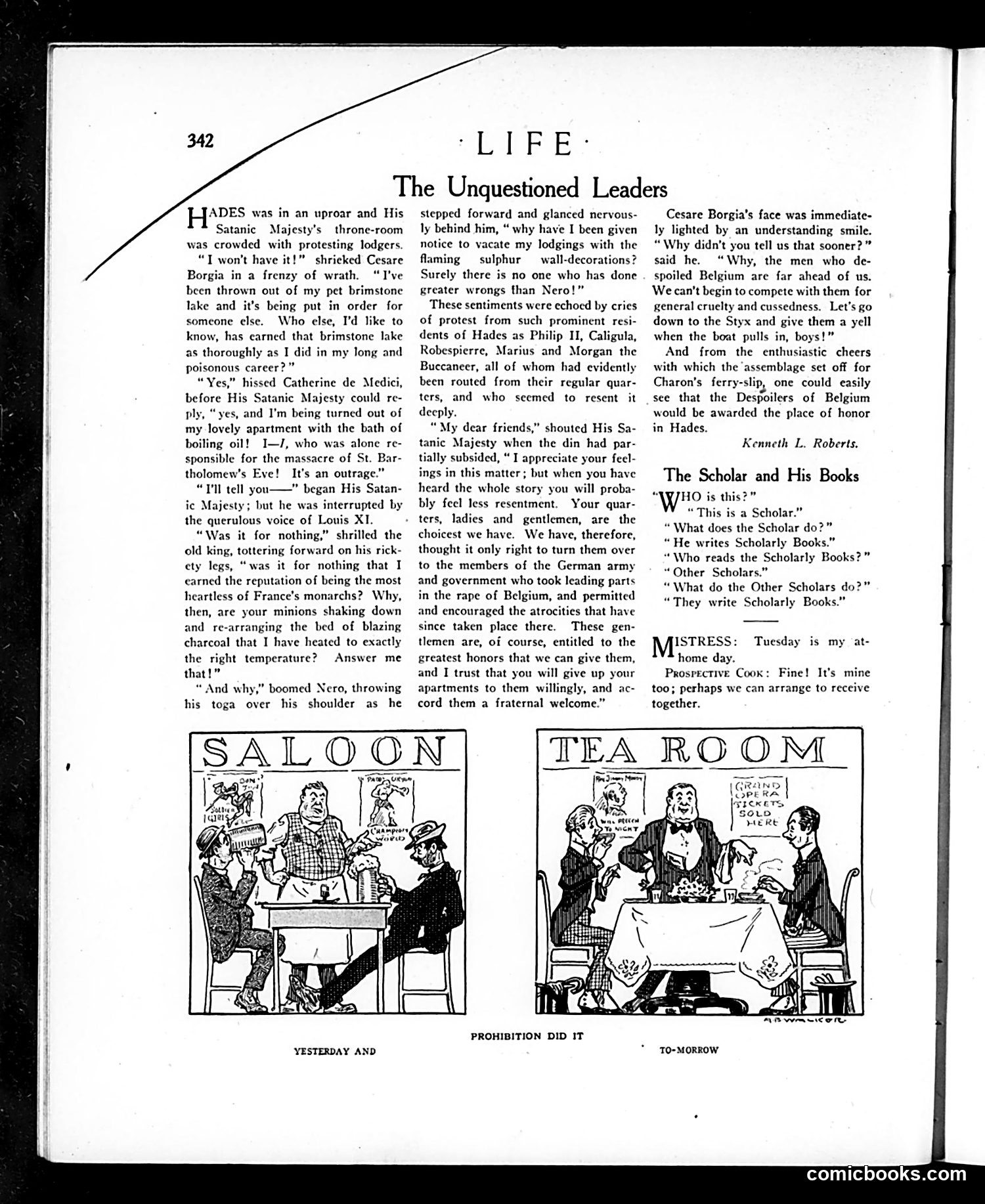
**"The Unquestioned Leaders"** story discusses Hades' crowded throne-room where various historical villains—Nero, Caligula, Cesare Borgia, and others—resent being displaced by modern figures they view as worse. Cesare Borgia notably welcomes German military and government leaders responsible for atrocities in occupied Belgium during (apparently) World War I, proposing they be honored in Hades. **The two cartoons** contrast social venues before and after Prohibition: - **Saloon (Yesterday)**: Working-class men drinking openly - **Tea Room (To-Morrow)**: Same activity continues disguised as genteel tea service The satire mocks Prohibition's ineffectiveness—suggesting illegal drinking will simply relocate to disguised venues rather than actually stop, a common contemporary criticism of the alcohol ban.
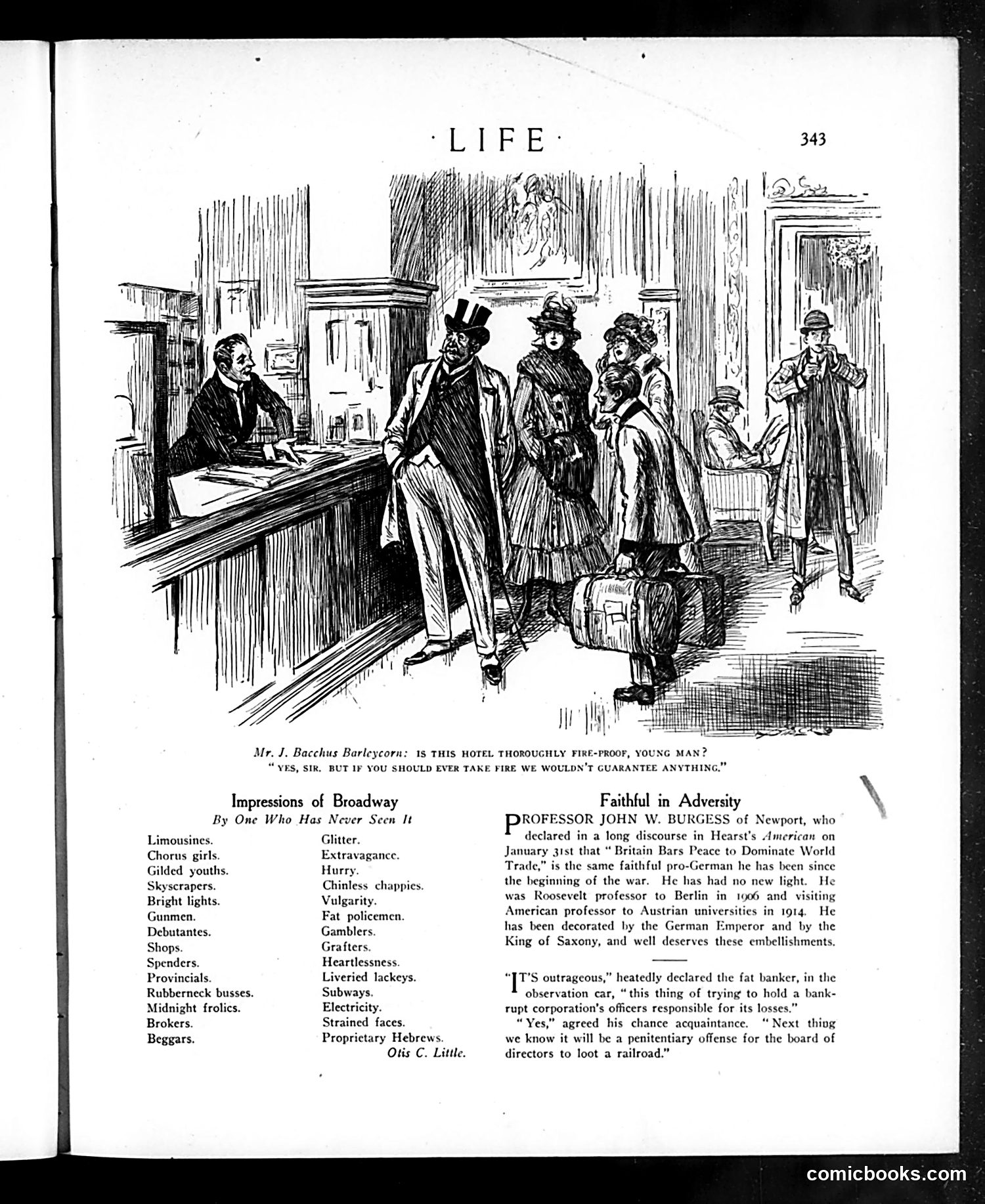
The main cartoon depicts a hotel clerk dealing with a group of travelers concerned about fire safety. The caption reads: "Is this hotel thoroughly fire-proof, sir? But if you should ever take fire we wouldn't guarantee anything." This satirizes unsafe hotel conditions and the clerk's absurd non-answer—he won't even guarantee safety *if* a fire occurs. This reflects genuine early-20th-century concerns about hotel fires, which were serious hazards. The accompanying article "Faithful in Adversity" discusses Professor John W. Burgess, a pro-German academic who maintained his German sympathies despite World War I. It mocks his unwavering loyalty despite geopolitical circumstances. The left column lists Broadway stereotypes ("Glitter," "Chorus girls," "Debutantes") in a satirical summary of theatrical culture.
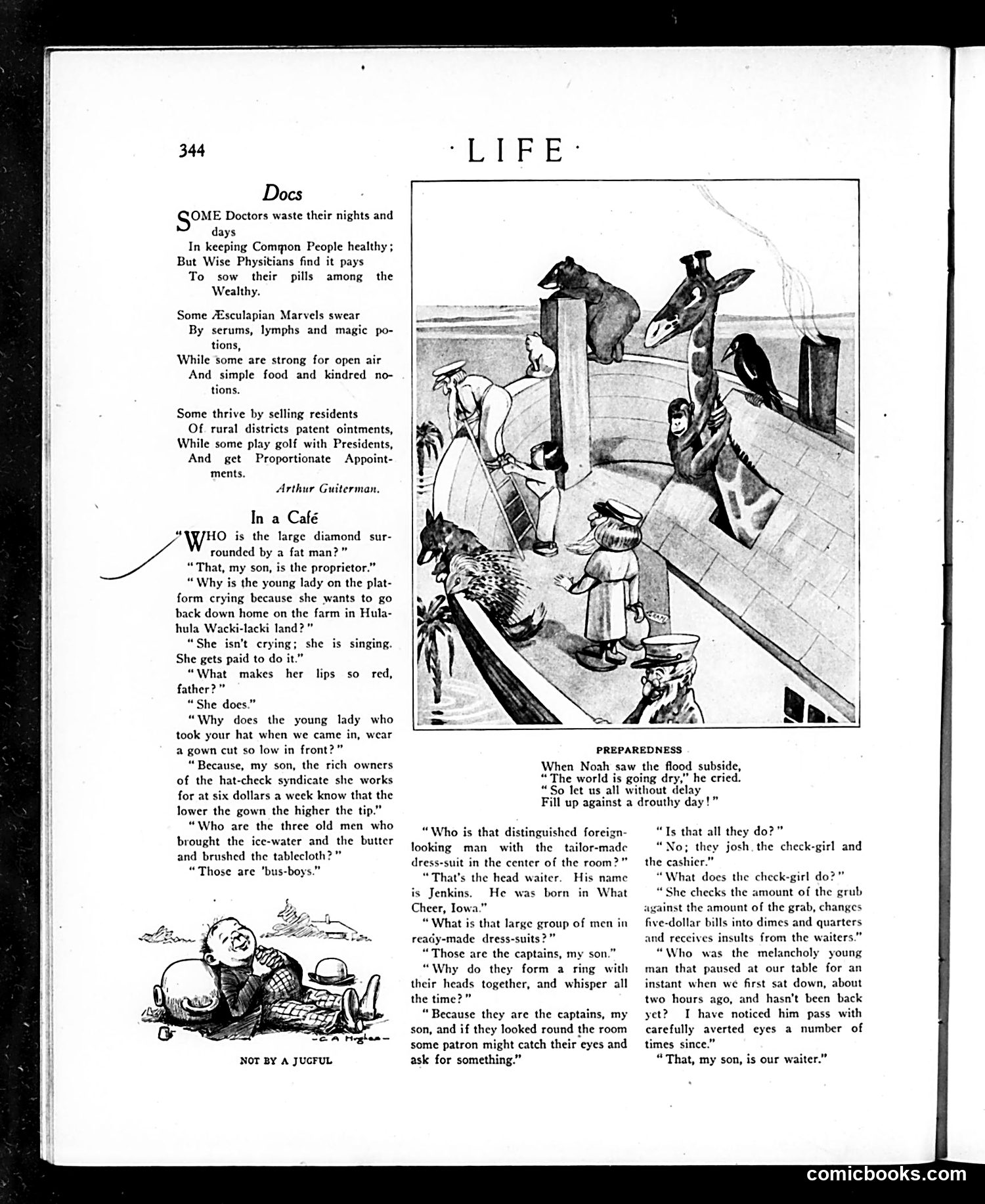
This page contains two satirical pieces critiquing social pretension and economic inequality in early 20th-century America. **"Docs"** (top left) mocks physicians who exploit wealthy patients while neglecting public health, using Aesculapian references to classical medicine. It suggests doctors profit more from the rich than from genuinely helping common people. **"In a Café"** (main dialogue) satirizes class consciousness through a conversation between a wealthy café patron and his son. The son asks naive questions about waiters, check-girls, and working-class people, revealing the father's cynical explanations of how social hierarchies function—tips, uniforms, and strategic positioning all serve to extract money from the wealthy. **"Preparedness"** (right) references Noah's flood, appearing to comment on economic readiness or social inequality during times of crisis. The overall tone critiques how the wealthy maintain their status through exploitation of service workers.
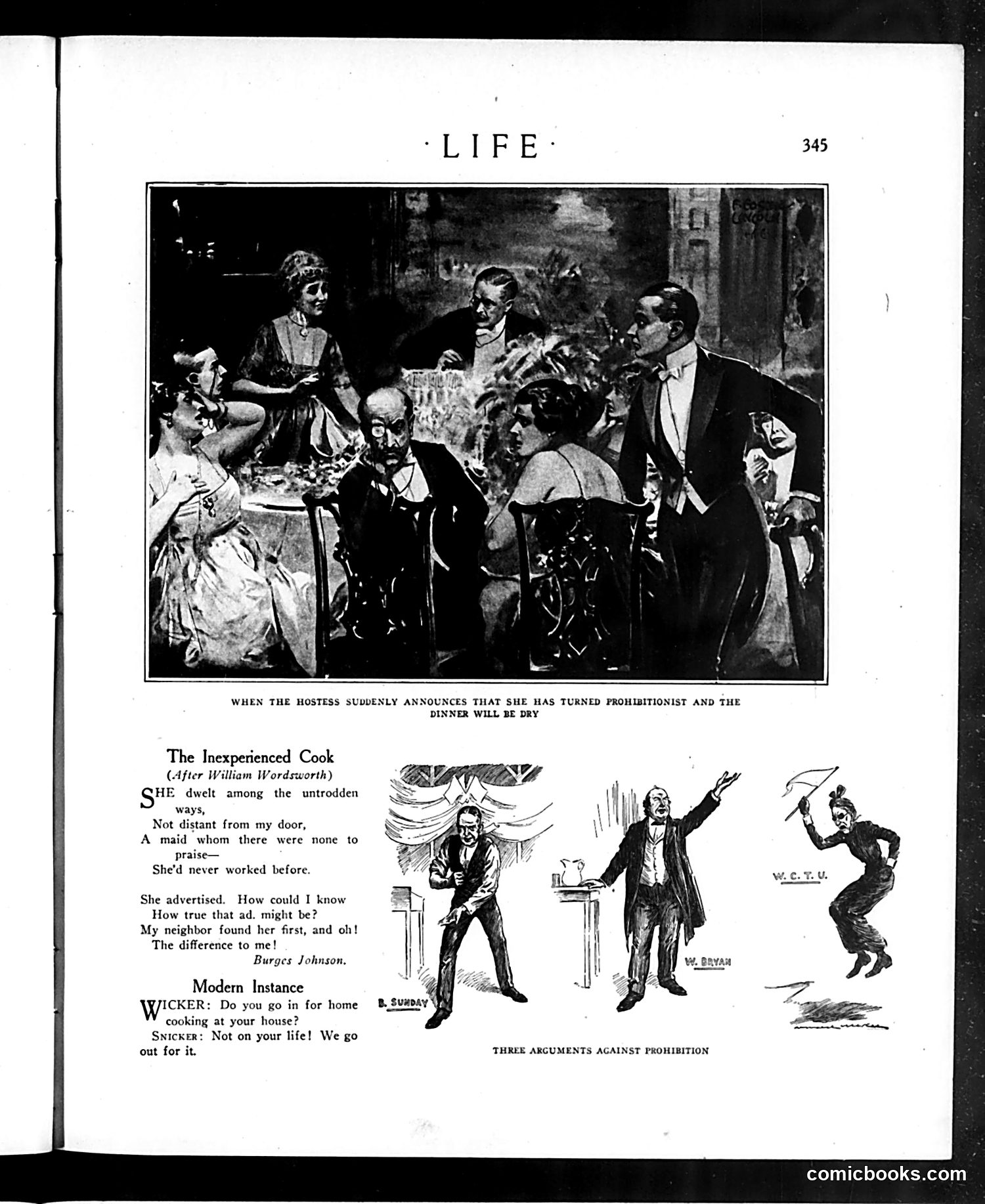
This page satirizes Prohibition and its social effects through three sections: **Top image**: Shows a dinner party's shocked reaction when the hostess announces she's become a "prohibitionist" and the dinner will be dry (alcohol-free). The satire mocks the inconvenience and social disruption Prohibition caused to entertained gatherings. **"The Inexperienced Cook"**: A poem by Burgess Johnson about hiring an untested maid through false advertising—satirizing both deceptive job postings and domestic help challenges of the era. **"Three Arguments Against Prohibition"**: Three cartoon figures (labeled with names like "W.E.T.U." and "W. BRYAN") present anti-Prohibition arguments through exaggerated physical comedy, mocking both Prohibition advocates and the desperate arguments used against it. The overall message criticizes Prohibition as socially disruptive and economically damaging.
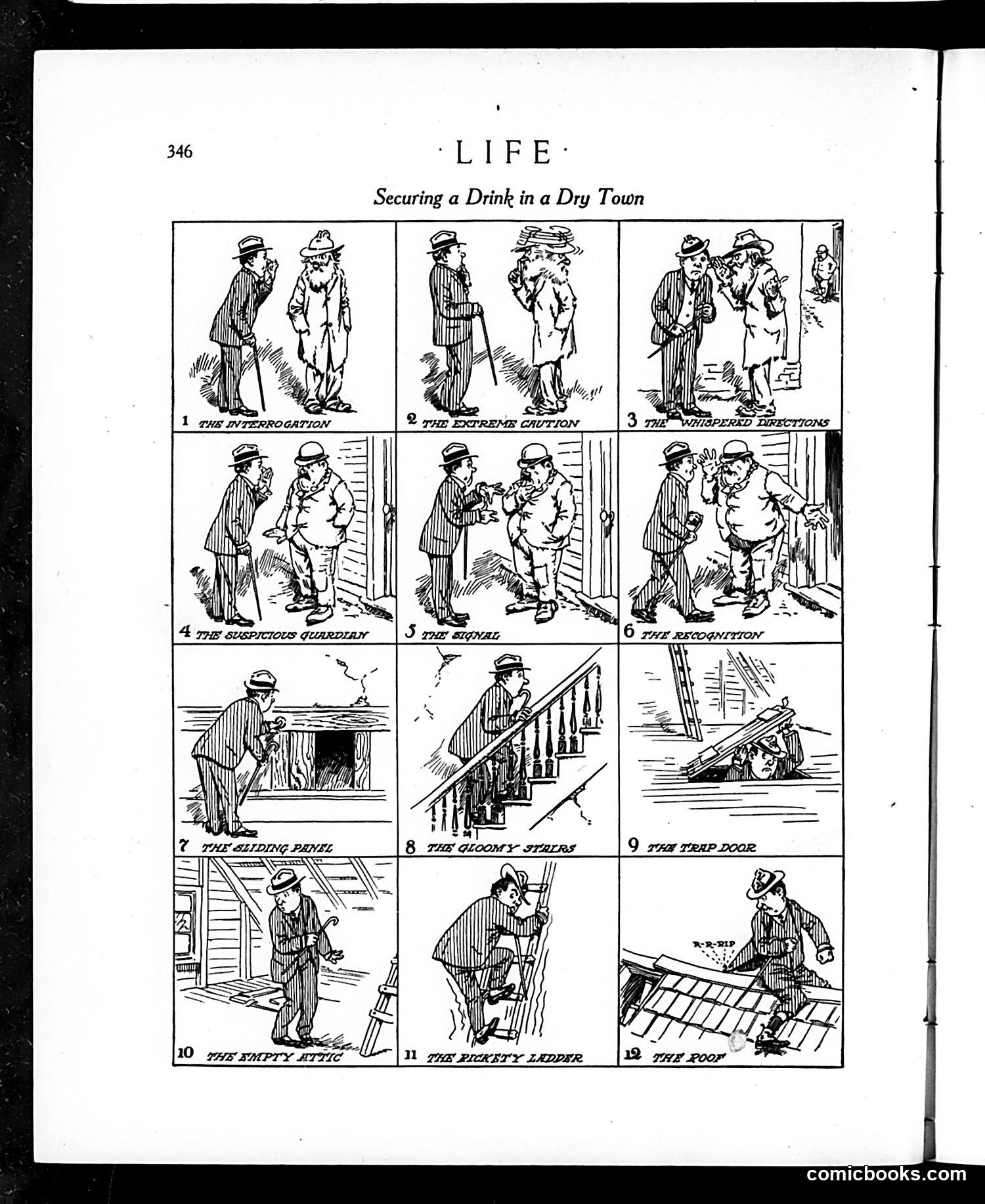
This is a humorous 12-panel satirical comic about Prohibition-era difficulties. The title refers to the legal ban on alcohol sales that was in effect during this period. The narrative follows a man in a pinstriped suit attempting various increasingly absurd methods to obtain alcoholic beverages in a town where alcohol sales are prohibited. The panels show him: interrogating someone, receiving cryptic directions, visiting suspicious locations, dealing with guardians and officials, and attempting entry through unconventional means (windows, doors, attics, cellars). The satire mocks both the resourcefulness required to circumvent Prohibition laws and the elaborate subterfuge ordinary citizens had to employ simply to drink. It depicts the practical chaos and absurdity that Prohibition created in American daily life.
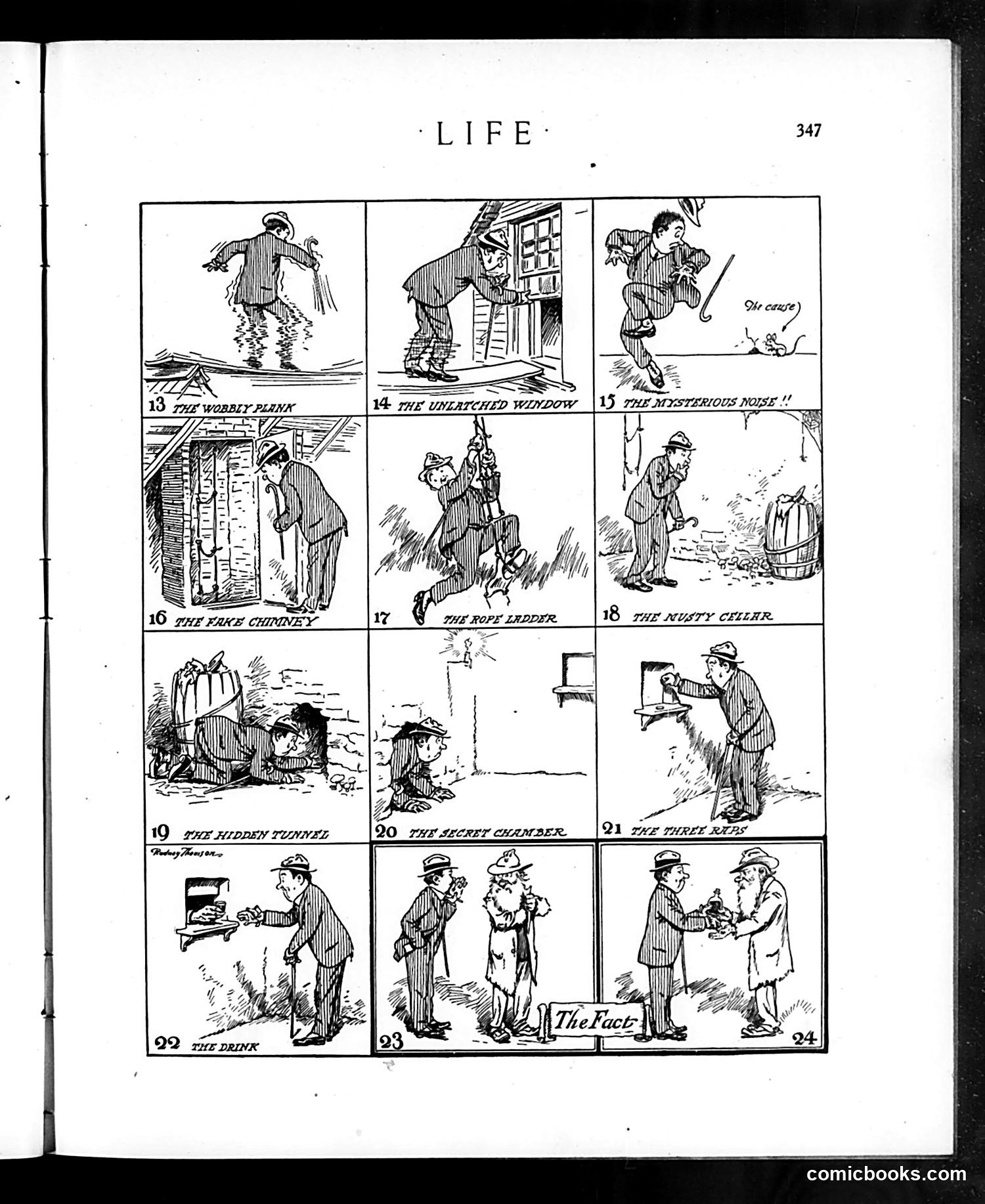
This is a sequential comic strip numbered 13-24, titled "The Pact," depicting a slapstick narrative about a man encountering various household mishaps and dangers. The sequence shows: a wobbly plank, an unlatched window, mysterious noises, a fake chimney, a rope ladder, a musty cellar, a hidden tunnel, a secret chamber, and thief jokes—culminating in two men apparently making an agreement ("The Pact"). The humor derives from classic silent-era physical comedy: the protagonist blunders through increasingly absurd situations. The final panels suggest the "pact" involves either the discovery of something valuable or an arrangement between characters. Without additional context, the specific satirical target remains unclear, though the exaggerated situations parody mystery or suspense narratives popular in early 20th-century entertainment.
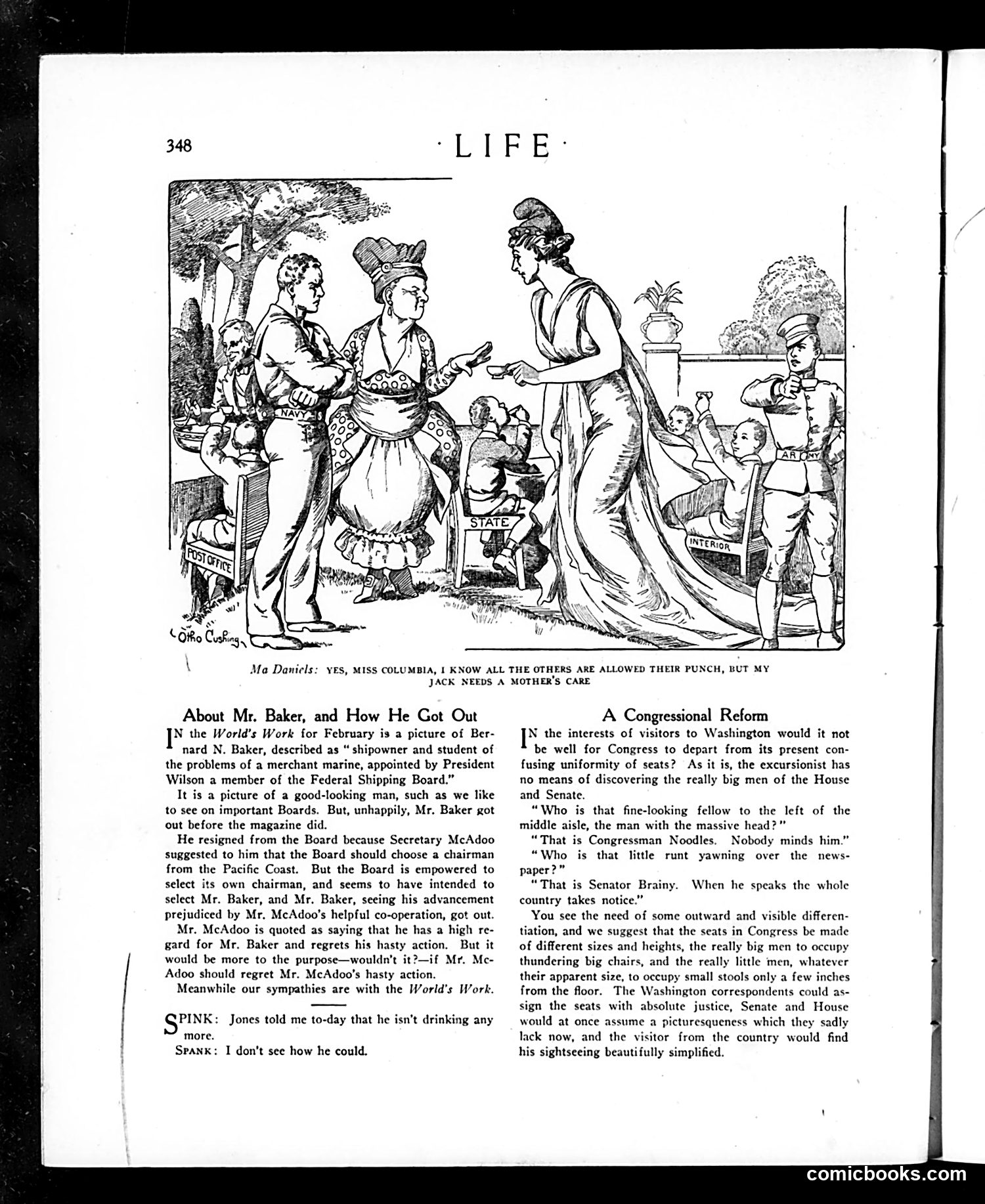
This page contains two separate satirical pieces: **"About Mr. Baker, and How He Got Out"** mocks Secretary of Treasury McAdoo's interference in the Federal Shipping Board. Bernard Baker resigned after McAdoo suggested the board choose a Pacific Coast chairman, undermining Baker's expected advancement. The satire criticizes McAdoo for this political meddling while claiming to support Baker—the point being McAdoo should regret *his own* hasty action, not Baker's resignation. **"A Congressional Reform"** satirizes Congress by proposing a solution to visitors' difficulty distinguishing important legislators from minor ones: assign Congressional seats by actual importance rather than uniform sizing. The joke suggests "big men" like "Senator Brainy" get tiny stools while nonentities like "Congressman Noodles" occupy large chairs—a visual inversion mocking how actual importance doesn't match apparent prominence in Congress. The top cartoon shows Miss Columbia (America personified) protecting "Jack" (American interests) from Congress's chaotic influence.
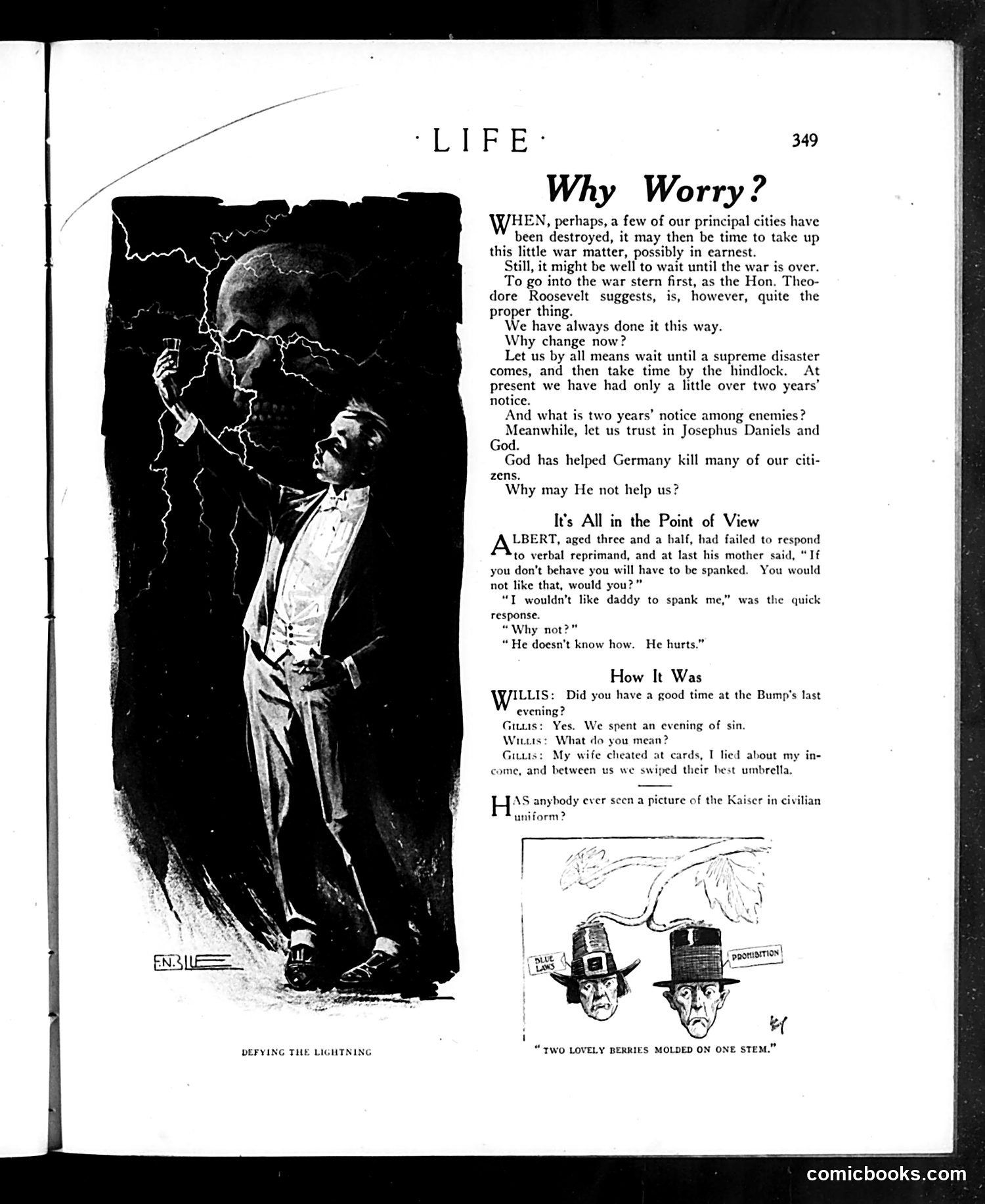
This page contains anti-war satire, likely from around 1915-1916 when America debated entering World War I. **"Why Worry?"** mocks isolationist attitudes and calls out Theodore Roosevelt's interventionist stance. The text sarcastically suggests waiting for "supreme disaster" before acting, and ironically invokes God's help while noting He's "helped Germany kill many of our citizens"—the satire's bitter point being that passivity is morally indefensible. **"Defying the Lightning"** (left illustration) depicts a man facing a map with lightning bolts, likely representing America's dangerous position ignoring the war's threat. **"It's All in the Point of View"** is a domestic joke about perspective: a child prefers mother spanking him to father because "he doesn't know how. He hurts." **"How It Was"** humorously catalogs minor moral failings at a social gathering. **"Two Lovely Berries"** references the Kaiser in civilian dress—unclear without more context, but appears topical commentary on German leadership. The page's overall tone: frustrated advocacy for American military preparedness disguised as sardonic humor.
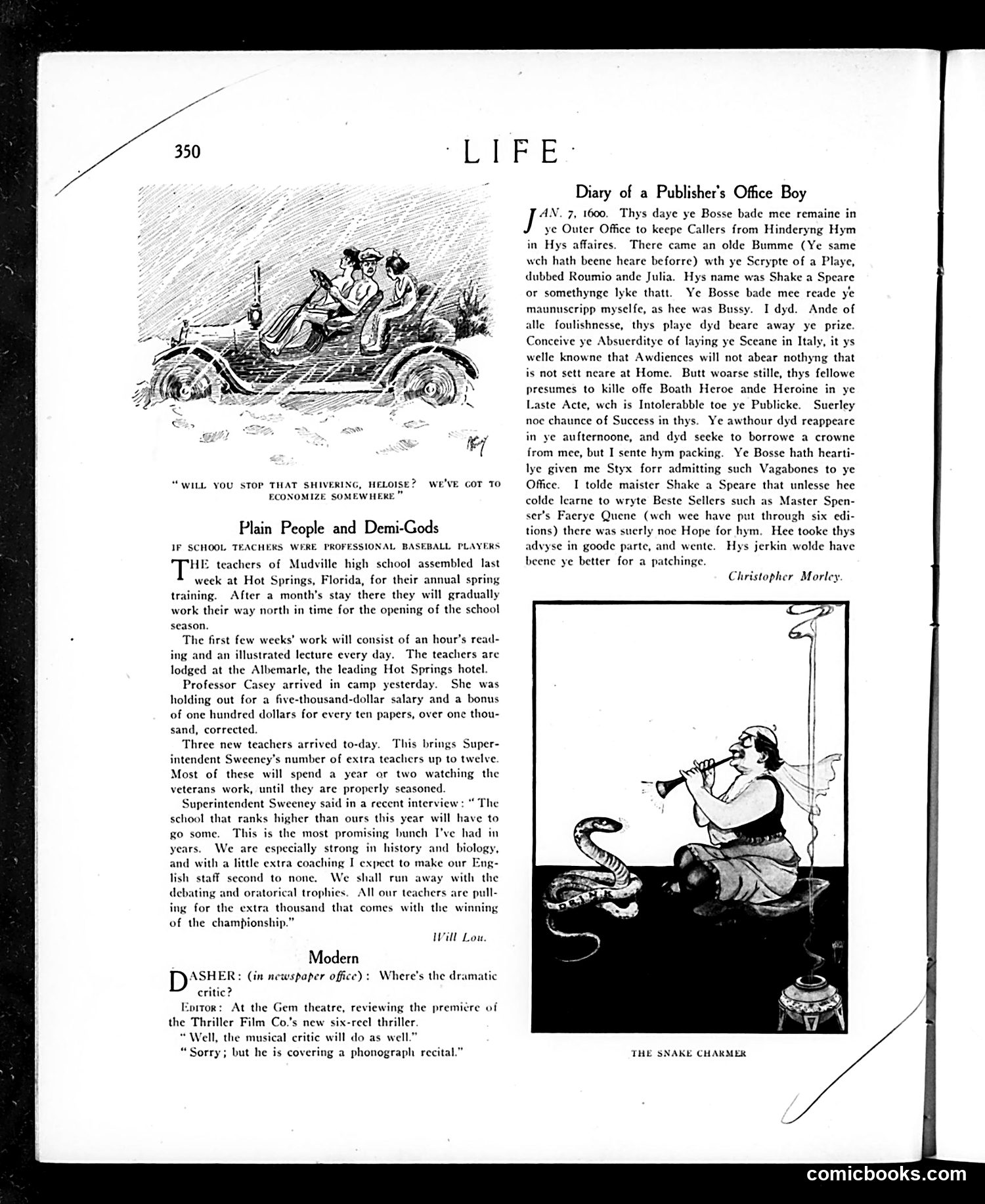
This *Life* magazine page contains three satirical pieces: **"Plain People and Demi-Gods"** parodies how schools treat teachers versus how baseball treats players. It imagines teachers undergoing "spring training" at luxury hotels with salary negotiations and performance bonuses—mocking the contrast between baseball's professional compensation and teachers' undervalued status. The superintendent's boastful claims mirror sports team competitiveness absurdly applied to education. **"Modern"** is a brief newspaper office joke: a dramatic critic is unavailable because he's covering a phonograph recital instead, so a musical critic will substitute—highlighting the era's fluid journalism and understaffing. **"Diary of a Publisher's Office Boy"** humorously reimagines Shakespeare pitching *Romeo and Juliet* to a 1600 publisher who rejects it for killing both leads and setting it abroad (audiences want domestic plots). This satirizes how even masterpieces might fail modern commercial publishing standards—a joke about shortsighted editorial judgment. The office boy dismisses Shakespeare as a vagrant.
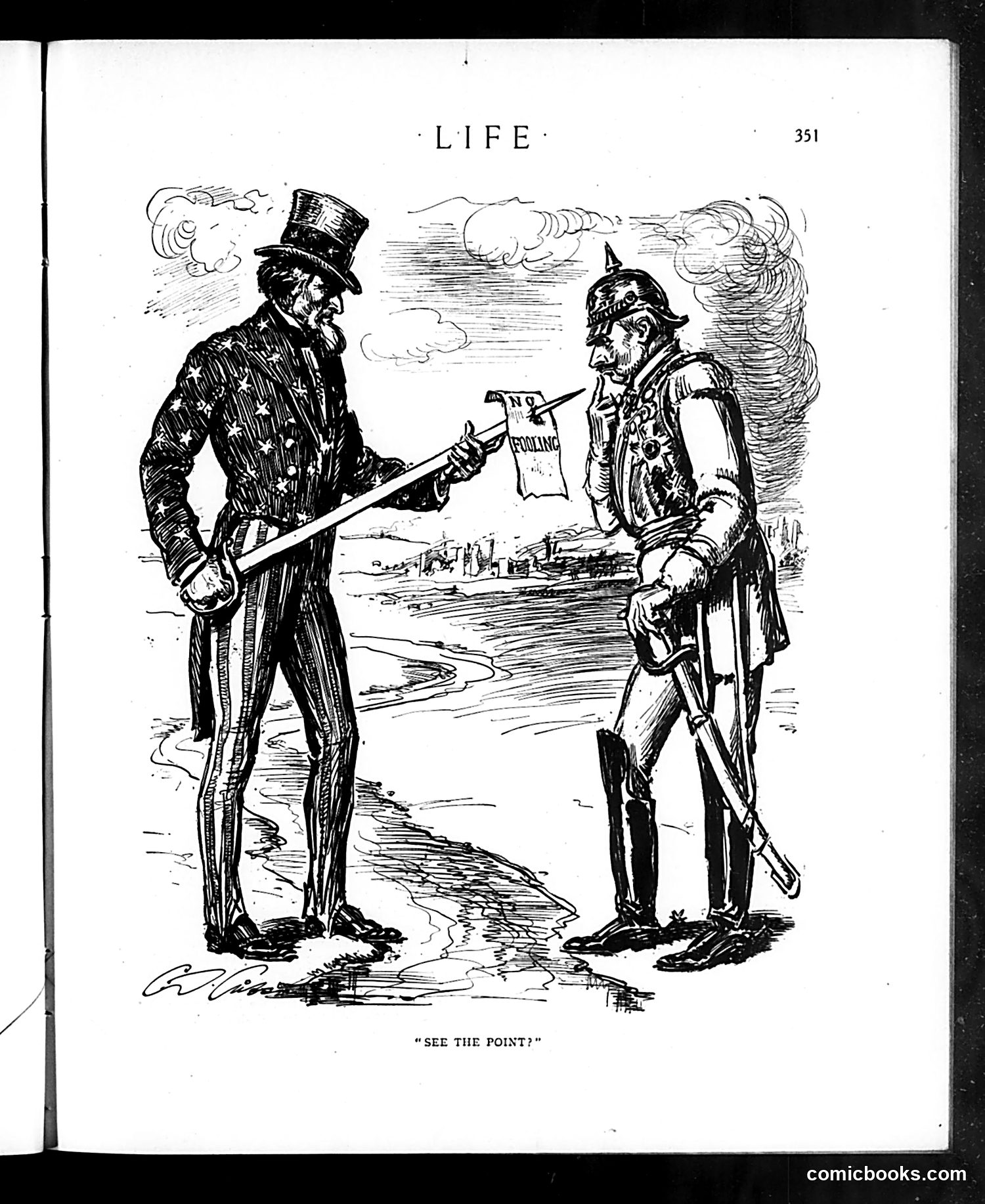
This political cartoon depicts two military figures in what appears to be a diplomatic or confrontational scene. The figure on the left wears American dress (stars-and-stripes patterned uniform, top hat) and holds a flag or document marked "NO POLLING" toward a spiked-helmeted German military officer on the right, who carries a sword. The caption "See the Point?" works as a double meaning—both asking if the German understands the message, and referring to the literal "point" of the bayonet/sword. The "NO POLLING" reference likely concerns American industrial or military production during wartime, with the cartoon suggesting America is asserting its position to Germany. Without the publication date visible, the precise historical context remains unclear, though the imagery suggests WWI-era tensions.
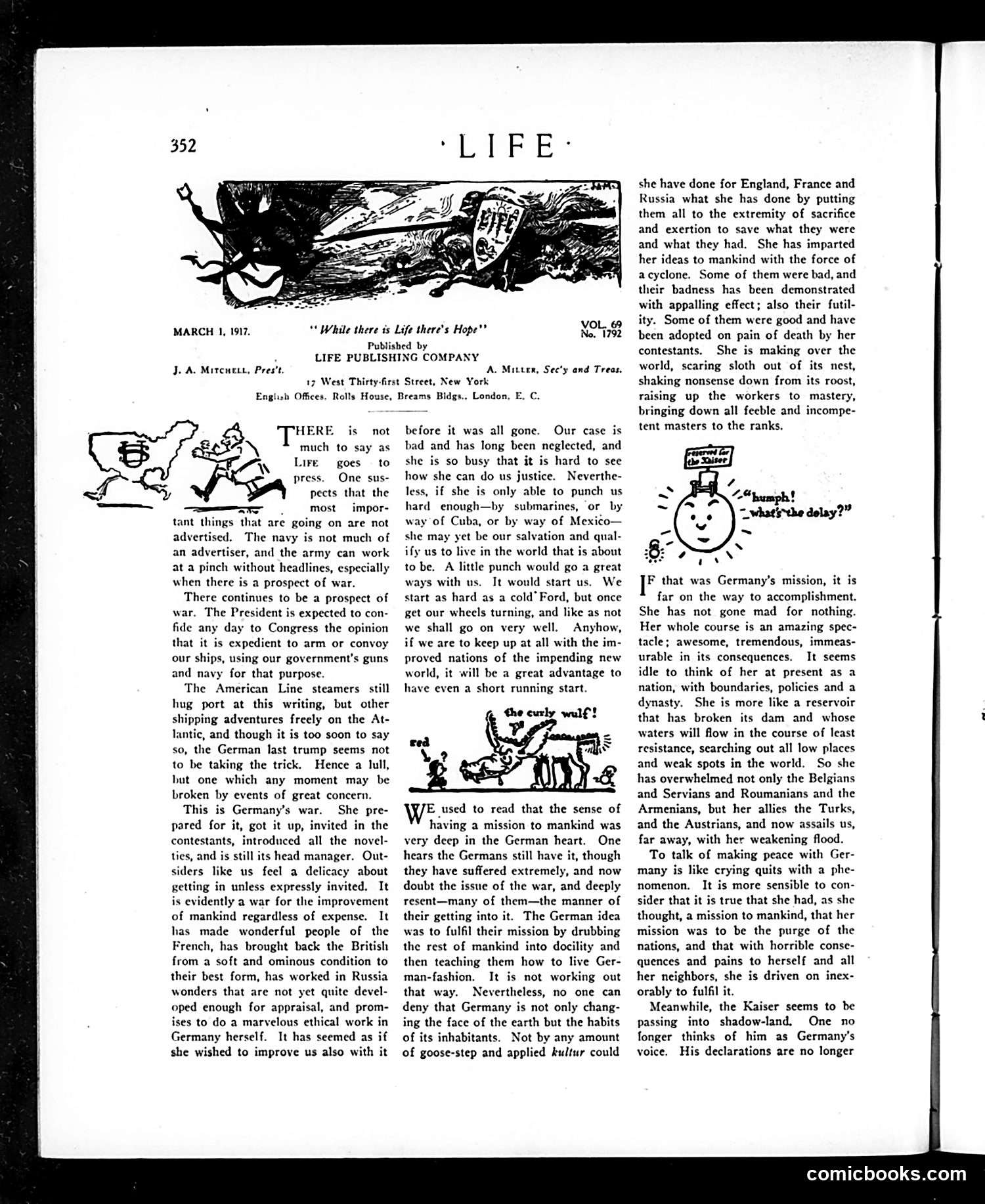
This page contains editorial commentary on American entry into World War I, written as Germany's unrestricted submarine warfare pushed the U.S. toward intervention. The cartoons depict **Germany as a threatening force**: one shows a menacing wolf ("the curly wulf"), another shows a round-faced figure asking "what's the delay?" — likely representing Germany impatient for America to enter the war through provocation. The text uses **sardonic humor** about U.S. reluctance to fight. It suggests Germany, through her "mission to mankind," might inadvertently help America by "punching us hard enough—by submarines, or by way of Cuba, or by way of Mexico." The author argues that war with Germany, while Germany's responsibility, could paradoxically improve America and its allies. The piece reflects the pre-April 1917 moment when submarine attacks and diplomatic crises made American intervention seem inevitable, while many Americans remained conflicted about joining Europe's devastating conflict.
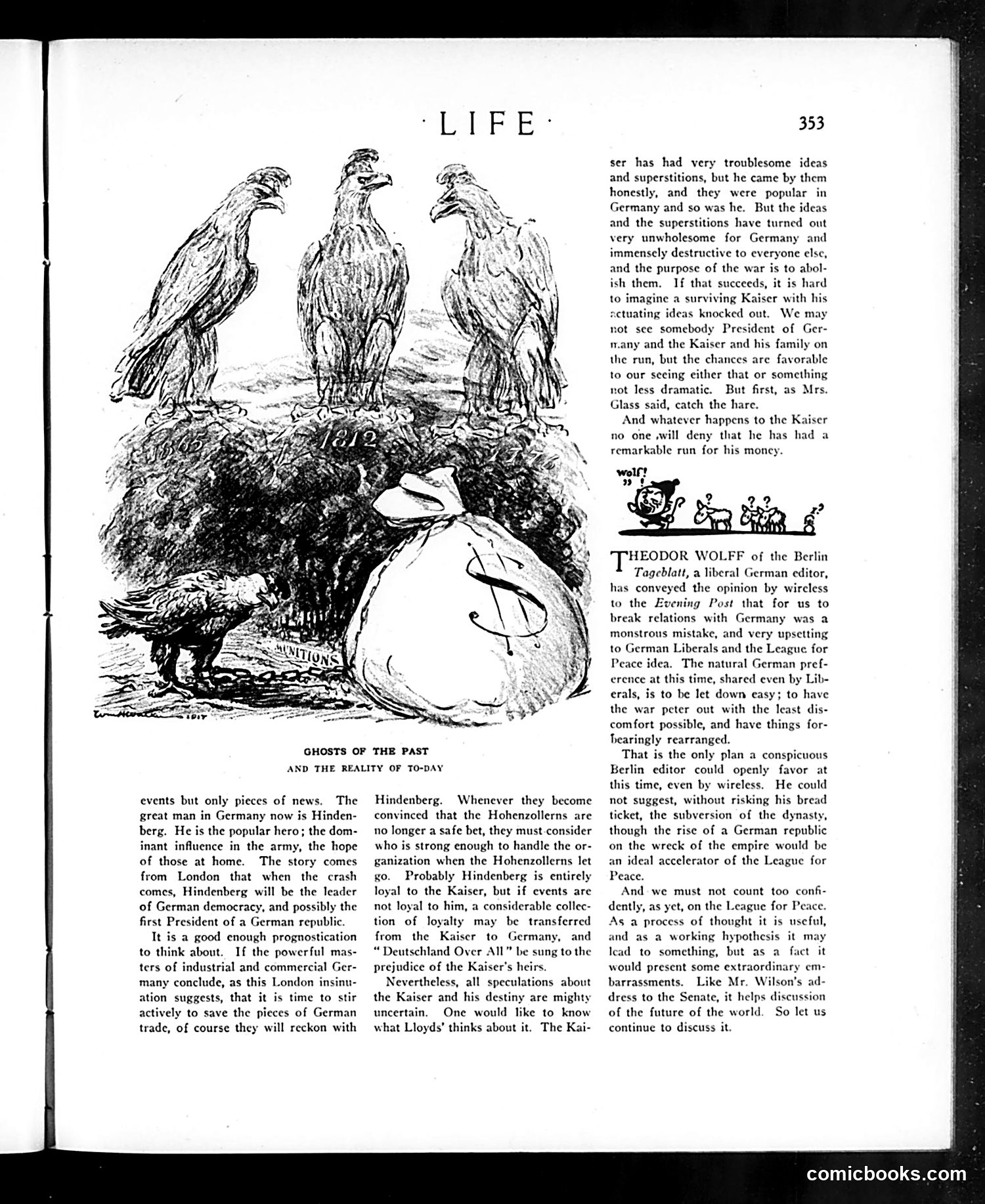
The cartoon titled "Ghosts of the Past and the Reality of To-Day" depicts three eagles perched on a nest containing a money bag marked with a dollar sign, illustrating Germany's military and financial interests during World War I. The text discusses Germany's political future, speculating that Field Marshal Hindenburg may become leader of a post-Kaiser German republic. The article also critiques Theodor Wolff, a Berlin liberal editor, for suggesting via wireless that America's break with Germany was a mistake—a position the author views as self-interested German propaganda seeking a comfortable peace. The satire targets German elites who prioritize financial survival and gentle reconciliation over genuine democratic reform, while questioning whether German liberals genuinely support peace or merely want to preserve their interests. The "ghosts of the past" reference suggests the Kaiser's outdated autocratic ideology haunts Germany's future.
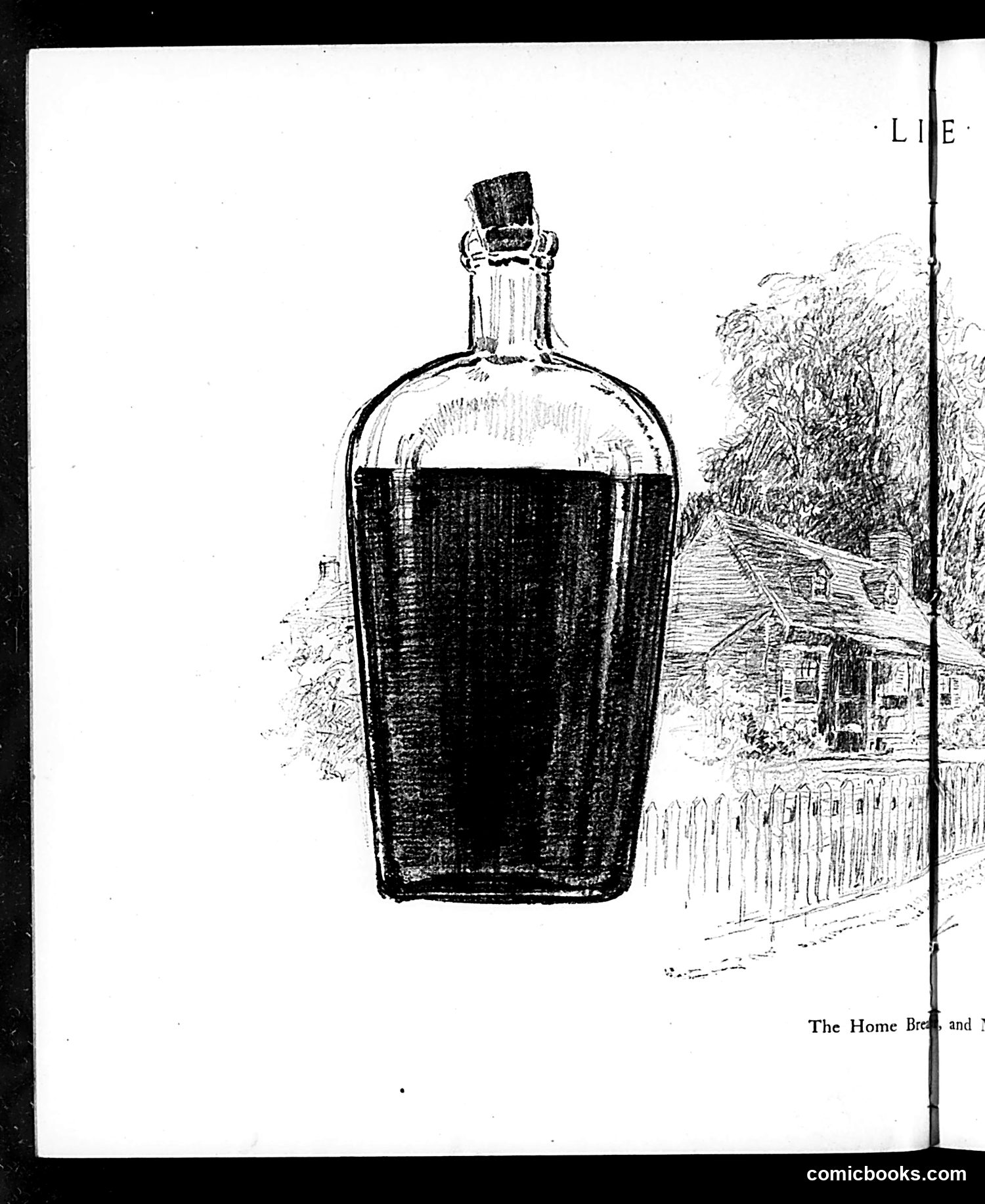
This page features a large illustration of a bottle filled with dark liquid, corked and sealed. The bottle is positioned against a rural landscape scene showing a cottage, fence, and overgrown vegetation. The text at bottom reads "The Home Brew and..." (cut off). This is clearly satirical commentary on **Prohibition-era home brewing**. The dramatic, almost ominous presentation of the homemade bottle suggests the dangers or illegality of producing alcohol at home during Prohibition (1920-1933). The rural cottage setting indicates this was common practice among ordinary Americans circumventing the alcohol ban. The satire likely mocks either the widespread defiance of Prohibition laws or warns of the risks of amateur alcohol production. Without the complete caption, the specific target of ridicule remains unclear, but the imagery unmistakably references illegal home alcohol manufacturing during this period.
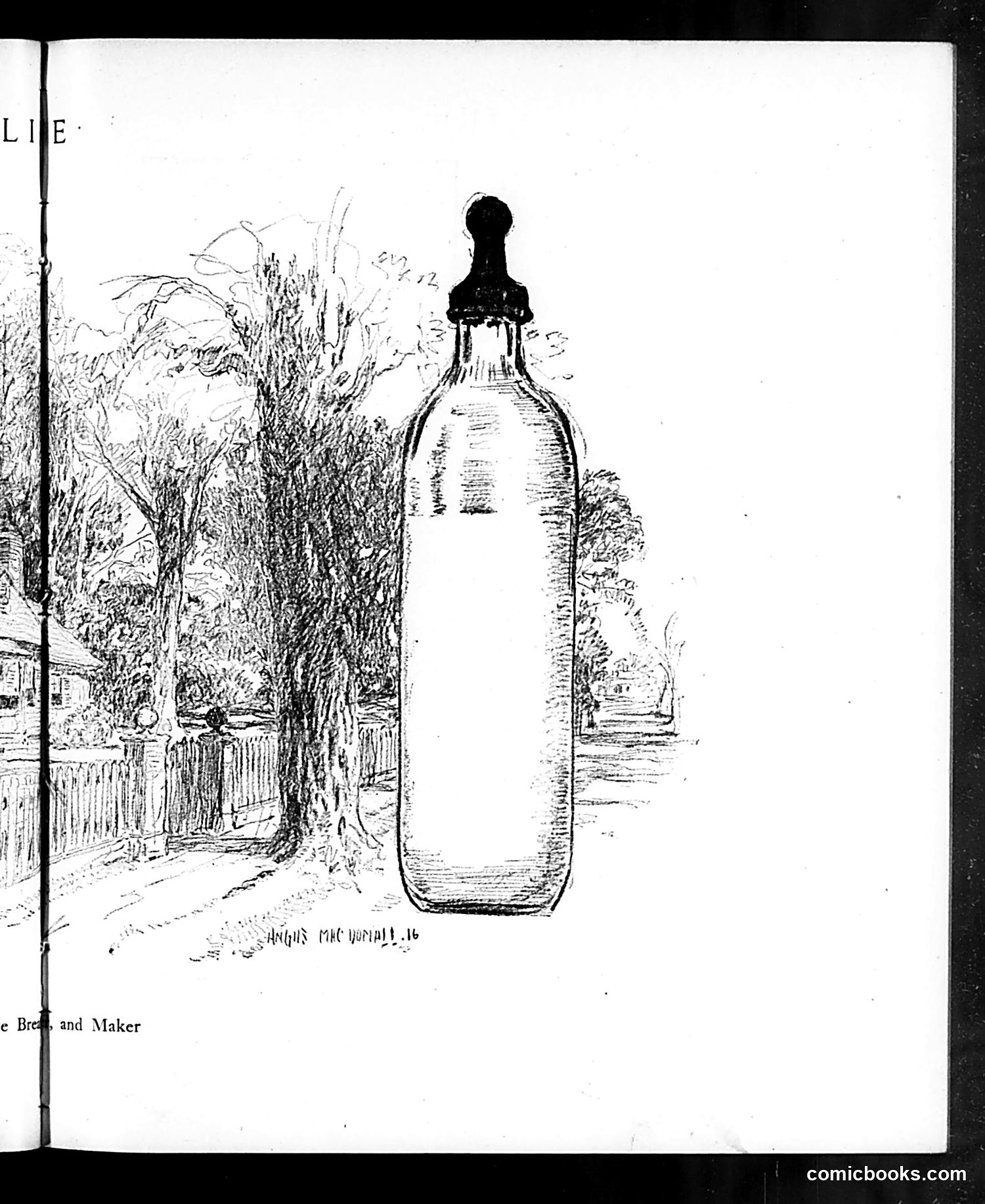
This page contains a single pen-and-ink illustration showing a large bottle with a black stopper positioned prominently in the center, with a rural scene featuring bare trees, a fence, and buildings in the background on the left. The OCR text "e Bre@, and Maker" (likely "Brewer and Maker") suggests this is advertising or satirizing alcohol production. Given Life magazine's satirical nature and the Prohibition era context of early 20th-century American history, this image likely critiques or comments on breweries and alcohol manufacturing—either celebrating them before Prohibition or mocking bootleggers during it. However, without a clear caption or date visible, the specific satirical point remains unclear. The bottle's prominent, almost monumental presentation could be either celebratory or mocking.
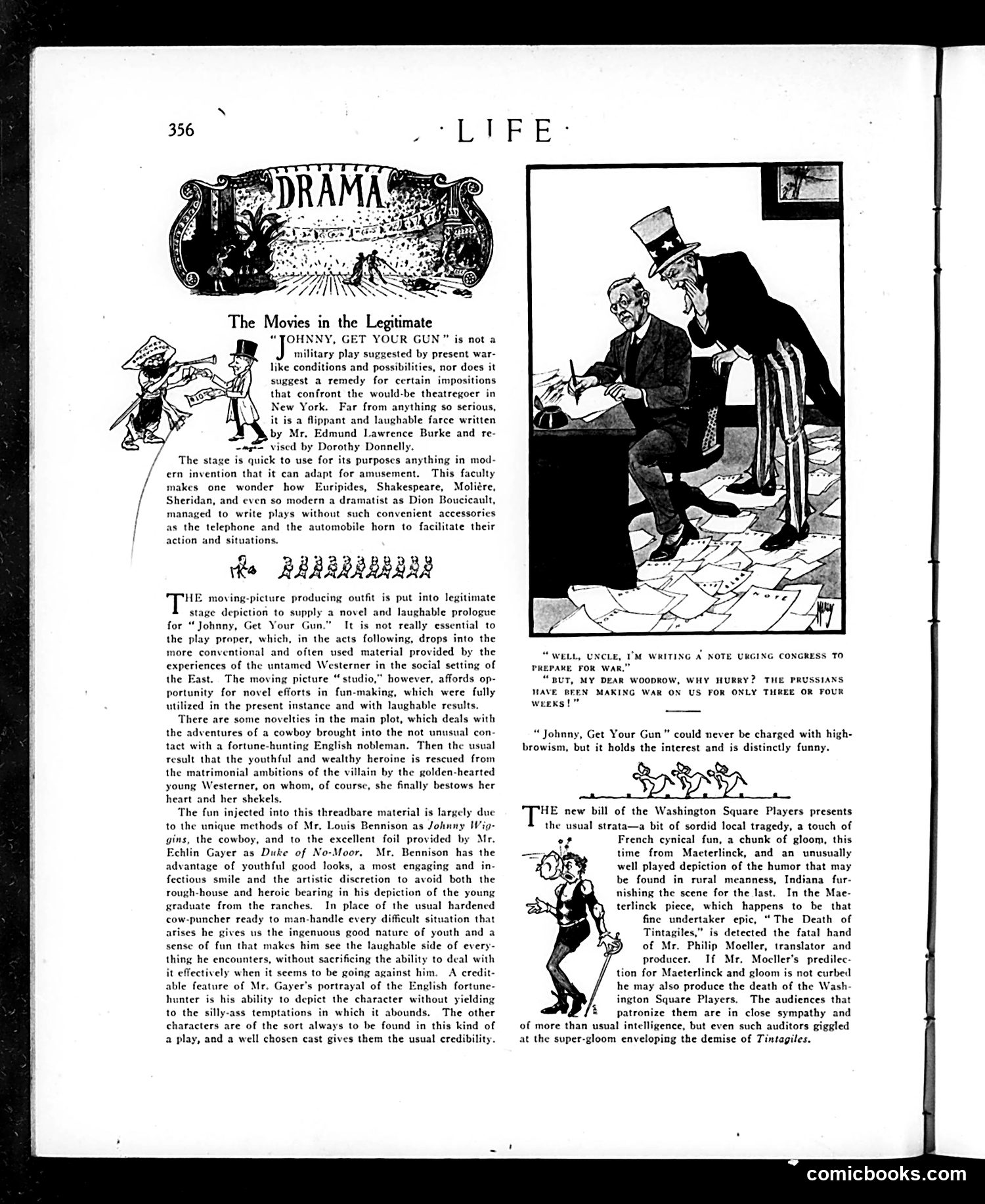
This page reviews theatrical productions, with a cartoon satirizing wartime anxiety. The main illustration shows two men—one identified by caption as "Uncle" (likely Uncle Sam, representing America) and another labeled "Woodrow" (President Woodrow Wilson)—discussing war preparedness. The joke satirizes Wilson's cautious approach to World War I. "Woodrow" is writing to Congress urging war preparation, but "Uncle" mocks the urgency, quipping that the Prussians have only been "making war on us" for "three or four weeks"—implying America should already be at war or that Wilson is unnecessarily alarmed. The cartoon reflects 1917 tensions over U.S. entry into WWI. Wilson initially campaigned on neutrality ("kept us out of war"), so this satirizes the sudden shift toward military preparation and the debate over American involvement. The page's primary content reviews the play "Johnny, Get Your Gun," a wartime farce with movie sequences—using modern film technology for theatrical novelty.
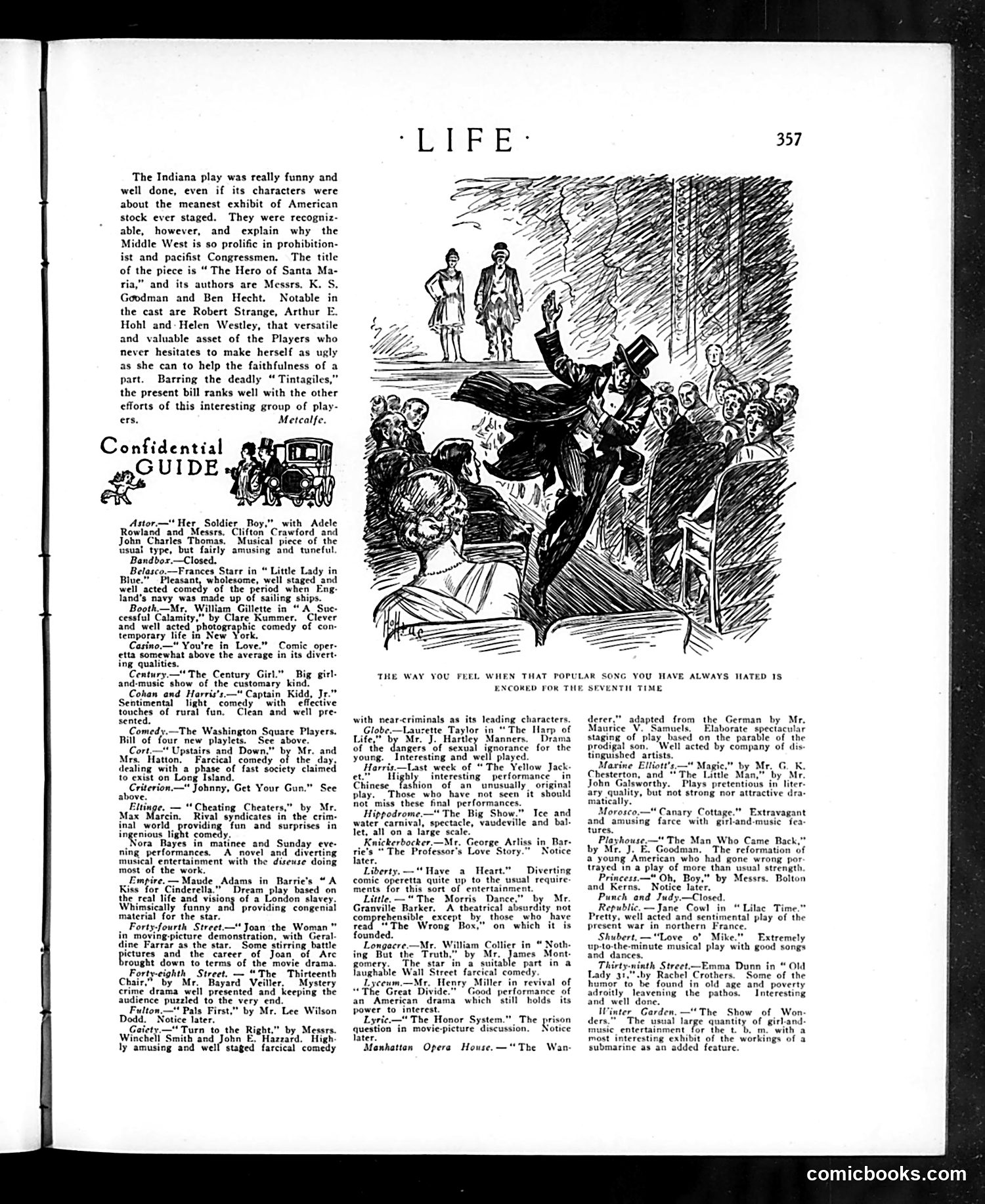
This page is primarily **theater reviews**, not political cartoons. The single illustration shows a social satire: a well-dressed man conducting an orchestra is surrounded by audience members displaying exaggerated expressions of agony and despair. The caption reveals the joke: "THE WAY YOU FEEL WHEN THAT POPULAR SONG YOU HAVE ALWAYS HATED IS ENCORED FOR THE SEVENTH TIME." This is gentle, relatable humor about the common experience of enduring a mediocre popular song repeated excessively—a situation any theatergoer would recognize. The man's oblivious enthusiasm contrasts with the audience's visible suffering. The broader context: Life magazine's theater section critiques various productions (musicals, comedies, dramas) with sharp but fair assessments. The reviews mention specific performers and plots, suggesting this reflects actual 1916-era theatrical offerings. The satire is social rather than political—mocking mass entertainment excess and audience politeness rather than current events.
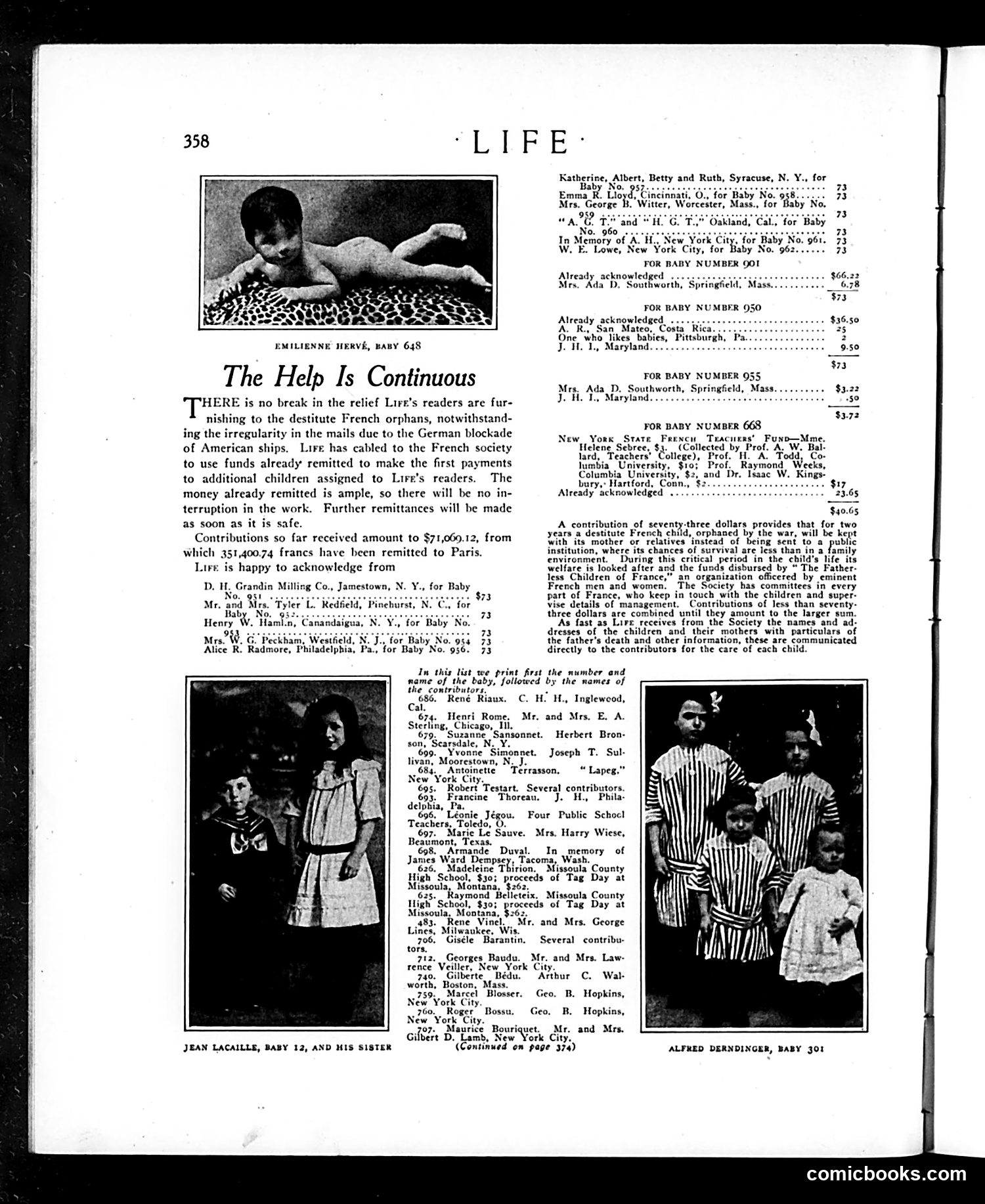
This page documents **Life magazine's charitable relief campaign for French war orphans** during or after World War I. The main article, "The Help Is Continuous," announces that Life's readers have collectively donated **$71,069.12** to support destitute French children orphaned by the war. The text explains the mechanics: Life channels funds through "The Fatherless Children of France," a French organization with committees nationwide who place children with families rather than institutions, believing home care improves survival chances. As donations arrive, Life publishes the names of supported children (numbered) alongside their American contributors' names—creating a direct connection between donors and specific orphans. The photographs show beneficiary children. This was a common early-20th-century fundraising tactic: personalizing charitable giving through named recipients made donors feel invested in individual lives rather than abstract humanitarian causes. The extensive lists document transparency and accountability—reassuring donors their money directly aided named children under proper oversight.
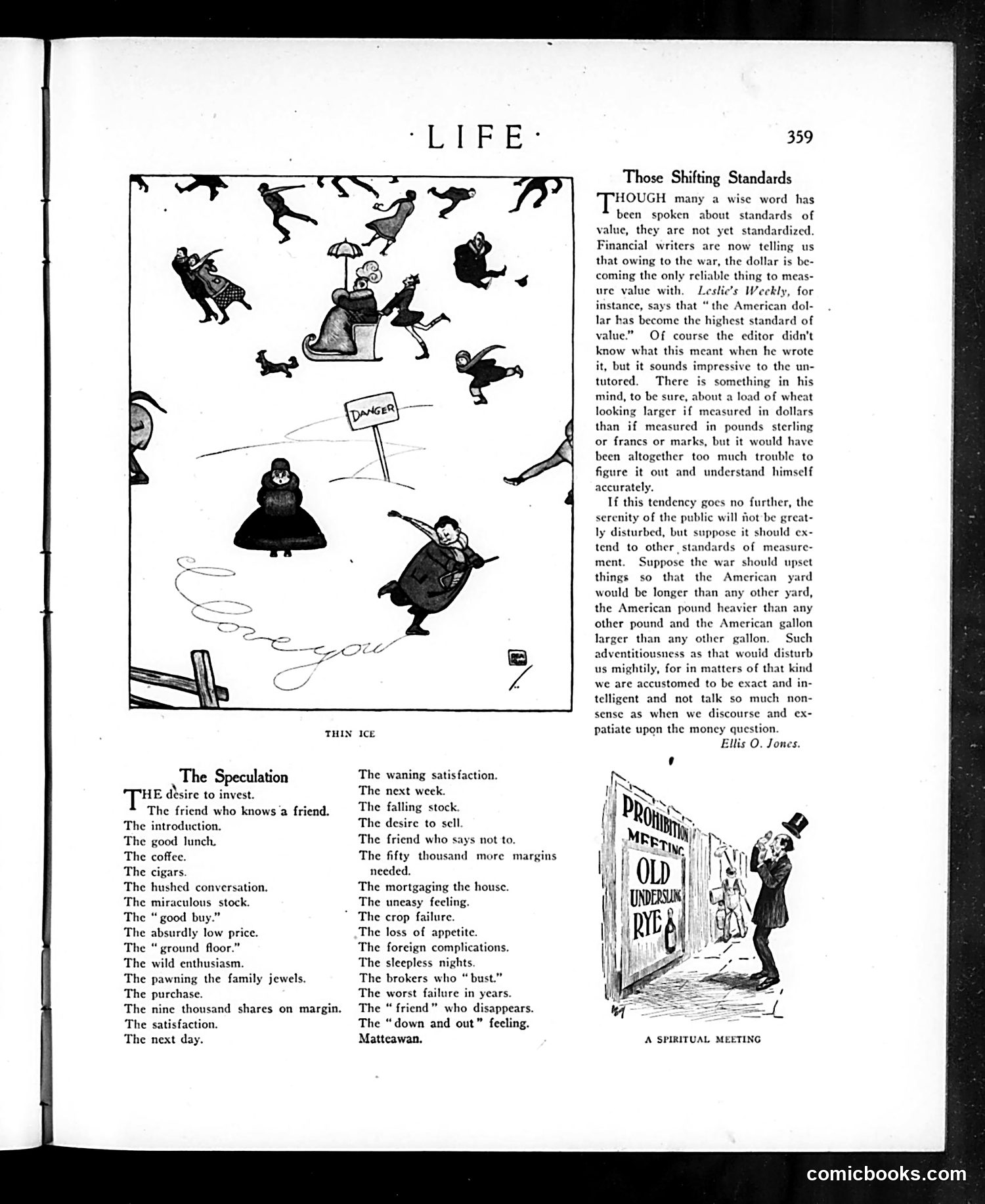
The top cartoon depicts stock market speculation during World War I. "This Ice" illustrates the dangerous progression of investment mania: friends convince each other to buy "miraculous stock" at absurdly low prices on margin (borrowed money), leading to euphoria, then rapid collapse when the stock falls. The figures tumbling and slipping on ice represent investors losing everything—mortgaging homes, pawning jewels, until complete financial ruin and disappearance of friends ("down and out" feeling, ending at "Mattcawan," likely an asylum reference). The accompanying text criticizes unstable currency values during wartime. It mocks financial writers claiming the dollar is now the "highest standard of value" due to war—an absurd statement implying subjective measurement standards. The author suggests this rhetorical confusion might dangerously extend to actual measurements (yards, pounds, gallons), illustrating how financial sophistry undermines rational discourse about money. The bottom cartoon shows a Prohibition-era meeting, satirizing temperance activism.
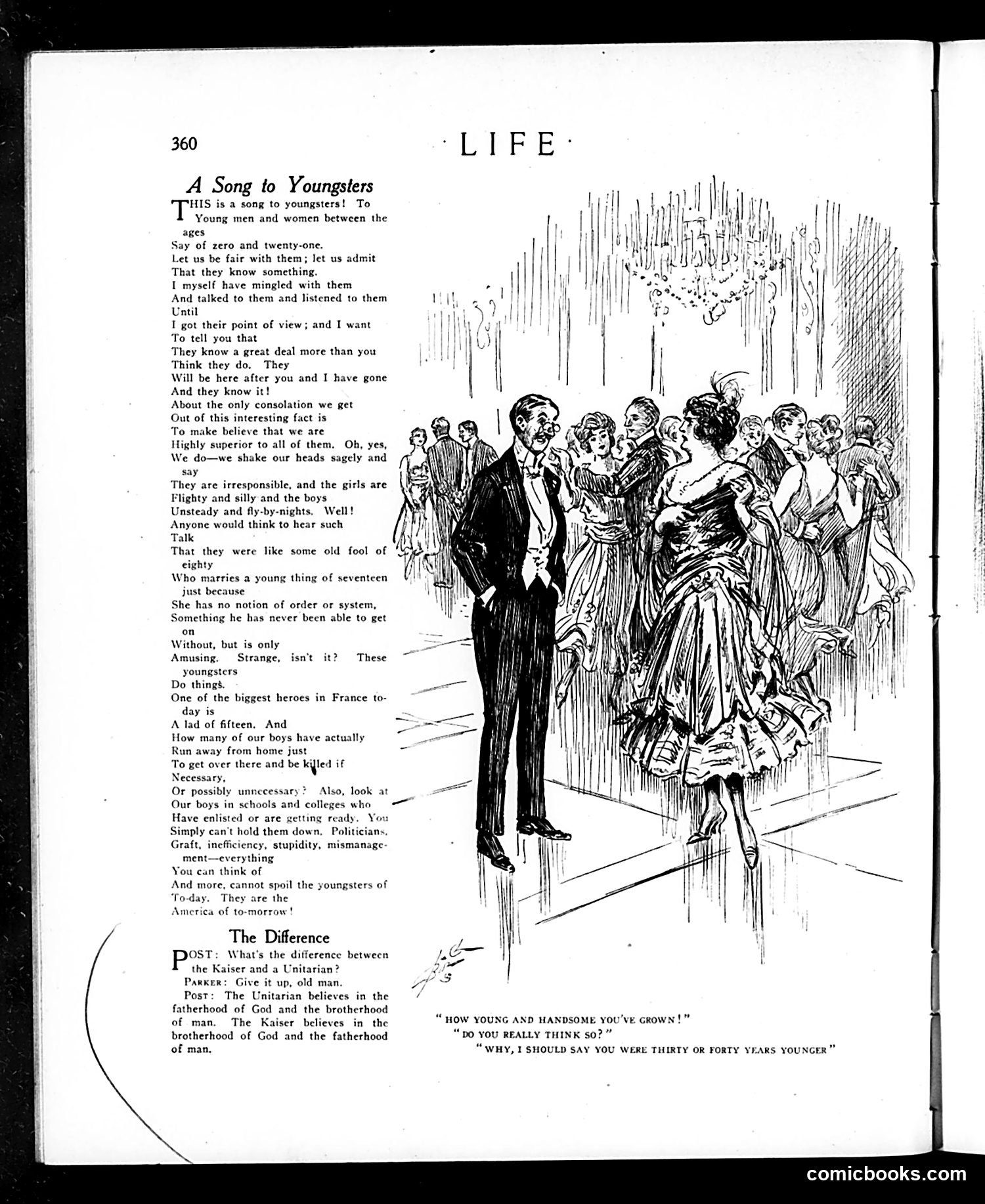
**"A Song to Youngsters"** praises young Americans (ages 0-21) for their maturity and patriotism, particularly regarding WWI. The author defends them against older generations' criticism as "irresponsible" and "flighty," citing examples like a fifteen-year-old French hero and American boys enlisting voluntarily. The piece argues youth represent "America of to-morrow" and cannot be corrupted by political failures. **"The Difference"** is a brief joke contrasting the Kaiser (German emperor Wilhelm II) with Unitarians. The punchline sardonically suggests the Kaiser inverts Christian values—believing in "brotherhood of God and fatherhood of man" rather than the Christian principle of God's fatherhood and human brotherhood. This mocks the Kaiser's authoritarian militarism as fundamentally unchristian. **The illustration** shows a well-dressed gentleman admiring young people at what appears to be a social gathering, supporting the text's theme of youth vitality. The page reflects early WWI-era American sentiment celebrating youth patriotism while criticizing German leadership.
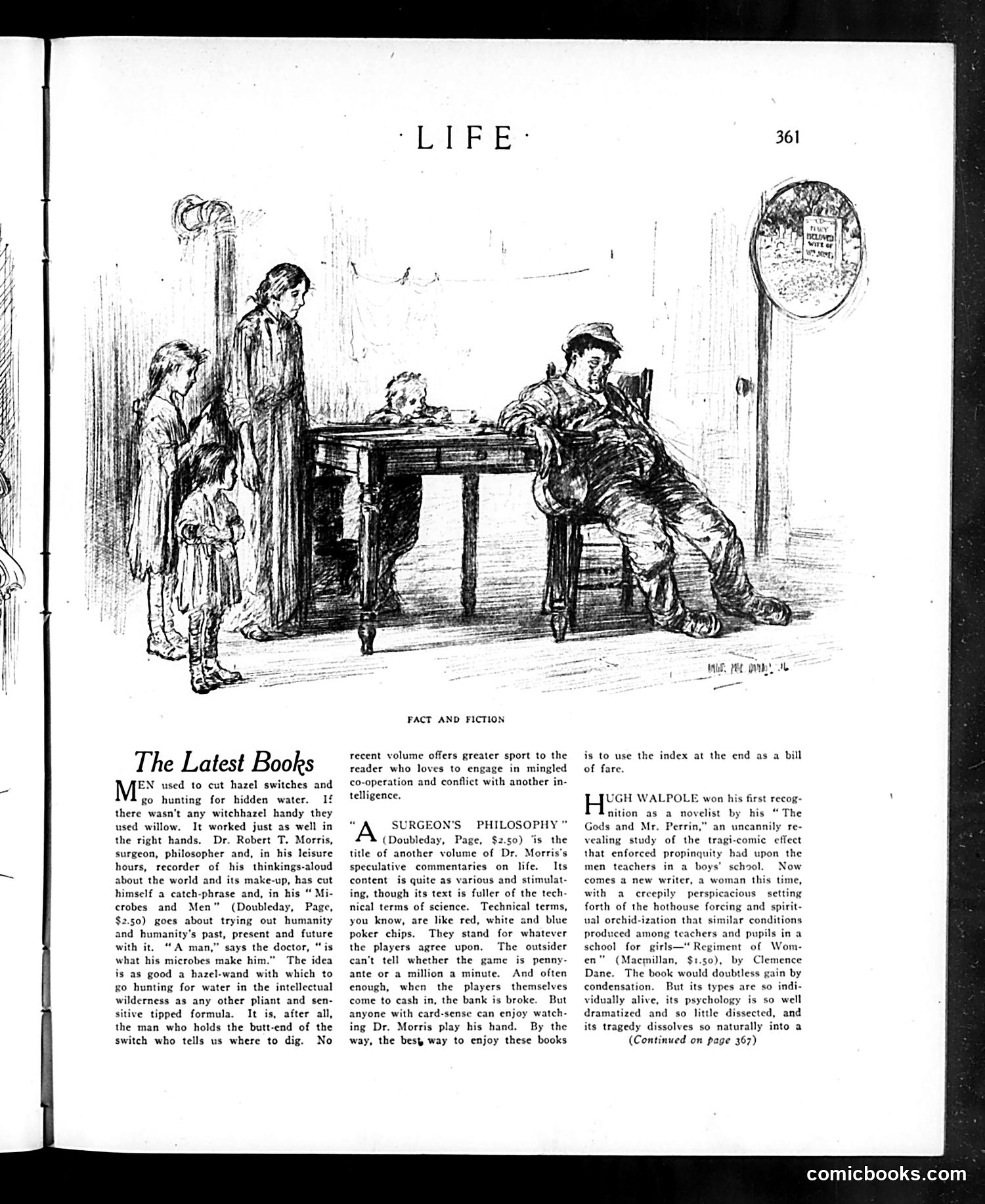
This page features a book review section titled "The Latest Books" with a single illustration at top showing what appears to be a schoolroom scene—children and an adult at a desk, suggesting an educational or institutional setting. The reviews discuss three works: Dr. Robert T. Morris's "Microbes and Men" and "A Surgeon's Philosophy" (both about how microbes shape human nature and life philosophy), and a new novel "Regiment of Women" by Clemence Dane about female teachers and pupils in a girls' school. The illustration likely relates to the Dane review, as the text discusses how her novel explores "the hothouse forcing and spiritual orchid-ization" of relationships in girls' schools—mirroring H.G. Walpole's earlier novel about boys' schools. The cartoon depicts institutional life's dynamics, the central subject of these literary critiques. The satire appears gentle, focusing on book recommendations for intellectual readers rather than political commentary.
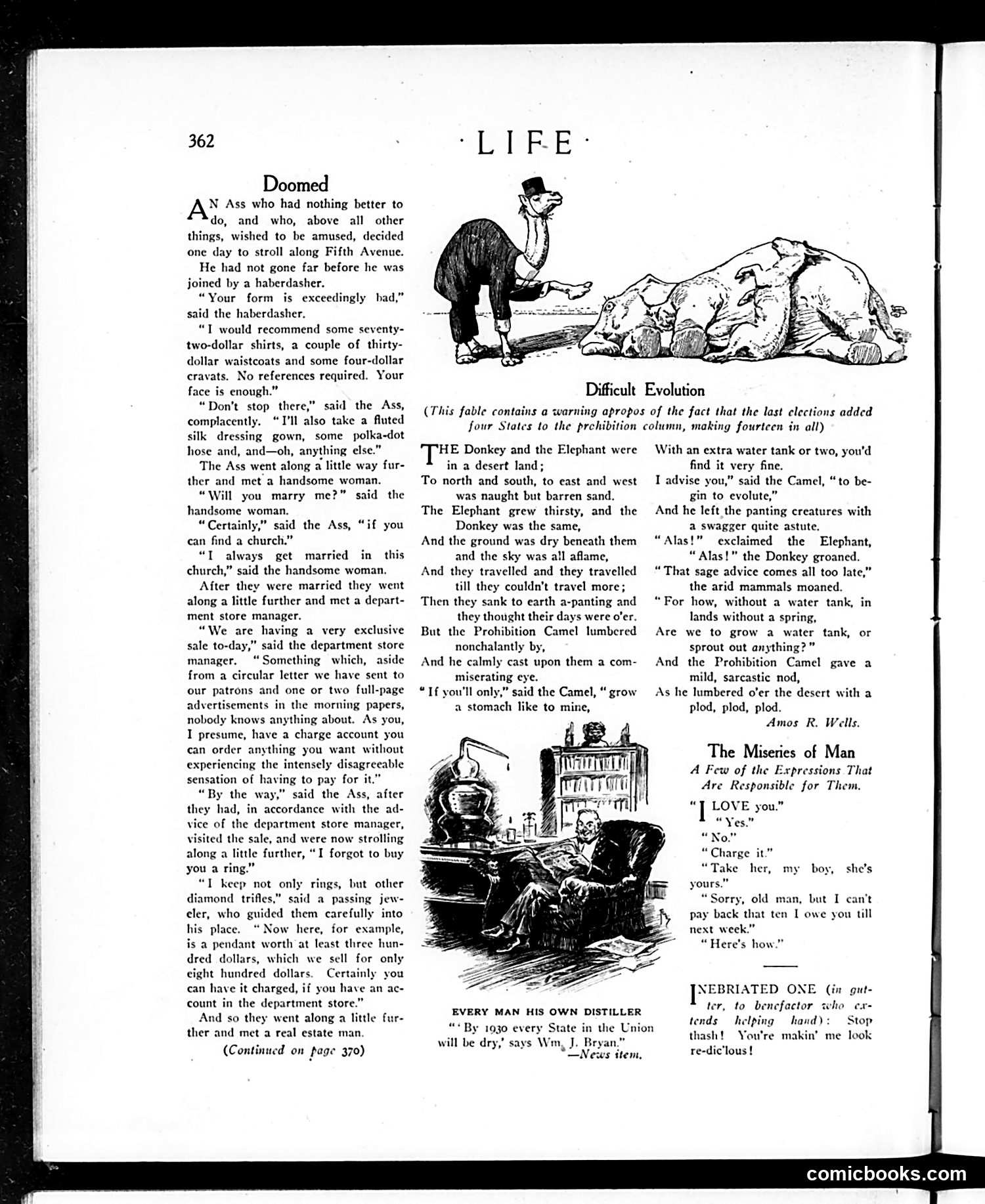
This Life page contains two satirical pieces about American consumer culture and Prohibition. **"Doomed"** mocks an easily manipulated Ass who encounters Fifth Avenue merchants—a haberdasher, a woman, a department store manager, and a jeweler—each convincing him to make frivolous purchases on credit. The satire targets both gullible consumers and merchants exploiting them with fake "exclusive" sales and charge accounts. **"Difficult Evolution"** uses animals as political figures: the Donkey and Elephant (Democratic and Republican parties) suffer in a desert while a Camel (representing Prohibition advocates) passes by smugly. The poem ridicules Prohibition as impractical and cruel—the animals cannot "evolve" water tanks as the Camel suggests, just as Americans cannot adapt to Prohibition laws. The caption references William Jennings Bryan's prediction that all states would be "dry" by 1930, treating the prediction as absurdly naive. Both pieces critique 1920s excess—whether through unchecked consumer spending or failed social engineering via Prohibition.
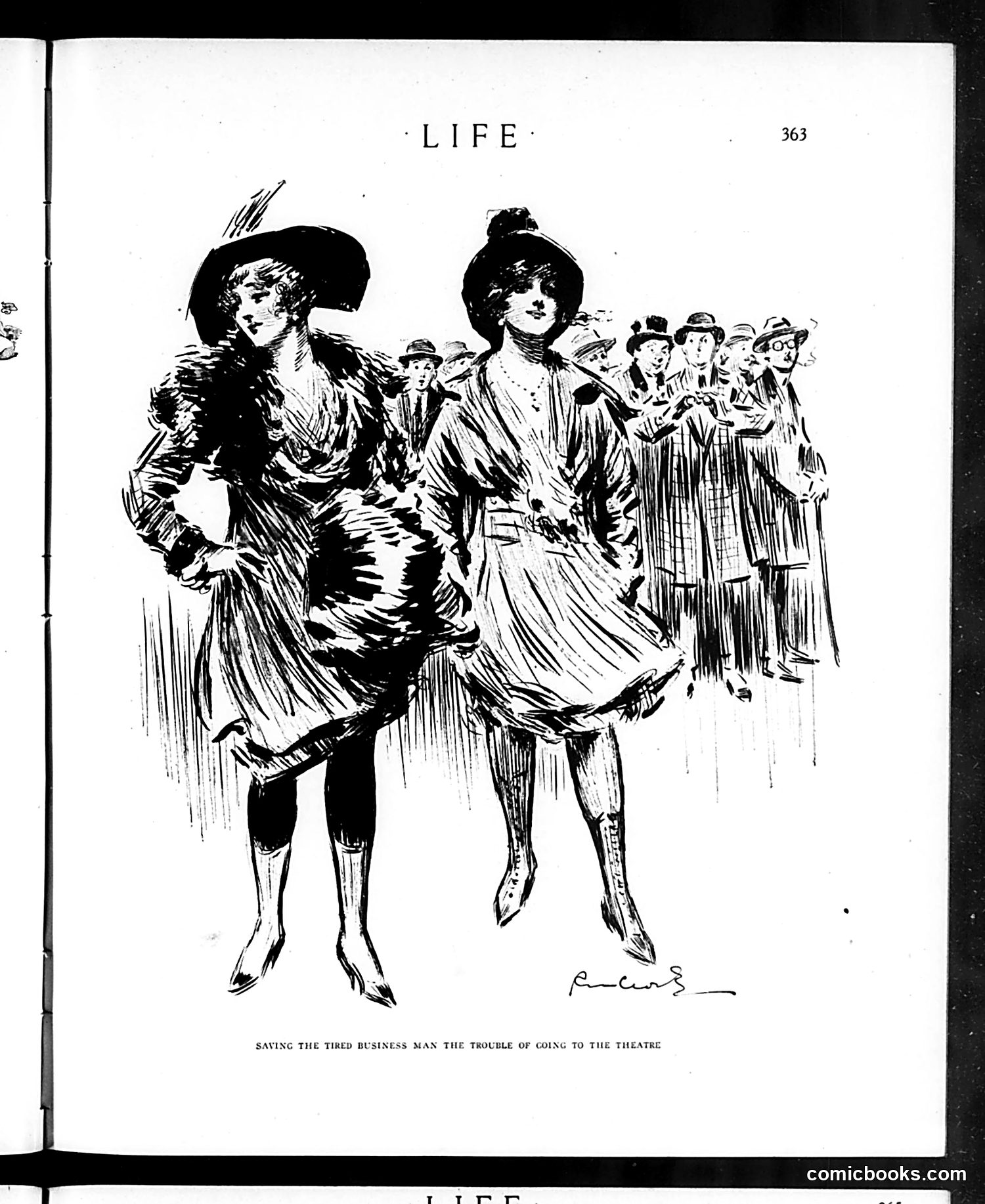
This cartoon satirizes early 20th-century gender dynamics and leisure habits. The caption reads: "SAVING THE TIRED BUSINESS MAN THE TROUBLE OF GOING TO THE THEATRE." Two fashionably dressed women in the foreground—wearing elaborate hats, furs, and period clothing—appear to be performing or displaying themselves, while a group of men in bowlers and suits watches from behind. The satire suggests that women were becoming public spectacles of fashion and entertainment, serving as unwitting "theatre" for male observation. It mocks both the performative nature of women's fashion display and the passivity of businessmen who prefer this free entertainment to attending actual theatrical performances. The joke relies on the notion that women's elaborate public dress and appearance constituted entertainment for male consumption.
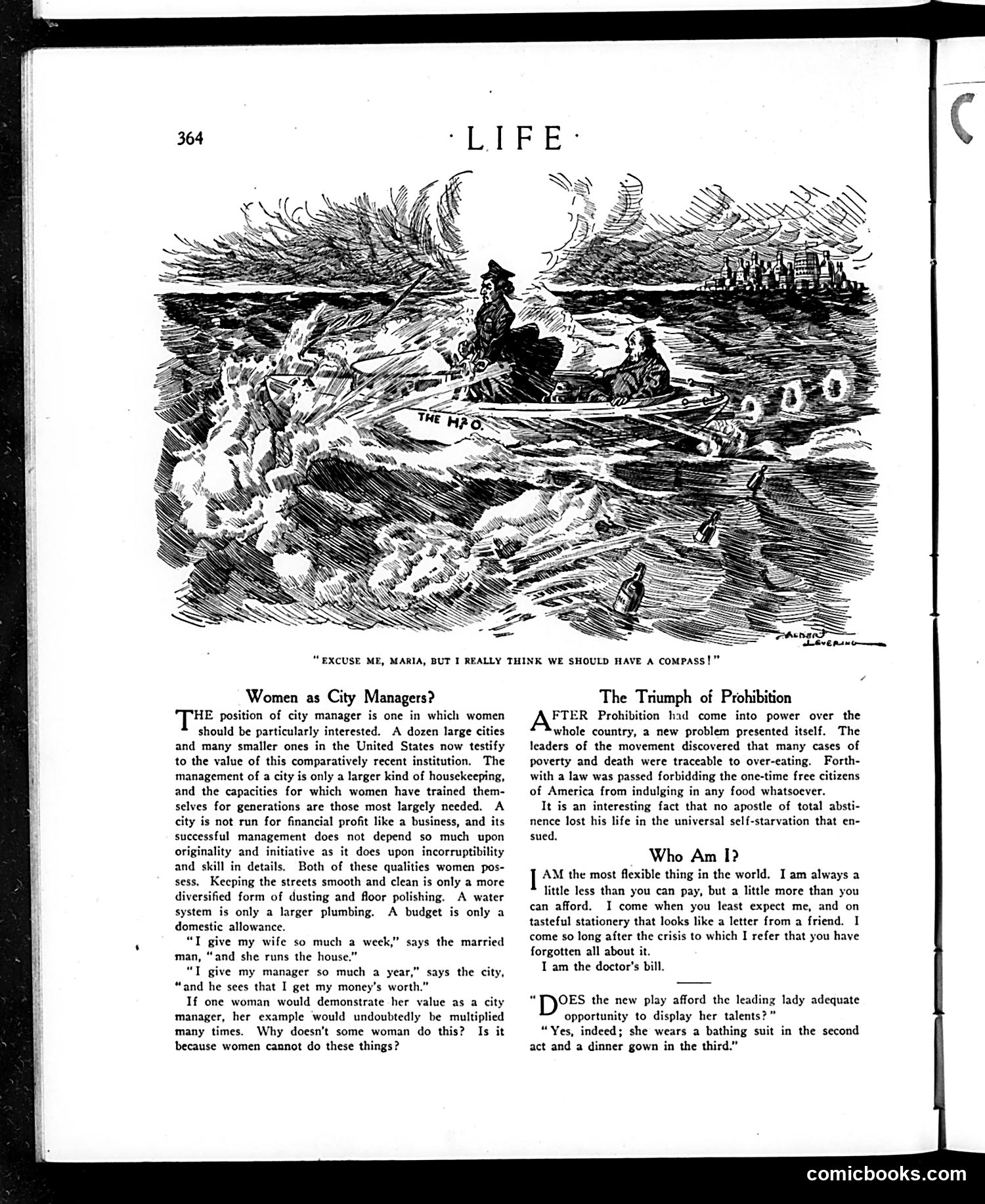
The cartoon depicts a boat labeled "THE H.P.O." (likely "H.P. Lovecraft" or another literary reference, though unclear) in turbulent waters. Two figures navigate while one says they need a compass, suggesting they're lost amid chaos. The accompanying articles use **satirical exaggeration** to critique 1920s social attitudes: 1. **"Women as City Managers?"** argues women *should* manage cities because municipal administration is "only a larger kind of housekeeping"—a patronizing argument sarcastically presented as progressive. The logic equates public administration to domestic chores (street cleaning = floor polishing). 2. **"The Triumph of Prohibition"** mocks the Prohibition movement by imagining it extended to food, resulting in mass starvation—satirizing the movement's perceived zealotry and unintended consequences. 3. **"Who Am I?"** riddles that the answer is a doctor's bill—critiquing medical expenses arriving late and unexpectedly. The cartoon's connection to these pieces remains **unclear**, though it may relate to navigating uncertainty in contemporary life.
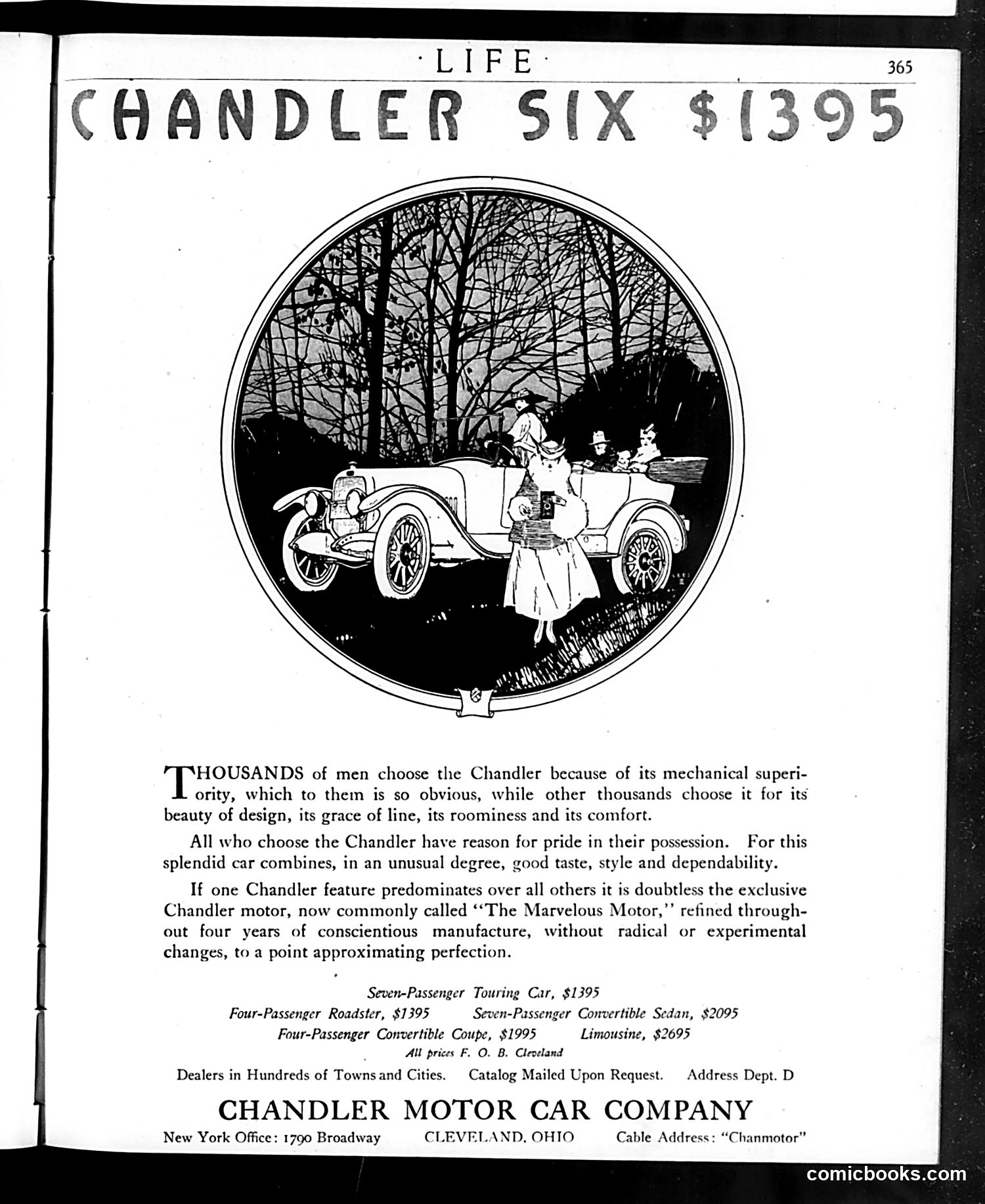
This page is primarily a **commercial advertisement**, not satirical content. It promotes the Chandler Motor Car Company's "Chandler Six" automobile, priced at $1395. The circular illustration depicts an elegantly dressed woman standing beside a touring car, with passengers visible inside and bare trees in the background—a common advertising aesthetic of the 1920s era, emphasizing luxury, leisure, and modernity. The text employs typical period advertising rhetoric: appeals to both mechanical superiority ("The Marvelous Motor") and aesthetic refinement ("beauty of design," "grace of line"). The messaging targets affluent buyers seeking status and dependability. There is **no political satire or social commentary evident**. Life magazine, while known for humor and satire, also contained substantial advertising revenue. This appears to be a straightforward automotive advertisement leveraging lifestyle imagery to sell vehicles ranging from $1395 to $2695—significant sums in that era.
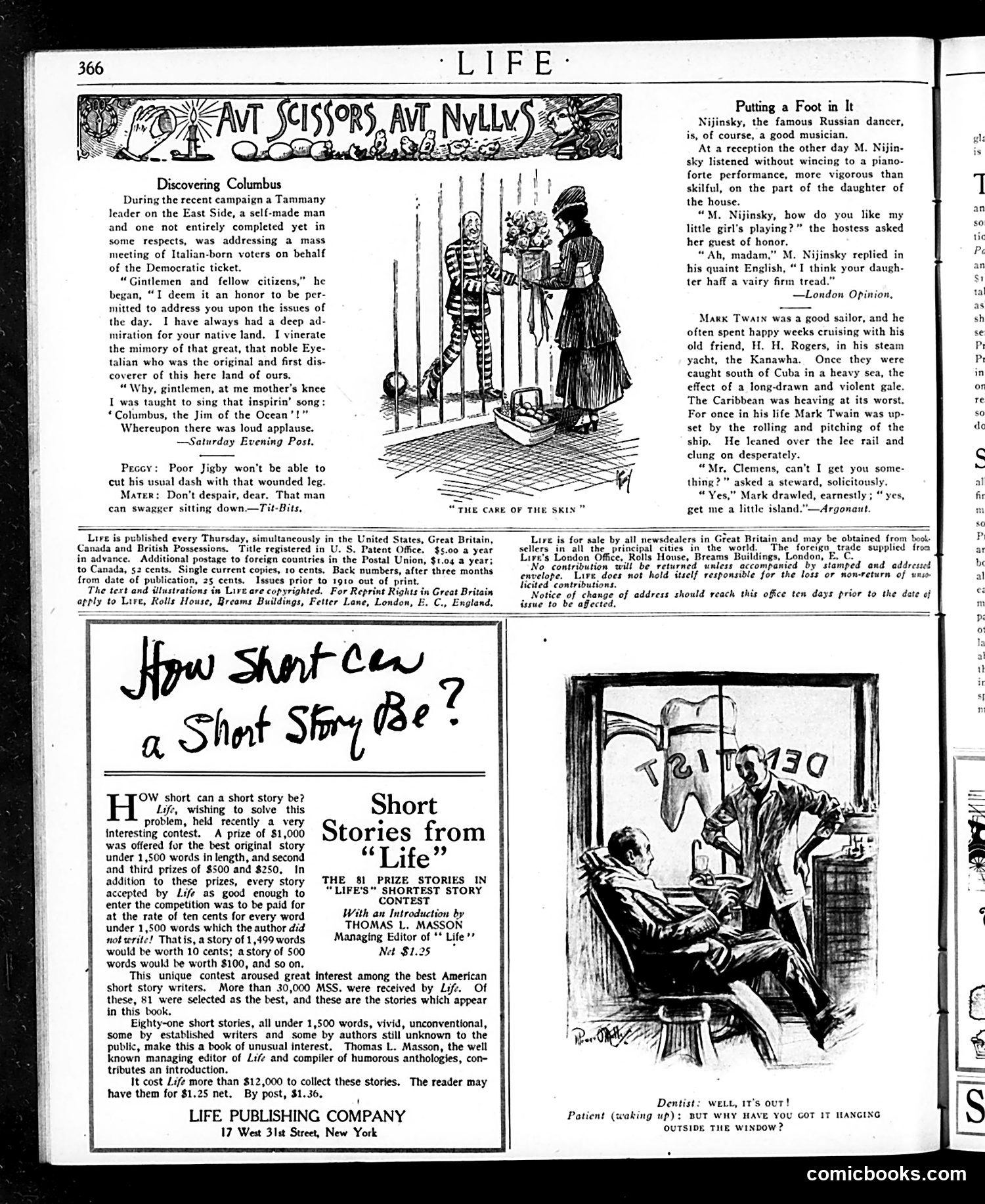
This page contains three humorous anecdotes rather than political cartoons: 1. **"Discovering Columbus"**: Satirizes a poorly educated Tammany Hall politician (Democratic machine operative) addressing Italian-American voters. The joke mocks his malapropisms ("Ey talian," "mimory," "coverer") and his cynical, superficial appeal to ethnic pride—praising Columbus to win votes while mangling basic facts and language. 2. **"Putting a Foot in It"**: A light social joke where Russian dancer Nijinsky diplomatically insults a hostess's daughter's piano playing by saying she has a "vairy firm tread"—confusing musical performance with dancing. 3. **Mark Twain anecdote**: Humorist Twain, seasick on a yacht during a Caribbean storm, requests "a little island" instead of typical remedies—typical Twain-style deadpan wit. The page also advertises Life's short-story contest, promoting an anthology of winning entries.
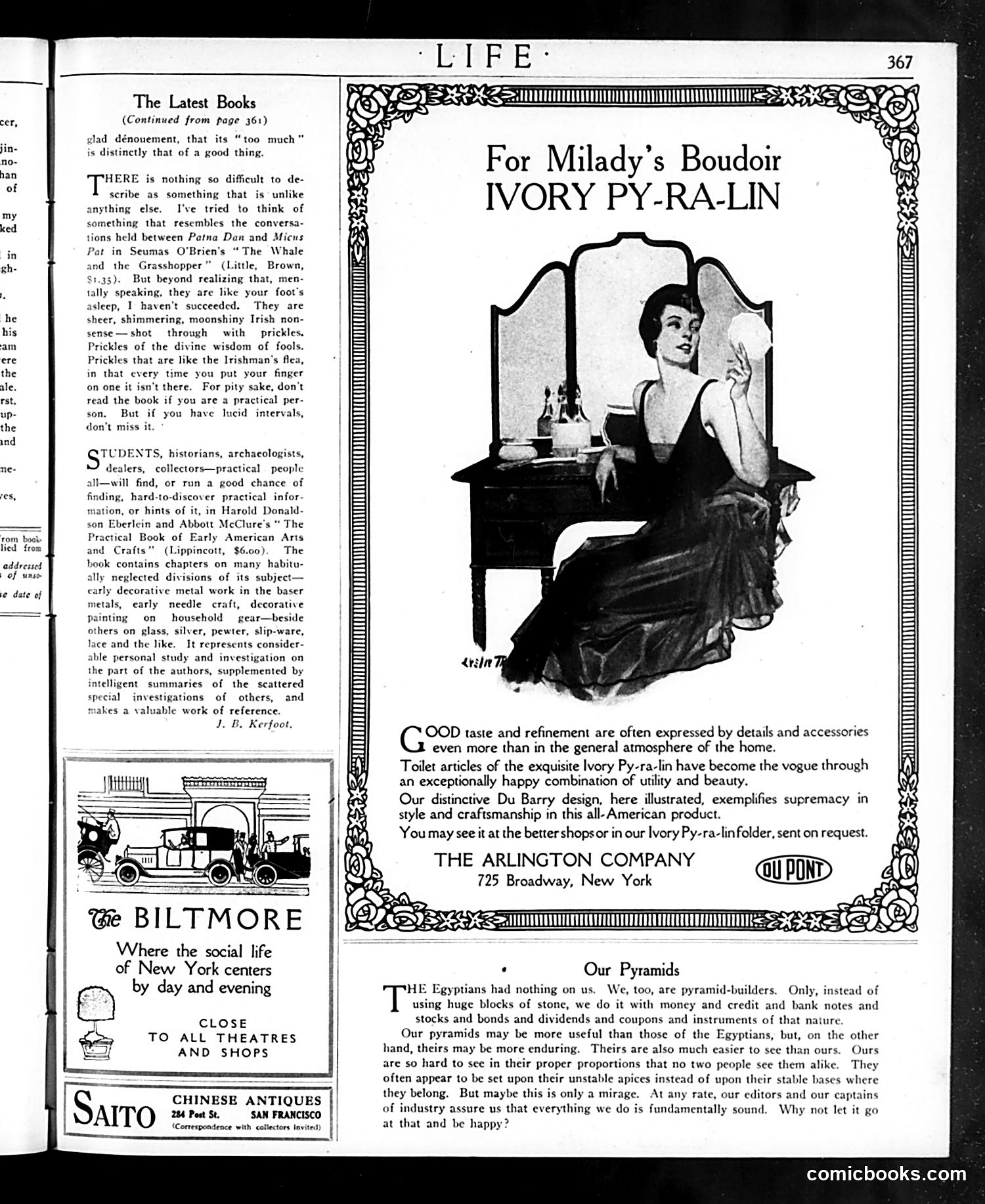
This page is primarily **advertising and editorial content**, not political satire. The main feature is a **beauty product advertisement** for "Ivory Py-ra-lin" toilet articles (likely combs, brushes, or similar items). The illustration shows a woman at her vanity, promoting these accessories as expressions of "good taste and refinement." This reflects 1920s consumer culture marketing to women's beauty routines. Below is a brief **editorial piece titled "Our Pyramids,"** comparing American financial structures (stocks, bonds, dividends) to Egyptian pyramids. The satire is gentle and self-aware: Americans build invisible "pyramids" of credit and money rather than stone, and they're "so hard to see in their proper proportions that no two people see them alike." It's a lighthearted commentary on the abstract nature of modern finance versus tangible ancient monuments—appropriate for the Jazz Age's speculative economy, though not sharply critical. The left column reviews literary books, including Irish fiction. Overall, this is a lifestyle/consumer-focused magazine page rather than pointed political commentary.
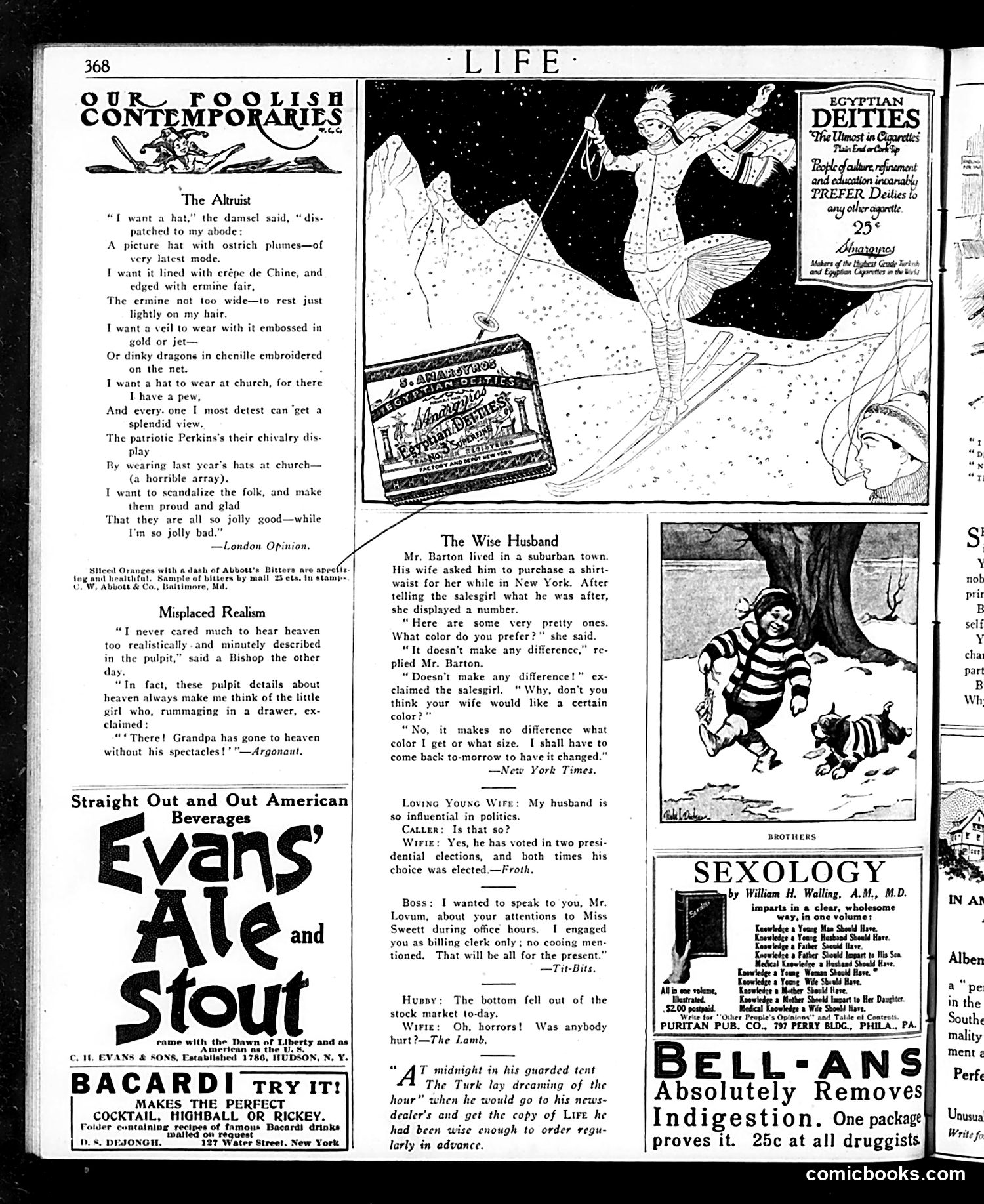
This section mocks a young woman's excessive vanity about hats and clothing. The "damsel" demands an elaborate, fashionable hat with ostrich plumes, ermine trim, embroidered veils—all so she can display it at church and scandalize "the folk" with her extravagance, while judging less fashionable women (like the "patriotic Perkins") as old-fashioned. The satire targets Edwardian-era female consumerism and competitive social display, particularly the contradiction of wanting to appear virtuous ("proud and glad") while deliberately flaunting wealth and fashion to make others feel inferior. The joke is her frank admission of vanity: "I'm so jolly bad." The piece is attributed to *London Opinion*, suggesting this was a common British/American satirical complaint about women's fashion obsession in the early 20th century.
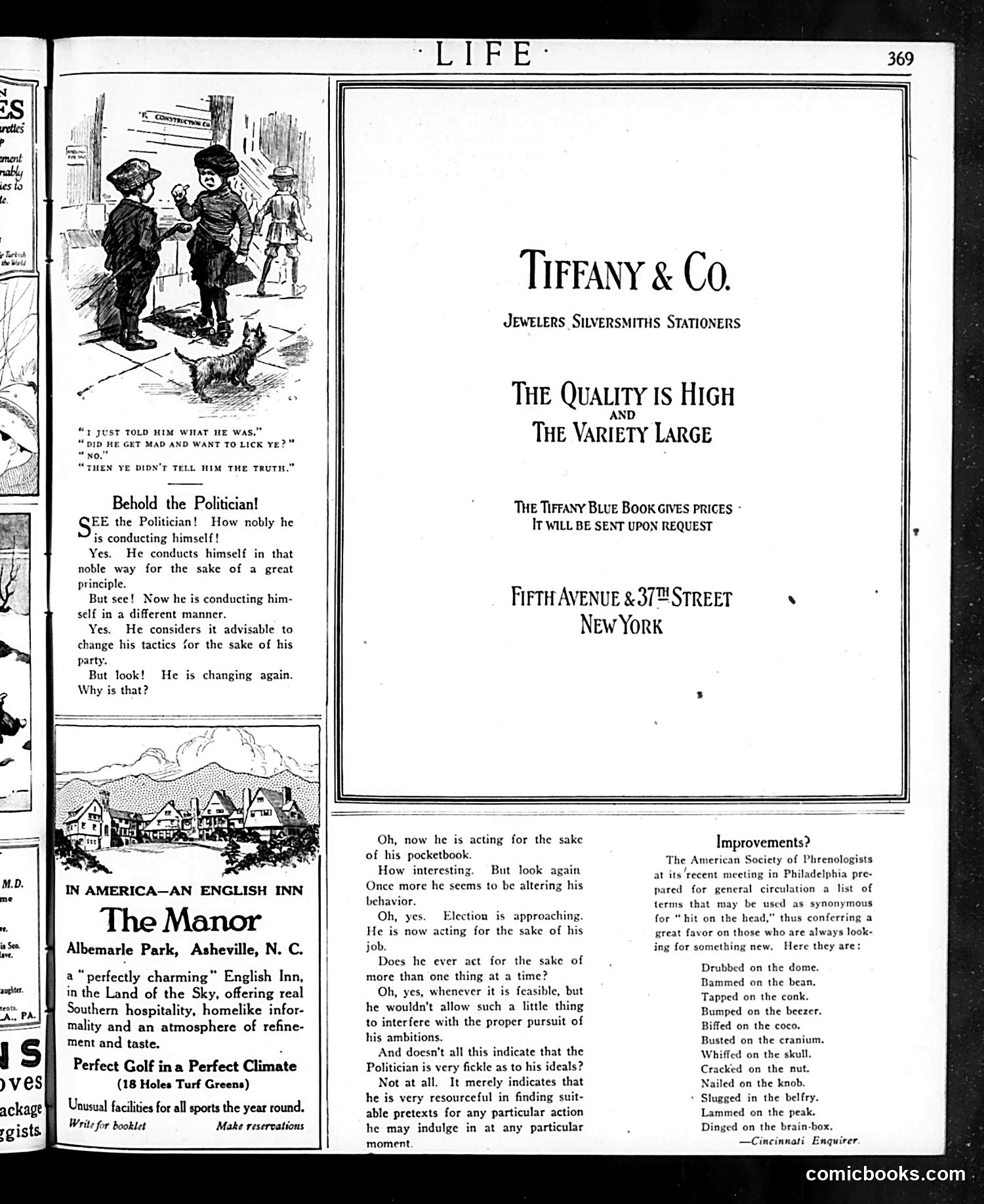
This cartoon mocks the hypocrisy and inconsistency of politicians. It depicts a figure who repeatedly changes his conduct and stated principles—first claiming noble ideals, then shifting tactics for party advantage, then for personal profit, then for election prospects. Each time, observers ask "why is he changing?" The punchline reveals the bitter truth: politicians are not genuinely principled but merely adopt convenient pretexts to justify whatever serves their current self-interest. The satire's point: politicians aren't actually fickle about ideals—they simply have no real ideals at all, only resourcefulness in manufacturing justifications for self-serving behavior. This reflects Progressive-era skepticism about political corruption and insincerity, a common theme in *Life* magazine's social commentary.
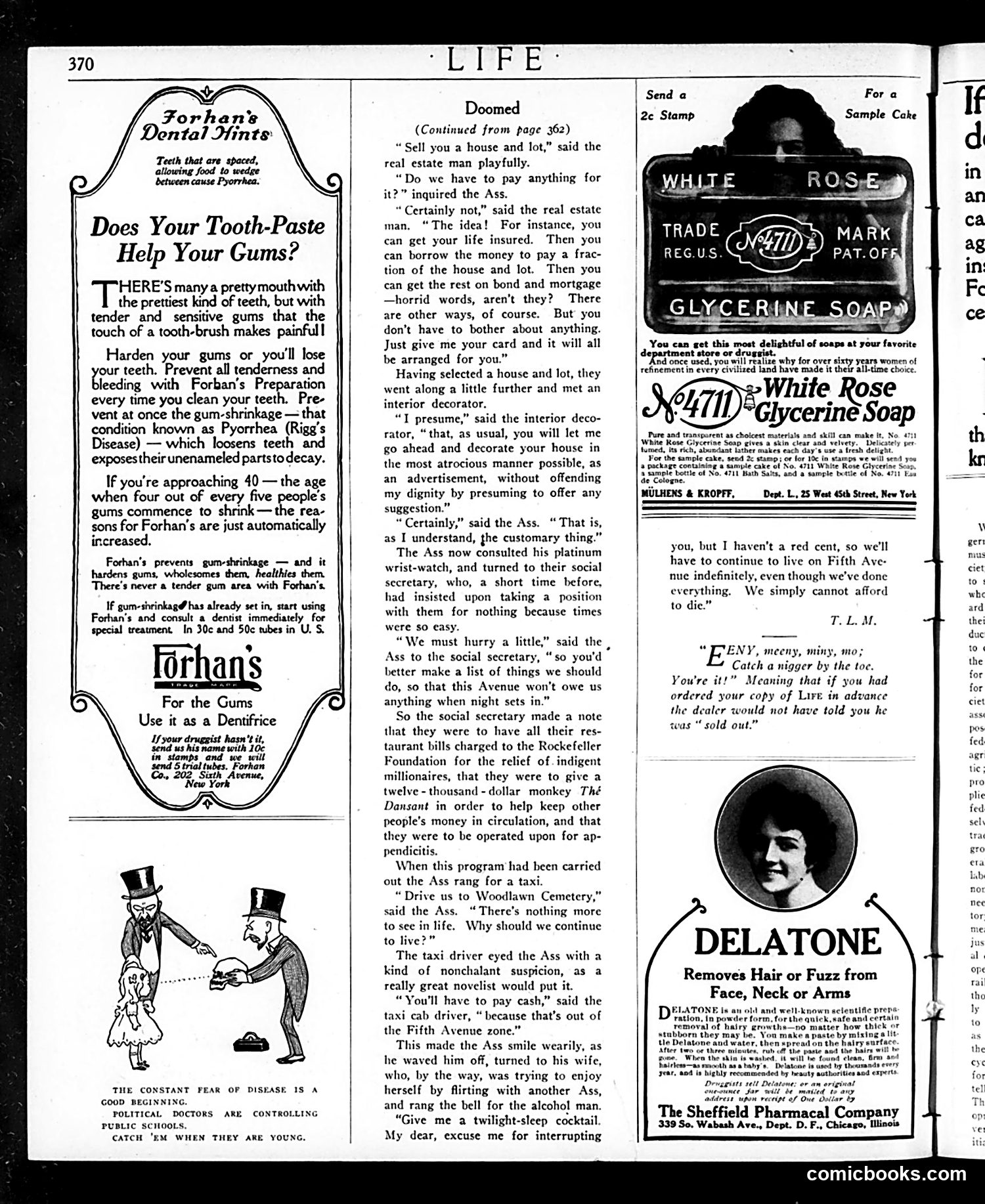
This page contains a multi-panel satirical story titled "Doomed" mocking wealthy, frivolous society during the Jazz Age. The narrative follows an Ass (a donkey—used as a literary device for stupidity) who acquires a house through easy credit, hires an interior decorator to extravagantly furnish it, and engages a social secretary to orchestrate wasteful entertainments. The satire targets: - **Easy consumer credit** and financial recklessness - **Conspicuous consumption** among the wealthy (decorating "in the most atrocious manner") - **Charity theater** (the "twelve-thousand-dollar monkey" dance) - **Class pretension** and hollow social rituals The punchline: the taxi driver refuses service because the cemetery visit is outside the Fifth Avenue zone—even death cannot escape monetary calculation. The Ass, facing financial ruin, requests an alcohol cocktail rather than confront reality. The surrounding advertisements for toothpaste and soap represent period consumer culture being satirized in the main story.
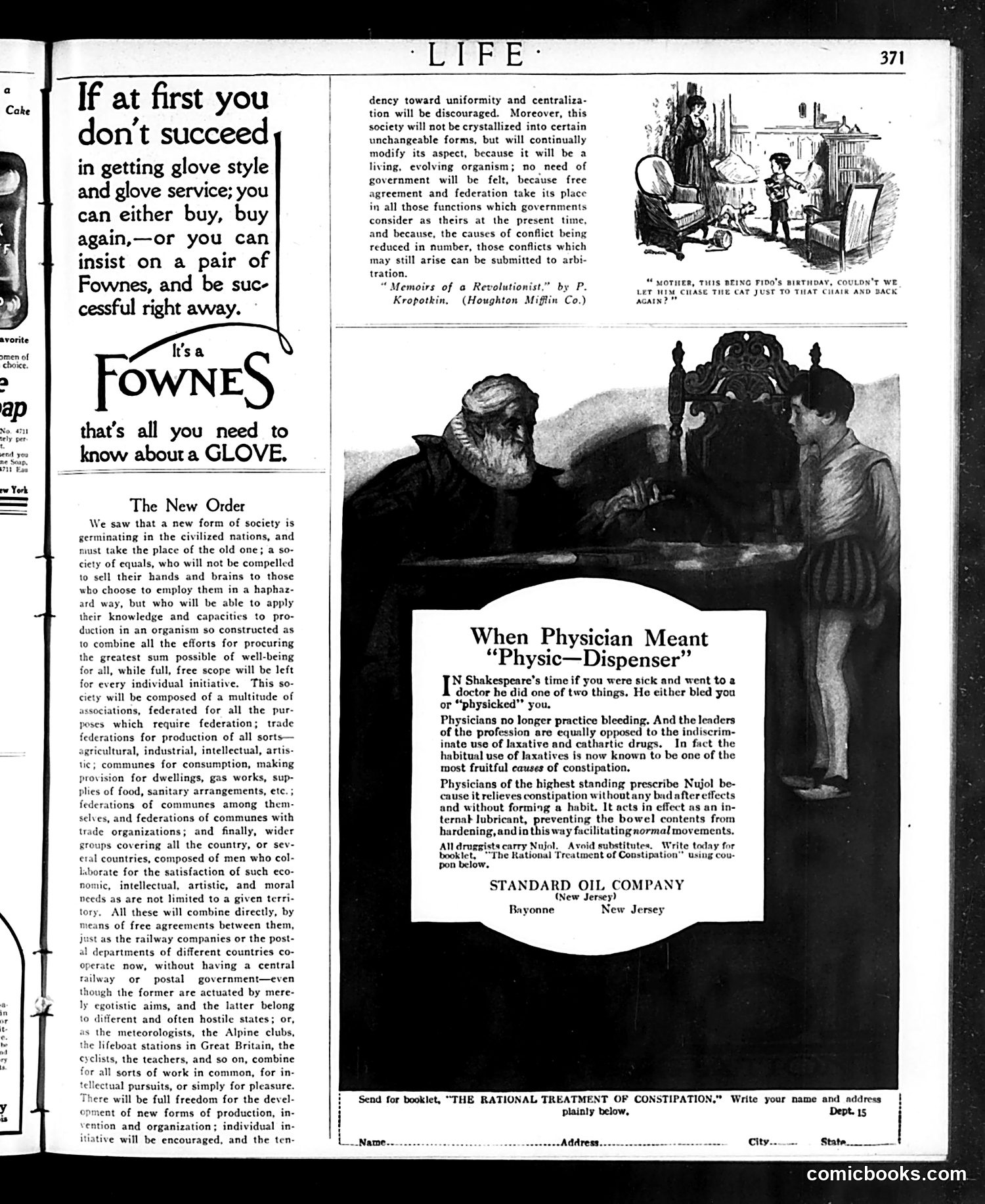
This page combines commercial advertising with political-philosophical content. The **Fownes gloves advertisement** (top left) uses a simple pitch: quality gloves ensure success. The long text column labeled "The New Order" appears to be an excerpt from P. Kropotkin's "Memoirs of a Revolutionist," outlining anarchist-communist ideals: a decentralized society of equals organized through voluntary associations rather than government coercion. The lower section features a **Standard Oil Company advertisement** disguised as medical advice, discussing how physicians once "physicked" (bled or purged) patients. It pivots to promoting Nujol, a laxative lubricant, as modern medicine's safer alternative to harsh cathartics. The accompanying image shows what appears to be a doctor or healer with patients. **The satire**: Life juxtaposed radical political theory advocating dissolution of hierarchical structures alongside corporate advertising promoting commercial products as solutions—embodying the consumer capitalism such revolutionary thought opposed.
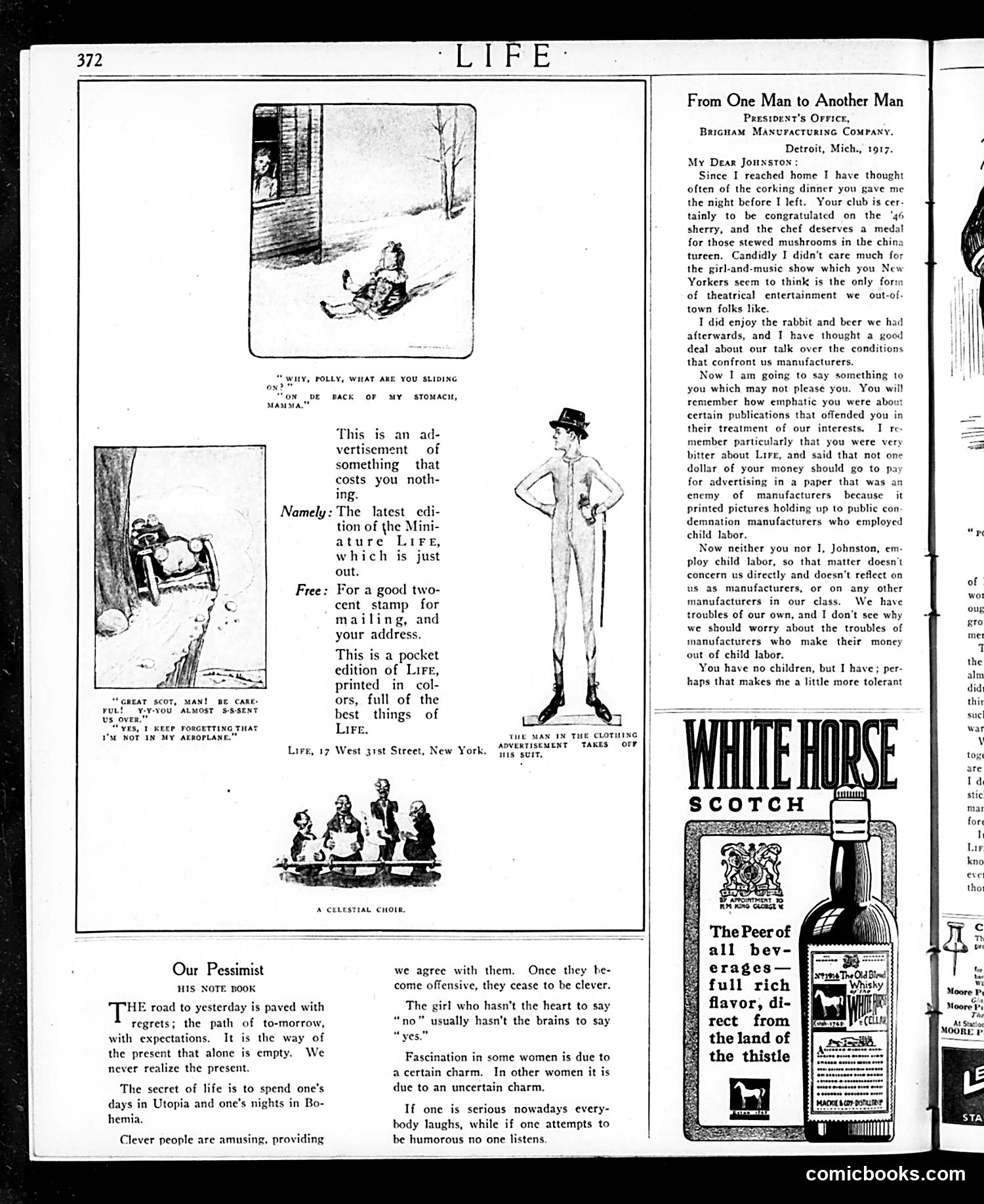
This page contains two unrelated cartoons and substantial advertising/editorial content. **Top cartoons:** Humor about an aviation pioneer who, accustomed to flying, instinctively braces himself while sledding—a joke about early airplane pilots and the novelty of aviation culture circa 1917. **"Our Pessimist" section:** A cynical philosophical column offering observations on human nature (e.g., "The girl who hasn't the heart to say 'no' usually hasn't the brains to say 'yes'"). This reflects early 20th-century salon-style wit. **Main content:** A letter from a Brigham Manufacturing Company president to "Johnston," discussing whether manufacturers should advertise in *Life* magazine. The president argues that *Life's* criticism of child labor in industry shouldn't concern manufacturers who don't employ children themselves—a defense of selective moral concern that now reads as callous corporate rationalization. The page primarily showcases *Life's* satirical voice through advertising and editorial material rather than traditional political cartoons.
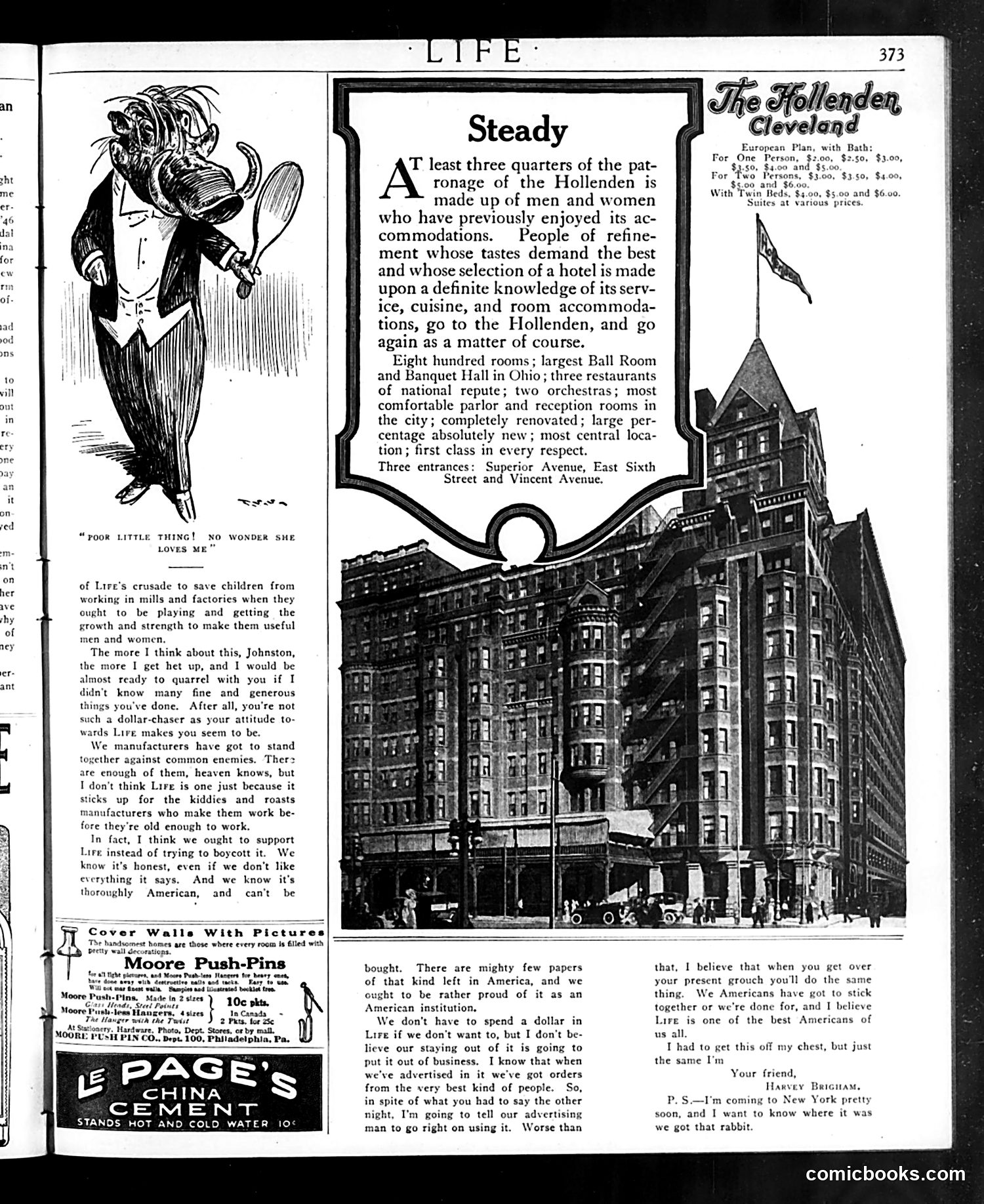
**The Cartoon:** The left side shows a caricatured figure (likely a manufacturer or business owner) looking distressed while holding what appears to be a copy of *Life* magazine. The caption reads: "POOR LITTLE THING! NO WONDER SHE LOVES ME." **The Context:** This is part of *Life* magazine's editorial crusade against child labor in mills and factories. The accompanying letter from "Harvey Brigham" defends *Life's* advocacy, arguing that manufacturers should *support* rather than boycott the magazine for its criticism of child labor practices. **The Satire:** The cartoon mocks the manufacturer's wounded vanity—suggesting he's upset that *Life* exposes his use of child workers, yet ironically imagines the magazine "loves" him despite this criticism. The satire targets the hypocrisy: businessmen want the prestige of advertising in a respected publication while resenting its moral stance on labor exploitation. **Modern Relevance:** This reflects early 20th-century progressive reform journalism using satire to shame corporate practices and appeal to readers' consciences about children's welfare.
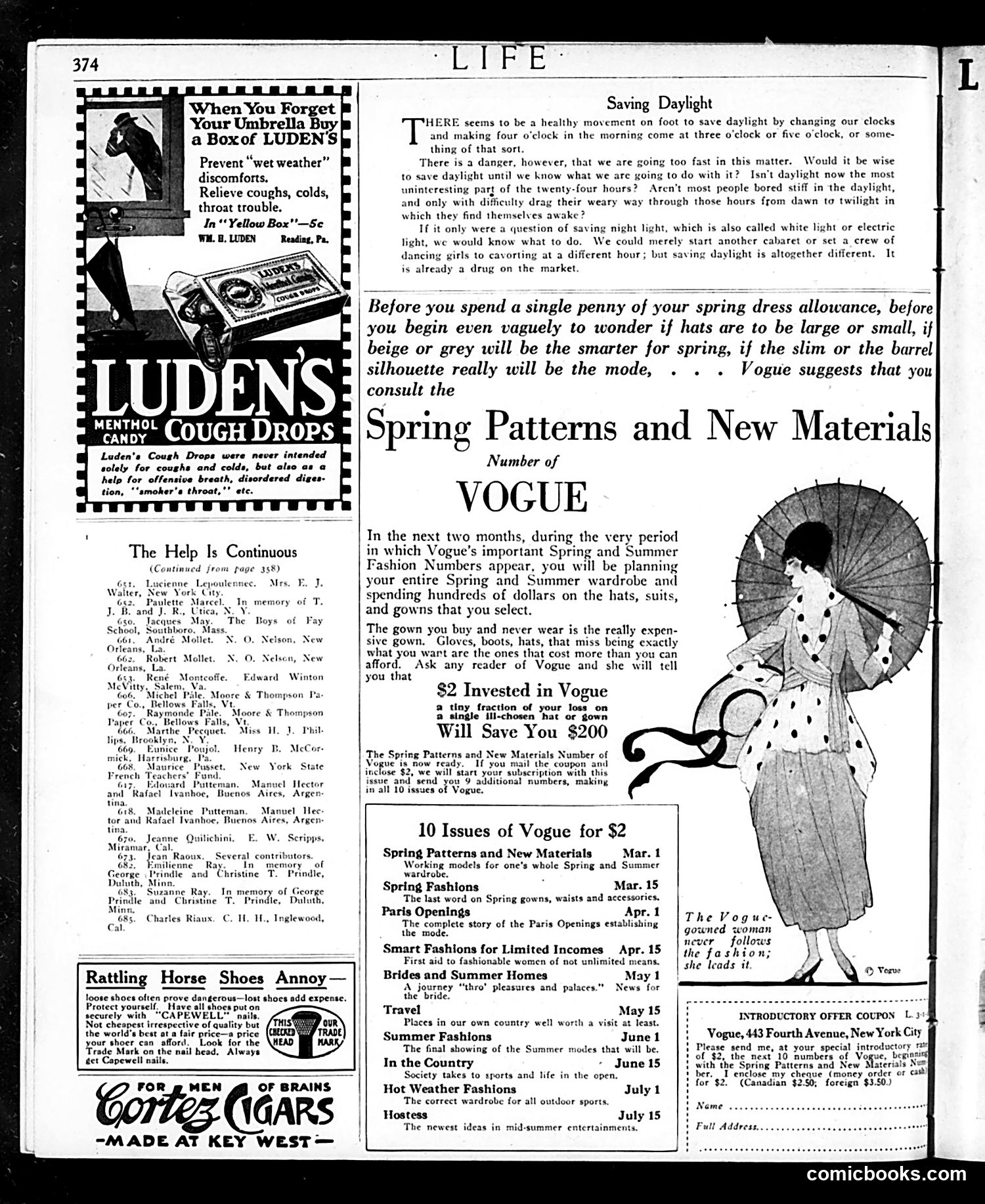
This page combines advertisements with editorial content addressing two contemporary issues from the 1910s-1920s era. **"Saving Daylight"** is an editorial piece satirizing the daylight saving time movement. The author argues that saving daylight is pointless—daylight is already "a drug on the market" because people find daytime boring and tedious. The satire suggests that while saving night light (electric light) for evening entertainment might make sense, daylight savings is absurd since no one particularly wants extra daylight hours anyway. **The Vogue advertisement** targets women's fashion spending, promoting a subscription offer. It argues that investing $2 in Vogue magazine will prevent costly fashion mistakes (poorly chosen hats, gloves, gowns), ultimately saving readers $200. The accompanying illustration shows a fashionable woman with a parasol. **Surrounding advertisements** promote Luden's cough drops and Cortez cigars—standard commercial content. The page reflects early 20th-century gender-specific consumer culture and period debates about time management and modernization.