
Life, 1917-03-01 · page 27 of 42
Life — March 1, 1917 — page 27: what you’re looking at
What you’re looking at
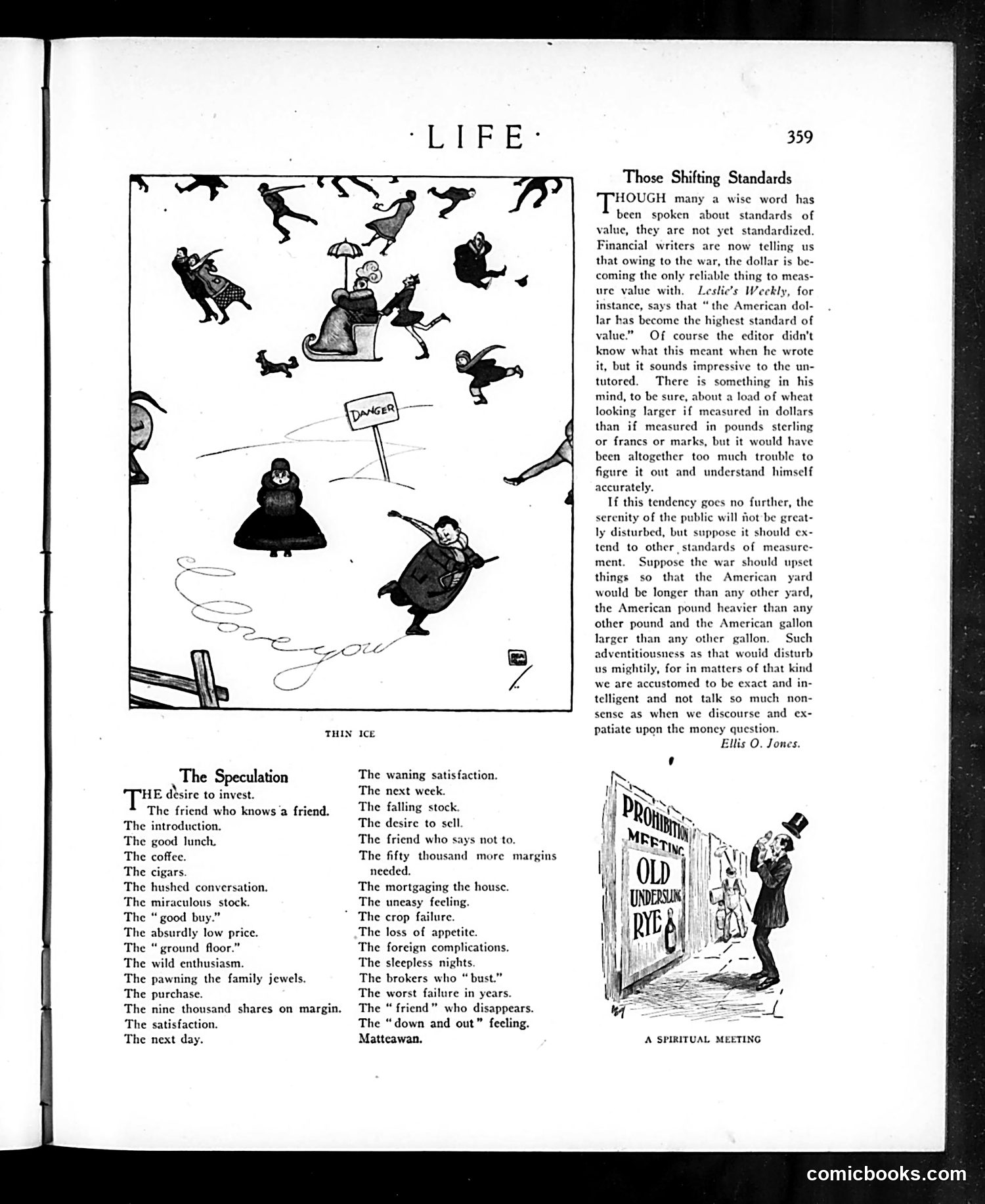
The top cartoon depicts stock market speculation during World War I. "This Ice" illustrates the dangerous progression of investment mania: friends convince each other to buy "miraculous stock" at absurdly low prices on margin (borrowed money), leading to euphoria, then rapid collapse when the stock falls. The figures tumbling and slipping on ice represent investors losing everything—mortgaging homes, pawning jewels, until complete financial ruin and disappearance of friends ("down and out" feeling, ending at "Mattcawan," likely an asylum reference). The accompanying text criticizes unstable currency values during wartime. It mocks financial writers claiming the dollar is now the "highest standard of value" due to war—an absurd statement implying subjective measurement standards. The author suggests this rhetorical confusion might dangerously extend to actual measurements (yards, pounds, gallons), illustrating how financial sophistry undermines rational discourse about money. The bottom cartoon shows a Prohibition-era meeting, satirizing temperance activism.
📄 Transcribed text from this page (OCR, searchable)
Machine-transcribed from the original scan — historical spelling and the odd misread are preserved.
THIN ICE The Speculation HE dtsire to invest. The friend who knows’a friend. The introduction. The good lunch. The coffee. The cigars. The hushed conversation. The miraculous stock. The “good buy.” The absurdly low price. The “ ground floor.” The wild enthusiasm. The pawning the family jewels. The purchase. The nine thousand shares on margin. The satisfaction. The next day. The waning satisfaction. The next week. The falling stock. The desire to sell. 359 Those Shifting Standards 'HOUGH many a wise word has been spoken about standards of value, they are not yet standardized. Financial writers are now telling us that owing to the war, the dollar is be- coming the only reliable thing to meas- ure value with. Leslie’s Weekly, for instance, says that “the American dol- lar has become the highest standard of value.” Of course the editor didn't know what this meant when he wrote it, but it sounds impressive to the un- tutored. There is something in his mind, to be sure, about a load of wheat looking larger if measured in dollars than if measured in pounds sterling or francs or marks, but it would have been altogether too much trouble to figure it out and understand himself accurately. If this tendency goes no further, the serenity of the public will fot be great- ly disturbed, but suppose it should ex- tend to other standards of measure- ment. Suppose the war should upset things so that the American yard would be longer than any other yard, the American pound heavier than any other pound and the American gallon larger than any other gallon. Such adventitiousness as that would disturb us mightily, for in matters of that kind we are accustomed to be exact and in- telligent and not talk so much non- sense as when we discourse and ex- patiate upon the money question. Ellis O. Jones. The friend who says not to. The fifty thousand more margins needed. The mortgaging the house. The uneasy feeling. The crop failure. The loss of appetite. The foreign complications. The sleepless nights. The brokers who “ bust.” The worst failure in years. The “ friend” who disappears. The “down and out” feeling. Mattcawan, ‘A SPIRITUAL MEETING comicbooks.com