
Life, 1917-03-01 · page 20 of 42
Life — March 1, 1917 — page 20: what you’re looking at
What you’re looking at
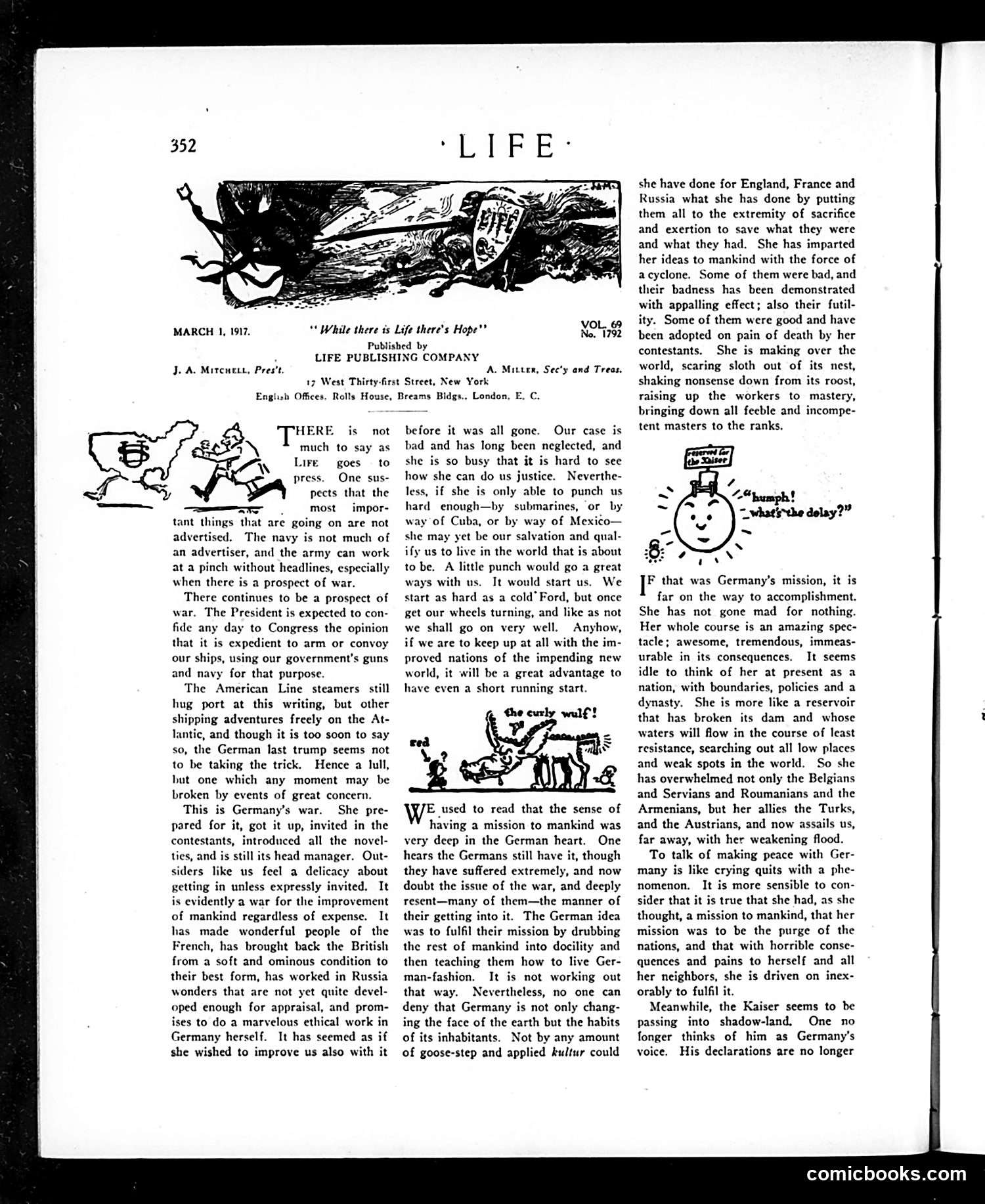
This page contains editorial commentary on American entry into World War I, written as Germany's unrestricted submarine warfare pushed the U.S. toward intervention. The cartoons depict **Germany as a threatening force**: one shows a menacing wolf ("the curly wulf"), another shows a round-faced figure asking "what's the delay?" — likely representing Germany impatient for America to enter the war through provocation. The text uses **sardonic humor** about U.S. reluctance to fight. It suggests Germany, through her "mission to mankind," might inadvertently help America by "punching us hard enough—by submarines, or by way of Cuba, or by way of Mexico." The author argues that war with Germany, while Germany's responsibility, could paradoxically improve America and its allies. The piece reflects the pre-April 1917 moment when submarine attacks and diplomatic crises made American intervention seem inevitable, while many Americans remained conflicted about joining Europe's devastating conflict.
📄 Transcribed text from this page (OCR, searchable)
Machine-transcribed from the original scan — historical spelling and the odd misread are preserved.
b= MARCH 1, 1917. ‘While there ts Life there's Hope” Published by LIFE PUBLISHING COMPANY J. A. Mitcwete, Pres’t. A. Mittrr, Sec'y and Treas. 17 West Thirty-first Street, New York English Offices. Rolls House, Breams Bldgs., London, E. C. S. THERE is not 3 aN much to say as N Lire goes to press. One sus- pects that the =—oo most impor- tant things that are going on are not advertised. The navy is not much of an advertiser, and the army can work at a pinch without headlines, especially when there is a prospect of war. There continues to be a prospect of war. The President is expected to con- fide any day to Congress the opinion that it is expedient to arm or convoy our ships, using our government's guns and navy for that purpose. The American Line steamers still hug port at this writing, but other shipping adventures freely on the At- lantic, and though it is too soon to say so, the German last trump seems not to be taking the trick. Hence a lull, but one which any moment may be broken by events of great concern. This is Germany’s war. She pre- pared for it, got it up, invited in the contestants, introduced all the novel- ties, and is still its head manager. Out- siders like us feel a delicacy about getting in unless expressly invited. It is evidently a war for the improvement of mankind regardless of expense. It has made wonderful people of the French, has brought back the British from a soft and ominous condition to their best form, has worked in Russia wonders that are not yet quite devel- oped enough for appraisal, and prom- ises to do a marvelous ethical work in Germany herself. It has seemed as if she wished to improve us also with it before it was all gone. Our case is bad and has long been neglected, and she is so busy that it is hard to see how she can do us justice. Neverthe- less, if she is only able to punch us hard enough—by submarines, ‘or by way of Cuba, or by way of Mexico— she may yet be our salvation and qual- ify us to live in the world that is about to be. A little punch would go a great ways with us. It would start us. We start as hard as a cold’ Ford, but once get our wheels turning, and like as not we shall go on very well. Anyhow, if we are to keep up at all with the im- proved nations of the impending new world, it will be a great advantage to have even a short running start. the curly wulf! E used to read that the sense of having a mission to mankind was very deep in the German heart. One hears the Germans still have it, though they have suffered extremely, and now doubt the issue of the war, and deeply resent—many of them—the manner of their getting into it. The German idea was to fulfil their mission by drubbing the rest of mankind into docility and then teaching them how to live Ger- man-fashion. It is not working out that way. Nevertheless, no one can deny that Germany is not only chang- ing the face of the earth but the habits of its inhabitants. Not by any amount of goose-step and applied kultur could she have done for England, France and Russia what she has done by putting them all to the extremity of sacrifice and exertion to save what they were and what they had. She has imparted her ideas to mankind with the force of acyclone. Some of them were bad, and their badness has been demonstrated with appalling effect; also their futil- ity. Some of them were good and have been adopted on pain of death by her contestants. She is making over the world, scaring sloth out of its nest, shaking nonsense down from its roost, raising up the workers to mastery, bringing down all feeble and incompe- tent masters to the ranks, IF that was Germany's mission, it is far on the way to accomplishment. She has not gone mad for nothing. Her whole course is an amazing spec- tacle; awesome, tremendous, immeas- urable in its consequences. It seems idle to think of her at present as a nation, with boundaries, policies and a dynasty. She is more like a reservoir that has broken its dam and whose waters will flow in the course of least resistance, searching out all low places and weak spots in the world. So she has overwhelmed not only the Belgians and Servians and Roumanians and the Armenians, but her allies the Turks, and the Austrians, and now assails us, far away, with her weakening flood. To talk of making peace with Ger- many is like crying quits with a phe- nomenon. It is more sensible to con- sider that it is true that she had, as she thought, a mission to mankind, that her mission was to be the purge of the nations, and that with horrible conse- quences and pains to herself and all her neighbors, she is driven on inex- orably to fulfil it. Meanwhile, the Kaiser seems to be passing into shadow-land, One no fonger thinks of him as Germany's voice, His declarations are no longer comicbooks.com