
Life, 1917-03-01 · page 25 of 42
Life — March 1, 1917 — page 25: what you’re looking at
What you’re looking at
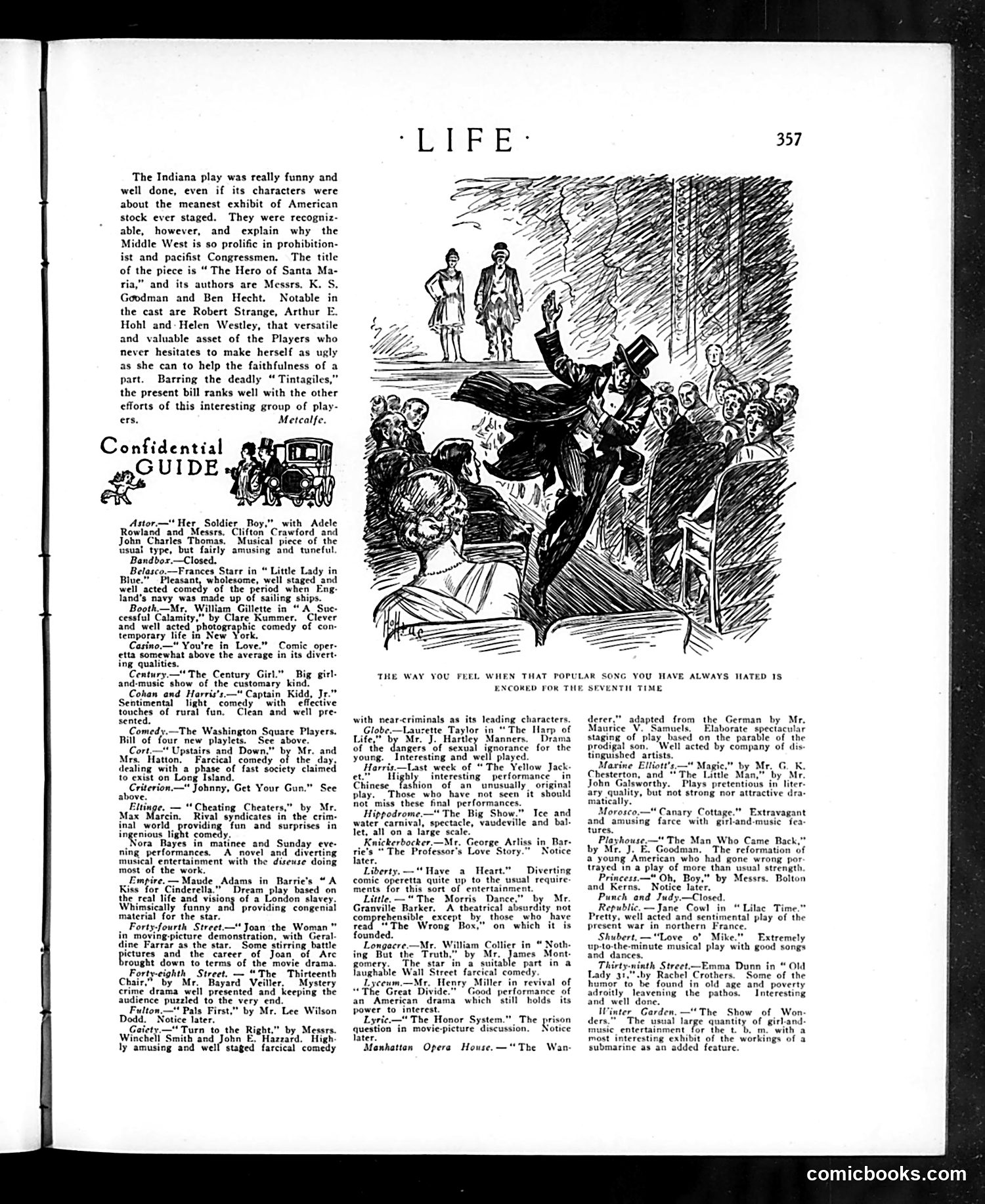
This page is primarily **theater reviews**, not political cartoons. The single illustration shows a social satire: a well-dressed man conducting an orchestra is surrounded by audience members displaying exaggerated expressions of agony and despair. The caption reveals the joke: "THE WAY YOU FEEL WHEN THAT POPULAR SONG YOU HAVE ALWAYS HATED IS ENCORED FOR THE SEVENTH TIME." This is gentle, relatable humor about the common experience of enduring a mediocre popular song repeated excessively—a situation any theatergoer would recognize. The man's oblivious enthusiasm contrasts with the audience's visible suffering. The broader context: Life magazine's theater section critiques various productions (musicals, comedies, dramas) with sharp but fair assessments. The reviews mention specific performers and plots, suggesting this reflects actual 1916-era theatrical offerings. The satire is social rather than political—mocking mass entertainment excess and audience politeness rather than current events.
📄 Transcribed text from this page (OCR, searchable)
Machine-transcribed from the original scan — historical spelling and the odd misread are preserved.
The Indiana play was really funny and well done, even if its characters were about the meanest exhibit of American stock ever staged. They were recogniz- able, however, and explain why the Middle West is so prolific in prohibition- ist and pacifist Congressmen. The title of the piece is “‘ The Hero of Santa Ma- ria,” and its authors are Messrs. K. S. Goodman and Ben Hecht. Notable in the cast are Robert Strange, Arthur E. Hohl and-Helen Westley, that versatile and valuable asset of the Players who never hesitates to make herself as ugly as she can to help the faithfulness of a part. Barring the deadly “ Tintagiles,” the present bill ranks well with the other efforts of this interesting group of play- ers. Metcalfe. Confidential ae Astor.—" Her. Soldier, Boy,” with Adele Rowland and Messrs. Clifton’ Crawford and John Charles Thomas. Musical piece of the usual type, but fairly amusing and tuneful. Bandbor.—Closed. Belasco.—Frances Starr in “ Little Lady in Blue.” Pleasant, wholesome, well staged and well ‘acted comedy of the period when Eng- land’s navy was made up of sailing ships. Booth.—Mr. William Gillette in “ A, Suc- cessful Calamity,” by Clare Kummer, Clever and well acted photographic comedy of con- temporary life in New York. Casino.—" You're in Love.” Comic, oper- etta somewhat above the average in its divert: ing_ qualities. Century.—" The Century Girl.” Big. girl- and-music show of the customary kind. Cohan and Harris's.—" Captain Kidd, Jr.” Sentimental light. comedy with effective touches of rural fun. Clean and well pre- sented. Comedy.—The Washington Square Players. Rill of four new playlets. See above. Cort.—" Upstairs and Down,” by Mr. and Mrs Hatton. Farcieal_ comedy of the day, dealing with a phase of fast society claimed to exist on Long Island. Criterion. —" Johnny, Get Your Gun.” See above, Eltinge, — “Cheating Cheaters,” by Mr. Max Marcin. Rival syndicates in the crim- al world providing fun and surprises in renious light comedy. Nora Rayes in matinee and Sunday eve- ning performances. A novel and diverting musical entertainment with the disewse doing most of the work. _ Empire. — Maude Adams in Barrie's “A Kiss for Cinderella.” Dream play based on the real life and visions of a London slavey. Whimsically funny and providing congenial material for the star. _ Forty-fourth Street—" Joan the Woman" in moving-picture demonsiration, with Geral dine Farrar as the star. Some stirring battle Pictures and ‘the career “of Joan, of Are rought down to terms of the ‘movie drama. Forty-eighth Street. — “The Thirteenth Chair.” by Mr. Bayard Veiller, Mystery crime’ drama well presented and keeping the audience puzzled to the very end. Fulton.—* Pals First,” by Mr. Lee Wilson Dodd, Notice later. “Turn to the Right.” by Messrs. AT Smith and John E. Hazzard. High ly amusing and welf staged farcical comedy THE WaY You SM NANA Se ON RANA SESS SON SS FEEL WHEN THAT POPULAR SONG YOU HAVE ALWAYS HATED 1S ENCORED FOR THE SEVENTI TIME with near-criminals as its leading characters. Globe.—Lauzette Taylor in “The Harp of Life,” ‘by Mr. J. Hartley Manners. Drama of the dangers of sexual ignorance for the young. Interesting and well played. Harris —Last week of “The Yellow Jack- et" Highly interesting performance _ Chinese fashion of an “unusually original Those who have not seen it should iss these final performances. Hippodrome.—" The Big Show.” Tce and water carnival, spectacle, vaudeville and bal- Tet, all on a large scale. ickerbocker.—Mr. George, Arliss in, Bar- “The Professor's Love Story.” Notice Liberty, —“' Haye a Heart.” Diverting comic operetta quite up to the usual require: ments for this sort of entertainment. Little. —"The Morris Dance,” by Mr. Granville Barker, A theatrical absurdity not comprehensible except. by, those who have read “The Wrong Box,” on which it is founded. Longacre.—Mr. William Collier ing But the Truth,” by Mr. James } gomery. The star in a suitable part in a Faughable Wall Street farcical comedy Lyceum.—Mr. Henry Miller in revival of “The Great Divide.” Good performance of an American drama which still holds its power to interes Lyric.—" The question in movie later. Manhattan Opera House. —“The Wan- Noth: nor System.” The prison icture discussion. Notice derer,” adapted from the German by Mr. Maurice V. Samuels, Elaborate spectacular staging of play based on the parable of the prodigal son. Well acted by company of dis: tinguished artists, Marine Elliott’ agic,” by Mr. G. K. Chesterton, and “The Little Man,” by Mr. John Galsworthy. Plays pretentious in liter- ary quality, but not strong nor attractive dra- matically, Morosco, Canary Cottage.” Extravagant and amusi @ farce with girland-music fea- tures. Playhouse.—" The Man Who Came Back,” by Mr. J. E. Goodman. The reformation of a young American who had gone wrong por trayed in a play of more than usual strength. Princess.—" Oh, Boy,” by Messrs. Bolton and Kerns. Notice later. Punch and Judy.—Closed. Republic. —Jane Cowl Pretty, well acted and sentimental play of the present war in northern France. Shubert, —“Love 0’ Mike." Extremely up-to-the-minute musical play with good songs and dance Thirty-ninth Street-—Emma Dunn in “ Old Lady 31,"-by Rachel Crothers. Some of the humor to be found in old age and poverty adroitly leavening the pathos. Interesting and well done. Winter Garden. —*The Show of Won ders.” The usual large quantity’ of ‘girl-and- music entertainment for the t. b. m. with a most interesting exhibit of the workings of a submarine as an added feature. “Lilac Time.” comicbooks.com