
Life, 1917-03-01 · page 16 of 42
Life — March 1, 1917 — page 16: what you’re looking at
What you’re looking at
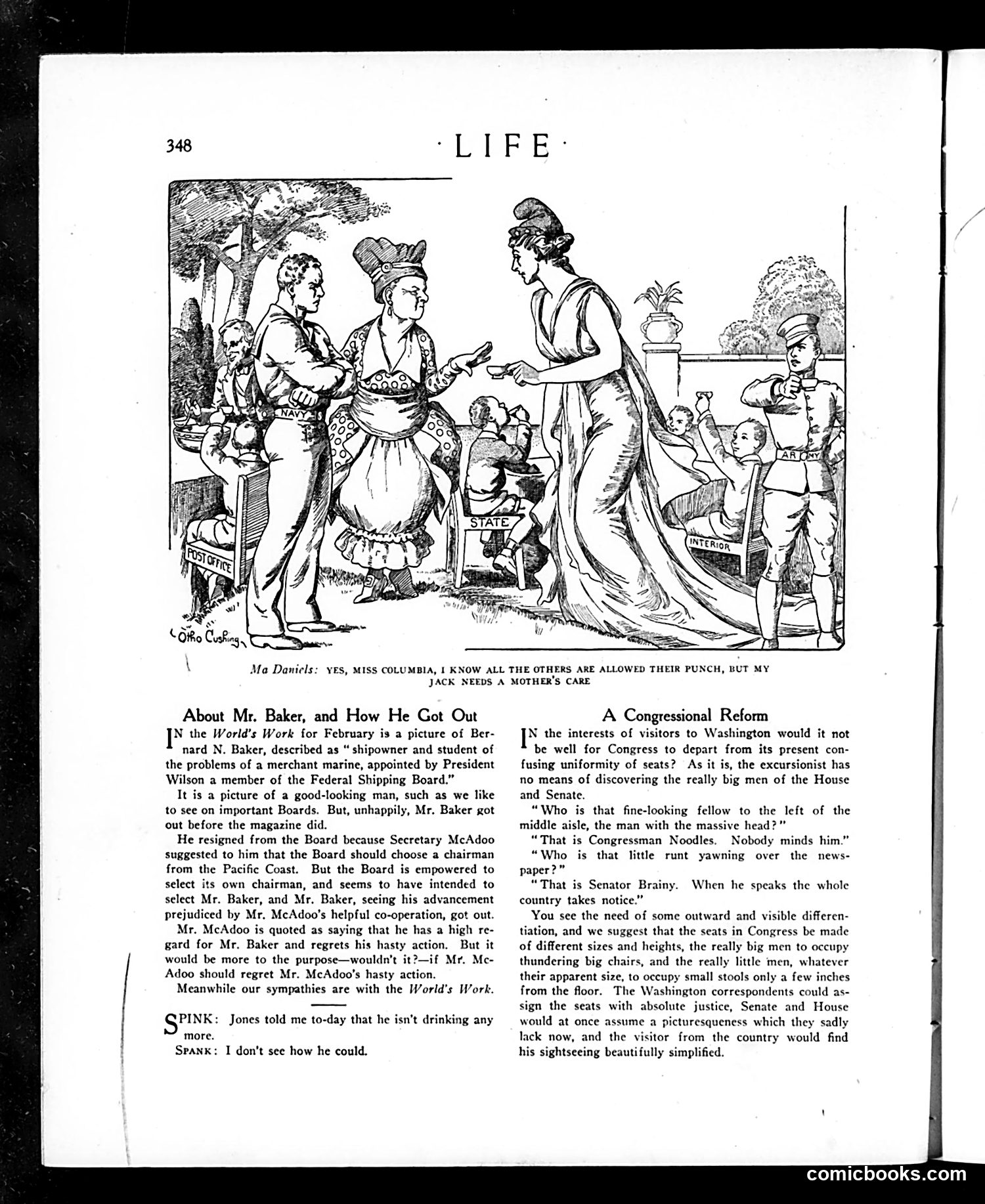
This page contains two separate satirical pieces: **"About Mr. Baker, and How He Got Out"** mocks Secretary of Treasury McAdoo's interference in the Federal Shipping Board. Bernard Baker resigned after McAdoo suggested the board choose a Pacific Coast chairman, undermining Baker's expected advancement. The satire criticizes McAdoo for this political meddling while claiming to support Baker—the point being McAdoo should regret *his own* hasty action, not Baker's resignation. **"A Congressional Reform"** satirizes Congress by proposing a solution to visitors' difficulty distinguishing important legislators from minor ones: assign Congressional seats by actual importance rather than uniform sizing. The joke suggests "big men" like "Senator Brainy" get tiny stools while nonentities like "Congressman Noodles" occupy large chairs—a visual inversion mocking how actual importance doesn't match apparent prominence in Congress. The top cartoon shows Miss Columbia (America personified) protecting "Jack" (American interests) from Congress's chaotic influence.
📄 Transcribed text from this page (OCR, searchable)
Machine-transcribed from the original scan — historical spelling and the odd misread are preserved.
‘Gio Cobos \ Ma Daniels: yes, MISS COLUMBIA, | KNOW ALL THE OTHERS ARE ALLOWED THEIR PUNCH, BUT MY JACK NEEDS A MOTHER'S CARE About Mr. Baker, and How He Got Out N the World’s Work for February is a picture of Ber- nard N. Baker, described as “ shipowner and student of the problems of a merchant marine, appointed by President Wilson a member of the Federal Shipping Board.” It is a picture of a good-looking man, such as we like to see on important Boards. But, unhappily, Mr. Baker got out before the magazine did. He resigned from the Board because Secretary McAdoo suggested to him that the Board should choose a chairman from the Pacific Coast. But the Board is empowered to select its own chairman, and seems to have intended to select Mr. Baker, and Mr. Baker, seeing his advancement prejudiced by Mr, McAdoo’s helpful co-operation, got out. Mr. McAdoo is quoted as saying that he has a high re- gard for Mr. Baker and regrets his hasty action. But it would be more to the purpose—wouldn’t it?—if Mr. Mc- Adoo should regret Mr. McAdoo’s hasty action. Meanwhile our sympathies are with the World’s Work. SPINK: Jones told me to-day that he isn’t drinking any more. Srank: I don't see how he could. A Congressional Reform I the interests of visitors to Washington would it not be well for Congress to depart from its present con- fusing uniformity of seats? As it is, the excursionist has no means of discovering the really big men of the House and Senate. “Who is that fine-looking fellow to the left of the middle aisle, the man with the massive head?” “That is Congressman Noodles. Nobody minds him.” “Who is that little runt yawning over the news- paper?” “That is Senator Brainy. country takes notice.” You see the need of some outward and visible differen- tiation, and we suggest that the seats in Congress be made of different sizes and heights, the really big men to occupy thundering big chairs, and the really little men, whatever their apparent size, to occupy small stools only a few inches from the floor. The Washington correspondents could as- sign the seats with absolute justice, Senate and House would at once assume a picturesqueness which they sadly lack now, and the visitor from the country would find his sightseeing beautifully simplified. When he speaks the whole comicbooks.com