
Life, 1917-03-01 · page 12 of 42
Life — March 1, 1917 — page 12: what you’re looking at
What you’re looking at
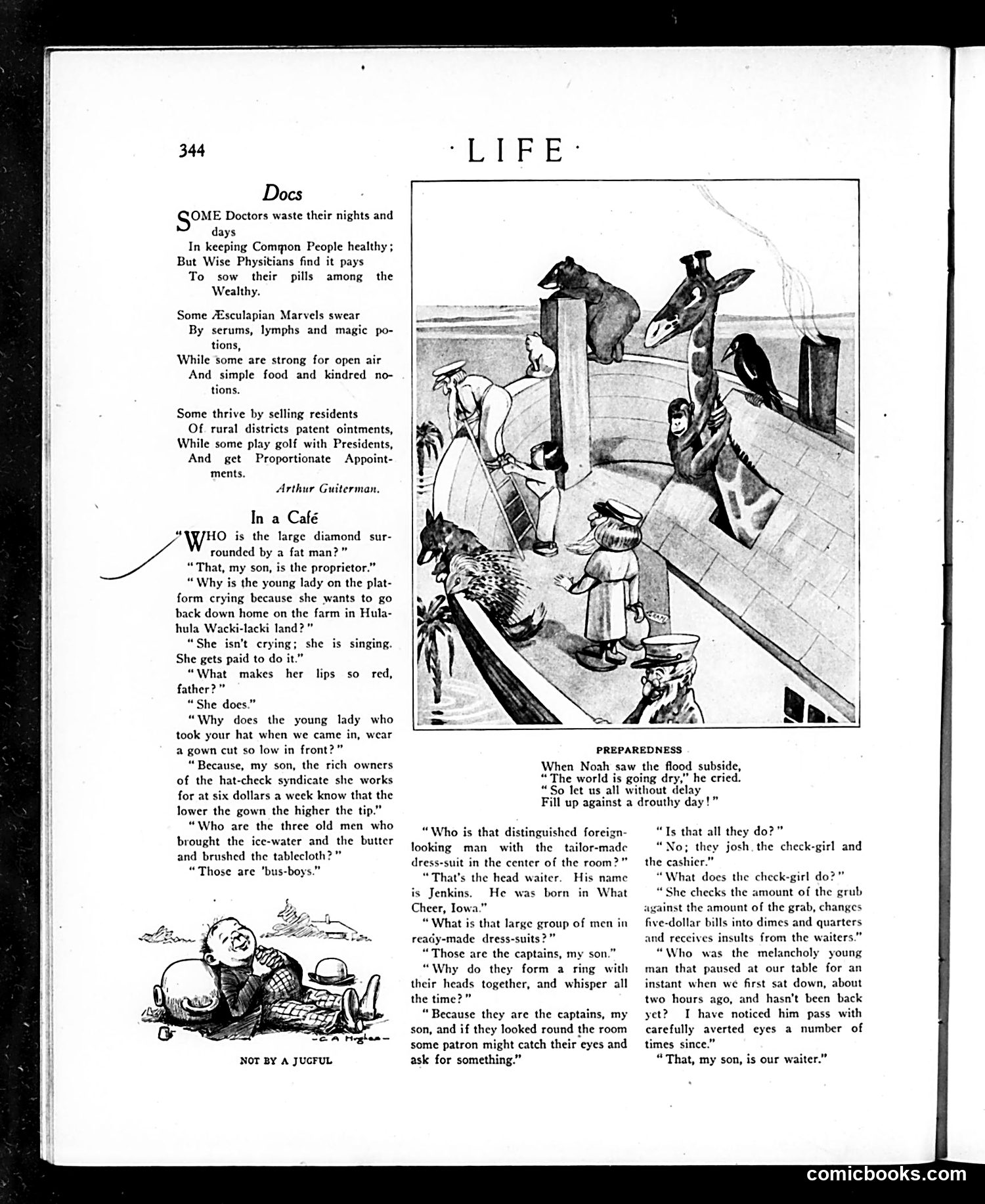
This page contains two satirical pieces critiquing social pretension and economic inequality in early 20th-century America. **"Docs"** (top left) mocks physicians who exploit wealthy patients while neglecting public health, using Aesculapian references to classical medicine. It suggests doctors profit more from the rich than from genuinely helping common people. **"In a Café"** (main dialogue) satirizes class consciousness through a conversation between a wealthy café patron and his son. The son asks naive questions about waiters, check-girls, and working-class people, revealing the father's cynical explanations of how social hierarchies function—tips, uniforms, and strategic positioning all serve to extract money from the wealthy. **"Preparedness"** (right) references Noah's flood, appearing to comment on economic readiness or social inequality during times of crisis. The overall tone critiques how the wealthy maintain their status through exploitation of service workers.
📄 Transcribed text from this page (OCR, searchable)
Machine-transcribed from the original scan — historical spelling and the odd misread are preserved.
344 Docs OME Doctors waste their nights and days In keeping Common People healthy ; But Wise Physitians find it pays To sow their pills among the Wealthy. Some Zsculapian Marvels swear By serums, lymphs and magic po- tions, While some are strong for open air And simple food and kindred no- tions. Some thrive by selling residents Of rural districts patent ointments, While some play golf with Presidents, And get Proportionate Appoint- ments. Arthur Guiterman. In a Café Y HO is the large diamond sur- rounded by a fat man?” “That, my son, is the proprietor.” “Why is the young lady on the plat- form crying because she wants to go back down home on the farm in Hula- hula Wacki-lacki land?” “She isn't crying; she is singing. She gets paid to do it.” “What makes her father?” “She does.” “Why does the young lady who took your hat when we came in, wear a gown cut so low in front?” “Because, my son, the rich owners of the hat-check syndicate she works for at six dollars a week know that the lower the gown the higher the tip.” “Who are the three old men who brought the ice-water and the butter and brushed the tablecloth?” “Those are 'bus-boys.” lips so red, NOT BY A JUGFUL | Ba PREPAREDNESS When Noah saw the flood subside, “The world is going dry,” he cried. “So let us all without delay Fill up against a drouthy day!” “Who is that distinguished foreign- looking man with the tailor-made dress-suit in the center of the room?” “That's the head waiter. His name is Jenkin: He was born in What Cheer, Iowa.” “ What is that large group of men in ready-made dress-suits?” “Those are the captains, my son.” “Why do they form a ring with their heads together, and whisper all the time?” “Because they are the captains, my son, and if they looked round the room some patron might catch their eyes and ask for something.” “Ts that all they do?” “No; they josh. the check-girl and the cashier.” “What does the check-girl do?” he checks the amount of the grub against the amount of the grab, changes five-dollar bills into dimes and quarters and receives insults from the waiters.” “Who was the melancholy young man that paused at our table for an instant when we first sat down, about two hours ago, and hasn't been back yet? I have noticed him pass with carefully averted eyes a number of times since.” “That, my son, is our waiter.” comicbooks.com