
Life, 1917-03-01 · page 24 of 42
Life — March 1, 1917 — page 24: what you’re looking at
What you’re looking at
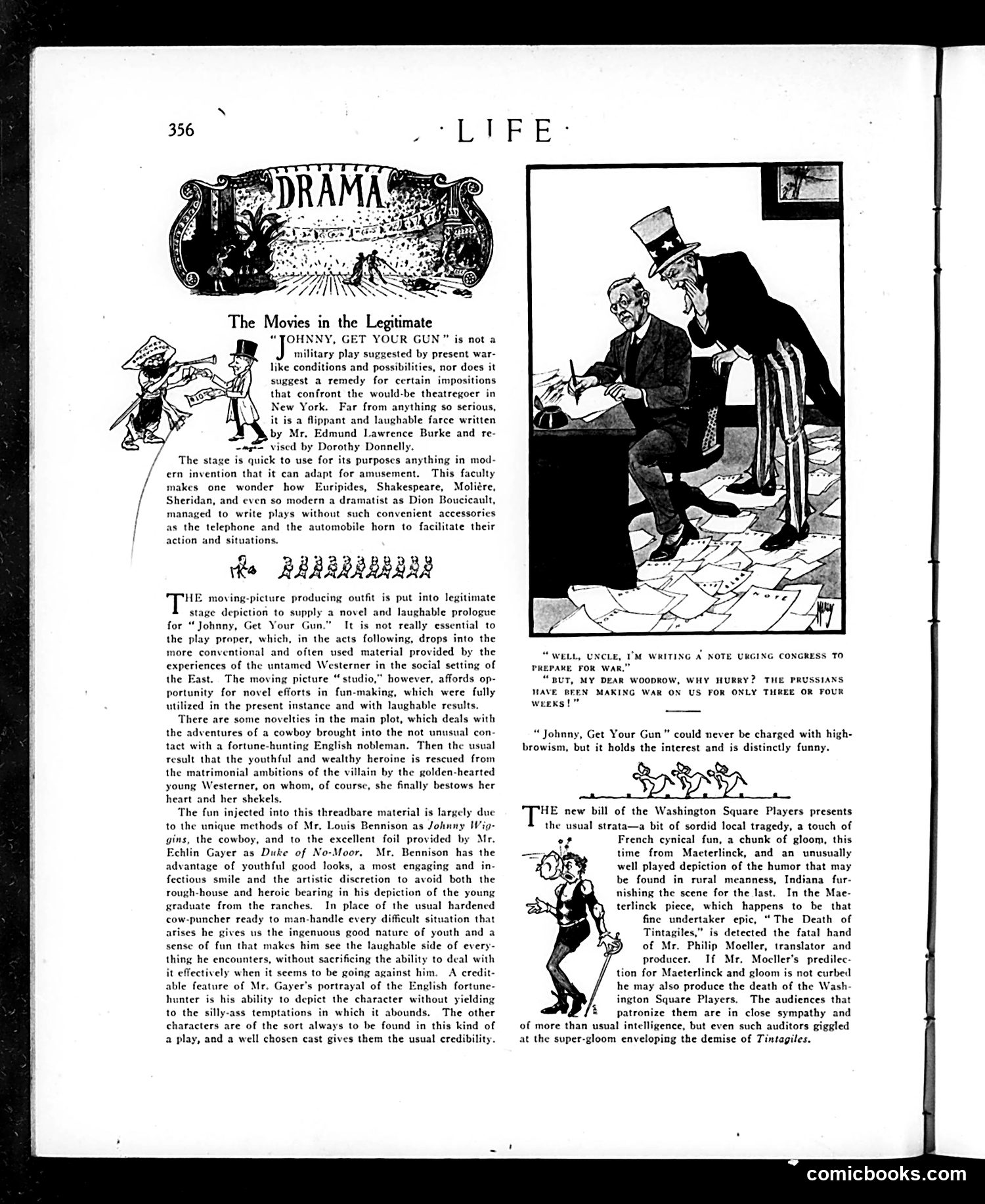
This page reviews theatrical productions, with a cartoon satirizing wartime anxiety. The main illustration shows two men—one identified by caption as "Uncle" (likely Uncle Sam, representing America) and another labeled "Woodrow" (President Woodrow Wilson)—discussing war preparedness. The joke satirizes Wilson's cautious approach to World War I. "Woodrow" is writing to Congress urging war preparation, but "Uncle" mocks the urgency, quipping that the Prussians have only been "making war on us" for "three or four weeks"—implying America should already be at war or that Wilson is unnecessarily alarmed. The cartoon reflects 1917 tensions over U.S. entry into WWI. Wilson initially campaigned on neutrality ("kept us out of war"), so this satirizes the sudden shift toward military preparation and the debate over American involvement. The page's primary content reviews the play "Johnny, Get Your Gun," a wartime farce with movie sequences—using modern film technology for theatrical novelty.
📄 Transcribed text from this page (OCR, searchable)
Machine-transcribed from the original scan — historical spelling and the odd misread are preserved.
The Movies in the Legitimate “TOHNNY, GET YOUR GUN” is not a J tary play suggested by present war- like conditions and possibilities, nor does it suggest a remedy for certain impositions that confront the would-be theatregoer in New York. Far from anything so serious, it is a flippant and laughable farce written by Mr, Edmund Lawrence Burke and re- caste vised by Dorothy Donnelly. The stage is quick to use for its purposes anything in mod- ern invention that it can adapt for amusement. This faculty makes one wonder how Euripides, Shakespeare, Moliére, Sheridan, and even so modern a dramatist as Dion Boucicault, managed to write plays without such convenient accessories as the telephone and the automobile horn to facilitate their and situations. * RARBRRERAAS moving-picture producing outfit is put into legitimate ¢ depiction to supply a novel and laughable prologue for “Johnny, Get Your Gun.” It is not really essential to the play proper, which, in the acts following, drops into the more conventional and often used material provided by the experiences of the untamed Westerner in the social setting of the East. The moving picture “studio,” however, affords op- portunity for novel efforts in fun-making, which were fully utilized in the present instance and with laughable result There are some novelties in the main plot, which deals with the adventures of a cowboy brought into the not unusual con tact with a fortune-hunting English nobleman. Then the usual result that the youthful and wealthy heroine is rescued from the matrimonial ambitions of the villain by the golden-hearted young Westerner, on whom, of course, she finally bestows her heart and her shekels. ‘The fun injected into this threadbare material is largely duc to the unique methods of Mr. Louis Bennison as Johnny Wig- gins, the cowboy, and to the excellent foil provided by Mr. Echlin Gayer as Duke of No-Moor, Mr. Bennison has the advantage of youthful good looks, a most engaging and in- fectious smile and the artistic discretion to avoid both the rough-house and heroic bearing in his depiction of the young graduate from the ranches. In place of the usual hardened cow-puncher ready to man-handle every difficult situation that arises he gives us the ingenuous good nature of youth and a sense of fun that makes him see the laughable side of every- thing he encounters, without sacrificing the ability to deal with it effectively when it seems to be going against him. A credit- able feature of Mr. Gayer’s portrayal of the English fortune- hunter is his ability to depict the character without yielding to the silly-ass temptations in which it abounds. The other characters are of the sort always to be found in this kind of a play, and a well chosen cast gives them the usual credibility. “WELL, UNCLE, I'M WRITING A NOTE URGING CONGRESS TO PREPAKE FOR WAR. “BUT, MY DEAR WOODROW, WHY HURRY? THE PRUSSIANS WAVE BEEN MAKING WAR ON US FOR ONLY THREE OR FOUR weeks!" “Johnny, Get Your Gun” could never be charged with high- browism, but it holds the interest and is distinctly funny. Sn HE new bill of the Washington Square Players presents the usual strata—a bit of sordid local tragedy, a touch of French cynical fun, a chunk of gloom, this time from Maeterlinck, and an unusually well played depiction of the humor that may be found in rural meanness, Indiana fur- nishing the scene for the last. In the Mae- terlinck piece, which happens to be that fine undertaker epic, “The Death of Tintagile: is detected the fatal hand of Mr. Philip Moeller, translator and producer. If Mr. Mocller’s predilec- tion for Maeterlinck and gloom is not curbed he may also produce the death of the Wash ington Square Players. The audiences that patronize them are in close sympathy and of more than usual intelligence, but even such auditors giggled at the super-gloom enveloping the demise of Tintagiles. comicbooks.com