
Life, 1917-03-01 · page 29 of 42
Life — March 1, 1917 — page 29: what you’re looking at
What you’re looking at
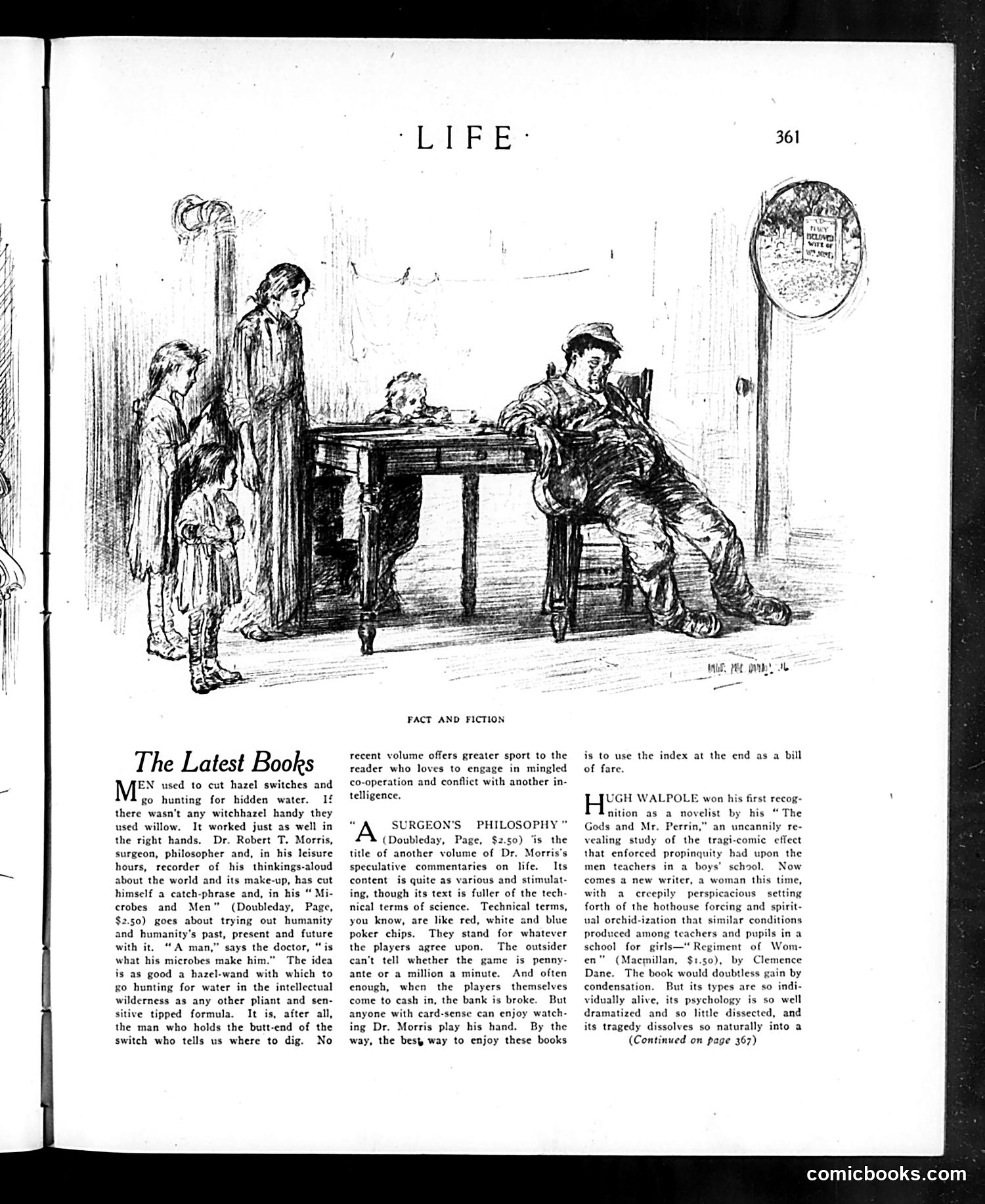
This page features a book review section titled "The Latest Books" with a single illustration at top showing what appears to be a schoolroom scene—children and an adult at a desk, suggesting an educational or institutional setting. The reviews discuss three works: Dr. Robert T. Morris's "Microbes and Men" and "A Surgeon's Philosophy" (both about how microbes shape human nature and life philosophy), and a new novel "Regiment of Women" by Clemence Dane about female teachers and pupils in a girls' school. The illustration likely relates to the Dane review, as the text discusses how her novel explores "the hothouse forcing and spiritual orchid-ization" of relationships in girls' schools—mirroring H.G. Walpole's earlier novel about boys' schools. The cartoon depicts institutional life's dynamics, the central subject of these literary critiques. The satire appears gentle, focusing on book recommendations for intellectual readers rather than political commentary.
📄 Transcribed text from this page (OCR, searchable)
Machine-transcribed from the original scan — historical spelling and the odd misread are preserved.
The Latest Books EN used to cut hazel switches and go hunting for hidden water. If there wasn't any witchhazel handy they used willow, It worked just as well in the right hands. Dr. Robert T. Morris, surgeon, philosopher and, in his leisure hours, recorder of his thinkings-aloud about the world and its make-up, has cut himself a catch-phrase and, in his “ Mi- crobes and Men” (Doubleday, Page, $2.50) goes about trying out humanity and humanity's past, present and future with it. “A man,” says the doctor, “is what his microbes make him.” The idea is as good a hazel-wand with which to go hunting for water in the intellectual wilderness as any other pliant and sen- sitive tipped formula. It is, after all, the man who holds the butt-end of the switch who tells us where to dig. No FACT AND FICTION recent volume offers greater sport to the reader who loves to engage in mingled co-operation and conflict with another in- telligence. “A SURGEON'S PHILOSOPHY” (Doubleday, Page, $2.50) ‘is the title of another volume of Dr. Morris's speculative commentaries on life. Its content is quite as various and stimulat- ing, though its text is fuller of the tech- nical terms of science. Technical terms, you know, are like red, white and blue poker chips. They stand for whatever the players agree upon. The outsider can’t tell whether the game is penny- ante or a million a minute. And often enough, when the players themselves come to cash in, the bank is broke. But anyone with card-sense can enjoy watch- ing Dr. Morris play his hand. By the way, the best way to enjoy these books is to use the index at the end as a bill of fare, UGH WALPOLE won his first recog- nition as a novelist by his “ The Gods and Mr. Perrin,” an uncannily re- vealing study of the tragi-comic effect that enforced propinquity had upon the men teachers in a boys’ school. Now comes a new writer, a woman this time, with a crcepily perspicacious setting forth of the hothouse forcing and spirit- ual orchid-ization that similar conditions produced among teachers and pupils in a school for girls—" Regiment of Wom- en” (Macmillan, $1.50), by Clemence Dane. The book would doubtless gain by condensation. But its types are so indi- vidually alive, its psychology is so well dramatized and so little dissected, and its tragedy dissolves so naturally into a (Continued on page 367) comicbooks.com