
A complete issue · 42 pages · 1917
Life — February 8, 1917
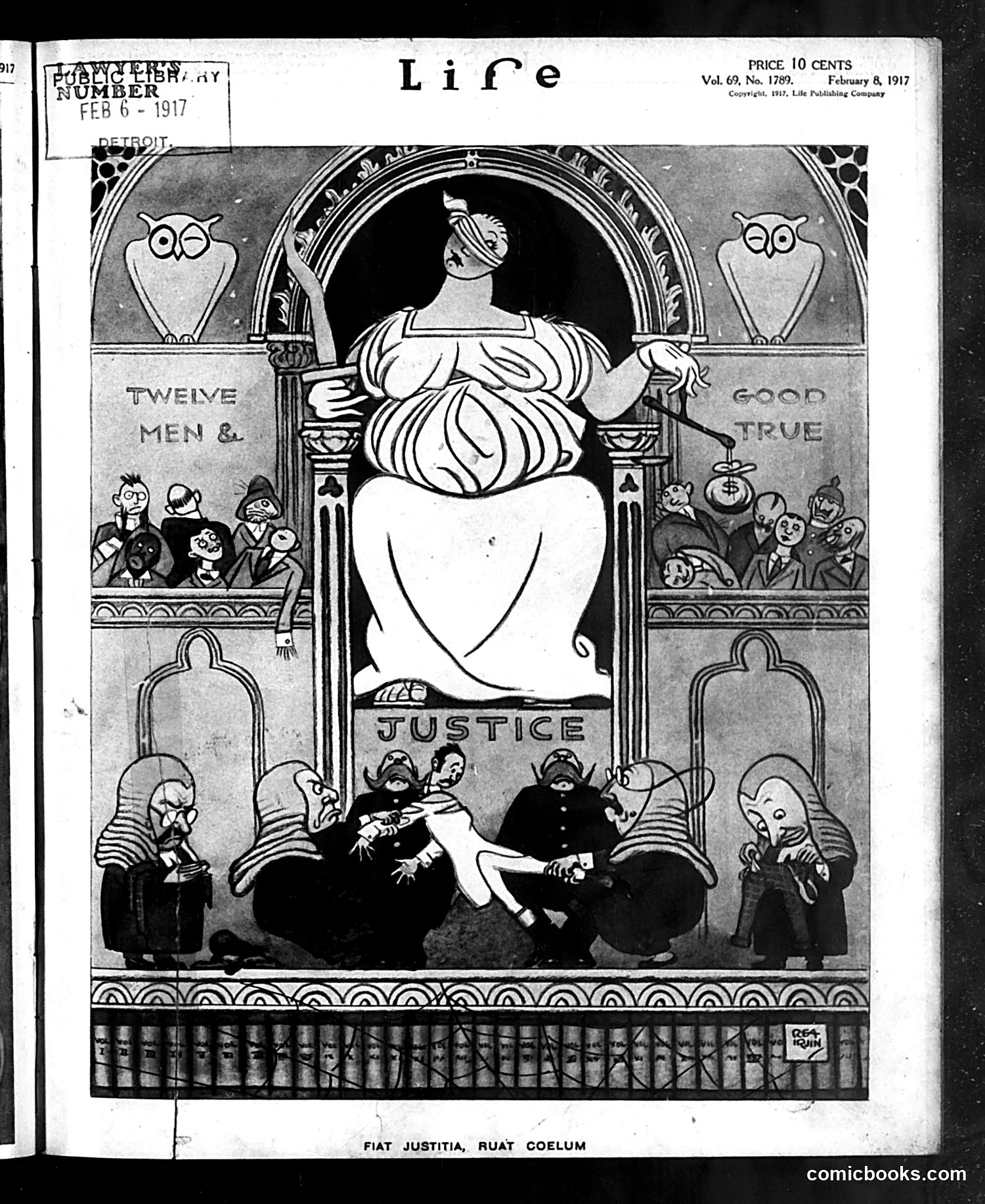
This 1917 *Life* magazine cartoon satirizes the American legal system. A massive female figure labeled "Justice" presides over a courtroom. On the left, "Twelve Men" (the jury) observe proceedings; on the right, "Good True" citizens witness the scene. Below, figures appearing to be lawyers or judges seem to be manipulating or controlling the judicial process, with one holding what appears to be a money bag. The Latin motto and composition suggest the cartoon critiques how actual justice becomes compromised—corrupted by money and powerful interests despite Justice's noble appearance above. The satirical point: American courts fail to deliver true justice when wealth and influence interfere with the legal process. This reflects Progressive Era concerns about judicial corruption.
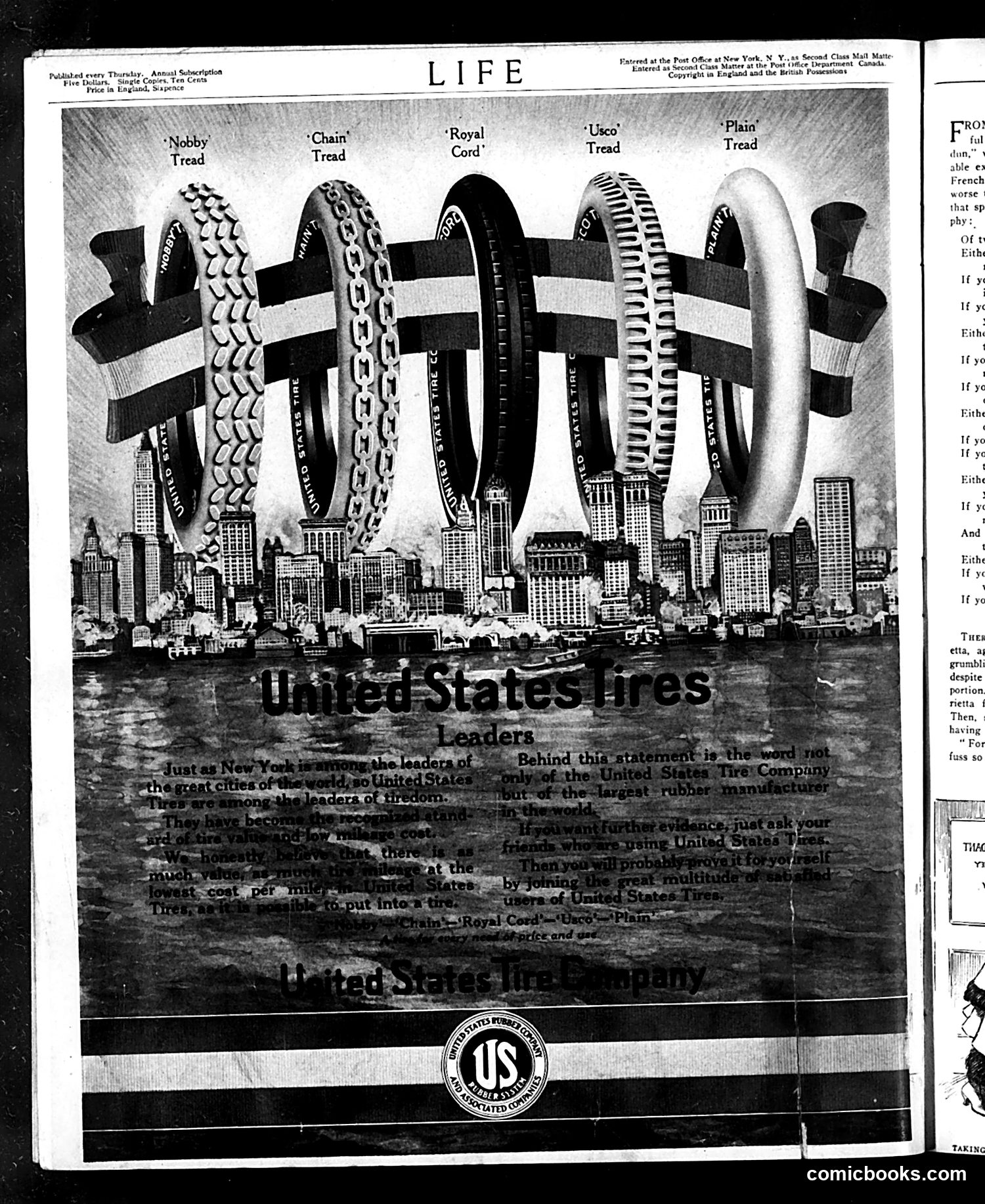
This is primarily a **commercial advertisement**, not political satire. The full-page ad for United States Tires depicts five giant tires looming over a New York City skyline, labeled with different product lines: "Nobby Tread," "Chain Tread," "Royal Cord," "Usco Tread," and "Plain Tread." The ad's headline proclaims United States Tires as "Leaders"—comparing them to how New York leads America's great cities. The copy argues that the tire company's dominance in rubber manufacturing justifies consumer trust. This represents typical early-20th-century advertising strategy: using civic pride and scale-comparison imagery to establish brand authority and market leadership. The surreal giant tires emphasize product variety and superiority rather than delivering satirical commentary.
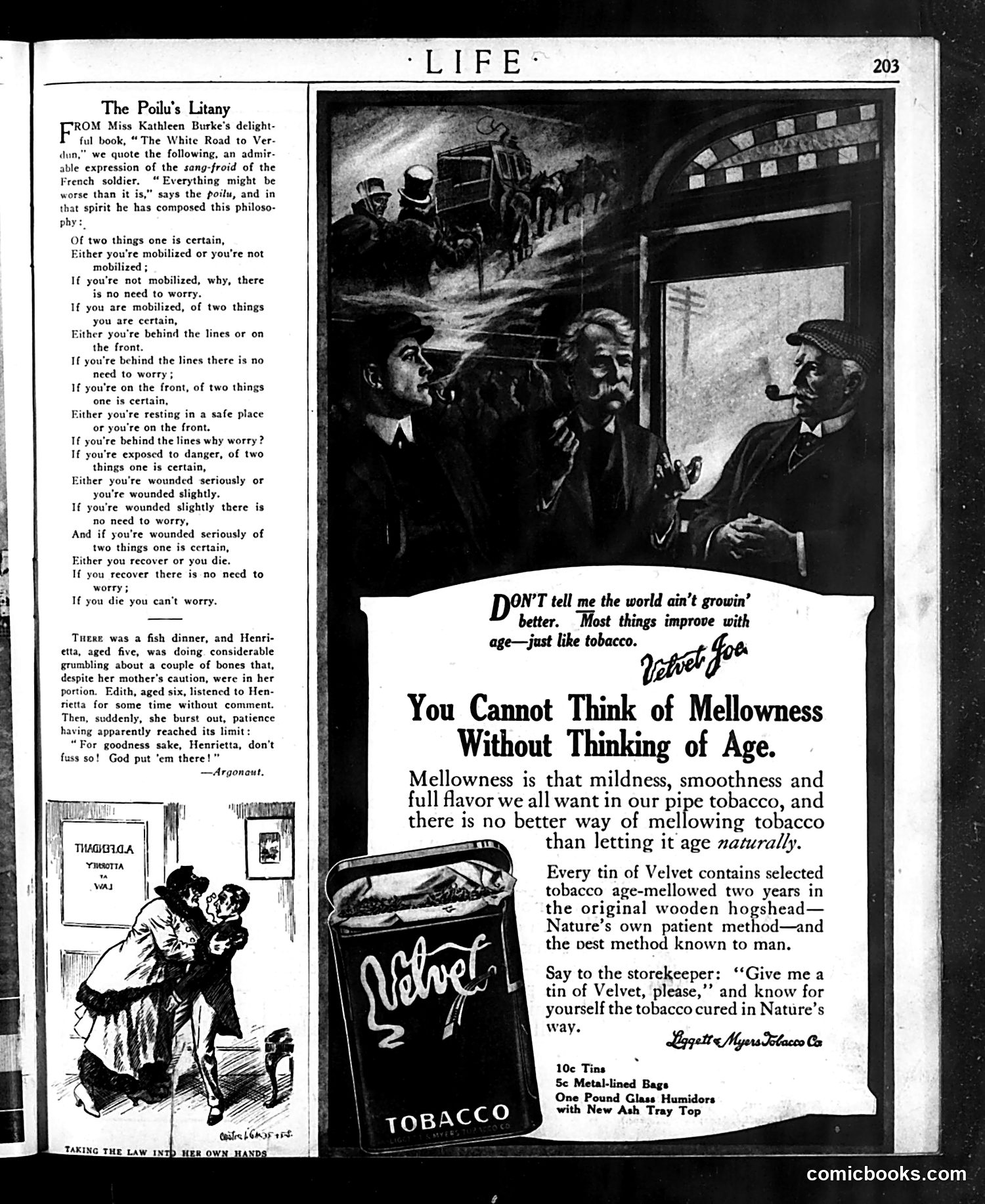
This page contains two distinct sections: **Left side:** A philosophical poem titled "The Poilu's Litany" (the poilu being a French WWI soldier) expressing fatalistic resignation about war's uncertainties. Below it is a small cartoon showing a domestic scene where a child (labeled "Henrietta") argues with her mother about fish bones, with the caption "TAKING THE LAW INTO HER OWN HANDS"—satirizing childhood rebellion over minor household grievances. **Right side:** A Velvet Tobacco advertisement disguised as editorial content. It features a conversation between two men, with copy claiming tobacco improves with age "just like" people. The ad emphasizes "natural" aging methods. The page juxtaposes serious wartime sentiment with lighthearted domestic humor and commercial messaging—typical of Life magazine's format mixing satire, comics, and advertising.
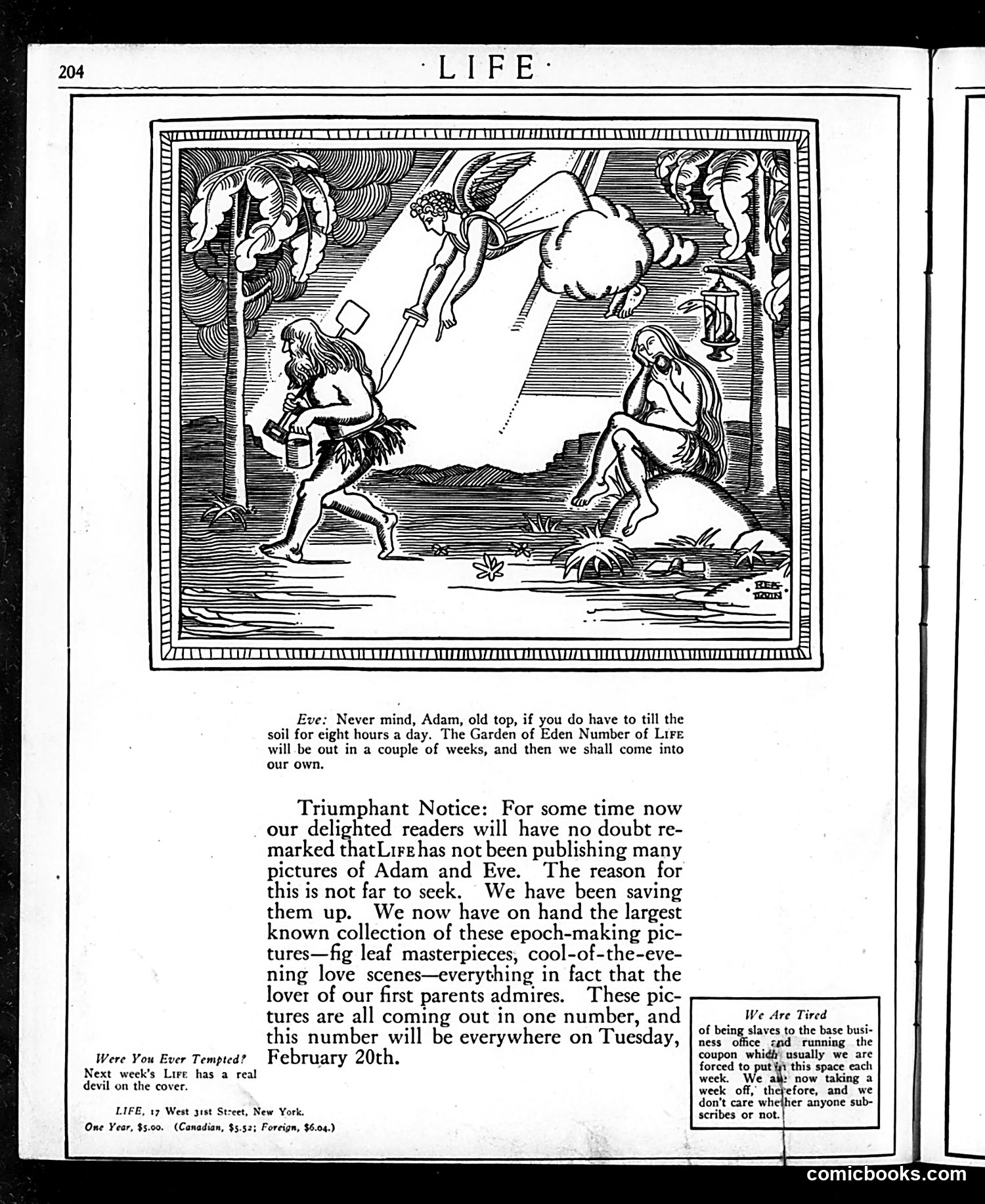
This page features a satirical cartoon depicting Adam and Eve in the Garden of Eden. Eve reassures Adam that despite having to till soil for eight hours daily, their "Garden of Eden Number" will soon be published, after which "we shall come into our own." The satire targets **labor conditions and economic inequality** of the era. The cartoon suggests that working-class people (represented by Adam and Eve) are promised future prosperity through some publication or scheme, similar to how workers were often sold false promises of upward mobility. The accompanying "Triumphant Notice" announces Life's collection of Adam and Eve pictures coming February 20th, functioning as self-promotion while reinforcing the cartoon's satirical message about exploitation and deferred rewards.
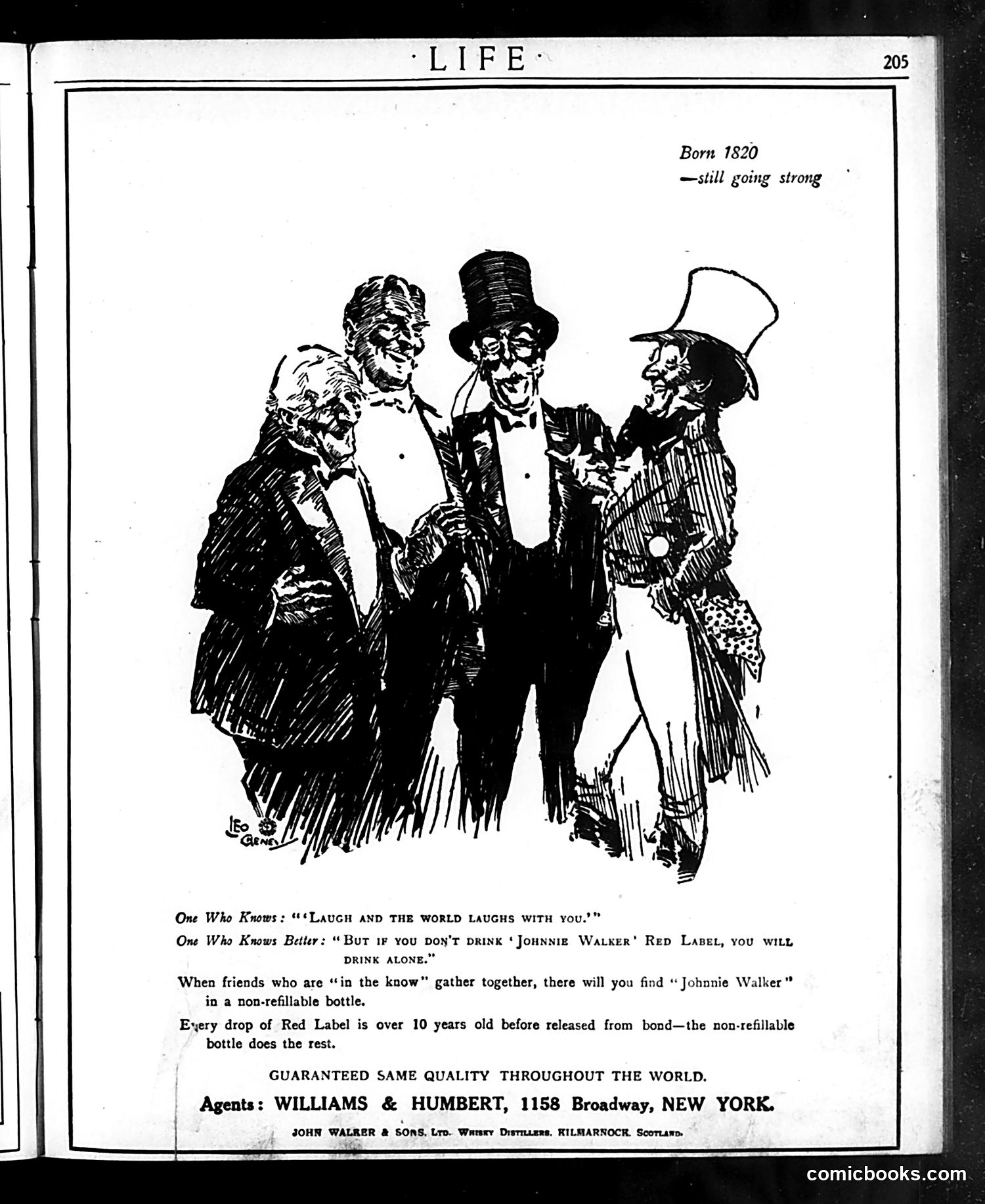
This is primarily a **Johnnie Walker whisky advertisement**, not political satire. The illustration shows four well-dressed men in formal evening wear (top hats, tuxedos) socializing together—depicting the aspirational "in the know" crowd of the era. The advertisement's humor relies on two contrasting statements: one claims "Laugh and the world laughs with you," while the other suggests drinking Johnnie Walker Red Label prevents social isolation ("you will drink alone"). The ad emphasizes the whisky's longevity ("over 10 years old before released") and quality consistency. The phrase "Born 1820—still going strong" personifies the brand as enduring and established. The page is dated to Life magazine's satirical period but contains **commercial rather than political content**.
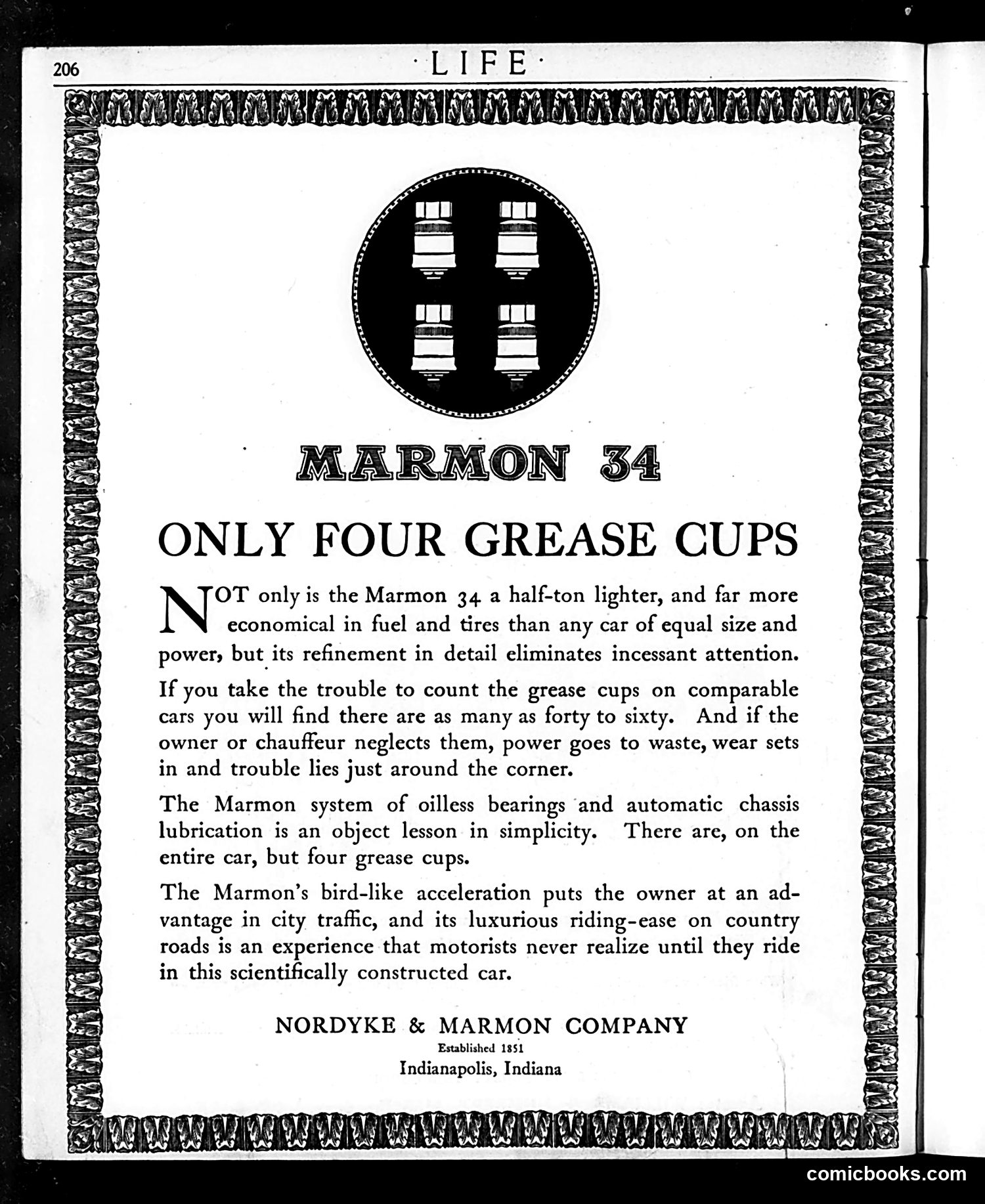
This is **not a political cartoon or satire**, but rather a **straightforward automobile advertisement** from Life magazine (page 206). The Marmon 34 was a real automobile marketed by Nordyke & Marmon Company of Indianapolis. The ad highlights a genuine engineering feature: the car required only four grease cups for lubrication, compared to forty to sixty on comparable vehicles of the era. The circular diagram shows the four lubrication points. The advertisement emphasizes practical benefits—reduced maintenance, fuel economy, and smooth performance—rather than satirizing anything. This reflects early automotive marketing's focus on mechanical reliability and owner convenience, concerns that dominated the 1920s-30s automobile market.
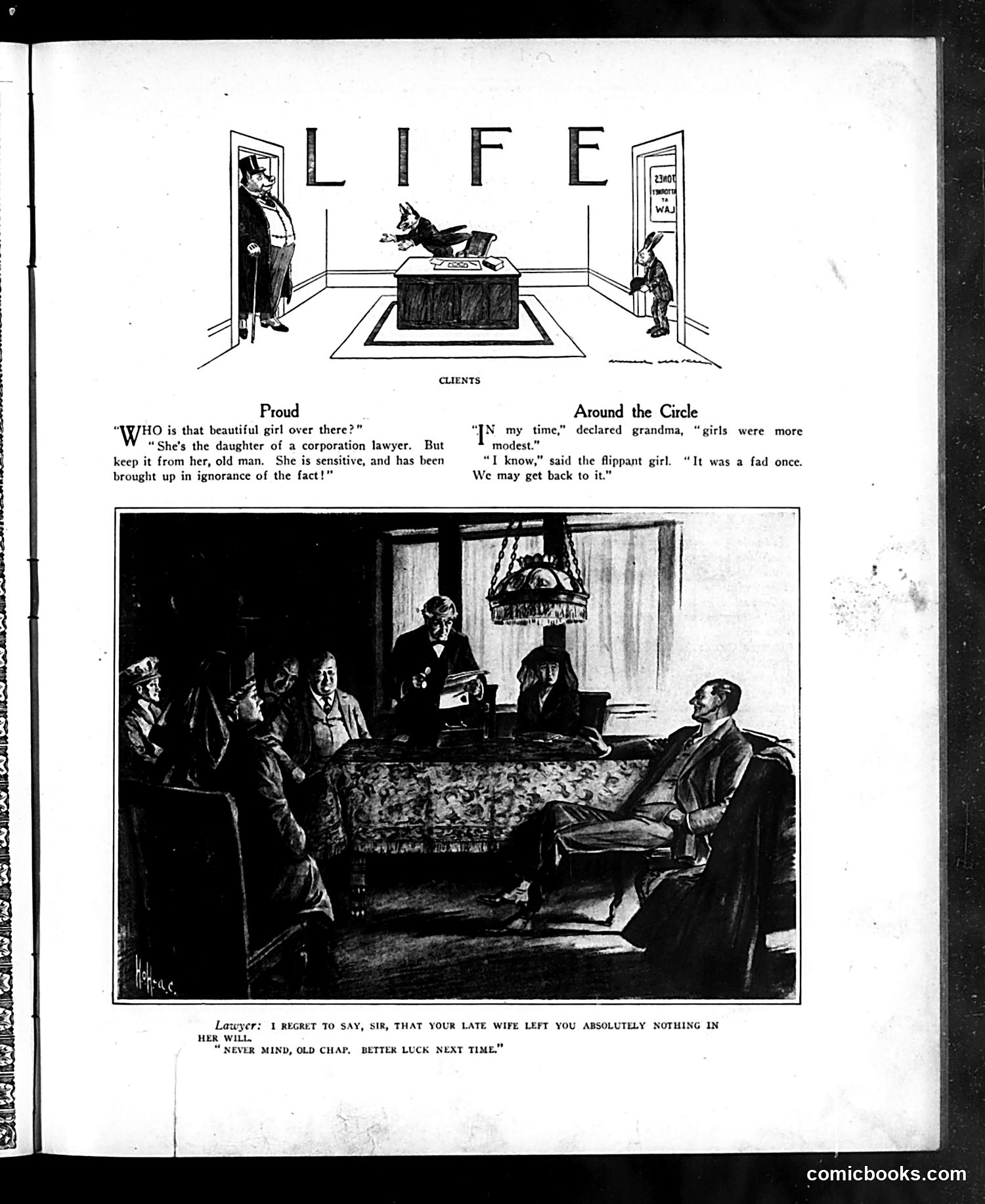
This page contains two separate satirical pieces about social class and wealth: **"Proud"**: A joke about a wealthy man's daughter. The setup mocks class pretension—a man boasts his beautiful daughter is "the daughter of a corporation lawyer," but admits he keeps her ignorant of her mother's lower-class origins, suggesting shame about marrying beneath his station. **"Around the Circle"**: An elderly woman recalls that girls were once "modest" as a fad, with a flippant younger woman suggesting they might "get back to it"—satire on changing female social behavior and generational attitudes. **"Clients" (illustration)**: A lawyer consoles a wealthy widower about his late wife's will, joking "better luck next time"—dark humor about inheritance and remarriage among the wealthy. The overall theme targets class anxiety and materialism among the affluent.
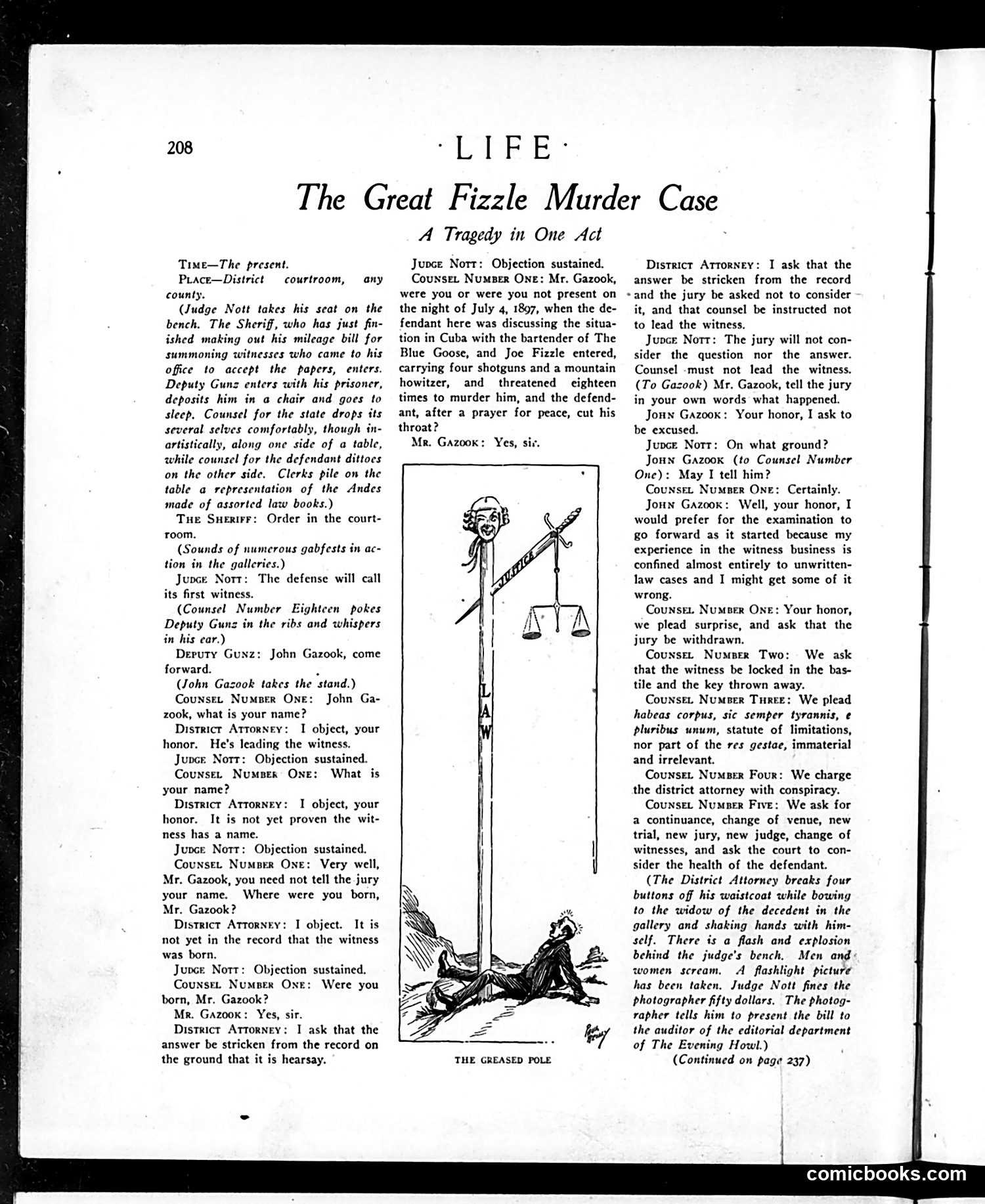
This is a satirical courtroom drama titled "A Tragedy in One Act." The sketch mocks legal proceedings through absurdist humor. The illustration shows a gallows with a figure, labeled "THE GREASED POLE," suggesting the case involves corruption or slippery justice. The courtroom dialogue parodies typical legal objections and procedural delays—judges sustaining objections, defense counsel requesting continuances and venue changes, prosecutors making sweeping accusations. The text suggests the actual facts remain obscured by procedural wrangling and legal posturing. The "greased pole" image implies that justice cannot be grasped due to institutional corruption or incompetence. This appears to satirize early 20th-century American legal system inefficiencies and the theatrical nature of criminal trials, where procedure often obscures truth.
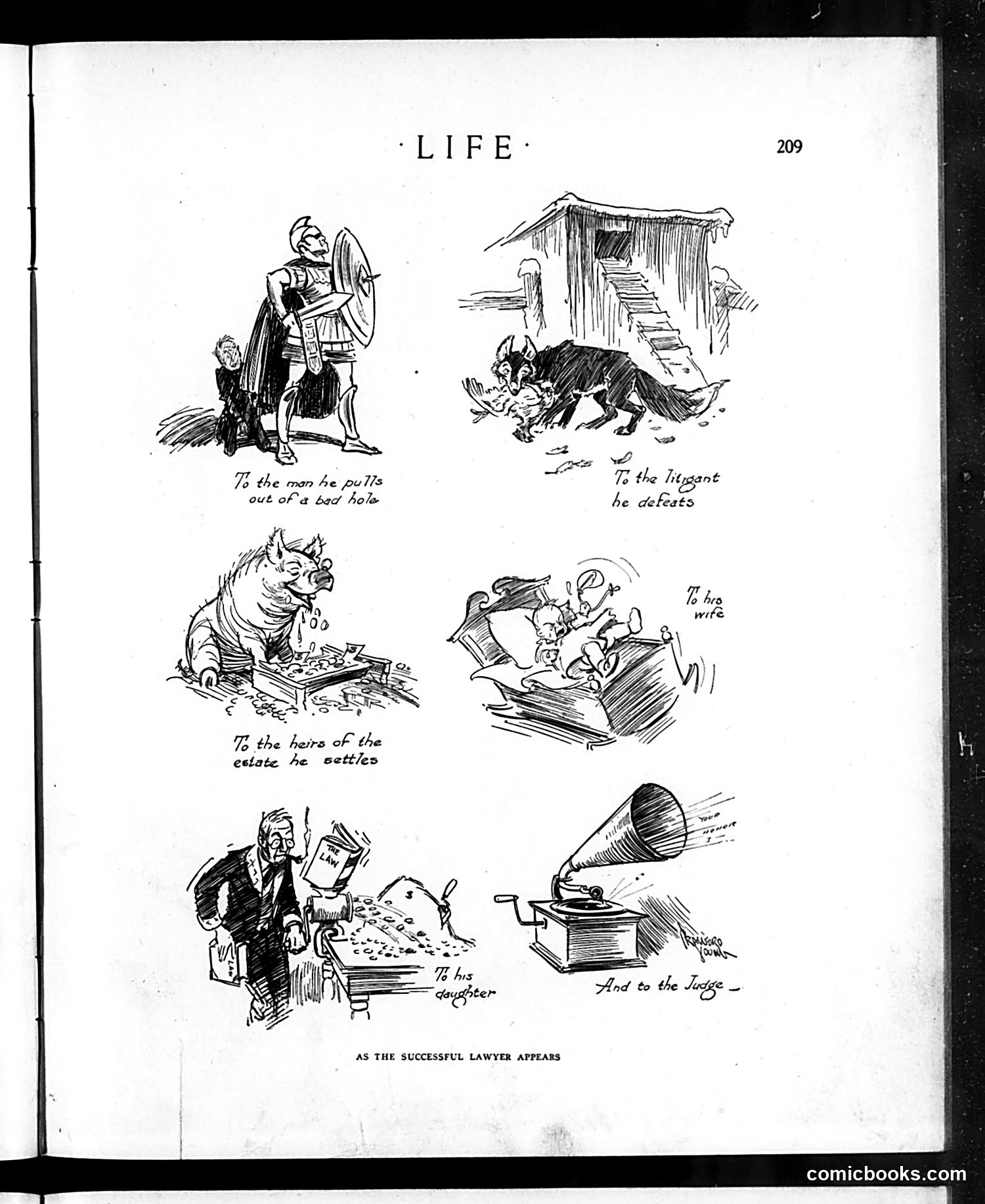
This page presents six comic vignettes satirizing how successful lawyers are perceived or behave. The cartoons illustrate stereotypical outcomes: 1. **"To the man he pulls out of a bad hole"** — The lawyer as heroic rescuer 2. **"To the litigant he defeats"** — The opponent as humiliated loser 3. **"To the heirs of the estate he settles"** — Wealthy beneficiaries 4. **"To his wife"** — Family receiving benefits 5. **"To his daughter"** — Another family member advantaged 6. **"And to the Judge"** — A phonograph, suggesting the lawyer "plays" the judge like a record The satire mocks how lawyers enjoy different reputations depending on perspective—heroic to clients, destructive to opponents, and corrupt to the judiciary. The final image implies judges are easily manipulated by successful attorneys.
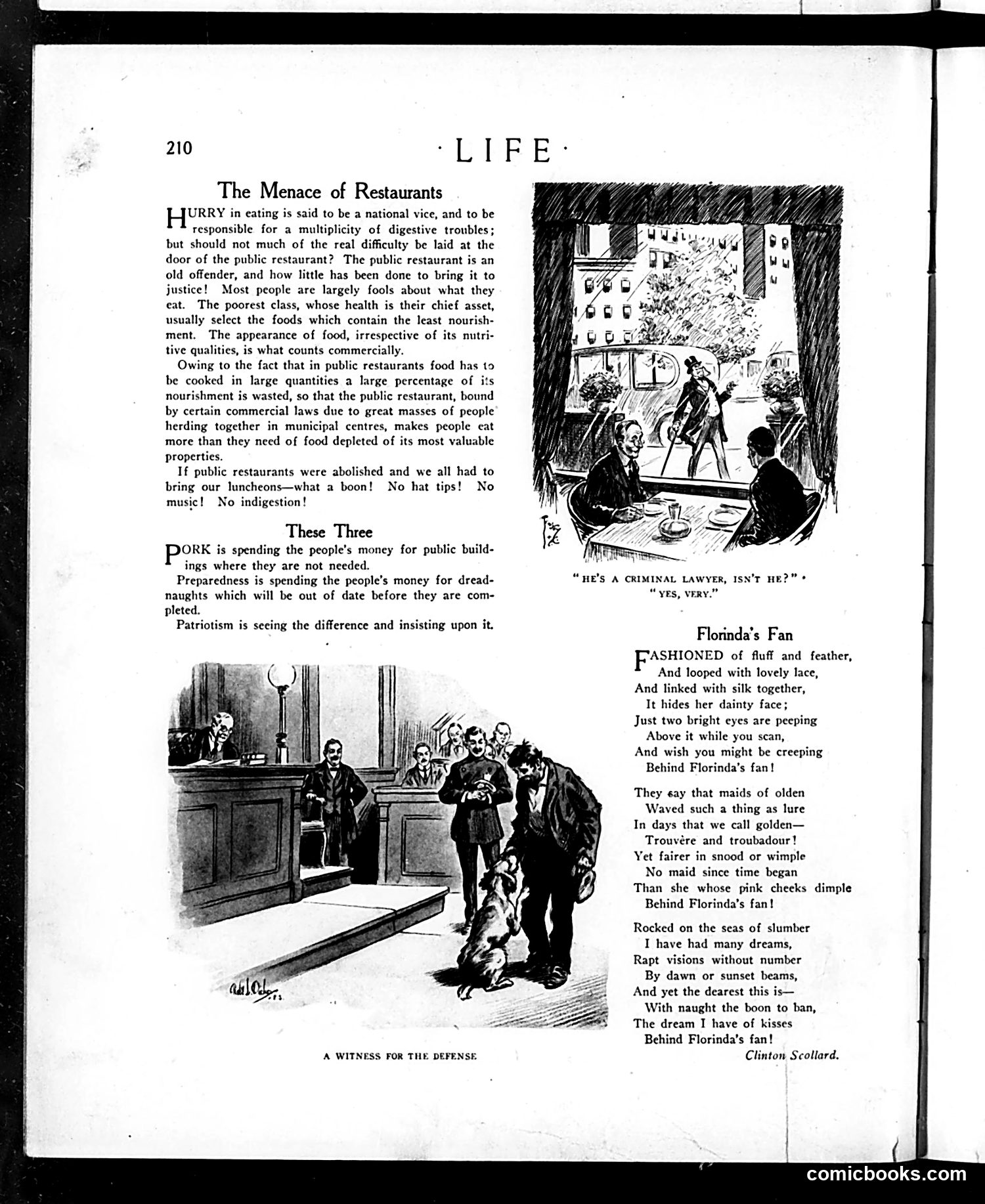
This page critiques public restaurants as sources of poor health. The article argues that restaurants prioritize appearance over nutrition, waste food in large-scale cooking, and force people to eat more than needed due to commercial pressures. The author proposes abolishing them entirely, sarcastically celebrating the elimination of tips, music, and indigestion. The left cartoon labeled "A Witness for the Defense" appears to show a courtroom scene, likely illustrating a legal case related to restaurant practices or food quality. The right cartoon depicts two men in conversation—one identified as "a criminal lawyer"—suggesting restaurants attract unsavory characters or litigation. The poem "Florida's Fan" by Clinton Scollard is unrelated romantic verse about a woman's fan.
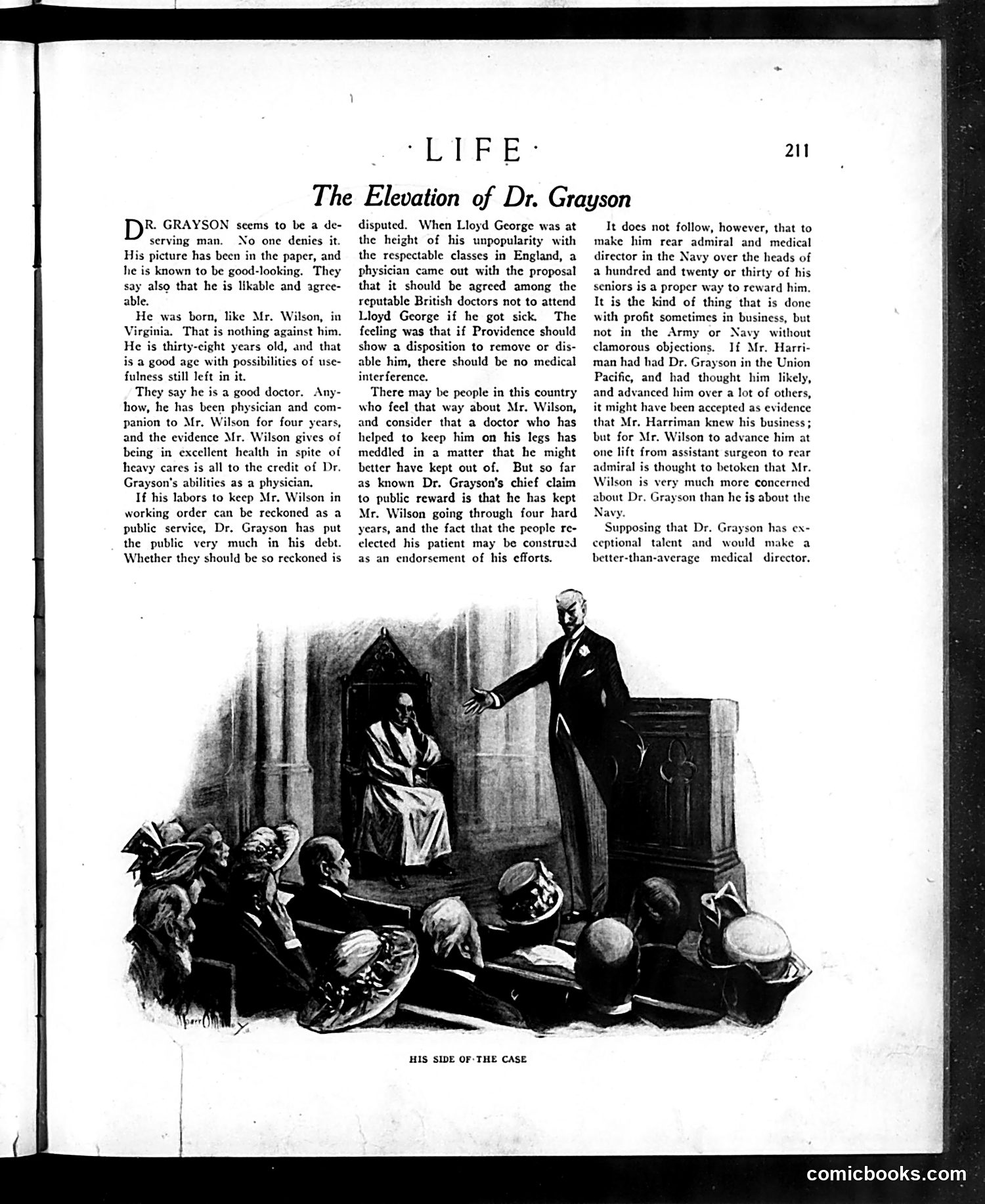
This satirical piece discusses Dr. Grayson's rise in prominence, likely through his association with a powerful figure (Mr. Wilson is mentioned repeatedly). The cartoon caption reads "HIS SIDE OF THE CASE," showing a man at a podium addressing an audience. The satire concerns whether Grayson deserves credit for his own medical competence or if his elevation results from his patron's influence. The text questions whether rewarding doctors who've helped prominent patients represents proper meritocracy or inappropriate favoritism. The piece debates whether Grayson earned advancement through genuine ability or through profitable connections—a critique of how proximity to powerful people can inflate a professional's reputation and career prospects beyond their actual capabilities.
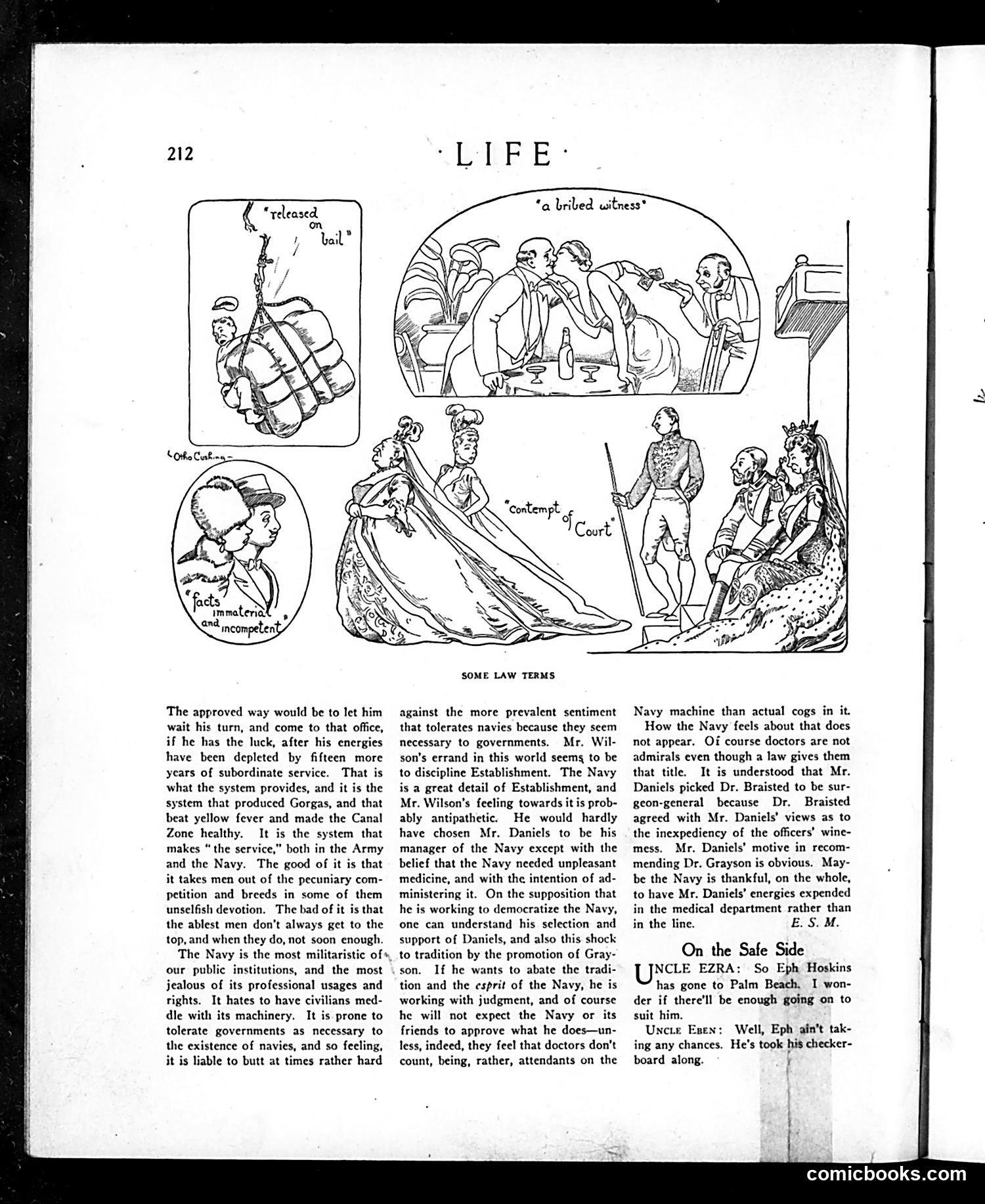
This page satirizes naval bureaucracy and military hierarchy. The cartoon panels labeled "released on bail," "a bribed witness," "Contempt of Court," and "Facts in a muddled and incompetent" use courtroom terminology to mock naval administrative practices. The text discusses Mr. Wilson's (likely Secretary of the Navy Josephus Daniels, based on context) management of the Navy. It criticizes naval officers' resistance to medical innovations and suggests Daniels implemented unpopular reforms. The satire implies the Navy functions like a chaotic legal proceeding rather than an efficient institution. The "Safe Side" dialogue below depicts Uncle Eben and Epi discussing someone named Hoskins going to Palm Beach, likely a contemporary social reference about leisure versus duty during wartime. The overall message critiques Navy leadership incompetence and resistance to modernization.
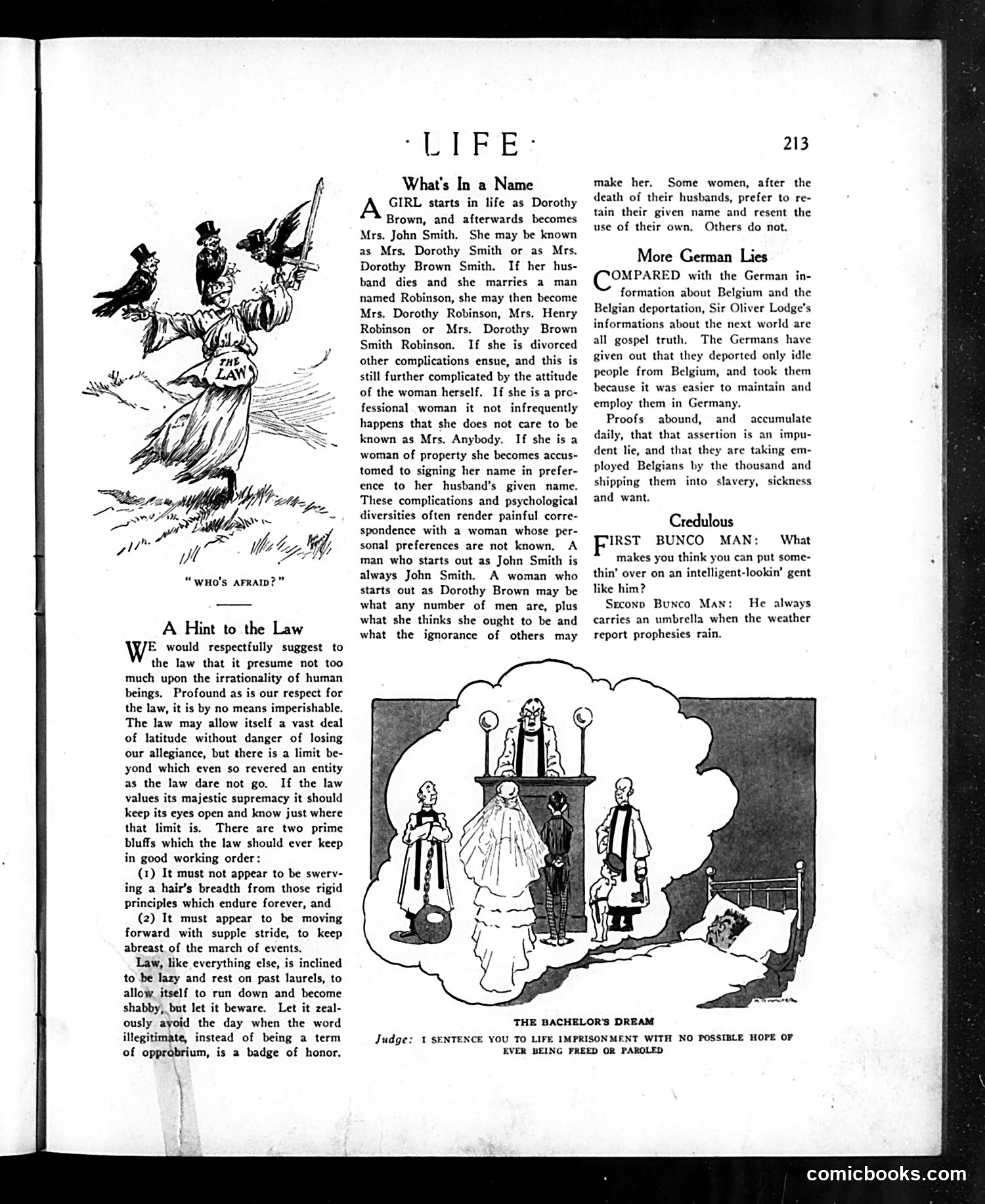
This page contains three distinct pieces: 1. **"What's in a Name"** — A humorous essay about how women's identities shift through marriage, using "Dorothy Brown" as an example who becomes Mrs. John Smith, then potentially Mrs. Robinson after remarriage. It satirizes how women traditionally lost their identity in their husband's name. 2. **"A Hint to the Law"** — A serious editorial arguing that laws must maintain clear principles ("keep their eyes open") and progress forward, warning against allowing laws to become obsolete or corrupt. 3. **"The Bachelor's Dream"** — A cartoon showing a groom's nightmare: a judge sentencing him to "life imprisonment with no possible hope of ever being freed or paroled." This is straightforward satire about marriage as loss of freedom—a common early-20th-century trope.
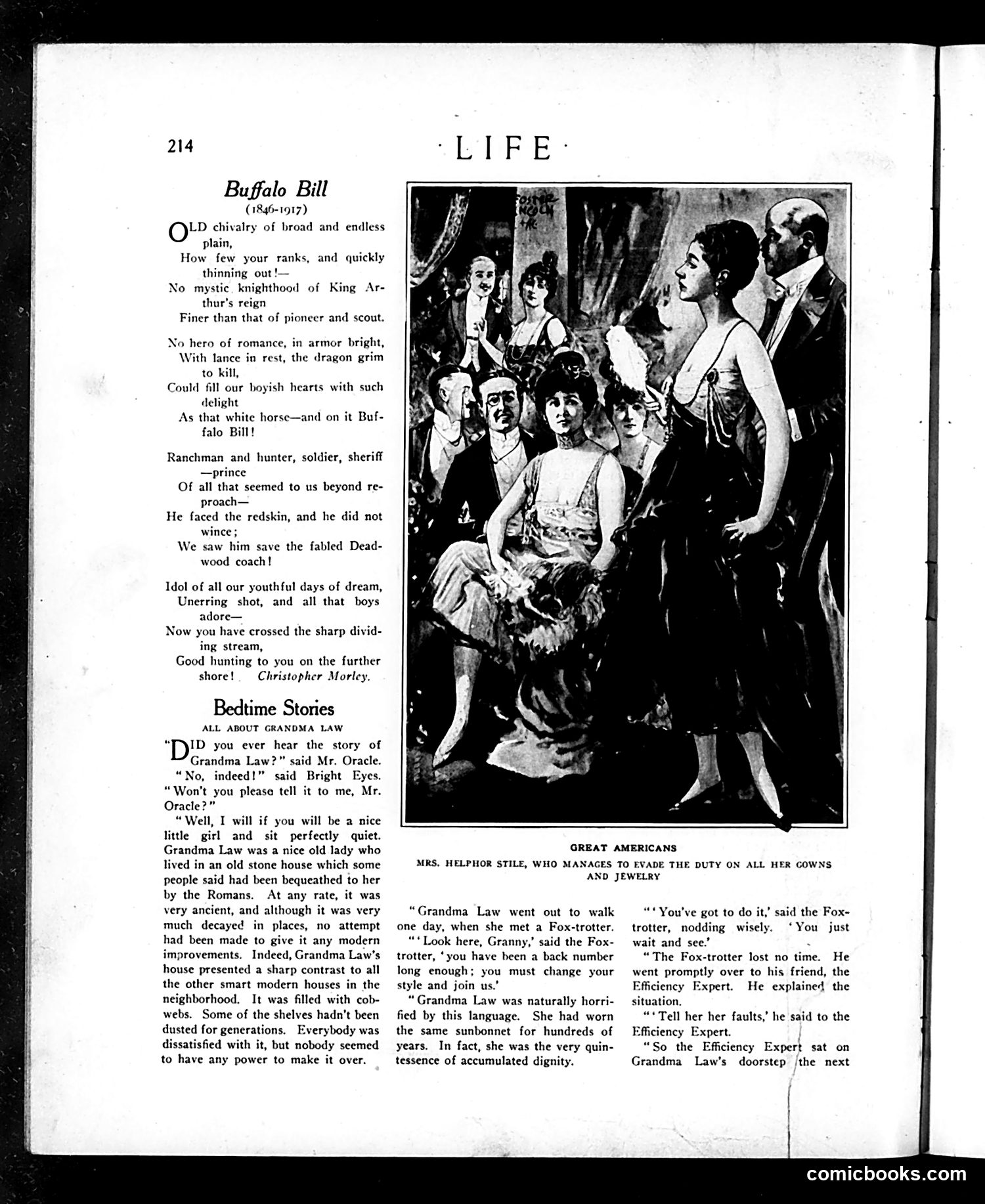
This page contains two distinct sections: **Buffalo Bill Poem** (left): A tribute poem by Christopher Morley commemorating Buffalo Bill (1840-1917), celebrating his frontier heroism—his skills as "ranchman and hunter, soldier, sheriff"—and his iconic white horse. The poem mourns his death and his representation of idealized American frontier mythology. **"Bedtime Stories" (right)**: A satirical tale about "Grandma Law" and an "Efficiency Expert" (appearing to represent early-20th-century business optimization movements). A Fox-trotter pressures the elderly woman to modernize her traditional lifestyle and home. The satire targets the era's obsession with "efficiency" and rationalization, mocking attempts to impose corporate-style improvement on traditional domestic life and elderly persons resistant to change. The illustration shows multiple figures in what appears to be a social gathering.
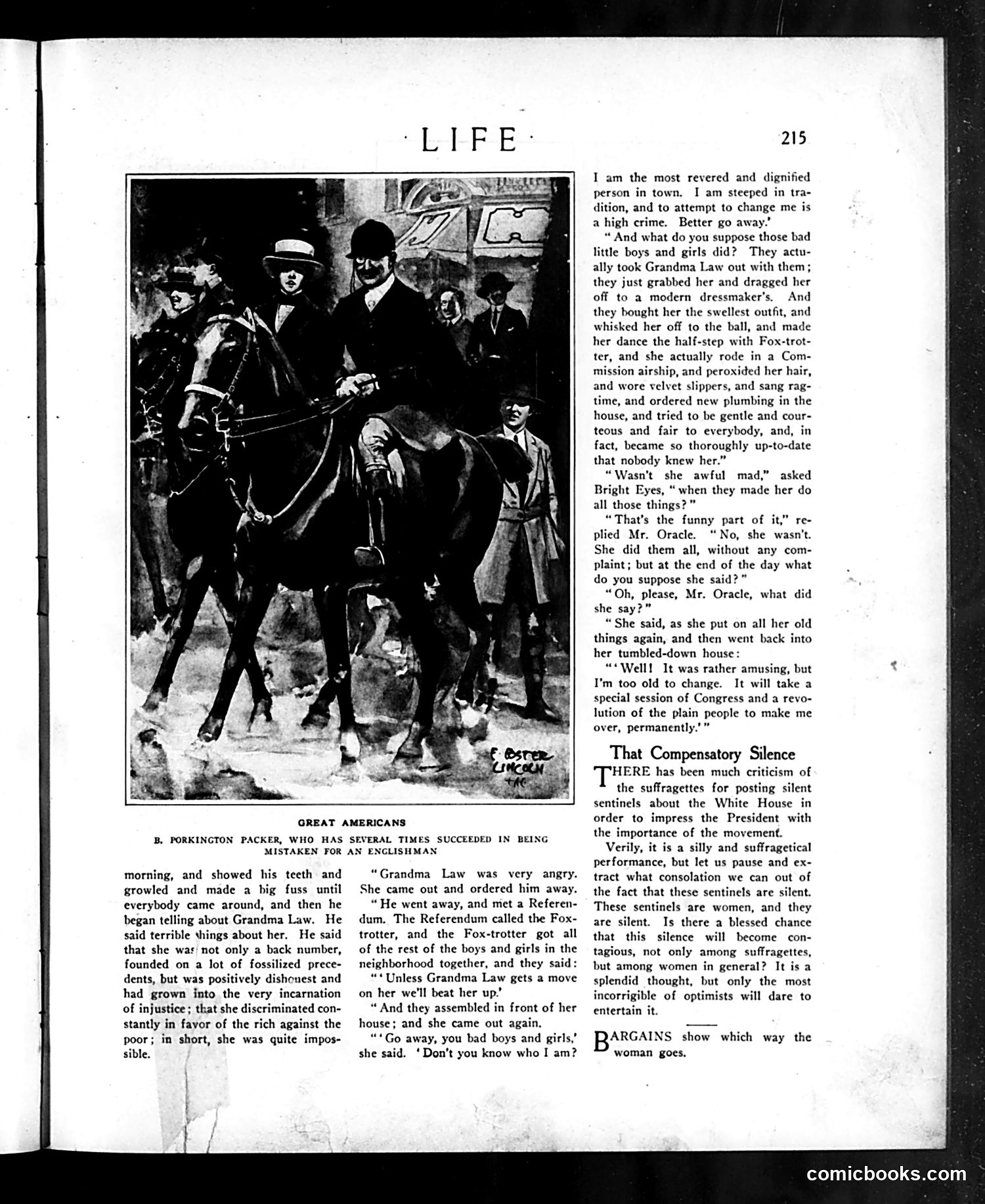
This page satirizes **B. Porkington Packer**, a character described as someone who has "several times succeeded in being mistaken for an Englishman." The illustration shows well-dressed figures on horseback in what appears to be a refined social setting. The satire centers on **class pretension**: Packer is mocked for attempting to adopt English mannerisms and aristocratic behavior to seem sophisticated. The text reveals he discriminates against poor people while favoring the wealthy, embodying hypocrisy about social justice. The secondary column discusses **suffragettes' silent protests** at the White House, calling this tactic "silly and suffragetical." The author argues their silence, while dramatic, offers no persuasive benefit to their cause—satirizing both the protesters and dismissive responses to women's political activism.
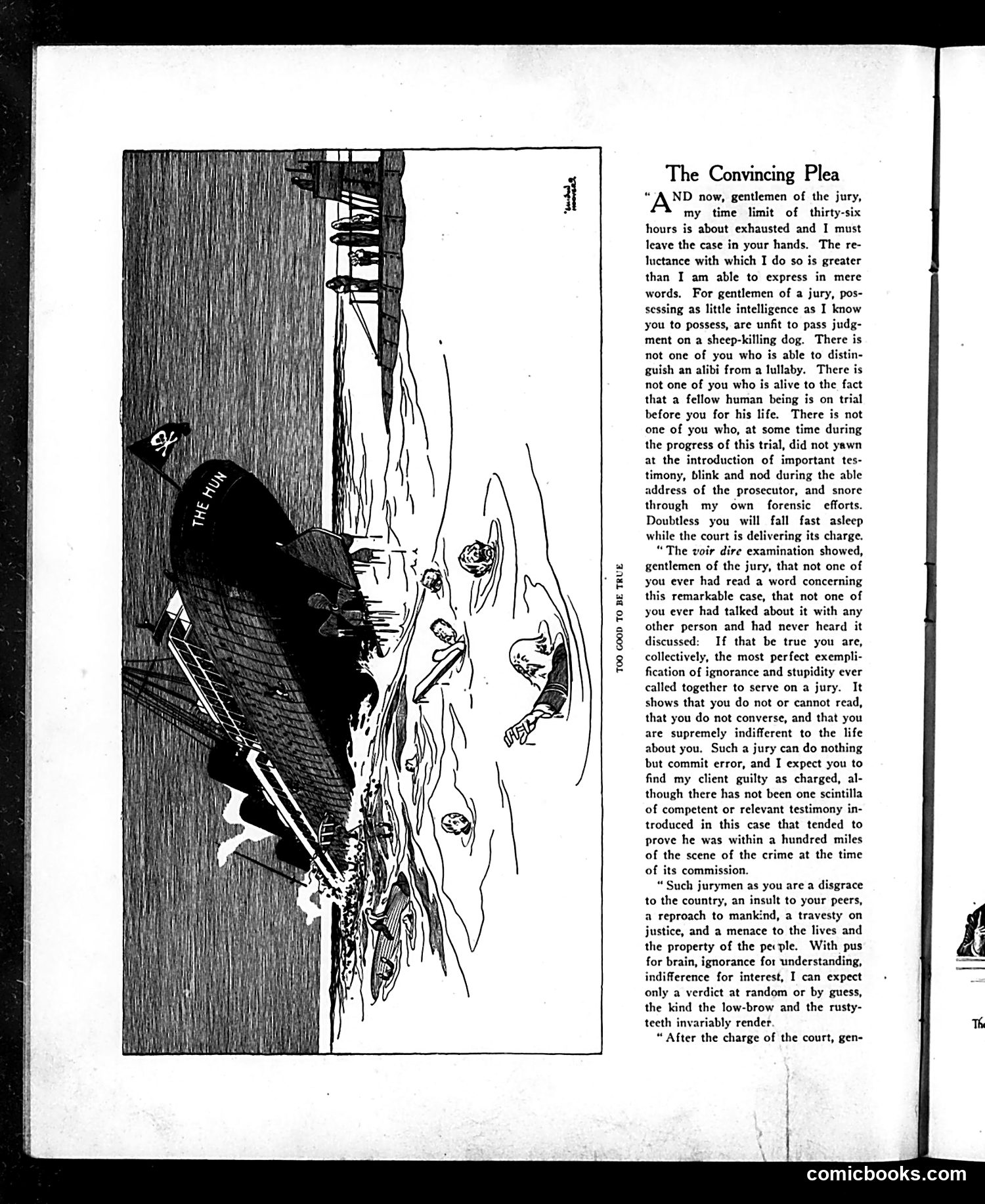
This cartoon satirizes a defense attorney's closing argument to a jury. The illustration shows the lawyer (left) delivering an insultingly condescending speech to jurors (right), while the accompanying text reproduces his remarks verbatim. The satire targets the attorney's counterproductive strategy: he systematically insults the jurors' intelligence, accusing them of illiteracy, inattention, stupidity, and indifference—then expects them to acquit his client. The title "Too Good to Be True" suggests this approach is absurdly optimistic. The piece mocks both courtroom theater and the absurdity of insulting decision-makers while asking for their favor. It reflects early 20th-century American skepticism about jury competence and legal procedure, using exaggeration to ridicule a lawyer's apparent belief that belittling jurors will somehow persuade them to render a not-guilty verdict.
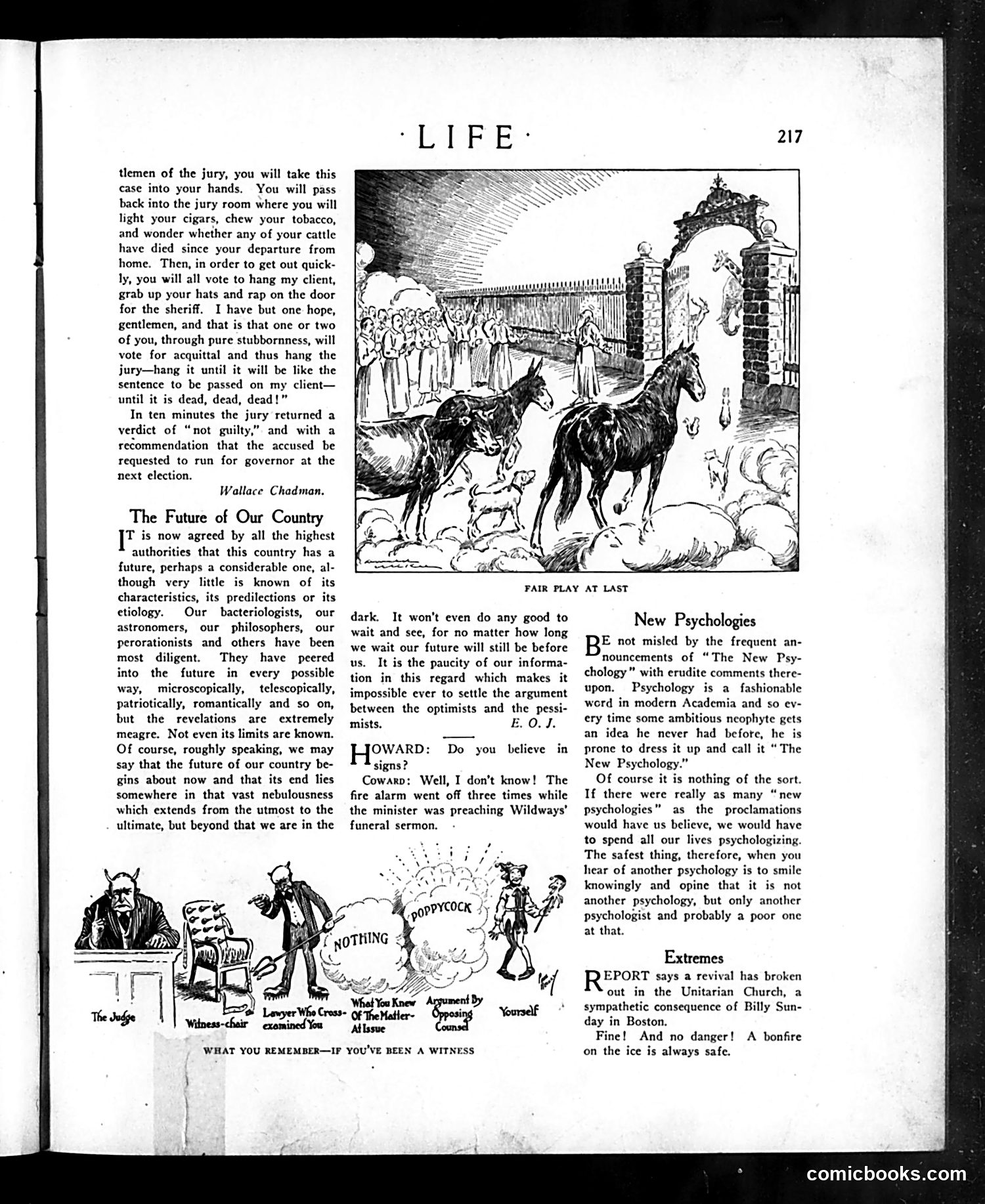
**The courtroom cartoon** (top left) satirizes judicial corruption and jury incompetence. A defense lawyer cynically tells jurors they'll vote to hang his client out of laziness—wanting to leave quickly to check on their cattle. Absurdly, the jury returns "not guilty" and recommends the defendant for governor, mocking how arbitrary and ridiculous verdicts can be when jurors aren't paying attention. **The bottom cartoon** depicts witness testimony as unreliable. It shows various courtroom figures (judge, lawyer, witness) around "NOTHING" and "POPPYCOCK," illustrating how contradictory or absurd testimony becomes when filtered through different perspectives—a joke about the unreliability of eyewitness accounts. **"New Psychologies"** (right column) mocks academia's trend of rebranding old ideas as "new psychology," suggesting ambitious scholars simply relabel existing concepts to appear innovative. It's satirizing intellectual pretension and academic faddishness.
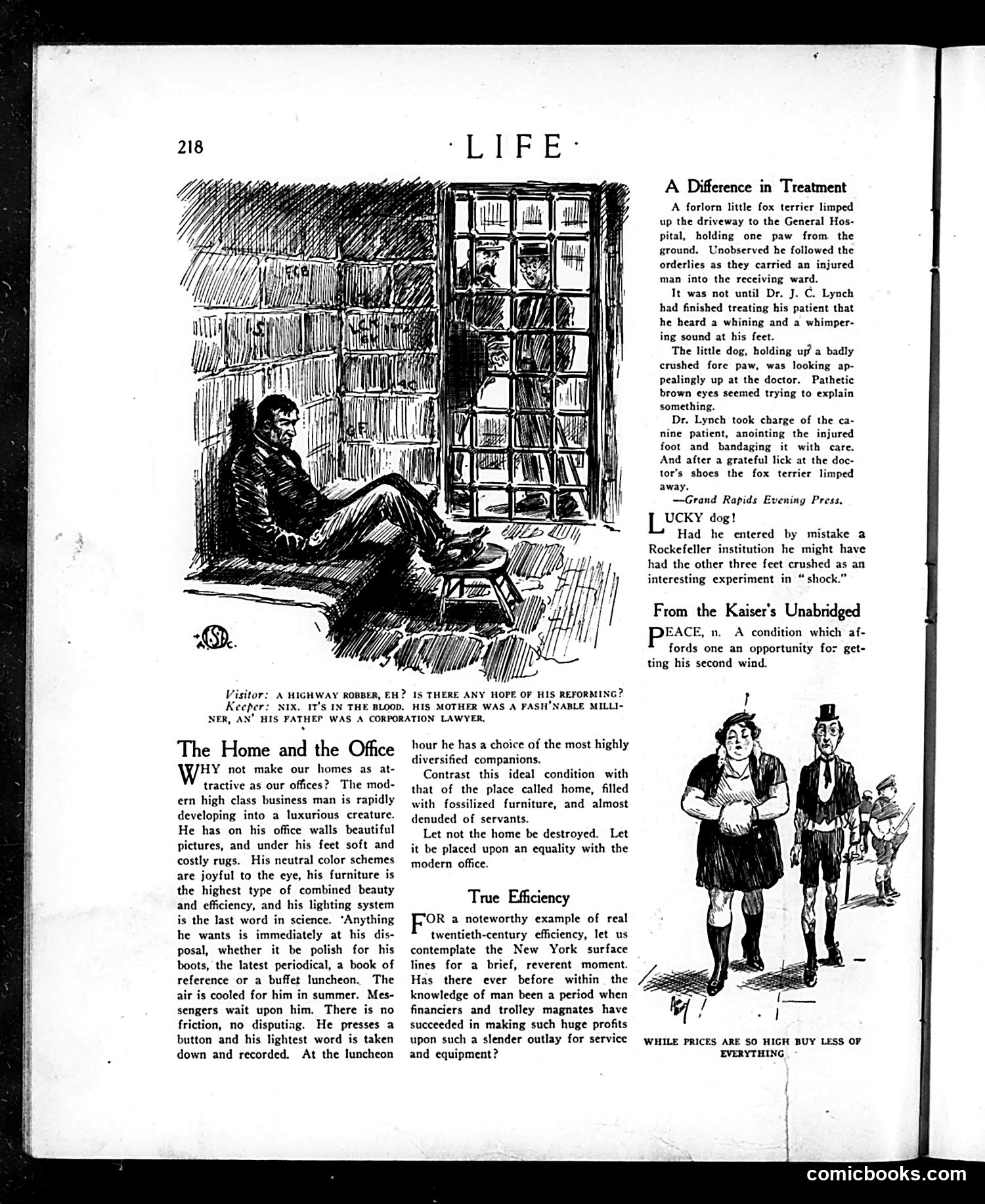
This page contains multiple satirical pieces critiquing early 20th-century American society: **Top cartoon**: A dialogue mocking hereditary criminality. A "highway robber" is deemed unreformable because his mother was a fashionable milliner and father a corporation lawyer—suggesting criminal tendencies run in "bad blood," while ironically implying respectable professions themselves breed corruption. **"The Home and the Office"**: Satirizes the disparity between luxurious modern offices (with art, rugs, climate control, servants, refreshments) and neglected homes. The piece argues homes should receive equal investment, critiquing how industrialized businessmen prioritize workplace comfort over domestic life. **"True Efficiency"**: Mocks New York trolley operators for achieving massive profits while providing minimal service—defining their "efficiency" as financial exploitation rather than actual operational excellence. **"A Difference in Treatment"**: A sentimental anecdote contrasting a doctor's compassion for an injured dog versus implied indifference toward human patients, particularly poor ones—possibly referencing Rockefeller institutions' reputation for exploitative medical experiments.
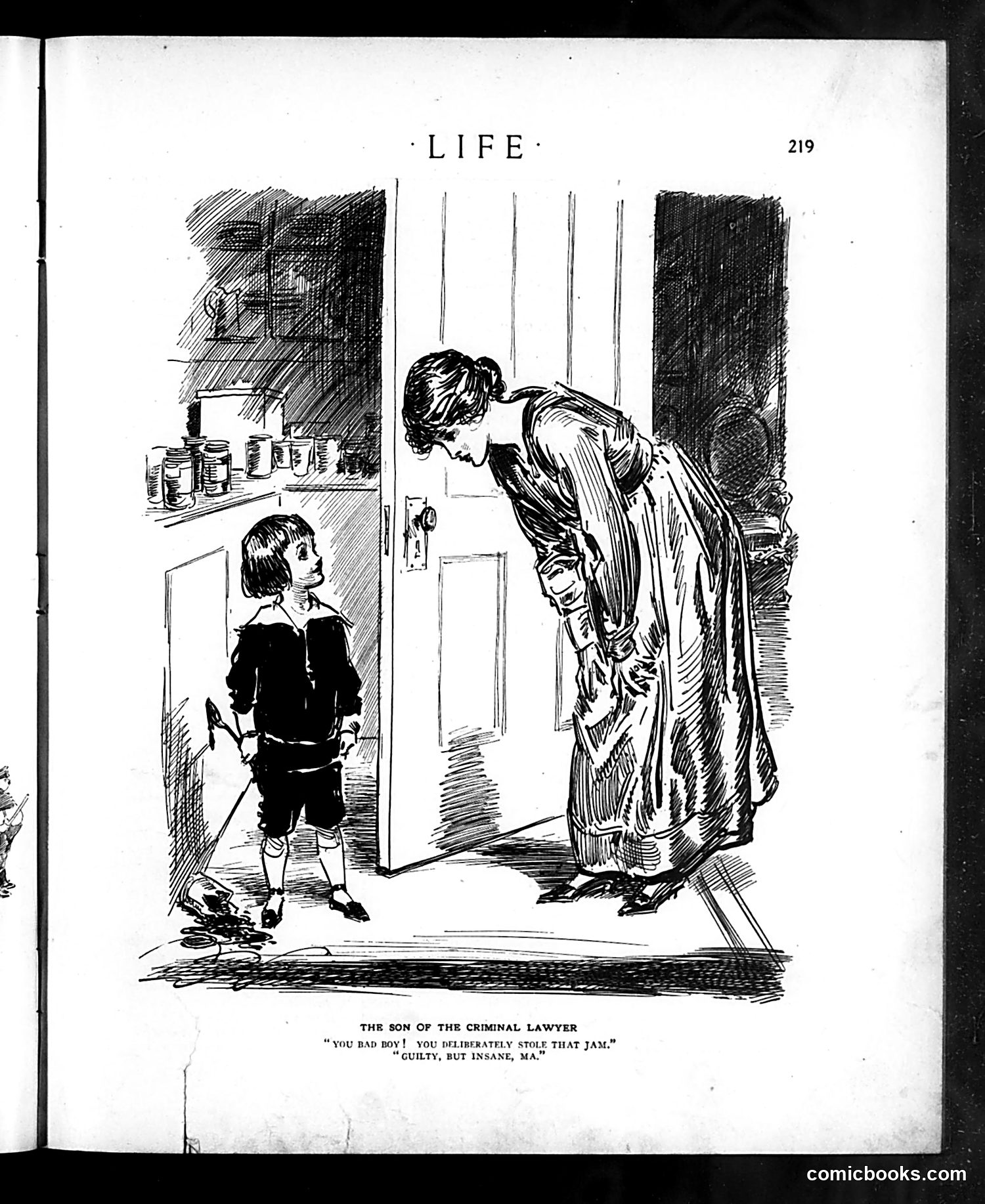
This satirical cartoon mocks how criminal defense lawyers use legal technicalities to evade justice. A mother catches her young son stealing jam. When she accuses him of deliberately stealing, he responds with the defense strategy his father (a criminal lawyer) would employ: "Guilty, but insane, Ma." The joke targets the profession's reputation for getting guilty clients acquitted through technicalities rather than proving innocence. By having a child apply this absurd legal argument to being caught red-handed stealing jam, the cartoon exaggerates and ridicules lawyers who exploit mental illness or other conditions as escape routes from accountability. The satire suggests that such courtroom tactics—divorcing guilt from responsibility—undermine justice and teach cynicism about the legal system.
This editorial page analyzes President Wilson's recent peace address, framed through a comparison between **Colonel Theodore Roosevelt** and **President Woodrow Wilson**—depicted as fundamentally opposed figures ("dog and cat"). **The context:** Wilson had delivered a "peace without victory" speech advocating for a negotiated end to World War I. Roosevelt, a vocal interventionist and Wilson's 1916 rival, attacked it harshly as "copperhead" dishonor. **The satire's point:** The author mocks Roosevelt's reflexive partisanship—his reaction reveals nothing about Wilson's actual address, only Roosevelt's character. Meanwhile, non-partisan readers (including former Roosevelt supporters like Albert Bushnell Harte) found the address genuinely inspiring and thoughtful. **The joke:** Even strong Republicans like William Howard Taft recognize Wilson's speech as 85% pro-Allied and reasonable, yet Roosevelt condemns it wholesale. The "dog and cat" metaphor suggests their opposition is temperamental rather than rational—they simply disagree by nature. The cartoon itself is unsigned and schematic, serving primarily as a visual break rather than carrying independent satirical content.
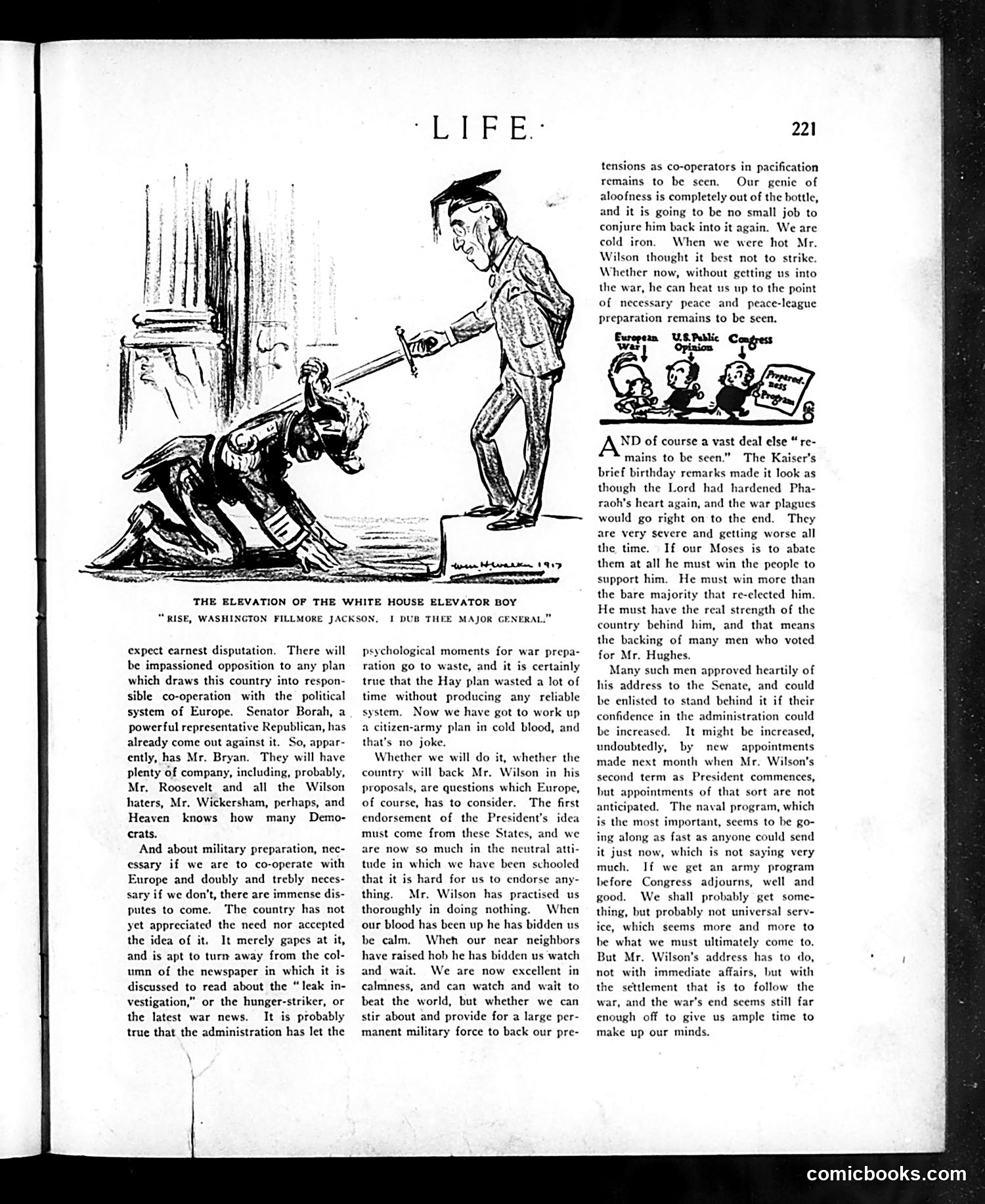
This satirical cartoon depicts President Woodrow Wilson as an "elevator boy" being elevated by a military/political figure (likely representing military or interventionist forces). The caption's wordplay—"elevation" and reference to "Washington Fillmore Jackson"—mocks Wilson's reluctant ascent toward military preparedness. The accompanying text critiques Wilson's administration for: 1. **Insufficient military preparation** despite European pressures for American cooperation in WWI 2. **Inconsistent leadership**: Wilson previously counseled restraint ("be calm") when tensions were high, now struggling to mobilize public support for defense measures 3. **Lost opportunities** for war preparation planning 4. **Need for broader support**: Wilson won re-election narrowly and must convince even Hughes supporters to back military expansion The satirist argues Wilson's previous "aloofness" policy has made it difficult to pivot toward necessary military action, comparing the challenge to magically returning a genie to its bottle. The cartoon suggests Wilson is being forced upward by circumstances rather than leading decisively.
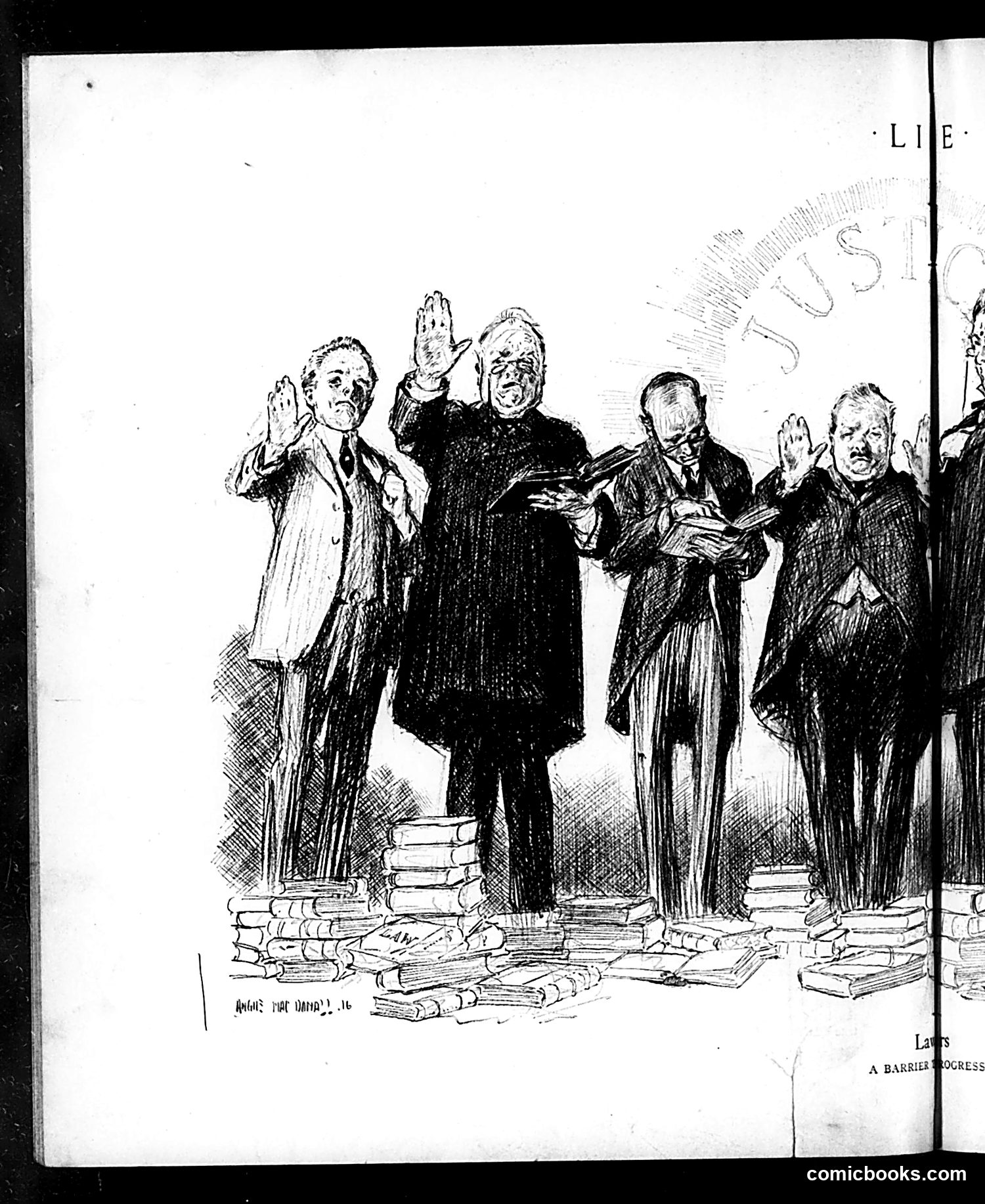
This political cartoon depicts five men in formal attire standing on stacks of books, with their hands raised in apparent obstruction or opposition. The title "A Barrier to Progress" suggests these figures represent obstacles to advancement or reform. The stack of books beneath them likely symbolizes accumulated laws, regulations, or legal precedent. The raised hands convey blocking or resistance. Based on the style and context, these appear to be lawyers or legal/judicial figures impeding social or legislative progress—a common satirical target in early 20th-century American reform-minded publications. The specific identity of the figures is unclear from visible text, but the cartoon critiques how legal establishments or conservative judicial forces obstruct progressive change or reform initiatives.
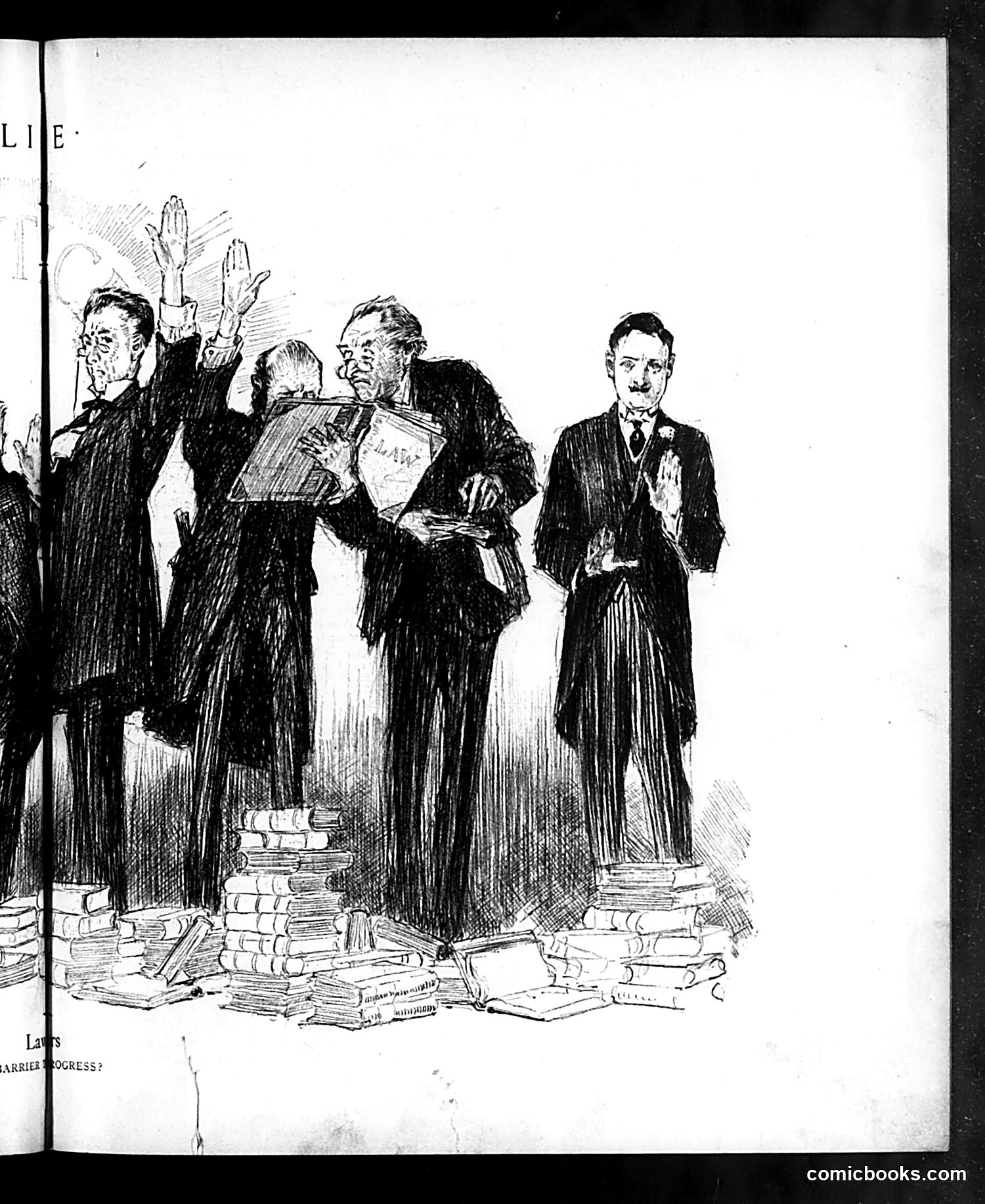
This is a satirical cartoon from *Life* magazine depicting five men in formal suits standing among scattered books and documents piled on the ground. The caption reads "BARRIER PROGRESS" (possibly "BARRING PROGRESS"). The cartoon appears to criticize political or legislative obstruction. The books and papers surrounding the figures suggest laws, legislation, or official documents being disregarded or blocked. One figure raises his hand in what appears to be a voting gesture, while others hold documents. The satire suggests these officials are impeding progress through legislative or bureaucratic means—either by ignoring laws, blocking reform, or using paperwork as a barrier to advancement. Without clearer date or context, the specific legislation or politicians targeted remains unclear, though the message condemns obstruction of forward movement.
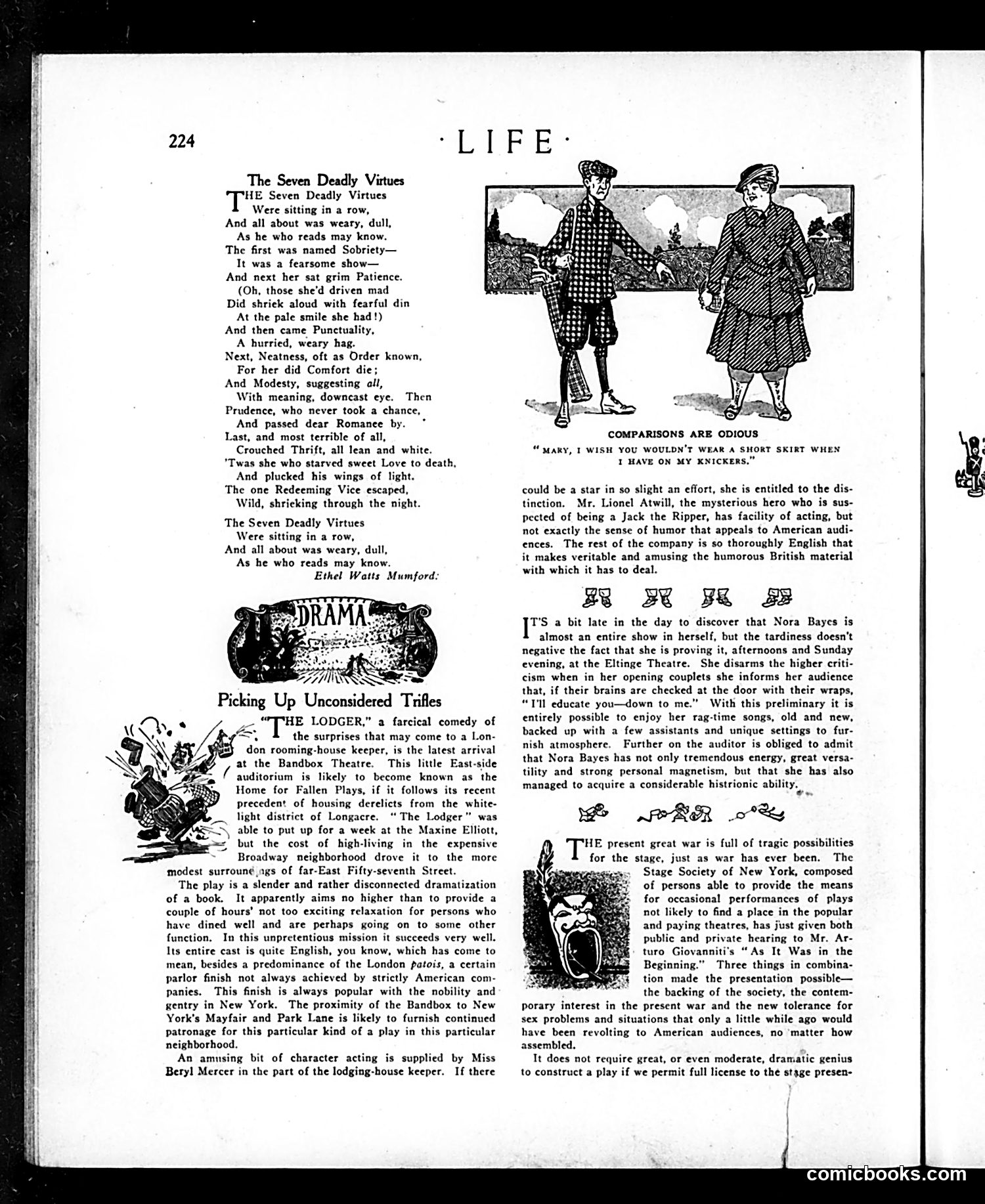
**"The Seven Deadly Virtues"** is a satirical poem inverting the concept of cardinal virtues. Rather than celebrating traditional moral qualities (sobriety, patience, punctuality, neatness, modesty, prudence, thrift), the author treats them as joyless, life-draining forces that kill pleasure and romance. The sole "redeeming vice" that escapes represents spontaneity and passion—implying that rigid Victorian morality itself is the real vice. This reflects early 20th-century backlash against strict social conventions. **"Picking Up Unconsidered Trifles"** reviews theatrical productions. The Bandbox Theatre, serving as a refuge for failing plays, houses "The Lodger" (a British farce). The reviewer notes its modest entertainment value for post-dinner audiences and praises the cast's "English" quality—refined parlor manners appealing to New York's wealthy. Mention of actress Nora Bayes emphasizes her star power, while actor Lionel Atwill's lack of comedic sensibility is criticized as unsuitable for American audiences. The cartoon above shows two figures in period dress with the caption mocking fashion inconsistency—a light social jab at women's clothing choices.
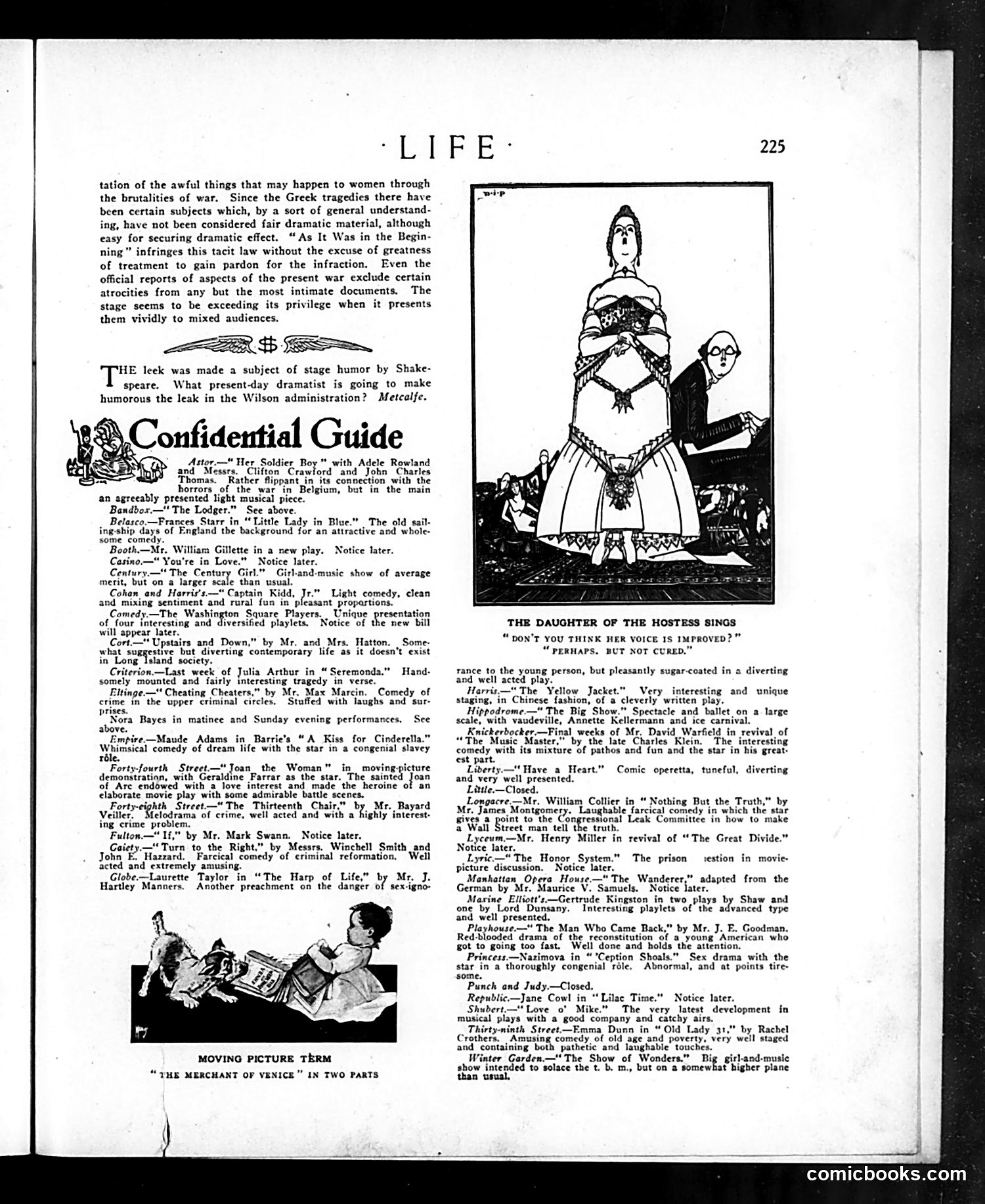
This page from *Life* magazine contains theater reviews and satirical commentary typical of the publication's entertainment coverage. ## The Main Cartoon The large illustration captioned "The Daughter of the Hostess Sings" depicts a woman performing while a man listens critically. The caption's joke—"Don't you think her voice is improved?" / "Perhaps, but not cured"—satirizes both amateur singers and polite social pretense. This mocks the common scenario of enduring mediocre performances by socially prominent women whose families overestimate their talents. ## Editorial Commentary The opening section critiques a play called "As It Was in the Beginning" for depicting wartime atrocities against women. The reviewer argues the theater is exceeding acceptable bounds by vividly presenting material even official war reports exclude from public documents. A separate joke references President Wilson's administration, suggesting contemporary political scandals. ## Context The page primarily contains theater reviews reflecting American entertainment during World War I, with the satire targeting both amateur artistic pretension and wartime social anxieties.
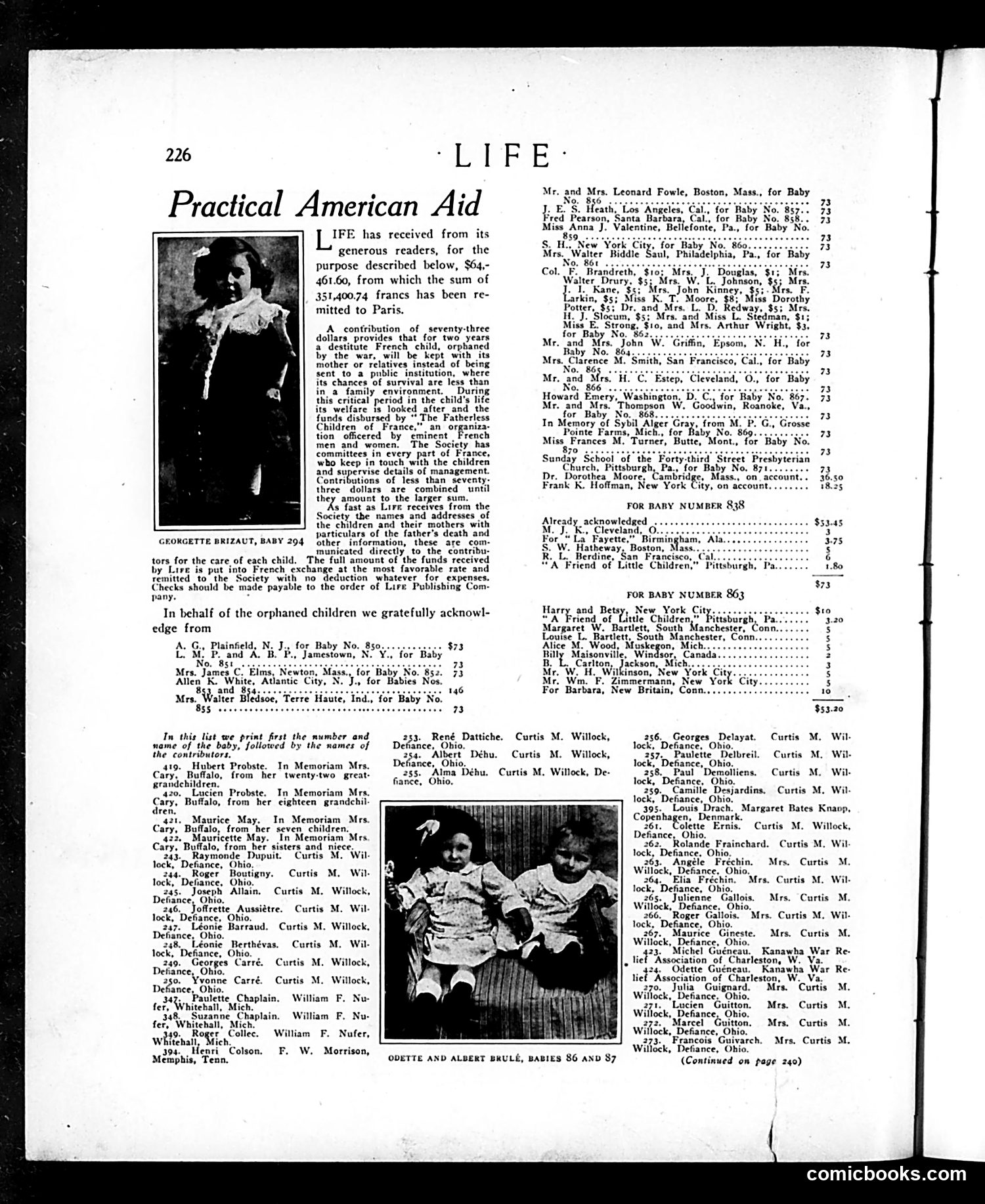
This page documents **"Practical American Aid,"** a charitable fundraising campaign by Life magazine to support French war orphans after World War I. **The Content:** Two photographs show individual orphaned children (Georgette Brizaut, age 294, and Dorete and Albert Brulé, ages 86 and 87) being sponsored through the "Fatherless Children of France" organization. The accompanying text explains that $73 donations support a child's care within a family for two years—considered more humane than institutional placement. **The Purpose:** The bulk of the page lists donors' names and amounts contributed, creating public recognition for contributors while demonstrating widespread American charitable engagement with European war relief. This reflects post-WWI American philanthropy toward devastated European nations. **Context for Modern Readers:** This represents early 20th-century American humanitarian aid and media-driven fundraising, showing how magazines mobilized readers for international relief causes before government aid programs existed.
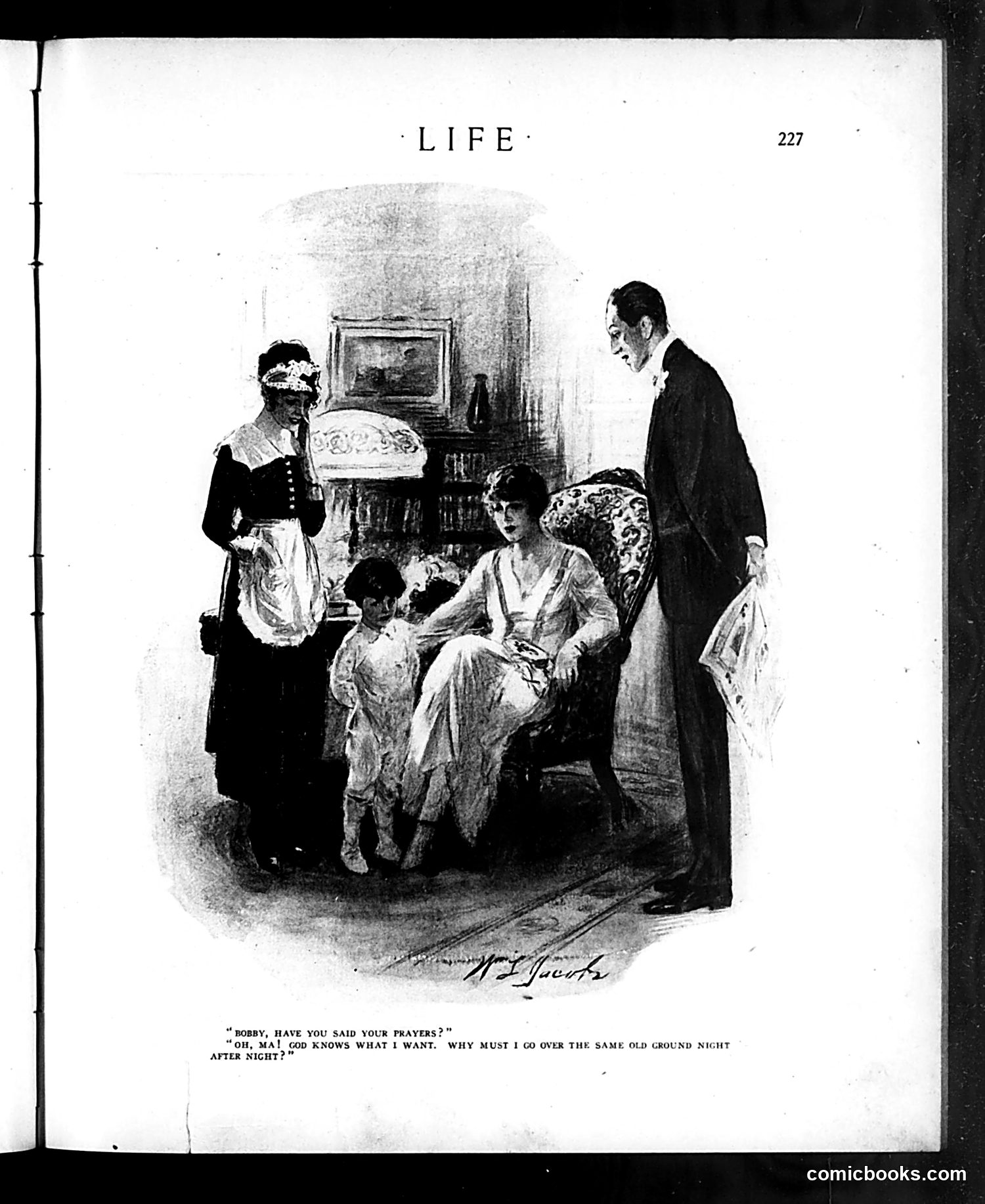
This domestic satire depicts a bedtime scene where a mother asks her young son if he's said his prayers. The boy's exasperated response—claiming God already knows his wants, so nightly repetition is pointless—mocks ritualistic religiosity without genuine devotion. The cartoon satirizes childhood resistance to rote religious practice and, more broadly, critiques mechanical prayer as ineffectual performance rather than sincere faith. It suggests that demanding children repeat identical prayers each night is tedious and logically absurd from a child's perspective. The illustration style and format indicate this appeared in *Life* magazine, which was known for genteel domestic humor targeting middle-class American readers. The satire takes a light, sympathetic tone toward the boy's rationalism while gently mocking parental insistence on traditional observance.
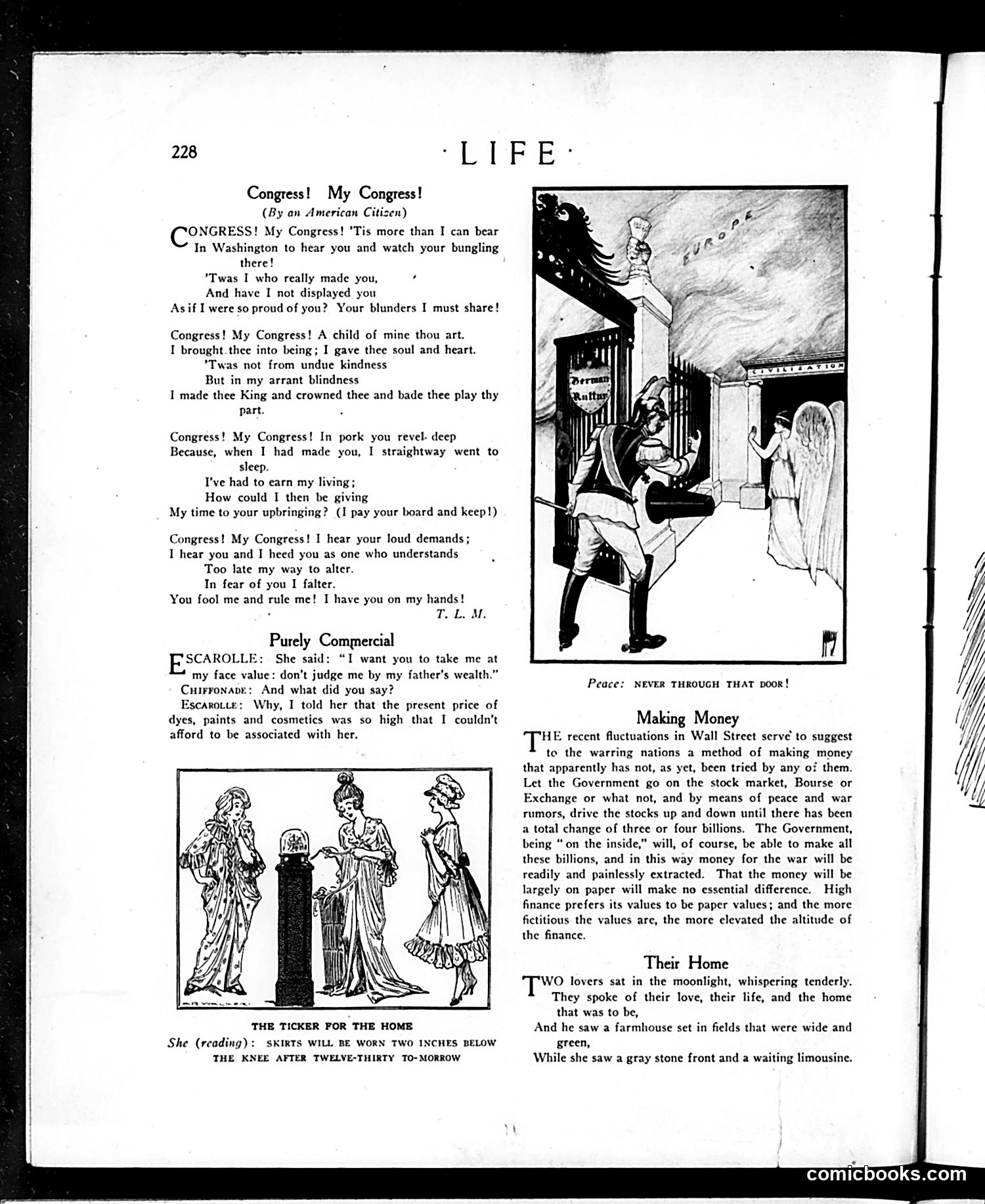
**"Congress! My Congress!"** is a bitter complaint poem personifying America as an angry parent to Congress. The citizen-speaker claims to have created Congress through voting, giving it "soul and heart," yet Congress squanders resources on "pork" (wasteful spending) while the parent labors to support it financially. The satire accuses Congress of incompetence and of ruling over rather than serving the people—"You fool me and rule me!" **"Purely Commercial"** mocks superficial courtship: a woman asks not to be judged by her father's wealth, but the man refuses her because cosmetics and dyes are expensive—reducing her to her appearance. **"The Ticker for the Home"** jokes about women's fashion reporting appearing in financial sections. **"Making Money"** sarcastically suggests warring nations profit from stock manipulation via peace/war rumors—satirizing financial speculation during wartime. **"Their Home"** contrasts romantic ideals: he envisions a modest farmhouse; she envisions wealth (stone mansion, waiting car)—a dig at materialism in relationships. The page reflects early-20th-century American anxieties about government waste, financial manipulation, and materialism.
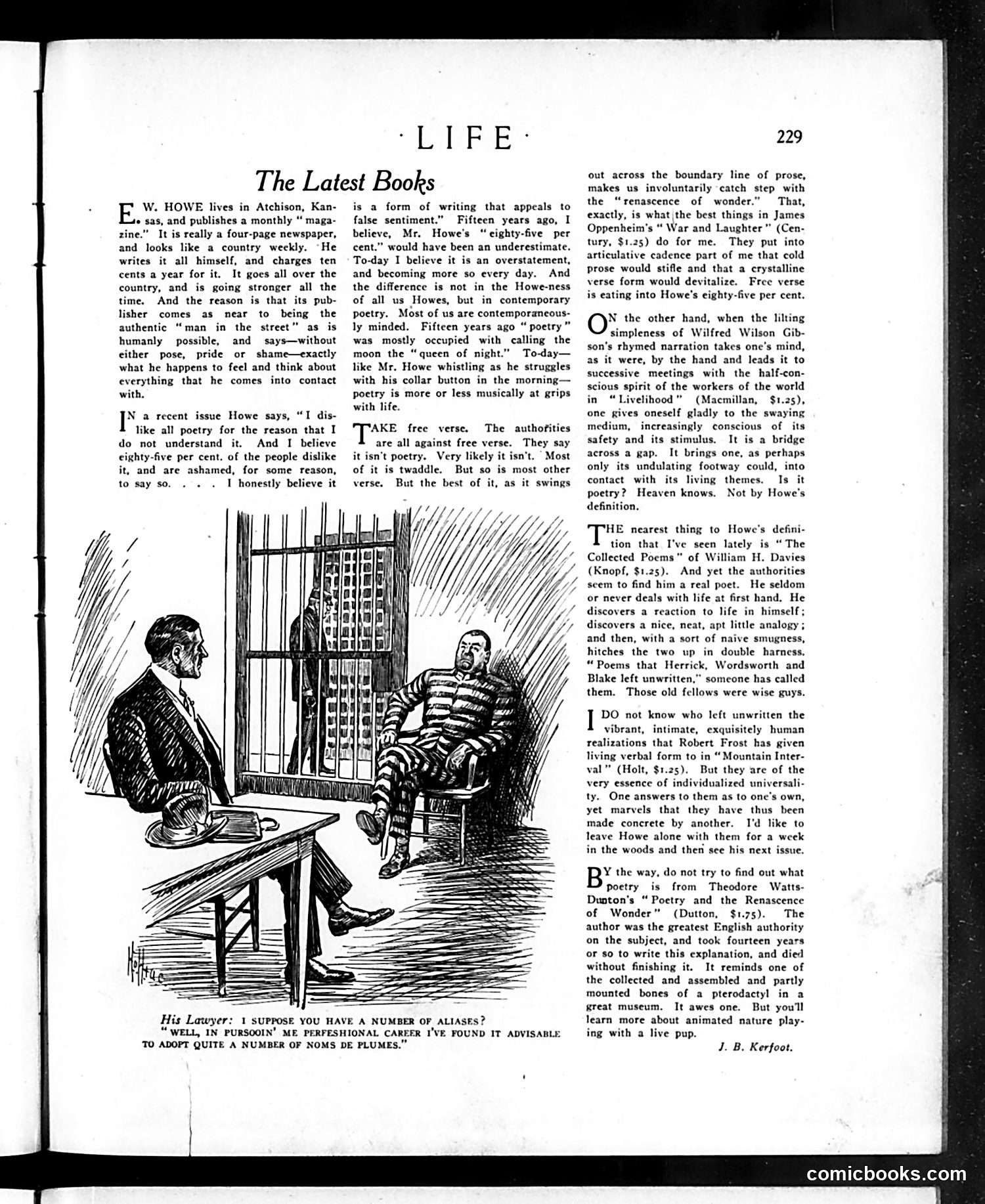
This page reviews contemporary poetry and modern literature circa 1916. The cartoon depicts a lawyer claiming to have adopted "a number of noms de plumes" in his professional career—a joke about using aliases, likely satirizing lawyers' reputations for deception or duplicity. The main text discusses E.W. Howe's complaint that 85% of people dislike poetry because they don't understand it. The critic argues this percentage is now *decreasing* because modern poetry has shifted from sentimental conventions (calling the moon the "queen of night") to engaging with real life experiences. The piece praises contemporary poets like Robert Frost and Wilfred Gibson for their accessible, vivid language, while gently mocking William H. Davies for derivative work ("poems that Herrick, Wordsworth and Blake left unwritten"). The satire targets outdated poetic conventions and defends modernist poetry's turn toward authenticity and lived experience.
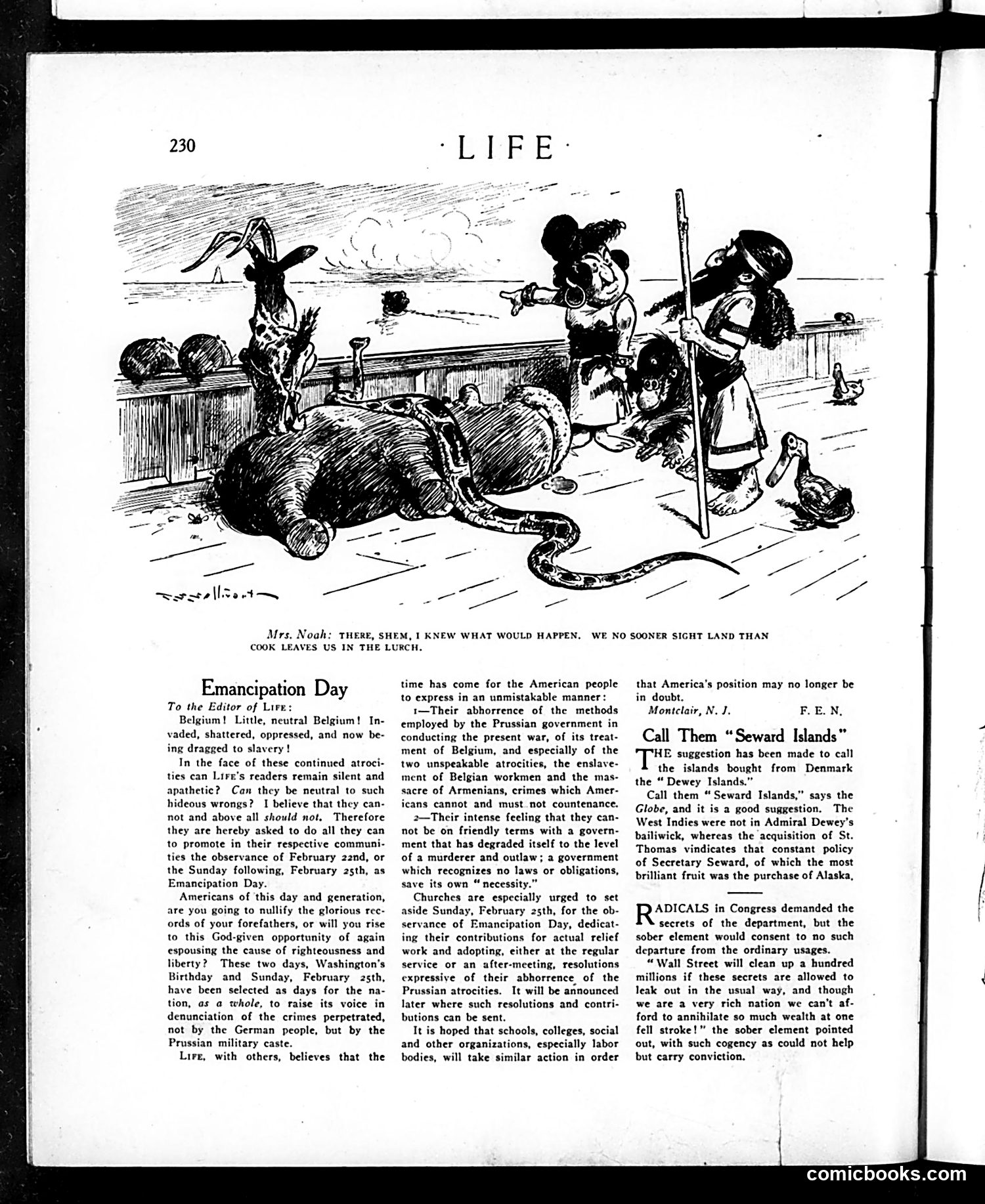
## The Cartoon The illustration depicts Mrs. Noah (wife of the biblical Noah) complaining that their cook has abandoned them upon reaching land after the flood. This is a visual pun on "Emancipation Day"—the cook, likely represented as an enslaved or servant figure, has seized freedom upon arrival. ## The Context This page addresses World War I atrocities. The editorial calls for Americans to observe "Emancipation Day" (February 25th, near Washington's Birthday) to protest Prussian military crimes: the enslavement of Belgian workers and the Armenian massacre. The cartoon sardonically suggests that even Noah's servant understood emancipation—a pointed comment on Germany's moral degradation and America's duty to denounce it. The secondary articles discuss naming newly-purchased Virgin Islands (advocating "Seward Islands" after Secretary Seward's Alaska purchase) and Congressional debate over state department transparency. The satire works by contrasting Noah's domestic inconvenience with the massive human suffering occurring in Europe, suggesting American indifference is absurd.
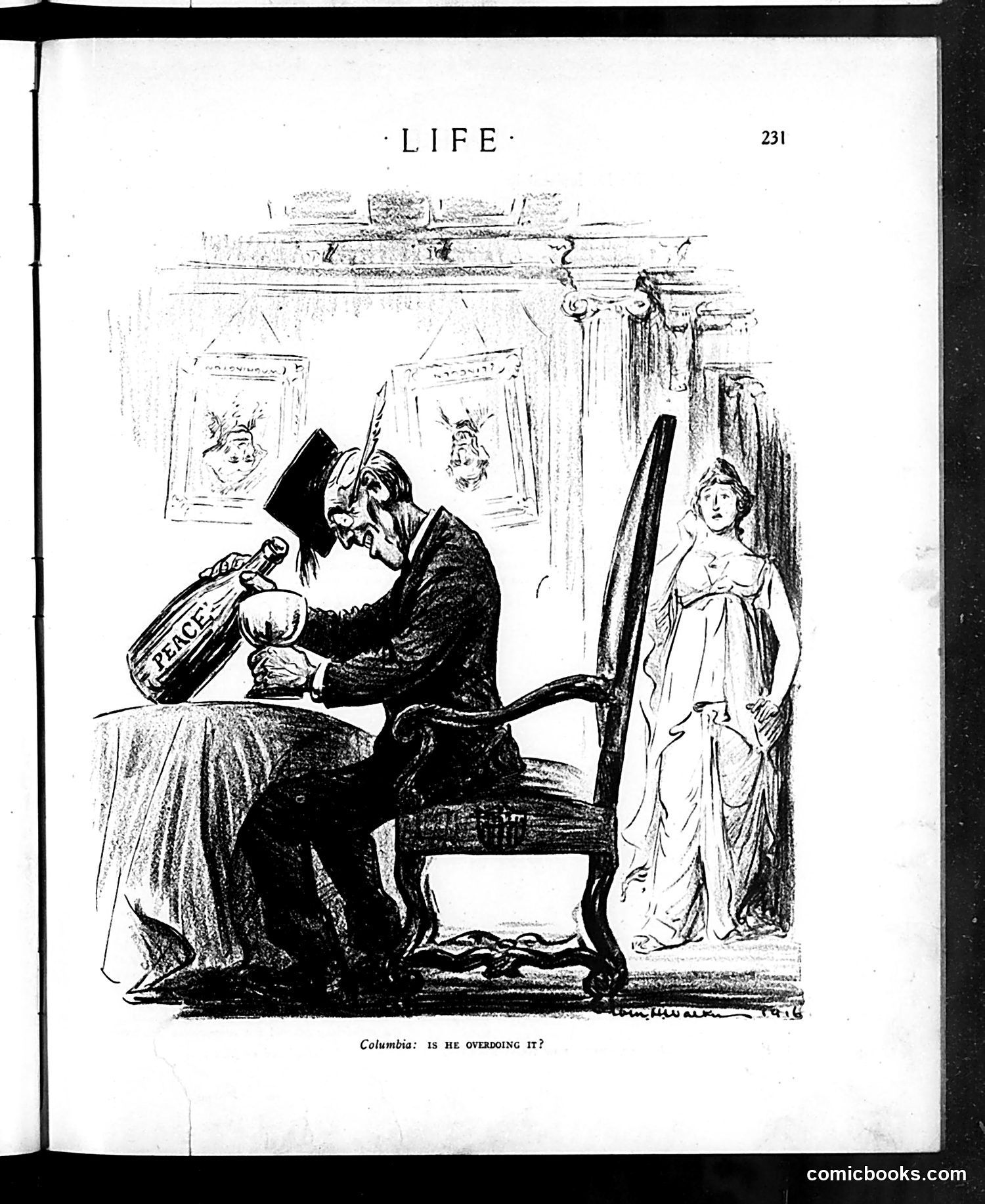
This political cartoon depicts a demonic or sinister figure (labeled as representing excess or overindulgence) seated at a table with a bottle labeled "PEACE," appearing to consume or abuse it. Columbia, the female allegorical figure of the United States (shown standing on the right in classical dress), observes the scene with concern. The satire suggests anxiety about how peace is being handled or exploited—whether through excessive celebration, misuse, or dangerous complacency following a conflict. The question in the caption implies commentary on whether America is taking peace too far, becoming reckless or negligent in its pursuit or enjoyment of peaceful conditions. The dark, grotesque figure contrasts sharply with Columbia's dignified presentation, emphasizing the threat posed by excess or mismanagement.
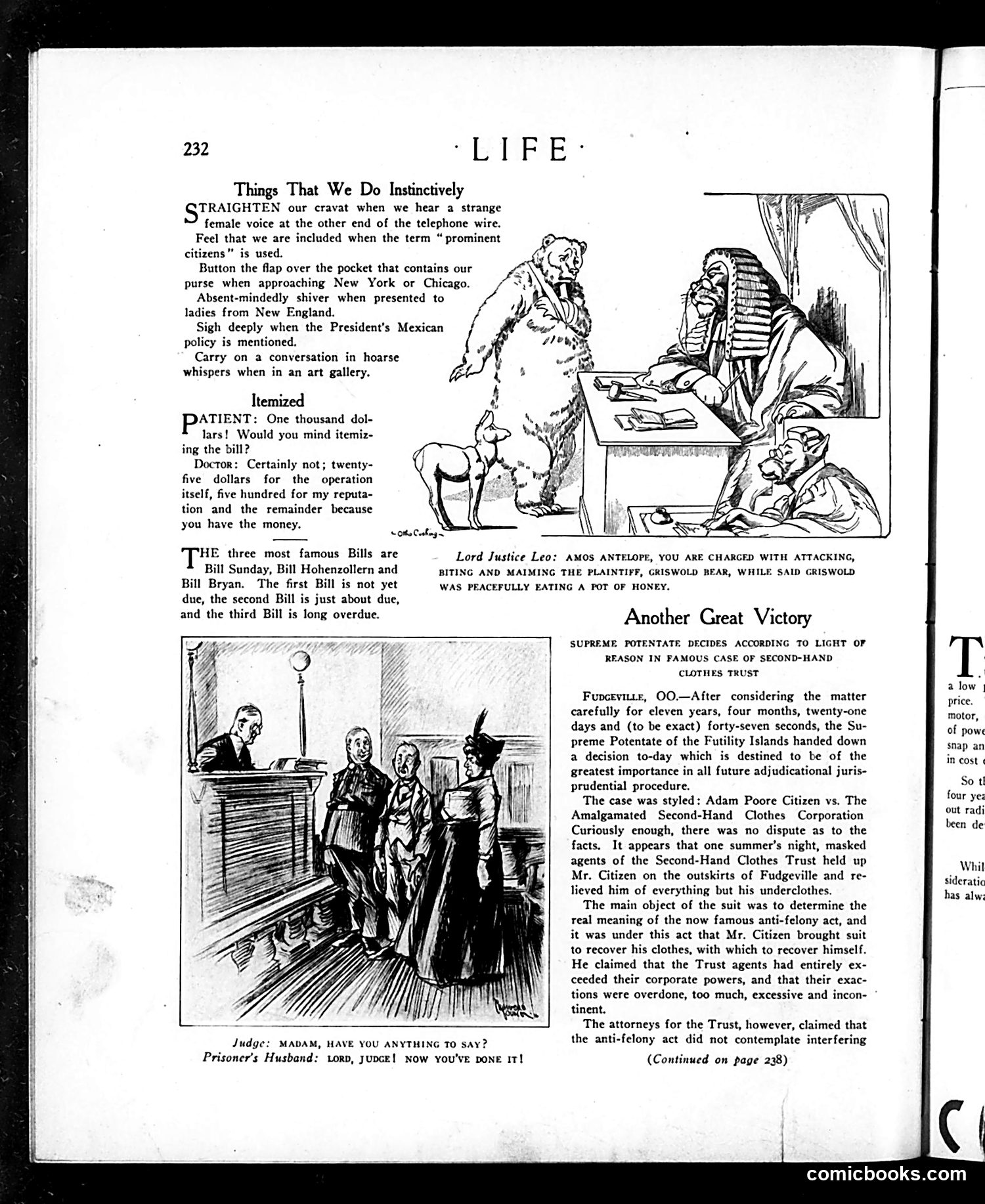
This page from *Life* magazine contains humorous social commentary and satirical cartoons: **"Things We Do Instinctively"** mocks middle-class American behaviors—straightening ties for women's voices, clutching wallets near big cities, whispering in art galleries. It satirizes social pretension and anxiety. **The Doctor Joke** lampoons medical billing: a surgeon itemizes costs as $25 for surgery, $500 for reputation, and the remainder because the patient can afford it—critiquing how doctors exploit wealthy patients. **"The Three Famous Bills"** likely references Bill Sunday (evangelist), Bill Hohenzollern (German Kaiser Wilhelm II), and Bill Bryan (William Jennings Bryan, politician)—the wordplay turning names into debts ("due," "overdue"). **The Animal Court Cartoon** depicts an antelope (Amos) accused of attacking a bear (Griswold) while eating honey—an absurdist parody of legal proceedings, mocking how courts handle trivial disputes with elaborate formality. **"Another Great Victory"** satirizes slow, incompetent judicial systems through a fictional case where the "Supreme Potentate" takes eleven years to decide a simple theft case with undisputed facts.
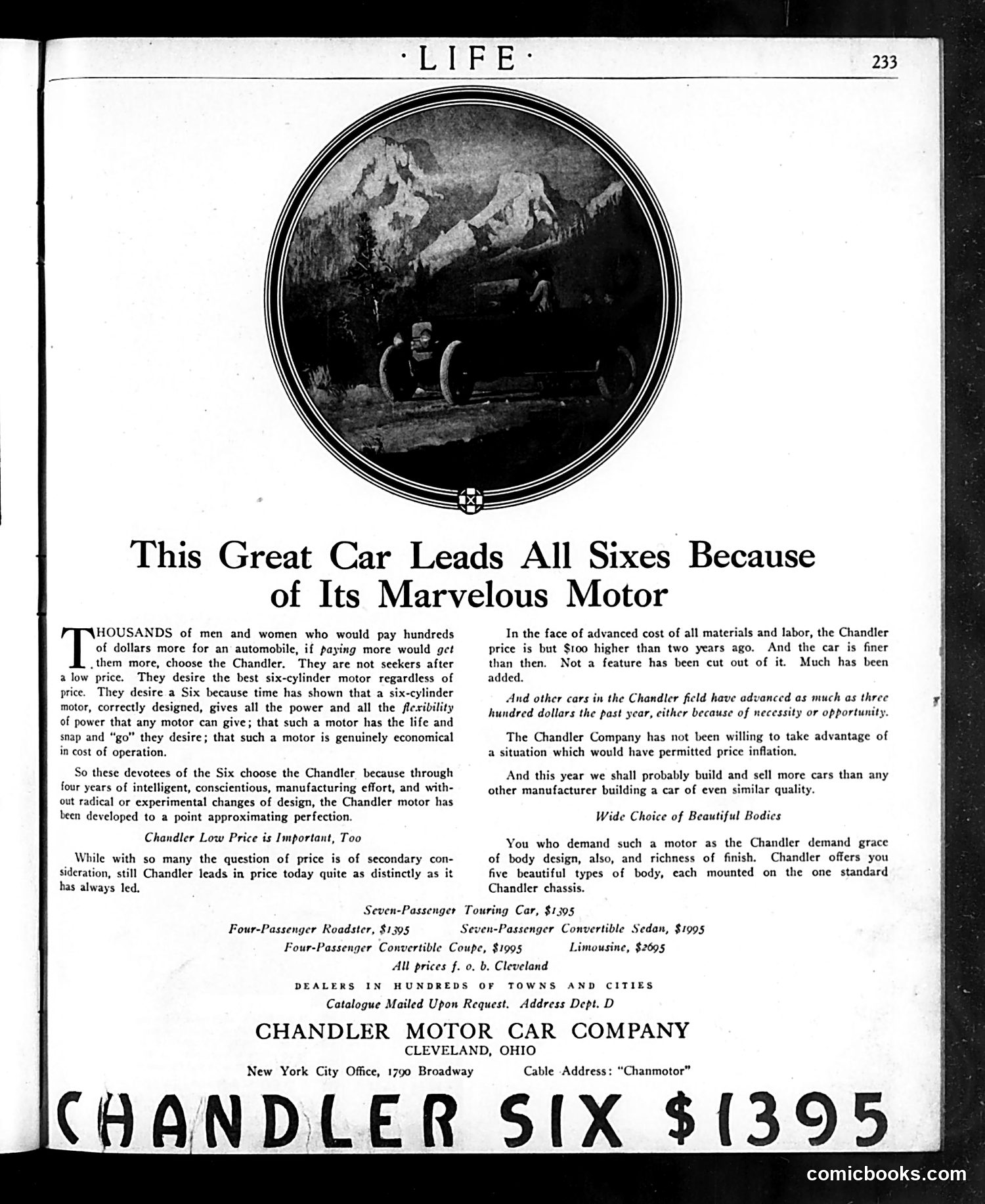
This is **not a cartoon or satire**—it's a straightforward automobile advertisement for the Chandler Motor Car Company, published in *Life* magazine (page 233). The circular image shows a vintage automobile in a mountainous landscape, illustrating the car's capability and appeal. The ad emphasizes the Chandler Six's superior six-cylinder motor, claiming it delivers power, flexibility, and economy. Key selling points include: the motor's four years of development toward "perfection"; the car's price stability (only $100 higher than two years prior, while competitors raised prices up to $300); and the availability of five body styles ranging from $1,395 to $2,695. The ad targets affluent buyers willing to pay premium prices for quality rather than seeking bargains. It positions Chandler as the ethical choice—refusing to exploit wartime material cost inflation, unlike competitors. The Cleveland-based company advertises nationwide dealer availability and a New York office.
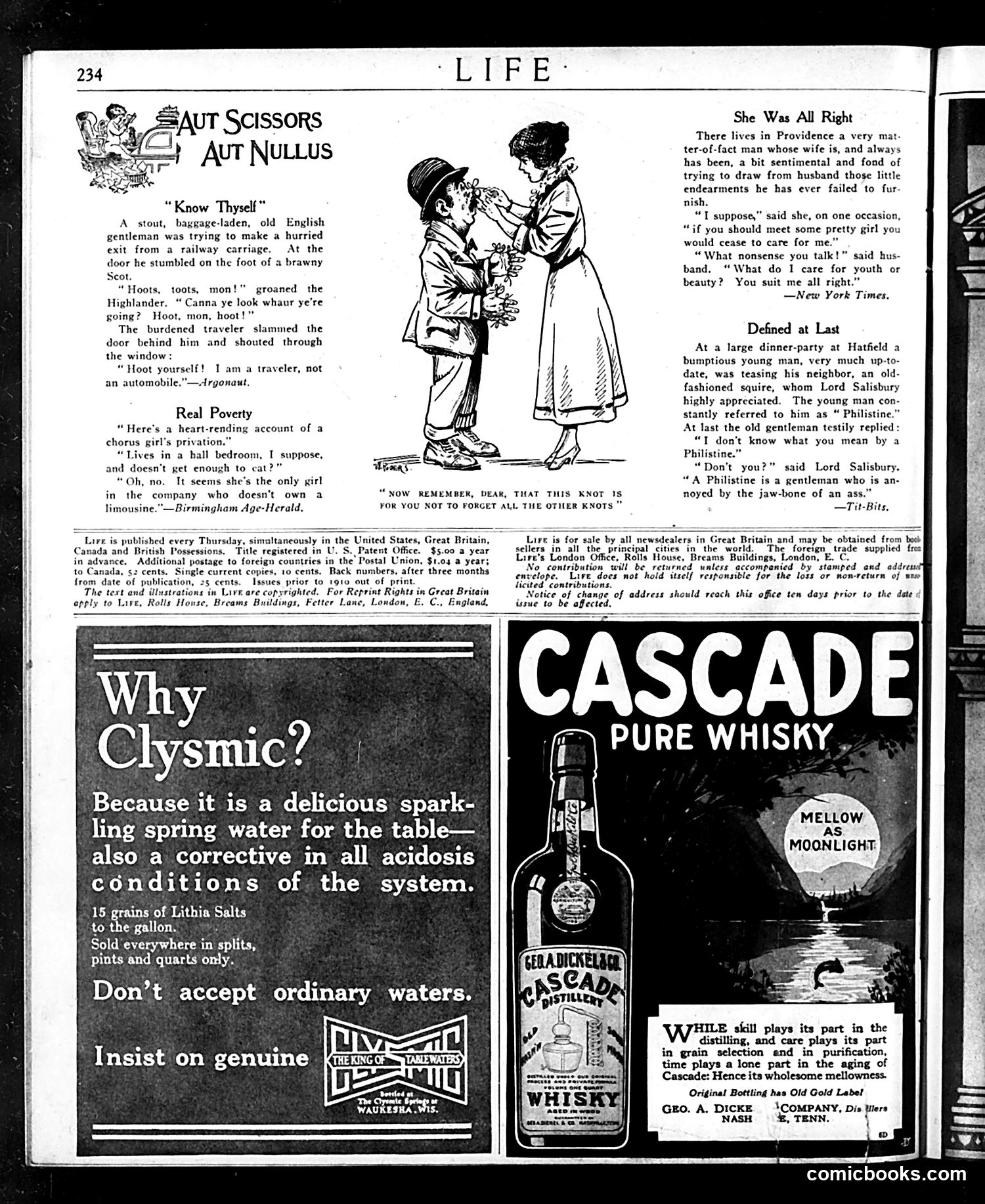
This page contains three brief humorous anecdotes typical of early 20th-century Life magazine, plus period advertisements. **The cartoons/jokes:** 1. **"Know Thyself"**: A stout English gentleman collides with a Scottish Highlander at a train door. When the Scot complains about the man's carelessness, the Englishman retorts that he's "a traveler, not an automobile"—mocking the man for treating him like a vehicle rather than a person. 2. **"Real Poverty"**: Satirizes wealthy chorus girls' expectations, noting one girl's "privation" is simply that she's the only cast member without a limousine. 3. **"Defined at Last"**: A young man repeatedly calls an elderly squire a "Philistine." Lord Salisbury's punchline: a Philistine is simply "a gentleman who is annoyed by the jaw-bone of an ass"—insulting the young man's pretension. The page is primarily **advertising-heavy**, featuring Clysmic spring water and Cascade whisky. The humor reflects period class consciousness and social satire rather than political commentary.
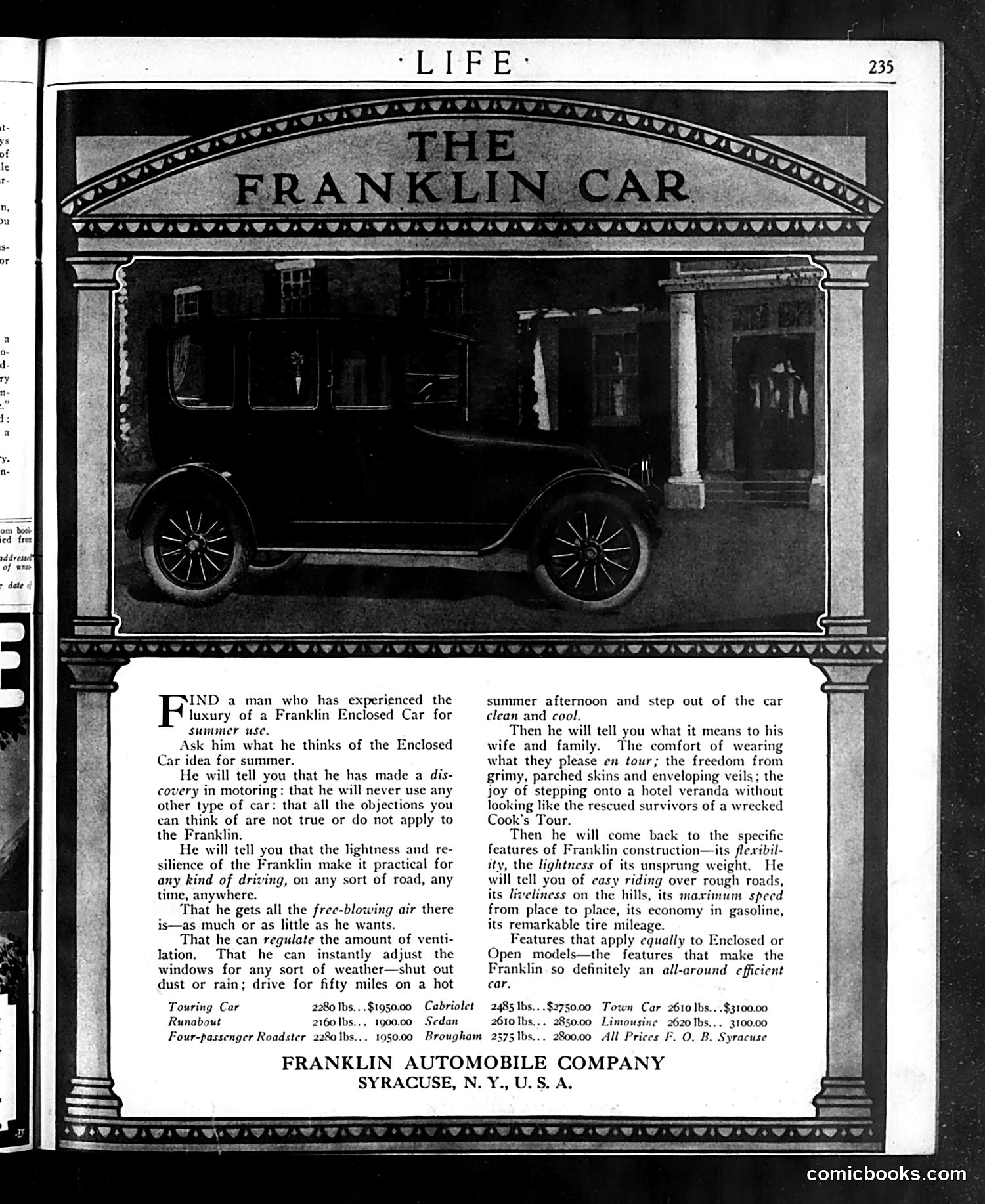
This is **not a cartoon or satire** — it's a straightforward automobile advertisement for the Franklin automobile company, published in *Life* magazine (page 235). The page features a side-view illustration of a Franklin Enclosed Car and promotional text arguing for its superiority as a summer vehicle. The advertisement emphasizes practical benefits: ventilation control, protection from dust and rain, comfort for passengers (particularly women, who wouldn't arrive "like rescued survivors"), and engineering features like lightness and fuel economy. The text uses a rhetorical device—imagining testimony from satisfied owners—to build credibility. Various Franklin models are listed with prices (ranging from $1,900-$3,100) at the bottom. This represents early 20th-century automotive marketing, when enclosed cars were still relatively novel and manufacturers needed to convince buyers of their advantages over open designs. The appeal to family comfort and (implicitly) women's interests in maintaining appearance during travel reflects period attitudes about automobiles' social use.
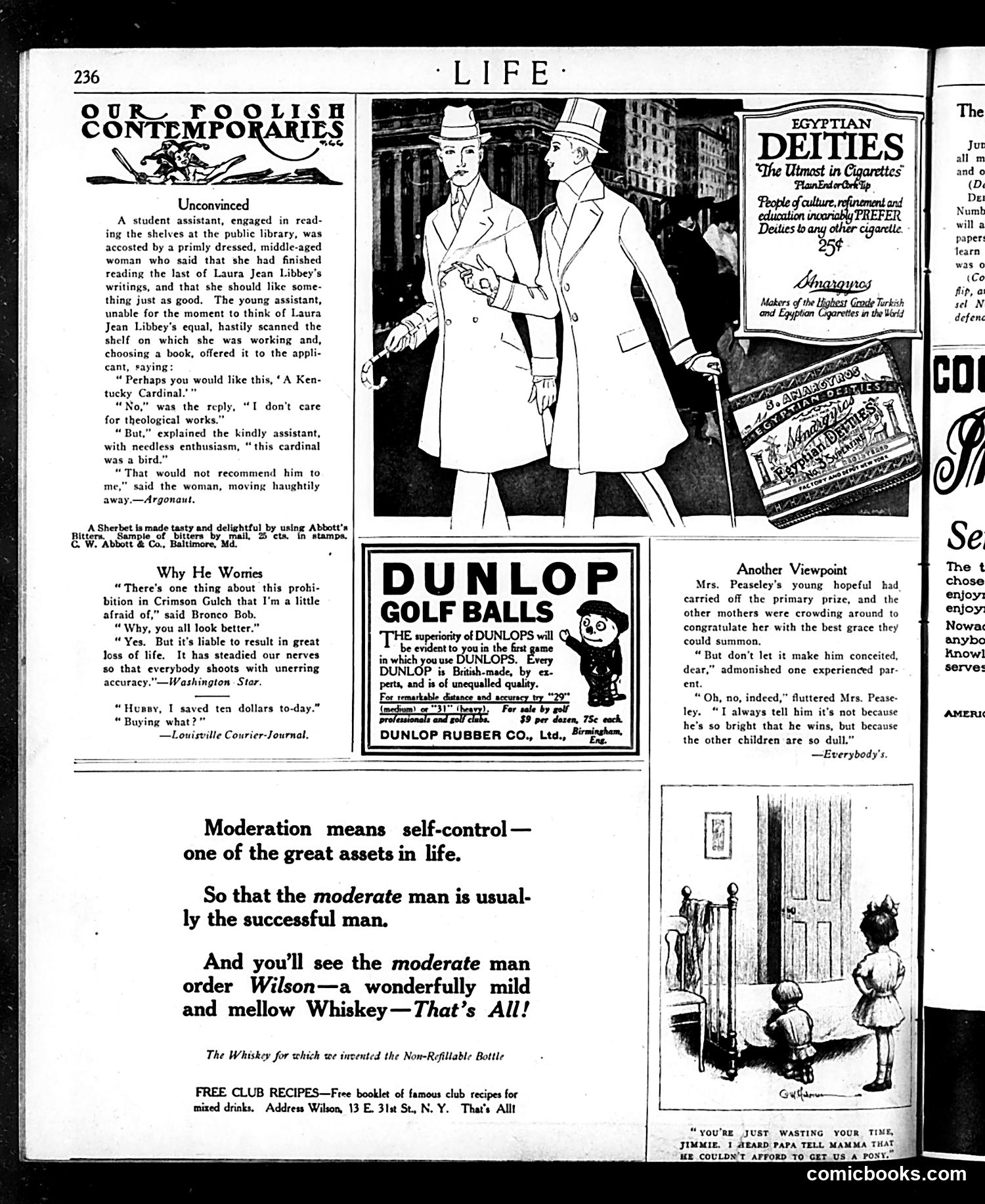
This page contains several satirical humor pieces typical of early 20th-century Life magazine: **"Unconvinced"** mocks a library patron's literary pretensions. A woman seeking books "just as good" as Laura Jean Libbey (a popular romance novelist) rejects "A Kentucky Cardinal" because she mistakes it for theology about a religious figure, then dismisses it further upon learning the "cardinal" is a bird. The joke satirizes her superficial reading tastes and snobbish assumptions. **"Why He Worries"** jokes about Prohibition's unintended consequences in a frontier town: sobriety has steadied people's aim with guns, making shootouts more lethal—darkly comic commentary on frontier violence. **"Another Viewpoint"** satirizes maternal vanity. A prize-winning child's mother reassures others her son won't become conceited, then reveals she actually tells him he wins only because other children are "so dull"—exposing her competitive smugness. The advertisements (Egyptian Deities cigarettes, Dunlop golf balls, Wilson whiskey) are period typical.
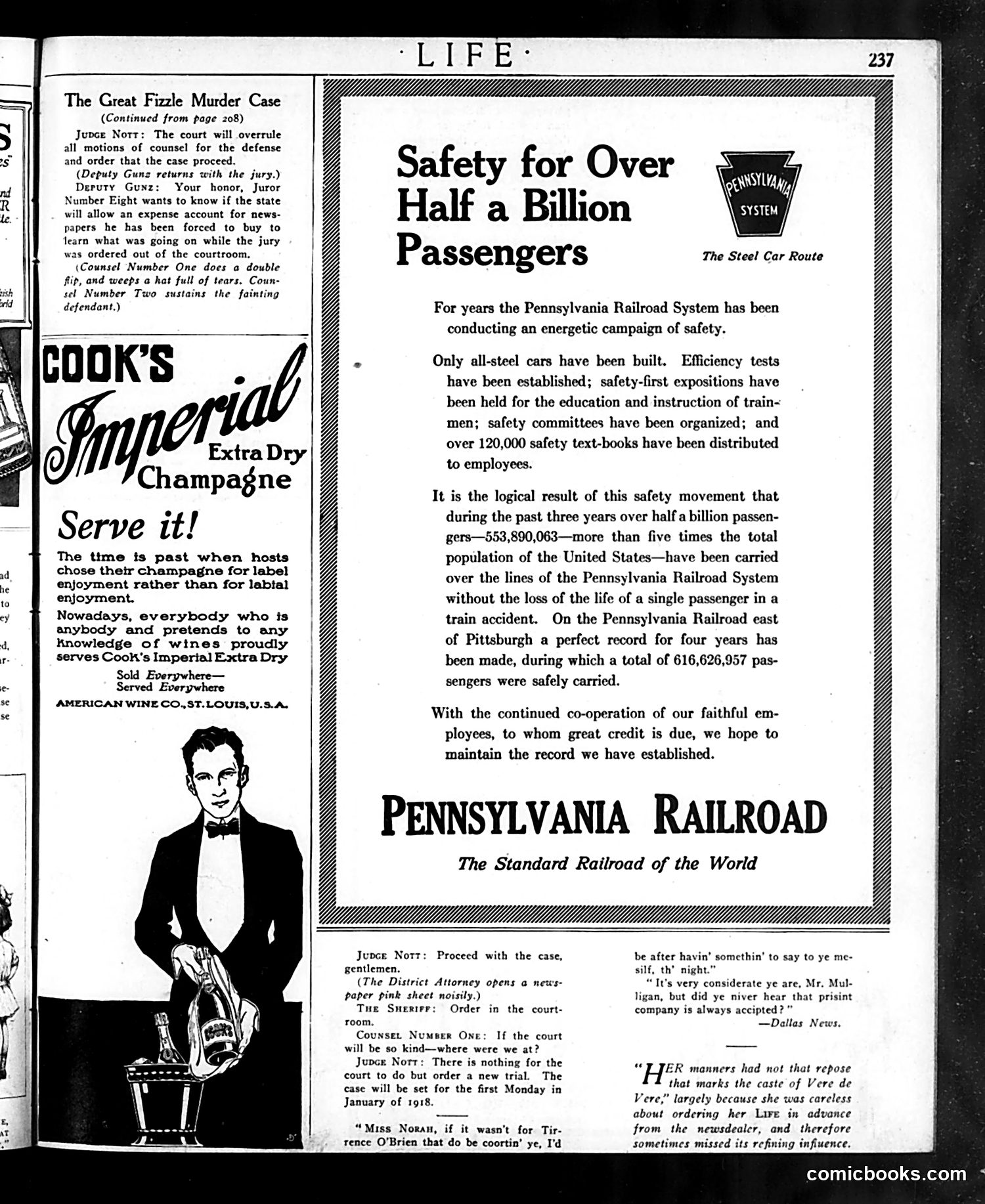
This page contains three distinct elements: **"The Great Fizzle Murder Case"** (top left): A satirical courtroom drama mocking legal incompetence. The humor centers on a juror demanding newspaper expense reimbursement because the court excluded jurors from the proceedings—forcing him to buy papers to learn what happened during his own trial. The joke targets judicial absurdity and the defendant's hysteria. **Cook's Imperial Champagne Advertisement** (left): A period advertisement playing on wine snobbery, suggesting sophisticated people now judge champagne by taste ("labial enjoyment") rather than label prestige. **Pennsylvania Railroad Safety Advertisement** (center/right): A corporate advertisement boasting 553 million passengers carried without fatalities, emphasizing modern steel cars and safety protocols. This represents typical early-20th-century corporate PR. **Bottom section**: Two brief humorous items—Irish dialect dialogue about courtship propriety, and a quip about a woman named "Vere de Vere" whose refined manners suffered because she didn't subscribe to *Life* magazine in advance, missing its "refining influence." This is self-promotional humor about the magazine itself.
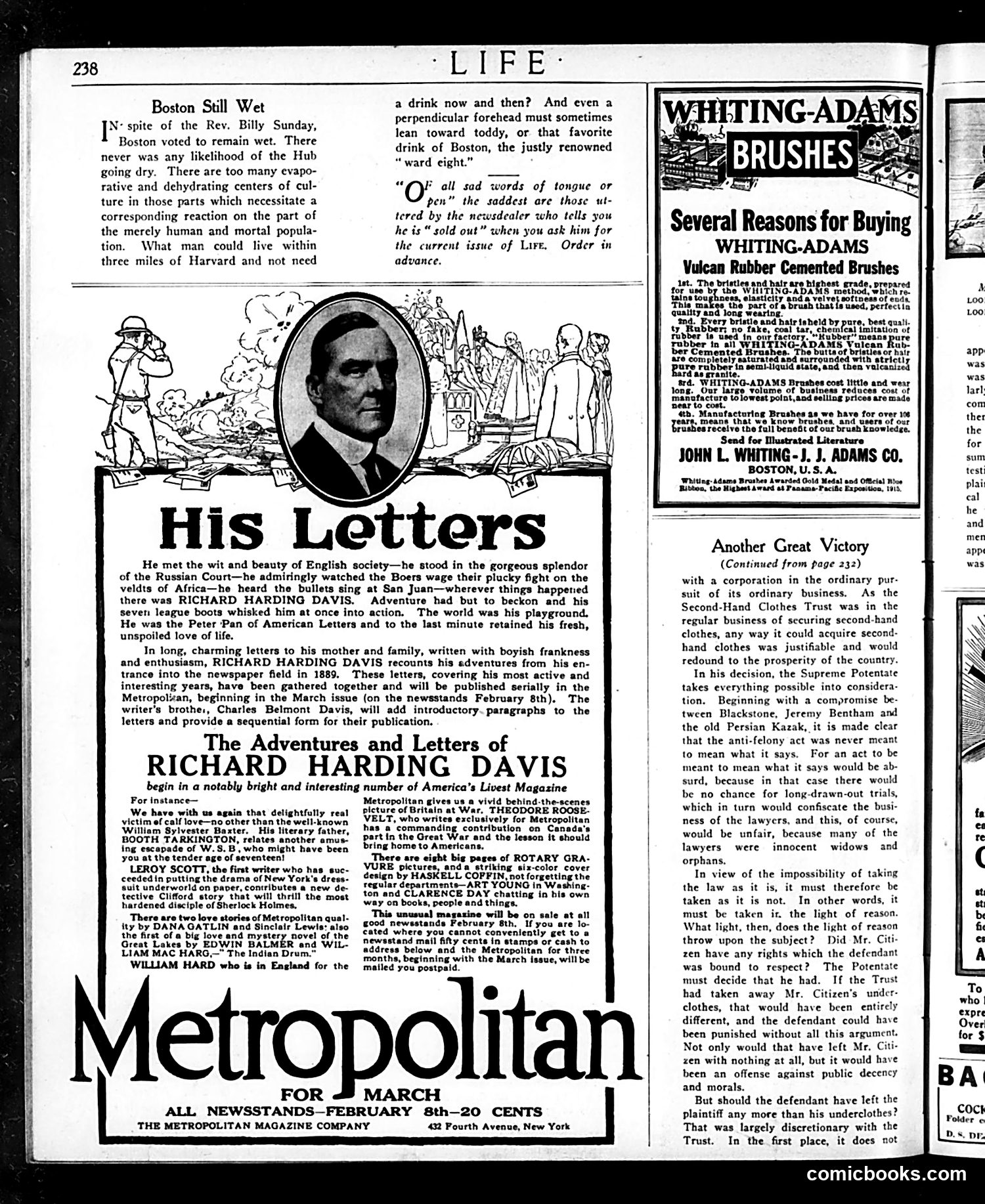
This page contains satirical commentary on Boston's prohibition vote alongside advertisements and magazine promotion. **"Boston Still Wet"** is a brief political satire about Boston's recent vote to remain a "wet" city (allowing alcohol sales) despite temperance reformer Rev. Billy Sunday's campaign. The joke mocks Boston's intellectual culture—specifically Harvard University—suggesting that cultured Bostonians need alcohol to cope with their surroundings. The reference to "ward eight" (a Boston cocktail) reinforces this. The satire implies that prohibition cannot succeed in a city of educated drinkers. The bulk of the page advertises the *Metropolitan* magazine's serialization of "The Adventures and Letters of Richard Harding Davis," a famous war correspondent and adventure writer. The text promotes upcoming March issue content featuring celebrity writers like Theodore Roosevelt and Booth Tarkington. Additional advertisements promote Whiting-Adams brushes. This is primarily an **advertising and promotional page** rather than a satirical commentary piece.
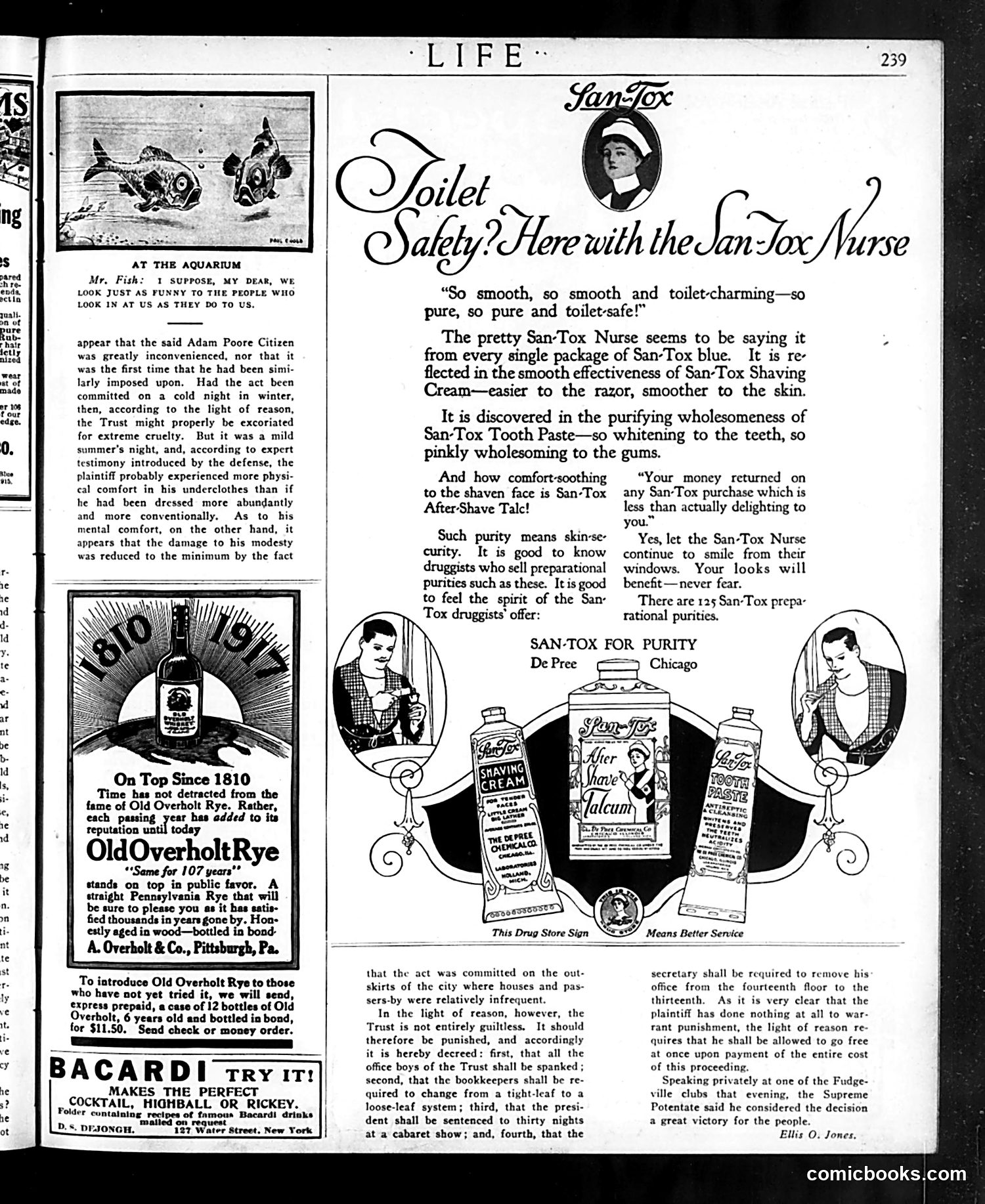
This page contains mostly **advertisements** interspersed with satirical content typical of Life magazine's format. The main cartoon ("At the Aquarium") is a brief visual joke: fish observing humans observing them, suggesting mutual bewilderment—a gentle commentary on perspective and reciprocal judgment. The dominant feature is a **mock court decision** satirizing corporate negligence. It describes a "Trust" punished for stripping a citizen on a summer night. The humor lies in the absurd punishments assigned: office boys spanked, bookkeepers forced to use loose-leaf systems, and the president sentenced to thirty nights at cabaret shows—trivial inconveniences disguised as serious penalties. The plaintiff goes free, ironically. This appears to mock corporate immunity and toothless legal accountability during the Progressive Era's trust-busting debates. The advertisements (San-Tox toiletries, Old Overholt Rye whiskey, Bacardi cocktails) are period standard.
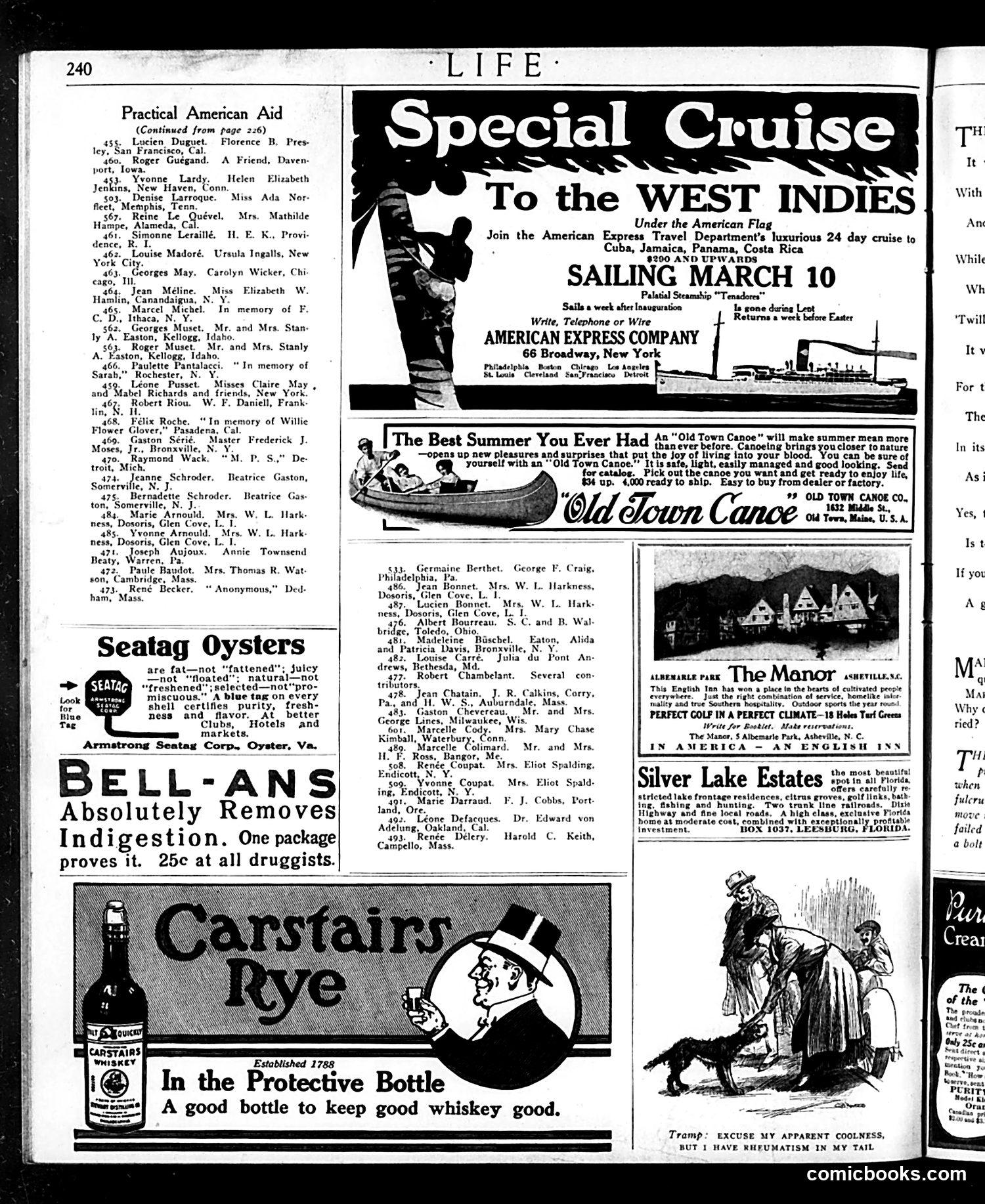
This page is primarily **advertising and listings**, not political satire. The main content includes: **Advertisements:** - A West Indies cruise by American Express (sailing March 10) - Old Town Canoe company - Bell-Ans indigestion remedy - Carstairs Rye whisky - The Manor resort in Asheville, NC - Silver Lake Estates in Florida **The single cartoon** appears at bottom right: a tramp figure asking for money, captioned "EXCUSE MY APPARENT COOLNESS, BUT I HAVE RHEUMATISM IN MY TAIL." This is a **mild joke about begging**—the tramp's excuse for his shabby demeanor invokes an absurd physical complaint (animals having tails), suggesting desperation rather than actual rudeness. The page also contains what appears to be a charitable donations list ("Practical American Aid"), common in Life magazine of this era. **Context for modern readers:** This reflects 1920s-30s American consumer culture and leisure advertising, with the West Indies cruise notably capitalizing on "Under the American Flag" patriotic messaging.
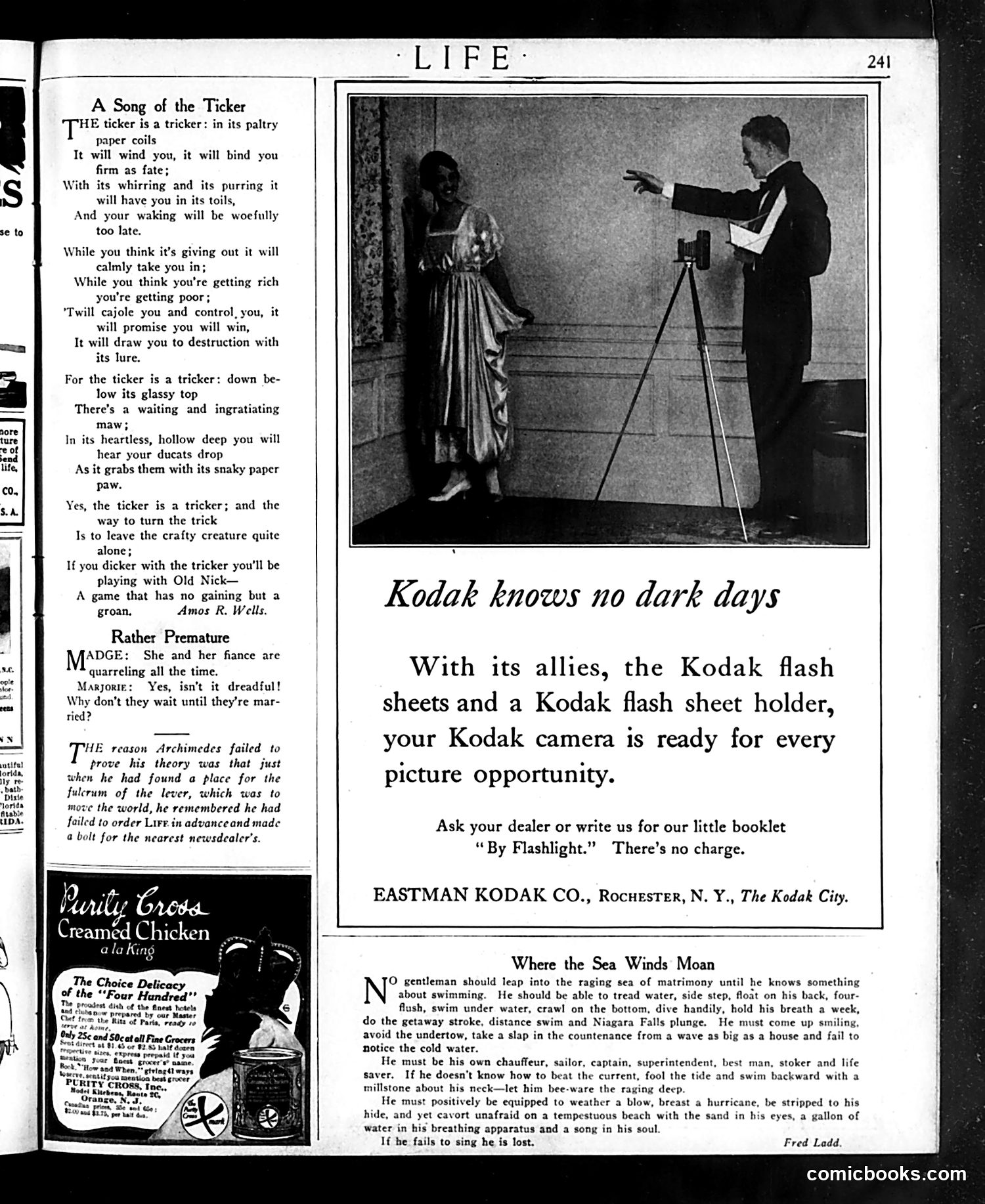
This page contains three satirical pieces on marriage and courtship, plus advertising. **"A Song of the Ticker"** is a cautionary poem warning against stock market speculation. The "ticker" (stock-price telegraph machine) is personified as a deceptive creature that appears generous but actually traps investors, draining their wealth while they believe they're growing rich. The satire warns that playing the market leads only to ruin. **"Rather Premature"** is a brief joke: a woman notes that a couple quarrels constantly before marriage, while her friend says they should "wait until they're married"—implying marital conflict is inevitable and expected. **"Where the Sea Winds Moan"** uses extended swimming metaphors to satirize marriage expectations for men. It humorously exaggerates the impossible skills husbands supposedly need: financial management, emotional resilience, domestic duties, and unwavering cheerfulness despite hardship—ultimately suggesting marriage demands superhuman endurance. The page also includes advertisements for Kodak cameras and Purity brand creamed chicken.
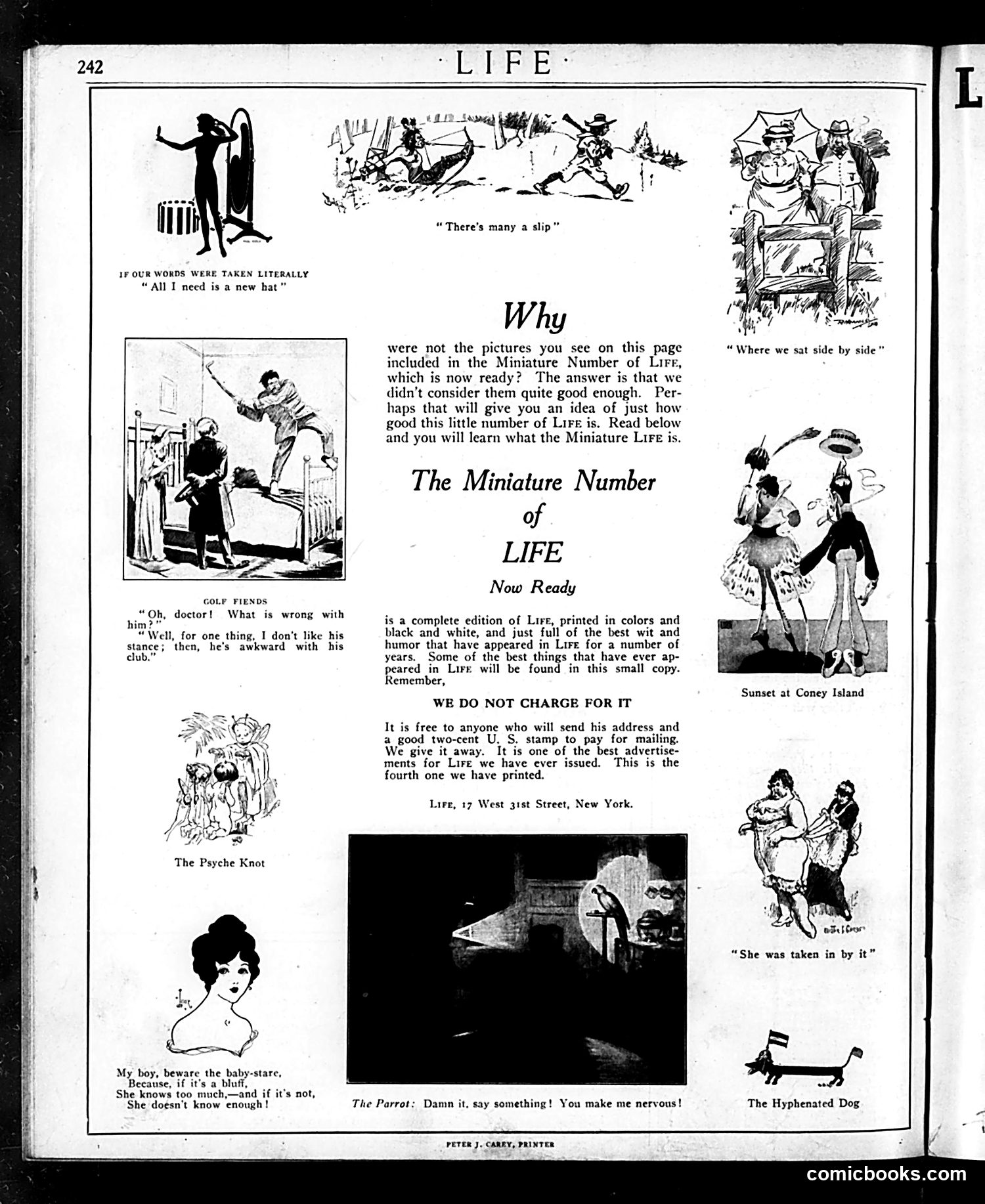
This is primarily a **promotional page** advertising Life's "Miniature Number"—a free, condensed edition of the magazine. The page explains why certain cartoons weren't included in that edition: they weren't considered good enough, which humorously demonstrates the high quality of the full publication. The surrounding illustrations are **sample cartoons** exemplifying Life's humor style: - **"If Our Words Were Taken Literally"**: Jokes about idiomatic expressions interpreted as stated (e.g., "All I need is a new hat" shown literally) - **"Golf Fiends"**: A doctor commenting on a golfer's awkward stance - **Character studies**: "The Psyche Knot," "The Hyphenated Dog," "The Parrot"—brief satirical vignettes about human behavior and romantic/social situations The cartoons mock familiar social types and relationship dynamics through exaggeration and visual puns, typical of early 20th-century American magazine humor. The page functions as both entertainment and advertisement, inviting readers to request the free miniature edition.