
Life, 1917-02-08 · page 12 of 42
Life — February 8, 1917 — page 12: what you’re looking at
What you’re looking at
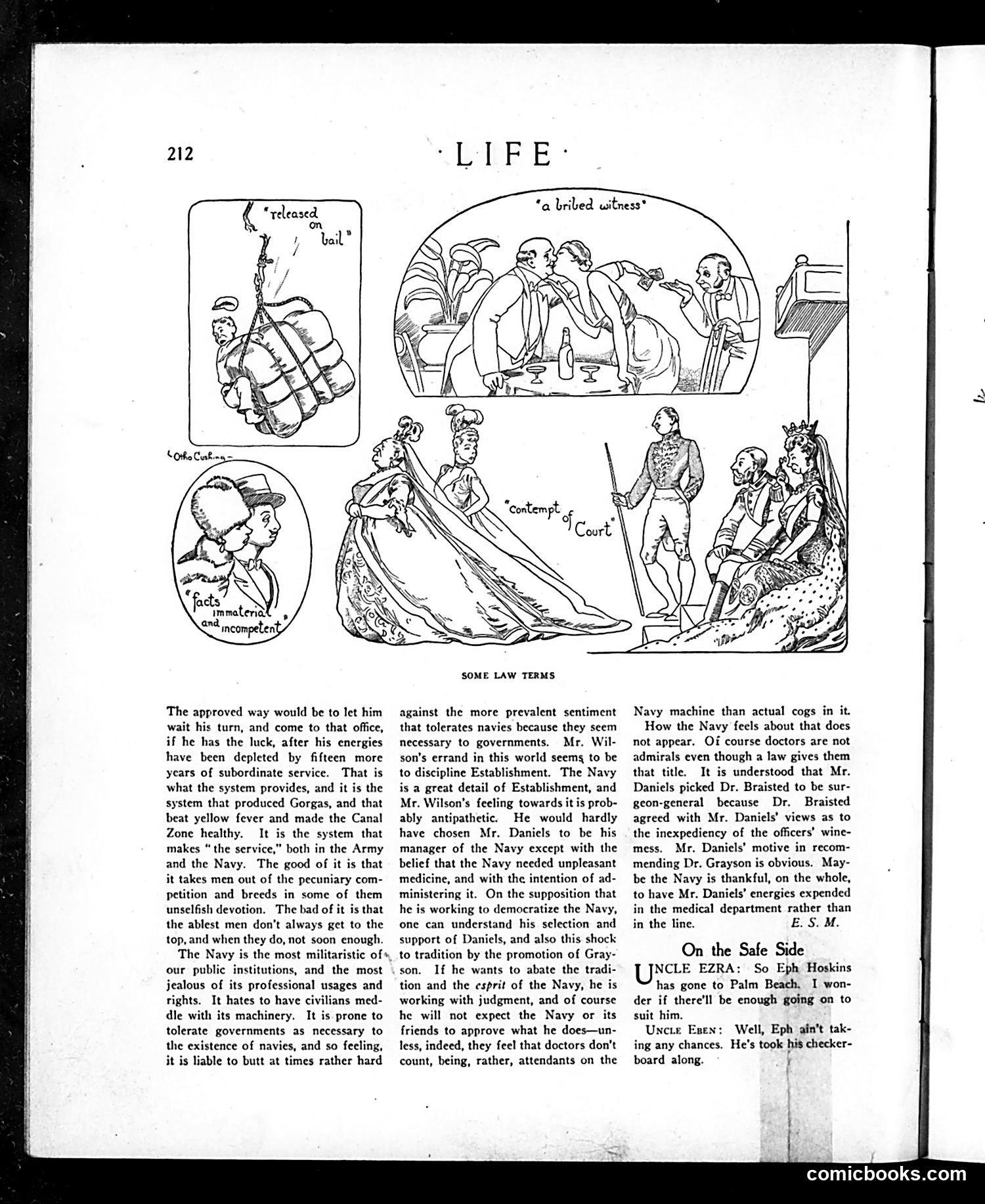
This page satirizes naval bureaucracy and military hierarchy. The cartoon panels labeled "released on bail," "a bribed witness," "Contempt of Court," and "Facts in a muddled and incompetent" use courtroom terminology to mock naval administrative practices. The text discusses Mr. Wilson's (likely Secretary of the Navy Josephus Daniels, based on context) management of the Navy. It criticizes naval officers' resistance to medical innovations and suggests Daniels implemented unpopular reforms. The satire implies the Navy functions like a chaotic legal proceeding rather than an efficient institution. The "Safe Side" dialogue below depicts Uncle Eben and Epi discussing someone named Hoskins going to Palm Beach, likely a contemporary social reference about leisure versus duty during wartime. The overall message critiques Navy leadership incompetence and resistance to modernization.
📄 Transcribed text from this page (OCR, searchable)
Machine-transcribed from the original scan — historical spelling and the odd misread are preserved.
The approved way would be to let him wait his turn, and come to that office, if he has the luck, after his energies have been depleted by fifteen more years of subordinate service. That is what the system provides, and it is the system that produced Gorgas, and that beat yellow fever and made the Canal Zone healthy. It is the system that makes “the service,” both in the Army and the Navy. The good of it is that it takes men out of the pecuniary com- petition and breeds in some of them unselfish devotion. The bad of it is that the ablest men don’t always get to the top, and when they do, not soon enough. The Navy is the most militaristic of» our public institutions, and the most jealous of its professional usages and rights. It hates to have civilians med- dle with its machinery. It is prone to tolerate governments as necessary to the existence of navies, and so feeling, it is liable to butt at times rather hard SOME LAW TERMS against the more prevalent sentiment that tolerates navies because they seem necessary to governments. Mr. Wil- son’s errand in this world seems to be to discipline Establishment. The Navy is a great detail of Establishment, and Mr. Wilson’s feeling towards it is prob- ably antipathetic. He would hardly have chosen Mr. Daniels to be his manager of the Navy except with the belief that the Navy needed unpleasant medicine, and with the intention of ad- ministering it. On the supposition that he is working to democratize the Navy, one can understand his selection and support of Daniels, and also this. shock to tradition by the promotion of Gray- son. If he wants to abate the tradi- tion and the esprit of the Navy, he is working with judgment, and of course he will not expect the Navy or its friends to approve what he does—un- less, indeed, they feel that doctors don’t count, being, rather, attendants on the Navy machine than actual cogs in it. How the Navy feels about that does not appear. Of course doctors are not admirals even though a law gives them that title. It is understood that Mr. Daniels picked Dr. Braisted to be sur- geon-general because Dr. Braisted agreed with Mr. Daniels’ views as to the inexpediency of the officers’ wine- mess. Mr. Daniels’ motive in recom- mending Dr. Grayson is obvious. May- be the Navy is thankful, on the whole, to have Mr. Daniels’ energies expended in the medical department rather than in the line. E.S. M. On the Safe Side NCLE EZRA: So Eph Hoskins has gone to Palm Beach, I won- der if there'll be enough going on to suit him. Uncre Esen: Well, Eph ain't tak- ing any chances. He's took his checker- board along. comicbooks.com