
Life, 1917-02-08 · page 20 of 42
Life — February 8, 1917 — page 20: what you’re looking at
What you’re looking at
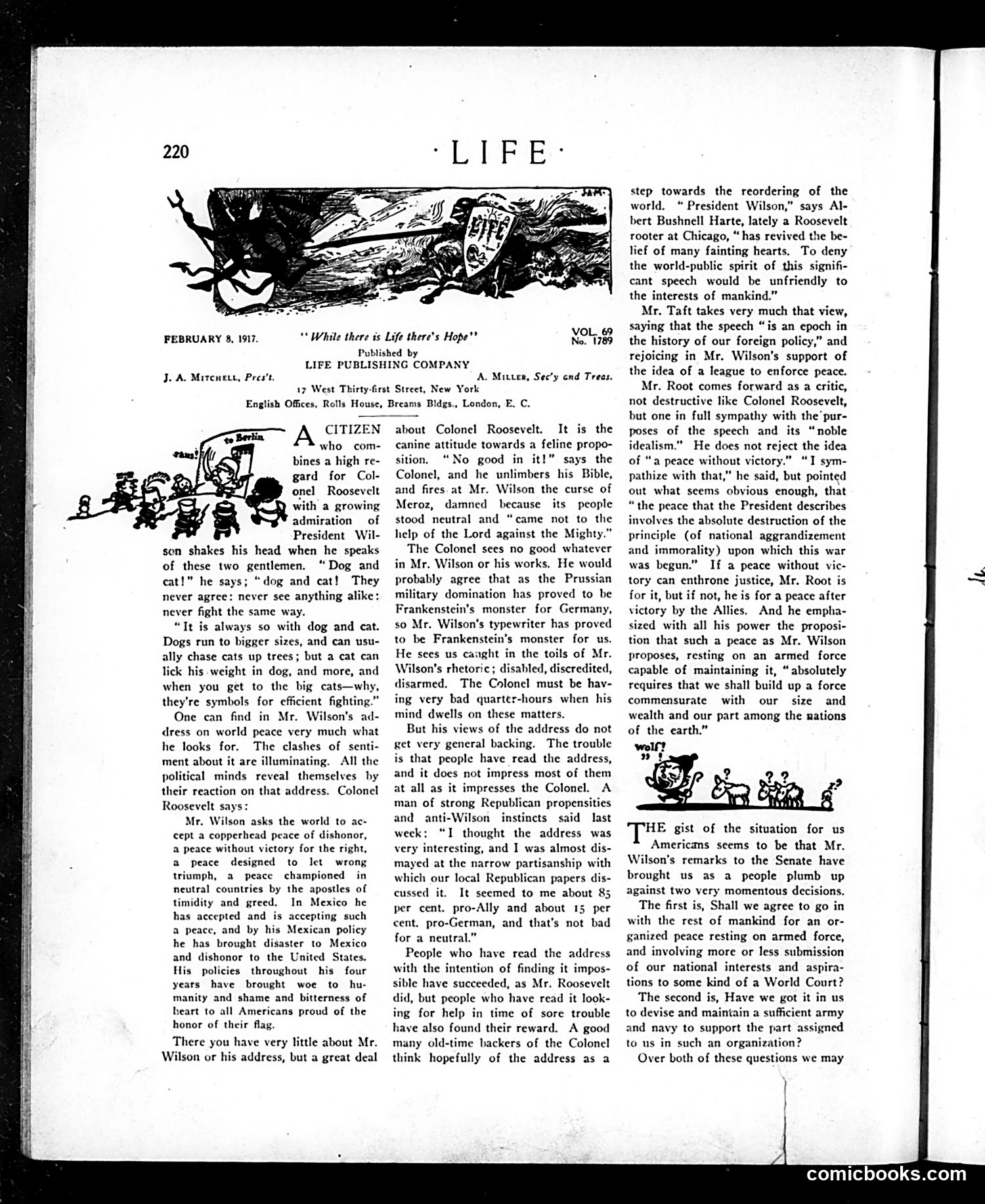
This editorial page analyzes President Wilson's recent peace address, framed through a comparison between **Colonel Theodore Roosevelt** and **President Woodrow Wilson**—depicted as fundamentally opposed figures ("dog and cat"). **The context:** Wilson had delivered a "peace without victory" speech advocating for a negotiated end to World War I. Roosevelt, a vocal interventionist and Wilson's 1916 rival, attacked it harshly as "copperhead" dishonor. **The satire's point:** The author mocks Roosevelt's reflexive partisanship—his reaction reveals nothing about Wilson's actual address, only Roosevelt's character. Meanwhile, non-partisan readers (including former Roosevelt supporters like Albert Bushnell Harte) found the address genuinely inspiring and thoughtful. **The joke:** Even strong Republicans like William Howard Taft recognize Wilson's speech as 85% pro-Allied and reasonable, yet Roosevelt condemns it wholesale. The "dog and cat" metaphor suggests their opposition is temperamental rather than rational—they simply disagree by nature. The cartoon itself is unsigned and schematic, serving primarily as a visual break rather than carrying independent satirical content.
📄 Transcribed text from this page (OCR, searchable)
Machine-transcribed from the original scan — historical spelling and the odd misread are preserved.
FEBRUARY 8, 1917. “*While there is Life there's Hope" No. 1789 Published by LIFE PUBLISHING COMPANY J. A. Mirenrtn, Pres’t. A. Miter, Sec’y end Treas. 17 West Thirty-first Street, New York English Offices, Rolls House, CITIZ who com- bines a high re- gard for Col- onel Roosevelt with a growing admiration of President Wil- son shakes his head when he speaks of these two gentlemen. “Dog and cat!” he says; “dog and cat! They never agree: never see anything alike: never fight the same way. “It is always so with dog and cat. Dogs run to bigger sizes, and can usu- ally chase cats up trees; but a cat can lick his weight in dog, and more, and when you get to the big cats—why, they're symbols for efficient fighting.’ One can find in Mr. Wilson’s ad- dress on world peace very much what he looks for. The clashes of senti- ment about it are illuminating. All the political minds reveal themselves by their reaction on that address. Colonel Roosevelt says: Mr. Wilson asks the world to ac- cept a copperhead peace of dishonor, a peace without victory for the right, a peace designed to let wrong triumph, a peace championed in neutral countries by the apostles of timidity and greed. In Mexico he has accepted and is accepting such a peace, and by his Mexican policy he has brought disaster to Mexico and dishonor to the United States. His policies throughout his four years have brought woe to hu- manity and shame and bitterness of heart to all Americans proud of the honor of their flag. There you have very little about Mr. Wilson or his address, but a great deal Breams Bldgs., London, E. C. about Colonel Roosevelt. It is the canine attitude towards a feline propo- sition, No good in it!” says the Colonel, and he unlimbers his Bible, and fires at Mr. Wilson the curse of Meroz, damned because its people stood neutral and “came not to the help of the Lord against the Mighty.” The Colonel sees no good whatever in Mr. Wilson or his works. He would probably agree that as the Prussian military domination has proved to be Frankenstein’s monster for Germany, so Mr. Wilson's typewriter has proved to be Frankenstein's monster for us. He sees us caught in the toils of Mr. Wilson's rhetoric; disabled, discredited, disarmed. The Colonel must be hav- ing very bad quarter-hours when his mind dwells on these matters. But his views of the address do not get very general backing. The trouble is that people have read the address, and it does not impress most of them at all as it impresses the Colonel. A man of strong Republican propensities and anti-Wilson instincts said last week: “I thought the address was very interesting, and I was almost dis- mayed at the narrow partisanship with which our local Republican papers dis- cussed it. It seemed to me about 85 per cent. pro-Ally and about 15 per cent. pro-German, and that’s not bad for a neutral.” People who have read the address with the intention of finding it impos- sible have succeeded, as Mr. Roosevelt did, but people who have read it look- ing for help in time of sore trouble have also found their reward. A good many old-time backers of the Colonel think hopefully of the address as a step towards the reordering of the world. “ President Wilson,” says Al- bert Bushnell Harte, lately a Roosevelt rooter at Chicago, “has revived the be- lief of many fainting hearts. To deny the world-public spirit of this signifi- cant speech would be unfriendly to the interests of mankind.” Mr. Taft takes very much that view, saying that the speech “is an epoch in the history of our foreign policy,” and rejoicing in Mr. Wilson's support of the idea of a league to enforce peace. Mr. Root comes forward as a critic, not destructive like Colonel Roosevelt, but one in full sympathy with the’ pur- poses of the speech and its “noble idealism.” He does not reject the idea of “a peace without victor: “T sym- pathize with that,” he said, but pointed out what scems obvious enough, that “the peace that the President describes involves the absolute destruction of the principle (of national aggrandizement and immorality) upon which this war was begun.” If a peace without vic- tory can enthrone justice, Mr. Root is for it, but if not, he is for a peace after victory by the Allies. And he empha- sized with all his power the proposi- tion that such a peace as Mr. Wilson proposes, resting on an armed force capable of maintaining it, “absolutely requires that we shall build up a force commensurate with our size and wealth and our part among the nations of the earth.” wolf? ne 252, HE gist of the situation for us Americans seems to be that Mr. Wilson’s remarks to the Senate have brought us as a people plumb up against two very momentous decisions. The first is, Shall we agree to go in with the rest of mankind for an or- ganized peace resting on armed force, and involving more or less submission of our national interests and aspira- tions to some kind of a World Court? The second is, Have we got it in us to devise and maintain a sufficient army and navy to support the part assigned to us in such an organization? Over both of these questions we may | comicbooks.com