
Life, 1917-02-08 · page 21 of 42
Life — February 8, 1917 — page 21: what you’re looking at
What you’re looking at
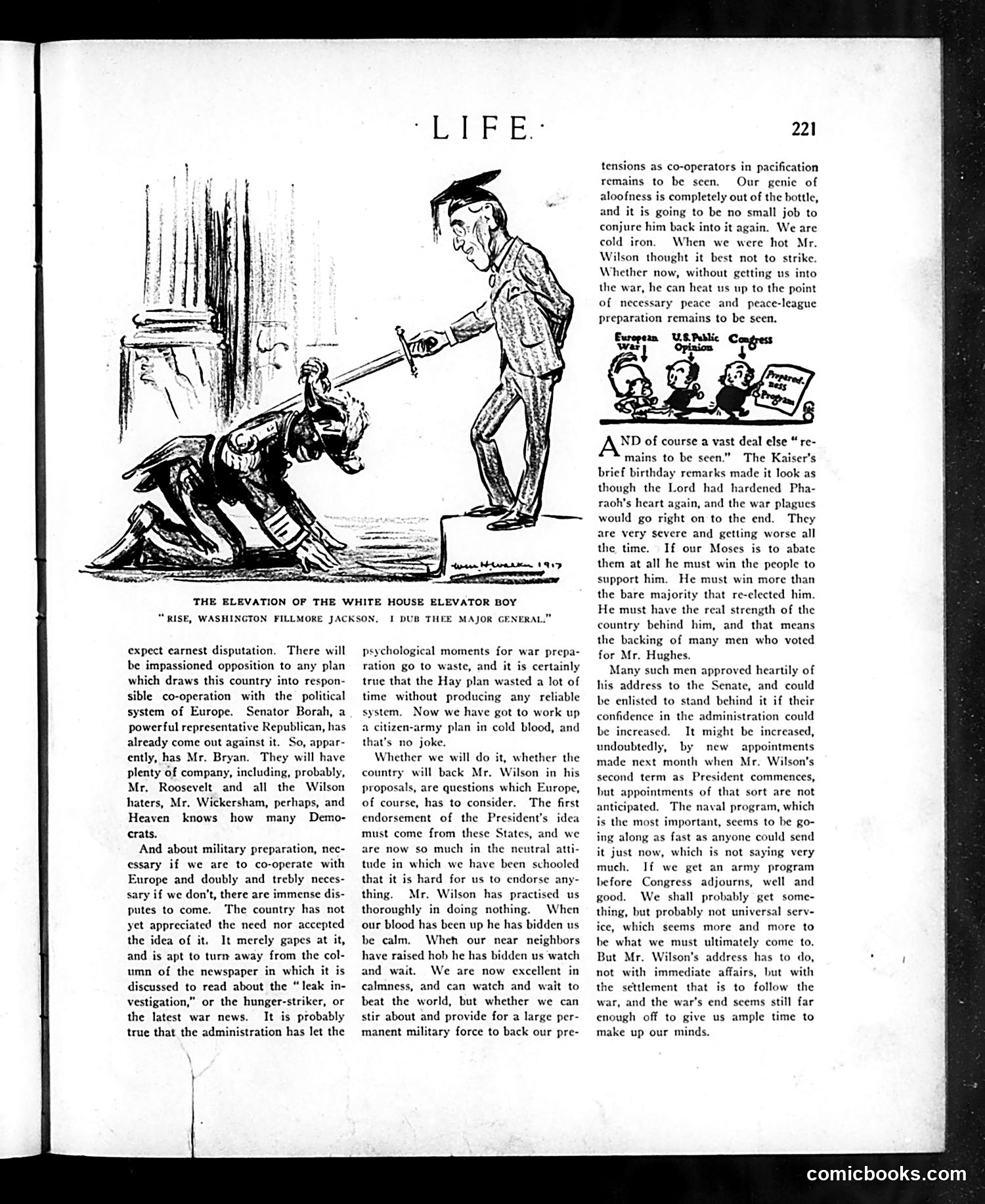
This satirical cartoon depicts President Woodrow Wilson as an "elevator boy" being elevated by a military/political figure (likely representing military or interventionist forces). The caption's wordplay—"elevation" and reference to "Washington Fillmore Jackson"—mocks Wilson's reluctant ascent toward military preparedness. The accompanying text critiques Wilson's administration for: 1. **Insufficient military preparation** despite European pressures for American cooperation in WWI 2. **Inconsistent leadership**: Wilson previously counseled restraint ("be calm") when tensions were high, now struggling to mobilize public support for defense measures 3. **Lost opportunities** for war preparation planning 4. **Need for broader support**: Wilson won re-election narrowly and must convince even Hughes supporters to back military expansion The satirist argues Wilson's previous "aloofness" policy has made it difficult to pivot toward necessary military action, comparing the challenge to magically returning a genie to its bottle. The cartoon suggests Wilson is being forced upward by circumstances rather than leading decisively.
📄 Transcribed text from this page (OCR, searchable)
Machine-transcribed from the original scan — historical spelling and the odd misread are preserved.
THE ELEVATION OF THE WHITE HOUSE ELEVATOR BOY WASH expect earnest disputation. There will be impassioned opposition to any plan which draws this country into respon- sible co-operation with the political system of Europe. Senator Borah, a powerful representative Republican, has already come out against it. So, appar- ently, has Mr. Bryan. They will have plenty of company, including, probably, Mr. Roosevelt and all the Wilson haters, Mr. Wickersham, perhaps, and Heaven knows how many Demo- crats. And about military preparation, nec- essary if we are to co-operate with Europe and doubly and trebly neces- sary if we don't, there are immense dis- putes to come. The country has not yet appreciated the need nor accepted the idea of it. It merely gapes at it, and is apt to turn away from the col- umn of the newspaper in which it is discussed to read about the “leak in- vestigation,” or the hunger-striker, or the latest war news. It is probably true that the administration has let the TON FILLMORE JACKSON, 1 DUB TH psychological moments for war prepa- ration go to waste, and it is certainly true that the Hay plan wasted a lot of time without producing any reliable system. Now we have got to work up a citizen-army plan in cold blood, and that’s no joke. Whether we will do it, whether the country will back Mr. Wilson in his proposals, are questions which Europe, of course, has to consider. The first endorsement of the President's must come from these States, and we are now so much in the neutral atti- tude in which we have been schooled that it is hard for us to endorse any- thing. Mr. Wilson has practised us thoroughly in doing nothing. When our blood has been up he has bidden us be calm. Wheh our near neighbors have raised hob he has bidden us watch and w We are now excellent in calmness, and can watch and wait to beat the world, but whether we can stir about and provide for a large per- manent military force to back our pre- idea 221 tensions as co-operators in pacification remains to be scen, Our genie of aloofness is completely out of the bottle, and it is going to be no small job to conjure him back into it again. We are cold iron. When we were hot Mr. Wilson thought it best not to strike. Whether now, without getting us into the war, he can heat us up to the point of necessary peace and peace-league preparation remains to be seen. fore U8 Public coges ND of course a vast deal else “ re- mains to be seen.” The Kaiser’s brief birthday remarks made it look as though the Lord had hardened Pha- raoh’s heart aga ind the war plagues would go right on to the end. They are very severe and getting worse all the time. If our Moses is to abate them at all he must win the people to support him. He must win more than the bare majority that re-elected him. He must have the real strength of the country behind him, and that means the backing of many men who voted for Mr. Hughes. Many such men approved heartily of his address to the Senate, and could be enlisted to stand behind it if their confidence in the administration could be increased. It might be increased, undoubtedly, by new appointments made next month when Mr. Wilson's second term as President commences, but appointments of that sort are not anticipated. The naval program, which is the most important, seems to be go- ing along as fast as anyone could send it just now, which is not saying very much. If we get an army program before Congress adjourns, well and good. We shall probably get some- thing, but probably not universal serv- ice, which seems more and more to be what we must ultimately come to. But Mr. Wilson's address has to do, not with immediate affairs, but with the settlement that is to follow the war, and the war's end scems still far enough off to give us ample time to make up our minds. comicbooks.com