
Life, 1917-02-08 · page 24 of 42
Life — February 8, 1917 — page 24: what you’re looking at
What you’re looking at
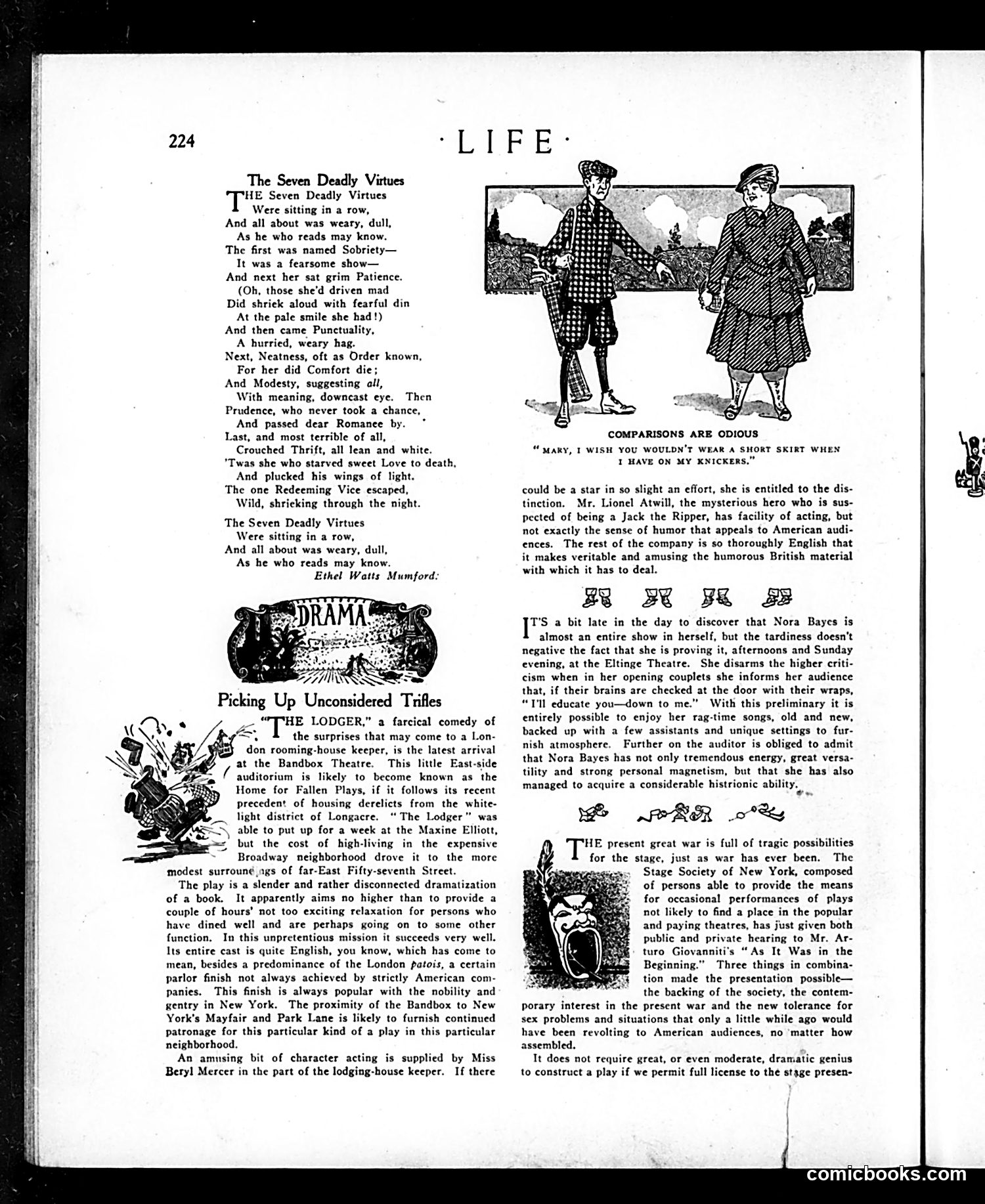
**"The Seven Deadly Virtues"** is a satirical poem inverting the concept of cardinal virtues. Rather than celebrating traditional moral qualities (sobriety, patience, punctuality, neatness, modesty, prudence, thrift), the author treats them as joyless, life-draining forces that kill pleasure and romance. The sole "redeeming vice" that escapes represents spontaneity and passion—implying that rigid Victorian morality itself is the real vice. This reflects early 20th-century backlash against strict social conventions. **"Picking Up Unconsidered Trifles"** reviews theatrical productions. The Bandbox Theatre, serving as a refuge for failing plays, houses "The Lodger" (a British farce). The reviewer notes its modest entertainment value for post-dinner audiences and praises the cast's "English" quality—refined parlor manners appealing to New York's wealthy. Mention of actress Nora Bayes emphasizes her star power, while actor Lionel Atwill's lack of comedic sensibility is criticized as unsuitable for American audiences. The cartoon above shows two figures in period dress with the caption mocking fashion inconsistency—a light social jab at women's clothing choices.
📄 Transcribed text from this page (OCR, searchable)
Machine-transcribed from the original scan — historical spelling and the odd misread are preserved.
The Seven Deadly Virtues 'HE Seven Deadly Virtues Were sitting in a row, And all about was weary, dull, As he who reads may know. The first was named Sobriety— It was a fearsome show— And next her sat grim Patience. (Oh, those she'd driven mad Did shriek aloud with fearful din At the pale smile she had!) And then came Punctuality, A hurried, weary hag. Next, Neatness, oft as Order known, For her did Comfort die; And Modesty, suggesting all, With meaning, downcast eye. Then Prudence, who never took a chance, And passed dear Romanee by. Last, and most terrible of all, Crouched Thrift, all lean and white. 'Twas she who starved sweet Love to death, And plucked his wings of light. The one Redeeming Vice escaped, Wild, shricking through the night. The Seven Deadly Virtues Were sitting in a row, And all about was weary, dull, ‘As he who reads may know. Ethel Watts Mumford: _ Picking Up Unconsidered Trifles “THE LODGER,” a farcical comedy of the surprises that may come to a L.on- don rooming-house keeper, is the latest arrival at the Bandbox Theatre. This little East-side ( auditorium is likely to become known as the Home for Fallen Plays, if it follows its recent precedent of housing derelicts from the white- , light district of Longacre. “The Lodger” was =) able to put up for a week at the Maxine Elliott, xz) but the cost of high-living in the expensive Broadway neighborhood drove it to the more modest surrouné,ogs of far-East Fifty-seventh Street. The play is a slender and rather disconnected dramatization of a book. It apparently aims no higher than to provide a couple of hours’ not too exciting relaxation for persons who have dined well and are perhaps going on to some other function, In this unpretentious mission it succeeds very well. Its entire cast is quite English, you know, which has come to mean, besides a predominance of the London patois, a certain parlor finish not always achieved by strictly American com- panies. This finish is always popular with the nobility and gentry in New York. The proximity of the Bandbox to New York's Mayfair and Park Lane is likely to furnish continued patronage for this particular kind of a play in this particular neighborhood. An amusing bit of character acting is supplied by Miss Beryl Mercer in the part of the lodging-house keeper. If there COMPARISONS ARE ODIOUS “ way, I WISH YOU WOULDN'T WEAR A SHORT SKIRT WHEN 1 HAVE ON MY KNICKERS,” could be a star in so slight an effort, she is entitled to the dis- tinction. Mr. Lionel Atwill, the mysterious hero who is sus- pected of being a Jack the Ripper, has facility of acting, but not exactly the sense of humor that appeals to American audi- ences. The rest of the company is so thoroughly English that it makes veritable and amusing the humorous British material with which it has to deal. SB SC HR SB T’S a bit late in the day to discover that Nora Bayes is almost an entire show in herself, but the tardiness doesn’t negative the fact that she is proving it, afternoons and Sunday evening, at the Eltinge Theatre. She disarms the higher criti- cism when in her opening couplets she informs her audience that, if their brains are checked at the door with their wraps, “T'll educate you—down to me.” With this preliminary it is entirely possible to enjoy her rag-time songs, old and new, backed up with a few assistants and unique settings to fur- nish atmosphere, Further on the auditor is obliged to admit that Nora Bayes has not only tremendous energy, great versa- tility and strong personal magnetism, but that she has also managed to acquire a considerable histrionic ability. 3 OBR 0 WY HE present great war is full of tragic possibilities for the stage, just as war has ever been. The Stage Society of New York, composed of persons able to provide the means for occasional performances of plays not likely to find a place in the popular and paying theatres, has just given both public and private hearing to Mr. Ar- turo Giovanniti’s “As It Was in the Beginning.” Three things in combina- tion made the presentation possible— the backing of the society, the contem- Porary interest in the present war and the new tolerance for sex problems and situations that only a little while ago would have been revolting to American audiences, no ‘matter how assembled. It does not require great, or even moderate, dramatic genius to construct a play if we permit full license to the stage presen- comicbooks.com