
Life, 1917-02-08 · page 29 of 42
Life — February 8, 1917 — page 29: what you’re looking at
What you’re looking at
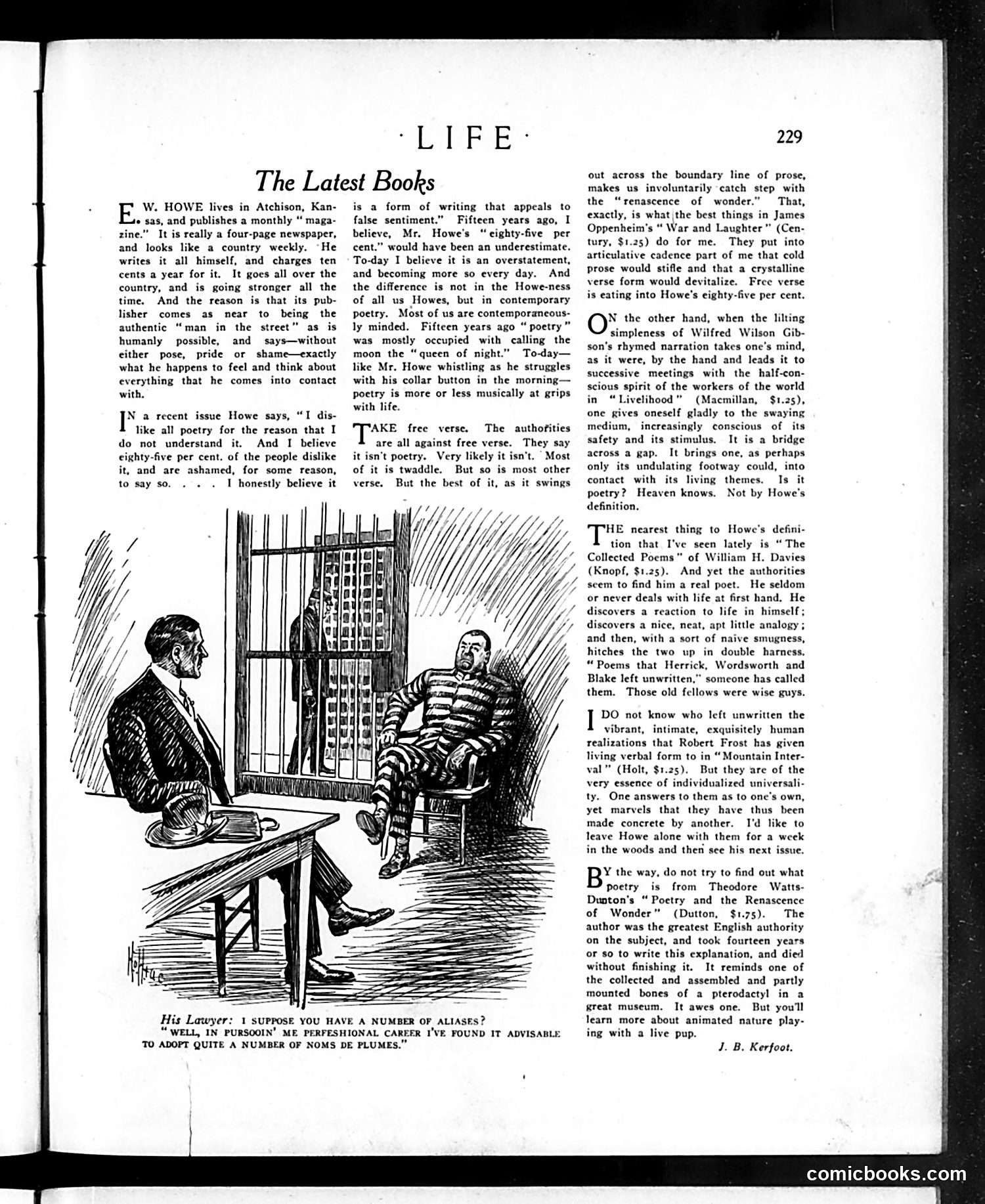
This page reviews contemporary poetry and modern literature circa 1916. The cartoon depicts a lawyer claiming to have adopted "a number of noms de plumes" in his professional career—a joke about using aliases, likely satirizing lawyers' reputations for deception or duplicity. The main text discusses E.W. Howe's complaint that 85% of people dislike poetry because they don't understand it. The critic argues this percentage is now *decreasing* because modern poetry has shifted from sentimental conventions (calling the moon the "queen of night") to engaging with real life experiences. The piece praises contemporary poets like Robert Frost and Wilfred Gibson for their accessible, vivid language, while gently mocking William H. Davies for derivative work ("poems that Herrick, Wordsworth and Blake left unwritten"). The satire targets outdated poetic conventions and defends modernist poetry's turn toward authenticity and lived experience.
📄 Transcribed text from this page (OCR, searchable)
Machine-transcribed from the original scan — historical spelling and the odd misread are preserved.
so The Latest Books W. HOWE lives in Atchison, Kan- «sas, and publishes a monthly “ maga- zine.” It is really a four-page newspaper, and looks like a country weekly, “He writes it all himself, and charges ten cents a year for it. It goes all over the country, and is going stronger all the time. And the reason is that its pub- lisher comes as near to being the authentic “man in the street" as is humanly possible, and says—without either pose, pride or shame—exactly what he happens to feel and think about everything that he comes into contact with, N a recent issue Howe says, “I dis- like all poetry for the reason that I do not understand it, And I believe ighty-five per cent. of the people dislike it, and are ashamed, for some reason, to say so. . . . I honestly believe it is a form of writing that appeals to false sentiment.” Fifteen years ago, I believe, Mr. Howe's “eighty-five per cent.” would have been an underestimate. To-day I believe it is an overstatement, and becoming more so every day. And the difference is not in the Howe-ness of all us Howes, but in contemporary poetry. Most of us are contemporancous- ly minded. Fifteen years ago “ poetry” was mostly occupied with calling the moon the “queen of night.” To-day— like Mr. Howe whistling as he struggles with his collar button in the morning— poetry is more or less musically at grips with life. ‘AKE free verse. The authofities are all against free verse. They say it isn’t poetry. Very likely it isn't. ’ Most of it is twaddle, But so is most other verse, But the best of it, as it swings His Lawyer: 1 suppose YoU HAVE A NUMBER OF ALIA: “WELL, IN PURSOOIN’ ME PERFESHIONAL CAREER I'VE FOUND IT ADVISABLE TO ADOPT QUITE A NUMBER OF NOMS DE PLUMES.” 229 out across the boundary line of prose, makes us involuntarily catch step with the “renascence of wonder.” That, exactly, is what the best things in James Oppenheim’s “ War and Laughter” (Cen- tury, $1.25) do for me. They put into articulative cadence part of me that cold prose would stifle and that a crystalline verse form would devitalize. Free verse is eating into Howe's eighty-five per cent. N the other hand, when the lilting simpleness of Wilfred Wilson Gib- son's rhymed narration takes one’s mind, as it were, by the hand and leads it to successive meetings with the half-con- scious spirit of the workers of the world in “Livelihood” (Macmillan, $1.25), one gives oneself gladly to the swaying medium, increasingly conscious of its safety and its stimulus, It is a bridge across a gap. It brings one, as perhaps only its undulating footway could, into contact with its living themes. Is it poetry? Heaven knows. Not by Howe's definition, HE nearest thing to Howe's defini- tion that I've seen lately is “The Collected Poems” of William H. Davies (Knopf, $1.25). And yet the authorities scem to find him a real poet. He seldom or never deals with life at first hand. He discovers a reaction to life in himself; discovers a nice, neat, apt little analogy and then, with a sort of naive smugness, hitches the two up in double harness. “Poems that Herrick, Wordsworth and Blake left unwritten,” someone has called them. Those old fellows were wise guys. DO not know who left unwritten the vibrant, intimate, exquisitely human realizations that Robert Frost has given living verbal form to in “ Mountain Inter- val” (Holt, $1.25). But they are of the very essence of individualized universali- ty. One answers to them as to one’s own, yet marvels that they have thus been made concrete by another. I'd like to leave Howe alone with them for a week in the woods and then see his next issue. Y the way, do not try to find out what poetry is from Theodore Watts- Dunton's “Poetry and the Renascence of Wonder” (Dutton, $1.75). The author was the greatest English authority on the subject, and took fourteen years or so to write this explanation, and died without finishing it. It reminds one of the collected and assembled and partly mounted bones of a pterodactyl in a great museum. It awes one. But you'll learn more about animated nature play- ing with a live pup. J. B. Kerfoot. comicbooks.com