
Life, 1917-02-08 · page 25 of 42
Life — February 8, 1917 — page 25: what you’re looking at
What you’re looking at
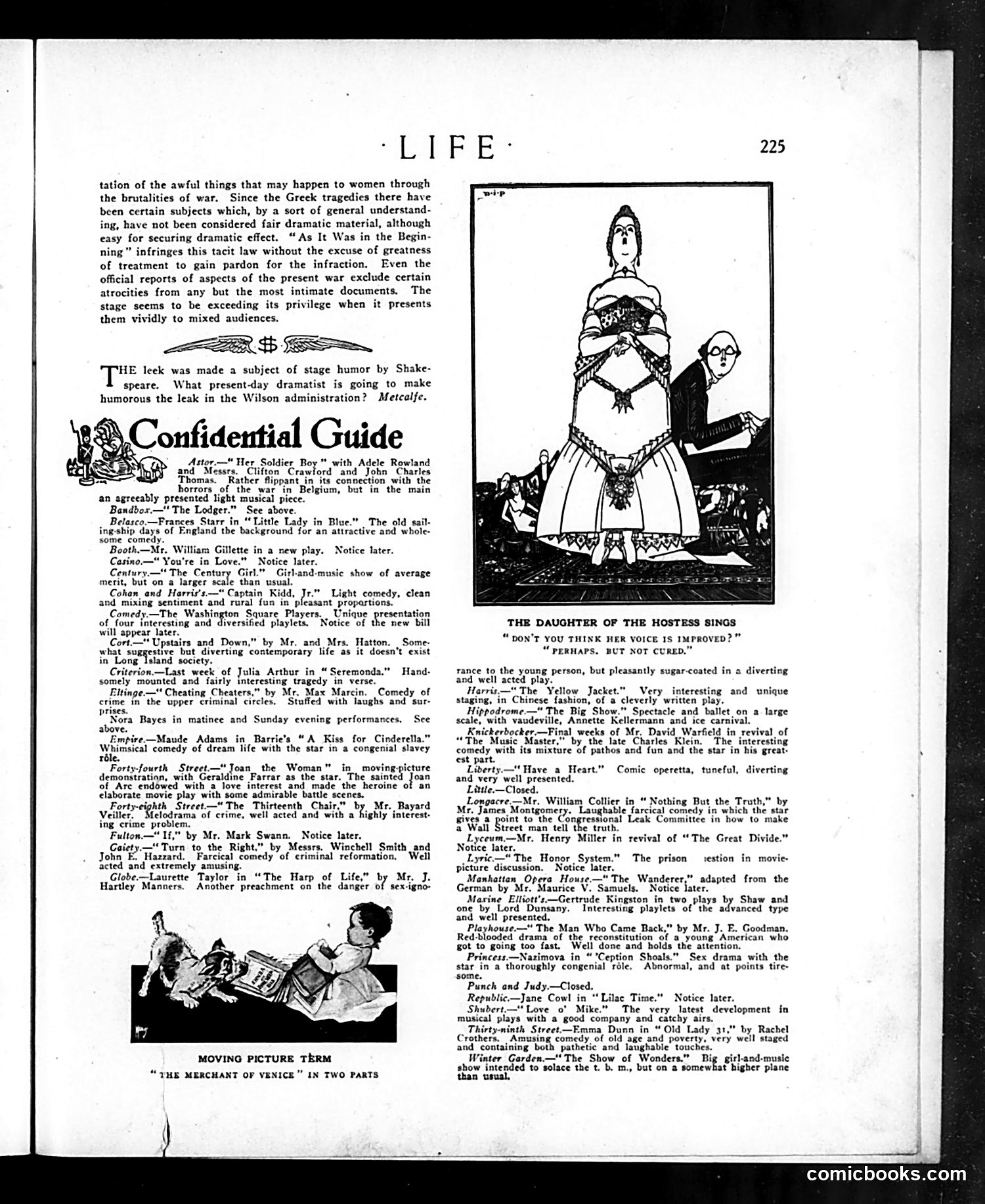
This page from *Life* magazine contains theater reviews and satirical commentary typical of the publication's entertainment coverage. ## The Main Cartoon The large illustration captioned "The Daughter of the Hostess Sings" depicts a woman performing while a man listens critically. The caption's joke—"Don't you think her voice is improved?" / "Perhaps, but not cured"—satirizes both amateur singers and polite social pretense. This mocks the common scenario of enduring mediocre performances by socially prominent women whose families overestimate their talents. ## Editorial Commentary The opening section critiques a play called "As It Was in the Beginning" for depicting wartime atrocities against women. The reviewer argues the theater is exceeding acceptable bounds by vividly presenting material even official war reports exclude from public documents. A separate joke references President Wilson's administration, suggesting contemporary political scandals. ## Context The page primarily contains theater reviews reflecting American entertainment during World War I, with the satire targeting both amateur artistic pretension and wartime social anxieties.
📄 Transcribed text from this page (OCR, searchable)
Machine-transcribed from the original scan — historical spelling and the odd misread are preserved.
a tation of the awful things that may happen to women through the brutalities of war. Since the Greek tragedies there have been certain subjects which, by a sort of general understand- ing, have not been considered fair dramatic material, although easy for securing dramatic effect. “As It Was in the Begin- ning” infringes this tacit law without the excuse of greatness of treatment to gain pardon for the infraction. Even the official reports of aspects of the present war exclude certain atrocities from any but the most intimate documents. The stage seems to be exceeding its privilege when it presents them vividly to mixed audiences. HE leek was made a subject of stage humor by Shake- speare. What present-day dramatist is going to make humorous the leak in the Wilson administration? Metcalfe. Astor.—" Her Soldier Boy " with Adele Rowland and Messrs. Clifton Crawford and. John Charles ‘Thomas. Rather flippant_in its connection with the horrors’ of the war in Belgium, but in the main an agreeably presented light musical piece. Bandbox.—" The Lodger.” See above. Belasco.—Frances Starr in “Little Lady in Blue.” The old ship days of England the background for an attractive and whol William Gillette in a new play. Notice later. ‘ou're in Love.” Notice later. The Century Girl” Girtand-musie show of average merit, but on a larger scale than usual. Cohan and Harris’s.—" Captain Kidd, Jr." Light comedy, clean and mixing sentiment and rural fun in ‘pleasant propartions. Comedy.—The Washington Square Players. Unique presentation of four interesting and diversified playlets. Notice of the new bill will appear later. Cort.—* Upstairs and Down,” by Mr. and Mrs. Hatton. Some: what suggestive but diverting contemporary life as it doesn’t exist In Long feland society, Criterion.—Last week of Hand- Julia Arthur in “ Seremonda.” somely mounted and fairly interesting tragedy in verse. Eltinge —* Cheating Cheaters,” by Mr. Max Marcin. Comedy of crime in the upper criminal circles, Stuffed with laughs and sur- prises. Nora Bayes in matinee and Sunday evening performances, See above. Empire—Maude Adams in Barrie's “A Kiss for Cinderella.” Whimsical comedy of dream life with the star in a congenial slavey r Forty-fourth Street—“Joan_ the Woman” in moving-picture demonstration, with Geraldine Farrar as the star. The sainted Joan of Arc endowed with a love interest and made the heroine of an elaborate movie play with some admirable battle scenes, Forty-eighth Street-—" The Thirteenth Chair.” by Mr. Bayard Veiller. Melodrama of crime, well acted and with a highly interest- ing crime problem. If," by Mr. Mark Swann. Notice later. “Turn to the Right,” by Messrs. Winchell Smith and John E. Hazzard. Farcical comedy of criminal reformation, Well acted and extremely amusing. Globe.—Laurette Taylor in “The Harp of Life,” by Mr. J. Hartley Manners. Another preachment on the danger of sex-igno- MOVING PICTURE TERM MERCHANT OF VENICE” IN TWO PARTS. THE DAUGHTER OF THE HOSTESS SINGS “DON'T YOU THINK HER VOICE 1S IMPROVED?" “ PERHAPS. BUT NOT CURED.” rance to the young person, but pleasantly sugar-coated in a diverting and well acted play. Harris—" The Yellow Jacket.” Very interesting and unique staging, in Chinese fashion, of a cleverly written play. i * Spectacle and ballet on a large Hermann and ice carnival. Knickerbocker-—Final weeks of Mr. David Warfield in revival of “The Music Master,” by the late Charles Klein. The interesting comedy with its mixture of pathos and fun and the star in his great: est part. Liberty.—" Have a Heart.” and very well presented. Little.—Closed. Longacre —Mr, William Collier in “ Nothing But the Truth,” by Mr. James Montgomery. Laughable farcical comedy in which the star Sixes 2 point to the Congressional Leak Committee in how to make a Wall Street man tell the truth. Lyceum.—Mr. Henry Miller in revival of “The Great Divide.” Notice late: Lyric—" The Honor System picture discussion. Notice later. Manhattan Opera House.—" The Wanderer,” adapted from the German by Mr. Maurice V. Samuels. Notice later. Marine Eltiott's—Gertrude Kingston in two plays by Shaw and one by Lord Dunsany. Interesting playlets of the advanced type and well presented. Playhouse.—“ The Man Who Came Back,” by Mr. J. FE. Goodman. Red-blooded drama of the reconstitution of a young American who got to going too fast. Well done and holds the attention. Princess.—Nazimova in “'Ception Shoals.” Sex drama with the star in a thoroughly congenial réle. Abnormal, and at points tire: some. Punch and Judy.—Closed. Republic-—Jane Cowl in “Lilac Time.” Notice later. Shubert—" Love o' Mike.” The very latest development in musical plays with a good company and catchy airs, Thirty-ninth Street.—Emma Dunn in “Old Lady 31," by Rachel Crothers. Amusing comedy of old age and poverty, very well staged and containing both pathetic and laughable touches. jer Garden —" The Show of Wonders.” Dig. girl-and-musie ended to solace the t. b, m., but on a somewhat higher plane than usual, Comic operetta, tuneful, diverting The prison sestion in movie et comicbooks.com