
Life, 1917-02-08 · page 11 of 42
Life — February 8, 1917 — page 11: what you’re looking at
What you’re looking at
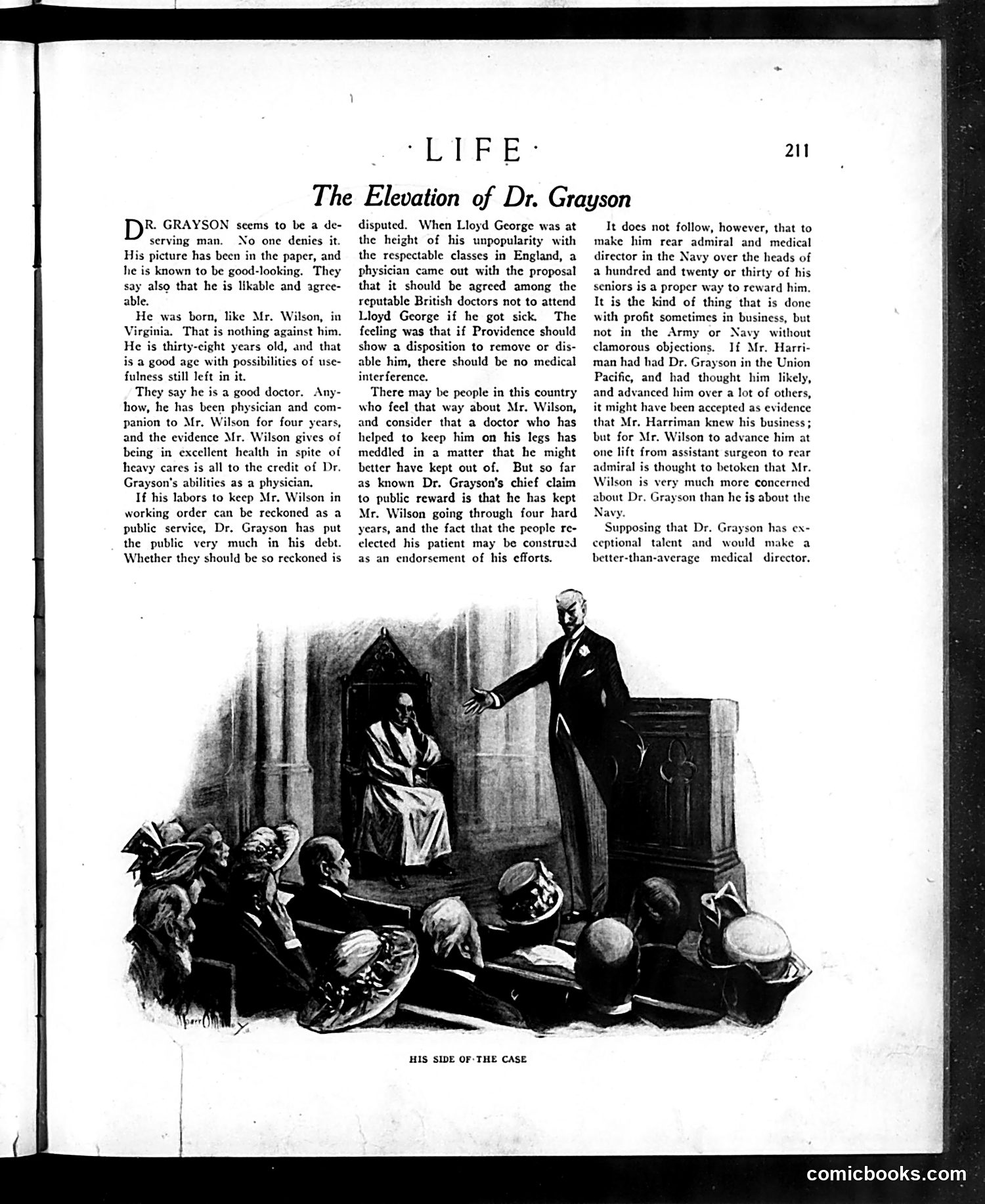
This satirical piece discusses Dr. Grayson's rise in prominence, likely through his association with a powerful figure (Mr. Wilson is mentioned repeatedly). The cartoon caption reads "HIS SIDE OF THE CASE," showing a man at a podium addressing an audience. The satire concerns whether Grayson deserves credit for his own medical competence or if his elevation results from his patron's influence. The text questions whether rewarding doctors who've helped prominent patients represents proper meritocracy or inappropriate favoritism. The piece debates whether Grayson earned advancement through genuine ability or through profitable connections—a critique of how proximity to powerful people can inflate a professional's reputation and career prospects beyond their actual capabilities.
📄 Transcribed text from this page (OCR, searchable)
Machine-transcribed from the original scan — historical spelling and the odd misread are preserved.
“LIFE: The Elevation of Dr. Grayson R. GRAYSON seems to be a de- serving man. No one denies it. His picture has been in the paper, and he is known to be good-looking. They say also that he is likable and agree- able. He was born, like Mr. Wilson, in Virginia, That is nothing against him. He is thirty-eight years old, and that is a good age with possibilities of use- fulness still left in it. They say he is a good doctor. Any- how, he has been physician and com- panion to Mr. Wilson for four years, and the evidence Mr. Wilson gives of being in excellent health in spite of heavy cares is all to the credit of Dr. Grayson's abilities as a physician, If his labors to keep Mr. Wilson in working order can be reckoned as a public service, Dr. Grayson has put the public very much in his debt. Whether they should be so reckoned is disputed. When Lloyd George was at the height of his unpopularity with the respectable classes in England, a physician came out with the proposal that it should be agreed among the reputable British doctors not to attend Lloyd George if he got sick The feeling was that if Providence should show a disposition to remove or dis- able him, there should be no medical interference. There may be people in this country who feel that way about Mr. Wilson, and consider that a doctor who has helped to keep him on his legs has meddled in a matter that he might better have kept out of. But so far as known Dr. Grayson’s chief claim to public reward is that he has kept Mr. Wilson going through four hard years, and the fact that the people re- elected his patient may be construed as an endorsement of his efforts. HIS SIDE OFTHE CASE It does not follow, however, that to make him rear admiral and medical director in the Navy over the heads of a hundred and twenty or thirty of his seniors is a proper way to reward him. It is the kind of thing that is done with profit sometimes in business, but not in the Army or Navy without clamorous objections. If Mr. Harri- man had had Dr. Grayson in the Union Pacific, and had thought him likely, and advanced him over a lot of others, it might have been accepted as evidence that Mr. Harriman knew his business; but for Mr. Wilson to advance him at one lift from assistant surgeon to rear admiral is thought to betoken that Mr. Wilson is very much more concerned about Dr, Grayson than he is about the Supposing that Dr. Grayson has ex- ceptional talent and would make a better-than-average medical director. comicbooks.com