
A complete issue · 40 pages · 1917
Life — January 25, 1917
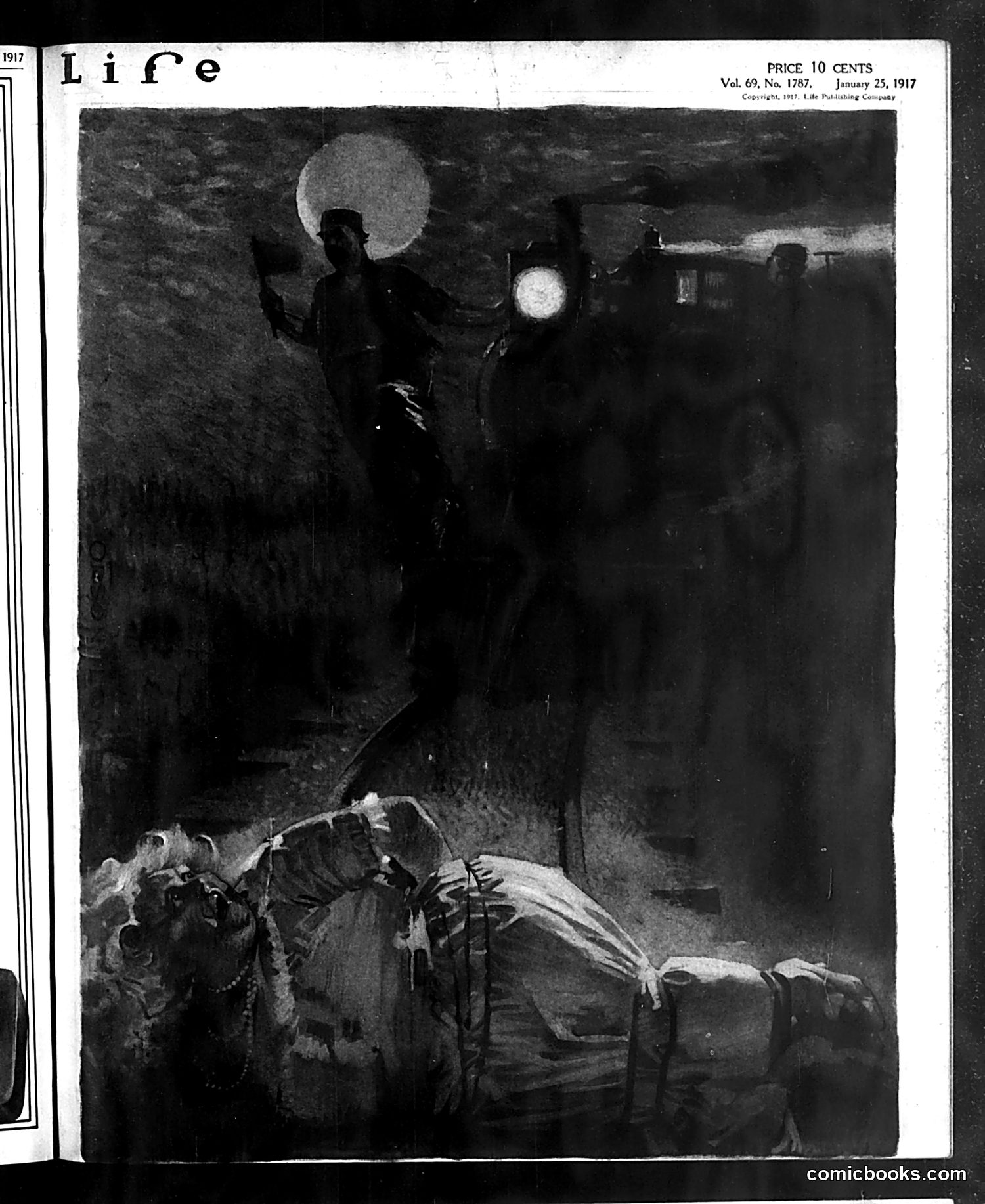
I can see this is a Life magazine cover from January 23, 1917, but the OCR text provided is blank, leaving me unable to read any caption or title that would explain the imagery. The image shows a dramatic nighttime scene: silhouetted figures standing with what appear to be lanterns or lights, looking down at a body lying on the ground. The composition and mood suggest either a crime scene, execution, or tragic incident. Without accompanying text, I cannot definitively identify the specific figures, political event, or satirical point being made. Given the 1917 date—during America's entry into World War I—this could reference wartime themes, but I cannot assert this with certainty based solely on the visual. Additional context would be needed for accurate interpretation.
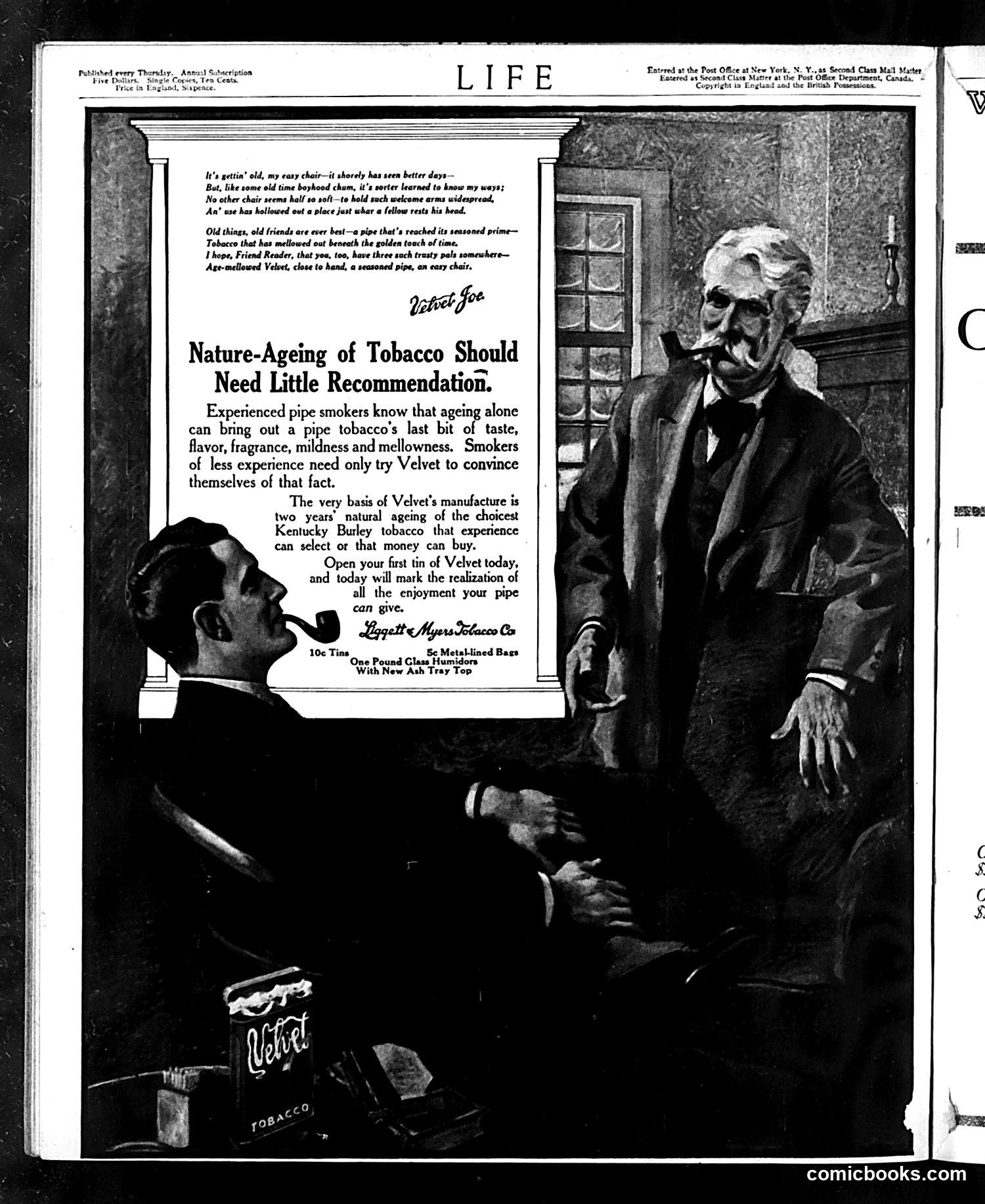
This page is primarily a **tobacco advertisement** for Velvet pipe tobacco by Liggett & Myers, not political satire. The ad emphasizes that aging tobacco improves its quality—a key selling point for the product. The illustration shows two gentlemen in formal dress examining or discussing the tobacco product. The accompanying poem at top ("Velvet Joe") uses nostalgic language about friendship and time's passage to create emotional appeal. The advertisement claims Velvet uses "two years' natural aging of the choicest Kentucky Burley tobacco," positioning aging as the product's distinguishing feature. The price is listed as "10¢ Tins" or "One Pound Glass Humidors." This reflects early 20th-century advertising conventions: using aspirational masculine imagery and poetic language to market consumer goods.
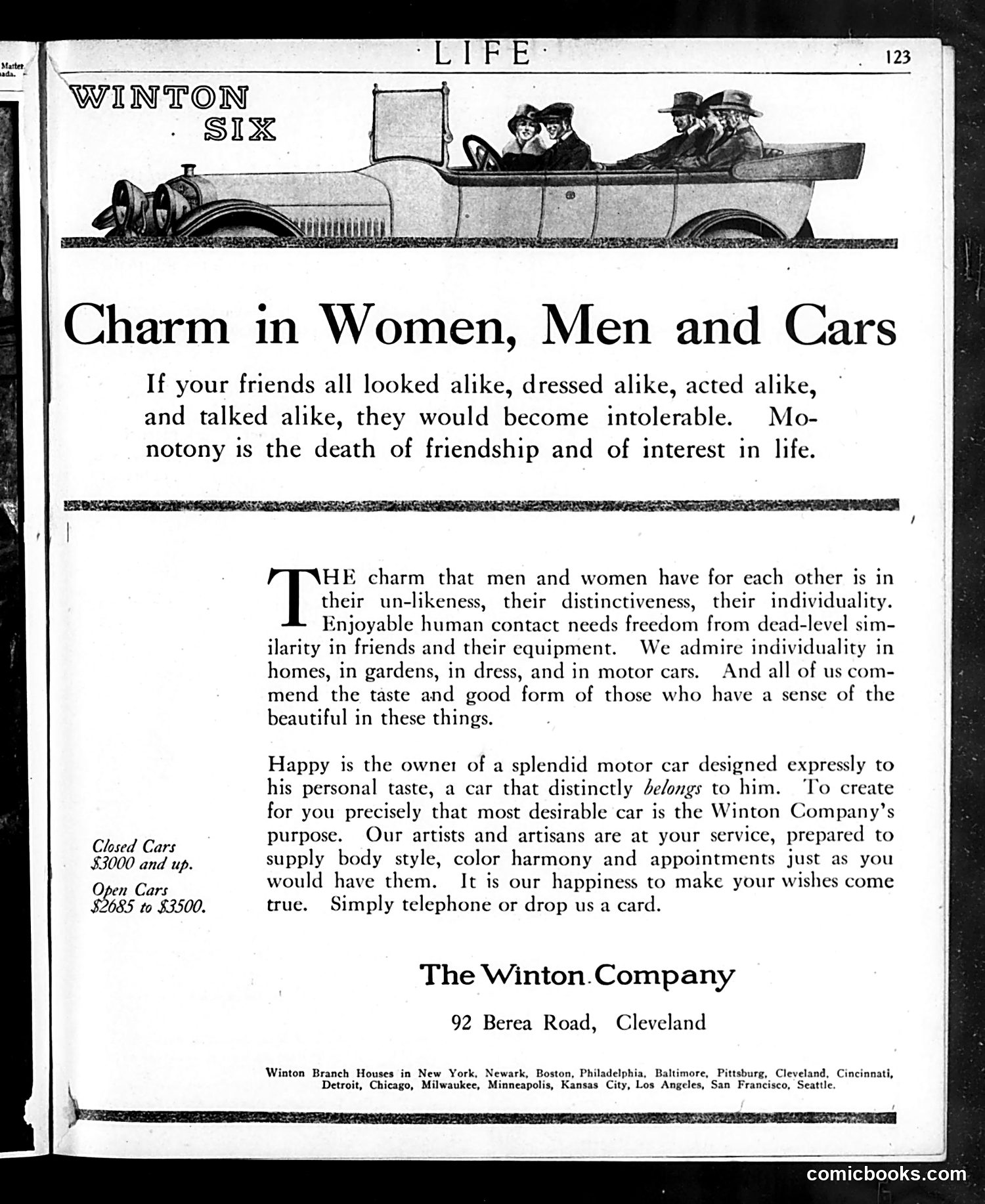
This page is primarily a **Winton Company automobile advertisement**, not satirical content. The "Winton Six" illustration at the top shows an early motorcar with several well-dressed passengers. The advertisement's text argues that charm comes from **individuality and distinctiveness** — that uniformity in friends and possessions becomes "intolerable." It then pivots to selling Winton cars as personalized luxury vehicles reflecting individual taste, positioning them as status symbols for discerning owners. The pricing ($3000+ for closed cars, $2685-$3500 for open cars) suggests this targets wealthy consumers during what appears to be the 1920s automobile era. The message appeals to affluent readers' desire for distinctive, customized possessions that signal refined taste and social distinction.
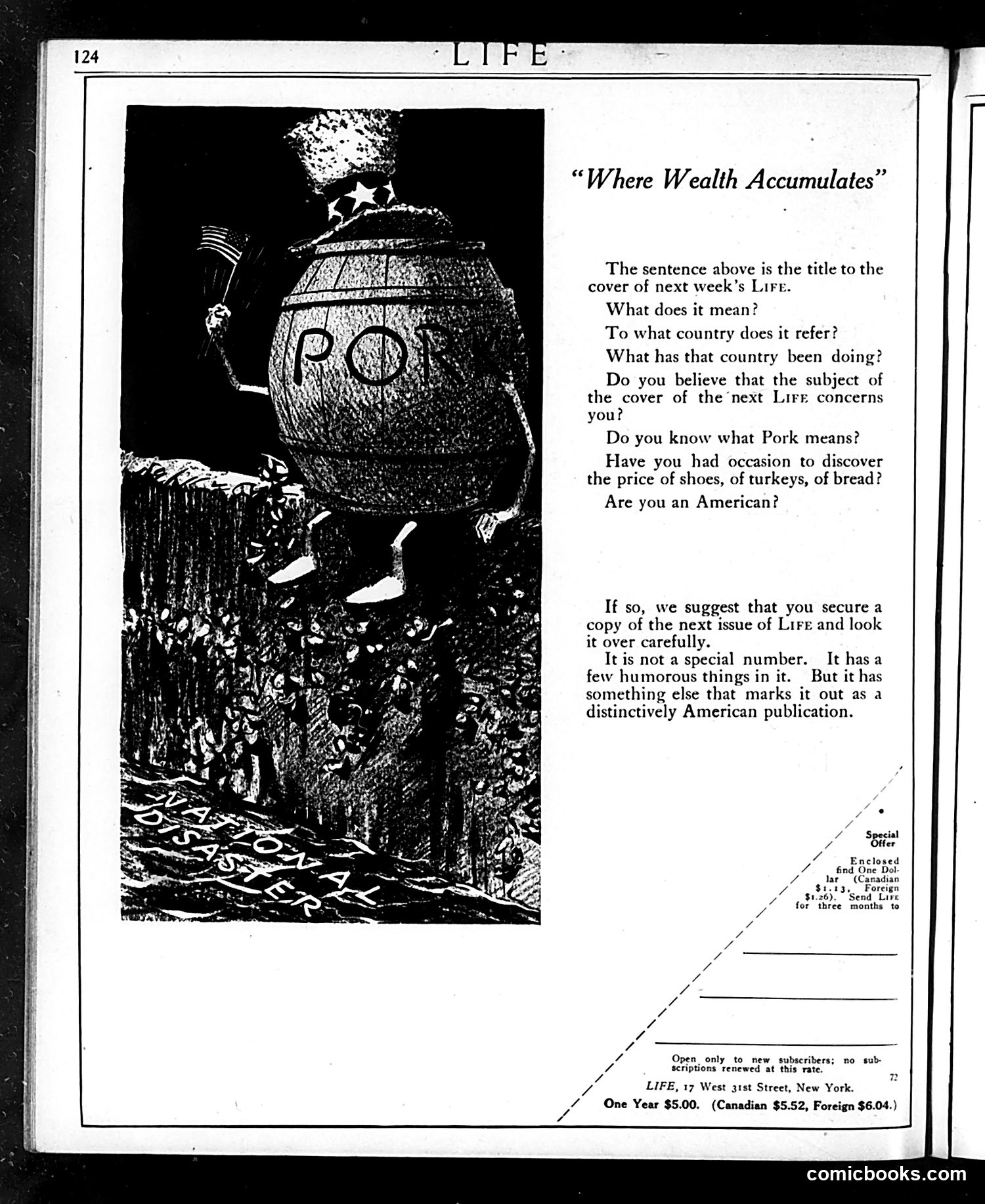
This page promotes next week's *Life* magazine cover, titled "Where Wealth Accumulates." The illustration depicts a large barrel labeled "PORK" being held by a figure wearing American flag clothing, standing atop what appears to be stacked money or wealth. The satire critiques American economic conditions—likely post-WWI inflation or economic inequality. "Pork" references both literal food prices and "pork barrel" spending (wasteful government expenditure). The editorial teases readers by asking provocative questions about inflation's impact on everyday goods (shoes, turkeys, bread) and directly addresses "Americans," suggesting the cover addresses national economic concerns. The figure appears to represent either American wealth-hoarding or government/corporate excess. The exact historical moment remains unclear without the actual cover image.
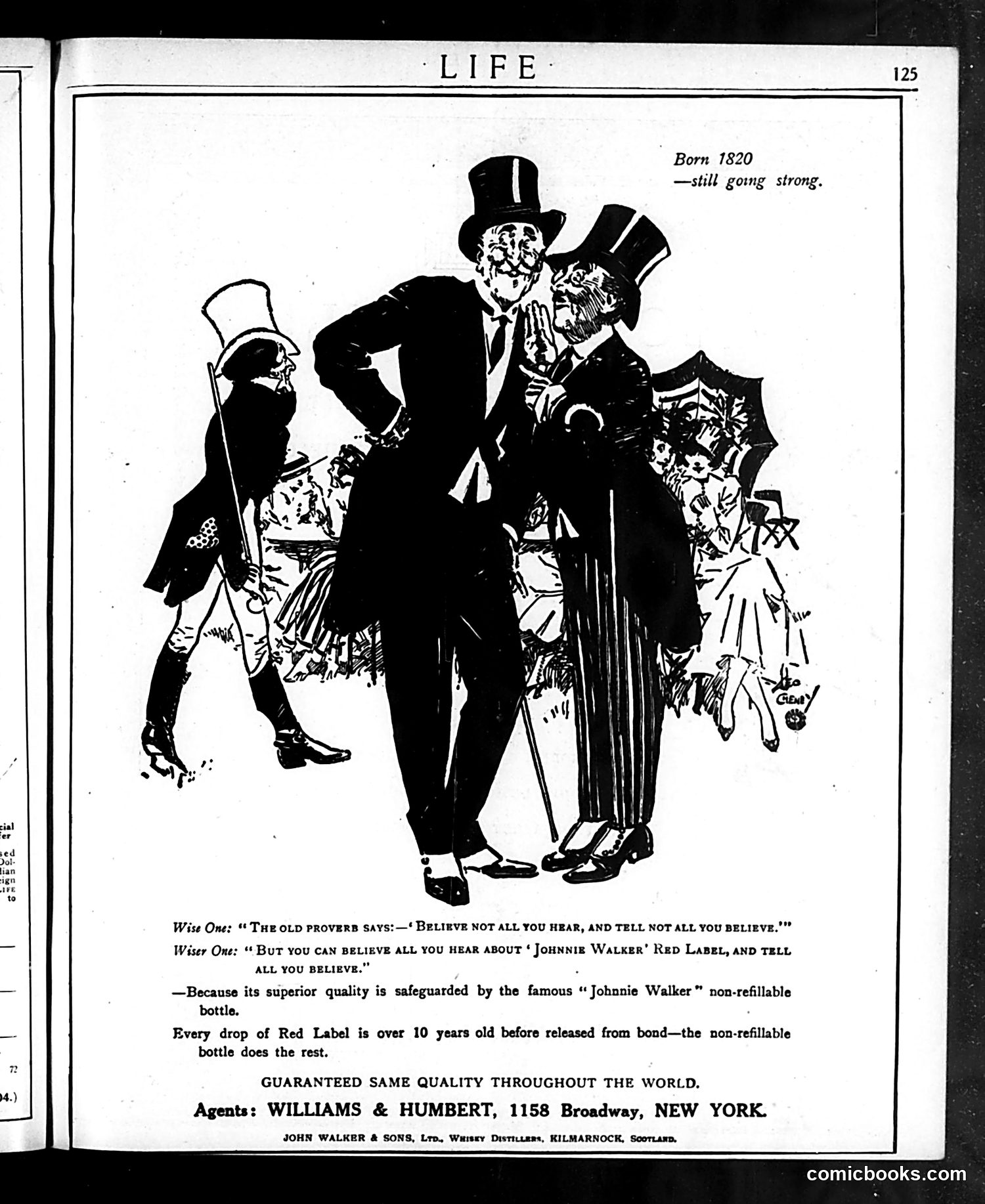
This is primarily **advertising disguised as editorial content**—a common early 20th-century practice. The cartoon depicts an elderly man (born 1820, "still going strong") surrounded by figures representing gossip and rumor, illustrating the proverb about not believing everything you hear. The actual message is a whiskey advertisement for Johnnie Walker Red Label. The "wise ones" dialogue contrasts unreliable hearsay with the trustworthiness of this specific brand, which the ad claims maintains consistent quality through sealed bottles aged over 10 years before release. The satire is subtle: using folk wisdom about discernment to sell liquor—suggesting consumers should trust *this* product while distrusting other information. It's clever marketing leveraging skepticism itself.
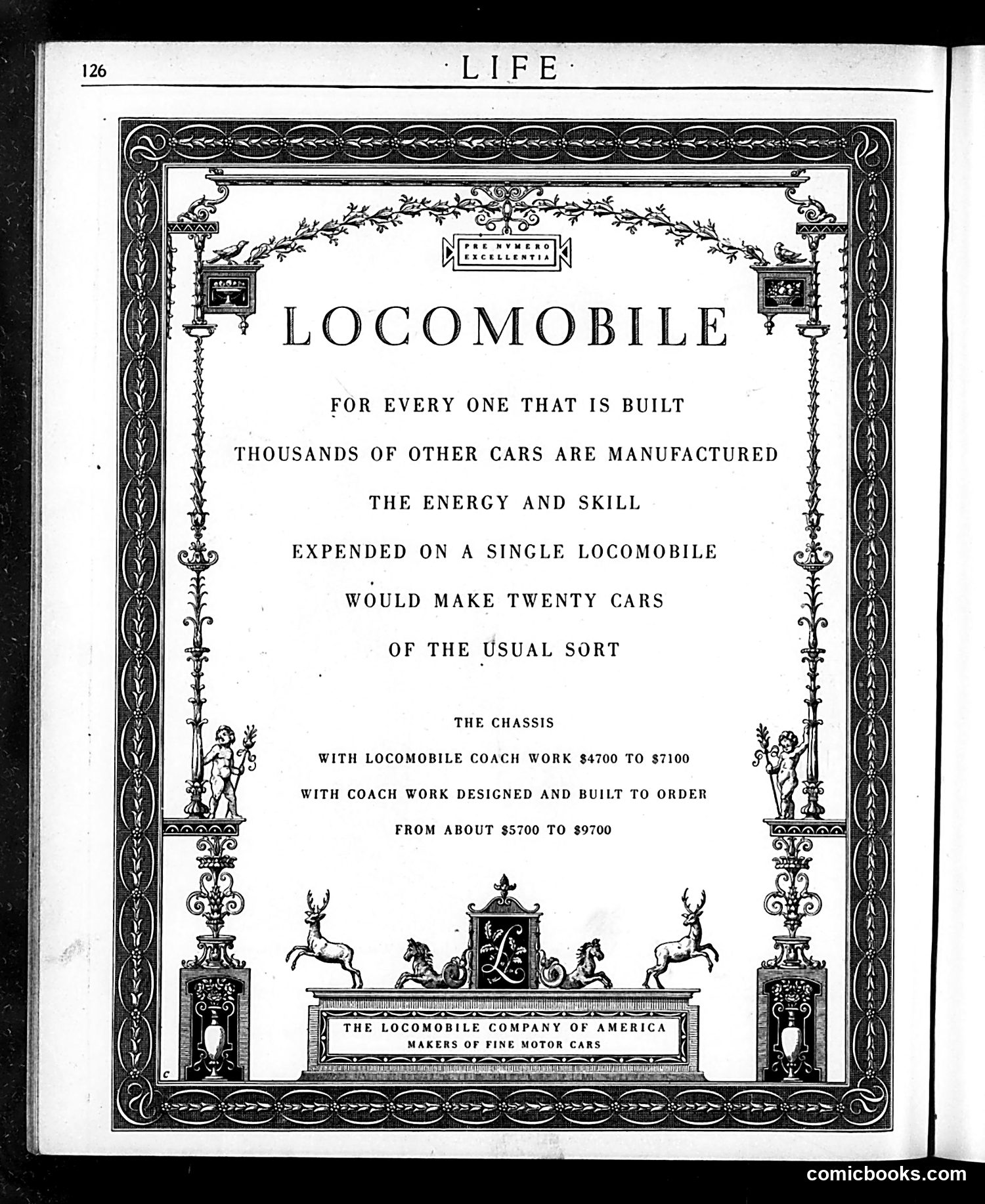
This is **not a cartoon or satire**—it's a **luxury automobile advertisement** for the Locomobile Company of America, published in Life magazine (page 126). The ad uses ornate Art Nouveau framing and classical imagery (cherubs, deer, decorative urns) to position the Locomobile as a high-end product. The text emphasizes exclusivity and craftsmanship: for every Locomobile built, thousands of ordinary cars are manufactured elsewhere. The pricing ($4,700–$9,700 for custom coach work) signals this was a vehicle for the wealthy elite. The decorative style and messaging reflect early 20th-century marketing strategies that equated luxury automobiles with fine art and classical refinement, appealing to aspirational wealthy readers of Life magazine.
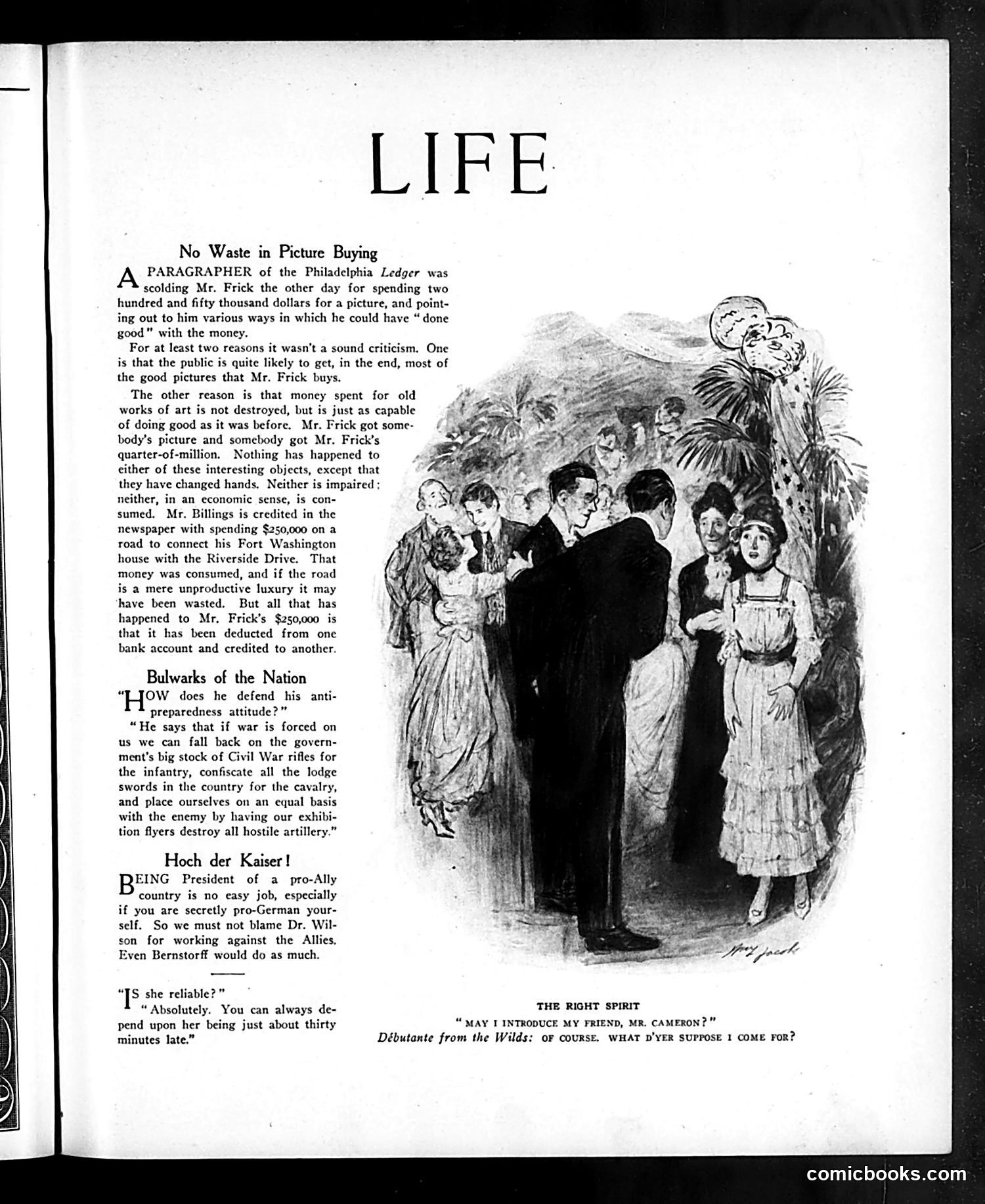
This page contains three separate opinion pieces with social commentary: 1. **"No Waste in Picture Buying"**: Critiques Mr. Frick's $250,000 art purchase, arguing the money simply transferred between wealthy individuals rather than being "wasted"—a satirical defense of wealthy art collecting. 2. **"Bulwarks of the Nation"**: Mocks someone's suggestion to use Civil War weapons for national defense, treating the idea as absurdly impractical. 3. **"Hoch der Kaiser!"**: Satirizes being pro-German while President, suggesting this is an inherently difficult position. The main illustration titled **"The Right Spirit"** shows a social gathering where someone introduces a friend as "Cameron," with the caption noting this is "Débutante from the Wilds"—likely satirizing either class pretension or recent wealth. The humor relies on contemporary references to WWI-era politics and Gilded Age society that modern readers would need historical context to fully appreciate.
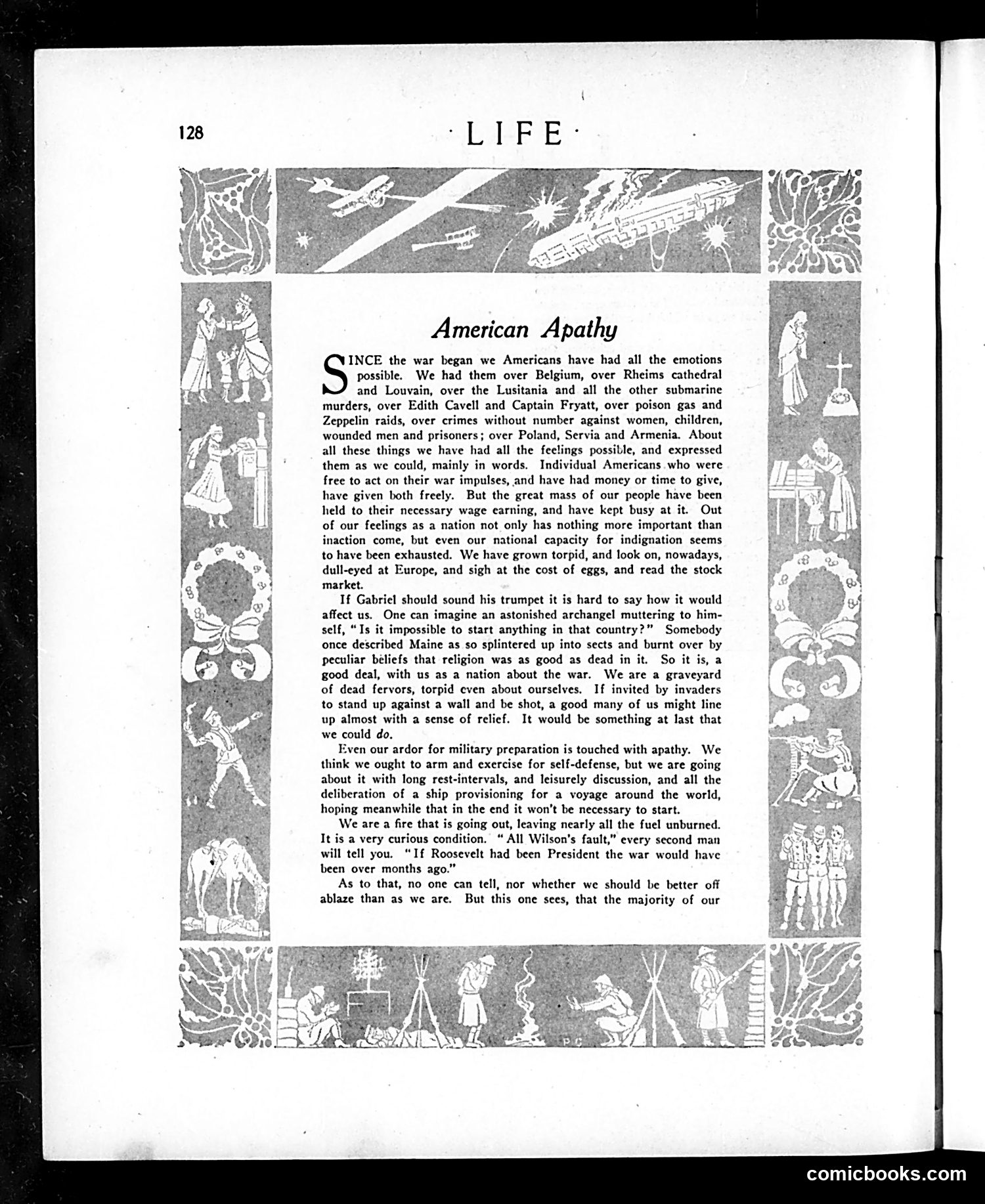
This editorial essay criticizes American public indifference to World War I, despite witnessing atrocities in Belgium, the sinking of the Lusitania, poison gas attacks, and crimes against civilians across Europe. The author argues that most Americans have remained detached—focused on earning wages rather than engaging emotionally or politically with the war. The piece expresses frustration that the nation shows "apathy" toward military preparedness and war readiness, using sarcasm about Maine being "splintered" and burned by religious conflict. It suggests Americans are emotionally exhausted ("dull-eyed") observers of European suffering, yet unmotivated to act decisively either for or against intervention. The decorative borders contain allegorical or classical figures, typical of Life magazine's artistic presentation during this period.
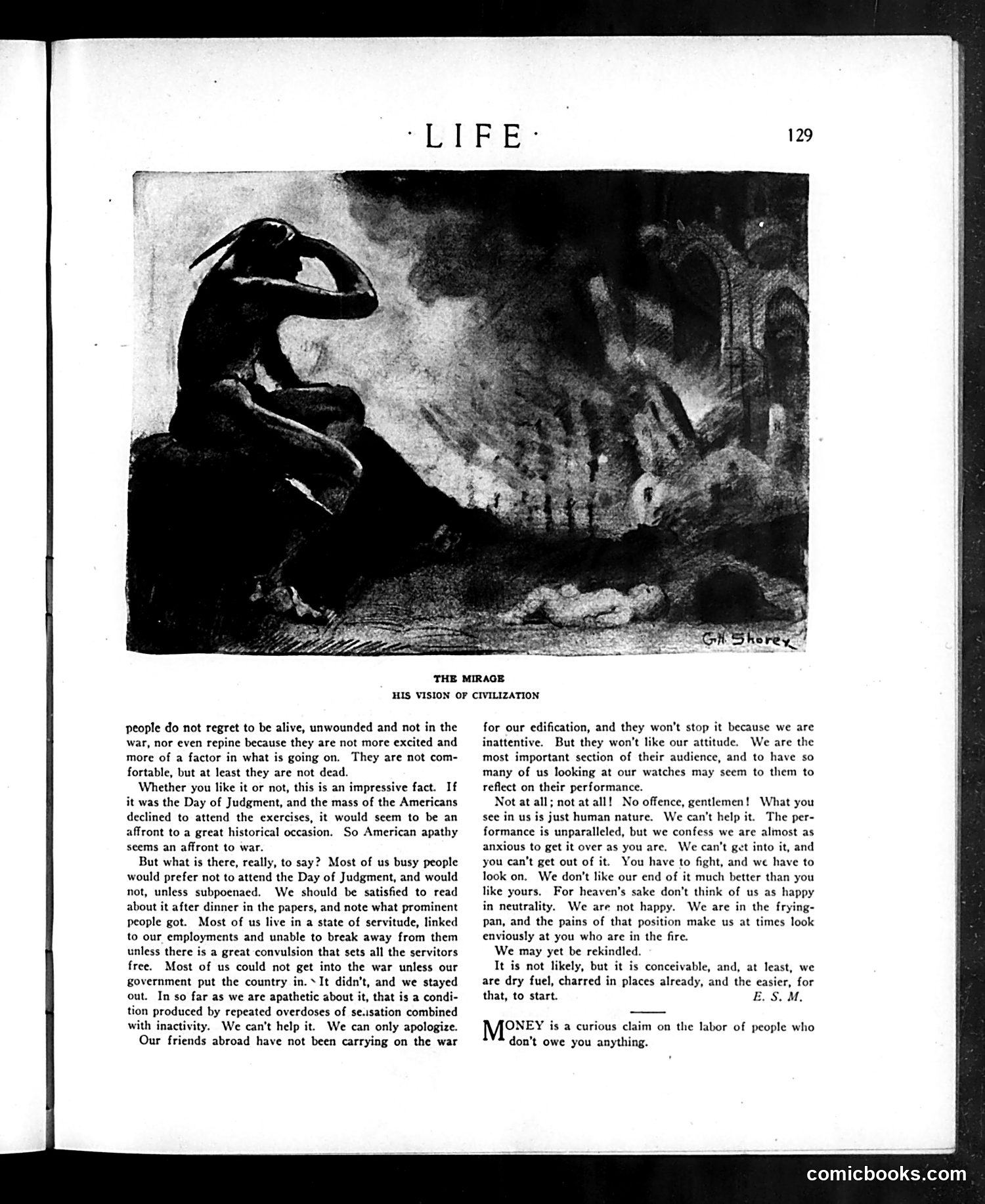
This political cartoon depicts a figure in military uniform gazing at a shimmering mirage of a cityscape. The satirical point appears to criticize post-WWI attitudes: the text argues that Americans reluctant to attend "Day of Judgment" exercises (likely military preparedness events) represent national apathy about war's realities. The cartoon suggests military leaders envision an idealized "civilization" that ordinary citizens won't support or sustain. The text's complaint—that Americans remain "inattentive" and "apathetic" about their civic/military duties—frames the soldier's hopeful vision as unrealistic fantasy. The unsigned artist (appears to be "Gil Short" based on visible signature) uses the mirage device to comment on the gap between military ambitions and public disengagement during the interwar period.
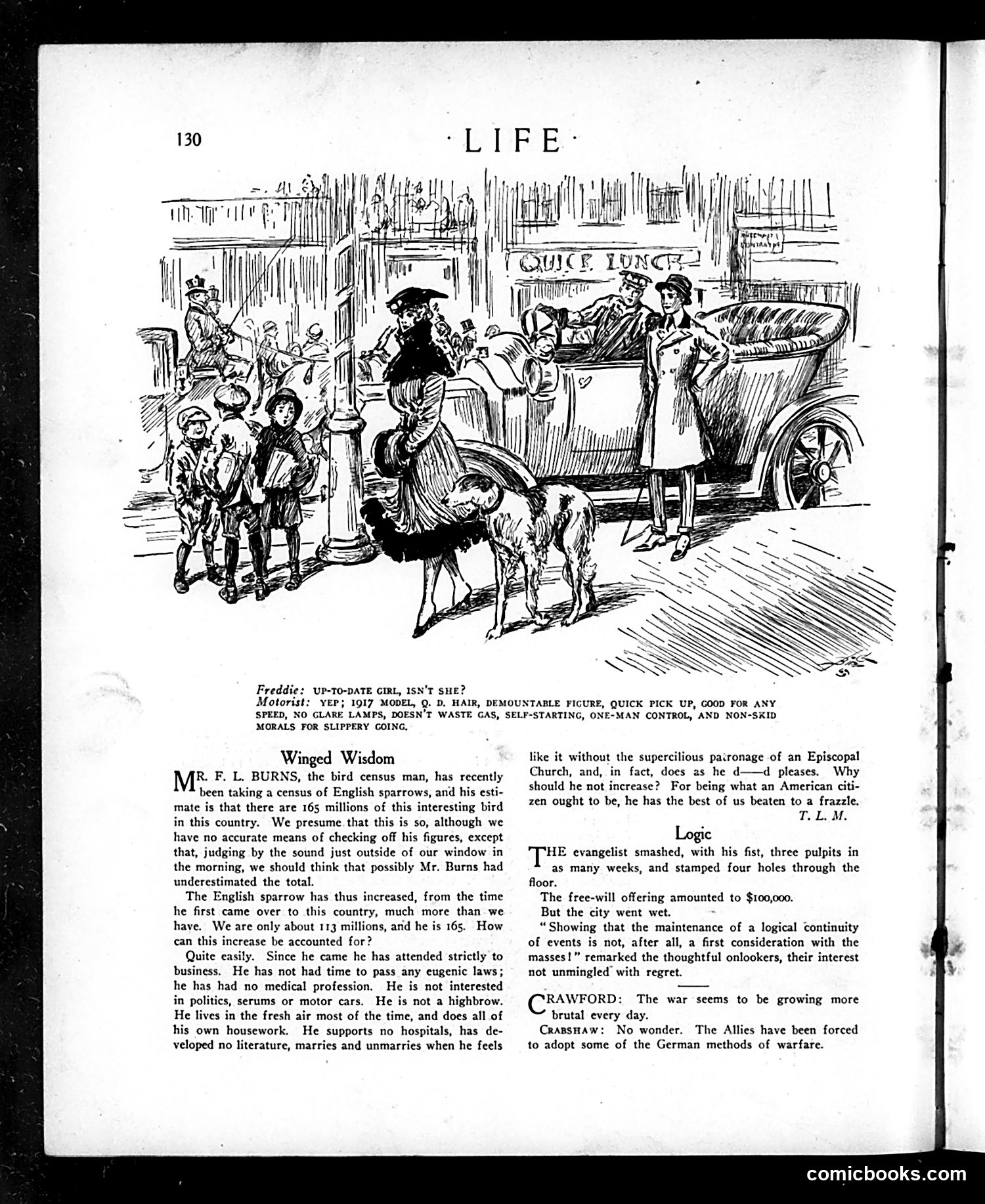
The main cartoon depicts a street scene with a woman and dogs near a fancy automobile labeled "Quick Lunch." The satirical caption mocks the vehicle as an "up-to-date girl" and lists absurd features: "1917 model, O.D. hair, demountable figure, quick pick up, good for any speed, no crank lamps, doesn't waste gas, self-starting, one-man control, and non-skid morals for slippery going." This is satirizing the "modern woman" of 1917—particularly the "flapper" type—by comparing her to an automobile with interchangeable parts and mechanical features. The joke plays on anxieties about women's changing roles, morality, and independence during the WWI era. Terms like "demountable figure" and "non-skid morals" sarcastically reference both automotive innovation and concerns about loose female sexuality.
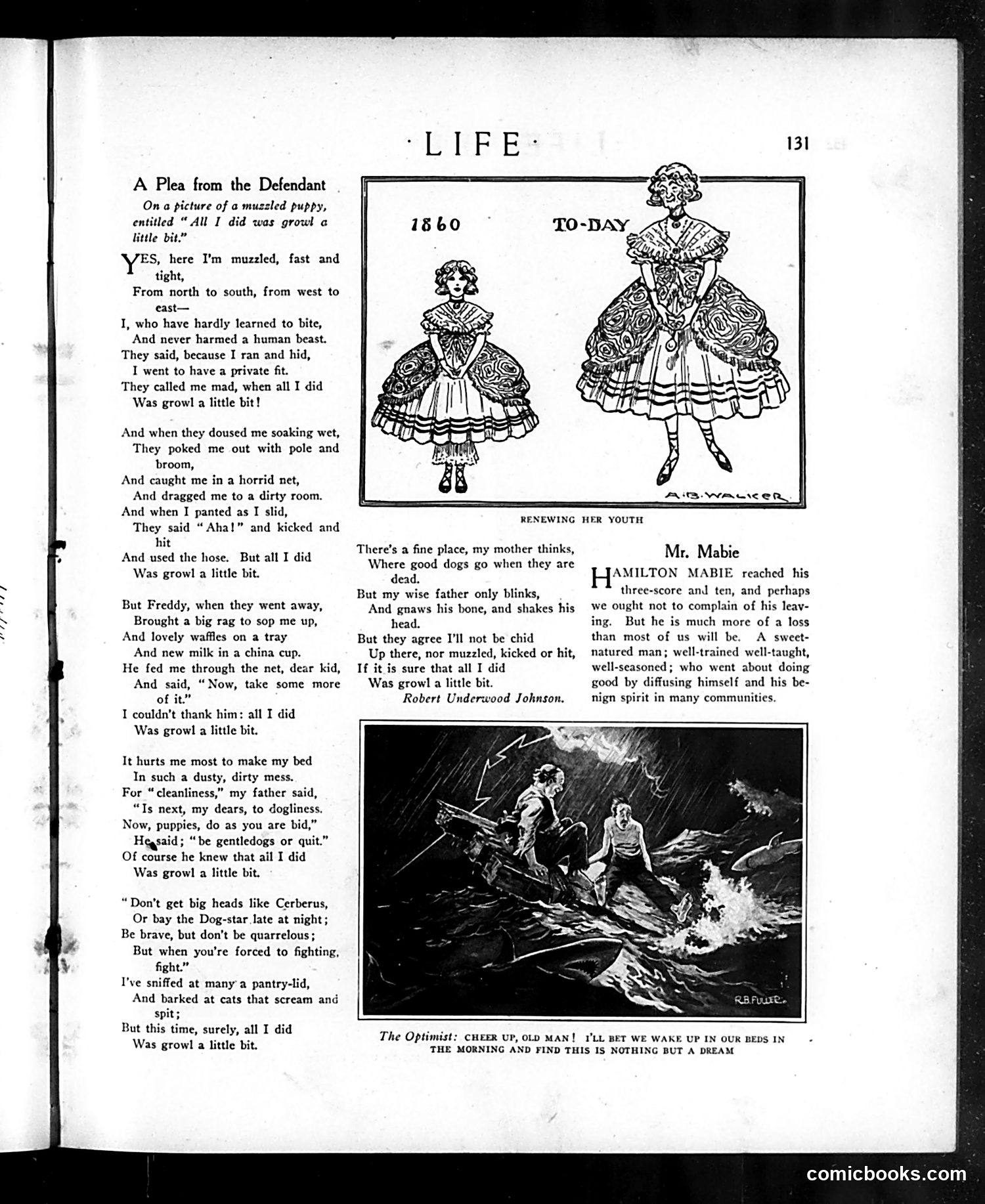
This page contains a poem titled "A Plea from the Defendant" about a muzzled puppy defending itself against accusations of misbehavior. The poem humorously presents the dog's perspective, claiming it never bit anyone and that all its misdeeds—being soaked, netted, dragged—were minor ("grew a little bit"). The accompanying illustration shows the dog's transformation from 1860 to today, depicting it as increasingly refined and well-dressed. Below is a brief biographical entry on "Mr. Mabie" (Hamilton Mabie), described as a well-natured man of good character. The lower illustration appears unrelated, showing people in what seems to be a dramatic or theatrical scene. The satire likely uses the puppy's plea as social commentary on unjust accusations or overblown criticism, though the specific target remains unclear.
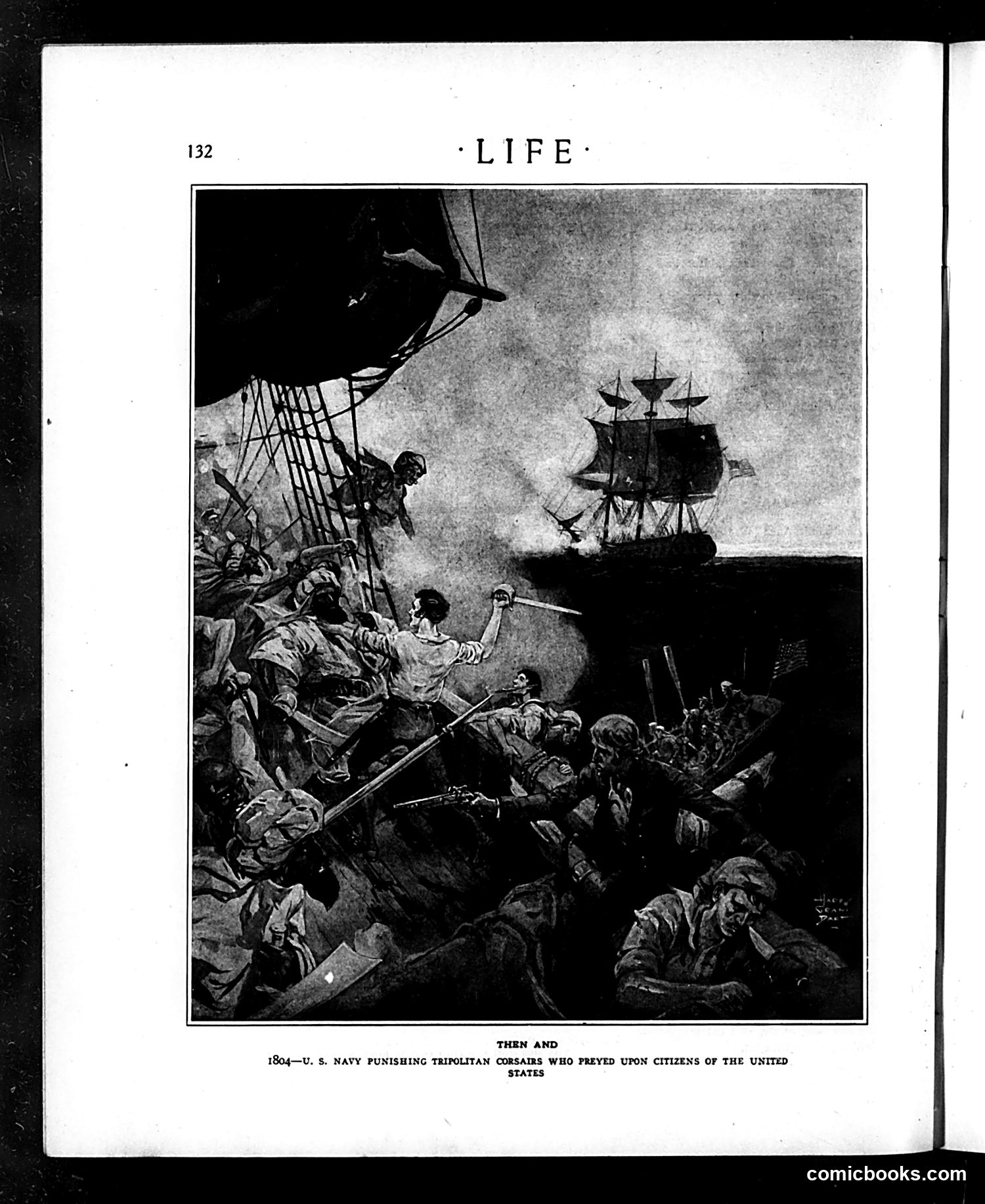
This illustration depicts a naval battle scene captioned "1804—U.S. Navy Punishing Tripolitan Corsairs Who Preyed Upon Citizens of the United States." The image shows American sailors engaged in combat with what appears to be Barbary pirates from Tripoli (in present-day Libya). This references the Barbary Wars (1801-1815), when American naval forces fought pirates operating from North African ports who had been capturing American merchant ships and enslaving crews. The dramatic scene emphasizes American naval power defending its citizens' commercial interests. The composition—with smoke, chaos, and armed conflict—glorifies this military action as justified punishment of those "preying" on Americans. This aligns with early American nationalism and the emerging U.S. Navy's role in protecting maritime commerce.
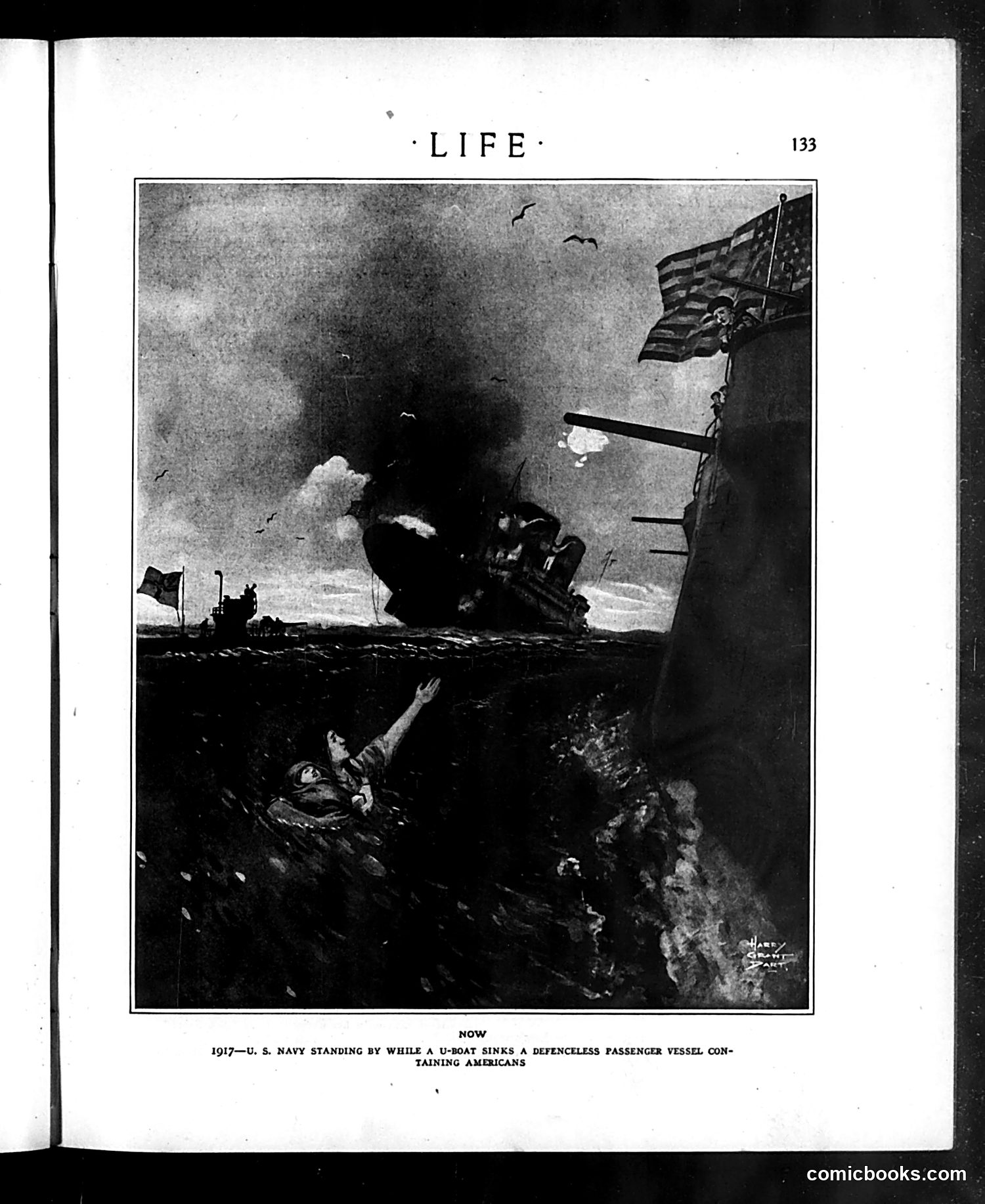
This is a dramatic illustration from *Life* magazine dated 1917, depicting a World War I naval scene. The caption reads: "U.S. NAVY STANDING BY WHILE A U-BOAT SINKS A DEFENCELESS PASSENGER VESSEL CONTAINING AMERICANS." The image shows a U-boat (German submarine) attacking a passenger ship, with an American naval vessel observing from the right side. A soldier or sailor in the water reaches toward the American ship, appearing to plea for help. The satire criticizes American naval inaction during German submarine warfare against American civilian vessels—a major historical grievance that contributed to U.S. entry into WWI in April 1917. The image condemns the perceived passivity of the U.S. Navy in protecting American lives, suggesting moral culpability through non-intervention.
This page announces Life magazine's $500 criticism contest results. The main text discusses Life's history since 1896 in Ireland and America, praising its editorial independence and literary quality. Rather than a political cartoon, this is a literary/editorial feature showcasing reader responses to the contest. Three winning letters appear below, from Birmingham Alabama, Tuxedo Park New York, and Douglas Ontario. The writers praise Life's wit, editorial integrity, and literary contributions while offering mild criticism of its poetry and occasional harshness toward competitors. The "satire" here is gentle—Life uses the contest to celebrate itself through readers' admiring commentary, presenting criticism that's fundamentally complimentary. This reflects Life's role as an intellectual, arts-focused magazine of the era.
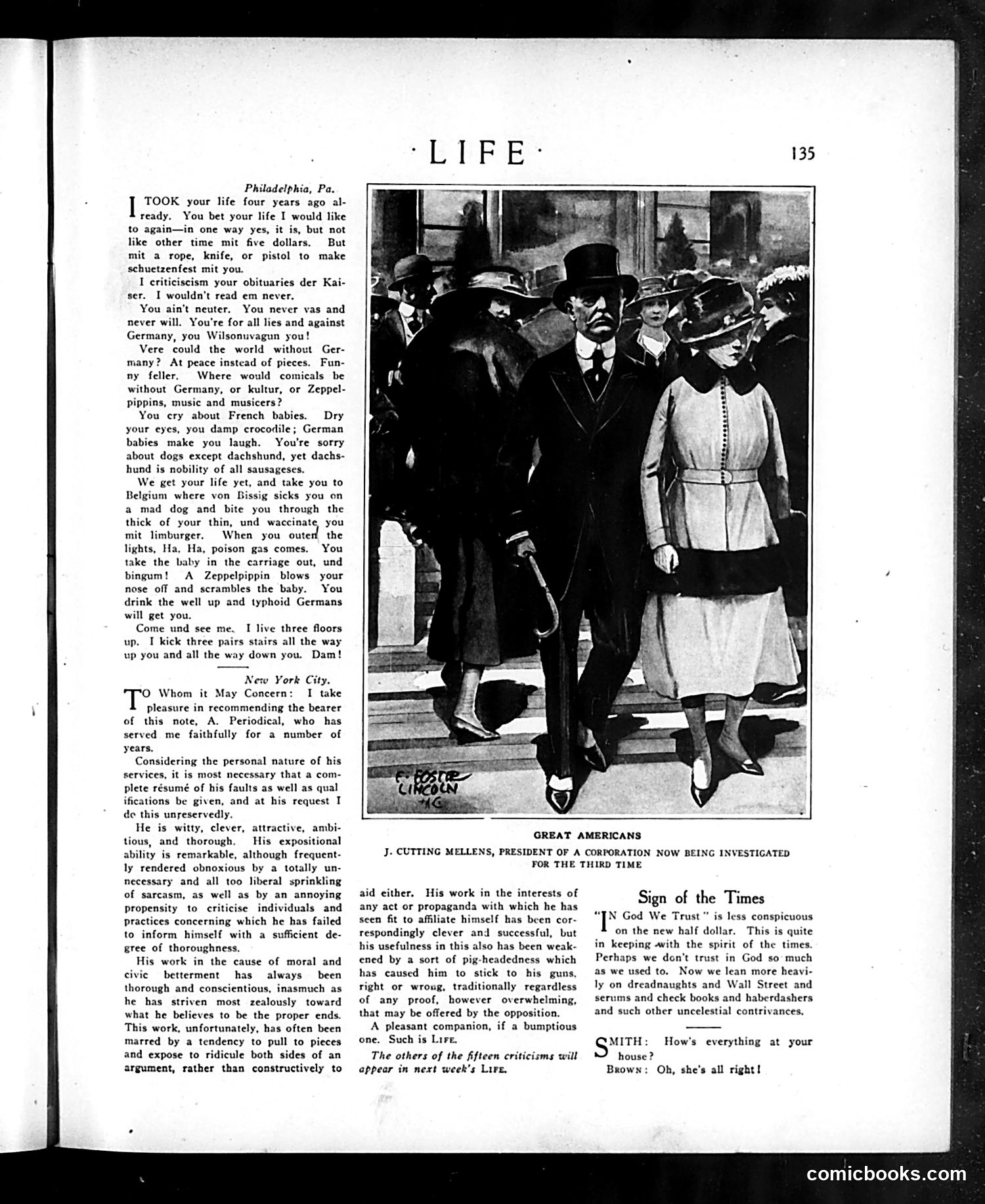
The main photograph shows "J. Cutting Mellens, President of a Corporation Now Being Investigated for the Third Time" — a public figure under scrutiny. The image captures him in what appears to be a formal public setting, surrounded by onlookers. The satirical text surrounding the photo critiques Mellens' character and business practices. It references his repeated involvement in corporate investigations, suggesting a pattern of questionable conduct. The writing emphasizes his cleverness at evading accountability despite apparent wrongdoing, portraying him as someone who manipulates circumstances through cunning rather than honest dealing. The satire implies that despite repeated investigations, he continues operating without serious consequence—a commentary on corporate accountability (or lack thereof) in this era.
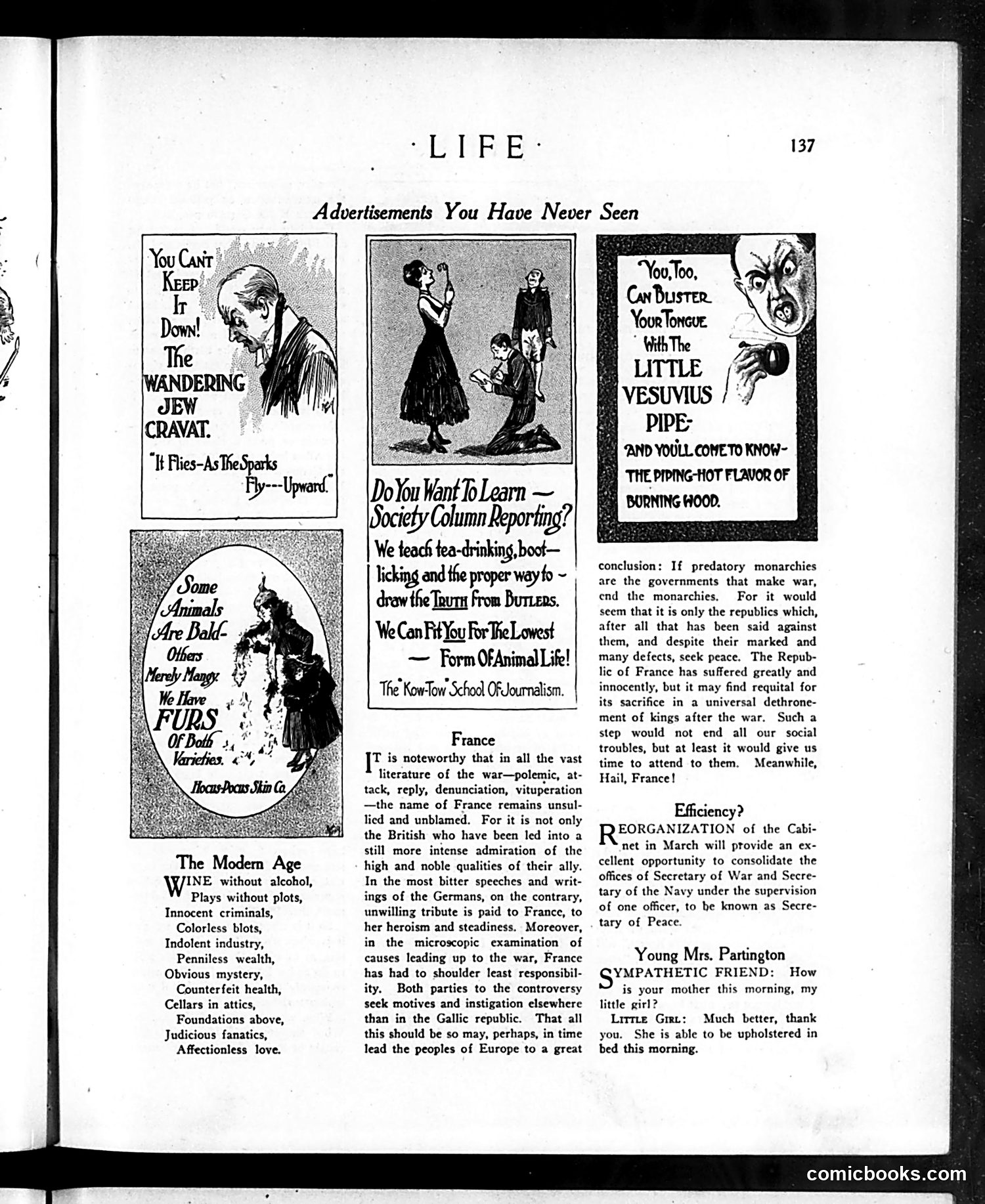
This page mixes fake advertisements with serious political commentary, likely from WWI era. The **fake ads** mock absurdities: one advertises a "Wandering Jew cravat" that "flies upward," another offers "society column reporting" instruction at a "Kow-Tow School of Journalism" (mocking obsequious journalism), and a third promotes a crude pipe with inflammatory language. The serious section **praises France**, noting that despite wartime literature filled with blame toward various nations, France remains uniquely unblamed by even enemy Germans—crediting French heroism and minimal war responsibility. The author argues this vindication may lead post-war Europe toward eliminating monarchies in favor of republics, which he claims inherently seek peace. A brief humor section includes wordplay: a child says her mother is "upholstered in bed" (likely meaning "up and able"), a nonsensical joke typical of the era's humor style. The page demonstrates Life's dual nature: biting satire alongside earnest political argument.
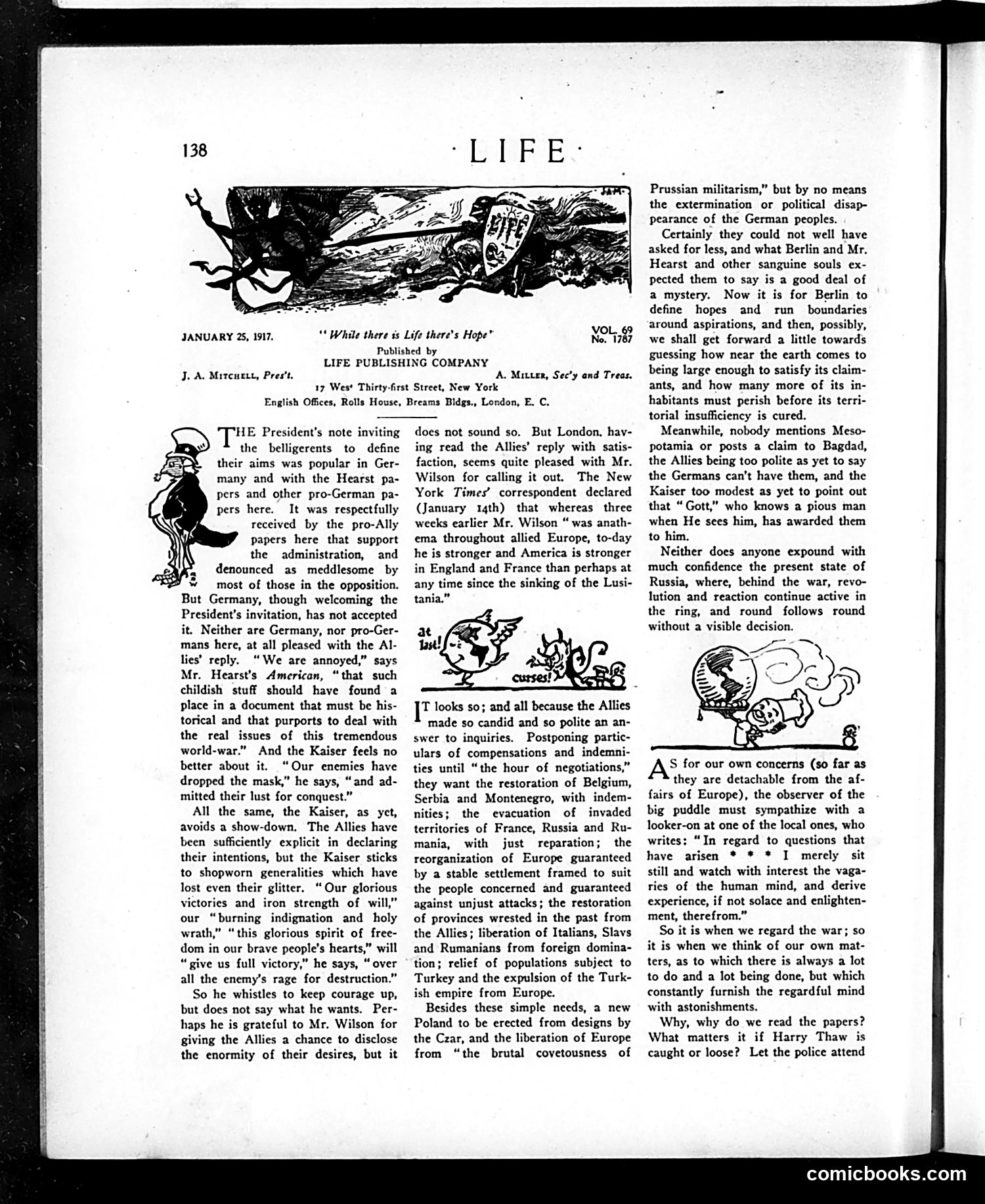
This page satirizes President Wilson's attempt to broker peace in World War I by inviting belligerents to state their war aims. The article mocks the contradictory reactions: Germany welcomed the invitation but rejected the Allies' response, while pro-German American papers (like Hearst's) called the Allies' stated goals "childish," and the Kaiser complained the Allies "dropped the mask" revealing conquest desires. Life's satire targets the Kaiser's hollow rhetoric—his repeated invocations of "glorious victories" and "iron strength" while avoiding specifics about what Germany actually wants. The cartoons (visible as small illustrations) appear to mock German bluster. The editorial suggests Germany must now clarify its own peace terms, implying the Kaiser's vague generalizations no longer suffice. The piece subtly supports the Allies' transparent, detailed response while ridiculing German evasiveness and American pro-German sentiment.
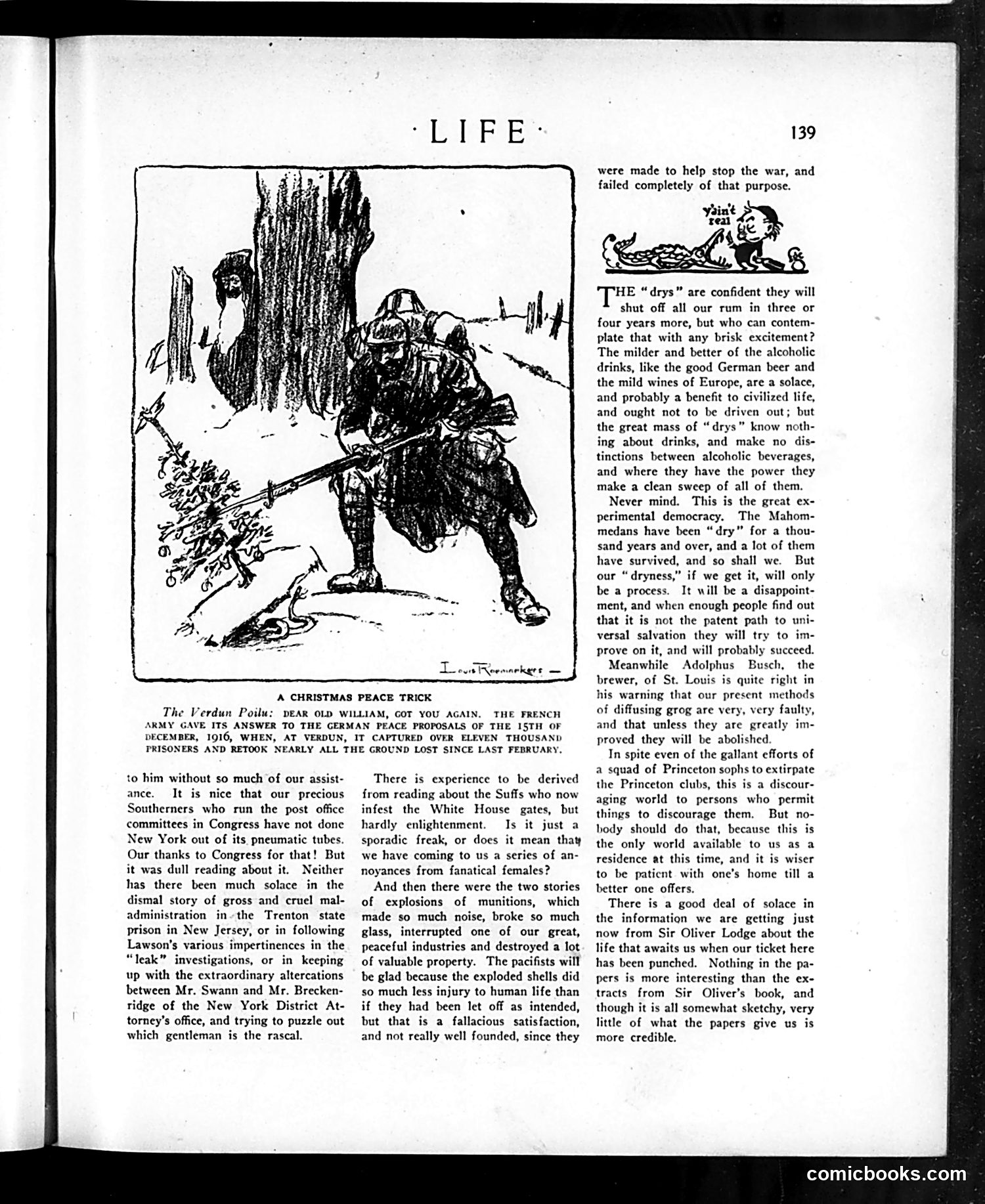
**The Cartoon:** "A Christmas Peace Trick" depicts a French soldier (poilu) at Verdun confronting a German soldier labeled "William" (representing Kaiser Wilhelm II). The caption explains this illustrates France's military response to Germany's December 15, 1916 peace proposals—by capturing 11,000 prisoners and retaking lost ground, France effectively rejected the offer through military action rather than negotiation. **Historical Context:** This references the Battle of Verdun, the devastating 1916 offensive. Germany's peace overtures came amid stalemate; France answered by demonstrating military capability rather than accepting terms. The "trick" is that Germany's peace offer was countered with battlefield success. **The Satire:** The cartoon mocks Germany's peace proposal as insincere—suggesting military strength, not diplomacy, was the appropriate response. It celebrates French resolve while implying German proposals were propaganda. **Surrounding Text:** The editorial discusses various domestic American concerns (postal service, prison conditions, munitions explosions, women's suffrage activists at the White House, prohibition debates) without the "brisk excitement" of foreign warfare.
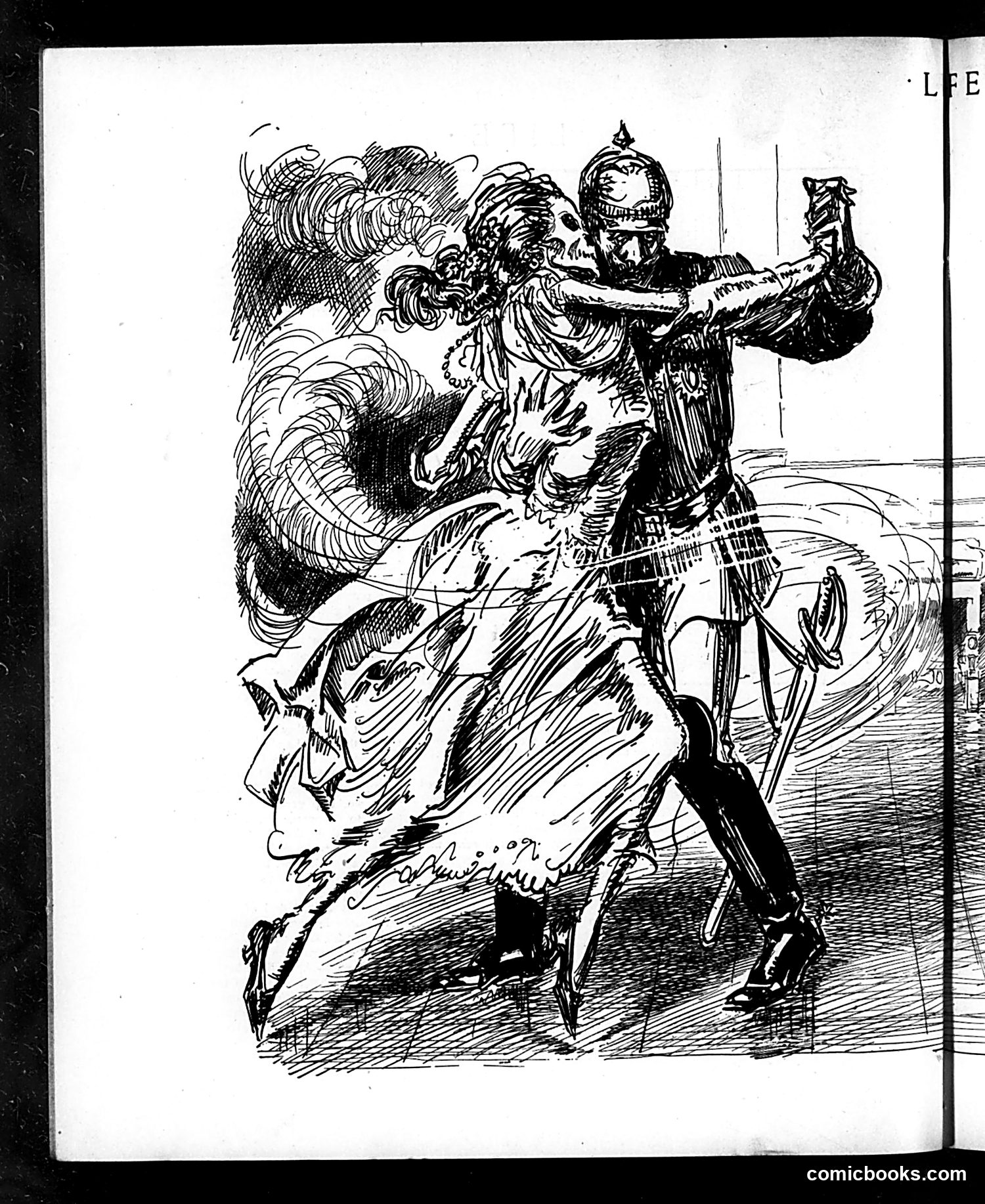
This appears to be a satirical illustration from *Life* magazine showing a military officer in a Prussian-style spiked helmet forcibly restraining or controlling a woman in elaborate dress, suggesting she represents a nation or state being dominated by militarism. The imagery critiques German imperial militarism and authoritarian control, likely from the early 20th century. The woman's ornate clothing contrasts with the officer's rigid military uniform, emphasizing the clash between civilian life and military domination. The exaggerated features and style are typical of *Life*'s political satire. Without visible text identifying specific figures or dates, the exact historical moment remains unclear, though the German military aesthetic suggests commentary on Prussian power or imperial German politics during a period of international tension.
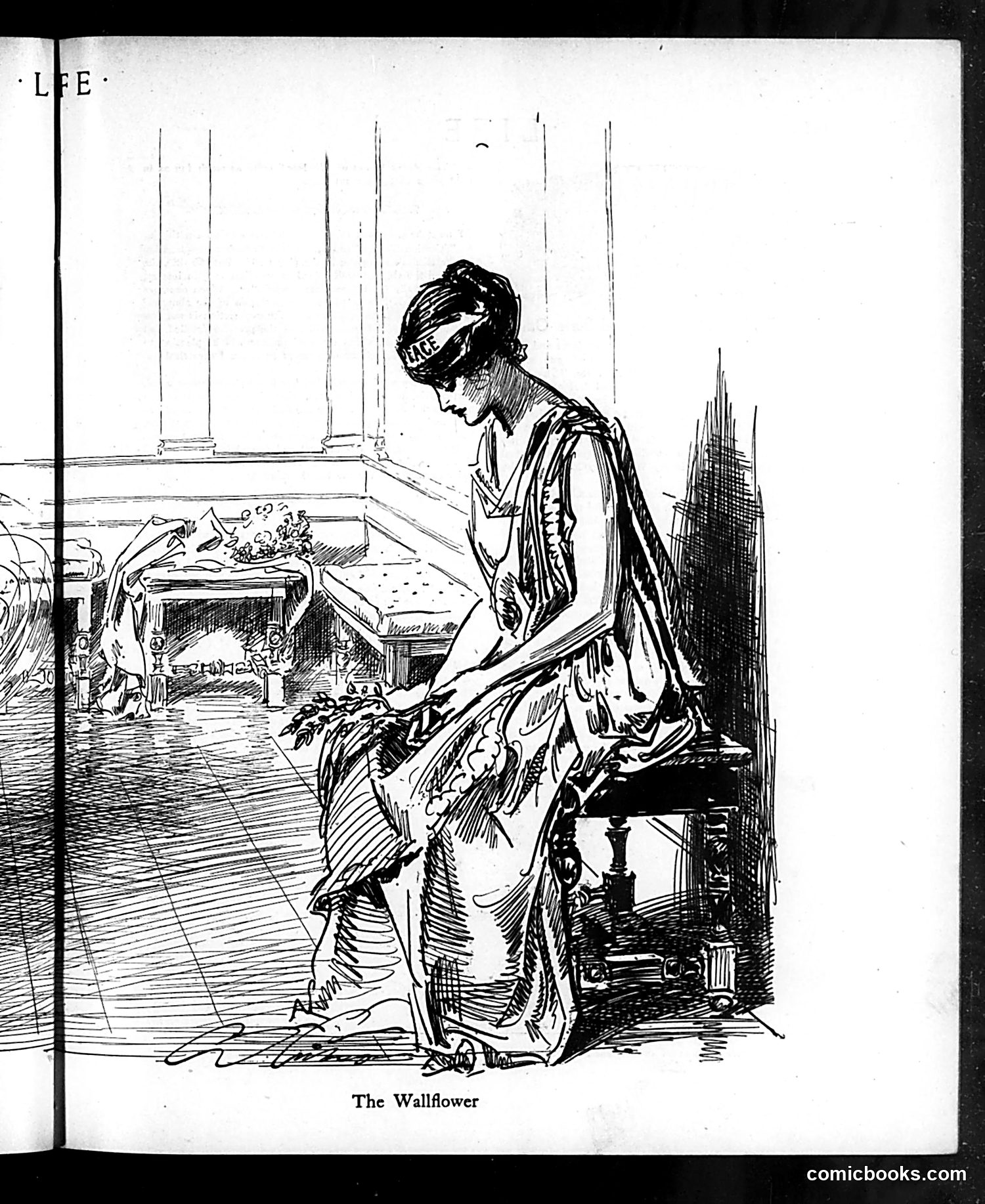
This illustration depicts a young woman seated alone in what appears to be a social gathering or dance setting, holding flowers. The title "The Wallflower" refers to the period slang term for a woman who sits out dances, typically because she lacks a dance partner or social attention. The satire appears to target the social anxiety and romantic disappointment experienced by unmarried women in early-20th-century American society. The woman's isolation—positioned at the margin of the room while activity occurs in the background—visualizes the discomfort of social exclusion. Her flowers likely represent unfulfilled romantic hopes. This reflects Life magazine's frequent commentary on courtship rituals, gender roles, and social embarrassment during the era.
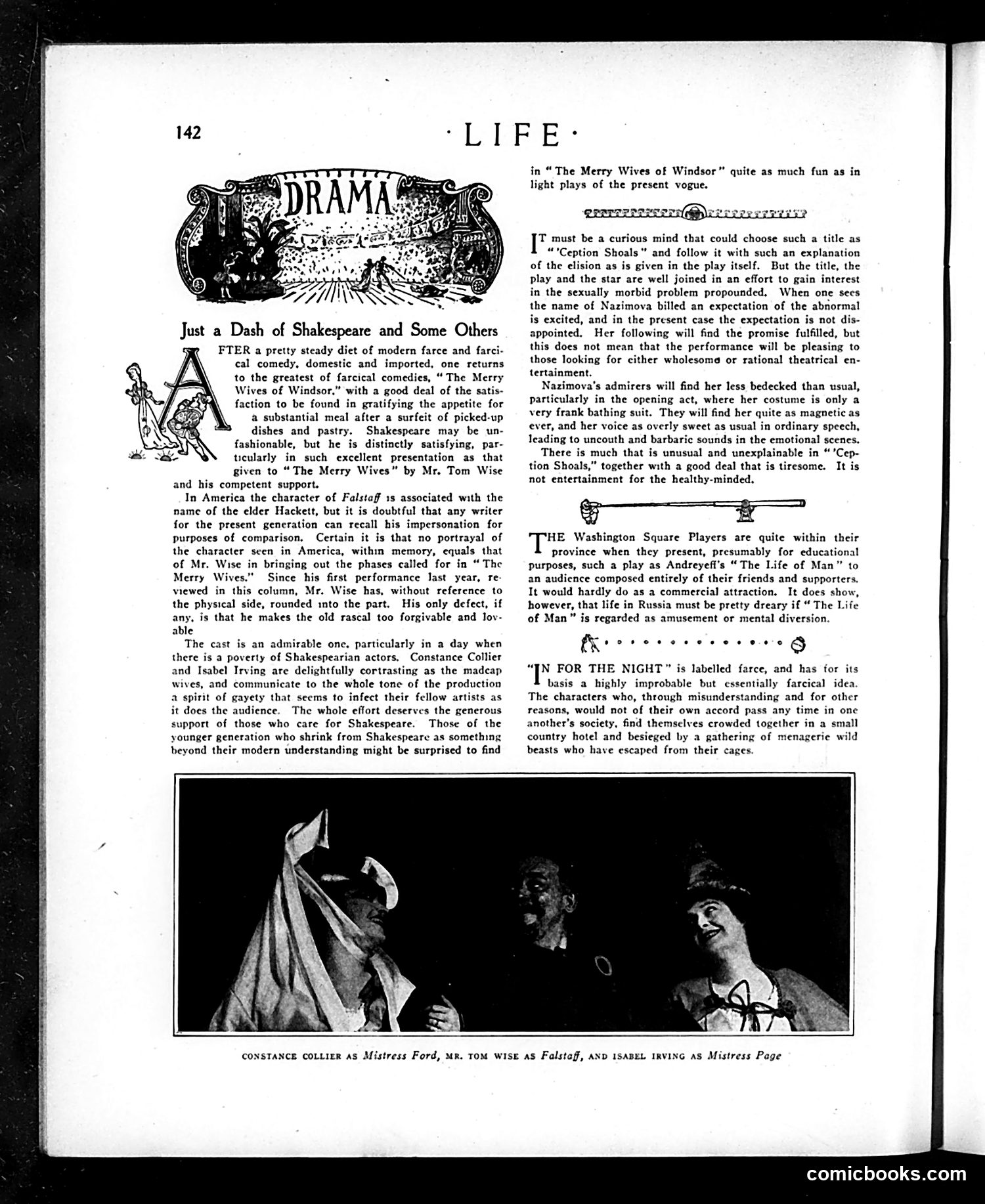
This page reviews three theatrical productions, with particular emphasis on a Shakespeare production and contemporary plays. **Main Content:** The article praises Tom Wise's performance as Falstaff in "The Merry Wives of Windsor," noting it surpasses remembered portrayals by the elder Hackett. The reviewer argues Shakespeare remains entertaining—as funny as modern comedies—and praises the supporting cast, particularly Constance Collier and Isabel Irving as the title wives. **The Photograph:** Shows three actors: Collier as Mistress Ford, Tom Wise as Falstaff, and Irving as Mistress Page, apparently in a comedic scene. **Critical Context:** The reviews also cover Nazimova in "'Ception Shoals" (criticizing its morbid sexual themes and Nazimova's "barbaric" emotional delivery) and the Washington Square Players' production of Andreyeff's "The Life of Man" (dismissing Russian drama as dreary). The page essentially argues for Shakespeare's continued relevance against modern theatrical trends.
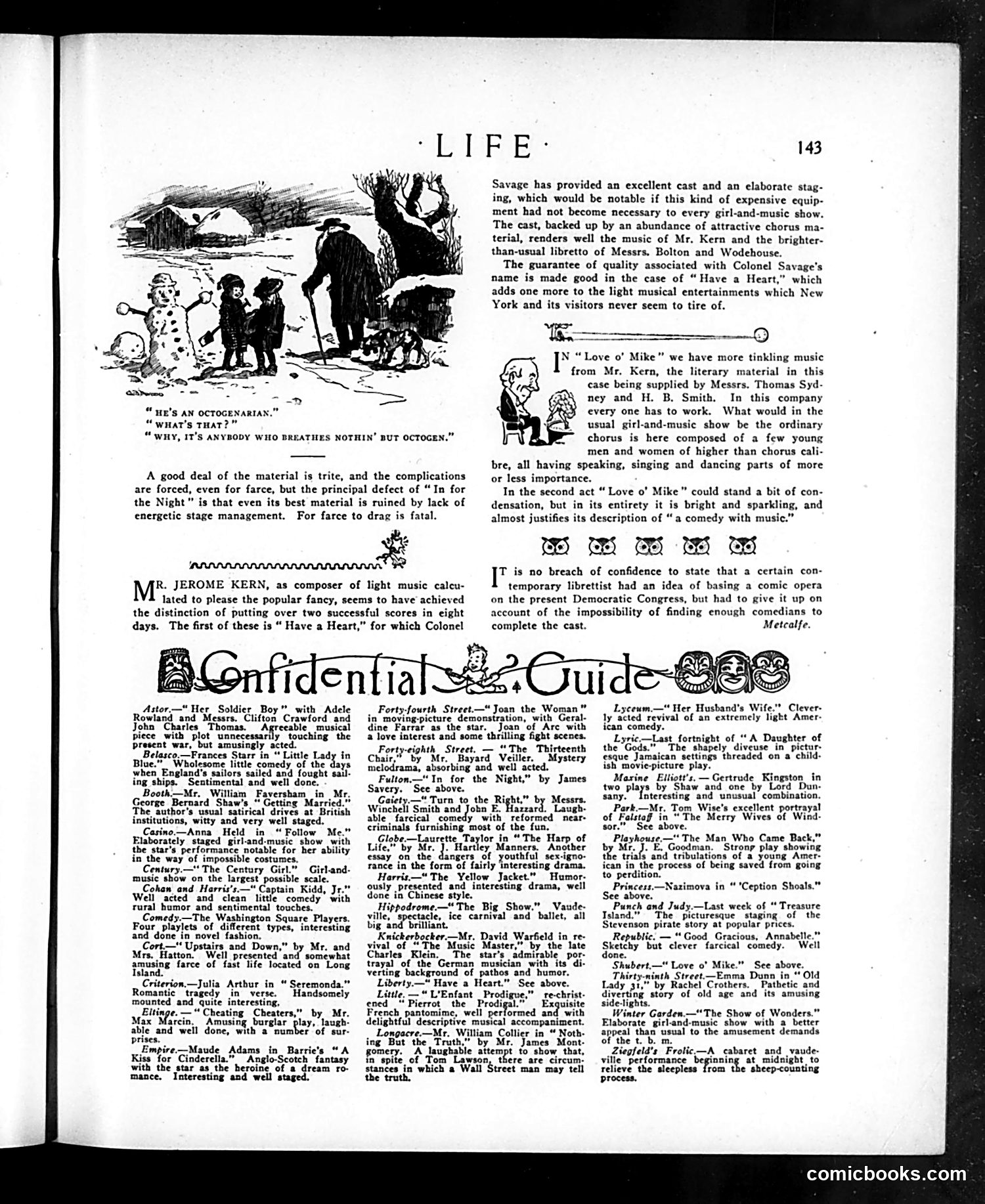
This page reviews theatrical productions on Broadway, primarily discussing musicals by composer Jerome Kern. The cartoon at the top is a joke about the word "octogenarian"—a character mistakes it for someone who breathes "octogen" (a chemical explosive), creating wordplay humor typical of Life's style. The main content critiques two Kern musicals: "Have a Heart" (with Colonel Savage's production) and "Love o' Mike." Reviewers praise the music but note that elaborate staging had become expected in girl-and-music shows. The most political element appears in the italicized section by Metcalfe, which jokes that a contemporary librettist abandoned plans to base a comic opera on "the present Democratic Congress" because there weren't enough comedians available to fill the cast—a satirical jab suggesting Democratic congressmen were themselves insufficiently competent or ridiculous. This reflects early-20th-century theatrical criticism mixed with political commentary.
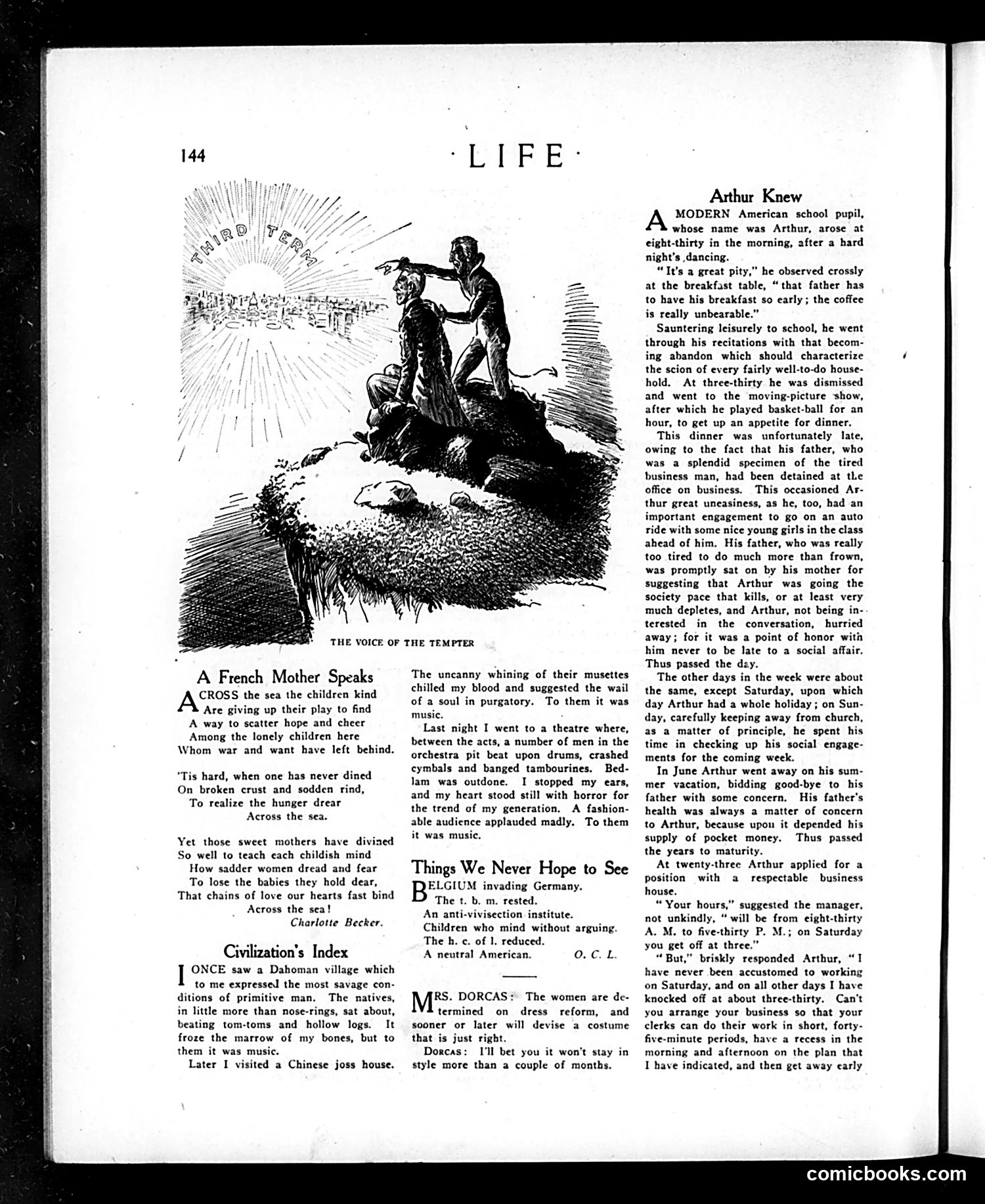
This page contains several satirical pieces critiquing early 20th-century American society and culture. **"The Voice of the Tempter"** (the illustration) shows a demonic figure tempting children, accompanying a sentimental poem about French children's charity appeals to American children. **"Civilization's Index"** mocks cultural relativism by equating "savage" non-Western music (Dahoman drums, Chinese instruments) with modern orchestral percussion at fashionable theaters—suggesting refined society enjoys the same "noise" it deems primitive elsewhere. **"Things We Never Hope to See"** lists absurdities, including "a neutral American" (likely referencing American neutrality debates during early WWI), unreformed children, and Belgium invading Germany (the reverse of actual German invasion). **"Arthur Knew"** satirizes a pampered, self-centered American schoolboy who complains about breakfast timing, prioritizes social engagements over family, and depends on his father's income while showing no genuine concern for his parent's exhaustion. The piece critiques youth entitlement and the "society pace that kills."
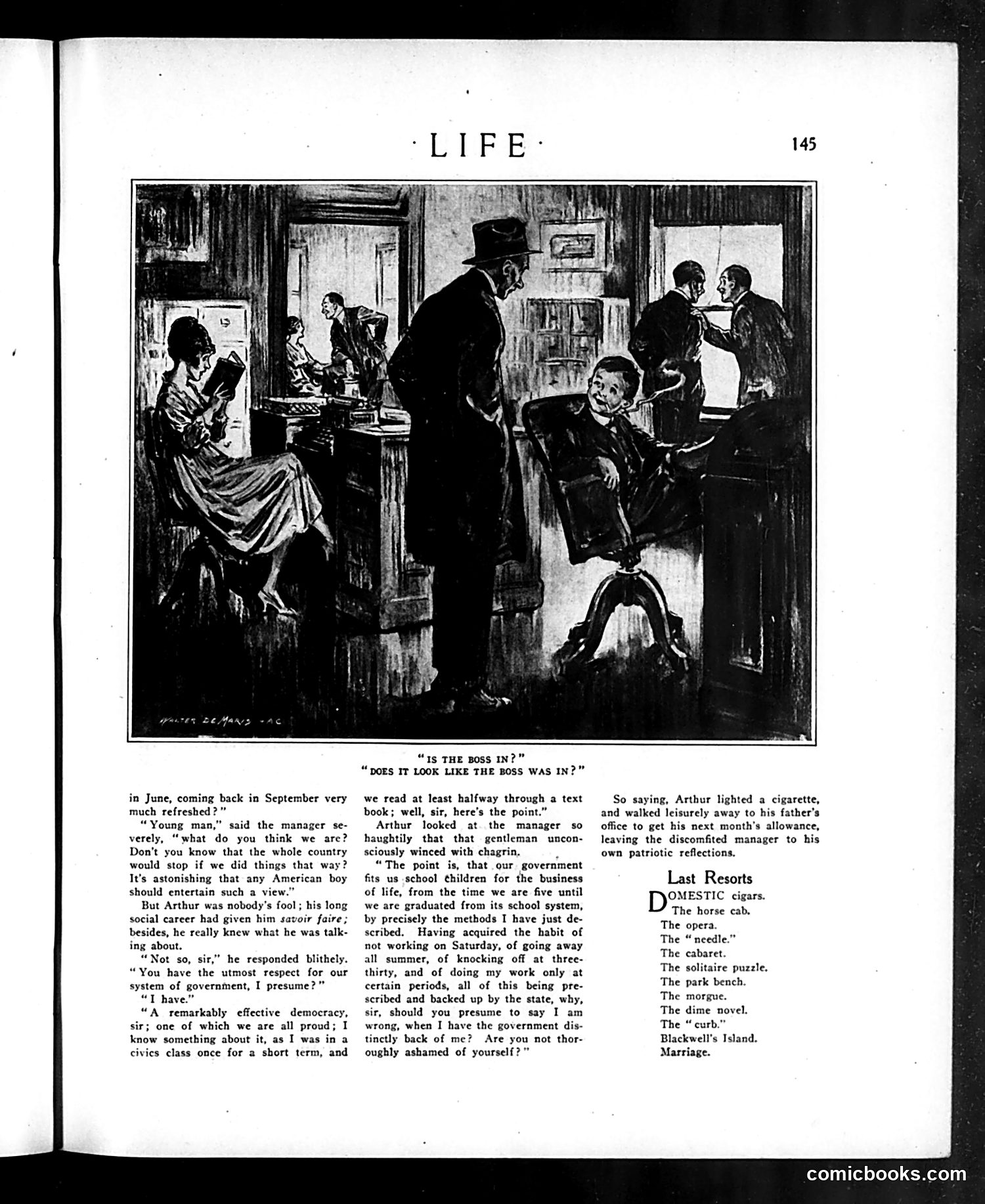
This Life magazine page satirizes American youth entitlement and the gap between democratic ideals and workplace reality. **The Main Cartoon:** A young man named Arthur approaches his boss requesting summers off and a shortened workweek, arguing that the American education system teaches exactly this schedule—weekends free, summers off, half-days—so why shouldn't work follow the same pattern? **The Satire:** Arthur weaponizes democratic principles and civics-class rhetoric against his boss, exposing the hypocrisy: if the government endorses this lifestyle for children, why is it irresponsible for adults? The joke hinges on Arthur's audacious logic and his shameless exit to collect his father's allowance. **Social Context:** This mocks privileged youth who absorb entitlement from their schooling and family wealth, and critiques how American education may fail to instill actual work discipline. The "Last Resorts" sidebar lists society's escapes from responsibility—suggesting widespread dissatisfaction with obligation. The cartoon reflects early 20th-century anxieties about generational character and work ethic.
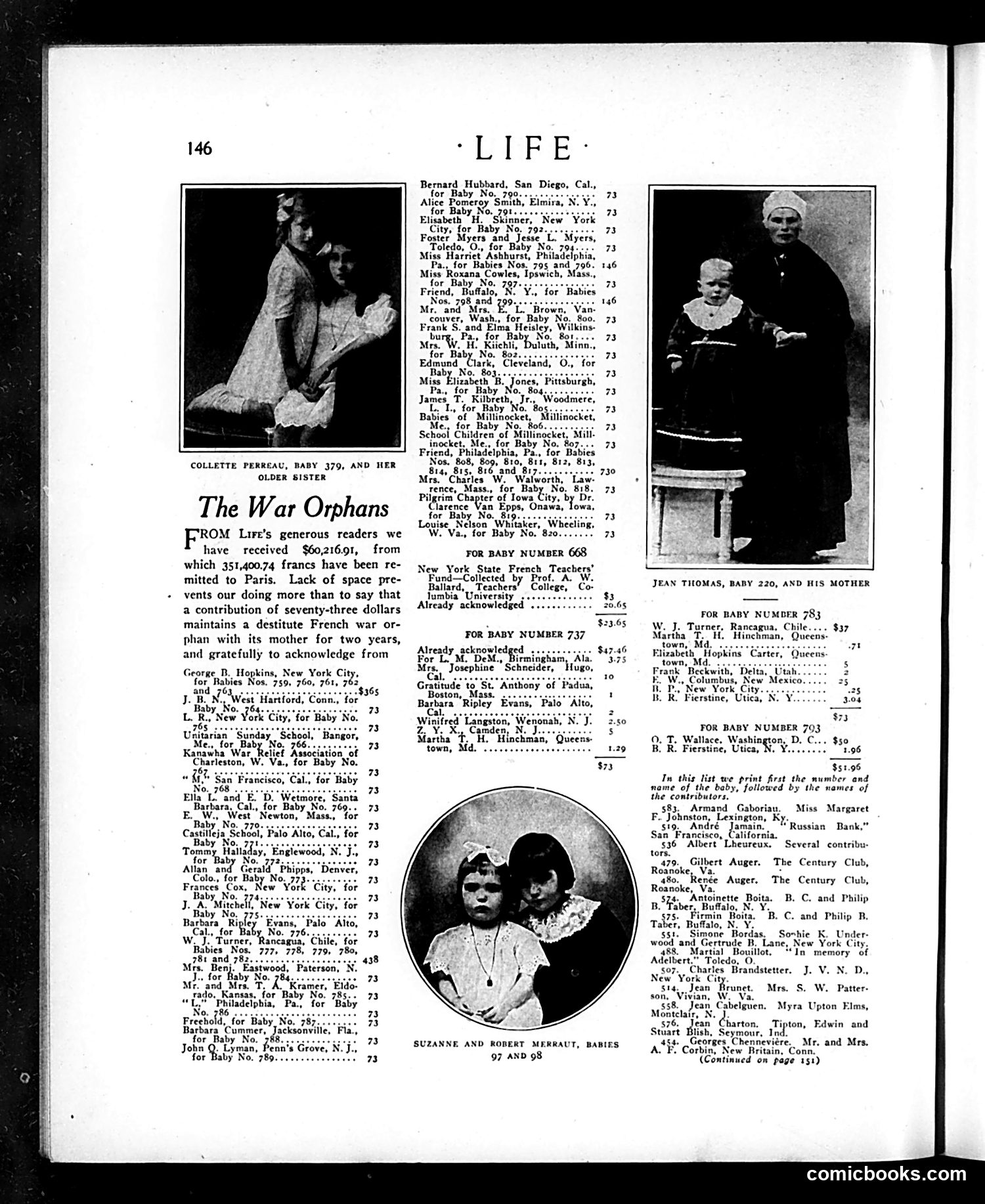
This page documents Life magazine's fundraising campaign to support French war orphans and their mothers following World War I. The photographs show actual orphans being aided: Collette Perreau (Baby 379) with her older sister, Jean Thomas (Baby 220) with his mother, and Suzanne and Robert Merraut (Babies 97 and 98). The bulk of the page lists donors and their contributions. Life reports receiving $60,216.91, with $51,400.74 francs sent to Paris. The text notes that $73 maintains one orphan with their mother for two years—establishing a specific, actionable donation amount for readers. The piece is humanitarian rather than satirical. It represents Life's post-WWI charitable mission, appealing to American generosity to support European civilians devastated by the war. Donors ranged from individuals to organizations like the New York State French Teachers' Fund, demonstrating broad-based American support for French relief efforts in the 1920s.
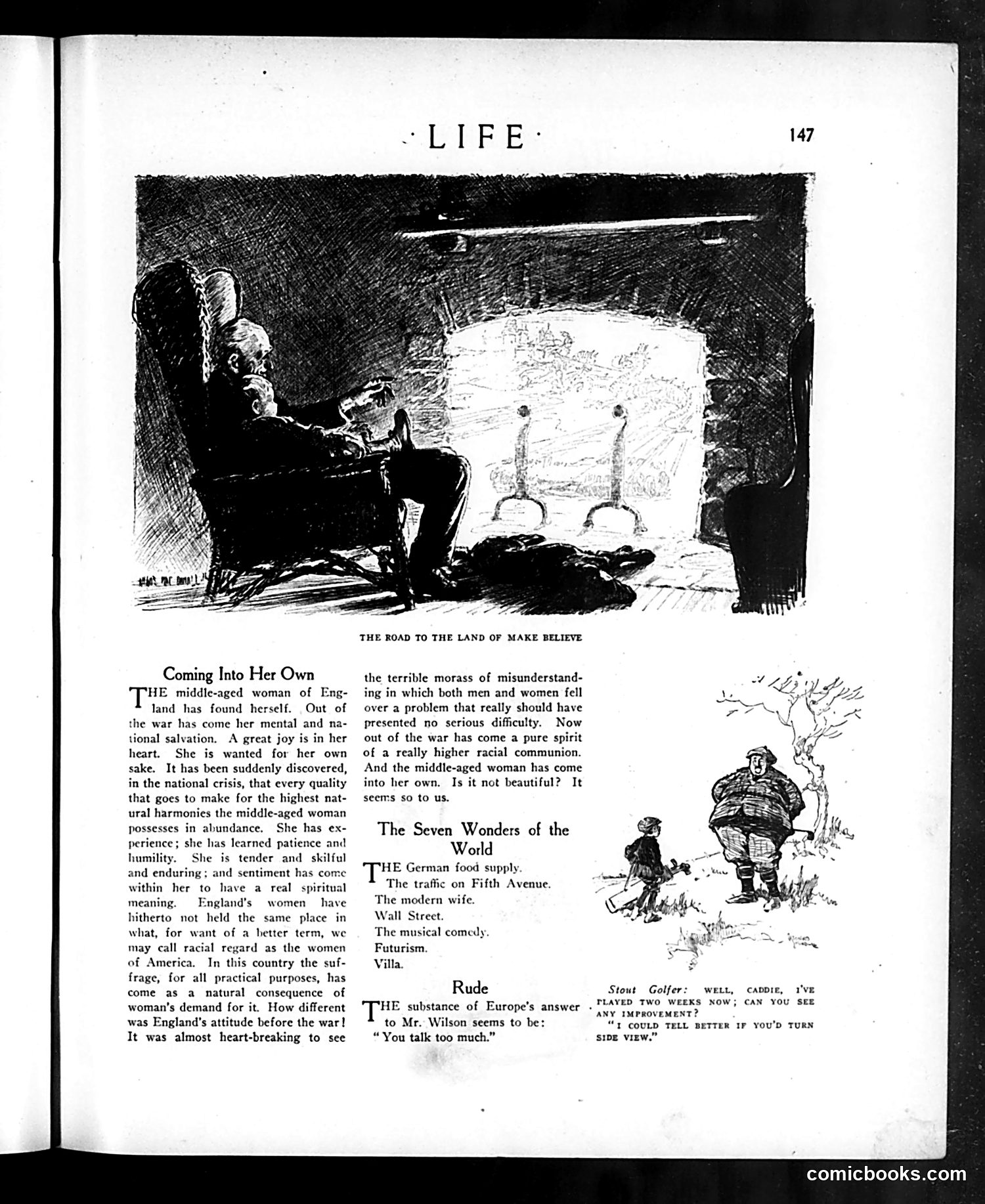
This post-WWI page celebrates the elevated status of middle-aged English women, who gained newfound social respect through wartime contributions. The text argues that qualities previously undervalued—patience, tenderness, practical skill—suddenly became nationally valued, allowing these women to "come into her own." The satirical elements include: **"Seven Wonders of the World"**: A mock list juxtaposing trivial modern American concerns (Fifth Avenue traffic, Wall Street, musical comedy) with serious matters, suggesting American frivolousness. **"Rude"**: Europe's curt response to President Wilson—"You talk too much"—satirizes both European dismissiveness toward American diplomatic overtures and Wilson's verbose idealism. **Golf cartoon**: A stunt golfer joke about perspective/improvement, unrelated to the page's themes. The main satire targets the irony that England needed a war to recognize women's inherent value, questioning whether this recognition was genuinely about equality or merely wartime necessity.
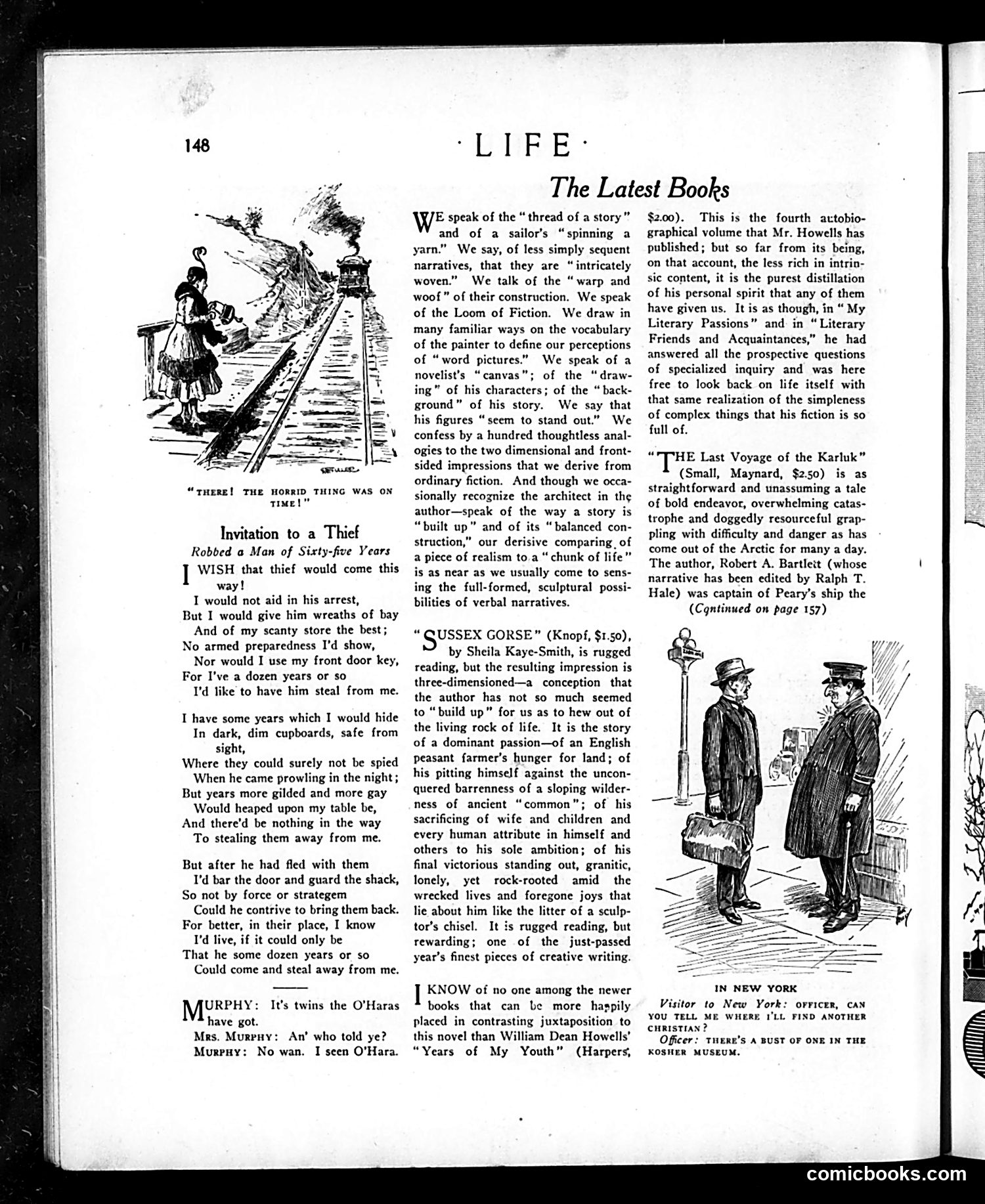
**The Main Cartoon:** The top illustration shows a figure on railroad tracks with the caption "THERE! THE HORRID THING WAS ON TIME!" This appears to be a satirical comment on railroad punctuality—likely mocking either the rarity of trains running on schedule or expressing frustration with their reliability. The "horrid thing" refers to the train itself. **The Poem "Invitation to a Thief":** This is sentimental verse expressing a common theme: the speaker wishes someone would steal their years of aging. The poem romanticizes youth-stealing, wishing a thief would take away unwanted years of decline while leaving the "gilded and gay" years intact—a humorous meditation on aging anxiety. **The Book Reviews Section:** Reviews discuss literary technique using metaphors (thread, loom, canvas, building). The reviews praise *Sussex Gorse* by Sheila Kaye-Smith as three-dimensional storytelling and favorably contrast it with William Dean Howells' autobiography *Years of My Youth*. **Overall Context:** This is a typical early 20th-century *Life* magazine page mixing light humor, poetry, and cultural criticism for educated readers.
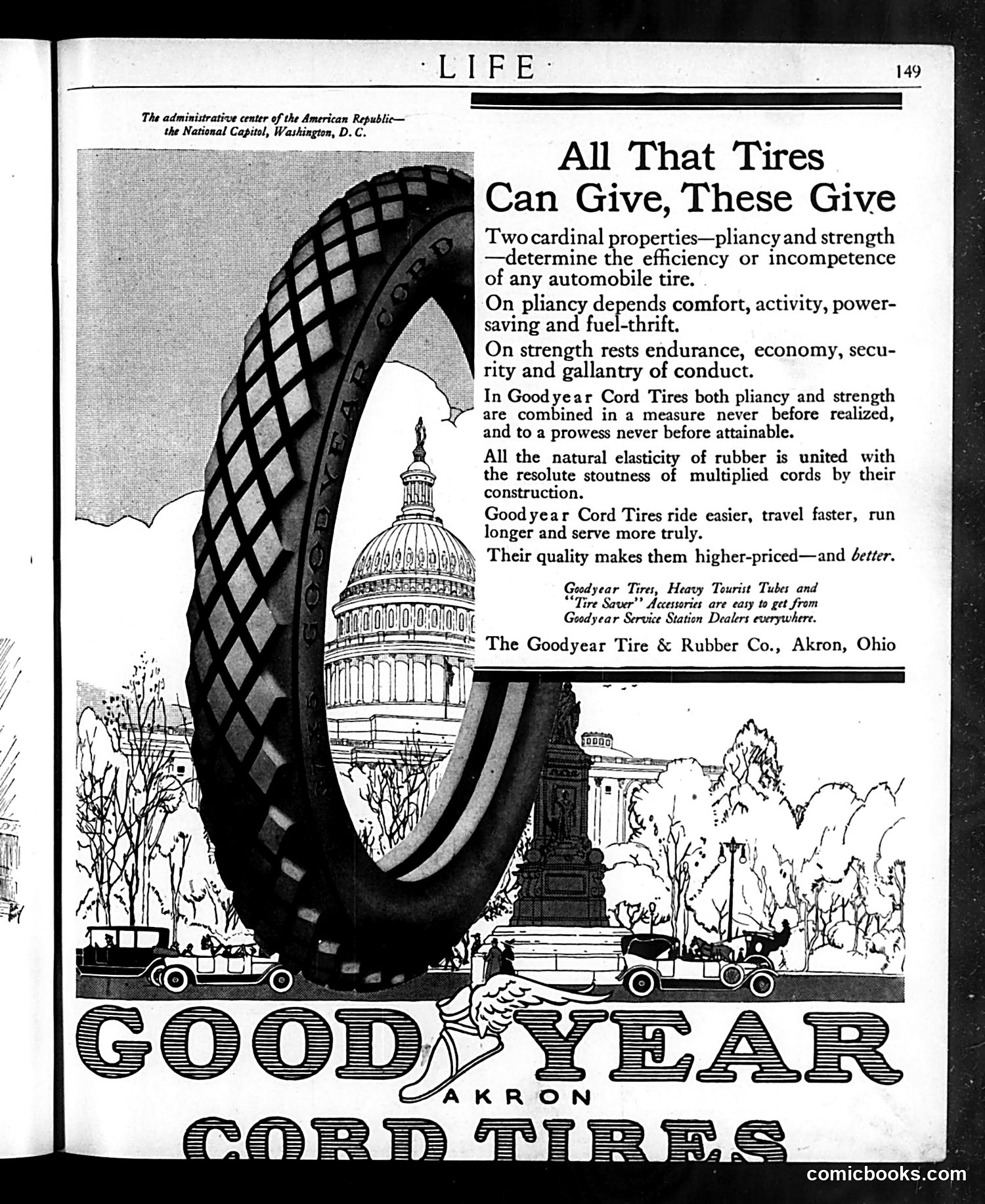
This is a **Goodyear tire advertisement**, not political satire. The page uses the U.S. Capitol building as a visual metaphor for stability and permanence to sell automobile tires. The giant tire arches over the Capitol dome, with automobiles passing beneath. The ad's rhetorical strategy compares tire qualities—"pliancy and strength"—to civic virtues like "security and gallantry of conduct," suggesting that buying Goodyear tires is as fundamentally American as the Capitol itself. The advertisement acknowledges higher pricing ("higher-priced—and *better*") while emphasizing durability and reliability. This reflects early automotive marketing that positioned quality tires as essential infrastructure for American progress and mobility. There is no satire or political commentary visible here—it's straightforward corporate advertising using patriotic imagery and architectural grandeur to build brand prestige.
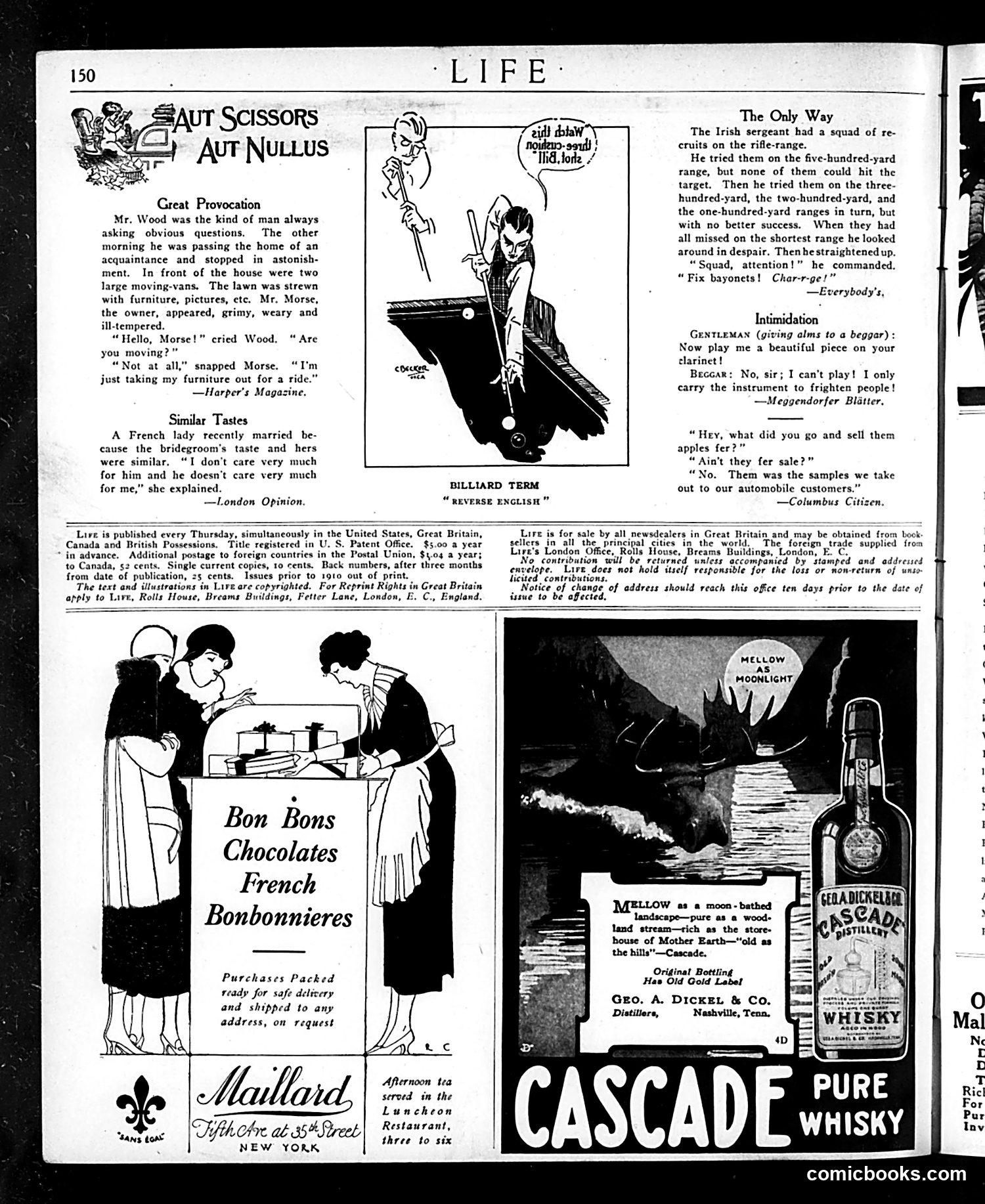
This page from *Life* magazine contains several brief humorous anecdotes typical of early 20th-century American satire, plus advertisements. **The main cartoons/jokes:** 1. **"Great Provocation"** (top left): A man asks an obviously moving neighbor "Are you moving?" while furniture sits outside. The joke is about asking stupid, obvious questions—a common *Life* theme mocking social obtuseness. 2. **"The Only Way"** (top right): An Irish drill sergeant, frustrated that recruits miss targets at all distances, orders them to fix bayonets and charge. The satire plays on Irish stereotypes and military incompetence. 3. **"Billiard Term: Reverse English"** (center): A cartoon showing billiards terminology used metaphorically—likely about deception or irony in everyday speech. The remaining content is primarily **advertisements** for Bon Bons chocolates, Maillard confections, and Cascade whiskey, which dominated *Life's* revenue model.
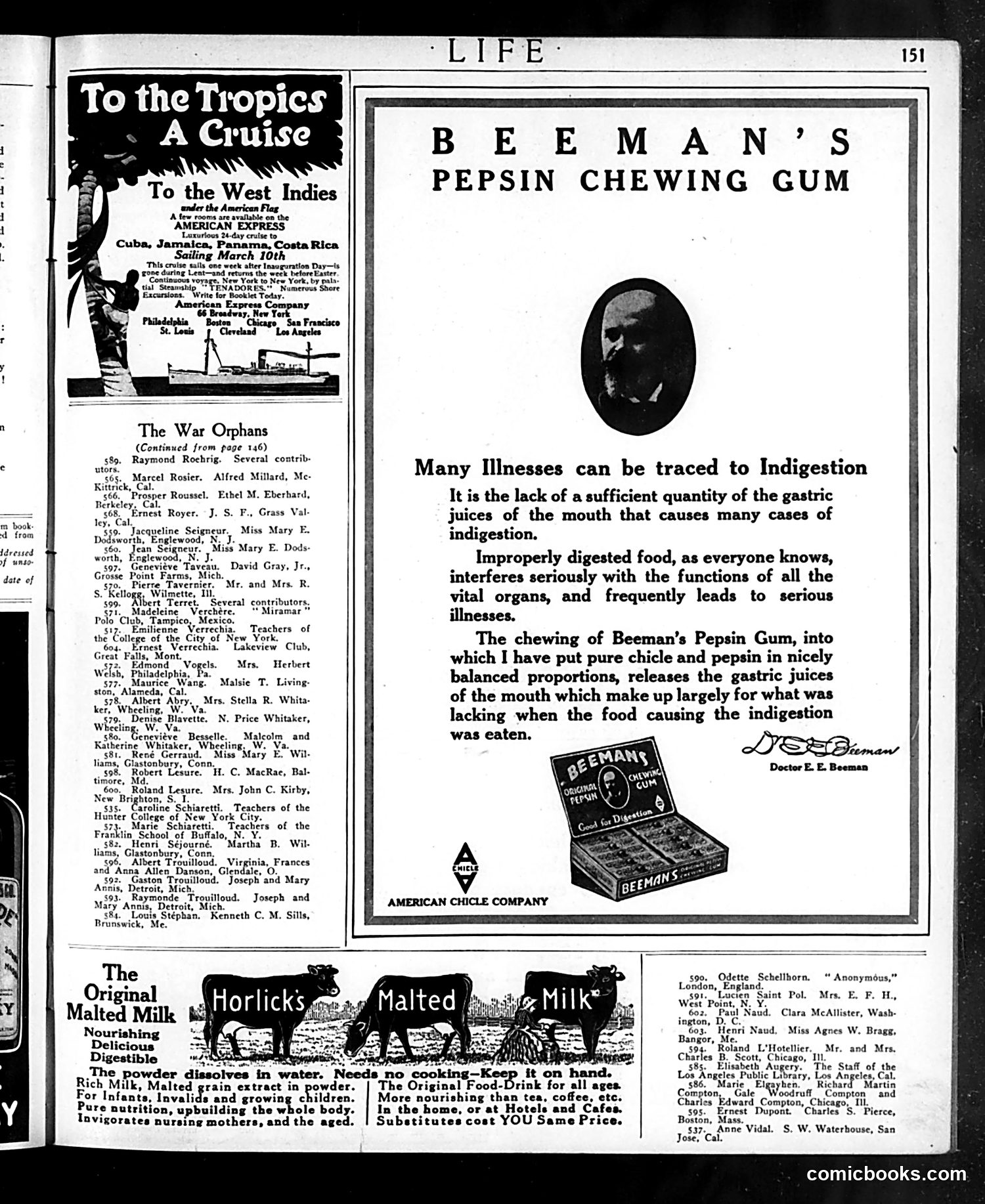
This page from *Life* magazine (page 151) is dominated by commercial advertisements rather than satirical cartoon content. It contains three major ads: 1. **"To the Tropics: A Cruise"** – promoting a 20-day cruise to the West Indies via American Express, departing March 10th 2. **Beeman's Pepsin Chewing Gum** – endorsed by "Doctor E.E. Beeman," claiming the gum aids digestion by stimulating gastric juices; this reflects early-20th-century medical marketing that would seem dubious today 3. **Horlick's Malted Milk** – marketed as a nutritious food drink for infants, invalids, and nursing mothers The page also contains a continuation of "The War Orphans" section with a long list of contributors' names. There is no satirical political cartoon visible. The advertising reflects period attitudes toward health claims and consumer products that lack modern regulatory scrutiny.
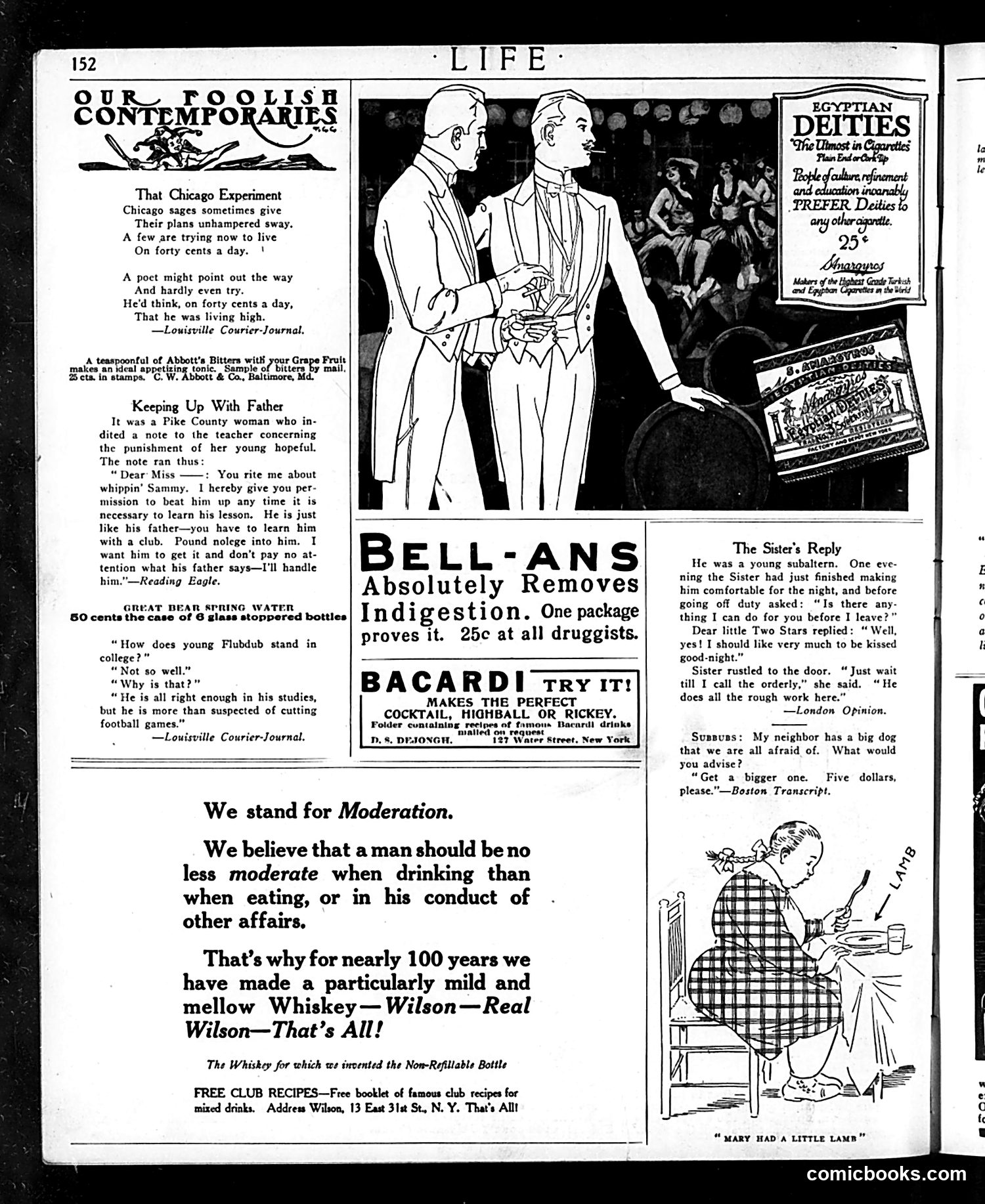
This Life magazine page (page 152) contains several satirical pieces and advertisements typical of early 20th-century humor. **"Our Foolish Contemporaries"** mocks a Chicago social experiment where residents attempted to live on forty cents daily—presented as impractical idealism. The Louisville Courier-Journal's quip suggests poets could manage this easily because they already live poorly. **"Keeping Up With Father"** satirizes rural/working-class parenting. A Pike County mother grants a teacher permission to beat her son into learning, comparing him to his father—both supposedly requiring physical punishment for education. This reflects period stereotypes about rural Americans and corporal punishment attitudes. **"The Sister's Reply"** is a mild romantic joke: a hospital patient (subaltern/military officer) asks a nurse for a goodnight kiss; she deflects by saying the orderly handles "rough work"—implying the orderly should do it instead. The page also contains period product advertisements (Bell-Ans antacid, Bacardi rum, Wilson whiskey) typical of Life's revenue model.
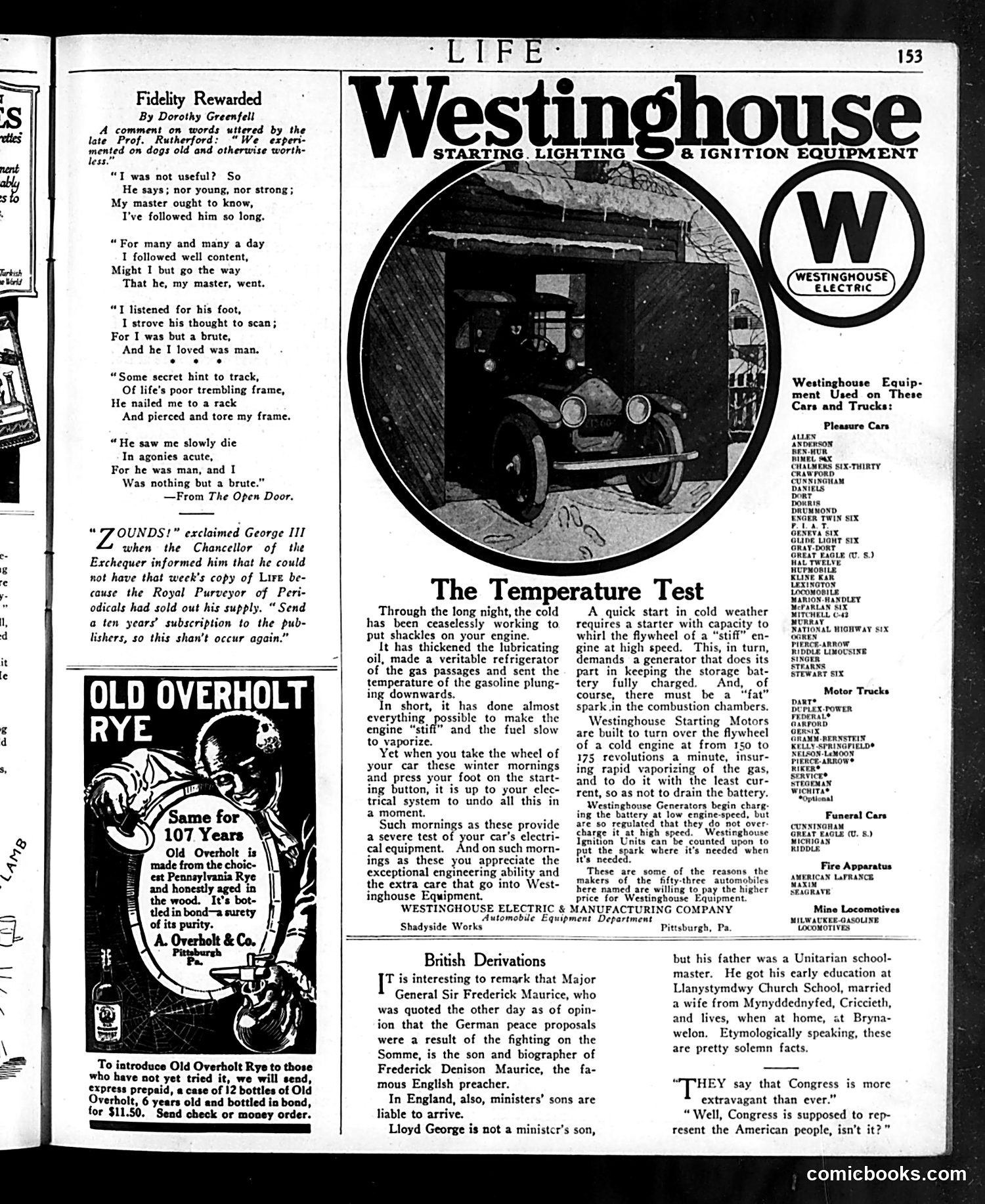
This page combines three distinct elements: **Left side:** "Fidelity Rewarded," a sentimental poem by Dorothy Greenfeld criticizing animal experimentation. It's a dog's monologue lamenting that despite faithful service to its master, he used it for laboratory torture—referenced as Prof. Rutherford's admission that he "experimented on dogs old and otherwise worthless." The poem mocks the scientist's callousness toward the animal's devotion. **Lower left:** An advertisement for Old Overholt Rye whiskey, featuring a colonial-era figure and a humorous anecdote about King George III supposedly demanding a ten-year subscription to LIFE after running out. **Right side:** A Westinghouse Electric advertisement promoting automobile electrical equipment, using winter cold-start performance as a selling point. The page reflects early 20th-century attitudes: concern about scientific ethics, nostalgia for monarchy, and industrial advertising dominance in popular magazines.
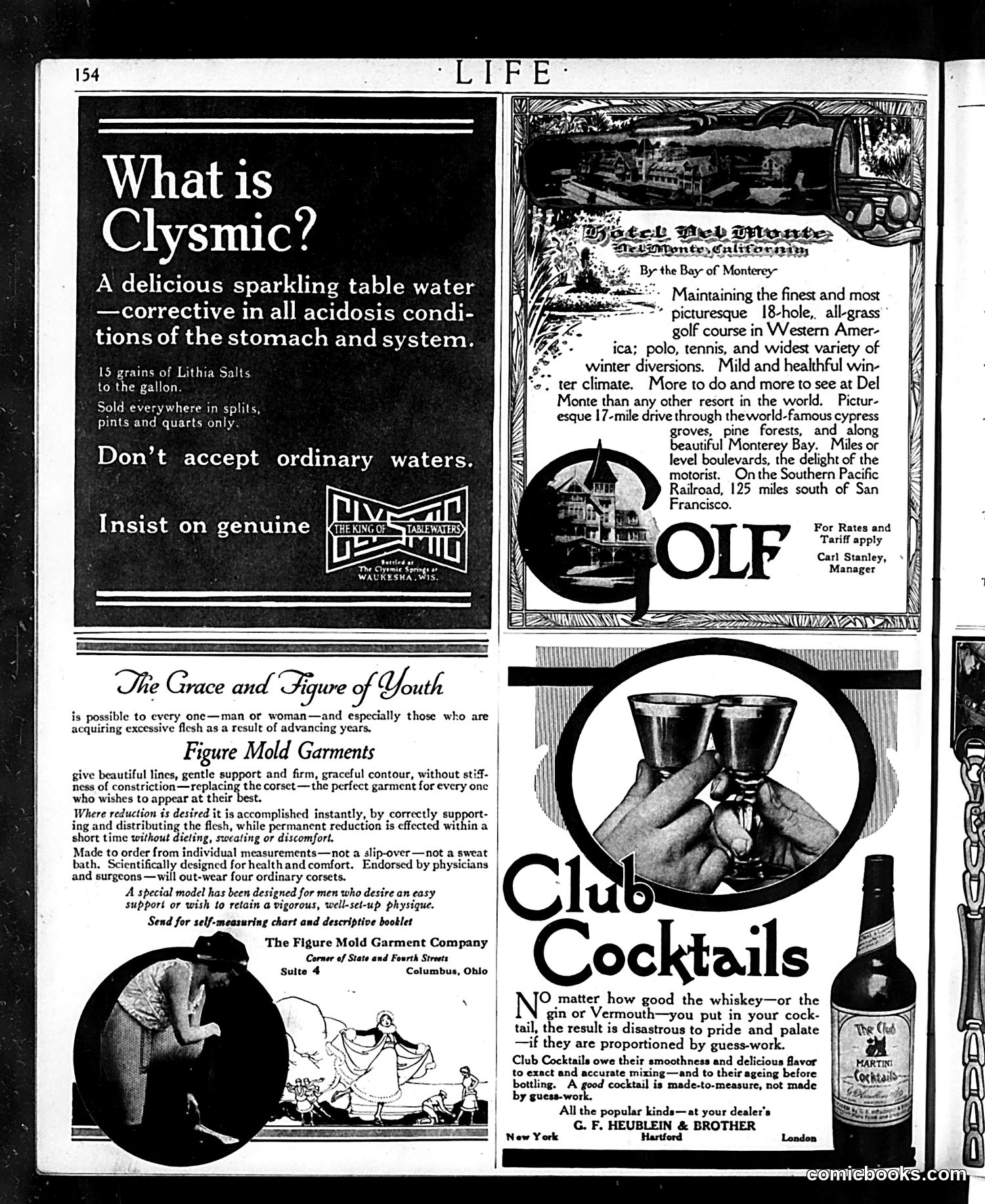
This page consists entirely of advertisements with no political cartoons or satirical content. The ads promote various products reflecting early 20th-century concerns: **Clysmic** sparkling water, marketed as a stomach remedy for "acidosis conditions" (reflecting period anxieties about digestive health); **Del Monte** golf resort in California, targeting wealthy leisure travelers; **Figure Mold Garments**, corset-like undergarments promising weight reduction and body shaping "without dieting"; and **Club Cocktails**, emphasizing precision mixing over homemade guesswork. These advertisements reveal contemporary preoccupations: medicalization of minor ailments, aspirational resort culture, beauty standards emphasizing slenderness, and the professionalization of cocktail-making during Prohibition's immediate aftermath. The tone is earnest rather than satirical—straightforward product promotion typical of Life's revenue model.
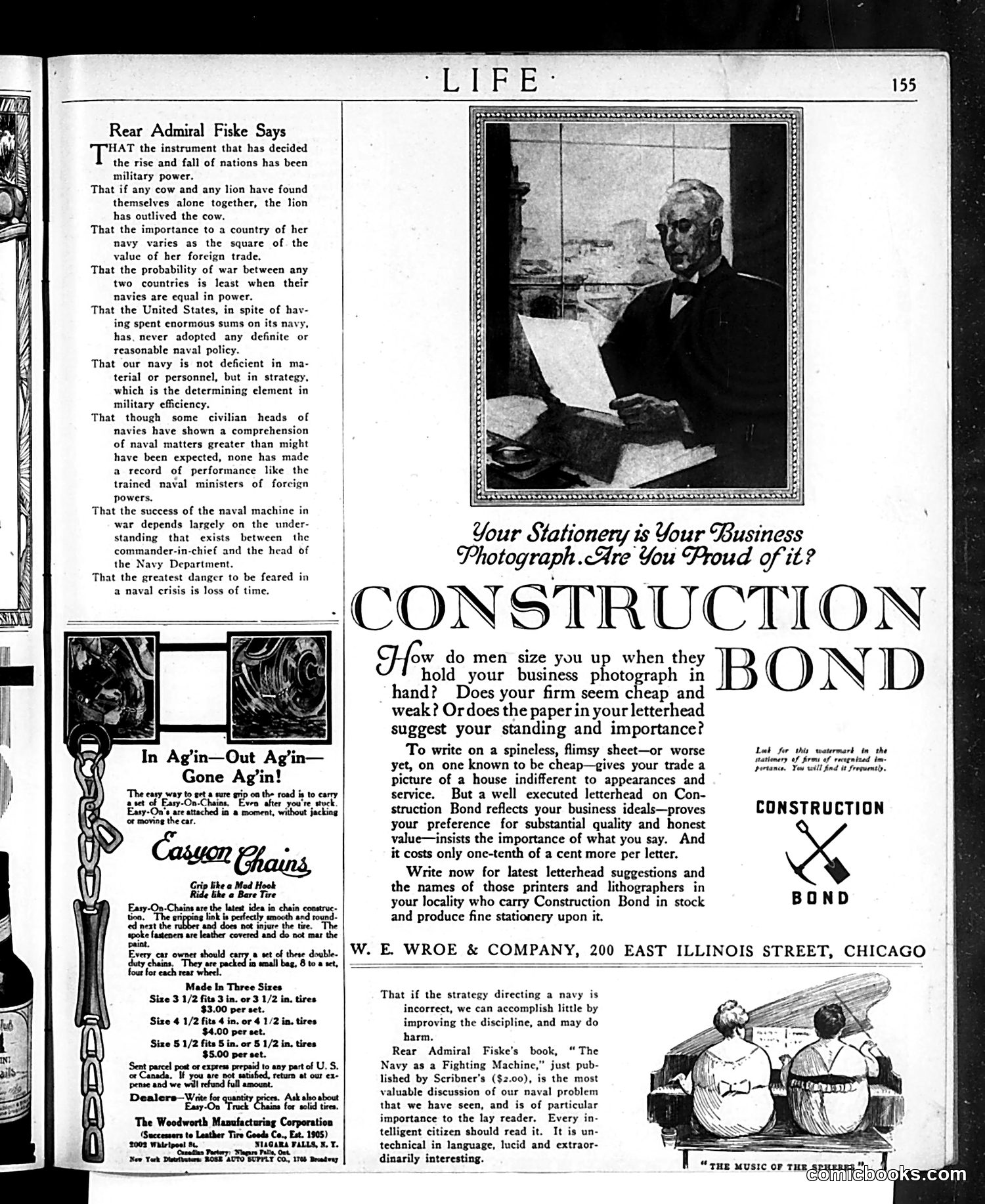
This page consists primarily of **advertisements and editorial commentary**, not satire or cartoons requiring historical decoding. The main content is **Rear Admiral Fiske's quoted statements** about naval power—these are presented straightforwardly as the admiral's views on military strategy, naval policy, and the importance of the Navy Department. The page then promotes **Fiske's book** "The Navy as a Fighting Machine" as a valuable discussion of American naval problems. The advertisements are standard early-20th-century commercial pitches: Casson Chains for automobiles, Construction Bond stationery (emphasizing professional appearance), and Woodworth Manufacturing's tire chains. The "In Ag'in—Out Ag'in" heading appears to be a humorous automotive reference, likely playing on the repetitive nature of applying and removing tire chains seasonally. **There is no political cartoon or satirical content requiring historical context to decode**—this is primarily a page of naval policy discussion and period advertising.
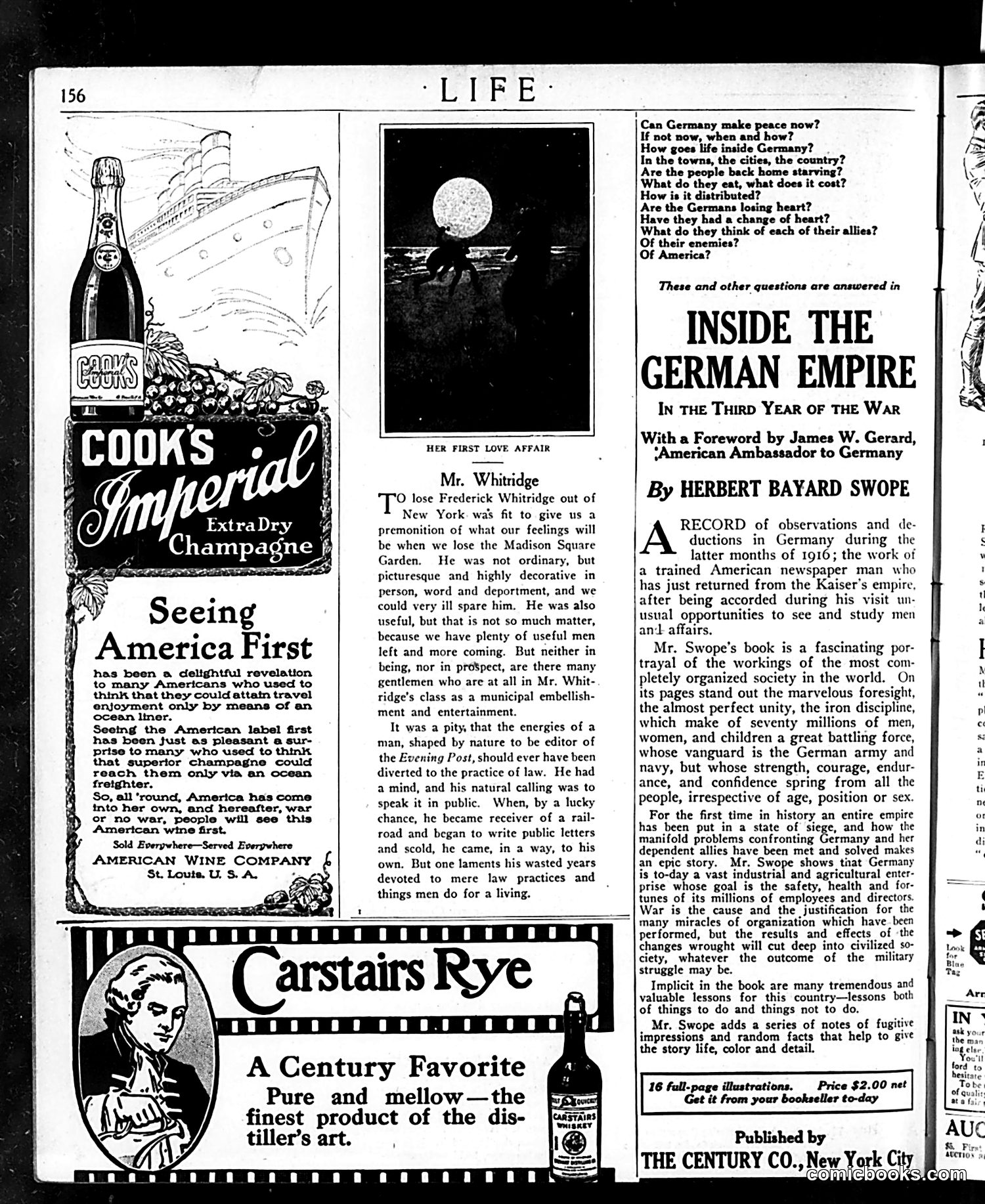
This page mixes advertisements with book promotion, reflecting WWI-era American interests. The ads (Cook's champagne, Carstairs rye) use patriotic "America First" messaging—emphasizing American products over European imports, a common wartime theme. The main content promotes Herbert Bayard Swope's book "Inside the German Empire" (1916), offering insider observations from someone with rare access to Kaiser Wilhelm's Germany. The accompanying questions ("Are the people starving?" "Have they lost heart?") reveal American anxiety about the war's impact on Germany's civilian population and morale. James W. Gerard, the American Ambassador to Germany, provided the foreword, lending diplomatic credibility. The book presents Germany as a unified, militarized society—both admiring its organizational efficiency while implicitly questioning its sustainability under wartime strain. This reflects American fascination with and concern about Germany during the later stages of WWI.
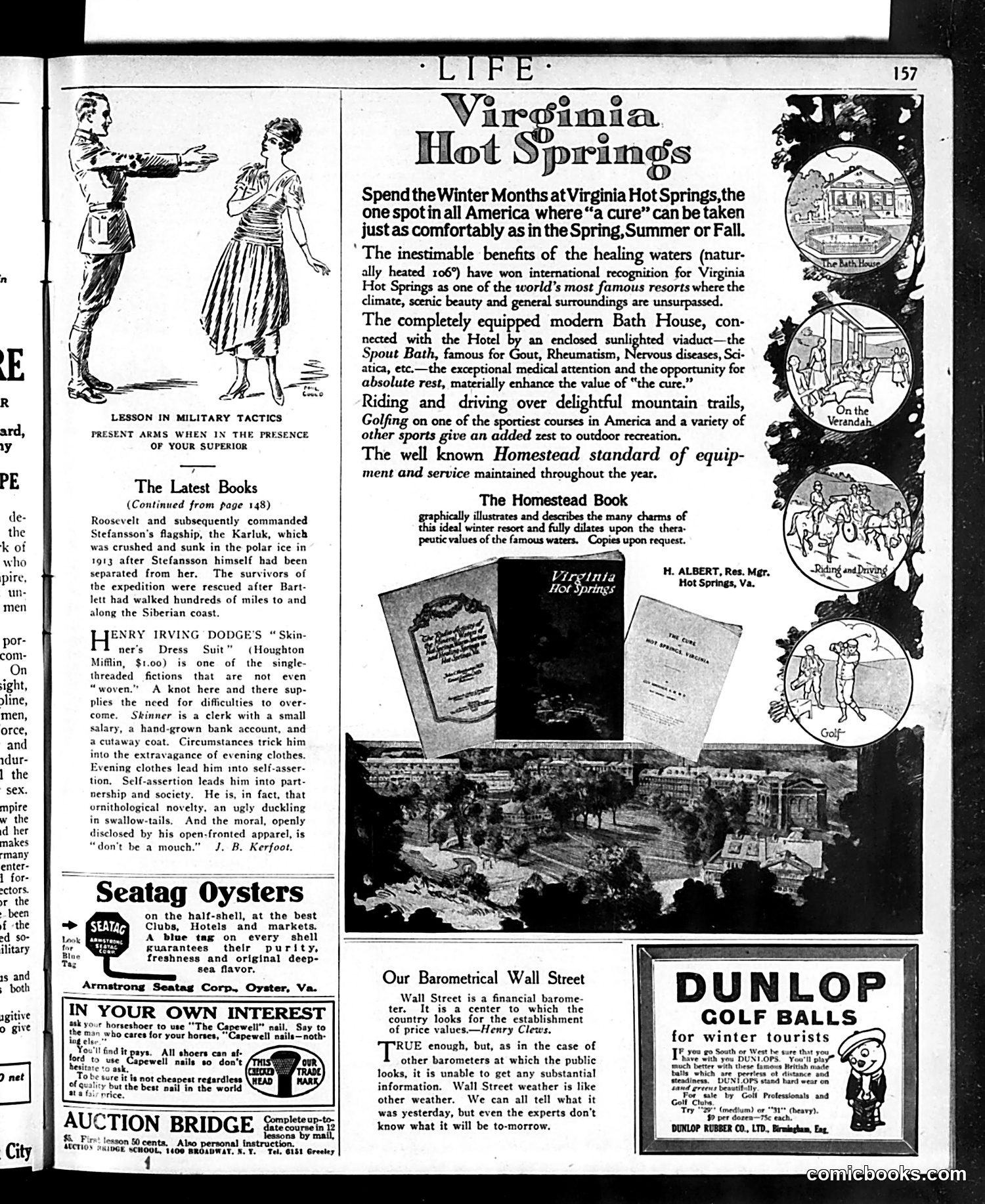
**The Military Tactics Cartoon** (top left): Shows a man in military uniform presenting arms to a woman. The caption "Present Arms When in the Presence of Your Superior" is satirical wordplay—it treats the woman as a social superior to whom military deference is owed, playing on the era's gender dynamics where women of certain social standing commanded respectful behavior from men. **Page Content**: This is primarily **advertising and book reviews**, not political satire. The dominant content promotes Virginia Hot Springs as a health resort, emphasizing its therapeutic waters for ailments like gout and rheumatism—reflecting early 20th-century belief in "cure resorts." The text excerpt about Wall Street as a "barometer" is financial commentary: it argues that while Wall Street supposedly indicates economic conditions, it actually only reflects past data, not future predictions—a mild jab at financial prognostication. Other ads include Seatag Oysters, Dunlop Golf Balls, and Capewell horseshoe nails. The page reflects leisure and consumer culture of the prosperous pre-WWI era.
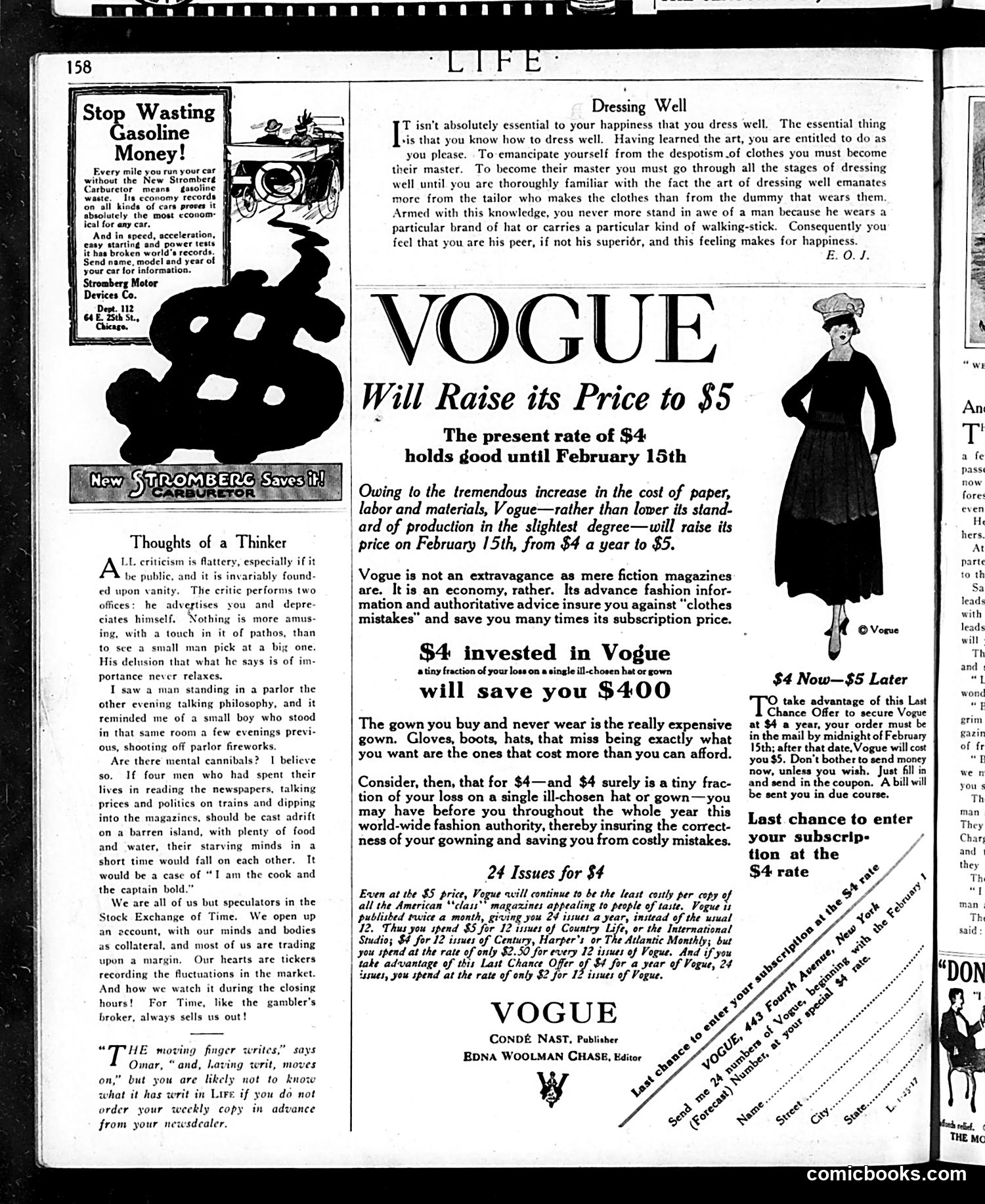
This page contains **advertising and lifestyle content**, not political satire. The main elements: **Top left**: A Stromberg Motor Devices ad mocking wasteful driving habits, using a giant dollar sign as visual emphasis. **Center**: A "Thoughts of a Thinker" column—satirizing pretentious intellectuals. The author mocks small-minded critics who perform for vanity, and uses extended metaphors comparing human nature to stock speculation and cannibalism on desert islands. This is *general social satire*, not political. **Right side**: The dominant feature is a **Vogue magazine advertisement** announcing a price increase from $4 to $5 yearly (effective February 15th). Vogue justifies this by claiming their fashion advice prevents costly wardrobe mistakes—the $4 subscription saves readers far more by preventing bad clothing purchases. An illustration shows a fashionable woman in contemporary dress. The page reflects **early-20th-century consumer culture** and magazine economics, not political commentary.
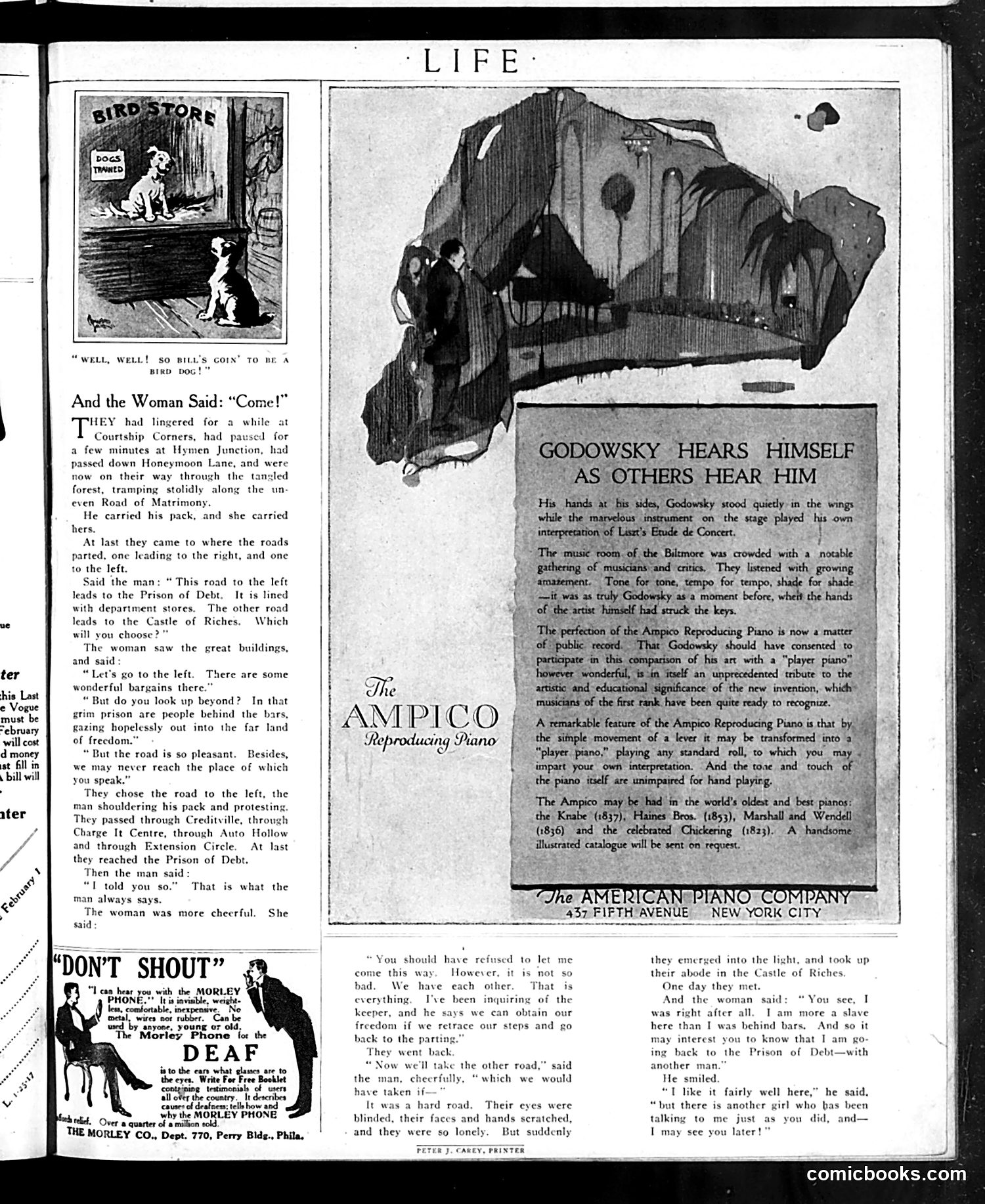
This page contains a satirical story about marriage and financial choices. A couple at a crossroads must choose between two paths: one toward the "Prison of Debt" (lined with department stores) or toward the "Castle of Riches." The woman chooses the debt path, drawn by bargains, ignoring the man's warnings about financial ruin. The satire critiques consumer culture and women's spending habits—a common early 20th-century stereotype. After reaching the Prison of Debt, the couple discovers they're trapped: the woman becomes "more a slave" than before. The story's cynical ending suggests that no matter which path is chosen, marriage and financial obligation lead to unhappiness. The accompanying Ampico piano advertisement showcases a luxury product, somewhat ironically placed beside this cautionary tale about consumerism and debt.
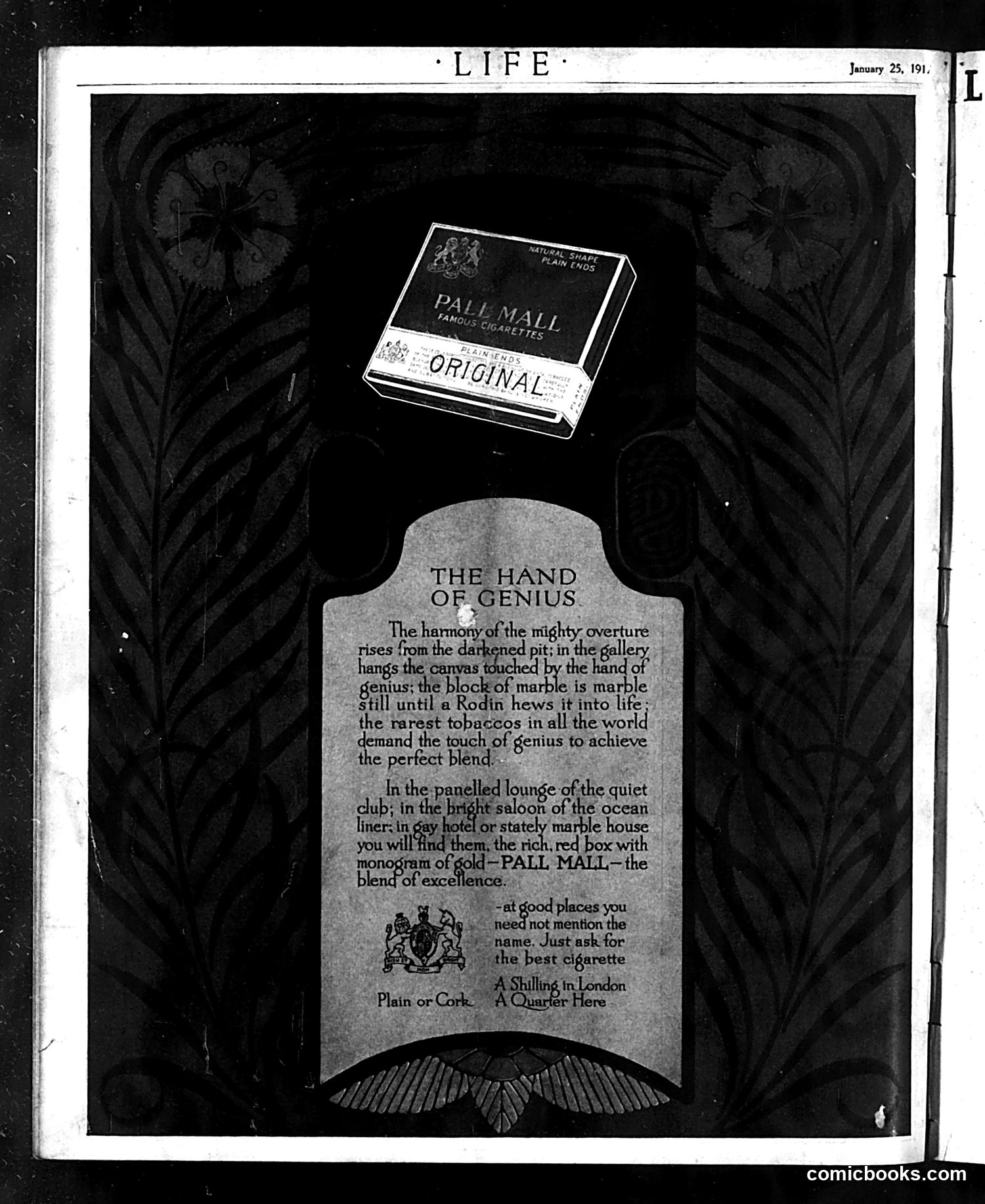
This is a full-page advertisement, not a political cartoon. It promotes Pall Mall cigarettes by invoking artistic and cultural prestige. The ad uses classical references—mentions of Rodin (the famous sculptor) and marble—to position smoking as a refined, elite activity. The phrase "The Hand of Genius" compares the blending of tobacco to artistic creation, suggesting that choosing Pall Mall requires discerning taste. The copy targets wealthy consumers in upscale venues: "panelled lounge of the quiet club," "bright saloon of the ocean liner," and "stately marble house." The price ("A Shilling in London / A Quarter Here") indicates this was a premium product. The design uses decorative borders and a cigarette box image to reinforce luxury branding. This exemplifies early 20th-century advertising that associated consumer goods with high culture and social status.