
Life, 1917-01-25 · page 18 of 40
Life — January 25, 1917 — page 18: what you’re looking at
What you’re looking at
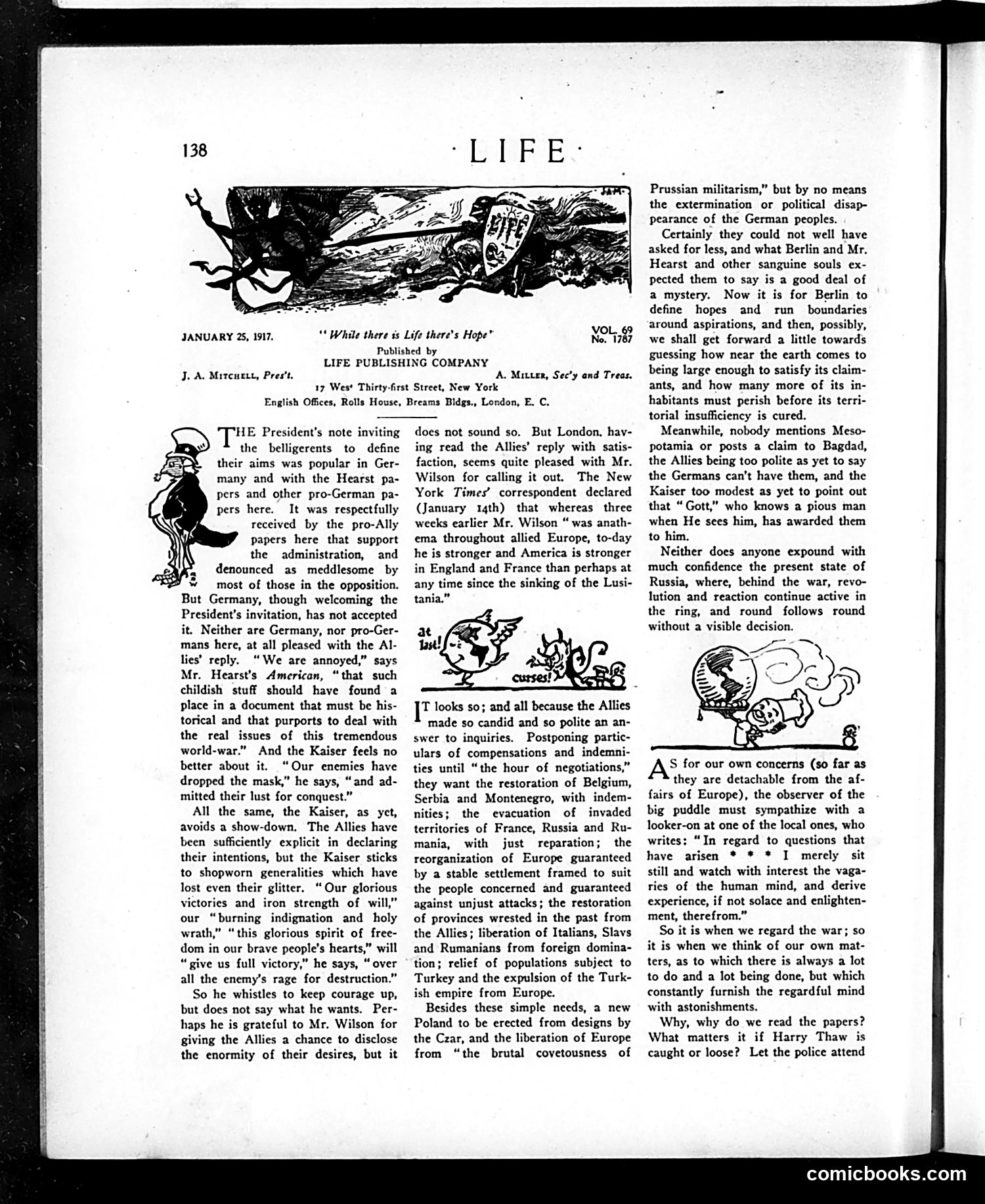
This page satirizes President Wilson's attempt to broker peace in World War I by inviting belligerents to state their war aims. The article mocks the contradictory reactions: Germany welcomed the invitation but rejected the Allies' response, while pro-German American papers (like Hearst's) called the Allies' stated goals "childish," and the Kaiser complained the Allies "dropped the mask" revealing conquest desires. Life's satire targets the Kaiser's hollow rhetoric—his repeated invocations of "glorious victories" and "iron strength" while avoiding specifics about what Germany actually wants. The cartoons (visible as small illustrations) appear to mock German bluster. The editorial suggests Germany must now clarify its own peace terms, implying the Kaiser's vague generalizations no longer suffice. The piece subtly supports the Allies' transparent, detailed response while ridiculing German evasiveness and American pro-German sentiment.
📄 Transcribed text from this page (OCR, searchable)
Machine-transcribed from the original scan — historical spelling and the odd misread are preserved.
JANUARY 25, 1917. “* While there ts Life there's Hope” No. 1787 Published by LIFE PUBLISHING COMPANY J. A. Mrtcuett, Pres’t. A. Minter, Sec’y and Treas. 17 West Thirty-first Street, New York English Offices, Rolls House, Breams Bldgs., London, E. C. HE President's note inviting the belligerents to define their aims was popular in Ger- many and with the Hearst pa- pers and other pro-German pa- pers here. It was respectfully received by the pro-Ally papers here that support the administration, and denounced as meddlesome by most of those in the opposition. But Germany, though welcoming the President's invitation, has not accepted it. Neither are Germany, nor pro-Ger- mans here, at all pleased with the Al- lies’ reply. ‘We are annoyed,” says Mr. Hearst's American, “that such childish stuff should have found a place in a document that must be his- torical and that purports to deal with the real issues of this tremendous world-war.” And the Kaiser feels no better about it. “Our enemies have dropped the mask,” he says, “and ad- mitted their lust for conquest.” All the same, the Kaiser, as yet, avoids a show-down, The Allies have been sufficiently explicit in declaring their intentions, but the Kaiser sticks to shopworn generalities which have lost even their glitter. “Our glorious victories and iron strength of will,” our “burning indignation and holy “this glorious spirit of free- our brave people’s hearts,” will “give us full victory,” he says, “over all the enemy’s rage for destruction.” So he whistles to keep courage up, but does not say what he wants. Per- haps he is grateful to Mr. Wilson for giving the Allies a chance to disclose the enormity of their desires, but it does not sound so. But London, hav- ing read the Allies’ reply with satis- faction, seems quite pleased with Mr. Wilson for calling it out. The New York Times’ correspondent declared (January 14th) that whereas three weeks earlier Mr. Wilson “ was anath- ema throughout allied Europe, to-day he is stronger and America is stronger in England and France than perhaps at any time since the sinking of the Lusi- tania.” T looks so; and all because the Allies made so candid and so polite an an- swer to inquiries. Postponing partic- ulars of compensations and indemni- ties until “the hour of negotiations,” they want the restoration of Belgium, Serbia and Montenegro, with indem- nities; the evacuation of invaded territories of France, Russia and Ru- mania, with just reparation; the reorganization of Europe guaranteed by a stable settlement framed to suit the people concerned and guaranteed against unjust attacks; the restoration of provinces wrested in the past from the Allies; liberation of Italians, Slavs and Rumanians from foreign domina- tion; relief of populations subject to Turkey and the expulsion of the Turk- ish empire from Europe. Besides these simple needs, a new Poland to be erected from designs by the Czar, and the liberation of Europe from “the brutal covetousness of Prussian militarism,” but by no means the extermination or political disap- pearance of the German peoples. Certainly they could not well have asked for less, and what Berlin and Mr. Hearst and other sanguine souls ex- pected them to say is a good deal of a mystery. Now it is for Berlin to define hopes and run boundaries around aspirations, and then, possibly, we shall get forward a little towards guessing how near the earth comes to being large enough to satisfy its claim- ants, and how many more of its in- habitants must perish before its terri- torial insufficiency is cured. Meanwhile, nobody mentions Meso- potamia or posts a claim to Bagdad, the Allies being too polite as yet to say the Germans can’t have them, and the Kaiser too modest as yet to point out that “Gott,” who knows a pious man when He sees him, has awarded them to him. Neither does anyone expound with much confidence the present state of Russia, where, behind the war, revo- lution and reaction continue active in the ring, and round follows round without a visible decision. AS for our own concerns (so far as they are detachable from the af- fairs of Europe), the observer of the big puddle must sympathize with a looker-on at one of the local ones, who writes: “In regard to questions that have arisen * * * I merely sit still and watch with interest the vaga- ries of the human mind, and derive experience, if not solace and enlighten- ment, therefrom.” So it is when we regard the war; so it is when we think of our own mat- ters, as to which there is always a lot to do and a lot being done, but which constantly furnish the regardful mind with astonishments. Why, why do we read the papers? What matters it if Harry Thaw is caught or loose? Let the police attend comicbooks.com