
Life, 1917-01-25 · page 28 of 40
Life — January 25, 1917 — page 28: what you’re looking at
What you’re looking at
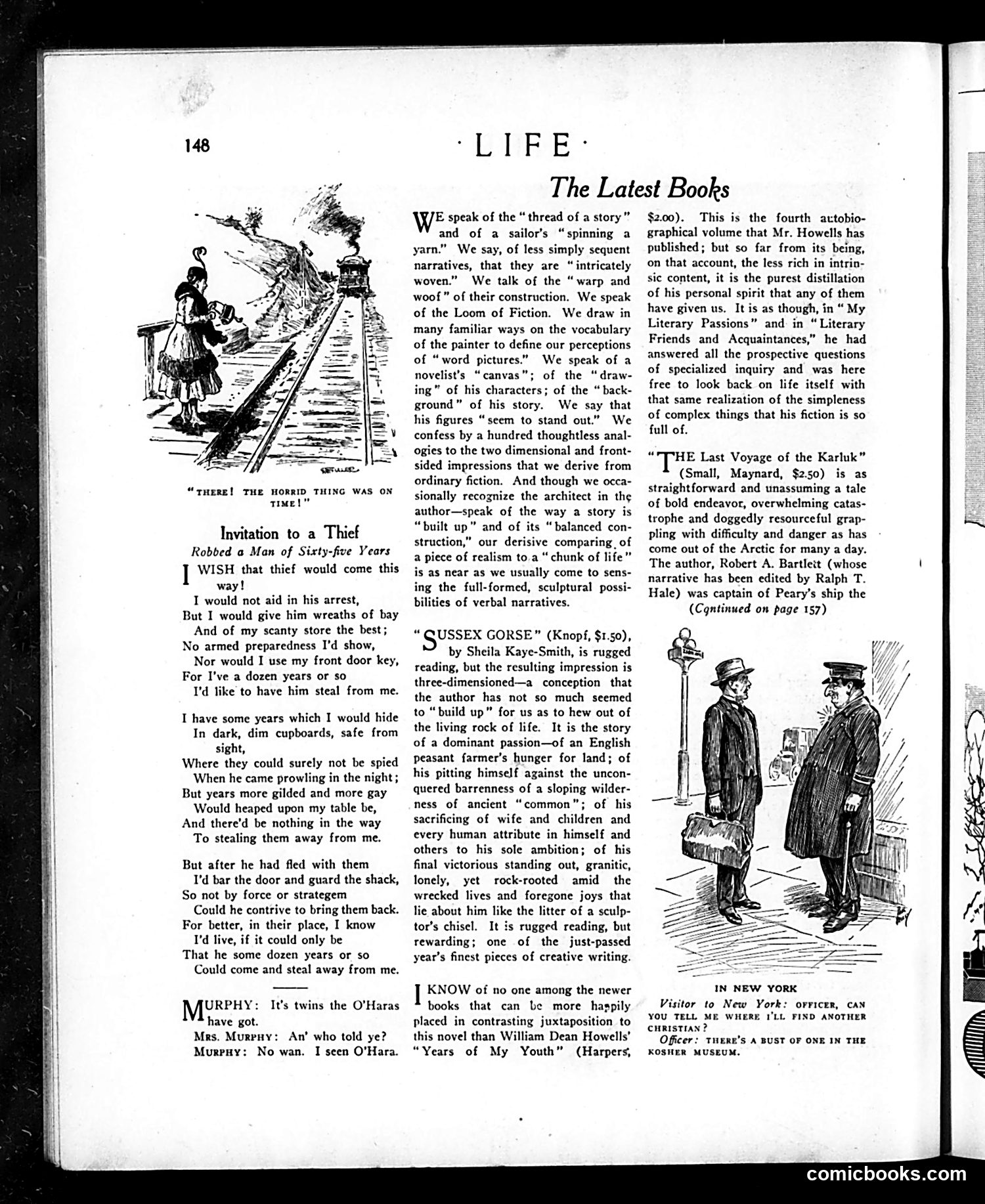
**The Main Cartoon:** The top illustration shows a figure on railroad tracks with the caption "THERE! THE HORRID THING WAS ON TIME!" This appears to be a satirical comment on railroad punctuality—likely mocking either the rarity of trains running on schedule or expressing frustration with their reliability. The "horrid thing" refers to the train itself. **The Poem "Invitation to a Thief":** This is sentimental verse expressing a common theme: the speaker wishes someone would steal their years of aging. The poem romanticizes youth-stealing, wishing a thief would take away unwanted years of decline while leaving the "gilded and gay" years intact—a humorous meditation on aging anxiety. **The Book Reviews Section:** Reviews discuss literary technique using metaphors (thread, loom, canvas, building). The reviews praise *Sussex Gorse* by Sheila Kaye-Smith as three-dimensional storytelling and favorably contrast it with William Dean Howells' autobiography *Years of My Youth*. **Overall Context:** This is a typical early 20th-century *Life* magazine page mixing light humor, poetry, and cultural criticism for educated readers.
📄 Transcribed text from this page (OCR, searchable)
Machine-transcribed from the original scan — historical spelling and the odd misread are preserved.
“THERE! THE HORRID THING WAS ON Time!" Invitation to a Thief Robbed a Man of Sixty-five Years WISH that thief would come this way! I would not aid in his arrest, But I would give him wreaths of bay And of my scanty store the best; No armed preparedness I'd show, Nor would I use my front door key, For I've a dozen years or so I'd like to have him steal from me. I have some years which I would hide In dark, dim cupboards, safe from sight, Where they could surely not be spied When he came prowling in the night ; But years more gilded and more gay Would heaped upon my table be, And there'd be nothing in the way To stealing them away from me. But after he had fled with them I'd bar the door and guard the shack, So not by force or strategem Could he contrive to bring them back. For better, in their place, I know I'd live, if it could only be That he some dozen years or so Could come and steal away from me. URPHY: have got. Mrs. Murry: An’ who told ye? Murray: No wan. I seen O'Hara. It’s twins the O'Haras “CUBE: The Latest Books WE speak of the “ thread of a story” and of a sailor’s “spinning a yarn.” We say, of less simply sequent narratives, that they are “intricately woven.” We talk of the “warp and woof” of their construction. We speak of the Loom of Fiction. We draw in many familiar ways on the vocabulary of the painter to define our perceptions of “word pictures.” We speak of a novelist’s “canvas”; of the “draw- ing” of his characters; of the “back- ground” of his story. We say that his figures “seem to stand out.” We confess by a hundred thoughtless anal- ogies to the two dimensional and front- sided impressions that we derive from ordinary fiction. And though we occa- sionally recognize the architect in the author—speak of the way a story is “built up” and of its “balanced con- struction,” our derisive comparing, of a piece of realism to.a “ chunk of life” is as near as we usually come to sens- ing the full-formed, sculptural possi- bilities of verbal narratives. “ QUSSEX GORSE” (Knopf, $1.50), by Sheila Kaye-Smith, is rugged reading, but the resulting impression is three-dimensioned—a_ conception that the author has not so much seemed to “build up” for us as to hew out of the living rock of life. It is the story of a dominant passion—of an English peasant farmer’s hunger for land; of his pitting himself against the uncon- quered barrenness of a sloping wilder- ness of ancient “common”; of his sacrificing of wife and children and every human attribute in himself and others to his sole ambition; of his final victorious standing out, granitic, lonely, yet rock-rooted amid the wrecked lives and foregone joys that lie about him like the litter of a sculp- tor’s chisel. It is rugged reading, but rewarding; one of the just-passed year’s finest pieces of creative writing. KNOW of no one among the newer books that can be more haspily placed in contrasting juxtaposition to this novel than William Dean Howells’ “Years of My Youth” (Harpers, $2.00). This is the fourth attobio- graphical volume that Mr. Howells has published; but so far from its being, on that account, the less rich in intrin- sic content, it is the purest distillation of his personal spirit that any of them have given us. It is as though, in “ My Literary Passions” and in “ Literary Friends and Acquaintances,” he had answered all the prospective questions of specialized inquiry and was here free to look back on life itself with that same realization of the simpleness of complex things that his fiction is so full of. “THE Last Voyage of the Karluk” (Small, Maynard, $2.50) is as straightforward and unassuming a tale of bold endeavor, overwhelming catas- trophe and doggedly resourceful grap- pling with difficulty and danger as has come out of the Arctic for many a day. The author, Robert A. Bartlett (whose narrative has been edited by Ralph T. Hale) was captain of Peary’s ship the (Cqntinued on page 157) IN NEW YORK Visitor to Ne York: orricer, CAN YoU TELL ME LL FIND ANOTHER CHRISTIAN ? Officer: tTHERE’s A BUST OF ONE IN THE KOSHER MUSEUM. IZLE SE comicbooks.com