
Life, 1917-01-25 · page 7 of 40
Life — January 25, 1917 — page 7: what you’re looking at
What you’re looking at
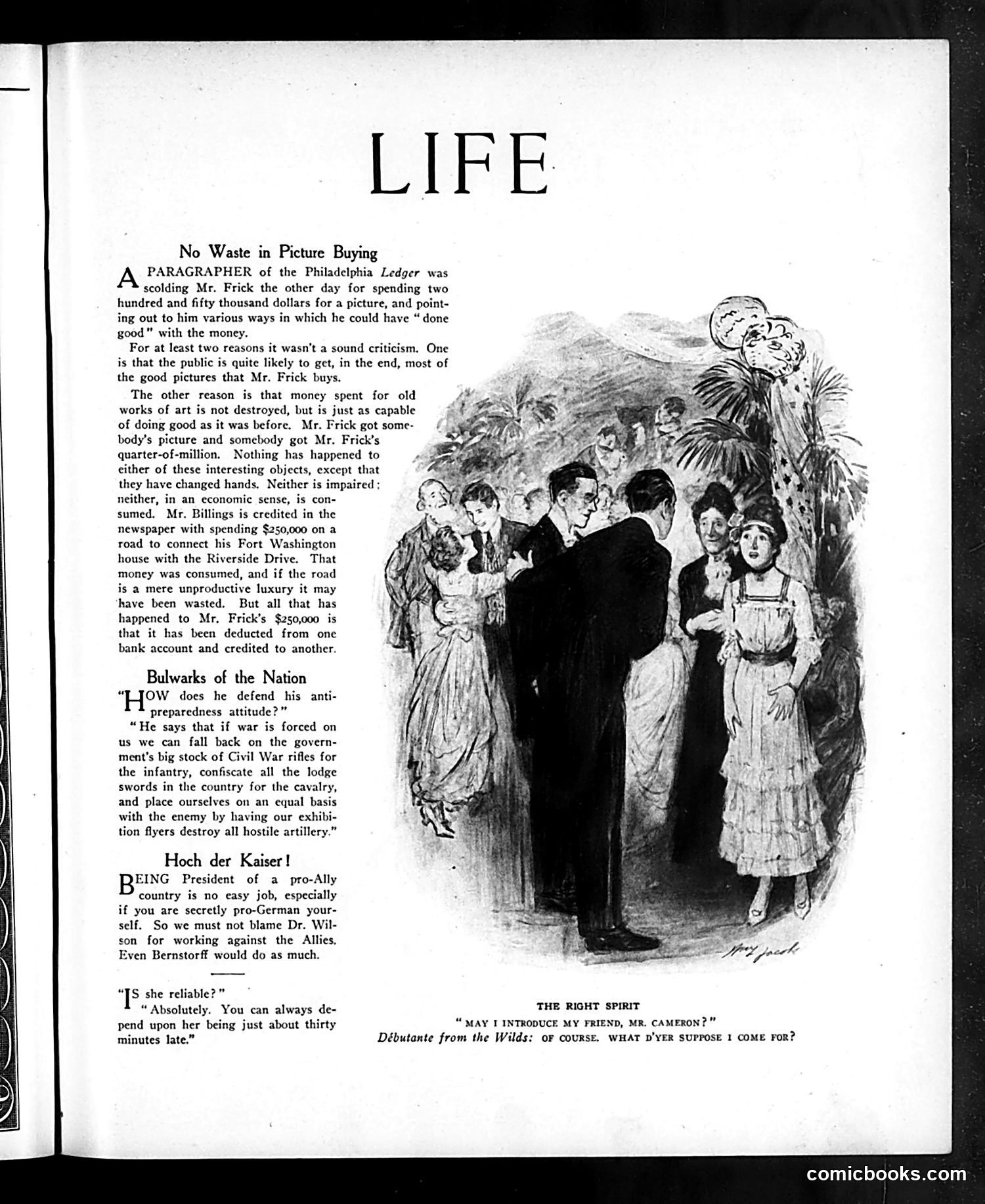
This page contains three separate opinion pieces with social commentary: 1. **"No Waste in Picture Buying"**: Critiques Mr. Frick's $250,000 art purchase, arguing the money simply transferred between wealthy individuals rather than being "wasted"—a satirical defense of wealthy art collecting. 2. **"Bulwarks of the Nation"**: Mocks someone's suggestion to use Civil War weapons for national defense, treating the idea as absurdly impractical. 3. **"Hoch der Kaiser!"**: Satirizes being pro-German while President, suggesting this is an inherently difficult position. The main illustration titled **"The Right Spirit"** shows a social gathering where someone introduces a friend as "Cameron," with the caption noting this is "Débutante from the Wilds"—likely satirizing either class pretension or recent wealth. The humor relies on contemporary references to WWI-era politics and Gilded Age society that modern readers would need historical context to fully appreciate.
📄 Transcribed text from this page (OCR, searchable)
Machine-transcribed from the original scan — historical spelling and the odd misread are preserved.
EFM No Waste in Picture Buying A PARAGRAPHER of the Philadelphia Ledger was scolding Mr. Frick the other day for spending two hundred and fifty thousand dollars for a picture, and point- ing out to him various ways in which he could have “done good” with the money. For at least two reasons it wasn't a sound criticism. One is that the public is quite likely to get, in the end, most of the good pictures that Mr. Frick buys. The other reason is that money spent for old works of art is not destroyed, but is just as capable of doing good as it was before. Mr. Frick got some- body’s picture and somebody got Mr. Frick’s quarter-of-million. Nothing has happened to either of these interesting objects, except that they have changed hands. Neither is impaired ; neither, in an economic sense, is con- sumed. Mr. Billings is credited in the newspaper with spending $250,000 on a road to connect his Fort Washington house with the Riverside Drive. That money was consumed, and if the road is a mere unproductive luxury it may have been wasted. But all that has happened to Mr. Frick’s $250,000 is that it has been deducted from one bank account and credited to another. Bulwarks of the Nation “LJOW does he defend his anti- preparedness attitude?” “He says that if war is forced on us we can fall back on the govern- ment’s big stock of Civil War rifles for the infantry, confiscate all the lodge swords in the country for the cavalry, and place ourselves on an equal basis with the enemy by having our exhibi- tion flyers destroy all hostile artillery.” Hoch der Kaiser ! EING President of a pro-Ally country is no easy job, especially if you are secretly pro-German your- self. So we must not blame Dr. W son for working against the Allies. eee Even Bernstorff would do as much. _ SPY joceh “[S she reliable?” “Absolutely. You can always de- THE RIGHT SPIRIT pend upon her being just about thirty “ MAY I INTRODUCE MY FRIEND, MR. CAMERON?” minutes late.” Débutante from the Wilds: oF COURSE. WHAT D'YER SUPPOSE I COME FOR? comicbooks.com