
Life, 1917-01-25 · page 22 of 40
Life — January 25, 1917 — page 22: what you’re looking at
What you’re looking at
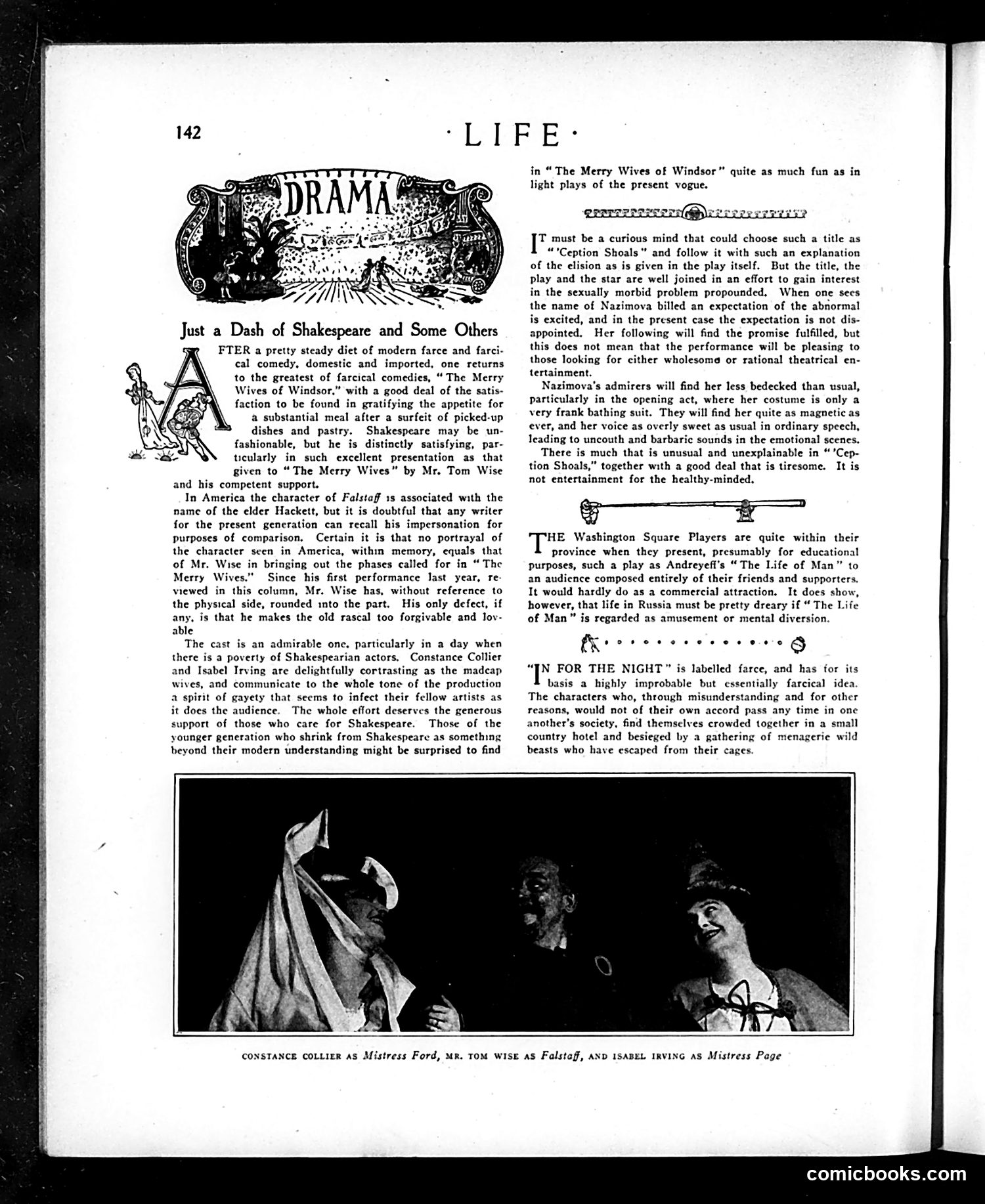
This page reviews three theatrical productions, with particular emphasis on a Shakespeare production and contemporary plays. **Main Content:** The article praises Tom Wise's performance as Falstaff in "The Merry Wives of Windsor," noting it surpasses remembered portrayals by the elder Hackett. The reviewer argues Shakespeare remains entertaining—as funny as modern comedies—and praises the supporting cast, particularly Constance Collier and Isabel Irving as the title wives. **The Photograph:** Shows three actors: Collier as Mistress Ford, Tom Wise as Falstaff, and Irving as Mistress Page, apparently in a comedic scene. **Critical Context:** The reviews also cover Nazimova in "'Ception Shoals" (criticizing its morbid sexual themes and Nazimova's "barbaric" emotional delivery) and the Washington Square Players' production of Andreyeff's "The Life of Man" (dismissing Russian drama as dreary). The page essentially argues for Shakespeare's continued relevance against modern theatrical trends.
📄 Transcribed text from this page (OCR, searchable)
Machine-transcribed from the original scan — historical spelling and the odd misread are preserved.
LIFE = a Dash of Shakespeare and Some Others FTER a pretty steady diet of modern farce and farci- cal comedy, domestic and imported, one returns to the greatest of farcical comedies, “ The Merry Wives of Windsor.” with a good deal of the sati faction to be found in gratifying the appetite for a substantial meal after a surfeit of picked-up 8 dishes and pastry. Shakespeare may be un- fashionable, but he is distinctly satisfying, par- ticularly in such excellent presentation as that given to “The Merry Wives” by Mr. Tom Wise and his competent support. In America the character of Falstaff 1s associated with the name of the elder Hackett, but it is doubtful that any writer for the present generation can recall his impersonation for purposes of comparison. Certain it is that no portrayal of the character seen in America, within memory, equals that of Mr. Wise in bringing out the phases called for in “ The Since his first performance last year, re: Merry Wives.” viewed in this column, Mr. Wise has, without reference to the physical side, rounded into the part. His only defect, if any, is that he makes the old rascal too forgivable and lov- able The cast is an admirable onc. particularly in a day when there is a poverty of Shakespearian actors. Constance Collier and Isabel Irving are delightfully cortrasting as the madcap wives, and communicate to the whole tone of the production a spirit of gayety that seems to infect their fellow artists as it does the audience. The whole effort deserves the generous support of those who care for Shakespeare. Those of the younger generation who shrink from Shakespeare as something beyond their modern understanding might be surprised to find in “The Merry Wives of Windsor” quite as much fun as in light plays of the present vogue. T must be a curious mind that could choose such a title as “'Ception Shoals” and follow it with such an explanation of the elision as is given in the play itself. But the title, the play and the star are well joined in an effort to gain interest in the sexually morbid problem propounded. When one secs the name of Nazimova billed an expectation of the abnormal is excited, and in the present case the expectation is not dis- appointed. Her following will find the promise fulfilled, but this does not mean that the performance will be pleasing to those looking for cither wholesome or rational theatrical en- tertainment. Nazimova’s admirers will find her less bedecked than usual, Particularly in the opening act, where her costume is only a very frank bathing suit. They will find her quite as magnetic as ever, and her voice as overly sweet as usual in ordinary speech, leading to uncouth and barbaric sounds in the emotional scenes, There is much that is unusual and unexplainable in “ ’Cep- tion Shoals,” together with a good deal that is tiresome. It is not entertainment for the healthy-minded. rs: HE Washington Square Players are quite within their province when they present, presumably for educational purposes, such a play as Andreyefi's “The Life of Man” to an audience composed entirely of their friends and supporters. It would hardly do as a commercial attraction. It does show, however, that life in Russia must be pretty dreary if “The Life of Man” is regarded as amusement or mental diversion. fo “IN FOR THE NIGHT” is labelled farce, and ha basis a highly improbable but essentially farcical idea. The characters who, through misunderstanding and for other reasons, would not of their own accord pass any time in one another's society, find themselves crowded together in a small country hotel and besieged by a gathering of menagerie wild beasts who have escaped from their cages. tor its CONSTANCE COLLIER AS Mistress Ford, MR. TOM WISE AS Falstaff, AND ISABEL IRVING AS Mistress Page comicbooks.com