
Life, 1917-01-25 · page 19 of 40
Life — January 25, 1917 — page 19: what you’re looking at
What you’re looking at
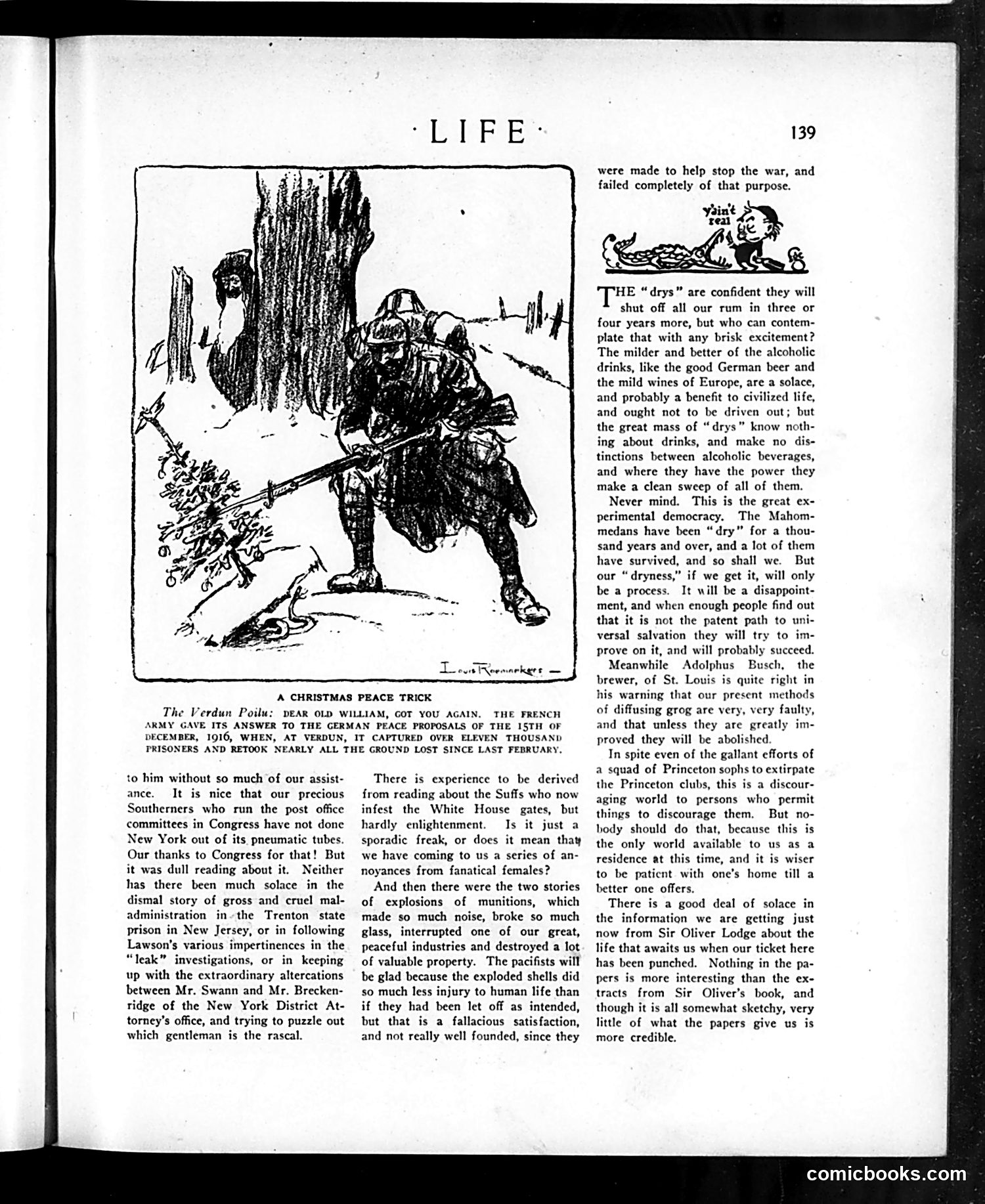
**The Cartoon:** "A Christmas Peace Trick" depicts a French soldier (poilu) at Verdun confronting a German soldier labeled "William" (representing Kaiser Wilhelm II). The caption explains this illustrates France's military response to Germany's December 15, 1916 peace proposals—by capturing 11,000 prisoners and retaking lost ground, France effectively rejected the offer through military action rather than negotiation. **Historical Context:** This references the Battle of Verdun, the devastating 1916 offensive. Germany's peace overtures came amid stalemate; France answered by demonstrating military capability rather than accepting terms. The "trick" is that Germany's peace offer was countered with battlefield success. **The Satire:** The cartoon mocks Germany's peace proposal as insincere—suggesting military strength, not diplomacy, was the appropriate response. It celebrates French resolve while implying German proposals were propaganda. **Surrounding Text:** The editorial discusses various domestic American concerns (postal service, prison conditions, munitions explosions, women's suffrage activists at the White House, prohibition debates) without the "brisk excitement" of foreign warfare.
📄 Transcribed text from this page (OCR, searchable)
Machine-transcribed from the original scan — historical spelling and the odd misread are preserved.
Loe Reennrkgee = A CHRISTMAS PEACE TRICK The Verdun Poilu: DEAR OLD WILLIAM, GOT YOU AGAIN. THE FRENCH ARMY GAVE ITS ANSWER TO THE GERMAN PEACE PROPOSALS OF THE ISTH OF DECEMBER, 1916, WHEN, AT VERDUN, IT CAPTURED OVER ELEVEN THOUSAND PRISONERS AND RETOOK NEARLY ALL THE GROUND LOST SINCE LAST FEBRUARY. to him without so much of our assist- ance. It is nice that our precious Southerners who run the post office committees in Congress have not done New York out of its. pneumatic tubes. Our thanks to Congress for that! But it was dull reading about it. Neither has there been much solace in the dismal story of gross and cruel mal- administration inthe Trenton state prison in New Jersey, or in following Lawson's various impertinences in the “leak” investigations, or in keeping up with the extraordinary altercations between Mr. Swann and Mr. Brecken- ridge of the New York District At- torney’s office, and trying to puzzle out which gentleman is the rascal. There is experience to be derived from reading about the Suffs who now infest the White House gates, but hardly enlightenment. Is it just a sporadic freak, or does it mean thay we have coming to us a series of an- noyances from fanatical females? And then there were the two stories of explosions of munitions, which made so much noise, broke so much glass, interrupted one of our great, peaceful industries and destroyed a lot of valuable property. The pacifists will be glad because the exploded shells did so much less injury to human life than if they had been let off as intended, but that is a fallacious satisfaction, and not really well founded, since they 139 were made to help stop the war, and failed completely of that purpose. 'HE “drys” are confident they will shut off all our rum in three or four years more, but who can contem- plate that with any brisk excitement? The milder and better of the alcoholic drinks, like the good German beer and the mild wines of Europe, are a solace, and probably a benefit to civilized life, and ought not to be driven out; but the great mass of “drys” know noth- ing about drinks, and make no dis- tinctions between alcoholic beverages, and where they have the power they make a clean sweep of all of them. Never mind. This is the great ex- perimental democracy. The Mahom- medans have been “dry” for a thou- sand years and over, and a lot of them have survived, and so shall we. But our “dryness,” if we get it, will only be a process. It will be a disappoint- ment, and when enough people find out that it is not the patent path to uni. versal salvation they will try to im- prove on it, and will probably succeed. Meanwhile Adolphus Busch, the brewer, of St. Louis is quite right in his warning that our present methods of diffusing grog are very, very faulty, and that unless they are greatly im- proved they will be abolished. In spite even of the gallant efforts of a squad of Princeton sophs to extirpate the Princeton clubs, this is a discour- aging world to persons who permit things to discourage them. But no- body should do that, because this is the only world available to us as a residence at this time, and it is wiser to be patient with one’s home till a better one offers. There is a good deal of solace in the information we are getting just now from Sir Oliver Lodge about the life that awaits us when our ticket here has been punched. Nothing in the pa- pers is more interesting than the ex- tracts from Sir Oliver’s book, and though it is all somewhat sketchy, very little of what the papers give us is more credible. comicbooks.com