
Life, 1917-01-25 · page 24 of 40
Life — January 25, 1917 — page 24: what you’re looking at
What you’re looking at
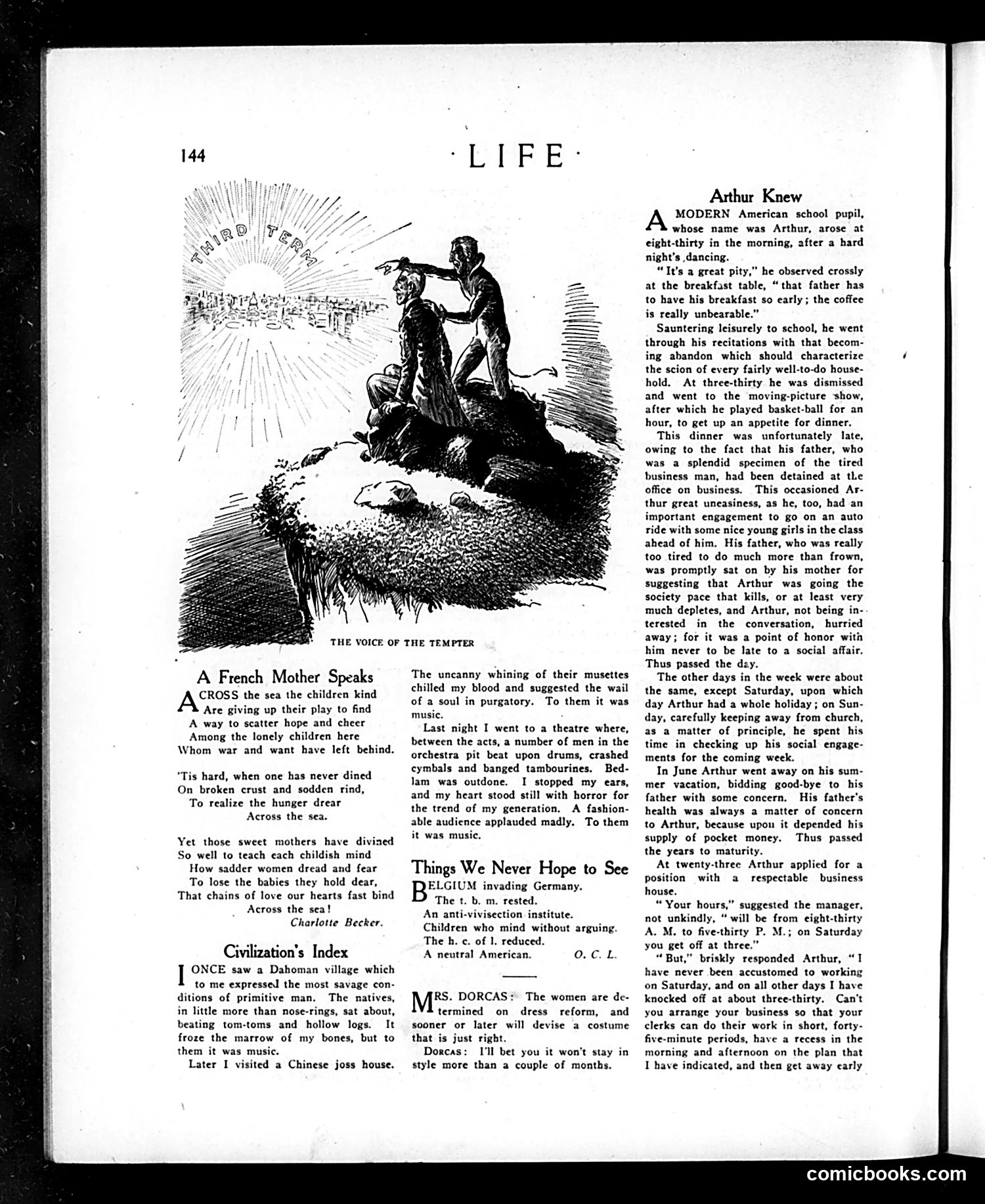
This page contains several satirical pieces critiquing early 20th-century American society and culture. **"The Voice of the Tempter"** (the illustration) shows a demonic figure tempting children, accompanying a sentimental poem about French children's charity appeals to American children. **"Civilization's Index"** mocks cultural relativism by equating "savage" non-Western music (Dahoman drums, Chinese instruments) with modern orchestral percussion at fashionable theaters—suggesting refined society enjoys the same "noise" it deems primitive elsewhere. **"Things We Never Hope to See"** lists absurdities, including "a neutral American" (likely referencing American neutrality debates during early WWI), unreformed children, and Belgium invading Germany (the reverse of actual German invasion). **"Arthur Knew"** satirizes a pampered, self-centered American schoolboy who complains about breakfast timing, prioritizes social engagements over family, and depends on his father's income while showing no genuine concern for his parent's exhaustion. The piece critiques youth entitlement and the "society pace that kills."
📄 Transcribed text from this page (OCR, searchable)
Machine-transcribed from the original scan — historical spelling and the odd misread are preserved.
THE VOICE OF THE TEMPTER A French Mother Speaks CROSS the sea the children kind Are giving up their play to find A way to scatter hope and cheer Among the lonely children here Whom war and want have left behind. ‘Tis hard, when one has never dined On broken crust and sodden rind, To realize the hunger drear Across the sea. Yet those sweet mothers have divined So well to teach each childish mind How sadder women dread and fear To lose the babies they hold dear, That chains of love our hearts fast bind Across the sea! Charlotte Becker. Civilization’s Index ONCE saw a Dahoman village which to me expressed the most savage con- ditions of primitive man. The natives, in little more than nose-rings, sat about, beating tom-toms and hollow logs. It froze the marrow of my bones, but to them it was music. Later I visited a Chinese joss house. The uncanny whining of their musettes chilled my blood and suggested the wail of a soul in purgatory. To them it was music. Last night I went to a theatre where, between the acts, a number of men in the orchestra pit beat upon drums, crashed cymbals and banged tambourines. Bed- lam was outdone. I stopped my ears, and my heart stood still with horror for the trend of my generation. A fashion- able audience applauded madly. To them it was music, Things We Never Hope to See ELGIUM invading Germany. The t. b. m. rested. An anti-vivisection institute. Children who mind without arguing. The h. ¢. of 1. reduced. A neutral American. 0. C. L. RS. DORCAS: The women are de- termined on dress reform, and sooner or later will devise a costume that is just right. Dorcas: I'll bet you it won't stay in style more than a couple of months. Arthur Knew MODERN American school pupil, whose name was Arthur, arose at eight-thirty in the morning, after a hard night’s dancing. “It's a great pity,” he observed crossly at the breakfast table, “that father has to have his breakfast so early; the coffee is really unbearable.” Sauntering leisurely to school, he went through his recitations with that becom- ing abandon which should characterize the scion of every fairly well-to-do house- hold. At three-thirty he was dismissed and went to the moving-picture show, after which he played basket-ball for an hour, to get up an appetite for dinner. This dinner was unfortunately late, owing to the fact that his father, who was a splendid specimen of the tired business man, had been detained at the office on business. This occasioned Ar- thur great uneasiness, as he, too, had an important engagement to go on an auto ride with some nice young girls in the class ahead of him. His father, who was really too tired to do much more than frown, was promptly sat on by his mother for suggesting that Arthur was going the society pace that kills, or at least very much depletes, and Arthur, not being in- terested in the conversation, hurried away; for it was a point of honor with him never to be late to a social affair. Thus passed the dzy. The other days in the week were about the same, except Saturday, upon which day Arthur had a whole holiday ; on Sun- day, carefully keeping away from church, as a matter of principle, he spent his time in checking up his social engage- ments for the coming week. In June Arthur went away on his sum- mer vacation, bidding good-bye to hi father with some concern. His father's health was always a matter of concern to Arthur, because upou it depended his supply of pocket money. Thus passed the years to maturity. At twenty-three Arthur applied for a position with a respectable business house. “Your hours,” suggested the manager, not unkindly, “will be from eight-thirty A. M. to five-thirty P. M.; on Saturday you get off at three.” “But,” briskly responded Arthur, “I have never been accustomed to working on Saturday, and on all other days I have knocked off at about three-thirty. Can't you arrange your business so that your clerks can do their work in short, forty- five-minute periods, have a recess in the morning and afternoon on the plan that I have indicated, and then get away early comicbooks.com