
Life, 1917-01-25 · page 23 of 40
Life — January 25, 1917 — page 23: what you’re looking at
What you’re looking at
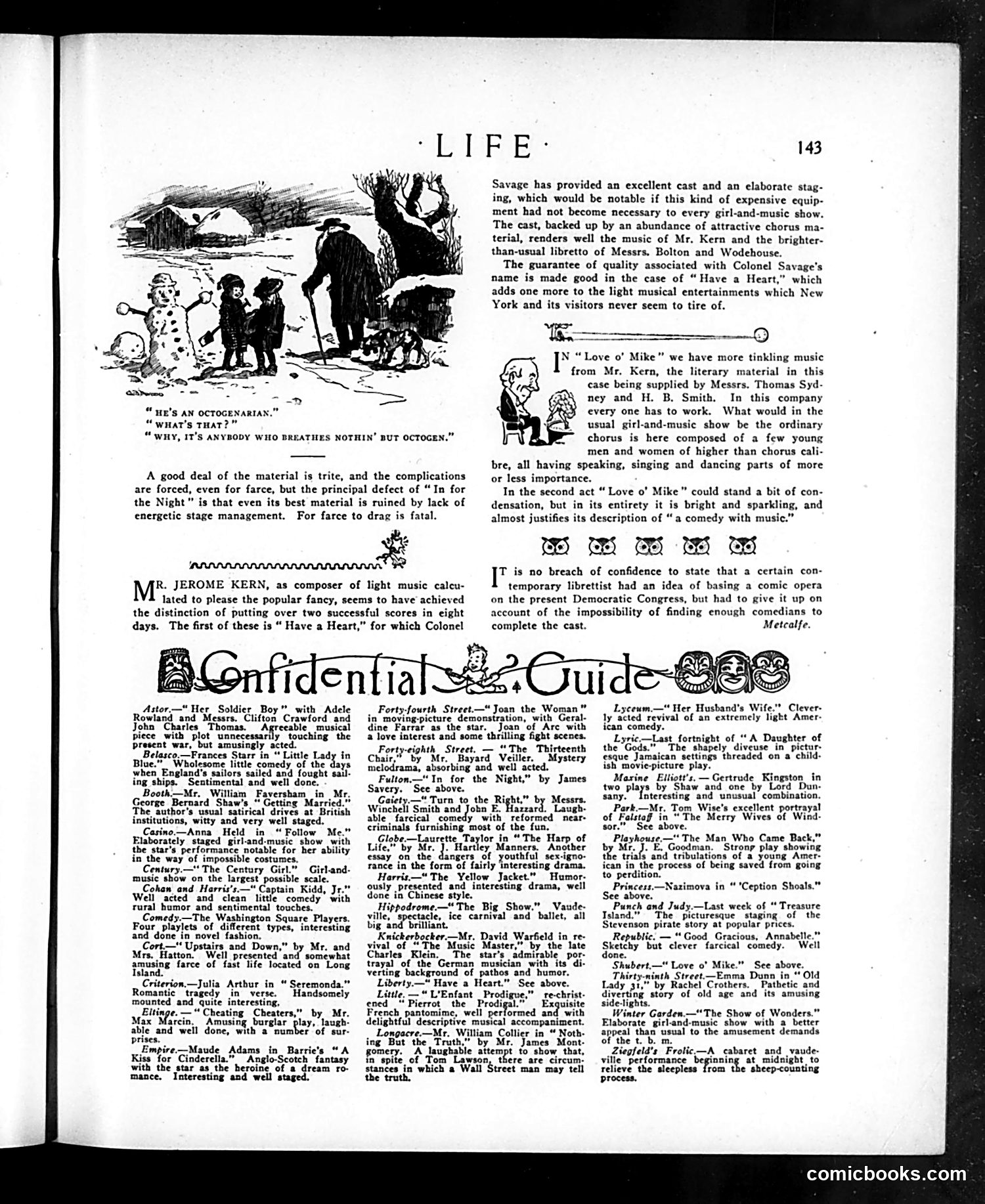
This page reviews theatrical productions on Broadway, primarily discussing musicals by composer Jerome Kern. The cartoon at the top is a joke about the word "octogenarian"—a character mistakes it for someone who breathes "octogen" (a chemical explosive), creating wordplay humor typical of Life's style. The main content critiques two Kern musicals: "Have a Heart" (with Colonel Savage's production) and "Love o' Mike." Reviewers praise the music but note that elaborate staging had become expected in girl-and-music shows. The most political element appears in the italicized section by Metcalfe, which jokes that a contemporary librettist abandoned plans to base a comic opera on "the present Democratic Congress" because there weren't enough comedians available to fill the cast—a satirical jab suggesting Democratic congressmen were themselves insufficiently competent or ridiculous. This reflects early-20th-century theatrical criticism mixed with political commentary.
📄 Transcribed text from this page (OCR, searchable)
Machine-transcribed from the original scan — historical spelling and the odd misread are preserved.
“HE'S AN OCTOGENARIAN.” “ WHaT’s THAT?” “ WHY, 17'S ANYBODY WHO BREATHES NOTHIN’ BUT OCTOGEN.” A good deal of the material is trite, and the complications are forced, even for farce, but the principal defect of “In for the Night” is that even its best material is ruined by lack of energetic stage management. For farce to drag is fatal. R. JEROME KERN, as composer of light music calcu- lated to please the popular fancy, seems to have achieved the distinction of putting over two successful scores in eight days. The first of these is “ Have a Heart,” for which Colonel Astor.—“ Her Soldier Boy" with Adele Rowland and Messrs. Clifton Crawford and John Charles Thomas. eeable musical dine fourth Street.—“ Joan the Woman" -picture demonsiration, with Geral- rrar as the star. 143 Savage has provided an excellent cast and an elaborate stag- ing, which would be notable if this kind of expensive equip- ment had not become necessary to every girl-and-music show. The cast, backed up by an abundance of attractive chorus ma- terial, renders well the music of Mr. Kern and the brighter- than-usual libretto of Messrs. Bolton and Wodehouse. The guarantee of quality associated with Colonel Savage's name is made good in the case of “Have a Heart,” which adds one more to the light musical entertainments which New York and its visitors never seem to tire of. —— =D “Love o’ Mike” we have more tinkling music from Mr. Kern, the literary material in this case being supplied by Messrs. Thomas Syd- ney and H. B. Smith, In this company every one has to work. What would in the usual girl-and-music show be the ordinary chorus is here composed of a few young men and women of higher than chorus cali bre, all having speaking, singing and dancing parts of more or less importance. In the second act “ Love o’ Mike” could stand a bit of con- densation, but in its entirety it is bright and sparkling, and almost justifies its description of “a comedy with musi lCOMBOSMBCOMOOMEOO! T is no breach of confidence to state that a certain con- temporary librettist had an idea of basing a comic opera on the present Democratic Congress, but had to give it up on account of the impossibility of finding enough comedians to complete the cast. Metcalfe. Lyceum.—“ Her Husband's Wife." Clever- ly acted revival of an extremely light Amer- Joan ‘of Arc with ican comedy. piece with plot unnecessarily touching the Present war, but amusingly acted. Belasco.—Frances Starr in Blue.” Whol i Little Lady in me little comedy of the days when England's sailors sailed and fought sail- i: Nt George Bernard Shaw's “ Getting Mari The author's usual satirical drives at British institutions, witty and very well staged. Casino.—Anna Held in “Follow Me.” Elaborately staged girl-and-music show with the star's performance notable for her ability in the way of impossible costumes, Century.—" The Century Girl.” Girland- music show on the largest possible scale. Cohan and Harris's. Captain Kidd, Jr. Well acted and clean little comedy’ wi rural humor and sentimental touches. Comedy.—The Washington Square Players. Four playlets of different types, interesting and done in novel fashion. Cort.—"' Upstairs and Down,” by Mr. and Mrs. Hatton. Well presented and somewhat Pate ig farce of fast life located on Long riterion.—Julia Arthur in “ Seremonda.” Romantic tragedy in verse. Handsomely mounted and quite interesting, Cheating Cheaters," by Mr. Max Marcin, Amusing burglar play, laugh: id well done, with a number of sur- Empire—Maude Adams in_ Barrie's “A Kiss for Cinderella.” Anglo-Scotch fantasy with the star as the heroine of a dream ro- mance. Interesting and well staged. a love interest and some thrilling fight scenes. Forty-eighth Street. — “The Thirteenth Chair,” by Mr, Bayard Veiller. Mystery melodrama, absorbing and well acted. Fulton.—"In for the Night,” by James Savery.” See above. Gaiety —" Turn fo the Right.” by Messrs Winchell Smith and Jobn E. Hazeard. Laugh: able. farcical comedy with reformed near- Criminals furnishing most of the fun. be—Laurette Taylor in “The Harp of by Mr Hartley Manners. Another essay on the’ dangers of youthful sex-igno- fance in the form of fairly Interesting drama, Harris—" The Yellow Jacket" Humor. ously presented and interesting drama, well done in Chinese style. Hippodrome —"The Big Show.” Vaude- ville, spectacle, ice carnival and ballet, all big and brilliant. Knickerbocker-—Mr, David Warfield in. re- vival of "The Music Master,” by Charles Klein. The star’s admirable por- trayal of the German musician with its di- verting background of pathos and humor. Liberty.—" Have a Heart.” See above. Little, —“ L'Enfant Prodigue.” re-christ- ened Pierrot the Prodigal.” Exquisite French pantomime, well performed and with delightful descriptive musical accompaniment, Longacre—Mr. William Collier in “ Noth- ing But the Truth,” by Mr. James Mont- fomery. A laughable attempt io show that fo"spite, of Tom Lawson, there are circum: stances in which a Wall Street man may tell the truth. t fortnight of “A Daughter of The shapely diveuse in pictur- esque Jamaican settings threaded on a child- ish movie-picture play. Maxine Elliott's. — Gertrude Kingston in two plays, by Shaw and one by Lord Dun- sany. Interesting and unusual combination. Mr. Tom Wise’s excellent portrayal in “The Merry Wives of Wind- "See above. Playhouse.—* The Man Who Came Back,” by Mr. J. E. Goodman. Strong play showing the triafs and tribulations of a young Amer: ican in the process of being saved from going to perdition. Princess. See above. Punch and Judy.—Last week of “ Treasure Island.” The picturesque staging of the Stevenson pirate story at popular prices. Republic. — “Good Gracious, Annabelle.” Sketchy but clever farcical comedy. Well done. Shubert,—" Love 0” Mike.” See abo Thirty-ninth Street.—Emma Dunn in Lady 31," by Rachel Crothers. Pathetic and diverting story of old age and its amusing side-lights. Winter Garden.—“The Show of Wonders. Elaborate girland-music show with a better appeal than usual to the amusement demands of the t. b. m. Ziegfeld’s Frotic—A cabaret and vaude- ville performance beginning at midnight, to relieve the sleepless from the sheep-counting process, Nazimova in “ 'Ception Shoals.” comicbooks.com