
A complete issue · 40 pages · 1917
Life — January 18, 1917
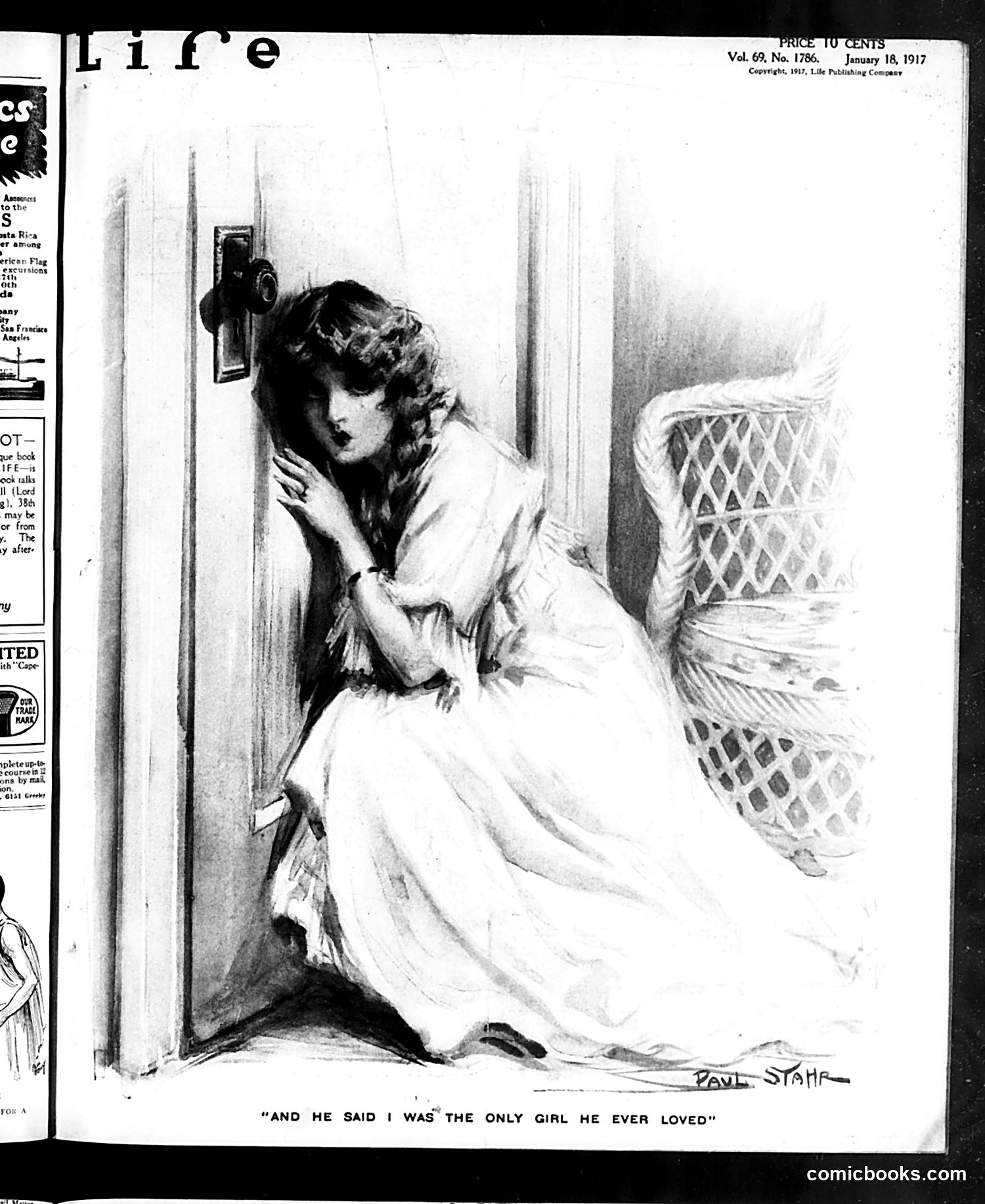
This illustration by Paul Starr depicts a young woman in an elegant white dress gazing longingly through a doorway, holding what appears to be a photograph or letter. The caption reads: "AND HE SAID I WAS THE ONLY GIRL HE EVER LOVED." The cartoon satirizes romantic deception—a common theme in early 20th-century humor. The woman's wistful expression and the sentimental caption suggest she's been told she's unique, yet the illustration implies this is a hollow romantic cliché that men use on multiple women. The artwork captures a moment of naive hope mixed with the suggestion of inevitable disappointment, mocking both male dishonesty and female gullibility in romantic matters. This reflects period attitudes about courtship and gender relations.
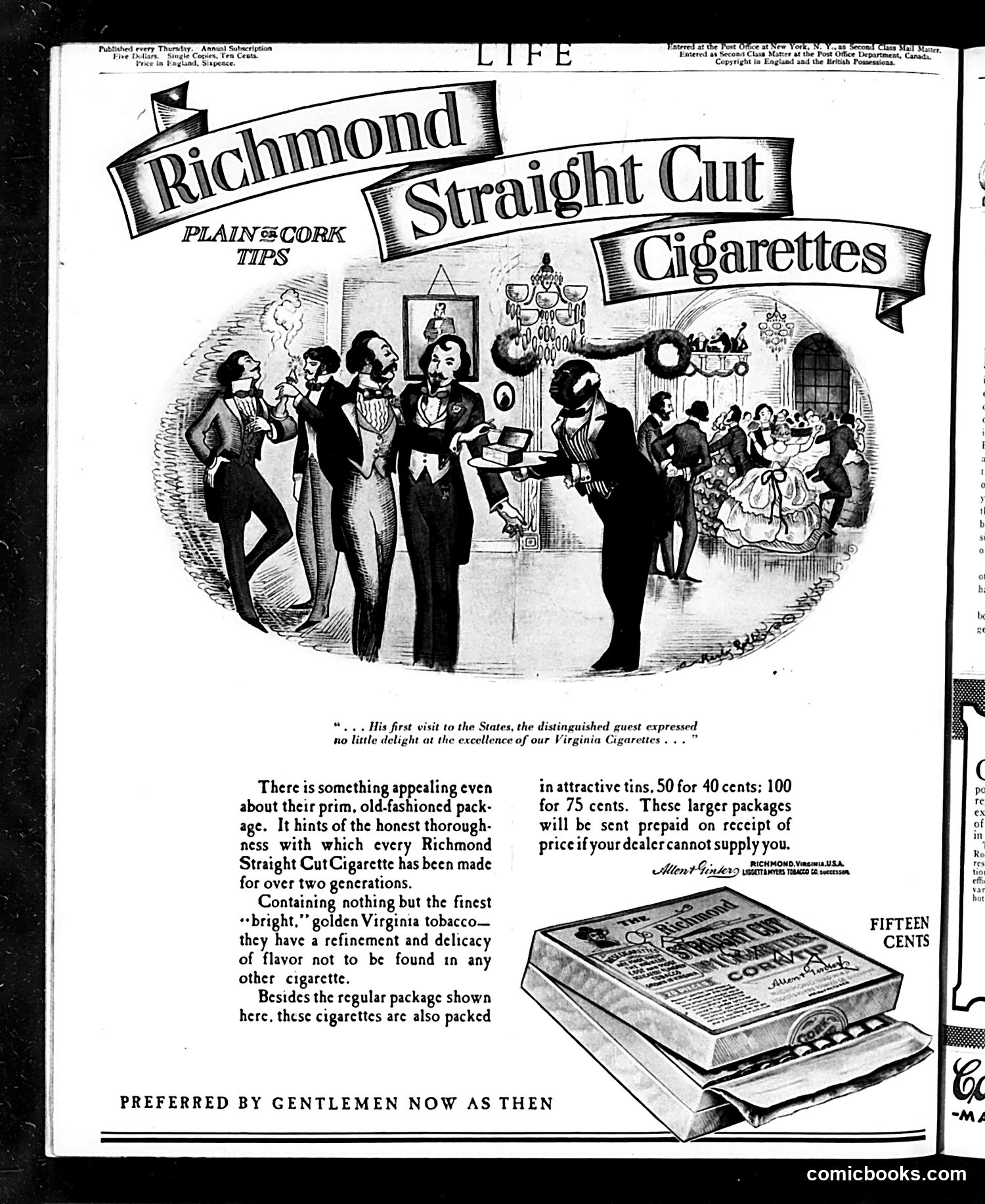
This page is primarily an **advertisement for Richmond Straight Cut Cigarettes**, not political satire. The large illustration depicts a formal social gathering—likely a ball or reception—where gentlemen in evening wear present cigarette packages to well-dressed ladies and guests. The accompanying text emphasizes the product's quality: "finest...bright, golden Virginia tobacco" with "refinement and delicacy of flavor." The tagline "PREFERRED BY GENTLEMEN NOW AS THEN" suggests the brand's established reputation. The illustration's satirical element appears gentle: it depicts cigarettes as a prestigious gift worthy of formal social occasions, appealing to upper-class masculinity. The price (fifteen cents) and packaging details support this is straightforward product marketing rather than political commentary.
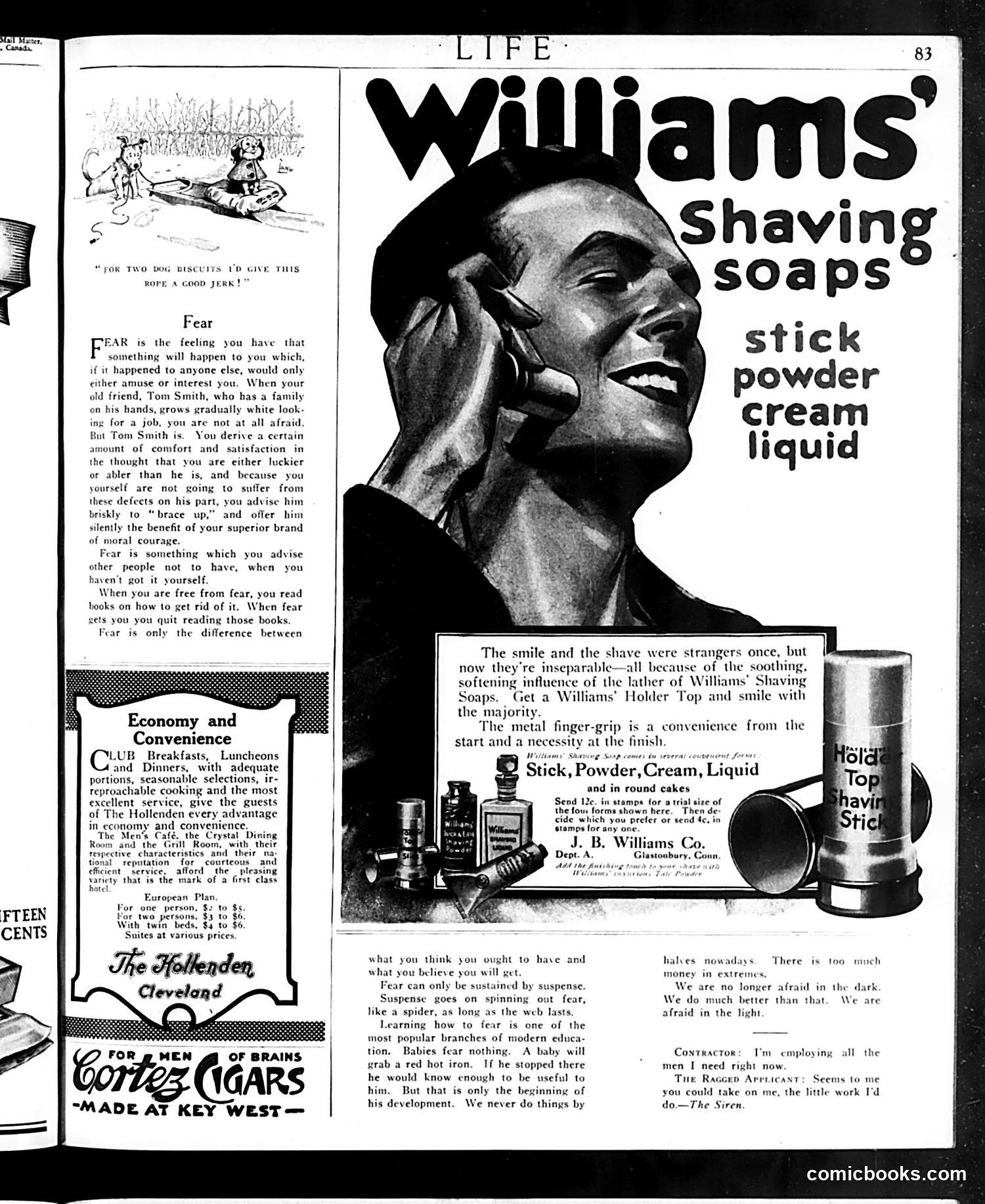
This page is primarily **advertising**, not political satire. The dominant content is a Williams' Shaving Soaps advertisement featuring a man's face and shaving products. The small cartoon in the upper left ("For Two Dog Biscuits I'd Give This Rope a Good Jerk!") appears to be a humorous illustration about dog treats, unrelated to the main advertisements. The essay titled "Fear" discusses the emotional response to uncertainty, using an example of a man named Tom Smith job-hunting. It's a motivational piece about managing anxiety. Additional advertisements include The Hollenden hotel (Cleveland), Cortez Cigars, and a sidebar about "Economy and Convenience" for the Hollenden's dining options. The page represents typical 1920s-era magazine layout mixing editorial content with commercial advertising.
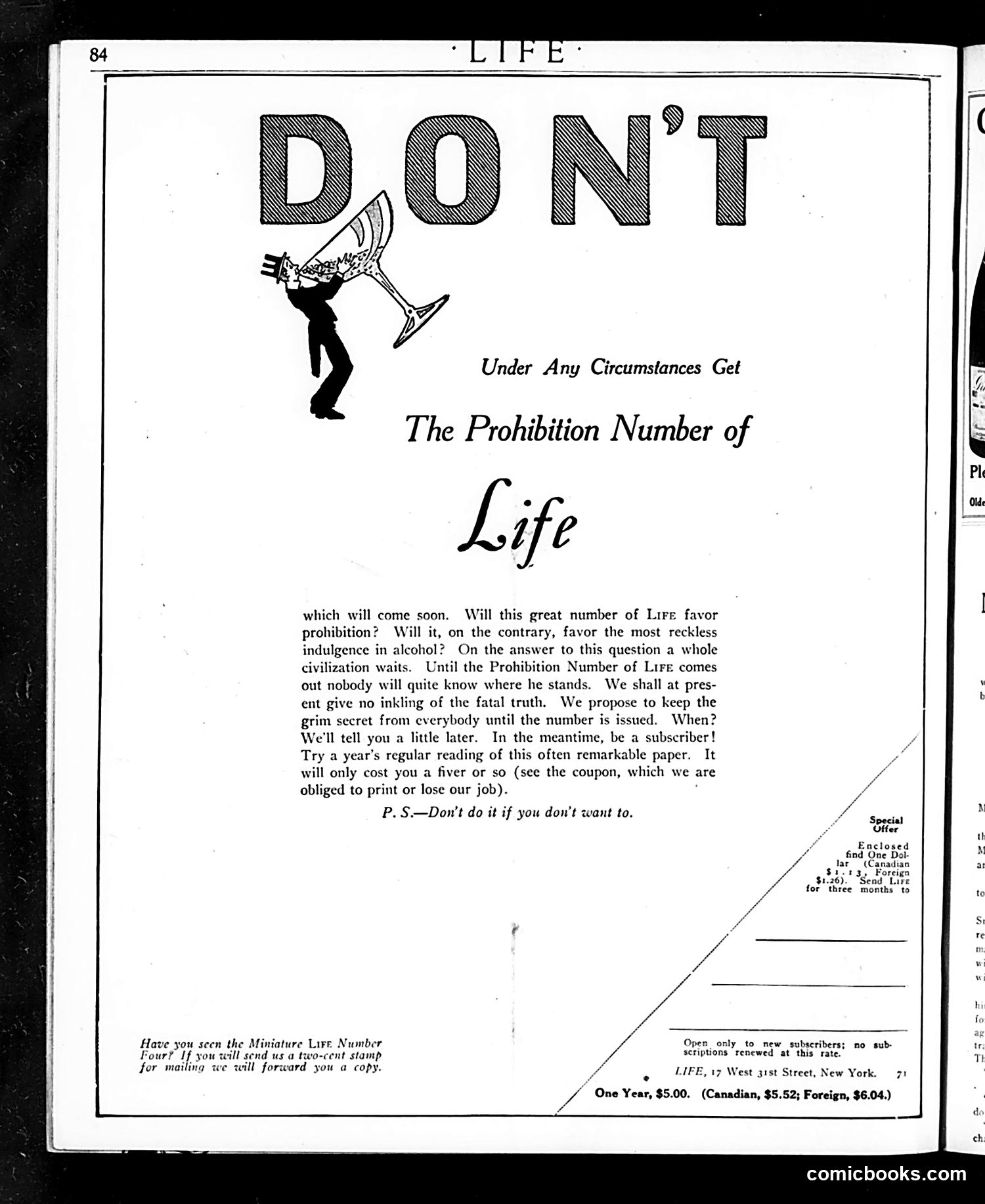
This is a **subscription advertisement** rather than editorial content. The page promotes Life magazine by playing on contemporary anxiety about **Prohibition** — the constitutional ban on alcohol (1920-1933). The satire works through a fake mystery: Life claims to possess "The Prohibition Number of Life" and promises to reveal whether Prohibition will encourage or discourage drinking. The publication teases readers that this "fatal truth" will solve the debate dividing the nation. The illustration shows a man dramatically clutching a cocktail glass, emphasizing the era's tension around illegal alcohol consumption. The appeal to "be a subscriber!" uses this manufactured intrigue to drive subscriptions, costing roughly five dollars annually. The postscript — "Don't do it if you don't want to" — adds ironic humor typical of Life's satirical tone.
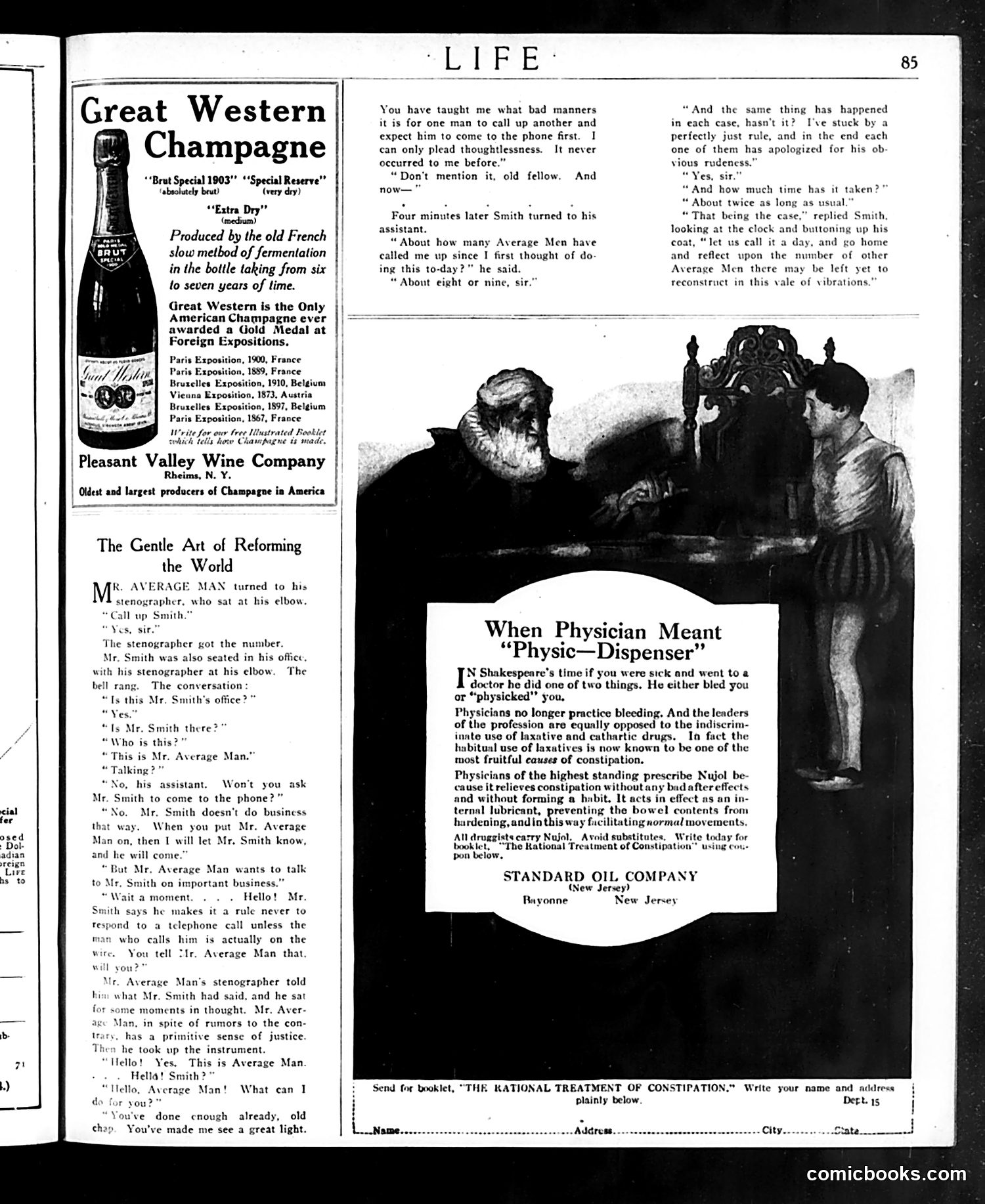
This page contains two distinct elements: **Left Side - Advertisement & Story**: An ad for Great Western Champagne and a satirical story titled "The Gentle Art of Reforming the World." The narrative mocks office bureaucracy, depicting "Mr. Average Man" trying to reach his boss Mr. Smith by phone. The satire critiques workplace inefficiency and the absurdity of office hierarchies—even simple communication requires navigating multiple intermediaries and formal procedures. **Right Side - Medical Advertisement**: A Standard Oil Company ad titled "When Physician Meant 'Physic-Dispenser'" references Shakespeare's era, when doctors prescribed laxatives and bleeding treatments. The ad promotes Nujol laxative as a modern, gentler alternative. It satirizes outdated medical practices while using historical comparison to market the product as progressive medicine. Both reflect early 20th-century American concerns: workplace frustration and medical advancement.
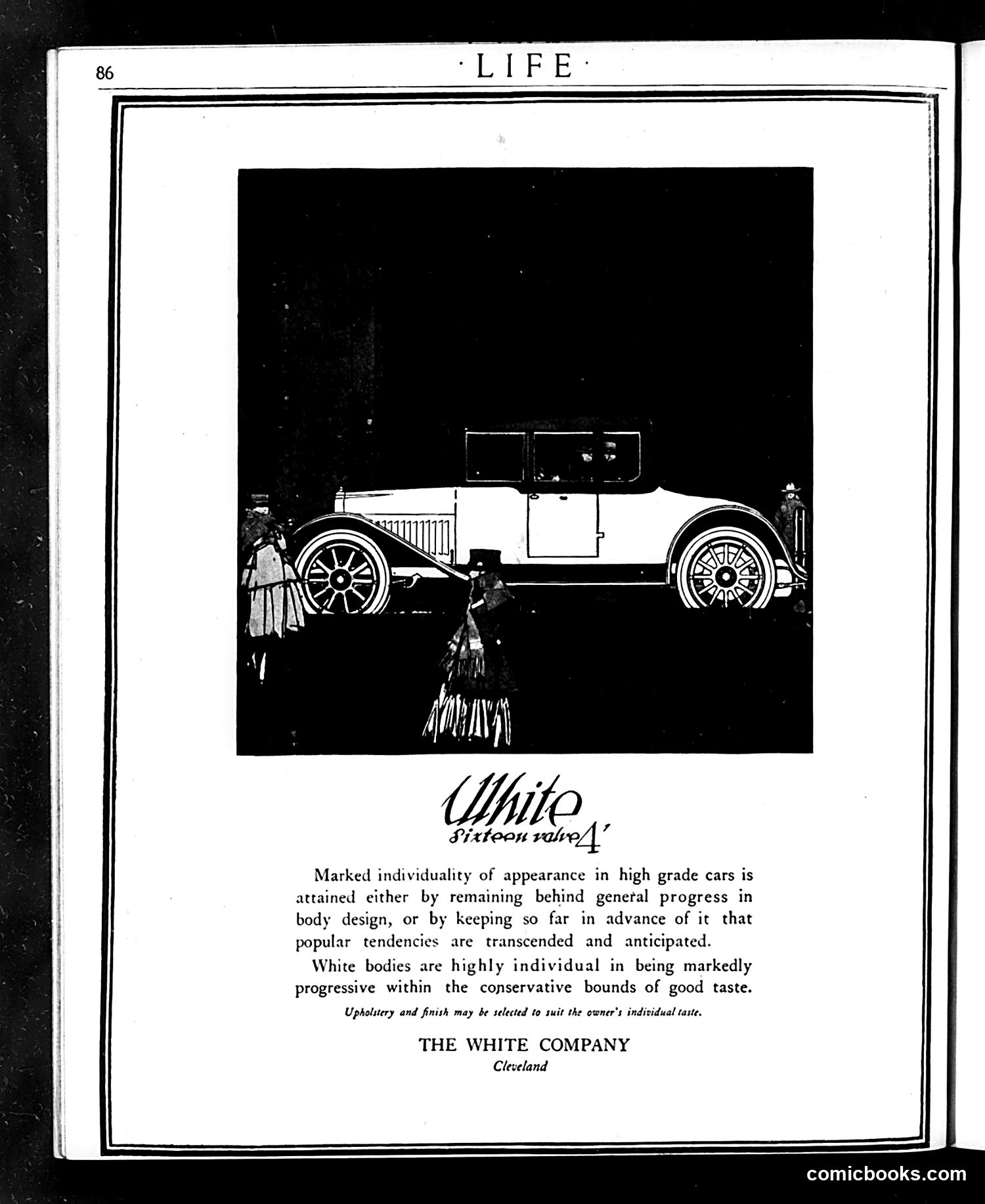
This is a straightforward advertisement, not satire. It promotes the White Motor Company's "Sixteen Valve" automobile from Cleveland, Ohio. The ad features an illustration of an elegant open-air touring car with two well-dressed figures—a woman in a long dress on the left and a man in formal attire on the right—examining the vehicle. The accompanying text argues that White cars achieve "marked individuality of appearance" while remaining "markedly progressive within the conservative bounds of good taste." It suggests the company offers customizable "upholstery and finish" to suit individual owner preferences. This represents typical 1920s-era luxury automobile marketing, emphasizing both distinction and refinement to appeal to affluent consumers. The design and messaging reflect period standards of elegance and exclusivity.
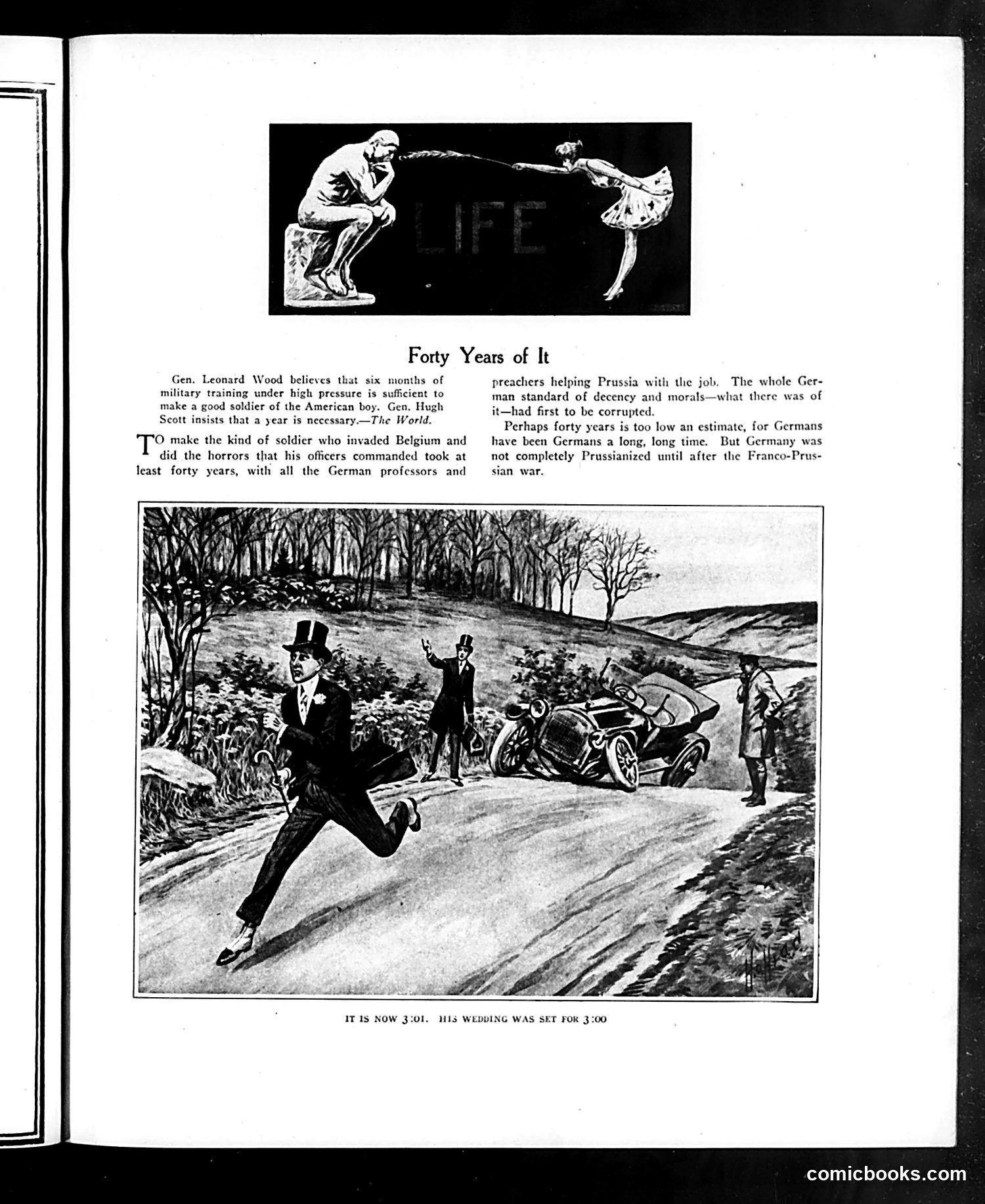
This page satirizes German militarism and discipline. The headline quotes military figures (Gen. Leonard Wood and Gen. Hugh Scott) debating whether six months or a year of military training suffices to create soldiers. The cartoon contrasts this with Germany's approach: forty years of harsh officer training in Belgium created such brutalized commanders that they committed atrocities. The text references "horrors that its officers commanded" and notes Germany's moral corruption required prior to its Prussianization. The illustration shows a man in formal dress fleeing a wedding (set for 3:00 PM, now only 3:01) past a wrecked automobile—suggesting chaotic, violent disruption of normal life, likely representing German militarism's destructive impact on civilian society.
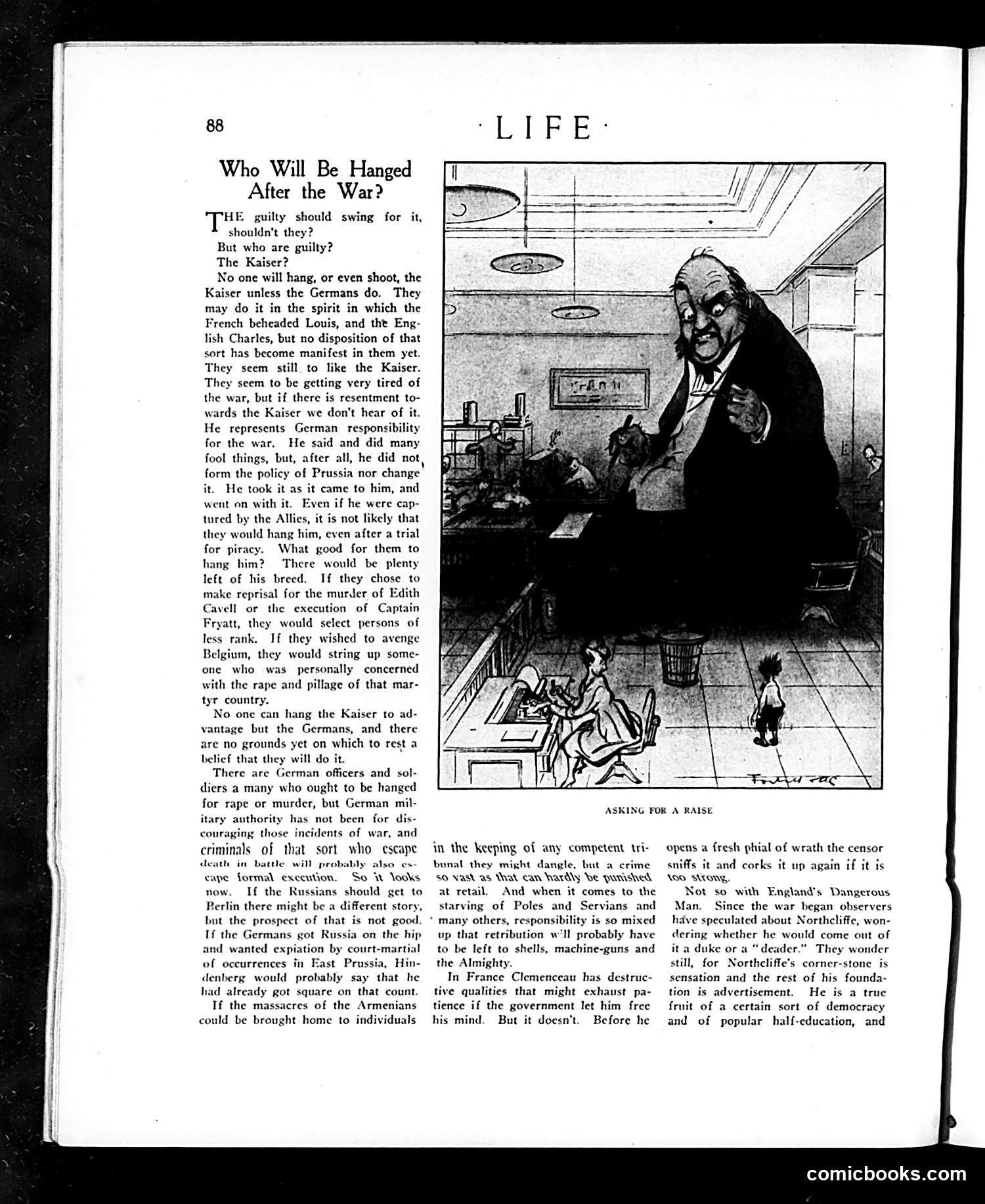
This page from *Life* magazine presents a post-World War I political argument about war crimes accountability. The cartoon illustration (captioned "Asking for a Raise") shows a figure in an elevated position addressing others below, likely depicting a German military or political leader. The text argues that hanging Kaiser Wilhelm II would be impractical and counterproductive. Instead, the author suggests targeting lower-ranking German officers responsible for specific atrocities—the execution of Edith Cavell, Captain Fryatt's death, and Belgian atrocities. The piece contends that Germans themselves should execute these war criminals, as the Allies lack practical authority to do so. It reflects contemporary debates over German accountability and justice following WWI's conclusion.
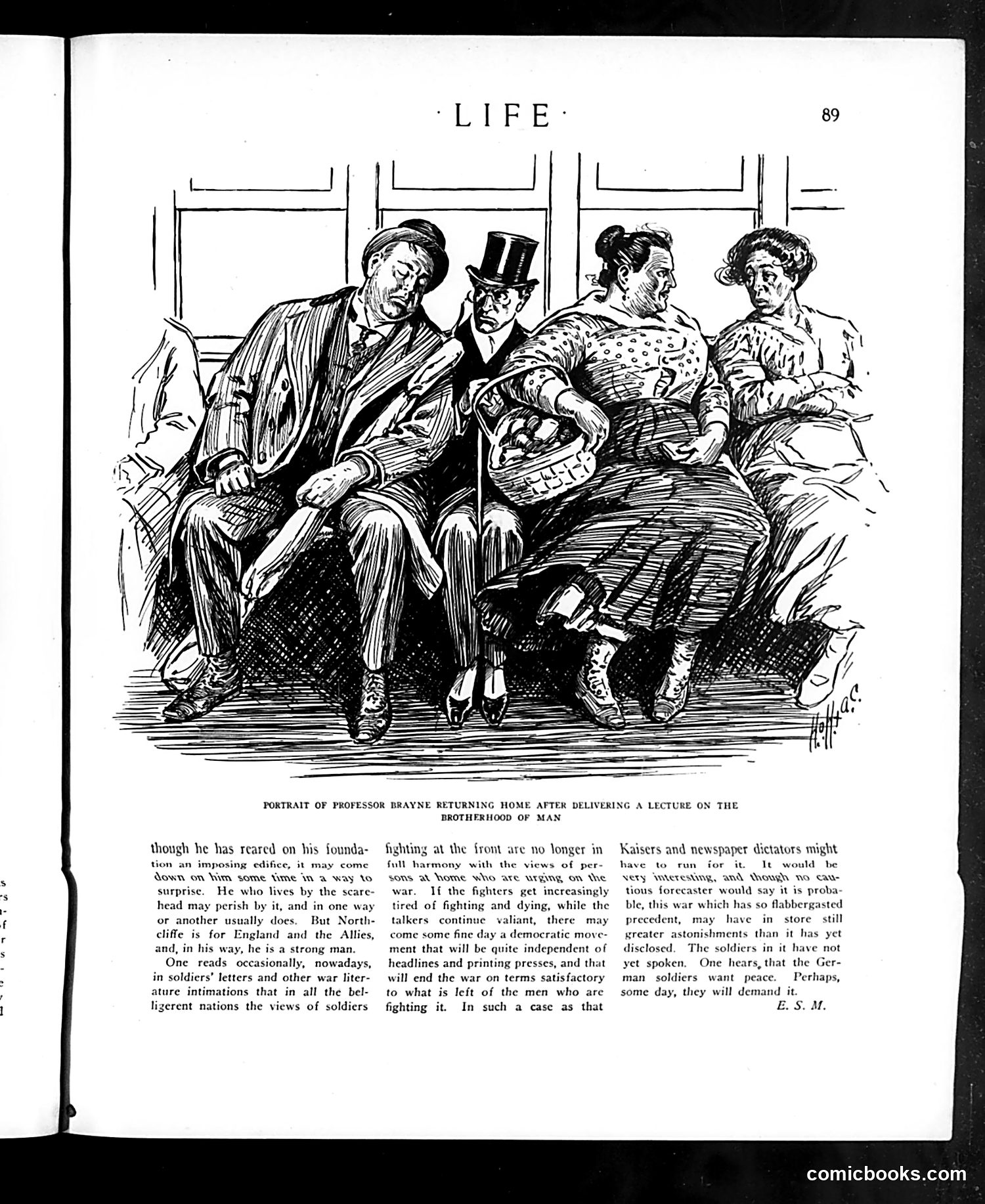
This is a satirical illustration titled "Portrait of Professor Brayne Returning Home After Delivering a Lecture on the Brotherhood of Man." The cartoon depicts an intellectual (the "Professor," identifiable by his top hat) arriving home by carriage, surrounded by what appear to be his family members or household occupants. The satire targets the hypocrisy of someone who publicly lectures about universal human brotherhood and equality while maintaining conventional Victorian social hierarchies in his private life. The accompanying text discusses soldiers' letters expressing views about post-war peace and democratic governance, suggesting the cartoon comments on the gap between idealistic public rhetoric and actual social practice—a common Life magazine theme. The satire implies that such elevated philosophizing about human unity rings hollow when one's own domestic arrangements reflect rigid class and gender distinctions.
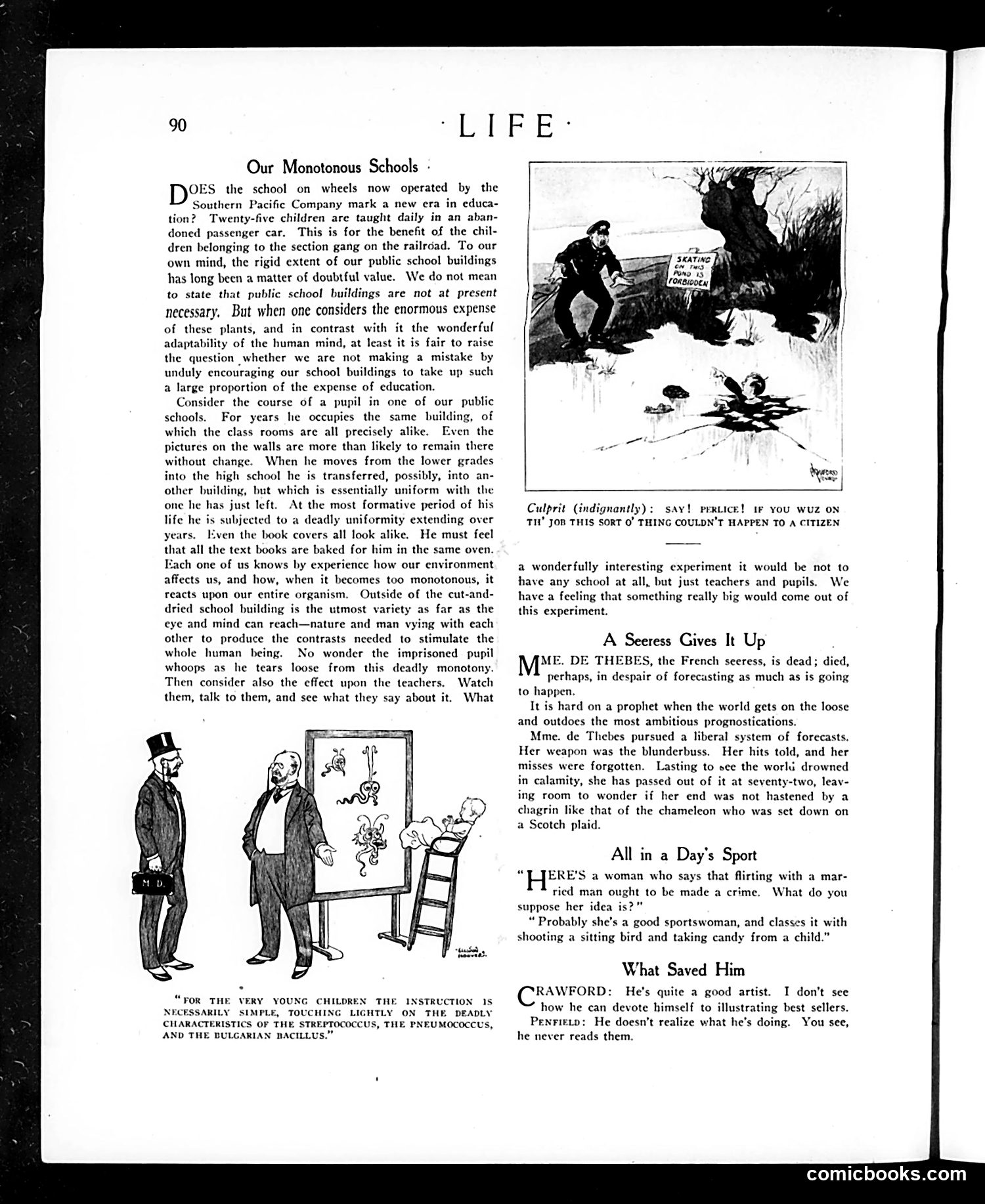
**Main Article: "Our Monotonous Schools"** This editorial criticizes rigid, uniform public school buildings as stifling to education. The author argues that identical classroom environments fail to stimulate children's development and suggests schools should encourage environmental variety to better engage students' minds. **Political Cartoon (bottom left):** Shows three men examining a child's drawing on a board. The caption states this instruction method is "necessarily simple, touching lightly on the deadly characteristics of the streptococcus, the pneumococcus, and the bulgarian bacillus." This appears to satirize overly technical, inappropriate science instruction for young children—teaching complex bacteriology to students incapable of understanding it. The other brief humor items on the page appear unrelated to political satire.
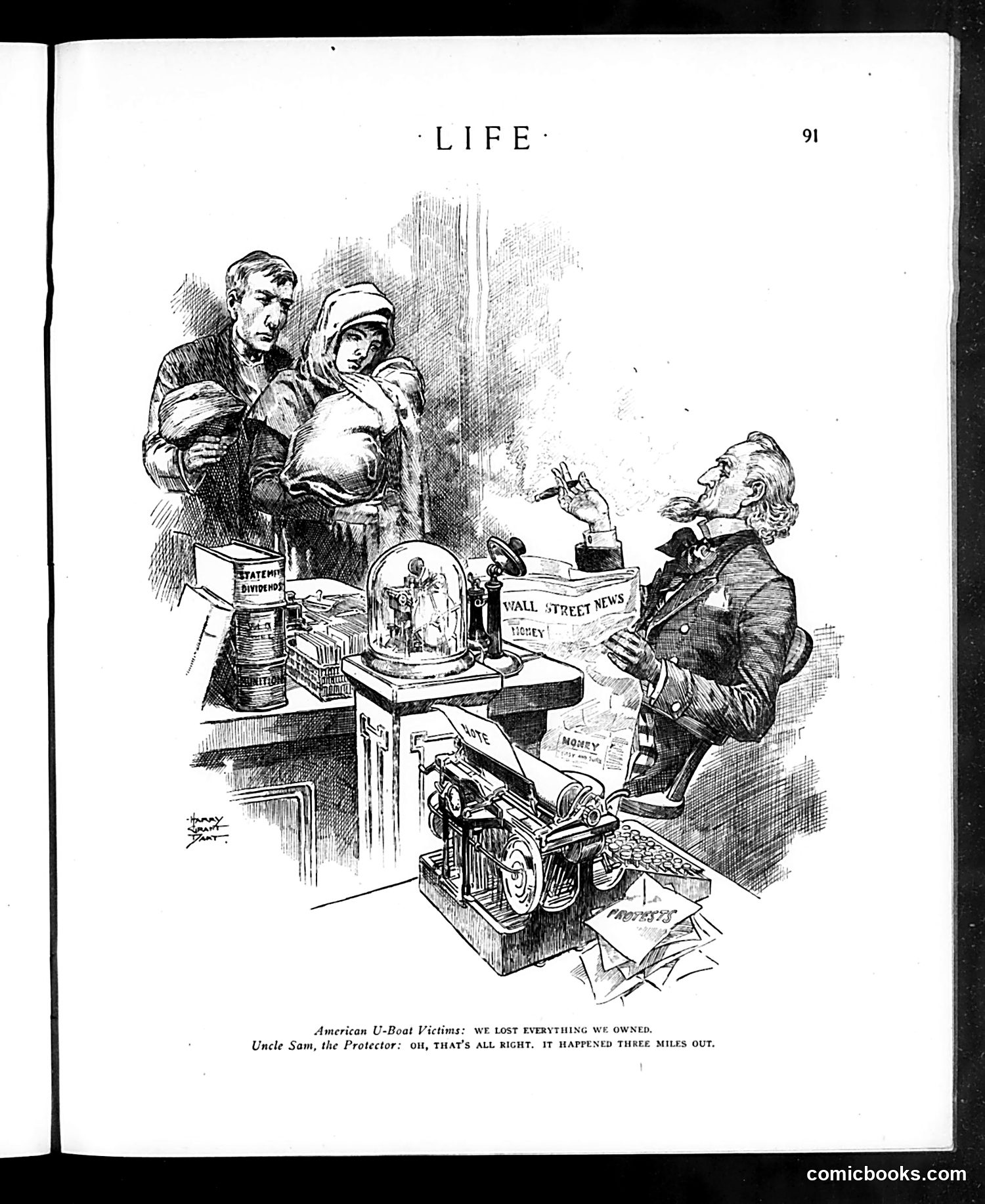
This satirical cartoon critiques government inadequacy during World War I submarine warfare. A distressed family (man, woman, and child) approaches Uncle Sam, who sits reading "Wall Street News" and smoking. The family has lost possessions displayed on a table—household items, a baby carriage, and documents marked "Money"—representing their complete financial ruin from a U-boat attack three miles offshore. The satire's point: Uncle Sam, portrayed as indifferent and focused only on financial news, offers hollow reassurance ("Oh, that's all right. It happened three miles out") rather than actual protection. The cartoon criticizes the government's failure to defend American civilians and property from German submarines operating near U.S. shores, suggesting official negligence masked by empty platitudes.
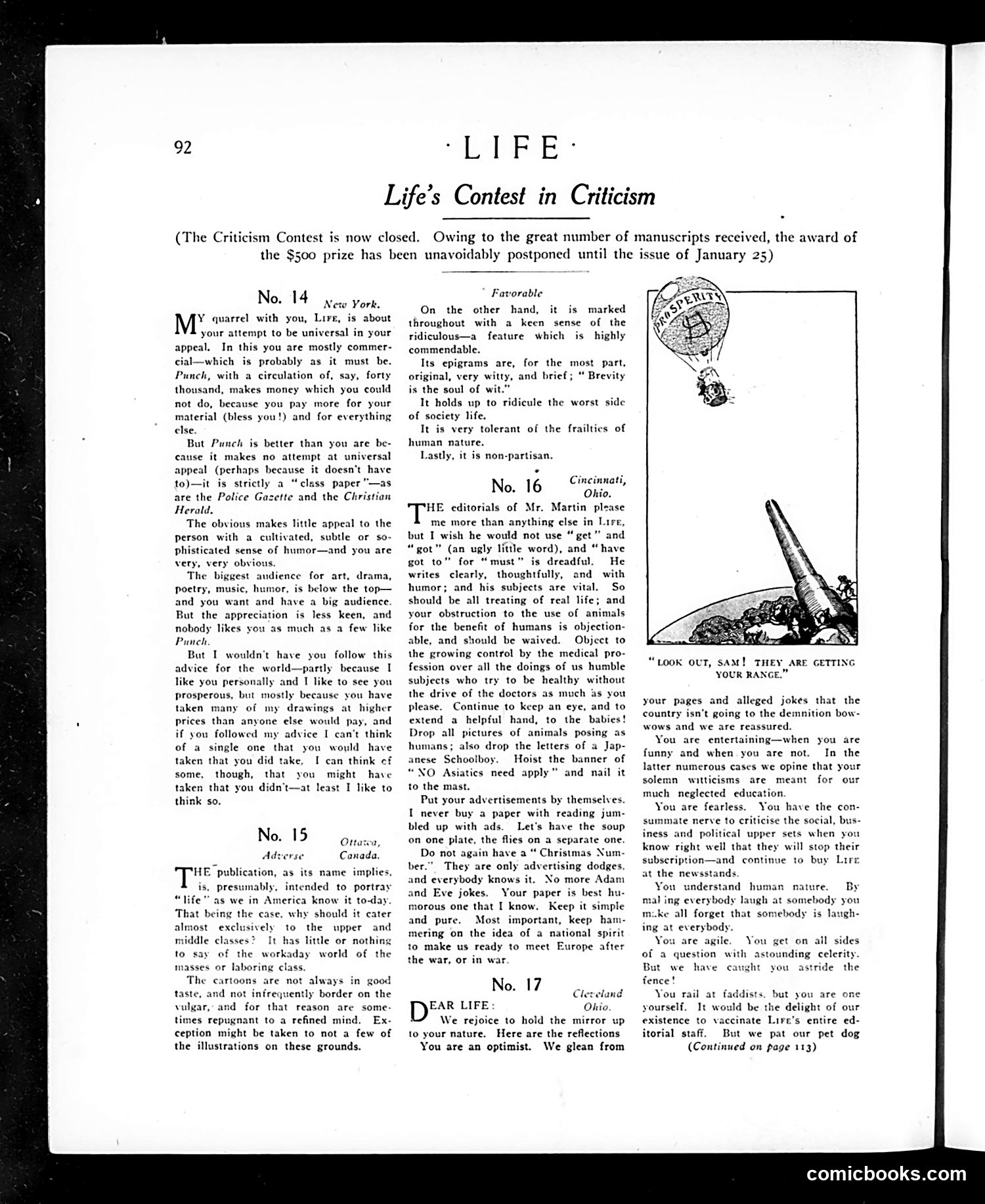
This page presents reader submissions critiquing *Life* magazine itself. The cartoon (top right) shows a hot air balloon labeled "Life" with a gun shooting at it, captioned "Look out, Sam! They are getting your range." The visual joke depicts *Life* as a high-flying target under attack—a self-aware commentary on the magazine receiving critical letters from readers. The submissions discuss *Life*'s satirical approach, its class-based humor, and editorial standards. One letter praises *Life*'s "keen sense of the ridiculous" and non-partisan stance. Another criticizes editorial word choices and requests focus on "real life" topics. A third commends *Life*'s optimistic outlook. The page reflects *Life*'s role as a satirical publication inviting public feedback about its own editorial voice and social commentary approach.
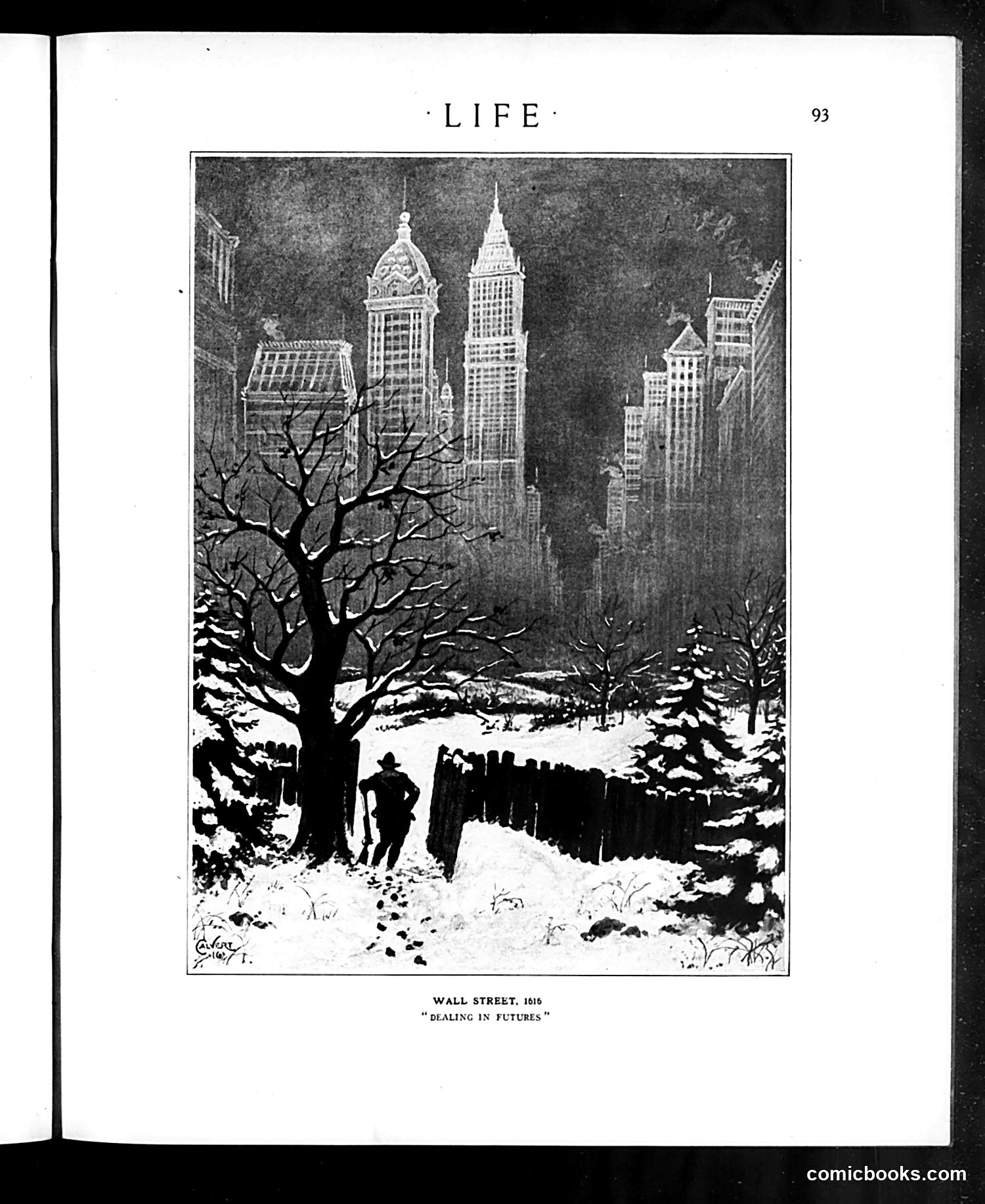
This single-panel cartoon depicts a winter scene of Wall Street's skyline viewed from a snowy landscape. A solitary figure stands amid bare trees and evergreens, gazing toward the distant buildings. The title "Dealing in Futures" is a pun: it references both stock market speculation (trading in futures contracts) and the literal future—the figure appears to be viewing an uncertain tomorrow. The desolate, frozen setting and isolated human figure suggest anxiety about economic prospects, likely reflecting concerns during World War I's impact on American markets and finance. The contrast between the barren foreground and imposing skyline emphasizes Wall Street's distant, imposing presence in American life.
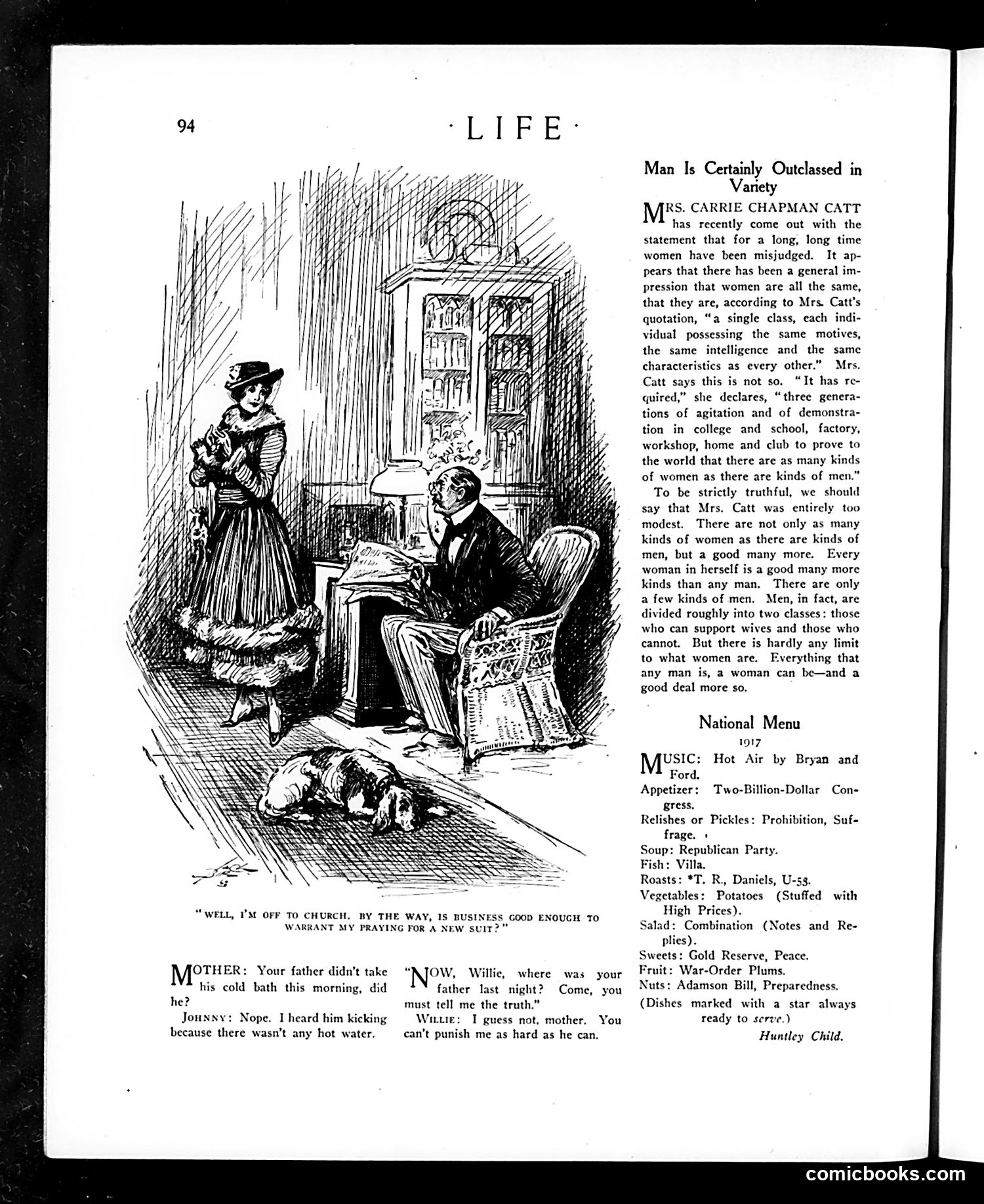
This page contains two separate pieces: **Top cartoon** shows a domestic scene with a man reading a newspaper while a woman stands nearby. The caption reads: "Well, I'm off to church. By the way, is business good enough to warrant my praying for a new suit?" The satire mocks the hypocrisy of prayer and materialism—the woman frames her request for new clothing as a spiritual matter, suggesting she'll pray for it only if business finances permit. It satirizes both gender dynamics (the woman's dependence on her husband's income) and the mixing of religious devotion with consumerism. **Lower dialogue** between mother and son jokes about the absence of hot water for a cold bath, likely referencing wartime or economic hardship (the 1917 date suggests WWI-era rationing). The boy's crude response about his father "kicking" humorously avoids the real issue.
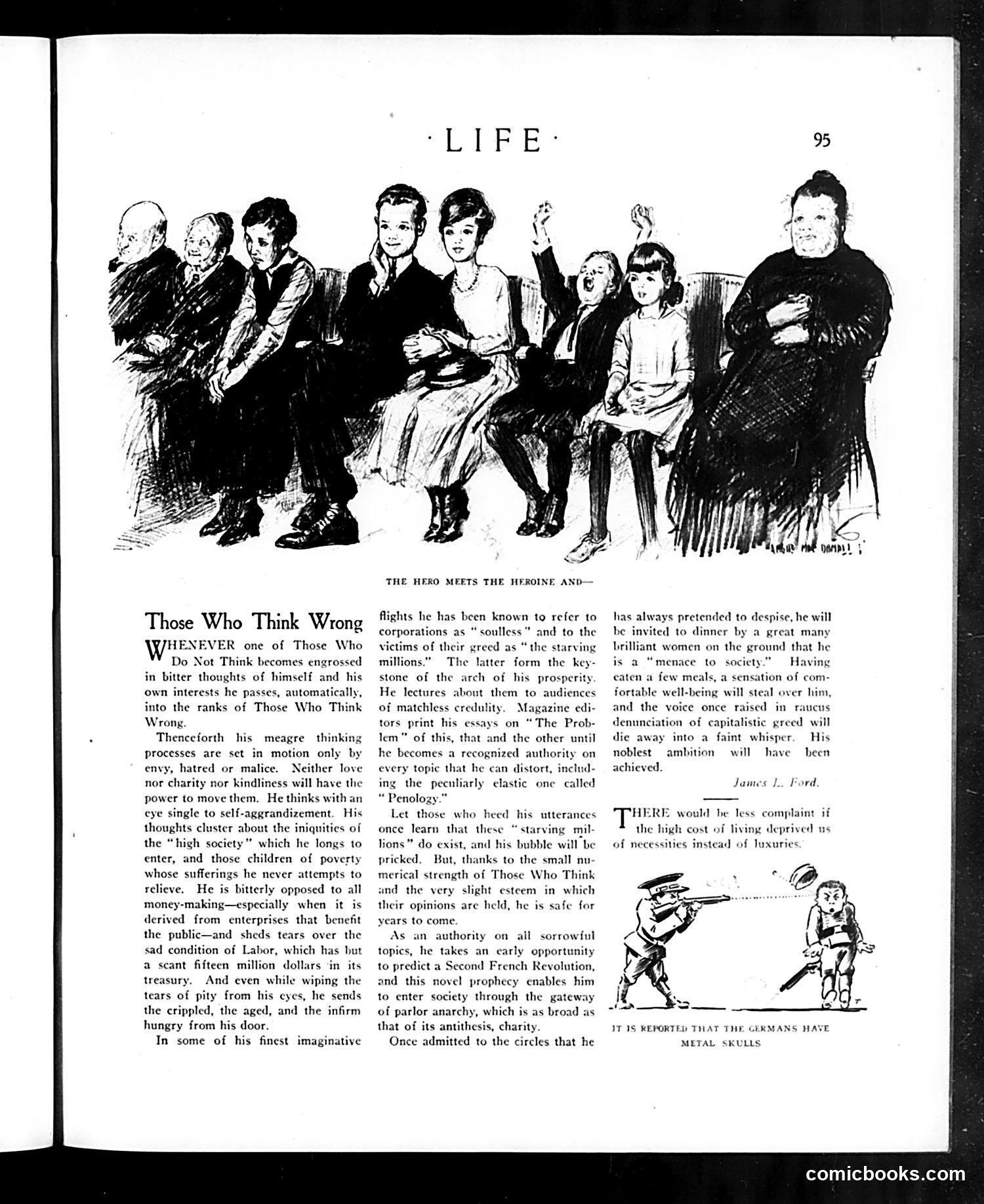
This Life magazine page (page 95) contains social satire about wealthy individuals who "think wrong"—those indifferent to labor exploitation and poverty. The text, attributed to James L. Ford, criticizes rich people who dismiss workers as "starving millions" while claiming poverty doesn't exist, and who oppose charity or labor reform. The upper illustration depicts "The Hero Meets the Heroine"—likely showing a wealthy man encountering women in a social setting, satirizing his superficial morality. The lower cartoon, "It Is Reported That the Germans Have Metal Skulls," uses absurdist humor to mock German military pretensions, a common satirical trope during the era of Anglo-German tensions (likely pre-WWI or inter-war period). Together, the page critiques both class hypocrisy and foreign militarism.
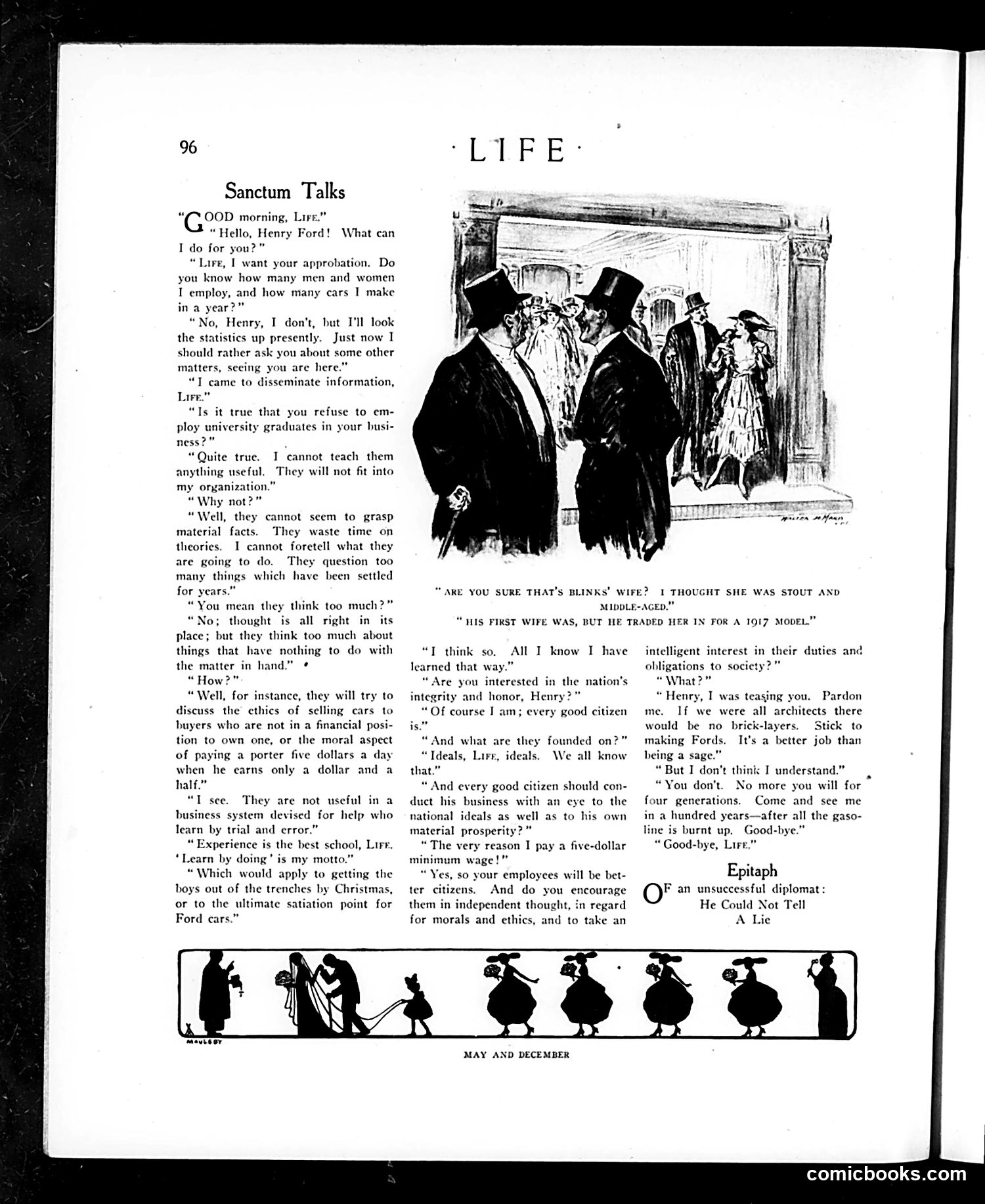
This satirical dialogue features **Henry Ford** (identifiable by name and the discussion of his auto manufacturing and five-dollar wage) meeting with "Lire," the magazine's editor. The cartoon attacks Ford's contradiction: he claims to value citizen integrity and national ideals while actively refusing to employ university graduates who think critically about ethics—such as the morality of selling cars to financially unqualified buyers or paying workers poverty wages. Ford's logic is exposed as hollow. He dismisses educated workers for "questioning too many things," yet simultaneously boasts of his five-dollar minimum wage as promoting better citizenship. The satire suggests Ford wants obedient workers who won't scrutinize his business practices, not genuinely thinking citizens. The secondary joke (bottom caption) mocks outdated values: a man "traded in" his first wife for a 1917 car model—darkly comparing marriage to consumer goods, echoing Ford's assembly-line mentality applied to human relationships.
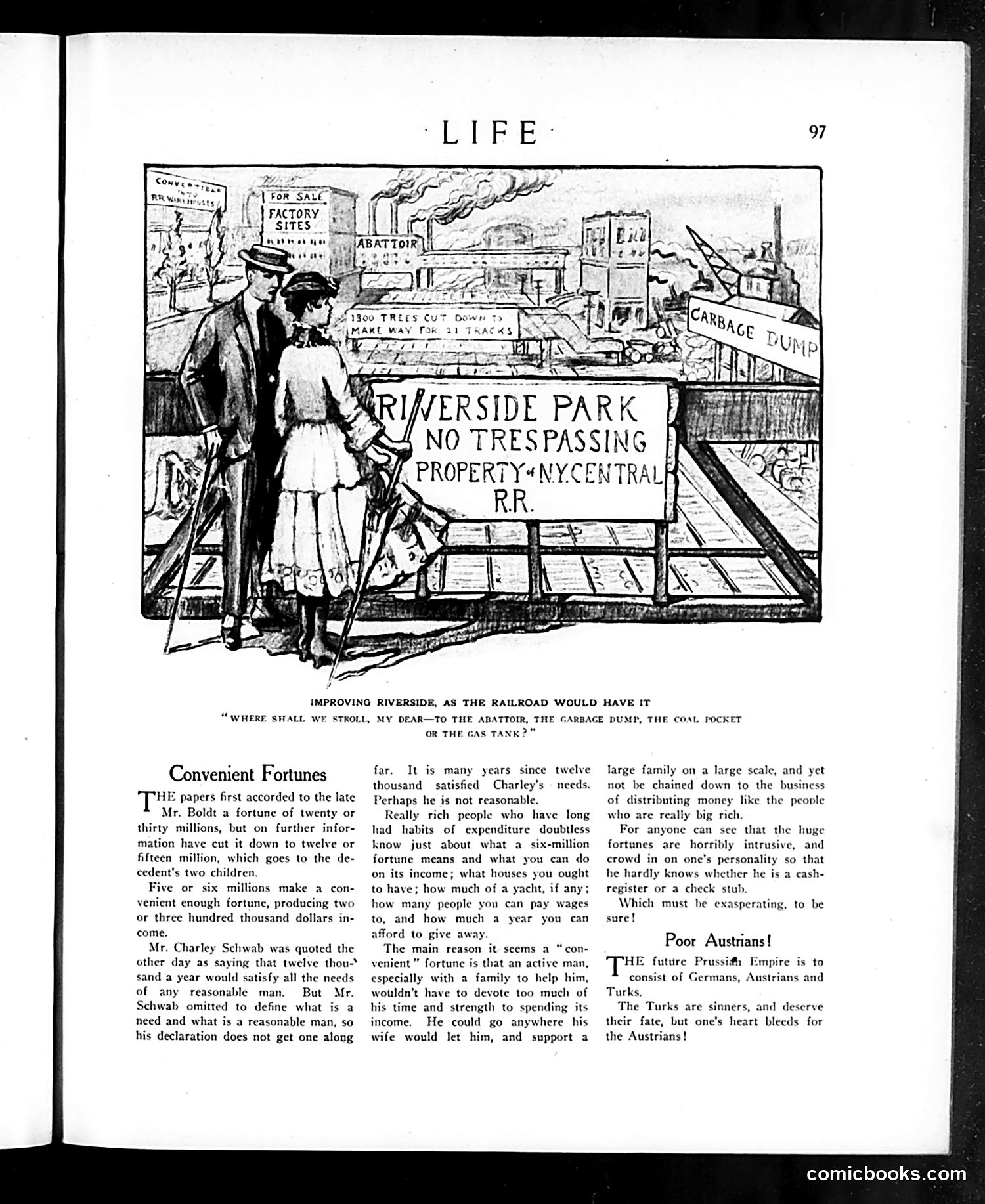
**The Main Cartoon** depicts a well-dressed couple contemplating a riverside park now marred by industrial development—factory smokestacks, an abattoir (slaughterhouse), garbage dump, and coal pocket visible in the background. A "No Trespassing" sign for "Riverside Park" blocks their stroll. **The Satire**: The cartoon mocks railroad companies' industrialization of formerly pleasant public spaces. The couple's dialogue—"where shall we stroll?"—sarcastically questions whether they can enjoy the park when it's been converted to industrial uses. The caption "Improving Riverside, as the Railroad Would Have It" is ironic: the railroad claims improvement, but actually destroys amenity. **The Point**: Critiques unchecked corporate development prioritizing profit over public welfare and urban quality of life—a Progressive-era concern about monopolies and industrial expansion overwhelming cities. **The Articles** below discuss wealth distribution (Boldt, Schwab fortunes) and Austrian fate under German expansion, unrelated to the cartoon.
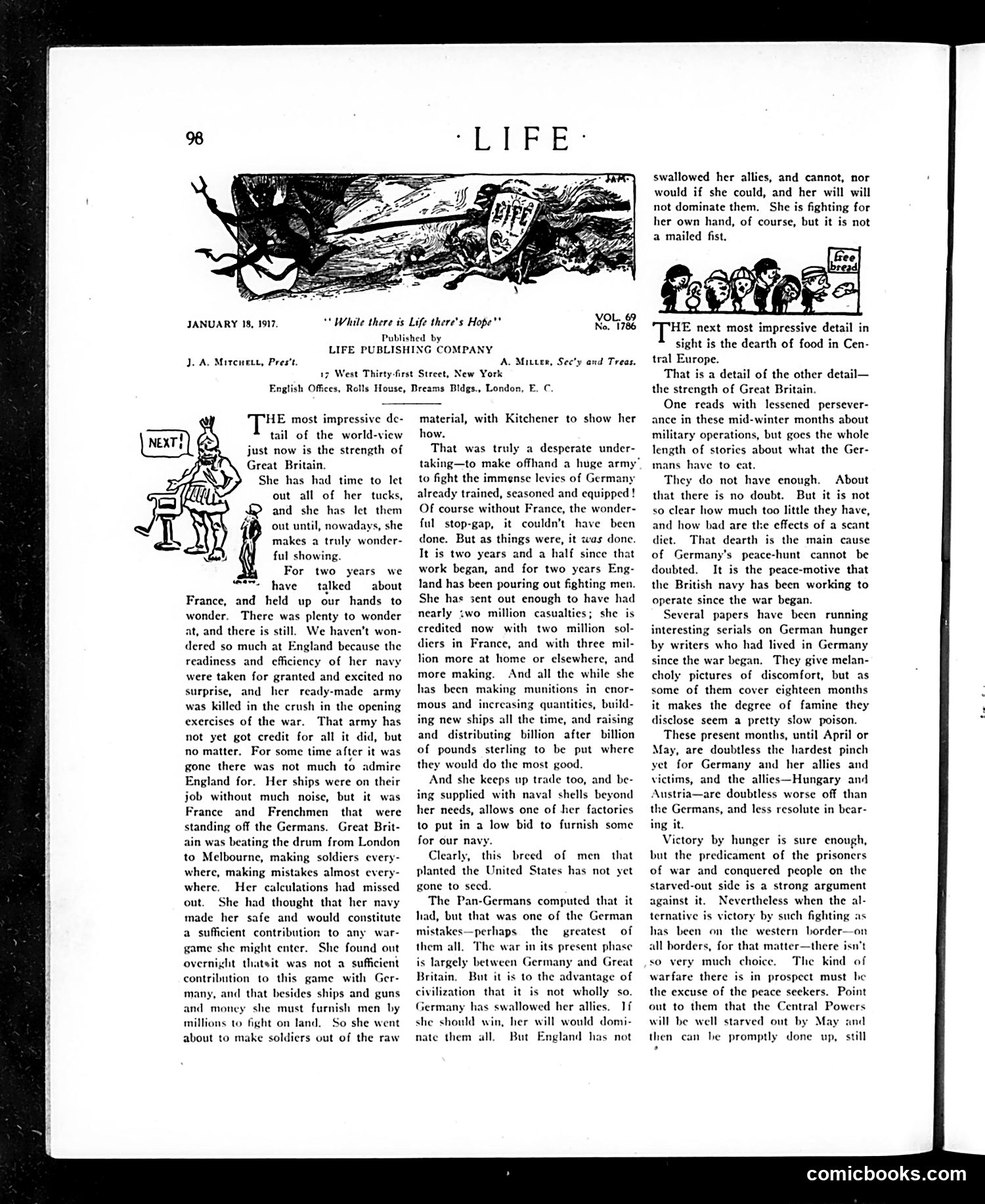
This page contains editorial commentary praising British military strength during World War I. The small cartoon (top left) shows a skeletal figure labeled "NEXT" — likely representing death or deprivation — appearing to approach, illustrating the article's grim discussion of food shortages in Central Europe. The main article argues that Britain's mobilization of millions of soldiers, massive munitions production, and financial contributions have proven the resilience of the Anglo-Saxon heritage. The writer contrasts Britain favorably with Germany: Britain fights for its "own hand" without dominating its allies, while Germany has "swallowed her allies." The piece also notes the emerging threat of starvation in Central Europe as a consequence of British naval blockade and war disruption — presented as evidence of Britain's strategic advantage. Published just before U.S. entry into WWI, this reflects American sympathies toward the British cause and skepticism toward German militarism.
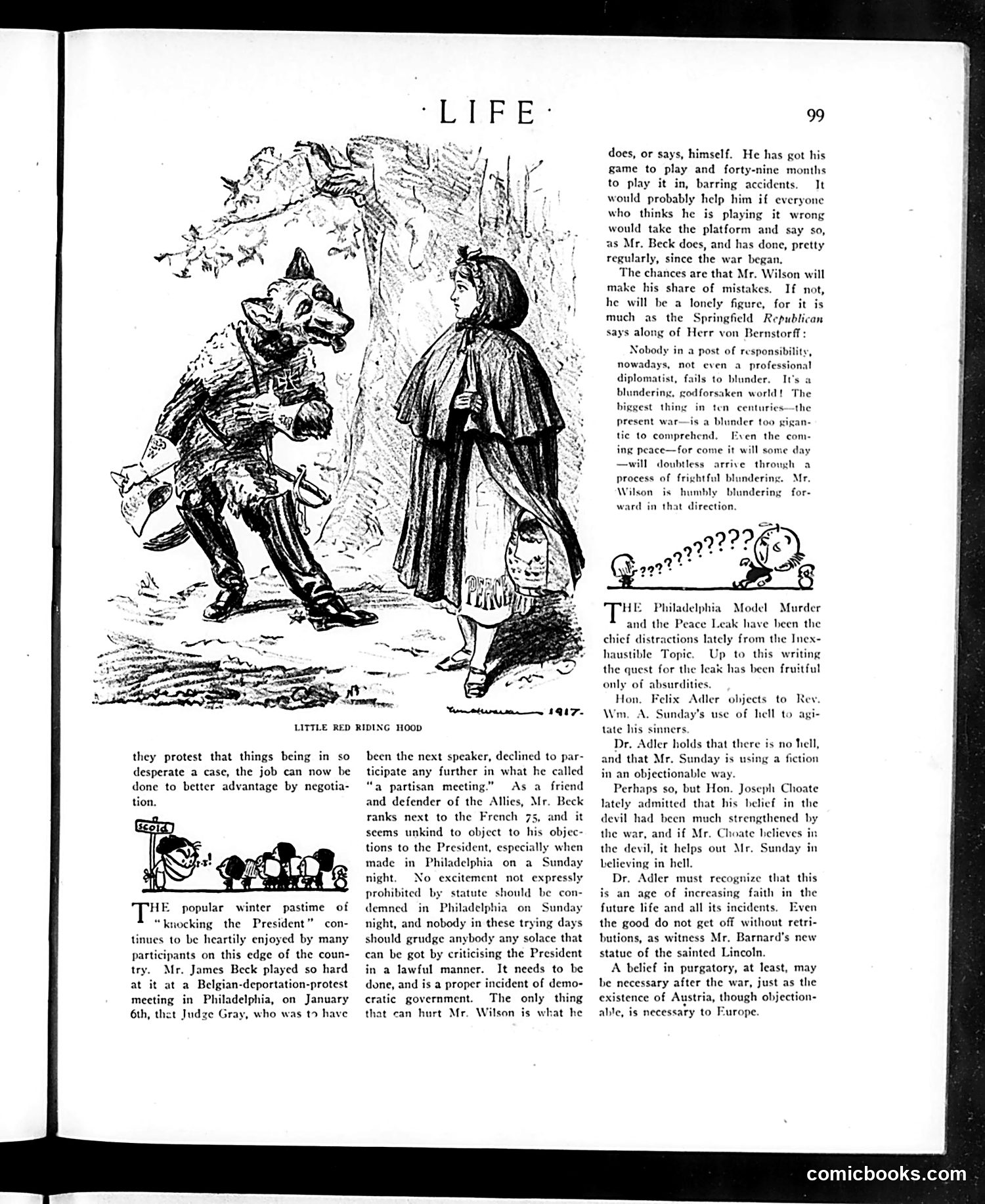
## Main Cartoon: "Little Red Riding Hood" The illustration reimagines the fairy tale with political figures. The "Wolf" (dressed as a German soldier) represents German militarism threatening innocence. The cloaked figure appears to represent either a neutral observer or America itself encountering European conflict. The 1917 date confirms this reflects WWI anxieties about American involvement. ## Editorial Content The page discusses President Wilson's policies and critics like James Beck, who publicly attacked Wilson at a Philadelphia meeting. The writer defends Wilson's right to be criticized while arguing Wilson himself—not critics—determines his success or failure. The piece also addresses Rev. Billy Sunday's use of hell-imagery in revival sermons, with philosopher Felix Adler objecting to this "fiction," while the writer suggests post-war trauma may make belief in divine punishment seem reasonable. The overall tone: satirical defense of Wilson against domestic political attacks amid wartime uncertainty.
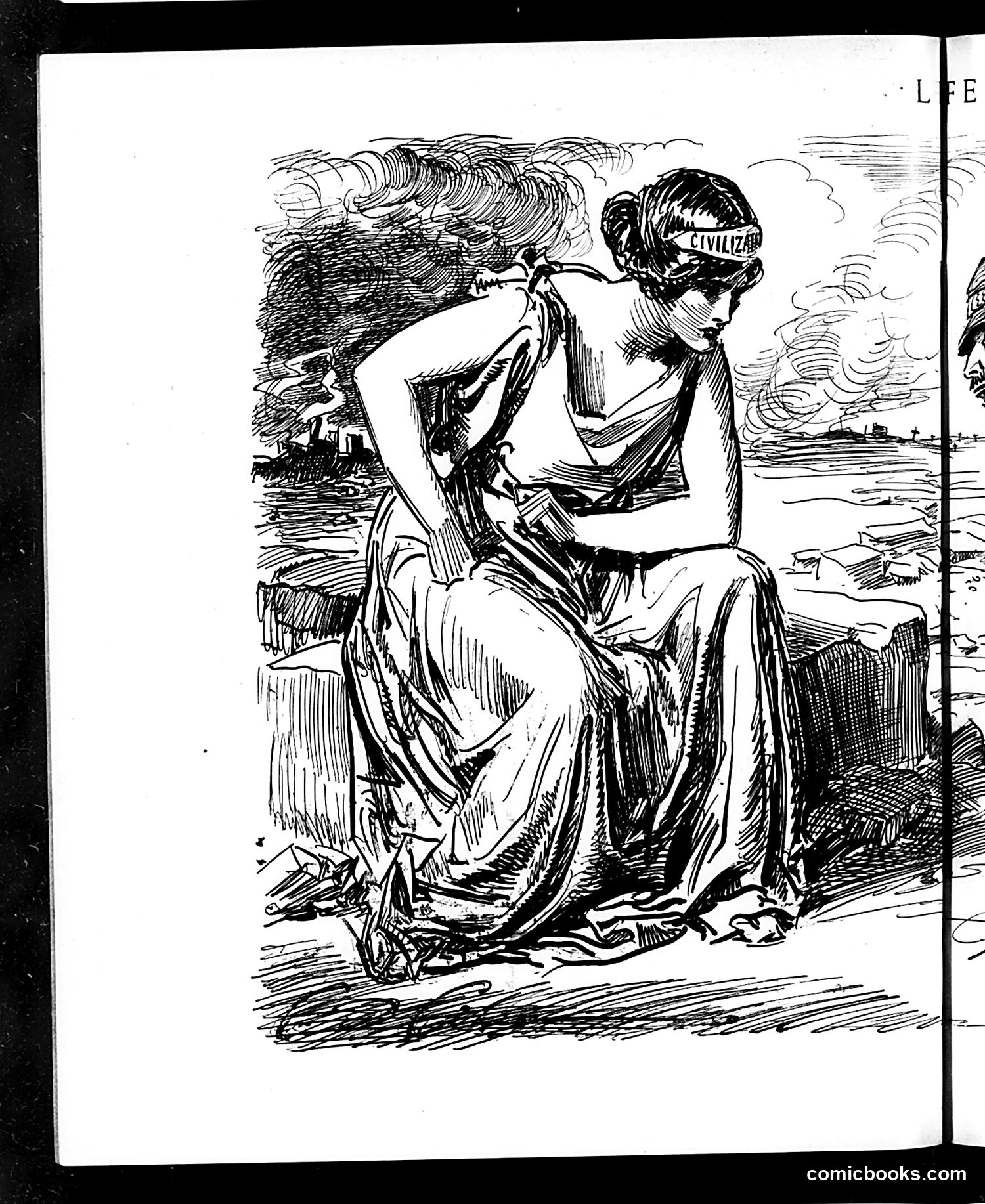
This is a satirical illustration from *Life* magazine depicting a woman labeled "CIVILIZATION" sitting amid destruction and ruin. She appears weary and burdened, holding what looks like a sword or weapon, with industrial smoke and devastation visible in the background landscape. The cartoon uses personification to critique the contradictions of modern civilization—particularly the destruction wrought by industrial development, warfare, or social upheaval. The woman represents civilization itself, portrayed as compromised and exhausted by the very forces it has unleashed. Without visible date markers or additional context, the specific historical moment is unclear, though the imagery suggests commentary on industrialization's costs or wartime destruction. The satire suggests civilization has become self-destructive rather than progressive.
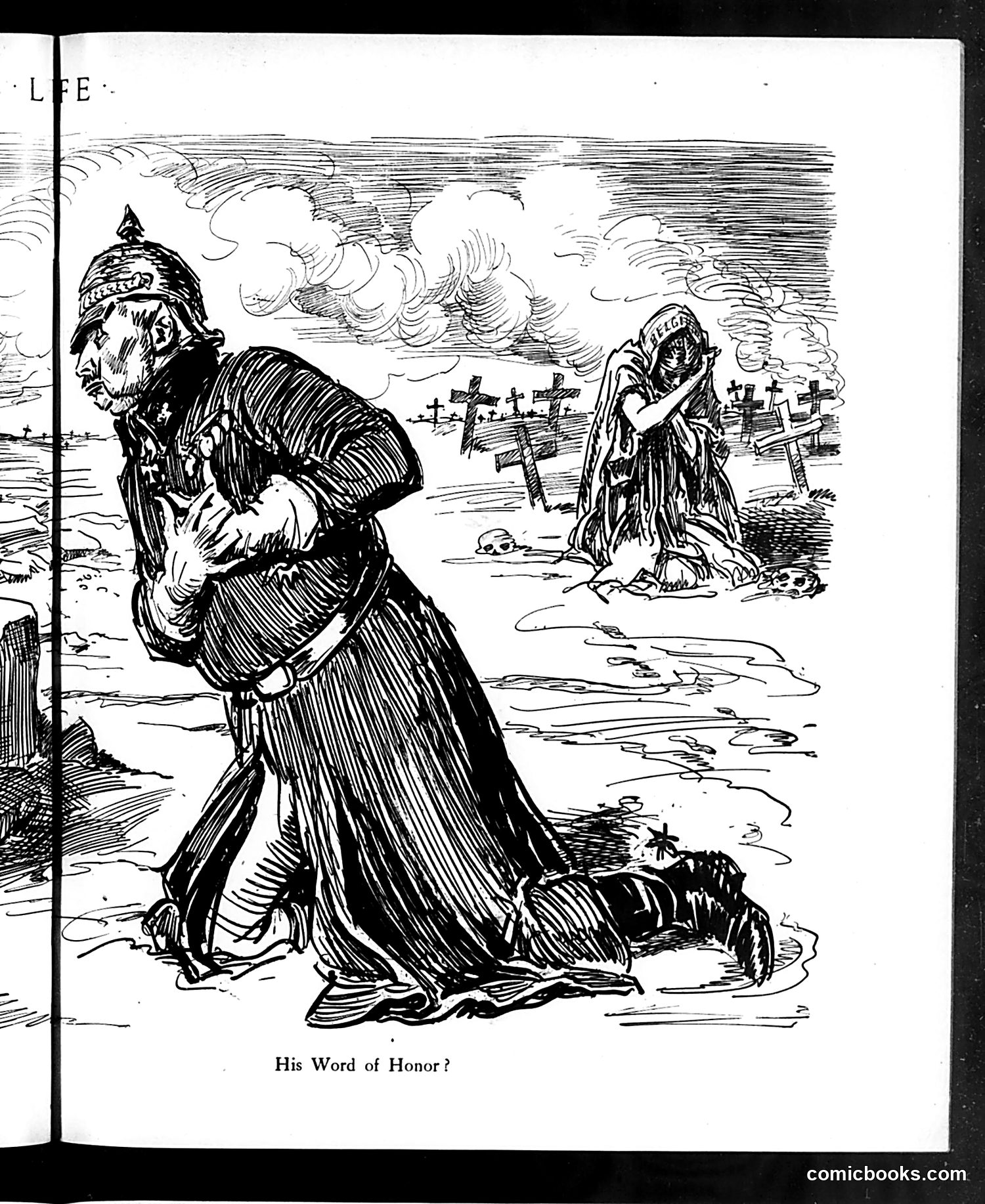
This appears to be a WWI-era political cartoon satirizing German military conduct and honor. The image shows a German military officer (identifiable by his spiked Prussian helmet) standing over a dead soldier on a battlefield. A grieving woman kneels in the background amid crosses marking graves. The caption "His Word of Honor?" suggests bitter irony about German claims to honorable conduct during the war, likely referencing allegations of atrocities or treaty violations. The contrast between the officer's dignified bearing and the death surrounding him—the corpse at his feet, the cemetery behind—emphasizes the satirist's accusation that German military "honor" is hollow propaganda masking brutal reality. This reflects American anti-German sentiment during or after World War I.
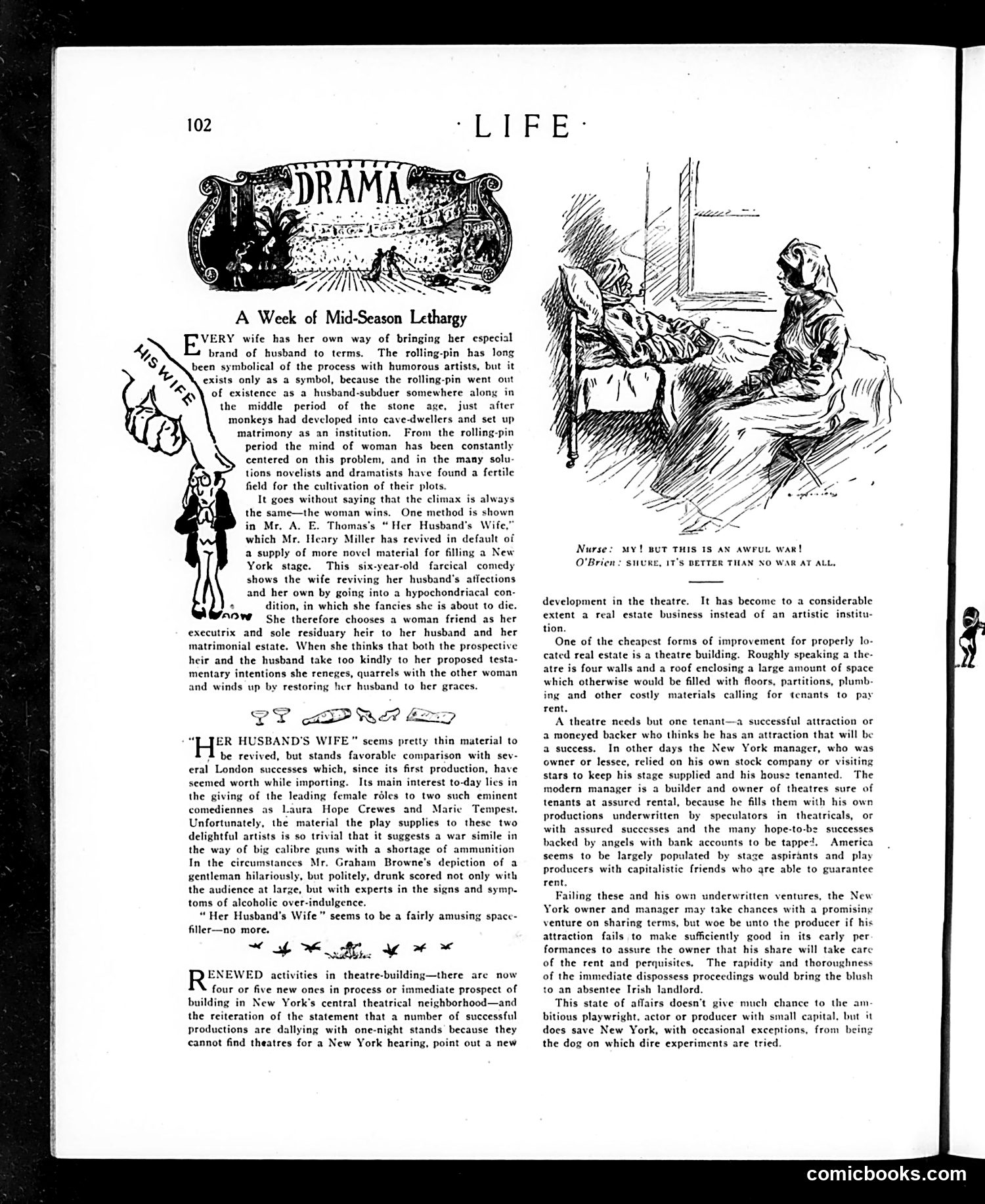
This page reviews "Her Husband's Wife," a six-year-old farce revived on the New York stage. The cartoon illustrates the play's premise: a wife feigns terminal illness to manipulate her husband's affections, naming a female friend as her heir to provoke jealousy. The husband ultimately submits, and she "wins" by restoring marital harmony. The sketch at top right shows a nurse and patient—O'Brien—joking that war is "better than no war at all," likely referencing the play's domestic "battle of wills" as metaphor. The satire critiques both the thin theatrical material and broader theater economics: successful plays struggle finding venues because theater owners now prioritize real estate development over artistic merit. The page suggests Broadway has become a real estate business where theaters are merely investment properties, not artistic institutions—a concern relevant to modern theater economics today.
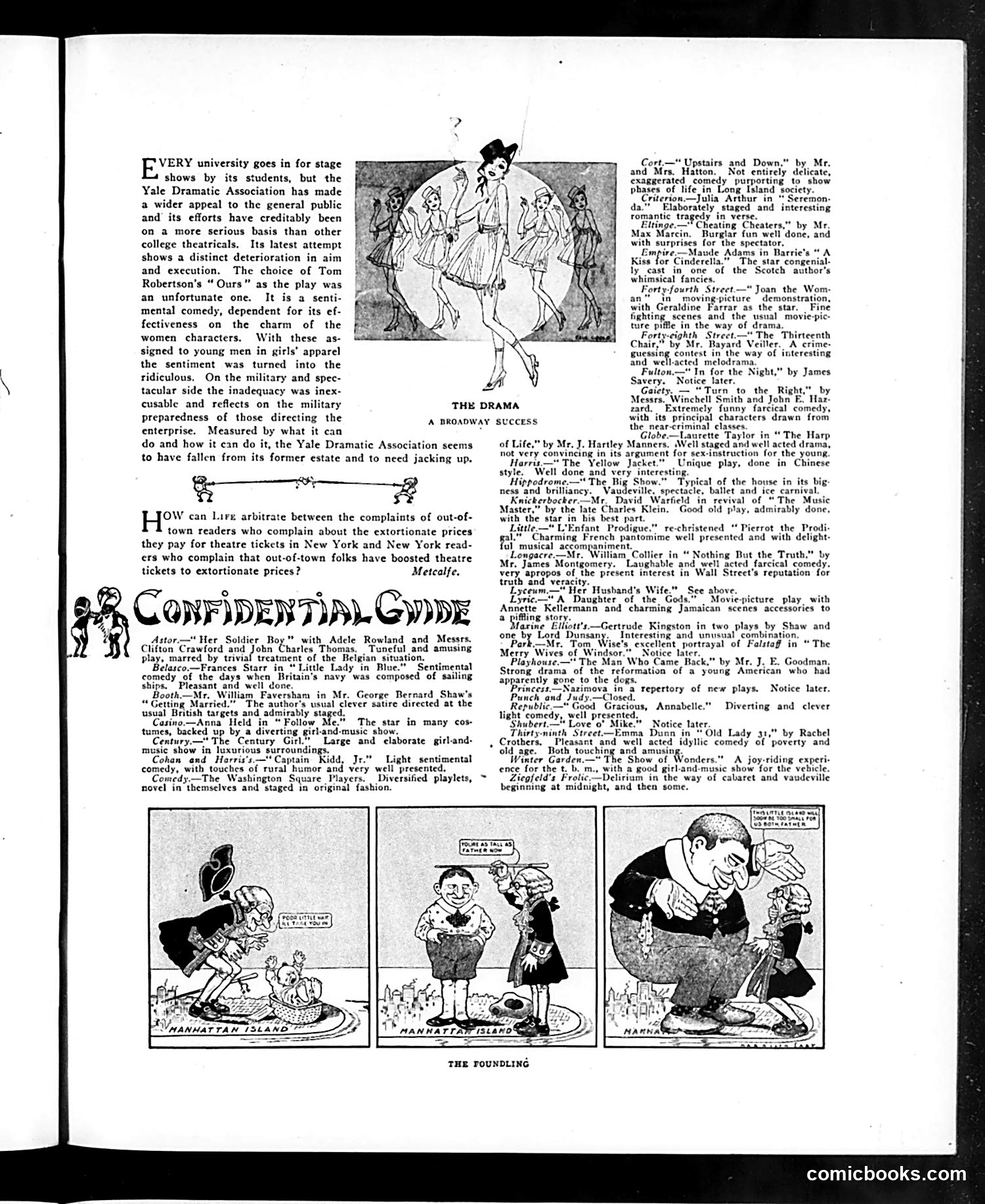
This page reviews Yale Dramatic Association's production of Robertson's "Ours," criticizing the university theater for a notable decline in quality. The key problem: the play's sentimental comedy relied on female charm, but Yale cast young men in women's roles, rendering the sentiment ridiculous rather than touching. Additionally, the military and spectacular elements were poorly executed, reflecting badly on those organizing it. The page also includes a humor column about New York theater ticket pricing (complaints go both directions), and a "Confidential Guide" listing Broadway theaters and current productions with brief reviews—standard entertainment journalism of the era (appears to be circa 1912-1916, based on production titles). The three cartoons at bottom titled "The Foundling" appear to be a separate comic strip feature, unrelated to the drama criticism above.
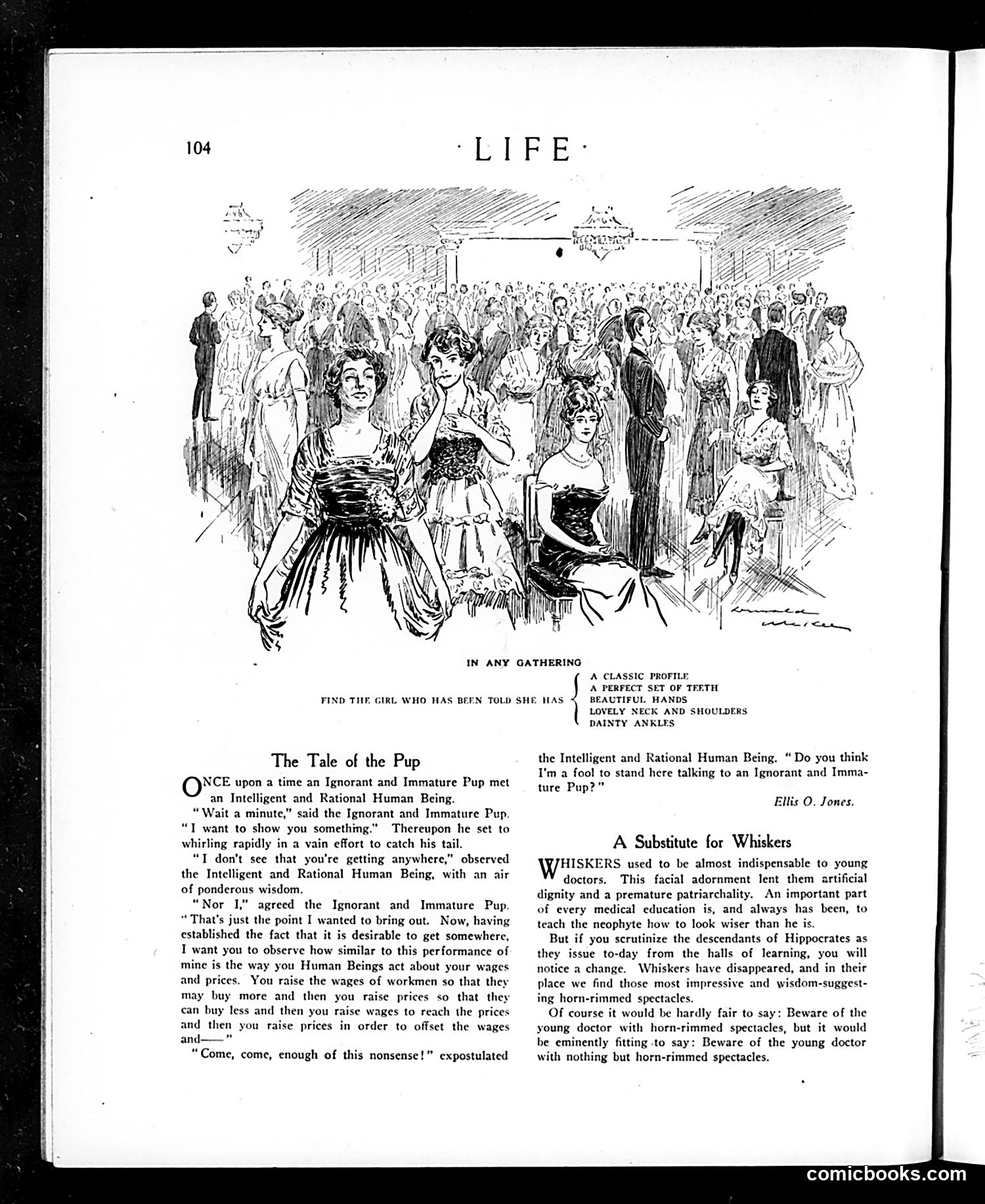
This page contains two distinct pieces of social satire from *Life* magazine. **"The Tale of the Pup"** uses an animal fable to mock economic policy. An ignorant pup chasing his tail becomes a metaphor for wage-price spirals: workers demand higher wages to afford goods, employers raise prices in response, triggering new wage demands in an endless, pointless cycle. The "Intelligent and Rational Human Being" represents supposedly wise policymakers who are actually powerless to break this loop. The satire criticizes the futility of both labor and management in this economic treadmill. **"A Substitute for Whiskers"** humorously observes that young doctors have abandoned facial hair—traditionally worn to appear authoritative—in favor of horn-rimmed spectacles as their new "wisdom prop." The piece gently warns that spectacles alone don't guarantee competence, satirizing how superficial appearance substitutes for genuine expertise among medical professionals. Both pieces target pretense and circular, self-defeating behavior in American society.
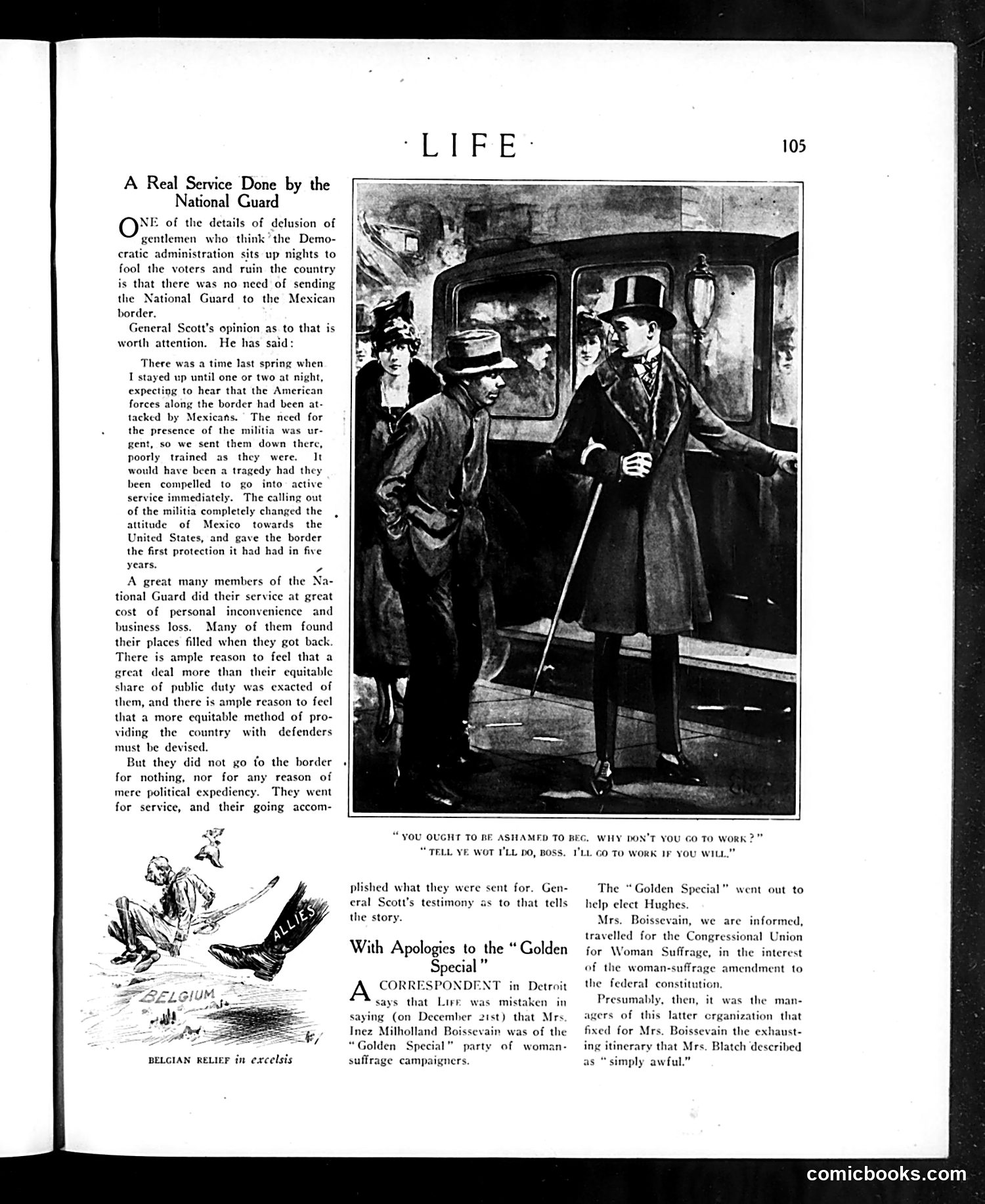
**Main Article & Political Context:** The article defends President Wilson's Democratic administration's decision to deploy the National Guard to the Mexican border in spring 1916. It quotes General Scott supporting this action as necessary for border security and deterring Mexican aggression. The piece argues National Guardsmen made real sacrifices (lost jobs, inconvenience) and should receive better treatment—a veiled criticism of how the government managed the deployment. **Political Cartoon ("Belgian Relief in excelsis"):** This small cartoon satirizes American relief efforts for Belgium during WWI. A ragged Belgian beggar asks for help; an American responds with condescension ("You ought to be ashamed to beg") before offering patronizing assistance ("I'll go to work if you will"). The satire mocks Americans who simultaneously pity Belgian suffering while blaming victims for their circumstances—typical Progressive-era criticism of charity's moral superiority. **Woman Suffrage Correction:** A minor editorial note clarifies that activist Inez Milholland Boissevain worked for the Congressional Union for Woman Suffrage (federal amendment focus), not the "Golden Special" party supporting Hughes's presidential campaign.
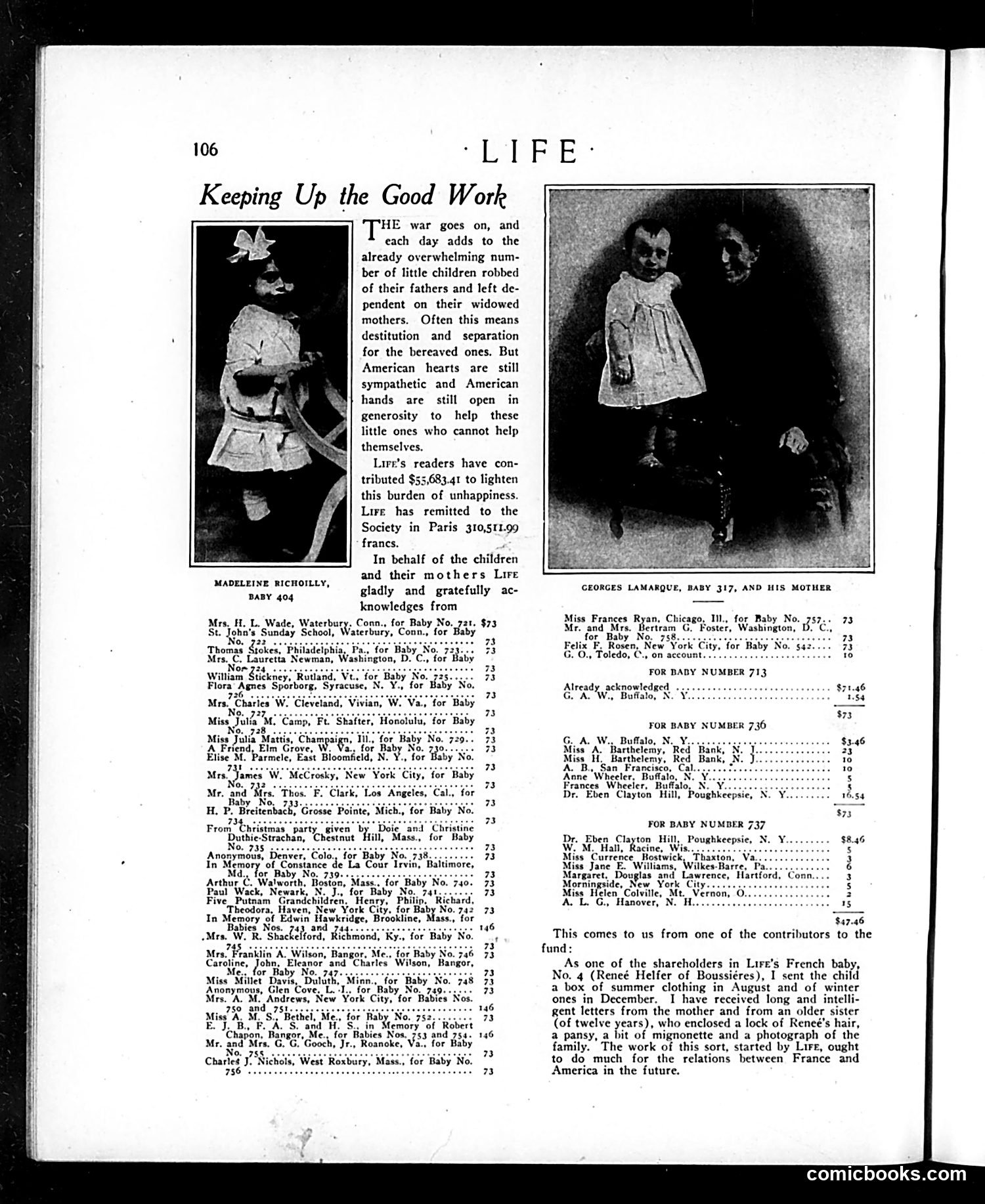
This is not a political cartoon but a **charity fundraising page** from Life magazine during World War I. The two photographs show war orphans—Madeleine Richoilly (Baby 404) and Georges Lamarque with his mother (Baby 317)—children whose fathers were killed in the war. The page documents Life magazine's fundraising campaign for French war orphans, listing donors and amounts contributed. Life had remitted over $310,000 francs to a Paris charity society supporting widows and fatherless children. The accompanying text appeals to American sympathy and generosity, emphasizing how war has left children "dependent on their widowed mothers" facing "destitution and separation." The final testimonial describes a donor's emotional correspondence with the family of one sponsored child (Baby 4), highlighting the personal connection such charitable work created between Americans and French families devastated by the war. This represents Life's use of its platform for progressive social causes during the 1910s.
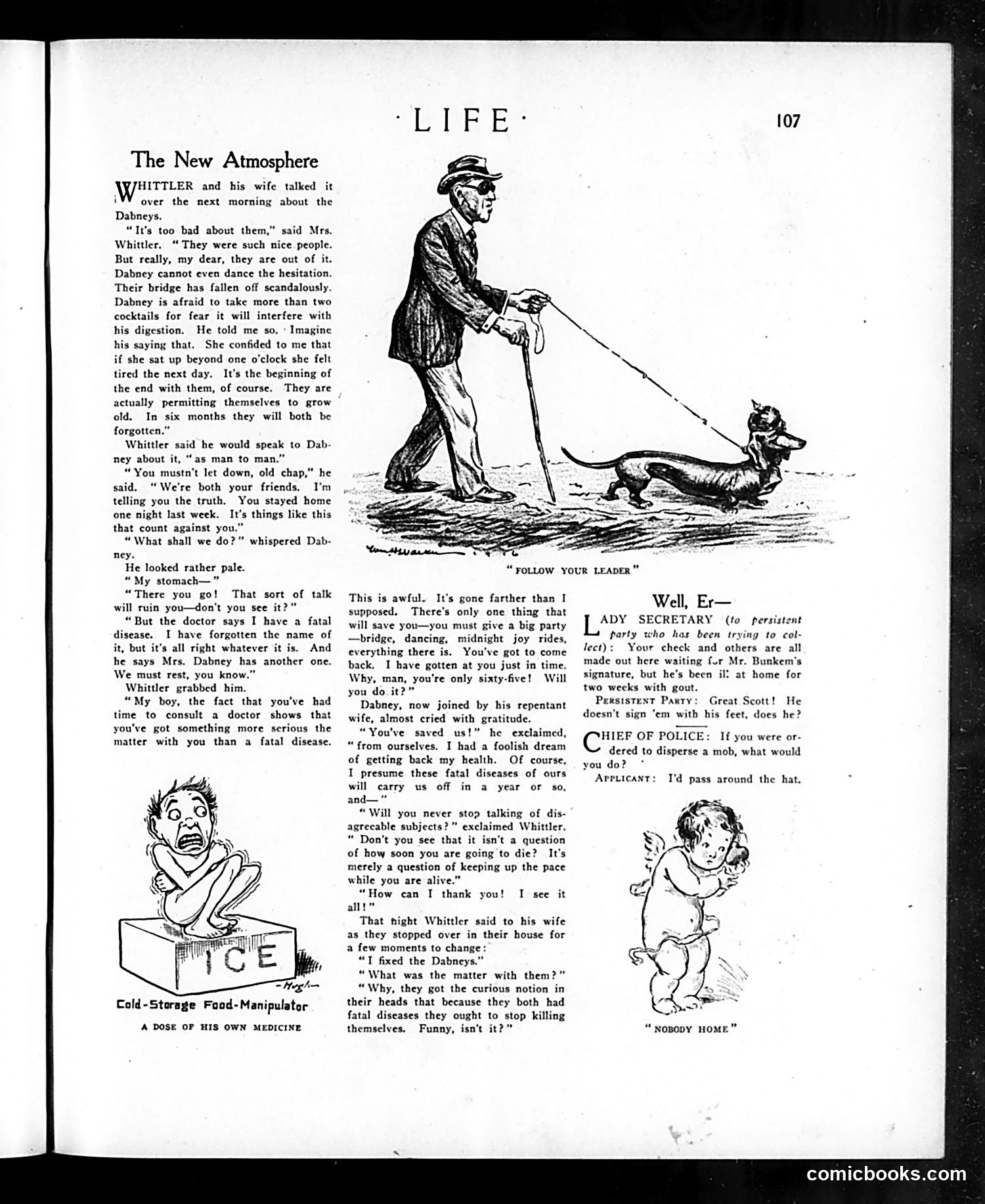
This story satirizes 1920s high-society conformity and excess. The Dabneys, a couple trying to rest due to genuine health problems, face social ostracism from the Whittlers, who represent the era's relentless pursuit of pleasure—constant partying, drinking, dancing, and late nights. The satire's target: society's judgment that *not* participating in destructive behavior marks one as obsolete or "out of it." Whittler persuades the Dabneys to abandon doctor's orders and resume dangerous social activities, framing this as salvation. The joke's dark irony: prioritizing social appearance over actual health, even unto death, is presented as normal and desirable. The cartoons below reinforce themes of societal dysfunction—a "Cold-Storage Food-Manipulator" (unclear reference, possibly to food industry), and bureaucratic absurdity (police chief, secretary). The page critiques Jazz Age culture's superficiality and peer pressure masquerading as friendship.
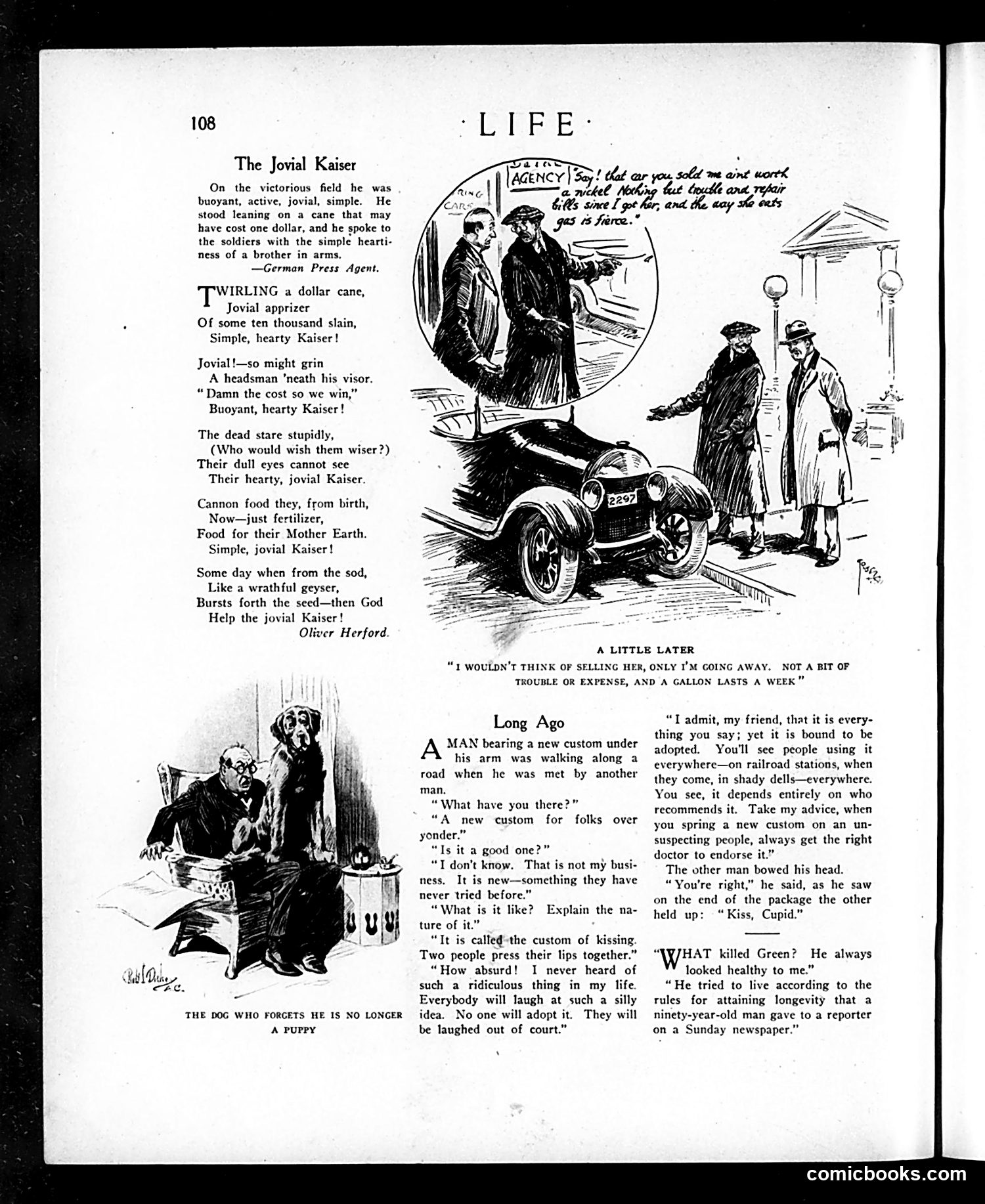
This page satirizes German Kaiser Wilhelm II's wartime public relations efforts during World War I. The German Press Agent quote claims the Kaiser was "jovial" and "simple" on the battlefield, addressing soldiers "like a brother in arms." Oliver Herford's poem savagely mocks this propaganda. The satire's core: the Kaiser grins while "ten thousand slain" lie dead—comparing his cheerfulness to a headsman (executioner) grinning beneath his visor. Soldiers are reduced to "cannon food" and "fertilizer." The poem culminates in a curse: someday the dead will rise "like a wrathful geyser" and God help the Kaiser then. The accompanying cartoon shows the Kaiser with an agency representative spinning propaganda, while ordinary people observe—illustrating how official narratives sanitize war's brutality. The satire exposes the grotesque disconnect between imperial cheerfulness and mass death.
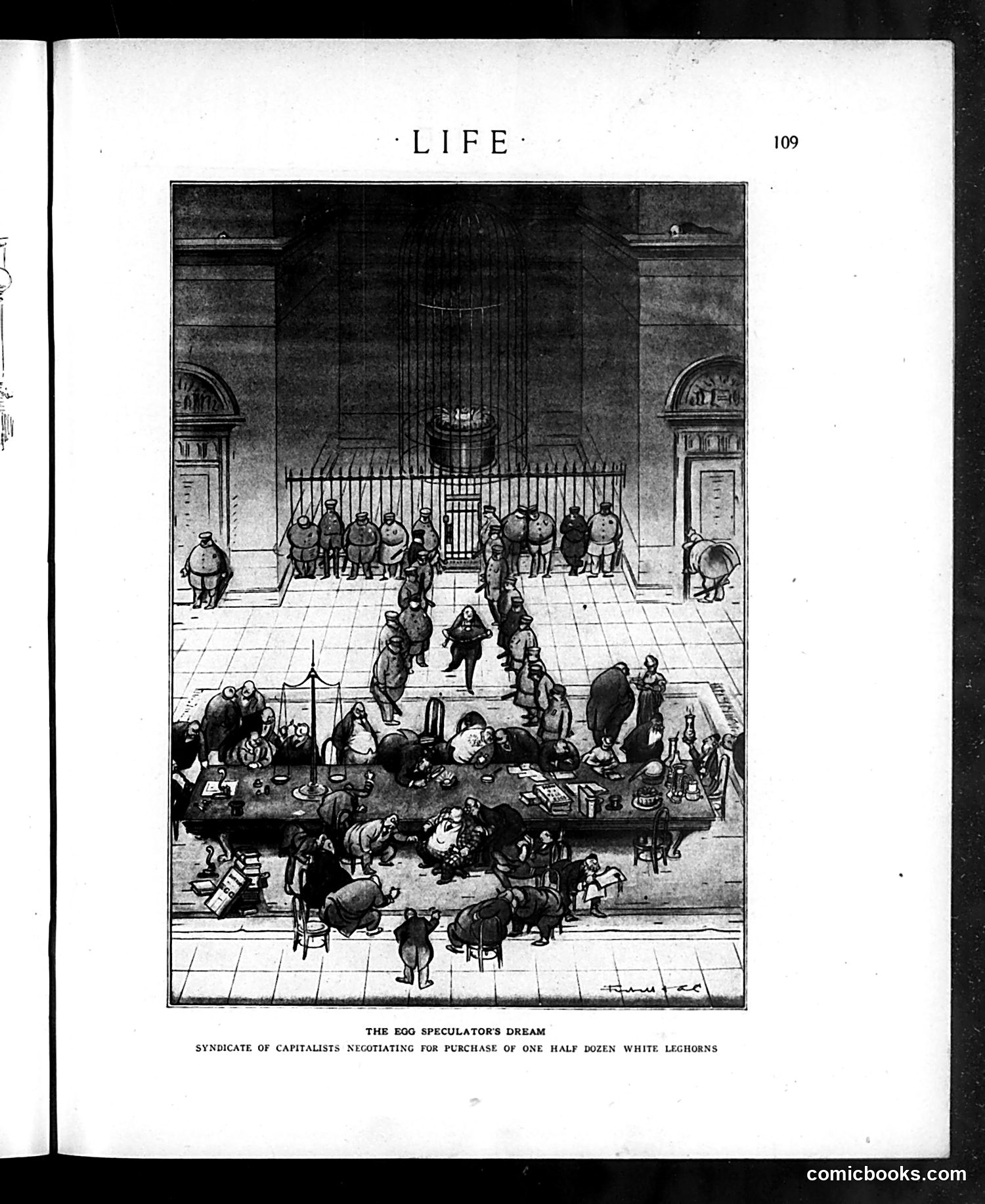
This cartoon satirizes financial speculation and capitalist greed through an absurdist scenario. The caption indicates wealthy businessmen (a "syndicate of capitalists") are formally negotiating to purchase just six white leghorn chickens—ordinary farm birds. The humor lies in treating mundane egg production like high-stakes commerce: the elaborate formal setting, the serious negotiations, and the disproportionate attention given to a trivial agricultural transaction. The ornate interior and numerous participants suggest unnecessary complexity and bureaucracy around what should be a simple transaction. The cartoon critiques how speculators artificially inflate value and create elaborate financial structures around basic commodities. It's a mockery of capitalism's tendency to overcomplicate and financialize everyday goods, likely referencing early 20th-century commodity speculation and market volatility that affected food prices and ordinary people's livelihoods.
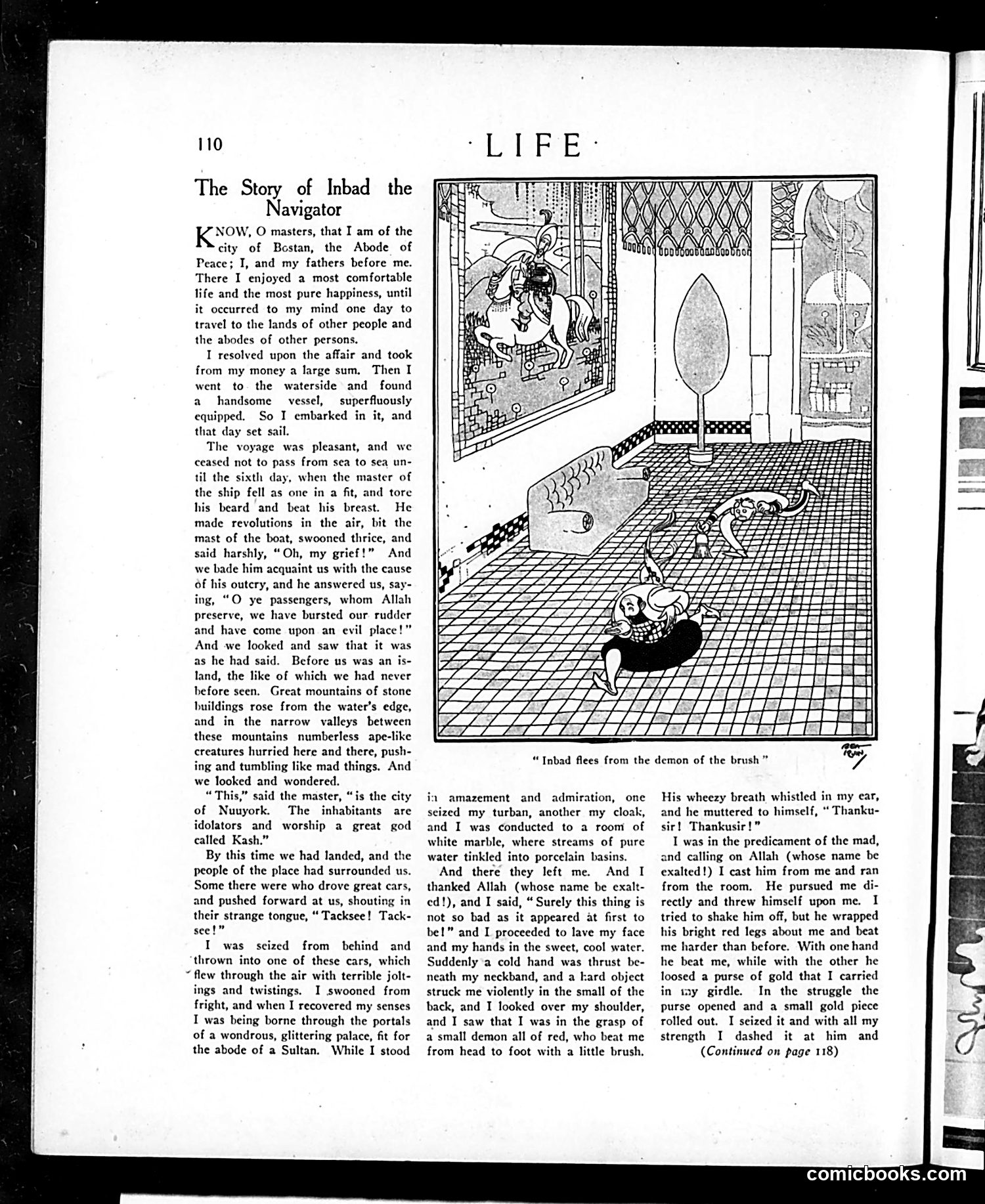
This is a parody of the classic Arabian Nights tale "Sinbad the Navigator," reimagined as a satirical attack on New York City and American culture. The story presents New York ("Nuuyork") as an exotic, dangerous land inhabited by primitive, ape-like creatures who worship a false god called "Kash" (likely "Cash"—money). The protagonist encounters aggressive taxi drivers ("Tacksee!") and is taken to a luxurious palace (a hotel), where he's attacked by a small red demon with a brush who steals his gold coins while beating him. The satire mocks New York's materialism, chaos, aggressive commerce, and perceived cultural depravity by presenting them through the lens of fantastical Oriental exoticism. The "demon of the brush" appears to represent a bellhop or porter—service workers depicted as thieves exploiting travelers. This reflects early 20th-century American anxieties about urban greed and corruption disguised by superficial hospitality.
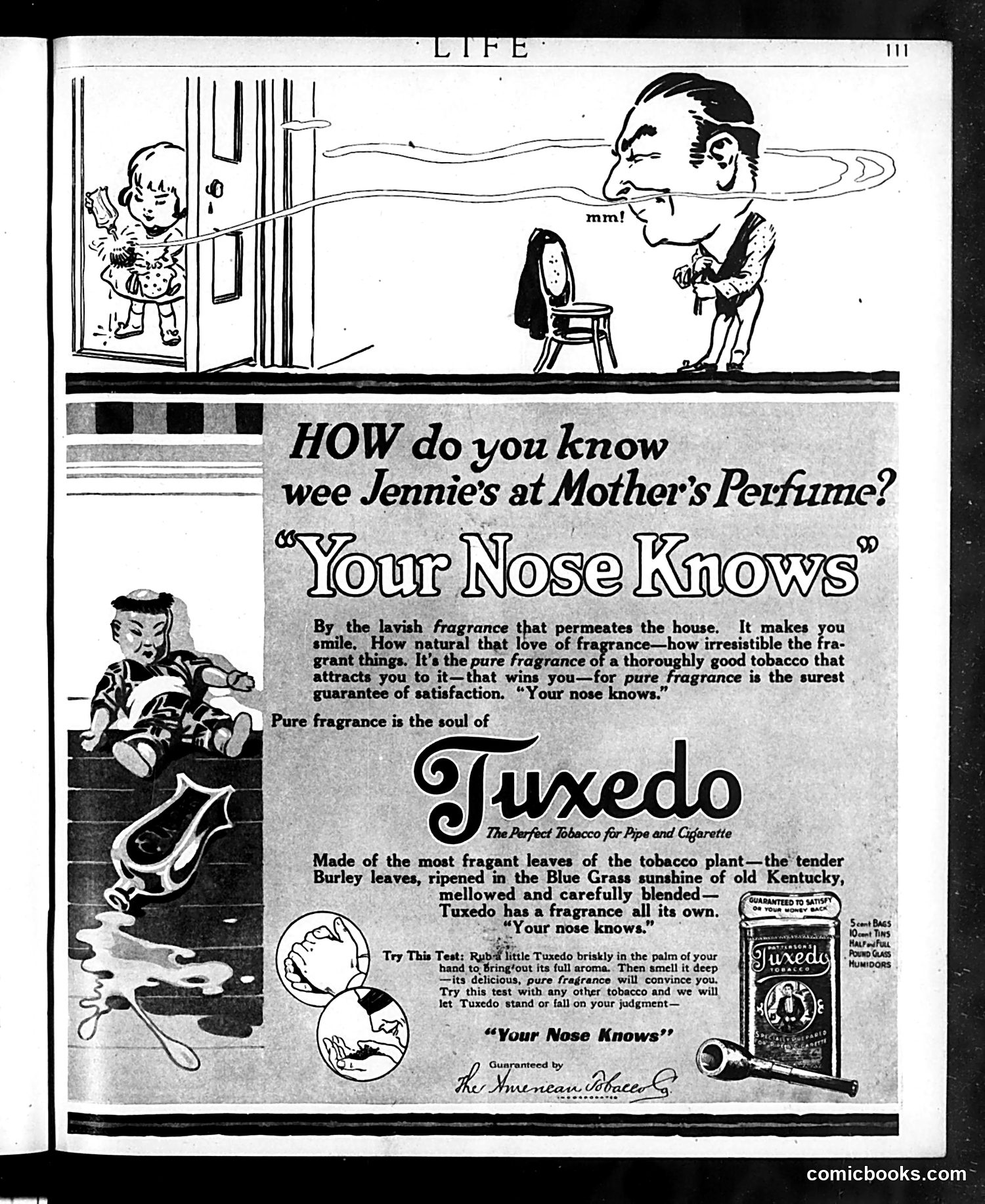
This is primarily a **tobacco advertisement** for Tuxedo brand pipe and cigarette tobacco, not political satire. The top cartoon is an advertising device: it humorously depicts a man stretching his absurdly elongated nose across a room to detect the fragrance of "Mother's Perfume," with a child visible at a doorway. The joke plays on the advertising slogan "Your Nose Knows"—suggesting one's sense of smell is the ultimate judge of quality. The ad then pivots to selling Tuxedo tobacco by claiming the same principle applies: pure fragrance indicates superior product. It emphasizes Kentucky Burley leaves and invites consumers to perform a tactile test—rubbing tobacco in one's palm to release aroma—as proof of quality. The left sidebar contains decorative illustrations of a cherub/cupid figure, adding whimsy. There is **no political content**; this is straightforward early-20th-century consumer advertising exploiting the appeal of sensory experience and nostalgia ("old Kentucky").
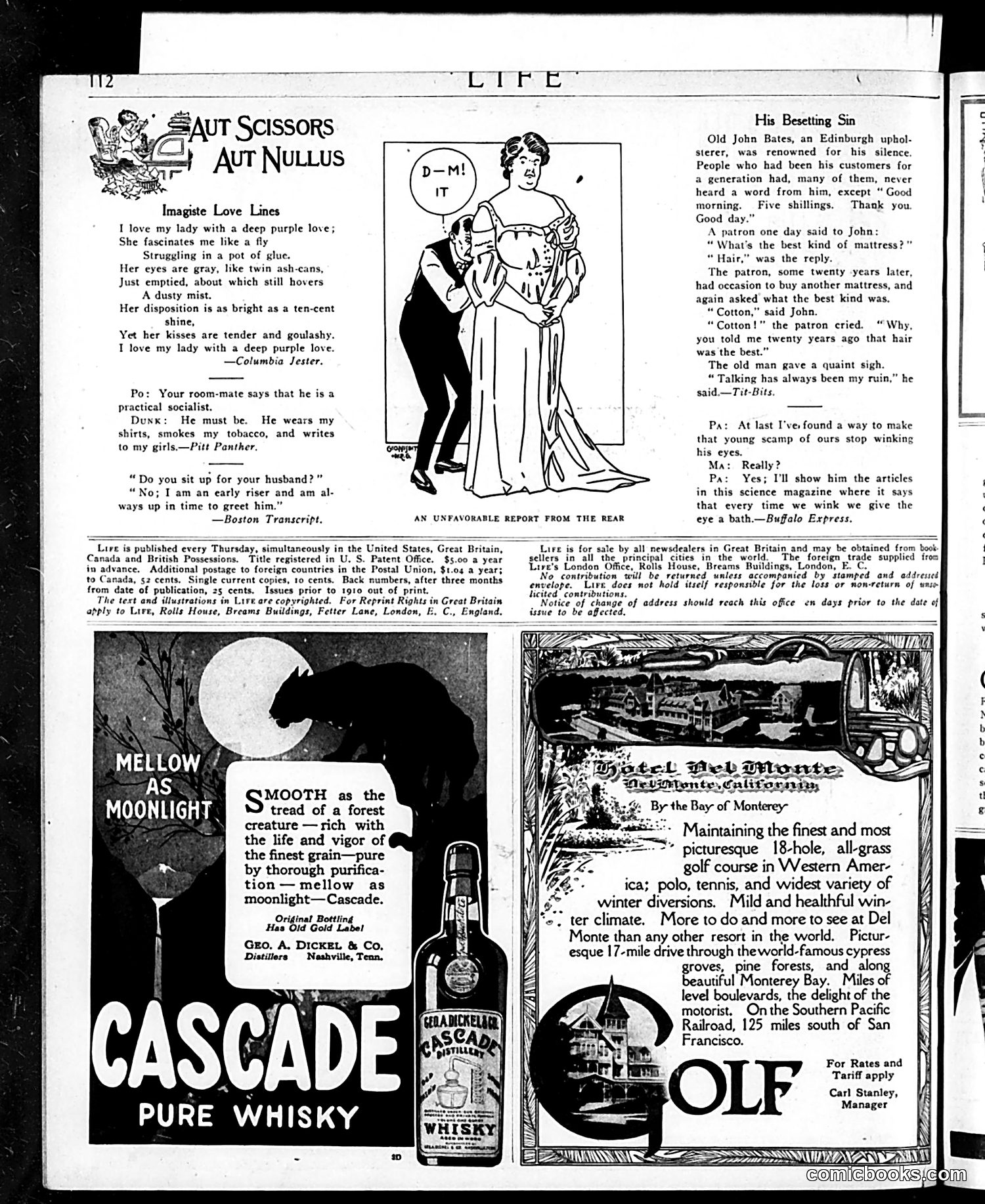
This page contains humorous short jokes and quips typical of early 20th-century American satirical magazines, alongside period advertisements. ## The Humor Content The "Imagiste Love Lines" section satirizes pretentious modern poetry (the Imagist movement), mocking overwrought romantic metaphors ("eyes are gray, like twin ash-cans"). The subsequent jokes are mild social observations: a socialist who borrows his roommate's belongings, a wife's quip about greeting her husband, and a father's dubious science lesson about eye-blinking. "His Besetting Sin" is a sentimental anecdote about an Edinburgh upholsterer whose rare chattiness over twenty years leads to contradictory mattress advice—the joke being that his one vice was talking. ## The Advertisements The page features whiskey (Cascade) and golf resort (Del Monte, California) ads—typical luxury goods marketed to Life's affluent readership. These ads reflect the magazine's pre-Prohibition era and target audience. The humor is gentle, wholesome, and aimed at educated readers familiar with literary pretension and upper-class social conventions.
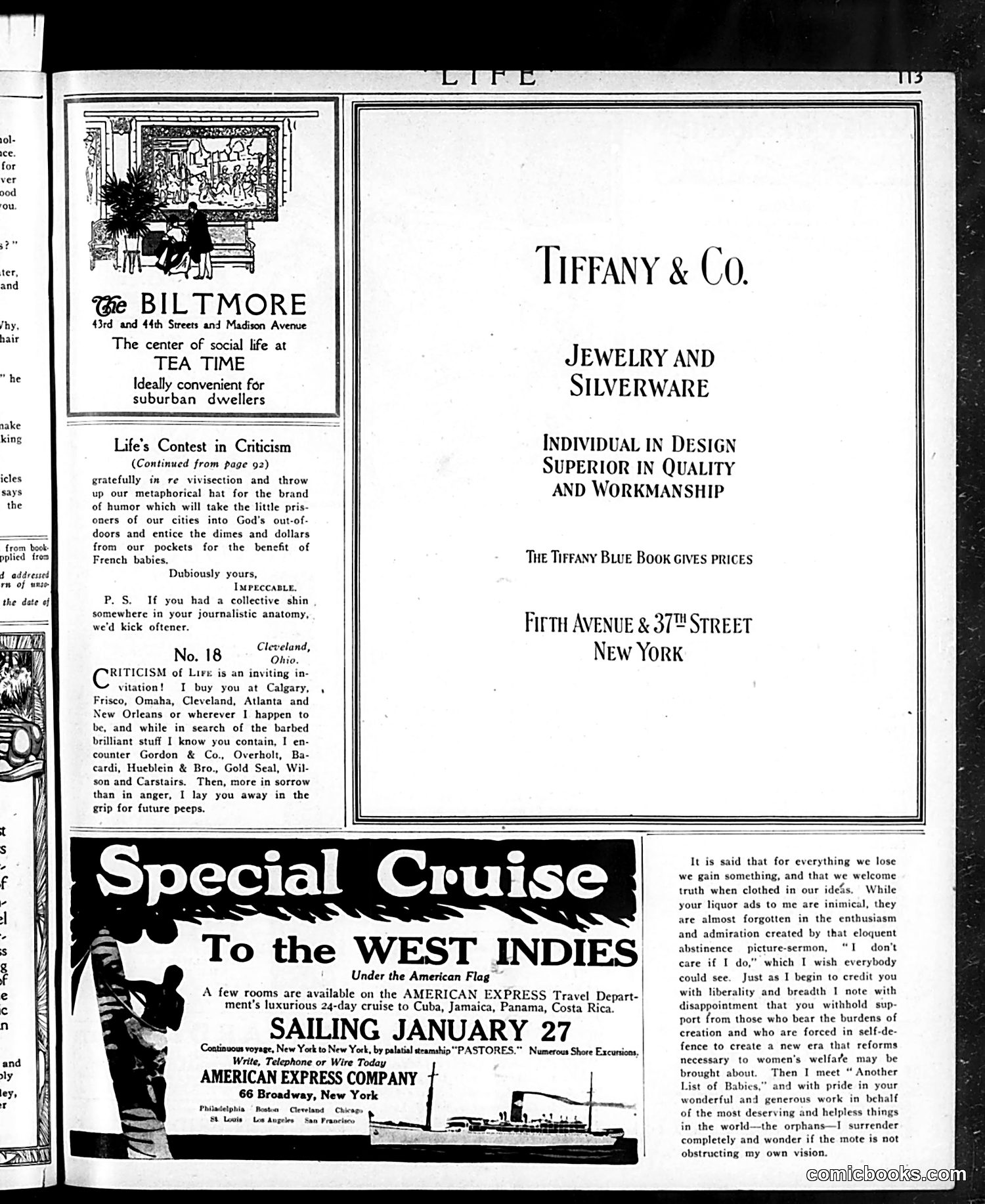
This page is primarily **advertisements and reader correspondence**, not political satire. The main content is "Life's Contest in Criticism"—a letters section where readers critique the magazine itself. One letter (No. 18, from Cleveland, Ohio) complains that while Life contains sharp wit and humor, the magazine's liquor advertisements undermine its moral credibility. The writer notes encountering brand names like Overholt and Bacardi while reading Life in various cities. A second, longer letter praises Life's abstinence-themed picture essay "I Don't Care If I Do" but then criticizes the magazine for not supporting women's welfare and orphan-related causes with equal vigor, suggesting Life's priorities are inconsistent. The surrounding ads—Tiffany & Co., The Biltmore Hotel, and American Express cruise promotions—represent luxury consumer goods typical of Life's affluent readership. These advertisements are ironic counterpoints to the letters criticizing Life's editorial values and social responsibility.
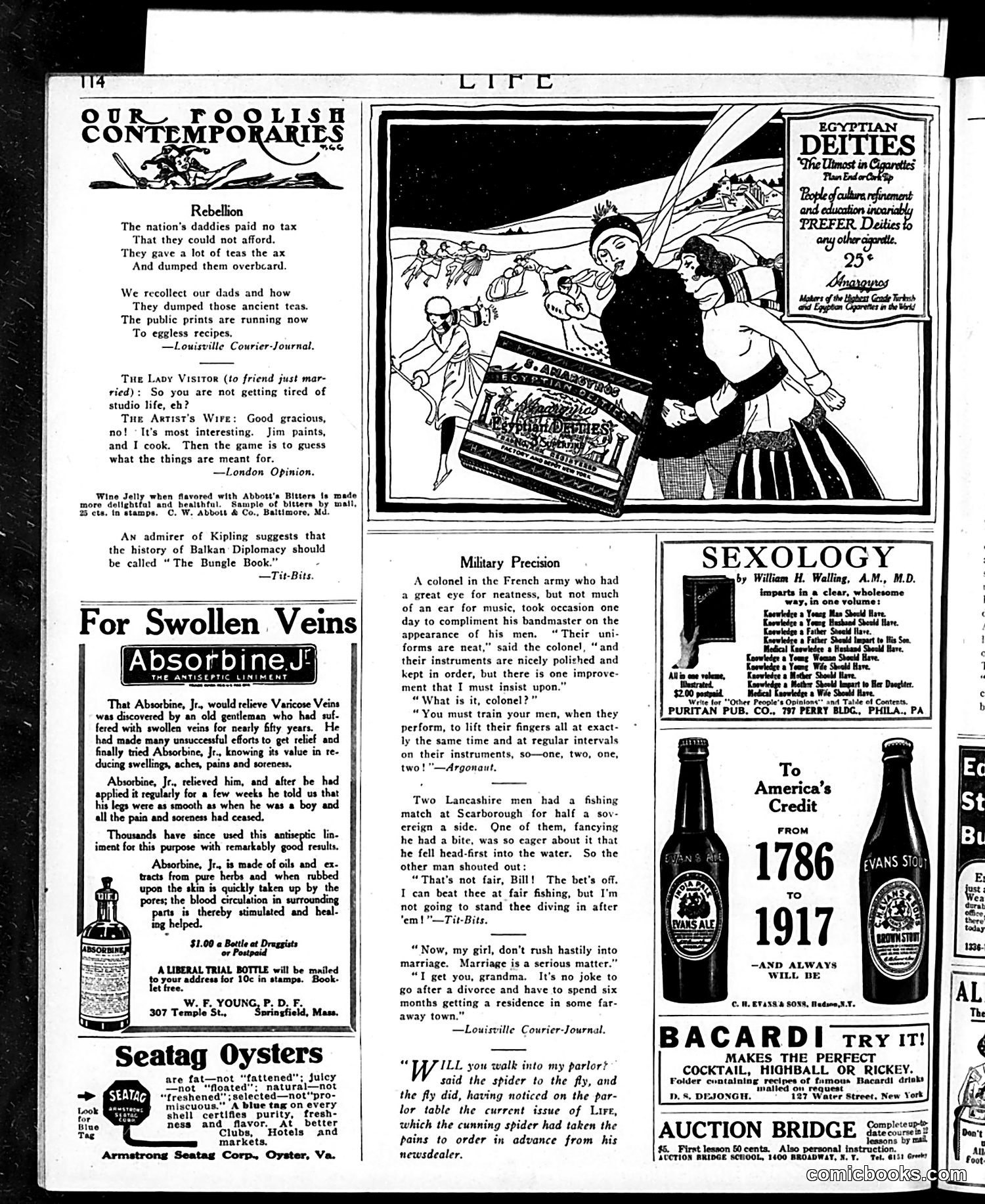
This page contains short humorous anecdotes rather than formal political cartoons. The "Foolish Contemporaries" section mocks current attitudes and behaviors: **"Rebellion"** references the Boston Tea Party—comparing fathers who avoided taxes to revolutionaries dumping tea. It's satire about tax avoidance and eggless recipes (likely referencing WWI food rationing). **Other jokes** poke fun at artists' wives, studio life, and Rudyard Kipling's views on Balkan politics. **"Military Precision"** satirizes a French colonel obsessed with visual neatness but tone-deaf to music—a jab at military bureaucracy prioritizing appearance over substance. The remaining anecdotes mock fishing etiquette and hasty marriage. The page is primarily **advertising**—promoting Absorbine liniment, oysters, and other products—with light satirical content filling space between ads. No specific named political figures are caricatured; instead, the humor targets generic contemporary social types and behaviors.
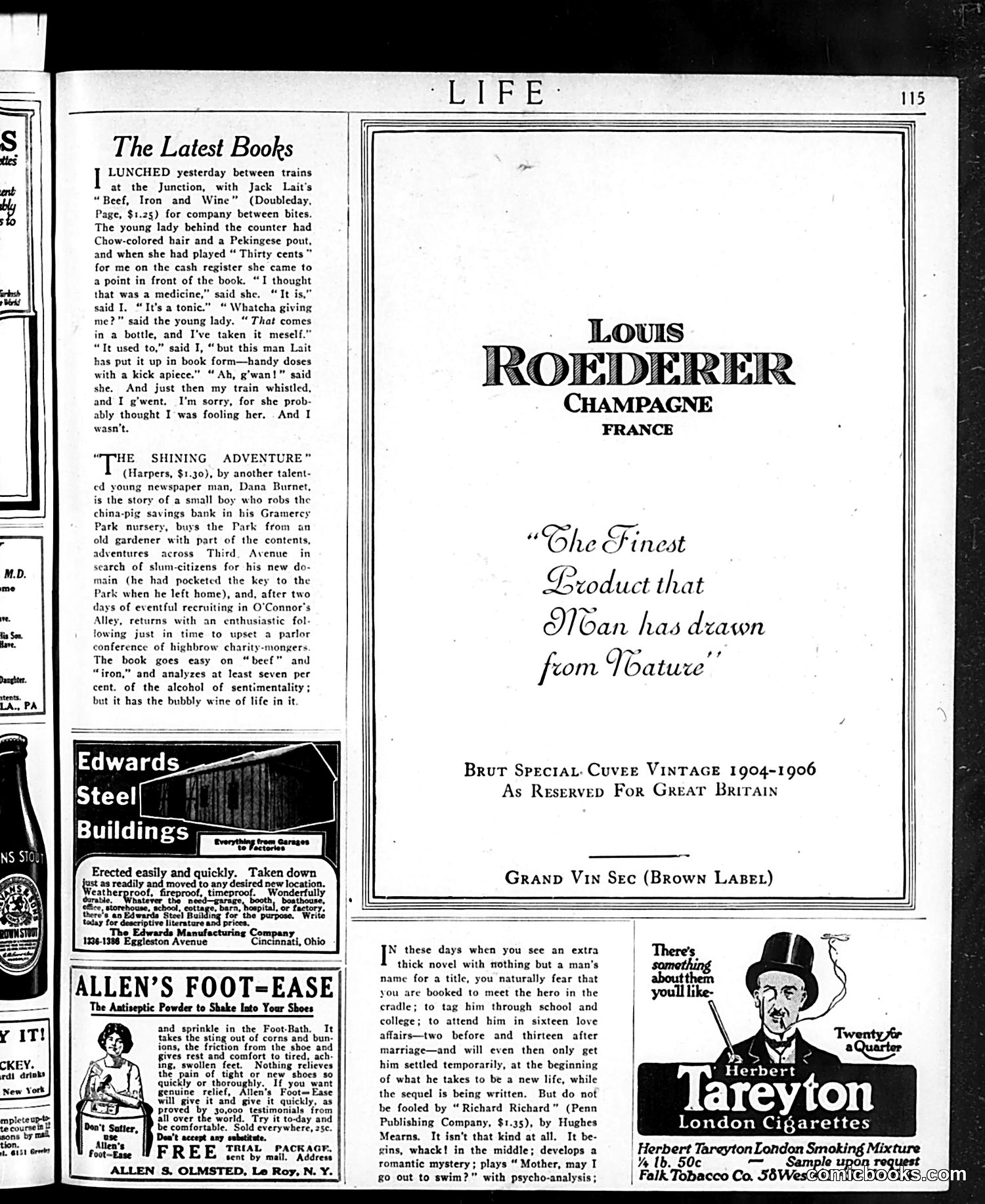
This page is primarily **book reviews and advertisements** rather than political satire. The content includes: **Book Reviews Section ("The Latest Books"):** The reviewer discusses three novels with light humor—Jack Lait's "Beef, Iron and Wine," Dana Burnet's "The Shining Adventure," and Hughes Mearns' "Richard Richard." The tone is conversational and whimsical rather than satirical. A anecdote about a waitress misunderstanding the book title as medicine appears designed for gentle comedic effect. **Advertisements:** The page features product ads (Edwards Steel Buildings, Allen's Foot-Ease powder, Herbert Tareyton cigarettes) and a full-page **Louis Roederer champagne advertisement** prominently displayed in the center—a luxury product marketed to Life's affluent readership. **Overall Context:** This appears to be a typical early 20th-century Life magazine page blending literary commentary with high-end consumer advertising, reflecting the magazine's target audience of educated, wealthy readers. There is no significant political cartoon or social satire visible on this particular page.
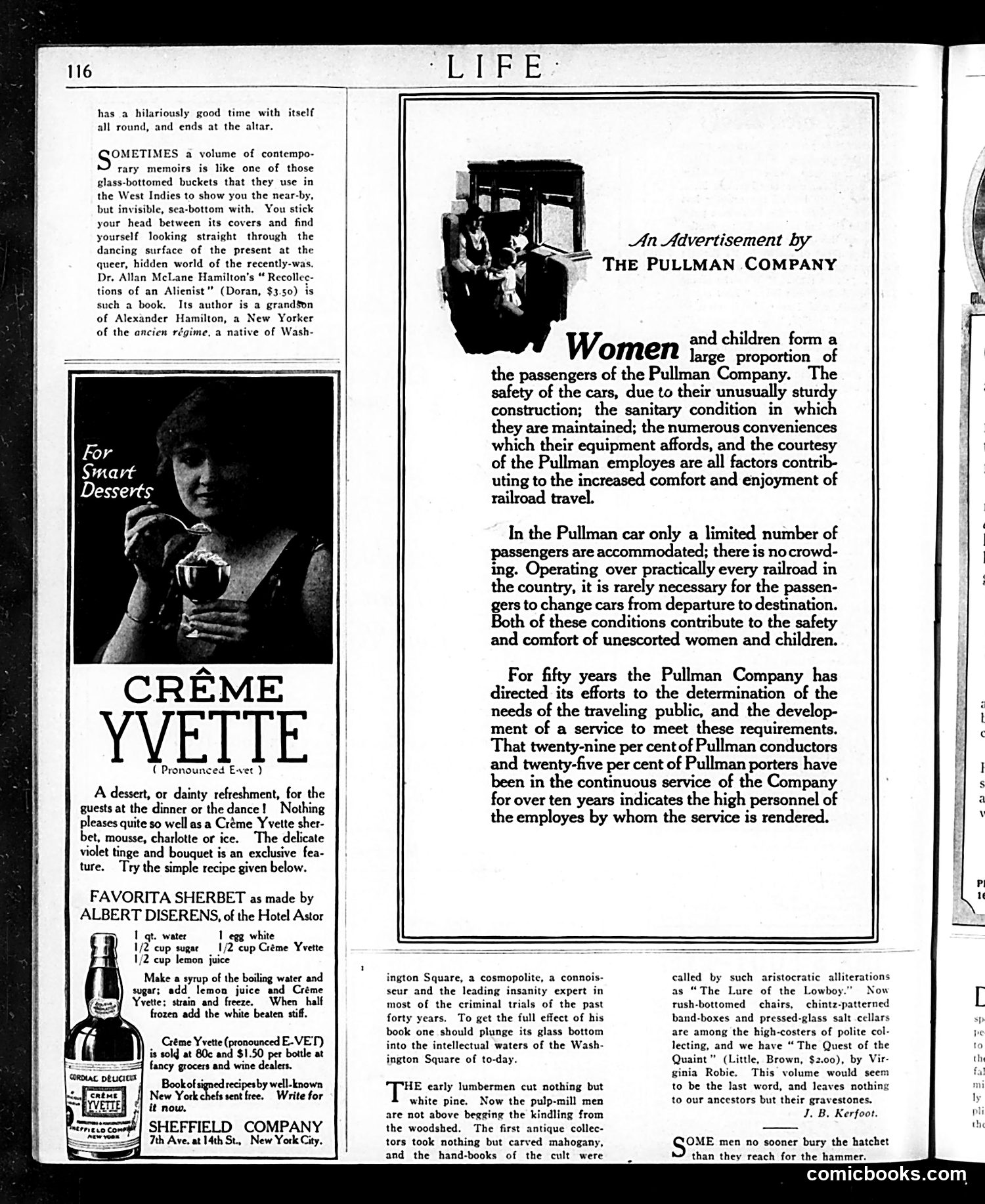
This page is **primarily advertising**, not satire or political commentary. The dominant content is a Pullman Company advertisement emphasizing the safety and comfort of their railroad cars for women and children travelers—highlighting sturdy construction, sanitation, limited capacity, and courteous staff. The left side contains book reviews discussing contemporary memoirs and antique collecting trends. A secondary advertisement promotes Crème Yvette, a violet-flavored liqueur dessert product, with a recipe and endorsement from a hotel chef. The imagery shows a Pullman car interior with passengers and the product bottle—straightforward promotional material rather than satirical commentary. The tone is aspirational and class-conscious, targeting affluent travelers concerned with comfort and respectability during rail journeys. There is **no political cartoon or satirical message** visible on this page.
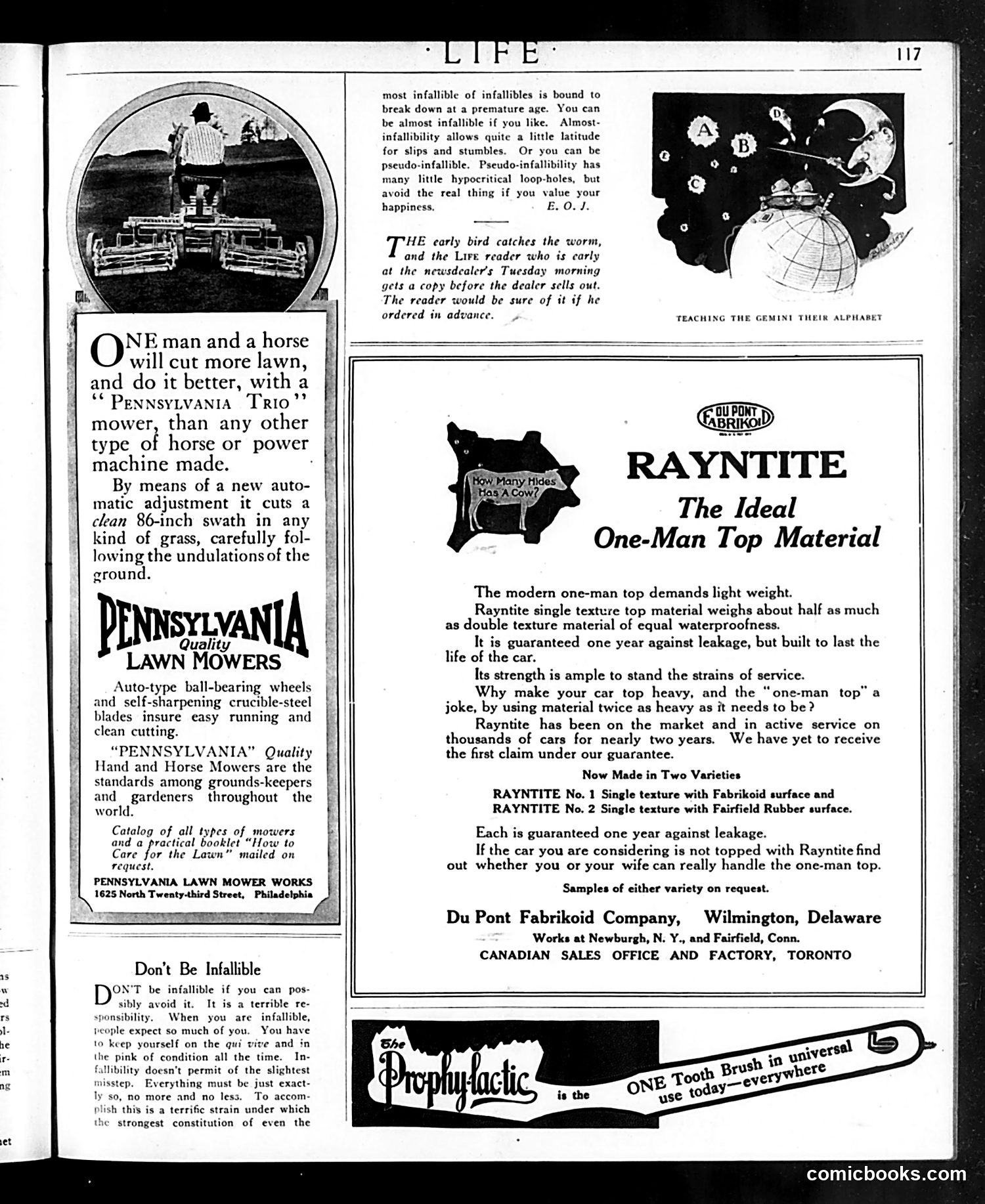
This page is primarily **advertisements** with a brief satirical essay. The main content includes: **"Don't Be Infallible" Essay** (by E.O.J.): A humorous piece advising readers against being perfectly infallible, as it creates unrealistic expectations and constant pressure. The author suggests "almost-infallible" or "pseudo-infallible" are preferable alternatives—light satire on perfectionism and human limitations. **Advertisements featured:** - Pennsylvania Lawn Mowers (horse-drawn equipment) - Rayntite car tops (automobile accessories) - Prophylactic toothbrush **Social context:** The mix of horse-drawn lawn equipment alongside automobile accessories reflects the 1920s transition period when both technologies coexisted. The satire gently mocks the burden of high expectations—relevant to early 20th-century American culture emphasizing productivity and self-improvement. The page contains no political cartoons or caricatures—it's primarily commercial advertising with light humor.
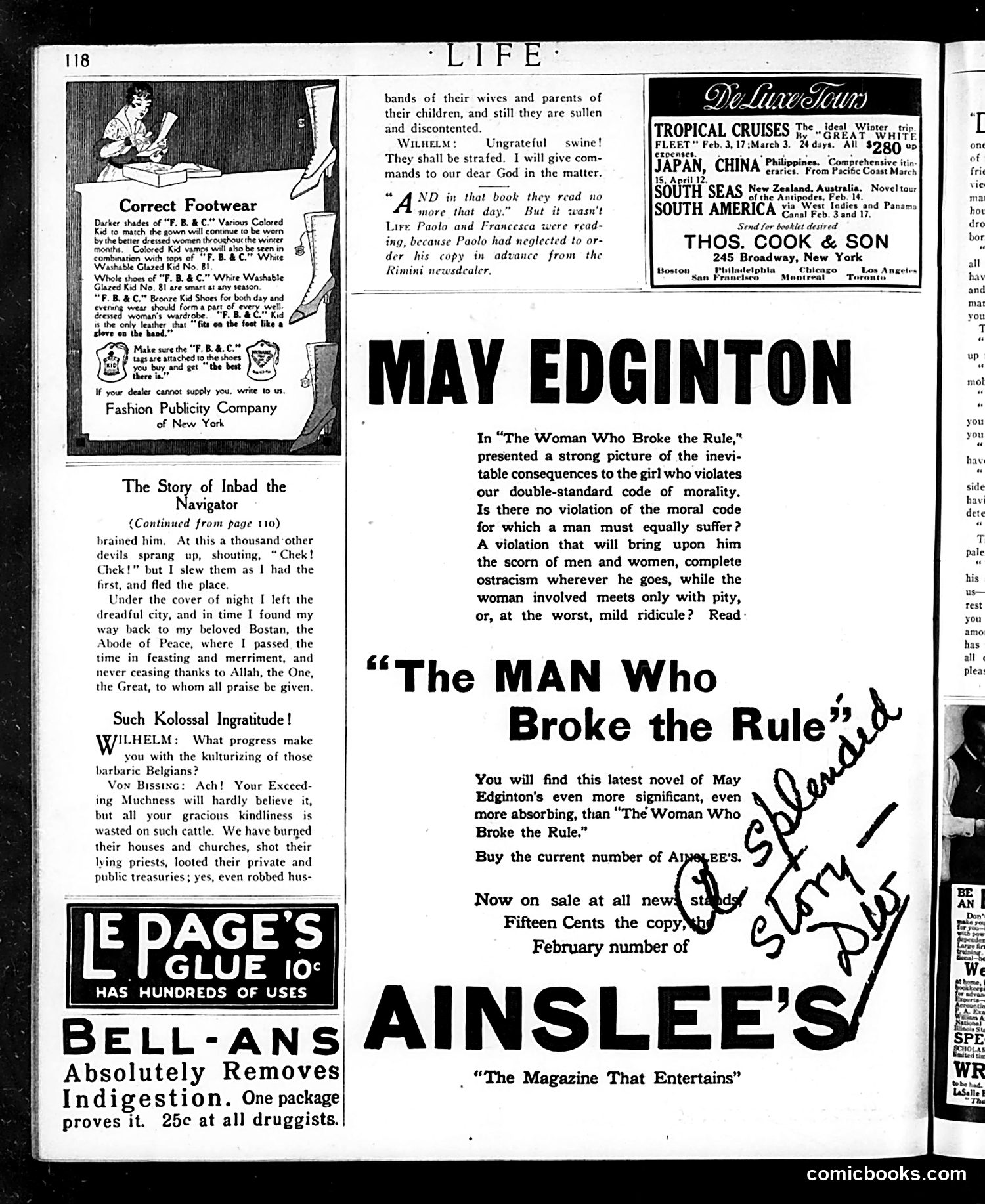
This page primarily contains **advertisements and literary promotion** rather than political satire. The main content advertises May Edginton's novel "The Man Who Broke the Rule" in *Ainslee's* magazine. The advertisement critiques the **double standard in sexual morality**: it notes that Edginton's earlier work showed consequences for women who violate moral codes, then poses a rhetorical question—does a man face equal punishment for the same violation? The advertisement suggests her new novel explores this inequality, implying men face only "scorn" while women face "complete ostracism." The page also includes a story continuation ("Inbad the Navigator"), a brief comedic dialogue between **Wilhelm (likely Kaiser Wilhelm II) and Von Bissing** mocking German brutality in Belgium with sardonic understatement, and various product advertisements (footwear, travel cruises, patent medicines). The Wilhelm/Bissing exchange is the closest to satire—darkly comic commentary on WWI atrocities presented as absurd ingratitude.
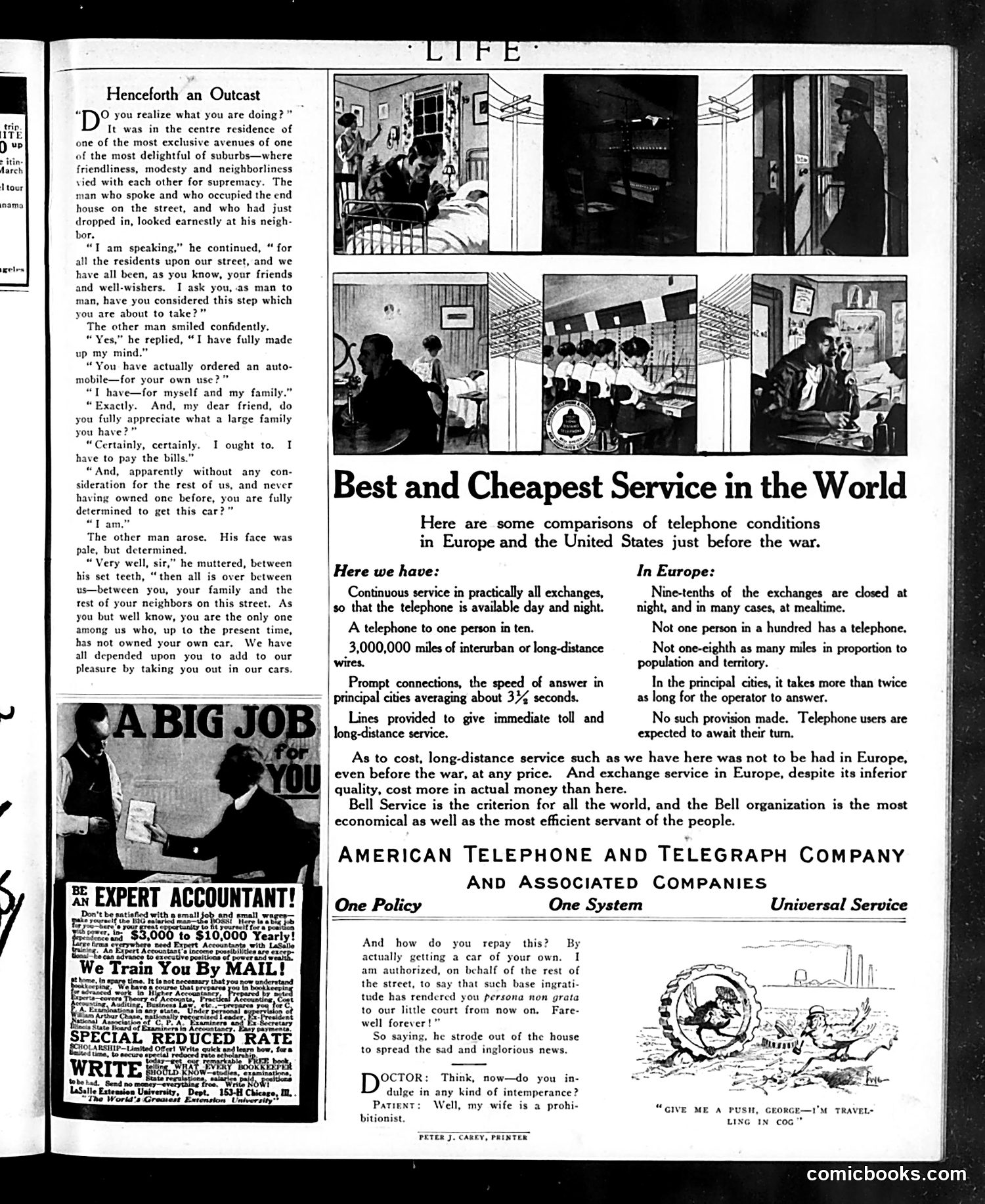
This story satirizes nouveau-riche social anxiety about automobiles in early 20th-century America. A suburban resident who has avoided buying a car becomes a pariah when he finally purchases one, accused by his neighbors of betraying their expectation that he remain dependent on them for rides. The satire targets two targets: the nouveaux riches' status-consciousness (automobiles were expensive luxury goods), and the absurdity of social pressure enforced through moral manipulation. The neighbors' indignation—that his independence somehow damages *their* pleasure—reveals the pettiness of exclusive suburban hierarchies. The page also includes a Bell Telephone Company advertisement comparing American telephone service (extensive, cheap, available 24/7) favorably to European systems—positioning American infrastructure as superior, likely resonating with pre-WWI nationalist sentiment.
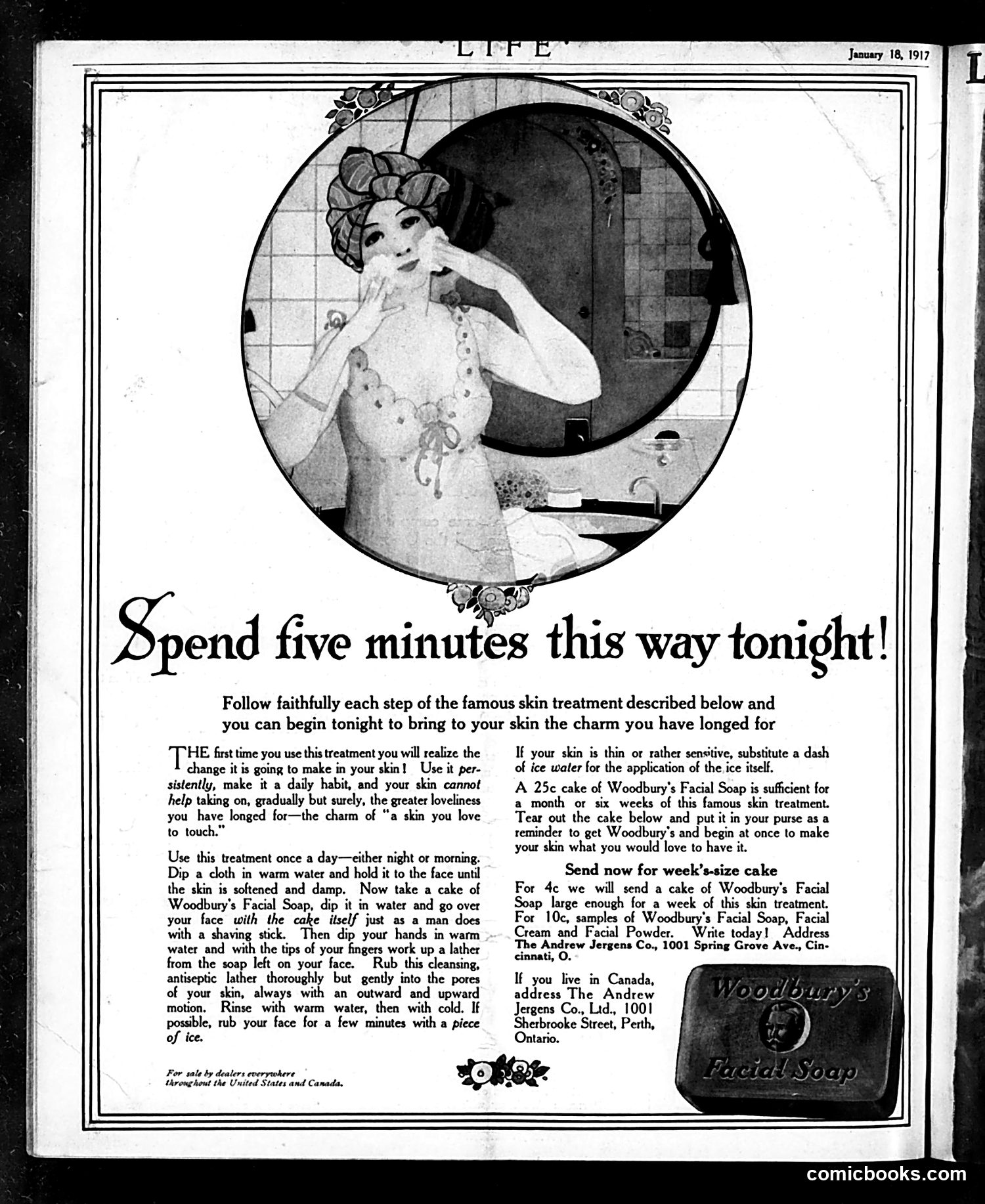
This is **not a cartoon or satire**—it's a straightforward advertisement for Woodbury's Facial Soap from January 1917. The circular image shows a woman in period dress demonstrating a facial skincare routine. The bulk of the page provides detailed instructions for a five-minute nightly treatment using the soap, promising improved skin appearance through regular use. The ad emphasizes the product's accessibility (25 cents) and offers samples for small fees (4-10 cents). It targets female readers seeking beauty enhancement, a common marketing approach of the era. The decorative oval frame and elegant typography were typical design conventions for women's beauty advertisements in early 20th-century magazines like *Life*. There is no political commentary, satire, or hidden meaning—this is period advertising reflecting contemporary beauty standards and consumer culture.