
Life, 1917-01-18 · page 8 of 40
Life — January 18, 1917 — page 8: what you’re looking at
What you’re looking at
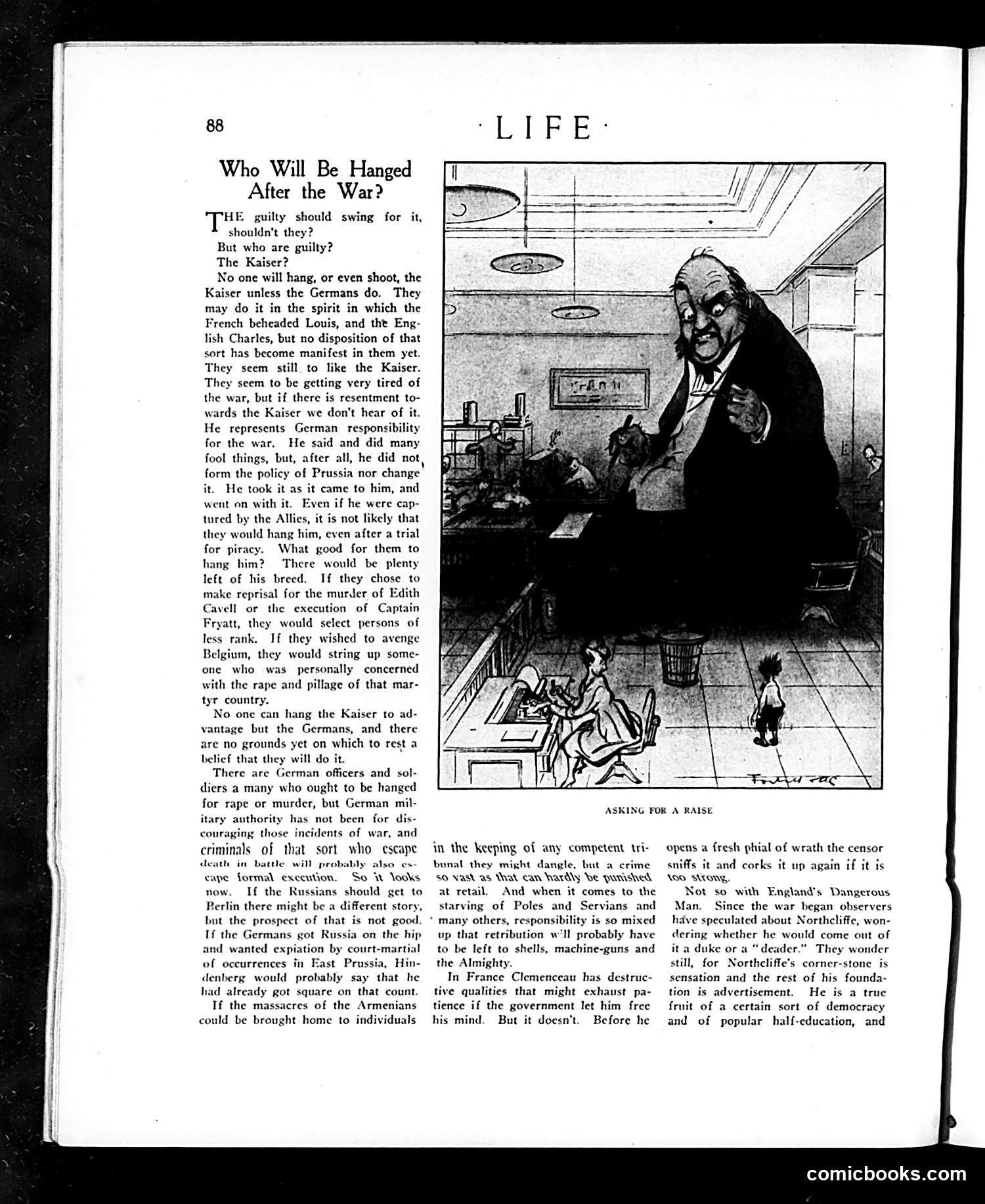
This page from *Life* magazine presents a post-World War I political argument about war crimes accountability. The cartoon illustration (captioned "Asking for a Raise") shows a figure in an elevated position addressing others below, likely depicting a German military or political leader. The text argues that hanging Kaiser Wilhelm II would be impractical and counterproductive. Instead, the author suggests targeting lower-ranking German officers responsible for specific atrocities—the execution of Edith Cavell, Captain Fryatt's death, and Belgian atrocities. The piece contends that Germans themselves should execute these war criminals, as the Allies lack practical authority to do so. It reflects contemporary debates over German accountability and justice following WWI's conclusion.
📄 Transcribed text from this page (OCR, searchable)
Machine-transcribed from the original scan — historical spelling and the odd misread are preserved.
Who Will Be Hanged After the War? HE guilty should swing for it, shouldn't they? But who are guilty? The Kaiser? No one will hang, or even shoot, the Kaiser unless the Germans do. They may do it in the spirit in which the French beheaded Louis, and tht Eng- lish Charles, but no disposition of that sort has become manifest in them yet. They seem still. to like the Kaiser. They seem to be getting very tired of the war, but if there is resentment to- wards the Kaiser we don't hear of it. He represents German responsibility for the war. He said and did many fool things, but, after all, he did not, form the policy of Prussia nor change it. He took it as it came to him, and went on with it. ven if he were cap- tured by the Allies, it is not likely that they would hang him, even after a trial What good for them to hang hi There would be plenty left of his breed. If they chose to make reprisal for the murder of Edith Cavell or the execution of Captain ryatt, they would select persons of s rank, If they wished to avenge Belgium, they would string up some- one who was personally concerned with the rape and pillage of that mar- tyr country. No one can hang the Kaiser to ad- vantage but the Germans, and there are no grounds yet on which to rest a belief that they will do it. There are German officers and sol- diers a many who ought to be hanged for rape or murder, but German mil- itary authority has not been for dis- ing those incidents of war, and criminals of that sort who escape dleath in battle will probably also cs. cape formal exceution. So it locks now. If the Russians should get to Perlin there might be a different story, but the prospect of that is not good. If the Germans got Russia on the hip and wanted expiation by court-martial of occurrences in East Prussia, Hin- denberg would probably say that he had already got square on that count. If the massacres of the Armenians could be brought home to individuals ASKING FOR A RAISE in the keeping of any competent tri- bunal they might dangle, but a crime so vast as that can hardly be punished at retail. And when it comes to the starving of Poles and Servians and * many others, responsibility is so mixed up that retribution w'll probably have to be left to shells, machine-guns and the Almighty. In France Clemenceau has destruc- tive qualities that might exhaust pa- tience if the government let him free his mind. But it doesn’t. Before he opens a fresh phial of wrath the censor sniffs it and corks it up again if it is oo trong. Not so with England's Dangerous Man. Since the war began observers have speculated about Northcliffe, won- dering whether he would come out of ita duke or a “deader.”| They wonder still, for Northcliffe’s corne sensation and the rest of h tion is advertisement. He is a true fruit of a certain sort of democracy and of popular half-education, and comicbooks.com