
Life, 1917-01-18 · page 36 of 40
Life — January 18, 1917 — page 36: what you’re looking at
What you’re looking at
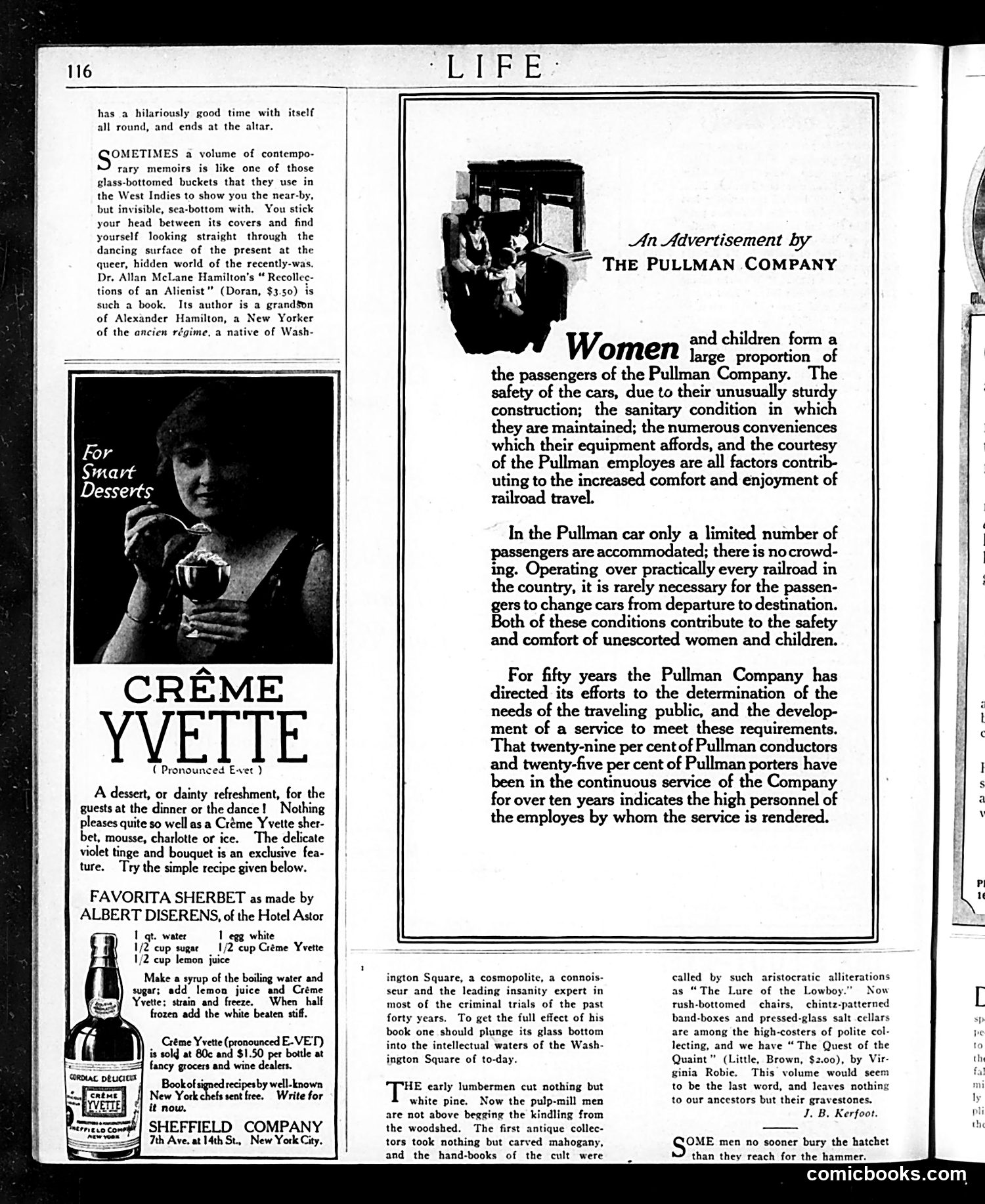
This page is **primarily advertising**, not satire or political commentary. The dominant content is a Pullman Company advertisement emphasizing the safety and comfort of their railroad cars for women and children travelers—highlighting sturdy construction, sanitation, limited capacity, and courteous staff. The left side contains book reviews discussing contemporary memoirs and antique collecting trends. A secondary advertisement promotes Crème Yvette, a violet-flavored liqueur dessert product, with a recipe and endorsement from a hotel chef. The imagery shows a Pullman car interior with passengers and the product bottle—straightforward promotional material rather than satirical commentary. The tone is aspirational and class-conscious, targeting affluent travelers concerned with comfort and respectability during rail journeys. There is **no political cartoon or satirical message** visible on this page.
📄 Transcribed text from this page (OCR, searchable)
Machine-transcribed from the original scan — historical spelling and the odd misread are preserved.
has a hilariously good time with itself all round, and ends at the altar. OMETIMES a volume of contempo- rary memoirs is like one of those glass-bottomed buckets that they use in the West Indies to show you the near-by, but invisible, sea-bottom with, You stick your head between its covers and find yourself looking straight through the dancing surface of the present at the queer, hidden world of the recently-was, Dr. Allan McLane Hamilton's “ Recollec- tions of an Alienist” (Doran, $3.50) is such a book. Its author is a grandSon of Alexander Hamilton, a New Yorker of the ancien régime, a native of Wash- and children form a Women large proportion of the passengers of the Pullman Company. The safety of the cars, due to their unusually sturd: construction; the sanitary condition in ‘which they are maintained; the numerous conveniences which their equipment affords, and the courtesy $ be of the Pullman employes are all factors contrib- mart . uting to the increased comfort and enjoyment of Desserts railroad travel. In the Pullman car only a limited number of passengers are accommodated; there is no crowd- ing. Operating over practically every railroad in the country, it is rarely necessary for the passen- gers to change cars from departure to destination. Both of these conditions contribute to the safety and comfort of unescorted women and children. For fifty years the Pullman Company has directed its efforts to the determination of the needs of the traveling public, and the develop- ment of a service to meet these requirements. That twenty-nine per cent of Pullman conductors and twenty-five per cent of Pullman porters have been in the continuous service of the Company for over ten years indicates the high personnel of the employes by whom the service is rendered. YVETTE ( Pronounced Ever ) A dessert, or dainty refreshment, for the guests at the dinner or the dance! Nothing pleases quite so well as a Créme Yvette sher- bet, mousse, charlotte or ice. The delicate violet tinge and bouquet is an exclusive fea- ture. Try the simple recipe given below. FAVORITA SHERBET as made by ALBERT DISERENS, of the Hotel Astor 1 qt. water 1 egg white 1/2 cup sugar 1/2 cup Creme Yvette 1/2 cup lemon juice it a syrup of the boiling water and ington Square, a cosmopolite, a connois- called by such aristocratic alliterations ld lemon juice and Creme Yvette: strain and freeze. When half frozen add the white beaten stiff. Creme Yvette (pronounced E-VET) is sold at 80c and $1.50 per bottle at fancy grocers and wine dealers. Book of signed recipes by well-known. ork chefs pane Write for it now. | SHEFFIELD COMPANY A 7th Ave.at 14th St, New York City. seur and the leading insanity expert in most of the criminal trials of the past forty years. To get the full effect of his book one should plunge its glass bottom into the intellectual waters of the Wash- ington Square of to-day. 'HE early lumbermen cut nothing but white pine. Now the pulp-mill men are not above begging the kindling from the woodshed. The first antique collec- tors took nothing but carved mahogany, and the hand-books of the cult were as “The Lure of the Lowboy.” Now rush-bottomed chairs, chintz-patterned band-boxes and pressed-glass salt cellars are among the high-costers of polite col- lecting, and we have “The Quest of the Quaint” (Little, Brown, $2.00), by Vir- ginia Robie. This volume would seem to be the last word, and leaves nothing to our ancestors but their gravestones. J. B. Kerfoot. OME men no sooner bury the hatchet than they reach for the hammer. comicbooks.com