
Life, 1917-01-18 · page 15 of 40
Life — January 18, 1917 — page 15: what you’re looking at
What you’re looking at
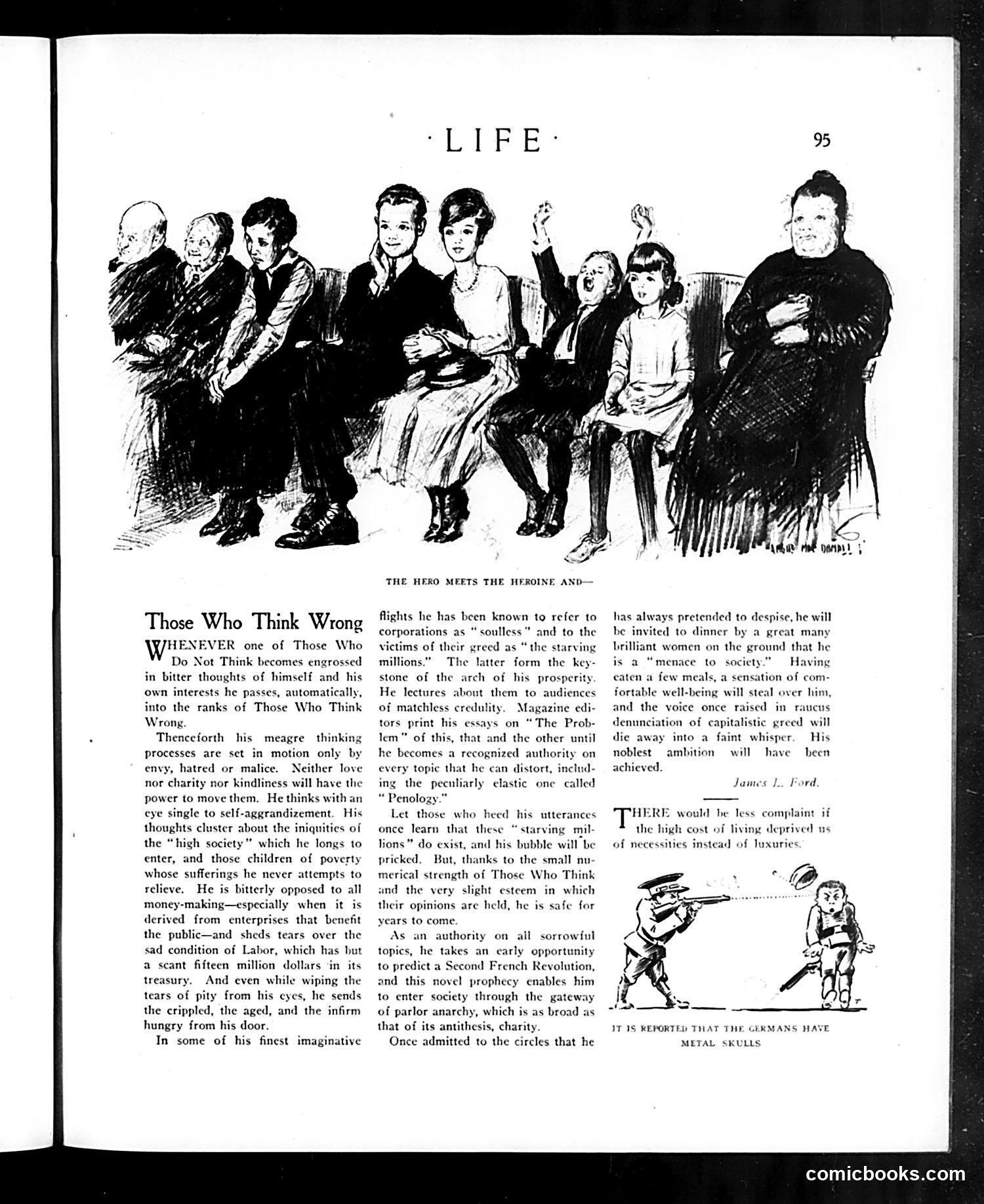
This Life magazine page (page 95) contains social satire about wealthy individuals who "think wrong"—those indifferent to labor exploitation and poverty. The text, attributed to James L. Ford, criticizes rich people who dismiss workers as "starving millions" while claiming poverty doesn't exist, and who oppose charity or labor reform. The upper illustration depicts "The Hero Meets the Heroine"—likely showing a wealthy man encountering women in a social setting, satirizing his superficial morality. The lower cartoon, "It Is Reported That the Germans Have Metal Skulls," uses absurdist humor to mock German military pretensions, a common satirical trope during the era of Anglo-German tensions (likely pre-WWI or inter-war period). Together, the page critiques both class hypocrisy and foreign militarism.
📄 Transcribed text from this page (OCR, searchable)
Machine-transcribed from the original scan — historical spelling and the odd misread are preserved.
Those Who Think Wrong HENEVER one of Those Who Do Not Think becomes engrossed in bitter thoughts of himself and his own interests he passes, automatically, into the ranks of Those Who Think Wrong. Thenceforth his meagre thinking Processes are sct in motion only by envy, hatred or malice. Neither love nor charity nor kindliness will have the power to move them. He thinks with an eye single to self-aggrandizement. His thoughts cluster about the iniquities of the “high society” which he longs to enter, and those children of poverty whose sufferings he never attempts to relieve. He is bitterly opposed to all money-making—especially when it is derived from enterprises that benefit the public—and sheds tears over the sad condition of Labor, which has but a scant fifteen million dollars in its treasury. And even while wiping the tears of pity from his cyes, he sends the crippled, the aged, and the infirm hungry from his door. In some of his finest imaginative THE HERO MEETS THE HEROINE AND— flights he has been known to refer to corporations as “soulless” and to the victims of their greed as “the starving millions.” The latter form the k stone of the arch of his prosperity He lectures about them to audiences Magazine edi- tors print his essays on “The Prob- lem” of this, that and the other until he becomes a recognized authority on of matchless credulity. every topic that he can distort, includ- ing the peculiarly clastic one called “ Penology. Let those who heed his utterances once learn t n lions” do exist, and his bubble will be d. But, thanks to the small nu- I strength of Those Who Think and the very slight esteem in which these “starving mil- their opinions are held, he is safe for rs to come. As an authority on ail topics, he takes an carly opportunity to predict a Second French Revolution, and this novel prophecy enables him to enter society through the gateway of parlor anarchy, which is as broad as that of its antithesis, charity. Once admitted to the circles that he sorrowful has always pretended to despise, he will be invited to dinner by a great many Drilli. is a “menace to society.” ant women on the ground that he Having eaten a few meals, a sensation of com- fortable well-being will steal over him, and the voice once raised in raucus tion of capitalistic greed will His been denunei die away into a faint whisper noblest ambition will achieved. have James 1. Ford. HERE would he less complaint if the high cost of living deprived us ssities instead of luxuries =, 3 IT 1S REPORTED THAT THE GERMANS HAVE METAL SKULLS comicbooks.com