
Life, 1917-01-18 · page 19 of 40
Life — January 18, 1917 — page 19: what you’re looking at
What you’re looking at
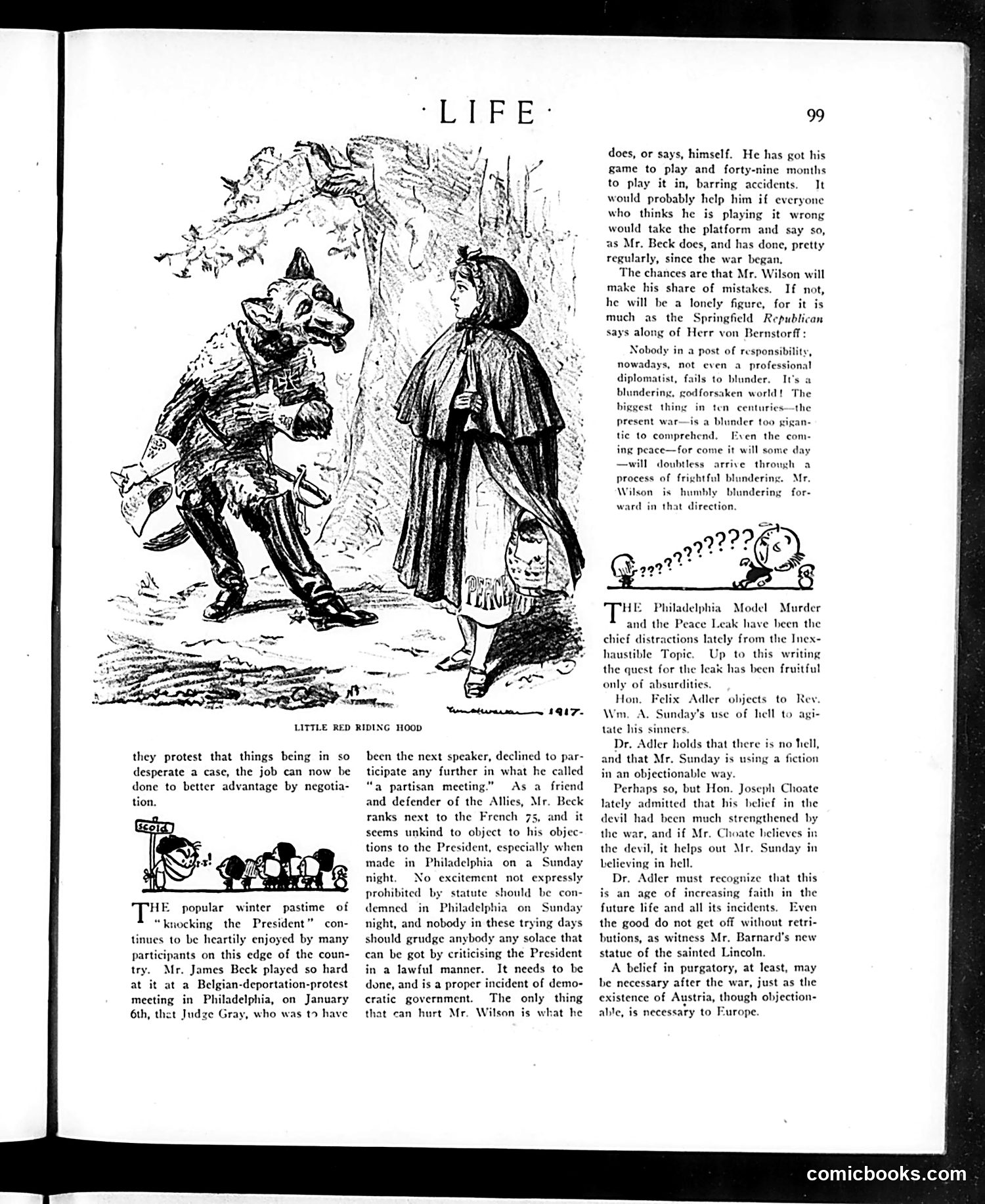
## Main Cartoon: "Little Red Riding Hood" The illustration reimagines the fairy tale with political figures. The "Wolf" (dressed as a German soldier) represents German militarism threatening innocence. The cloaked figure appears to represent either a neutral observer or America itself encountering European conflict. The 1917 date confirms this reflects WWI anxieties about American involvement. ## Editorial Content The page discusses President Wilson's policies and critics like James Beck, who publicly attacked Wilson at a Philadelphia meeting. The writer defends Wilson's right to be criticized while arguing Wilson himself—not critics—determines his success or failure. The piece also addresses Rev. Billy Sunday's use of hell-imagery in revival sermons, with philosopher Felix Adler objecting to this "fiction," while the writer suggests post-war trauma may make belief in divine punishment seem reasonable. The overall tone: satirical defense of Wilson against domestic political attacks amid wartime uncertainty.
📄 Transcribed text from this page (OCR, searchable)
Machine-transcribed from the original scan — historical spelling and the odd misread are preserved.
41Qt7- LITTLE RED RIDING HOOD they protest that things being in so desperate a case, the job can now be done to better advantage by negotia- tion, winter pastime of “knocking the President” con- tinues to be heartily enjoyed by many participants on this edge of the coun- try. Mr. James Beck played so hard at it at a Belgian-deportation-protest meeting in Philadelphia, on January 6th, thet Judge Gray, who was to have HE popular been the next speaker, declined to par- ticipate any further in what he called “a partisan meeting.” As a_ friend and defender of the Allies, Mr. Beck ranks next to the French 75, and it seems unkind to object to his objec- tions to the President, especially when made in Philadelphia on a Sunday night. No excitement not expressly prohibited by statute should be con- demned in Philadelphia on Sunday night, and nobody in these trying da should grudge anybody any solace that can be got by criticising the President in a lawful manner. It needs to be done, and is a proper incident of demo- cratic government. The only thing that can hurt Mr. Wilson is what he 99 does, or says, himself. He has got his game to play and forty-nine months to play it in, barring accidents. It would probably help him if everyone who thinks he is playing it wrong would take the platform and say so, as Mr. Beck does, and has done, pretty regularly, since the war began. The chances are that Mr. Wilson will make his share of mistakes. If not, he will be a lonely figure, for it is much as the Springfield Republican says along of Herr von Bernstorff: Nobody in a post of responsibility, nowadays, not even a professional diplomatist, fails to blunder. blundering, godforsaken world! It's a The biggest thing in ten centuries—the present war—is a blunder too gigan- tic to comprehend. Even the com- ing peace—for come it will some day —will through a process of frightful blundering. Mr. Wilson is humbly blundering for- ward in that direction, doubtless arrive HE Philadelphia Model Murder and the Peace Leak have been the chief distractions lately from the Inex- haustible Topic. Up to this writing the quest for the leak has been fruitful only of absurdities. Hon. Felix Adler objects to Rev. Wm. A. Sunday's use of hell to agi tate his sinners. Dr. Adler holds that there is no hell, and that Mr. Sunday is using a fiction in an objectionable way. Perhaps so, but Hon. Joseph Choate lately admitted that his belief in the devil had been much strengthened by the war, and if Mr. Choate helieves in the devil, it helps out Mr. Sunday in Lelieving in hell. Dr. Adler must recognize that this is an age of increasing faith in the future life and all its incidents. Even the good do not get off without retri- butions, as witness Mr. Barnard’s new statue of the sainted Lincoln. A belief in purgatory, at least, may be necessary after the war, just as the existence of Austria, though objection- able, is necessary to Europe. comicbooks.com