
Life, 1917-01-18 · page 25 of 40
Life — January 18, 1917 — page 25: what you’re looking at
What you’re looking at
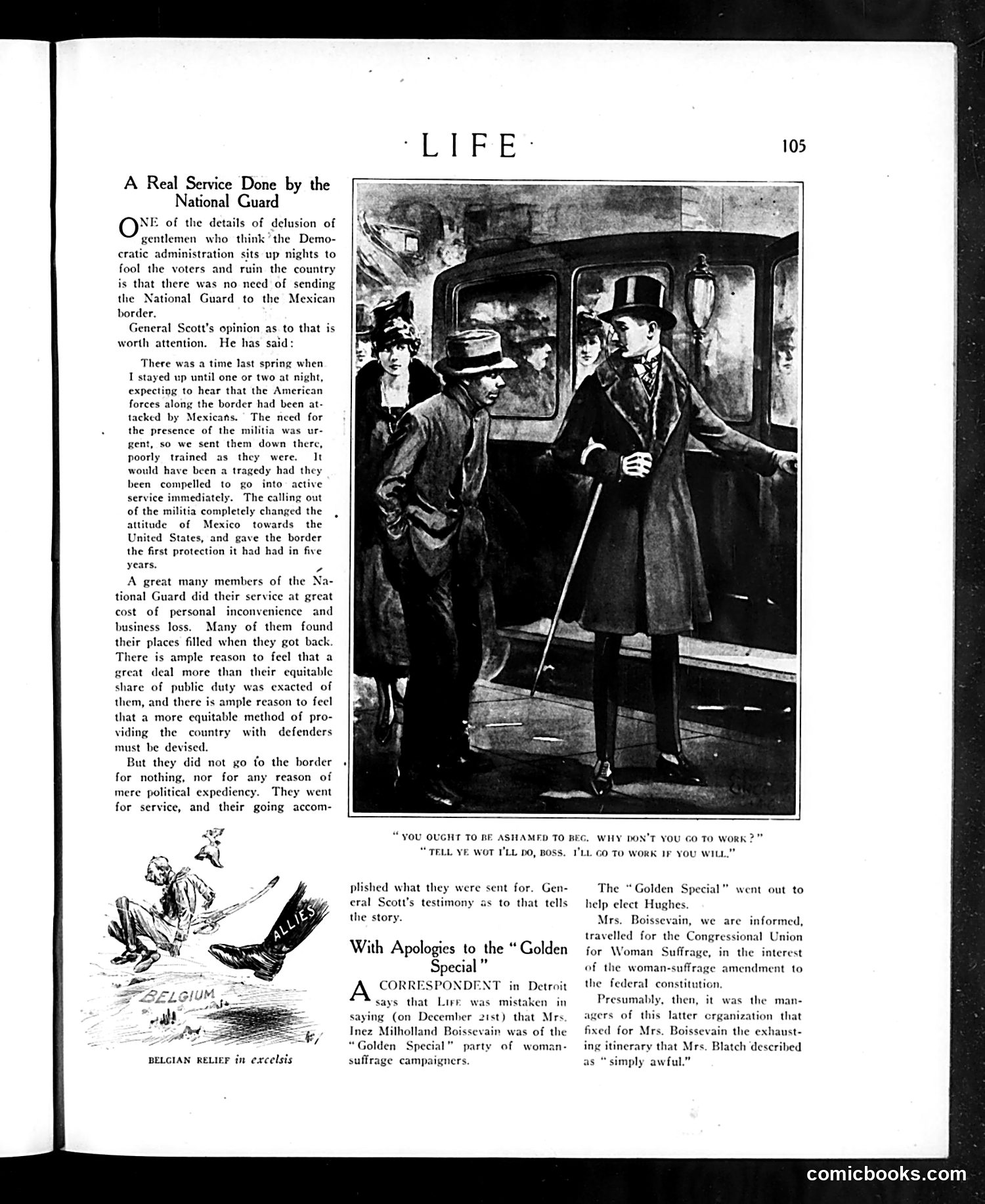
**Main Article & Political Context:** The article defends President Wilson's Democratic administration's decision to deploy the National Guard to the Mexican border in spring 1916. It quotes General Scott supporting this action as necessary for border security and deterring Mexican aggression. The piece argues National Guardsmen made real sacrifices (lost jobs, inconvenience) and should receive better treatment—a veiled criticism of how the government managed the deployment. **Political Cartoon ("Belgian Relief in excelsis"):** This small cartoon satirizes American relief efforts for Belgium during WWI. A ragged Belgian beggar asks for help; an American responds with condescension ("You ought to be ashamed to beg") before offering patronizing assistance ("I'll go to work if you will"). The satire mocks Americans who simultaneously pity Belgian suffering while blaming victims for their circumstances—typical Progressive-era criticism of charity's moral superiority. **Woman Suffrage Correction:** A minor editorial note clarifies that activist Inez Milholland Boissevain worked for the Congressional Union for Woman Suffrage (federal amendment focus), not the "Golden Special" party supporting Hughes's presidential campaign.
📄 Transcribed text from this page (OCR, searchable)
Machine-transcribed from the original scan — historical spelling and the odd misread are preserved.
A Real Service Done by the National Guard NE of the details of delusion of gentlemen who think ‘the Demo- cratic administration sits up nights to fool the voters and ruin the country is that there was no need of sending the National Guard to the Mexican border. General Scott's opinion as to that is worth attention. He has said: There was a time last spring when I stayed up until one or two at night, expecting to hear that the Ame: forces along the border had been at- tacked by Mexicans. The need for the presence of the militia was ur- gent, so we sent them down there, poorly trained as they were. It would have been a tragedy had they been compelled to go into active service immediately. The calling out of the militia completely changed the attitude of Mexico towards the United tes, and gave the border the first protection it had had in five years, , A great many members of the Na- tional Guard did their service at great cost of personal inconvenience and business loss. Many of them found their places filled when they got back. There is ample reason to feel that a great deal more than their equitable share of public duty was exacted of them, and there is ample reason to feel that a more equitable method of pro- viding the country with defenders must be devised. But they did not go fo the border for nothing, nor for any reason of mere political expediency. They went for service, and their going accom- =f, BELGIAN RELIEF in excelsis “YOU OUGHT TO RE ASHAMFD TO BEG, “TELL YE WOT I'LL DO, Boss. 1’ plished what they were sent for. Gen- eral Scott's testimony as to that tells the story. With Apologies to the “ Golden Special ” CORRESPONDENT in Detroit says that Lire was mistaken in saying (on December 21st) that Mrs Inez Milholland Boissevain was of the “Golden Special” party of woman- suffrage campaigners. WHY DON'T YOU GO TO Work?” GO TO WORK IF YOU WILL.” The “Golden Special” went out to help elect Hughes. Mrs. Boissevain, we are informed, travelled for the Congressional Union for Woman Suffrage, in the interest of the woman-suffrage amendment to the federal constitution, Presumably, then, it was the man- agers of this latter crganization that fixed for Mrs. Boissevain the i nerary that Mrs. Blatch described * simply awful, haust- comicbooks.com