
Life, 1917-01-18 · page 27 of 40
Life — January 18, 1917 — page 27: what you’re looking at
What you’re looking at
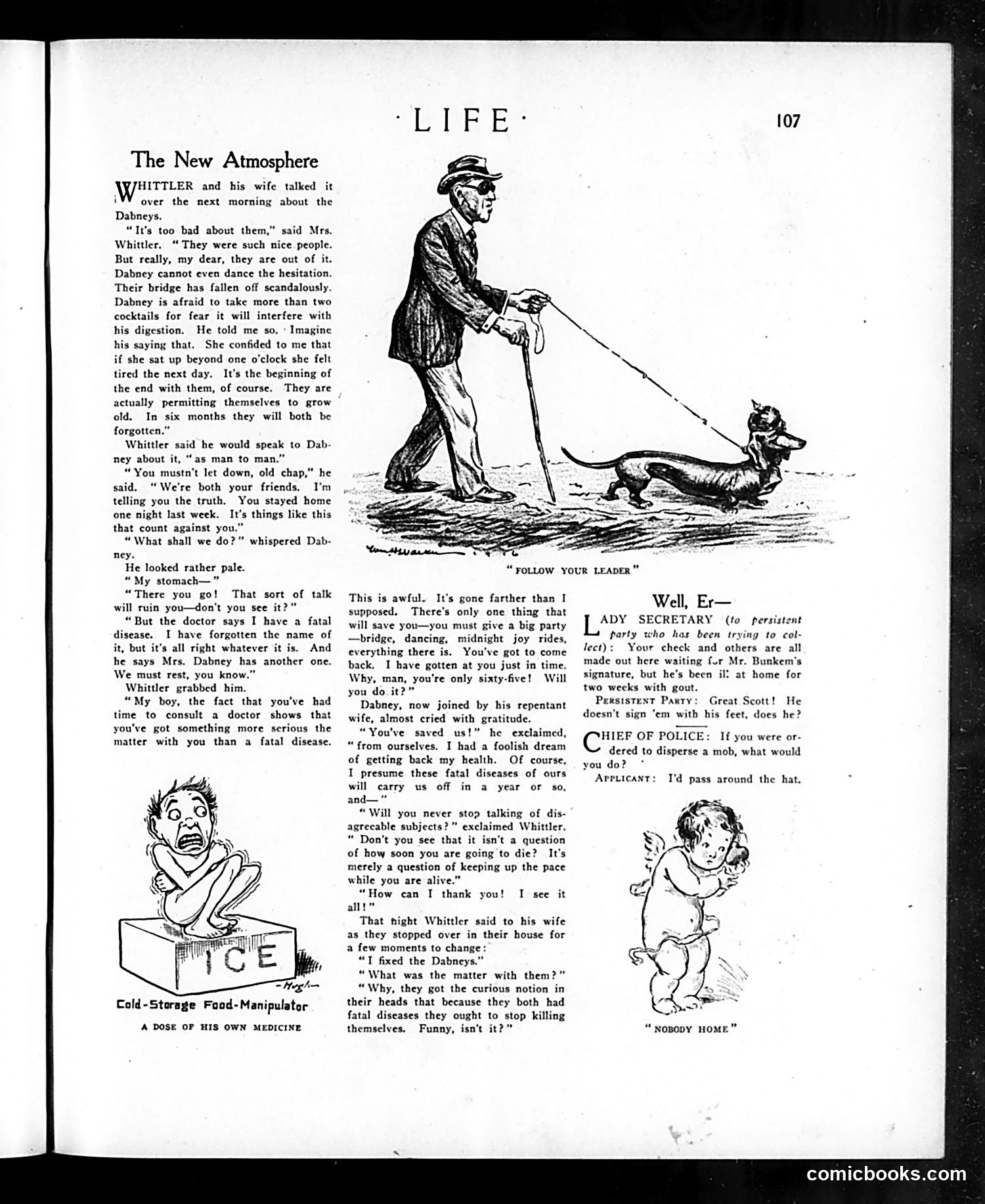
This story satirizes 1920s high-society conformity and excess. The Dabneys, a couple trying to rest due to genuine health problems, face social ostracism from the Whittlers, who represent the era's relentless pursuit of pleasure—constant partying, drinking, dancing, and late nights. The satire's target: society's judgment that *not* participating in destructive behavior marks one as obsolete or "out of it." Whittler persuades the Dabneys to abandon doctor's orders and resume dangerous social activities, framing this as salvation. The joke's dark irony: prioritizing social appearance over actual health, even unto death, is presented as normal and desirable. The cartoons below reinforce themes of societal dysfunction—a "Cold-Storage Food-Manipulator" (unclear reference, possibly to food industry), and bureaucratic absurdity (police chief, secretary). The page critiques Jazz Age culture's superficiality and peer pressure masquerading as friendship.
📄 Transcribed text from this page (OCR, searchable)
Machine-transcribed from the original scan — historical spelling and the odd misread are preserved.
The New Atmosphere 'HITTLER and his wife talked it ' over the next morning about the Dabneys. “Tt's too bad about them,” said Mrs. Whittler, “ They were such nice people. But really, my dear, they are out of it. Dabney cannot even dance the hesitation. Their bridge has fallen off scandalously. Dabney is afraid to take more than two cocktails for fear it will interfere with his digestion. He told me so. » Imagine his saying that. She confided to me that if she sat up beyond one o'clock she felt tired the next day. It’s the beginning of the end with them, of course. They are actually permitting themselves to grow old. In six months they will both be forgotten.” Whittler said he would speak to Dab: ney about it, “as man to man.” “You mustn't let down, old chap,” he said, “We're both your friends. I'm telling you the truth. You stayed home one night last week. It’s things like this that count against you.” “What shall we do?" whispered Dab- ney. He looked rather pale. “My stomach—” “There you go! That sort of talk will ruin you—don't you see it “But the doctor says I have a fatal disease. I have forgotten the name of it, but it’s all right whatever it is. And he says Mrs. Dabney has another one. We must rest, you know.” Whittler grabbed him. “My boy, the fact that you've had time to consult a doctor shows that you've got something more scrious the matter with you than a fatal disease. Cold-Storage Food-Manipulator A DOSE OF HIS OWN MEDICINE “FOLLOW YOUR LEADER” This is awful. It’s gone farther than I supposed. There's only one thing that will save you—you must give a big party —bridge, dancing, midnight joy rides, everything there is. You've got to come back. I have gotten at you just in time. Why, man, you're only sixty-five! Will you do. it?” Dabney, now joined by his repentant wife, almost cried with gratitude. “You've saved us!” he exclaimed, “from ourselves. I had a foolish dream of getting back my health. Of course, I presume these fatal diseases of ours will carry us off in a year or so, and—" “Will you never stop talking of dis- agrecable subjects?” exclaimed Whittler. “Don't you see that it isn't a question of how soon you are going to die? It's merely a question of keeping up the pace while you are alive.” “How can I thank you! all!” That hight Whittler said to his wife as they stopped over in their house for a few moments to change: “T fixed the Dabneys.” “What was the matter with them?” “Why, they got the curious notion in their heads that because they both had fatal diseases they ought to stop killing themselves. Funny, isn’t it?” I see it Well, Er— ADY SECRETARY (to persi: party who has been trying to col- lect): Your check and others are all made out here waiting fr Mr. Bunkem's signature, but he’s been il: at home for two weeks with gout. Persistent Party: Great Scott! He doesn’t sign ‘em with his feet, does he? HIEF OF POLICE: If you were or- dered to disperse a mob, what would you do? * APPLICANT: jeont I'd pass around the hat, “Nopopy HOME” comicbooks.com