
Life, 1917-01-18 · page 18 of 40
Life — January 18, 1917 — page 18: what you’re looking at
What you’re looking at
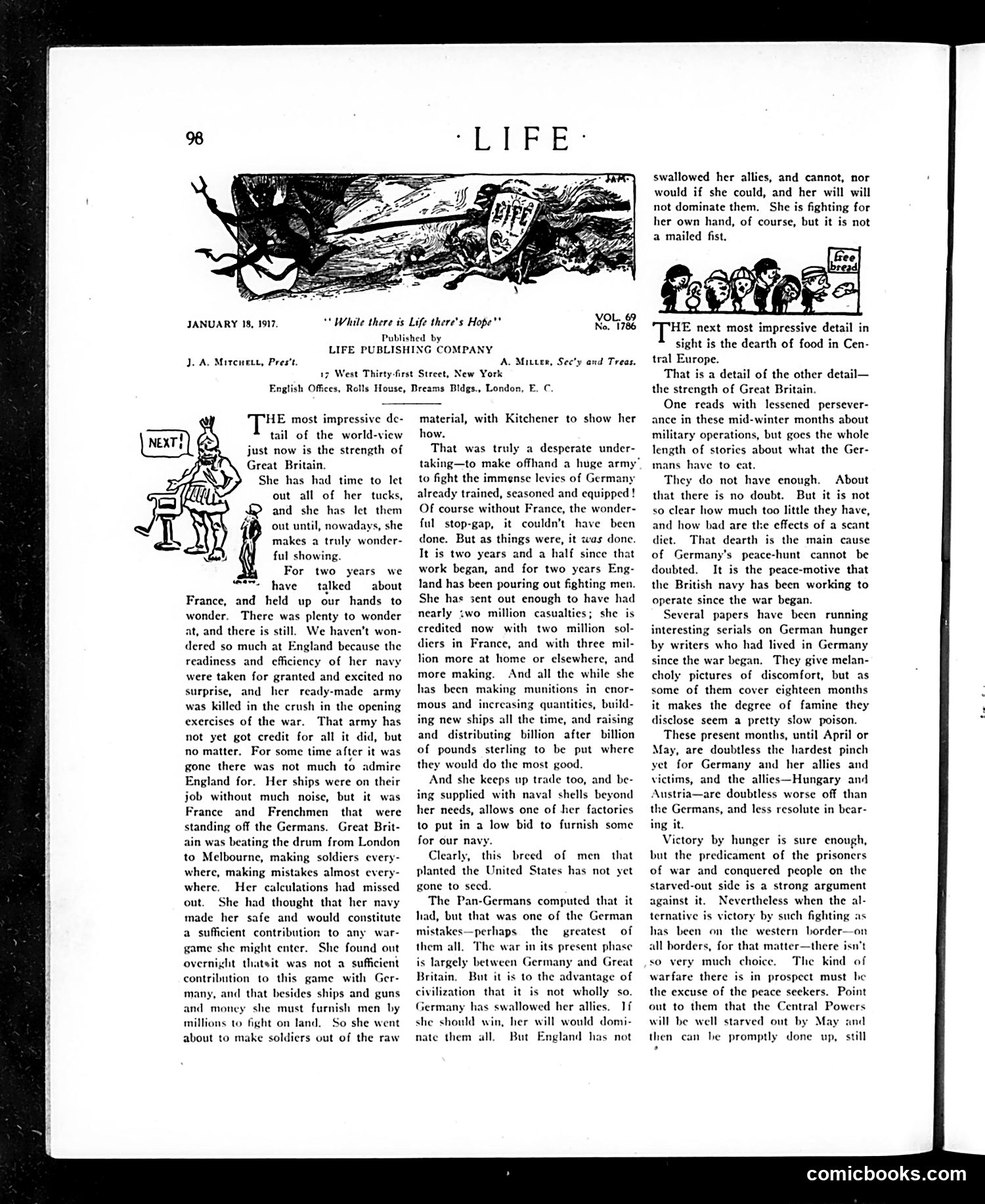
This page contains editorial commentary praising British military strength during World War I. The small cartoon (top left) shows a skeletal figure labeled "NEXT" — likely representing death or deprivation — appearing to approach, illustrating the article's grim discussion of food shortages in Central Europe. The main article argues that Britain's mobilization of millions of soldiers, massive munitions production, and financial contributions have proven the resilience of the Anglo-Saxon heritage. The writer contrasts Britain favorably with Germany: Britain fights for its "own hand" without dominating its allies, while Germany has "swallowed her allies." The piece also notes the emerging threat of starvation in Central Europe as a consequence of British naval blockade and war disruption — presented as evidence of Britain's strategic advantage. Published just before U.S. entry into WWI, this reflects American sympathies toward the British cause and skepticism toward German militarism.
📄 Transcribed text from this page (OCR, searchable)
Machine-transcribed from the original scan — historical spelling and the odd misread are preserved.
JANUARY 18, 1917. Publi: “* While there is Life there's Hope"* No. 1786 ed by LIFE PUBLISHING COMPANY J. A. Mivcnete, Pres’t. HE most impressive de- tail of the world-view just now is the strength of Great Britain. She has had time to let out all of her tucks, and she has let them out until, nowadays, she makes a truly wonder- ful showing. For two years we - have talked about France, and held up our hands to wonder. There was plenty to wonder at, and there is We haven't won- dered so much at England because the readiness and efficiency of her navy were taken for granted and excited no surprise, and her ready-made army was killed in the crush in the opening exercises of the war. That army has not yet got credit for all it did, but no matter. For some time after it was gone there was not much to admire England for. Her ships were on their job without much noise, but it was France and Frenchmen that were standing off the Germans. Great Brit- ain was beating the drum from London to Melbourne, making soldiers every- where, making mistakes almost every- where. Her calculations had missed out. She had thought that her navy made her safe and would constitute a sufficient contribution to any war- he might enter. She found out ight thateit was not a sufficient nition to this game with Ger- many, and that besides ships and guns and moncy she must furnish men by millions to fight on land. So she went about to make soldiers out of the raw A. Miter, Sec’y and Treas. 17 West Thirty-first Street, New York English Offices, Rolls House, Breams Bldgs., London, E. C. material, with Kitchener to show her how. That was truly a desperate under- taking—to make offhand a huge army’ to fight the immense levies of Germany already trained, seasoned and equipped ! Of course without France, the wonder- ful stop-gap, it couldn’t have been done. But as things were, it was done. It is two years and a half since that work began, and for two years Eng- land has been pouring out fighting men. She has sent out enough to have had nearly two million casualties; she is credited now with two million sol- diers in France, and with three mil- lion more at home or elsewhere, and more making. And all the while she has been making munitions in cnor- mous and increasing quantities, build- ing new ships all the time, and raising and distributing billion after billion of pounds sterling to be put where they would do the most good. And she keeps up trade too, and be- ing supplied with naval shells beyond her needs, allows one of her factories to put in a low bid to furnish some for our navy. Clearly, this breed of men that planted the United States has not yet gone to secd. The Pan-Germans computed that it had, but that was one of the German mistakes—perhaps the greatest of them all, The war in its present phase is largely between Germany and Gr Britain, But it is to the advantage of civilization that it is not wholly so. rmany has swallowed her allies. If she should win, her will would domi- nate them all. But England has not swallowed her allies, and cannot, nor would if she could, and her will will not dominate them, She is fighting for her own hand, of course, but it is not a mailed fist. 'HE next most impressive detail in sight is the dearth of food in Cen- tral Europe. That is a detail of the other detail— the strength of Great Britain. One reads with lessened persever- ance in these mid-winter months about military operations, but goes the whole length of storics about what the Ger- mans have to eat. They do not have enough. About that there is no doubt. But it is not so clear how much too little they have, and how bad are tke effects of a scant diet. That dearth is the main cause of Germany's peace-hunt cannot be doubted. It is the peace-motive that the British navy has been working to operate since the war began. Several papers have been running interesting serials on German hunger by writers who had lived in Germany since the war began. They give melan- choly pictures of discomfort, but as some of them cover cighteen months it makes the degree of famine they disclose seem a pretty slow poison. These present months, until April or May, are doubtless the hardest pinch t for Germany and her allies and victims, and the allies—Hungary and Austria—are doubtless worse off than the Germans, and less resolute in bear- ing it. Victory by hunger is sure enough, but the predicament of the prisoners of war and conquered people on the starved-out side is a strong argument against it. Nevertheless when the al- ternative is victory by such fighting as has been on the western border—on all borders, for that matter—there isn’t so very much choice. The kind of warfare there is in prospect must be the excuse of the peace seekers. Point out to them that the Central Powers will be well starved out by May and then can be promptly done up, still comicbooks.com