
Life, 1917-01-18 · page 16 of 40
Life — January 18, 1917 — page 16: what you’re looking at
What you’re looking at
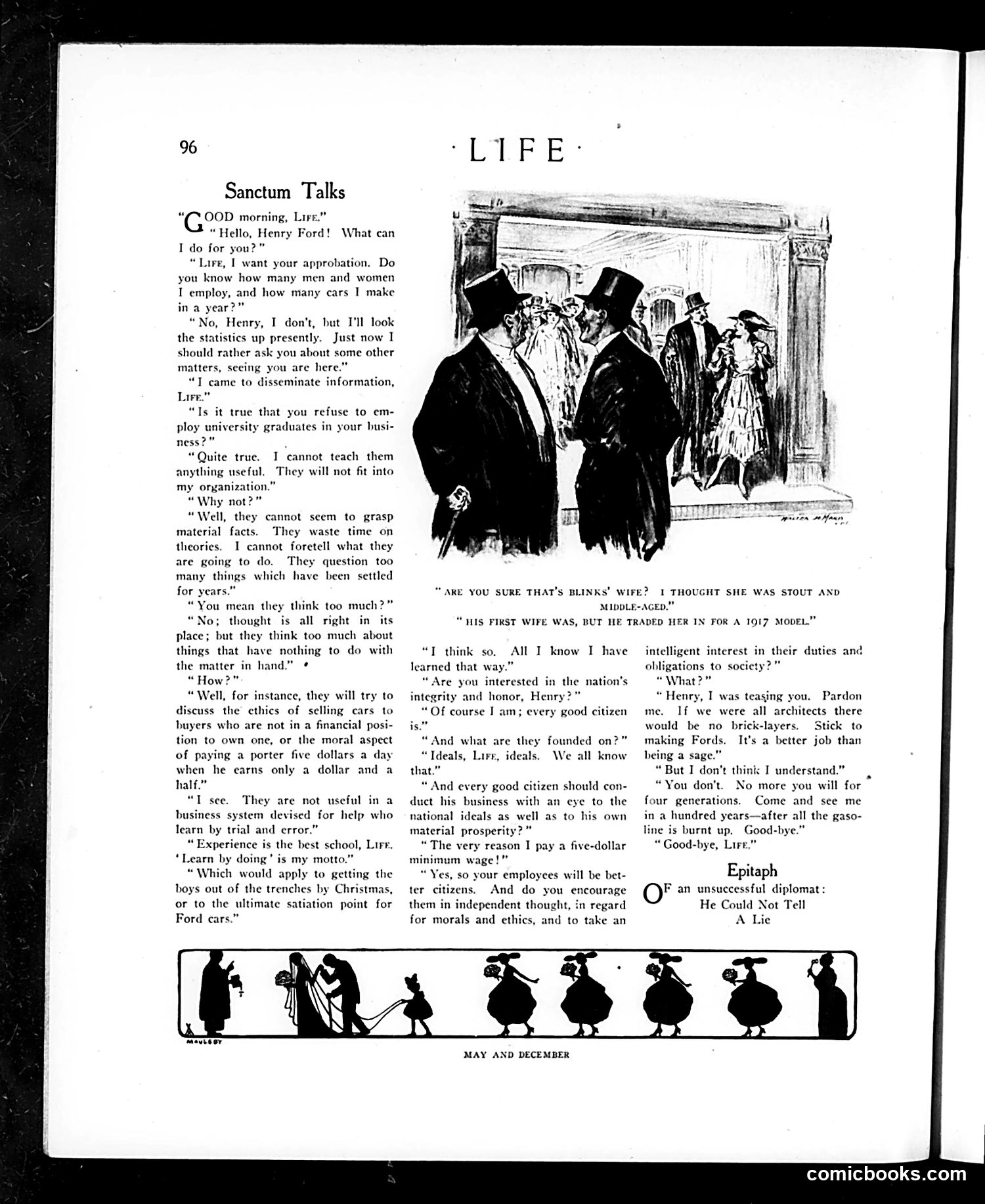
This satirical dialogue features **Henry Ford** (identifiable by name and the discussion of his auto manufacturing and five-dollar wage) meeting with "Lire," the magazine's editor. The cartoon attacks Ford's contradiction: he claims to value citizen integrity and national ideals while actively refusing to employ university graduates who think critically about ethics—such as the morality of selling cars to financially unqualified buyers or paying workers poverty wages. Ford's logic is exposed as hollow. He dismisses educated workers for "questioning too many things," yet simultaneously boasts of his five-dollar minimum wage as promoting better citizenship. The satire suggests Ford wants obedient workers who won't scrutinize his business practices, not genuinely thinking citizens. The secondary joke (bottom caption) mocks outdated values: a man "traded in" his first wife for a 1917 car model—darkly comparing marriage to consumer goods, echoing Ford's assembly-line mentality applied to human relationships.
📄 Transcribed text from this page (OCR, searchable)
Machine-transcribed from the original scan — historical spelling and the odd misread are preserved.
Sanctum Talks “CX OOD morning, Lire.” Hello, Henry Ford! I do for you?” “Lire, I want your approbation. Do you know how many men and women I employ, and how many cars I make in a year?” “No, Henry, I don't, but I'll look the statistics up presently. Just now I should rather ask you about some other matters, seeing you are here.” “T came to disseminate information, Lire. “Is it true that you refuse to em- ploy university graduates in your busi- ness?” “Quite true. anything useful. my organization.’ “Why not “Well, they cannot seem to grasp material facts. They waste time on theories. I cannot foretell what they are going to do. They question too many things which have been settled for years. “You mean they think too much?” “No; thought is all right in its place; but they think too much about things that have nothing to do with the matter in hand.” ¢ “How?” “Well, for instance, they will try to discuss the cthics of selling cars to buyers who are not in a financial posi- tion to own one, or the moral aspect of paying a porter five dollars a day when he earns only a dollar and a half.” “Tosee. They are not useful in a business system devised for help who learn by trial and error.” “Experience is the best school, Lirr, ‘Learn by doing’ is my motte “Which would apply to getting the boys out of the trenches by Christmas, or to the ultimate satiation point for Ford cars.” What can I cannot teach them They will not fit into ‘mavbeor “ARE YOU SURE THAT'S BLINKS’ WIFE MIDDLE 1 THOUGHT SHE WAS STOUT AND cED.”" “HIS FIRST WIFE WAS, BUT HE TRADED HER IN FOR A 1917 MODEL.” “I think so. All I know I have learned that wa; “Are you intere integrity and honor, Henry?” “Of course I am; every good citizen is.’ “And what are they founded on?” “Ideals, Lire, ideals. We all know that.” “And every good citizen should con- duct his business with an eye to the national ideals as well as to his own material prosperity?” “The very reason I pay a five-dollar minimum wage!" “Yes, so your employees will be bet- ter citizens. And do you encourage them in independent thought, in regard for morals and ethics, and to take an ed in the nation’s MAY AND DECEMBER intelligent interest in their duties and obligations to societ} “What?” “Henry, I was teasing you. Pardon me. If we were all architects there would be no brick-layers. Stick to making Fords. It's a better job than being a sage.” “But I don't think I understand.” “You don’t. No more you will for four generations. Come and st in a hundred years—after all the gaso- line is burnt up, Good-bye.” 300d-bye, Lire.” me Epitaph an unsuccessful diplomat: He Could Not Tell A Lie O comicbooks.com